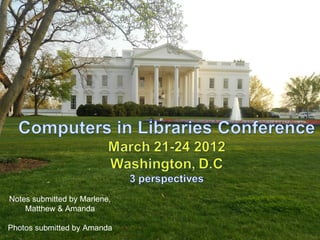
Notes submitted by Marlene,
    Matthew & Amanda

Photos submitted by Amanda
Computers in Libraries 2012
      (a few highlights anyway)

  Keynote by Susan Hildreth, Institute
   of Museum & Library Sciences
  Creative Ideas, Insights &Trends:
   Innovation to Go
  Redesigning Reference Models
  And more…
Creating Innovative Libraries
            (keynote by Susan Hildreth)
 Hildreth described the process of creating a
  strategic plan for her organization including
  the following goals…
   – Learning
   – Community
   – Content
   – Equitable Access to Knowledge
   – Public Management Excellence


(We can use these goals too)
Goals in depth…
 Learning
   – Move libraries from “nice to have” to “NEED to
     have”--to have democratic society.
   – DIY & maker culture very important in libraries
     today
   – Prepare users to be “full participants in their local
     community and our global society”
 Community
   – Libraries must be strong community anchors
   – We must build digitally inclusive communities
   – Foster Civic engagement and create cultural
     opportunities
 Content
   – Libraries must emphasize good stewardship of
     materials
   – Enable users to connect to collections
   – Users must create content
 Equitable Access to Knowledge
   – Sustain/increase user access to information and
     new ideas
   – In case of ILMS leading to creation of


 Public Management Excellence
   – Strategic alignment of resources and prudent risk
     taking
 She insists the in 21st century
 libraries, users must be able to
 create content at the library!


              We must engage learners
             and go to communities
             (embedded approach).
Creative Ideas, Insights &
 Trends: Innovation to Go
   (presented by Chris Olson and Barbara Ferry)


“Be the innovative sandbox for
       your organization”
See what others are doing.
  Use other industries for inspiration!
 Google: “2012 innovations in…” (food
service, hotels, car rentals--don’t do the
         obvious…like schools)
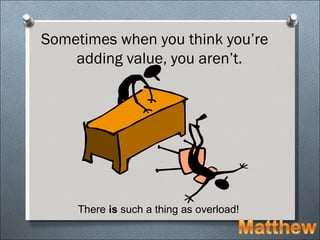
Sometimes when you think you’re
    adding value, you aren’t.


     There is such a thing as overload!
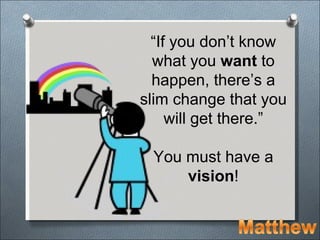
“If you don’t know
  what you want to
  happen, there’s a
slim change that you
     will get there.”

 You must have a
     vision!
Sites worth checking out
  trendwatching.com
 libraryinnovation.org
   trendreports.com
 anythinklibraries.org
Redesigning Reference
           Models
(presented by Melissa Gold, Greg Szczyrbak, & Erin Dorney)
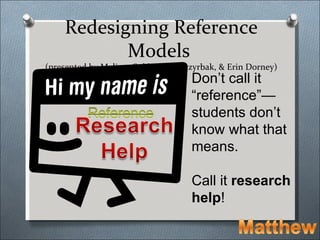
                                    Don’t call it
                                    “reference”—
                                    students don’t
                                    know what that
                                    means.

                                    Call it research
                                    help!
Meet them wherever they
are (texting, Facebook, in
person, outside the library…)—
don’t just rely on one method or
tech tool.
Be an expert about something
 on campus--doesn't matter
 what. Get out of the library.
Why do we hold new ideas
 to a higher assessment
standard than old ideas?
Enrich existing programs on
campus--even if the library's not
 already involved. Be proactive.
A few other good ideas
Check content across
multiple browsers to
ensure they see what
      you see.


                    Social
                  media isn’t
                   optional
                  anymore.
Approach activities at
 your organization as
    if you were an
extraterrestrial space
        auditor.


Think big
Start small
Move fast
…and avoid this scenario
          at all costs
  Proposed: “Build an online collection of 10
  million portraits of citizens and their stories…
 Build a community around this initiative to fuel
engagement with natural history, biography, and
                artistic creativity…”

Adopted: “Do a web site about family portraits.”
3 Days, 3 Keynotes, 6 tracks & 15
  sessions later…..
I returned from this year’s CIL conference
  with a pad full of notes and renewed
  conviction that Berkeley College
  Librarians are on the frontier, having
  already incorporated so many of the
  tools and techniques presented.


- Marlene
From my notes:
O Create a ‘fix it team’ to study and resolve - problems encountered,
   behaviors observed, questions repeated, complaints and
   incorporate cool stuff.

O   The fuzzy front end of capturing ideas and opportunity. Capture
    tools: Evernote – Springpad – Poll Everywhere – Yammer

O   Library Camp developed especially for Faculty, Adjuncts,
    Departments, New Starts, Alumni, and other possibilities. Or
    PodCamp?

O   Omeka, the free, flexible, and open source web-publishing platform
    for the display of library, museum, archives, and scholarly
    collections and exhibitions. Berkeley’s History?
Notes continued…
O   Using QR codes to attach the physical to the virtual [for ideas see:
    http://qrinlibs.blogspot.com/&
    http://www.libsuccess.org/index.php?title=QR_Codes

O   For thought. The library’s impact on the individual… not the
    institution. Creating learner centered, empowering and engaging
    experiences that motivate, stimulate curiosity and cause further
    self-directed actions.

O   A College/Library Repository or Scholarly commons may include:
    presentations, newsletters, research guides, special collections,
    institutional materials, handbooks, press releases, student
    organizations, other?

O   Impressive interactive teaching tools are linked to many of the
    Capitals monuments, memorials and archives
    http://docsteach.org/activities/5276/detail?mode=browse&menu=closed&era[]=the-
Notes continued…
O Attending a conference is a professionally rewarding
  experience. In addition to socializing with colleagues
  from other institutions and a paid trip to an exciting
  locale, you have the opportunity to see presenters in
  action; learning what works and falls short of
  audience expectation. If you go to a conference or
  workshop this year make it a practice to return with
  the plan to initiate at least one new idea. I’m already
  plotting ways to get started on many of the items
  above.
1.Learn to dream big when it comes to
            Digital Initiatives
• Several sessions gave me more confirmation that technology
should be one of our BIG priorities. From these sessions I have
some ideas for future events & initiatives
•Tech petting zoo- Have people bring in their favorite tech gadget and
showcase it. Great way to have people be interactive with technology & be
exposed to different technologies.
•Dreaming big- Create MORE opportunities that lend
themselves to thinking about technology in the library
   Examples: Think tanks, surveys, committees.
2.   We need to find new ways to capture ideas & DO something with
                               them.

                            How can we Capture?
•Solution-Idea book- carry a small book with you & write down ideas so you
don’t lose them.

•Keep an idea book at the ref. desk for anyone to use.

•Create polls for both librarians and patrons to fill out.
                  How can we do something with these ideas?
•Berkeley Librarians can save their ideas by putting it on our Library Buzz
bucket list

•Analyze our reference stats. Taking these stats and create solutions and/or
look for patterns and FAQs.

•Keep the captured ideas separate from your to-do list.
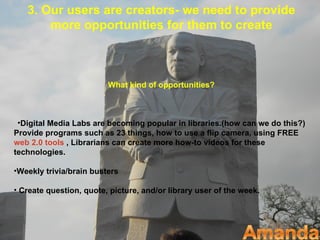
3. Our users are creators- we need to provide
       more opportunities for them to create


                         What kind of opportunities?


 •Digital Media Labs are becoming popular in libraries.(how can we do this?)
Provide programs such as 23 things, how to use a flip camera, using FREE
web 2.0 tools , Librarians can create more how-to videos for these
technologies.

•Weekly trivia/brain busters

• Create question, quote, picture, and/or library user of the week.
4. How can we make our collection more user
   friendly but stay academic at the same time?


•Better Signage- Better signage in the stacks, on our displays, by the copier
& Printers and on the desks.

•More visual promotion of our services & collection

•Easier lingo- Get rid of the name reference desk and/or information
commons- students don’t know what that is.

•Re-think how we organize our Video Collection- Perhaps we should consider
the Barnes & Noble type grouping by subject rather than Dewey? We would
probably see an increase in older entertainment titles circulating.
The Keynotes and many of
    the conference session
   PowerPoint’s have been
          posted at:
http://www.infotoday.com/cil2012/P

Cil conference 2012 3 perspectives

  • 1.
    Notes submitted byMarlene, Matthew & Amanda Photos submitted by Amanda
  • 2.
    Computers in Libraries2012 (a few highlights anyway)  Keynote by Susan Hildreth, Institute of Museum & Library Sciences  Creative Ideas, Insights &Trends: Innovation to Go  Redesigning Reference Models  And more…
  • 3.
    Creating Innovative Libraries (keynote by Susan Hildreth)  Hildreth described the process of creating a strategic plan for her organization including the following goals… – Learning – Community – Content – Equitable Access to Knowledge – Public Management Excellence (We can use these goals too)
  • 4.
    Goals in depth… Learning – Move libraries from “nice to have” to “NEED to have”--to have democratic society. – DIY & maker culture very important in libraries today – Prepare users to be “full participants in their local community and our global society”  Community – Libraries must be strong community anchors – We must build digitally inclusive communities – Foster Civic engagement and create cultural opportunities
  • 5.
     Content – Libraries must emphasize good stewardship of materials – Enable users to connect to collections – Users must create content  Equitable Access to Knowledge – Sustain/increase user access to information and new ideas – In case of ILMS leading to creation of  Public Management Excellence – Strategic alignment of resources and prudent risk taking
  • 6.
     She insiststhe in 21st century libraries, users must be able to create content at the library!  We must engage learners and go to communities (embedded approach).
  • 7.
    Creative Ideas, Insights& Trends: Innovation to Go (presented by Chris Olson and Barbara Ferry) “Be the innovative sandbox for your organization”
  • 8.
    See what othersare doing. Use other industries for inspiration! Google: “2012 innovations in…” (food service, hotels, car rentals--don’t do the obvious…like schools)
  • 9.
    Sometimes when youthink you’re adding value, you aren’t. There is such a thing as overload!
  • 10.
    “If you don’tknow what you want to happen, there’s a slim change that you will get there.” You must have a vision!
  • 11.
    Sites worth checkingout trendwatching.com libraryinnovation.org trendreports.com anythinklibraries.org
  • 12.
    Redesigning Reference Models (presented by Melissa Gold, Greg Szczyrbak, & Erin Dorney) Don’t call it “reference”— students don’t know what that means. Call it research help!
  • 13.
    Meet them whereverthey are (texting, Facebook, in person, outside the library…)— don’t just rely on one method or tech tool.
  • 14.
    Be an expertabout something on campus--doesn't matter what. Get out of the library.
  • 15.
    Why do wehold new ideas to a higher assessment standard than old ideas?
  • 16.
    Enrich existing programson campus--even if the library's not already involved. Be proactive.
  • 17.
    A few othergood ideas Check content across multiple browsers to ensure they see what you see. Social media isn’t optional anymore.
  • 18.
    Approach activities at your organization as if you were an extraterrestrial space auditor. Think big Start small Move fast
  • 19.
    …and avoid thisscenario at all costs Proposed: “Build an online collection of 10 million portraits of citizens and their stories… Build a community around this initiative to fuel engagement with natural history, biography, and artistic creativity…” Adopted: “Do a web site about family portraits.”
  • 20.
    3 Days, 3Keynotes, 6 tracks & 15 sessions later….. I returned from this year’s CIL conference with a pad full of notes and renewed conviction that Berkeley College Librarians are on the frontier, having already incorporated so many of the tools and techniques presented. - Marlene
  • 21.
    From my notes: OCreate a ‘fix it team’ to study and resolve - problems encountered, behaviors observed, questions repeated, complaints and incorporate cool stuff. O The fuzzy front end of capturing ideas and opportunity. Capture tools: Evernote – Springpad – Poll Everywhere – Yammer O Library Camp developed especially for Faculty, Adjuncts, Departments, New Starts, Alumni, and other possibilities. Or PodCamp? O Omeka, the free, flexible, and open source web-publishing platform for the display of library, museum, archives, and scholarly collections and exhibitions. Berkeley’s History?
  • 22.
    Notes continued… O Using QR codes to attach the physical to the virtual [for ideas see: http://qrinlibs.blogspot.com/& http://www.libsuccess.org/index.php?title=QR_Codes O For thought. The library’s impact on the individual… not the institution. Creating learner centered, empowering and engaging experiences that motivate, stimulate curiosity and cause further self-directed actions. O A College/Library Repository or Scholarly commons may include: presentations, newsletters, research guides, special collections, institutional materials, handbooks, press releases, student organizations, other? O Impressive interactive teaching tools are linked to many of the Capitals monuments, memorials and archives http://docsteach.org/activities/5276/detail?mode=browse&menu=closed&era[]=the-
  • 23.
    Notes continued… O Attendinga conference is a professionally rewarding experience. In addition to socializing with colleagues from other institutions and a paid trip to an exciting locale, you have the opportunity to see presenters in action; learning what works and falls short of audience expectation. If you go to a conference or workshop this year make it a practice to return with the plan to initiate at least one new idea. I’m already plotting ways to get started on many of the items above.
  • 24.
    1.Learn to dreambig when it comes to Digital Initiatives • Several sessions gave me more confirmation that technology should be one of our BIG priorities. From these sessions I have some ideas for future events & initiatives •Tech petting zoo- Have people bring in their favorite tech gadget and showcase it. Great way to have people be interactive with technology & be exposed to different technologies. •Dreaming big- Create MORE opportunities that lend themselves to thinking about technology in the library Examples: Think tanks, surveys, committees.
  • 25.
    2. We need to find new ways to capture ideas & DO something with them. How can we Capture? •Solution-Idea book- carry a small book with you & write down ideas so you don’t lose them. •Keep an idea book at the ref. desk for anyone to use. •Create polls for both librarians and patrons to fill out. How can we do something with these ideas? •Berkeley Librarians can save their ideas by putting it on our Library Buzz bucket list •Analyze our reference stats. Taking these stats and create solutions and/or look for patterns and FAQs. •Keep the captured ideas separate from your to-do list.
  • 26.
    3. Our usersare creators- we need to provide more opportunities for them to create What kind of opportunities? •Digital Media Labs are becoming popular in libraries.(how can we do this?) Provide programs such as 23 things, how to use a flip camera, using FREE web 2.0 tools , Librarians can create more how-to videos for these technologies. •Weekly trivia/brain busters • Create question, quote, picture, and/or library user of the week.
  • 27.
    4. How canwe make our collection more user friendly but stay academic at the same time? •Better Signage- Better signage in the stacks, on our displays, by the copier & Printers and on the desks. •More visual promotion of our services & collection •Easier lingo- Get rid of the name reference desk and/or information commons- students don’t know what that is. •Re-think how we organize our Video Collection- Perhaps we should consider the Barnes & Noble type grouping by subject rather than Dewey? We would probably see an increase in older entertainment titles circulating.
  • 28.
    The Keynotes andmany of the conference session PowerPoint’s have been posted at: http://www.infotoday.com/cil2012/P