GEC 111: Art of the Argument
Researching for Reaction Papers #1 & #2
Prof. Baxter
WINTER 2015
Presented by Berkeley College Library
Kelly Bennett
Reference & Instruction Librarian
Your Assignment:
Choose a topic. Be sure to choose an issue that really personally interests you!
Decide whether you are for or against it. Construct an argument supporting your side of the
argument, organizing it into a minimum of three reasons and conclusions. Evaluate the strengths
and/or weaknesses of your argument, and be aware of the emotional element in each of them.
Write a well-developed minimum five-paragraph essay (you can add more paragraphs if wanted)
that runs like this:
Paragraph 1. Introduction, set up the issue and its implications
Paragraph 2. State your first reason/conclusion with its supporting information
Paragraph 3. State your second reason/conclusion with its supporting information
Paragraph 4. State your third reason/conclusion with its supporting information.
Paragraph 5. Make a concluding statement that wraps up your argument.
Attach another sheet and put down the citations (in MLA format) of works you consulted to
research your argument and support your side of the argument. Now, annotate each citation with a
1-3 sentence description of how this content helped your research.
Ideally, you should have 3-5 citations from journal articles, newspapers, books, URLs, etc.
Topics
Paper #1
• Negative Campaigning by politicians is helpful in
understanding issues
• Foreign Oil Dependence accepted by Americans
• Right to Bear Arms as the Second Amendment of
the U.S. Constitution
• Torture is okay when used to uncover terrorism
plots against the U.S.
• Charter Schools are an elitist idea and unworthy
Paper #2
• Americas Global Influence should be as world
leader other countries look up to
• Body Piercing and Tattooing need to be avoided
by young people who seek to be accepted as
professional workers
• Cyberbullying is a real social problem that needs
legal penalties
• Junk Food should be banned since it encourages
Obesity
• Wage Discrimination is not really a problem
anymore
Where to look:
Library Databases
E-books
Credible Internet Sources
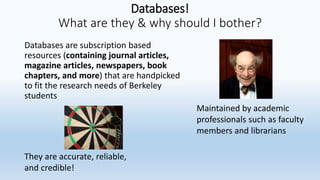
Databases!
What are they & why should I bother?
Databases are subscription based
resources (containing journal articles,
magazine articles, newspapers, book
chapters, and more) that are handpicked
to fit the research needs of Berkeley
students
Maintained by academic
professionals such as faculty
members and librarians
They are accurate, reliable,
and credible!
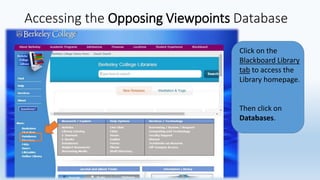
Accessing the Opposing Viewpoints Database
Click on the
Blackboard Library
tab to access the
Library homepage.
Then click on
Databases.
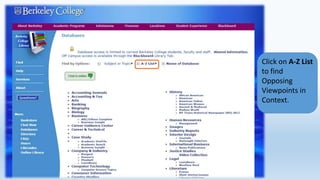
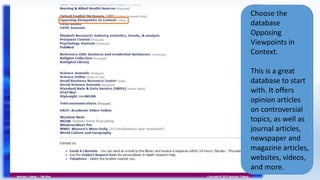
Click on A-Z List
to find
Opposing
Viewpoints in
Context.
Choose the
database
Opposing
Viewpoints in
Context.
This is a great
database to start
with. It offers
opinion articles
on controversial
topics, as well as
journal articles,
newspaper and
magazine articles,
websites, videos,
and more.
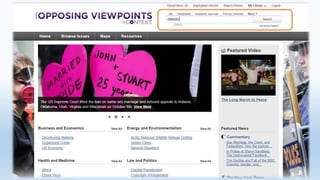
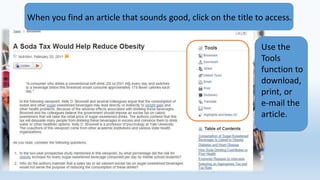
When you find an article that sounds good, click on the title to access.
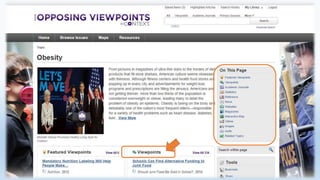
Use the
Tools
function to
download,
print, or
e-mail the
article.
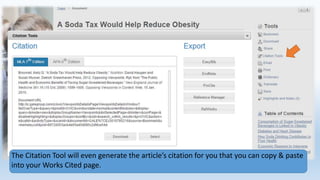
The Citation Tool will even generate the article’s citation for you that you can copy & paste
into your Works Cited page.
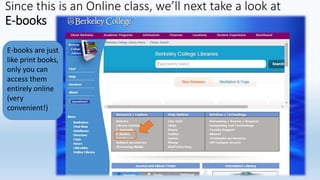
Since this is an Online class, we’ll next take a look at
E-books
E-books are just
like print books,
only you can
access them
entirely online
(very
convenient!)
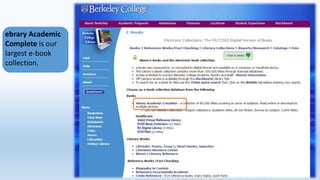
ebrary Academic
Complete is our
largest e-book
collection.
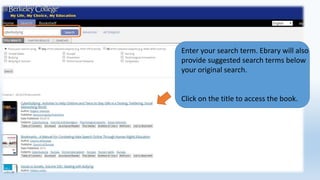
Enter your search term. Ebrary will also
provide suggested search terms below
your original search.
Click on the title to access the book.
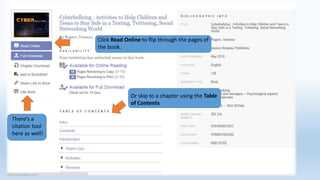
Click Read Online to flip through the pages of
the book.
Or skip to a chapter using the Table
of Contents
There’s a
citation tool
here as well!
For these 2 reaction papers,
library databases such as
Opposing Viewpoints as well as
others, such as ProQuest
Central, are excellent resources
for your research.
E-books also provide a reliable
and easy to access resource.
But can you use the Web?
Sure! There are great resources
online, but you have to know
what you’re looking for….
When researching on the internet, use this
acronym to find quality sources:
• Source- Who is the author of the website. (Hint: look at the domain
name and who wrote any articles on the webpage)
• Currency- How often is the website updated?
• Objectivity- Is the website displaying all angles of a situation or being
very one sided?
• Purpose- Is there anywhere on the website that shows why they
created the website ( look for the “about us” tab. It will allow you to
further evaluate their credibility)
• Accuracy-Are they listing their sources? Can you contact the creator
of the website?
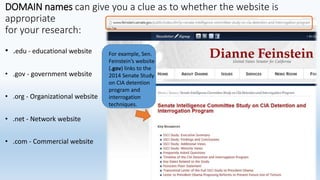
DOMAIN names can give you a clue as to whether the website is
appropriate
for your research:
• .edu - educational website
• .gov - government website
• .org - Organizational website
• .net - Network website
• .com - Commercial website
For example, Sen.
Feinstein’s website
(.gov) links to the
2014 Senate Study
on CIA detention
program and
interrogation
techniques.
Citations!
Remember! Anytime you use information from a source, you must cite it!
This includes both in-text citations, as well as a Works Cited page at the end of
your papers.
MLA Resources:
ASC Writing and Citing: From the Writing Process to Avoiding Plagiarism –
includes an entire page on citing in MLA
http://berkeleycollege.libguides.com/Writing
Purdue OWL MLA Formatting & Style Guide – a great resource for examples
on how to cite many types of resources
https://owl.english.purdue.edu/owl/resource/747/01/
Questions? I’m here to help!
Kelly Bennett
Kelly-bennett@berkeleycollege.edu
732-750-1800 x2201
Chat with a librarian 7 days a week! (Click
on Live Chat on the Library Homepage)

Gec 111 OL Baxter WINTER 2015

  • 1.
    GEC 111: Artof the Argument Researching for Reaction Papers #1 & #2 Prof. Baxter WINTER 2015 Presented by Berkeley College Library Kelly Bennett Reference & Instruction Librarian
  • 2.
    Your Assignment: Choose atopic. Be sure to choose an issue that really personally interests you! Decide whether you are for or against it. Construct an argument supporting your side of the argument, organizing it into a minimum of three reasons and conclusions. Evaluate the strengths and/or weaknesses of your argument, and be aware of the emotional element in each of them. Write a well-developed minimum five-paragraph essay (you can add more paragraphs if wanted) that runs like this: Paragraph 1. Introduction, set up the issue and its implications Paragraph 2. State your first reason/conclusion with its supporting information Paragraph 3. State your second reason/conclusion with its supporting information Paragraph 4. State your third reason/conclusion with its supporting information. Paragraph 5. Make a concluding statement that wraps up your argument. Attach another sheet and put down the citations (in MLA format) of works you consulted to research your argument and support your side of the argument. Now, annotate each citation with a 1-3 sentence description of how this content helped your research. Ideally, you should have 3-5 citations from journal articles, newspapers, books, URLs, etc.
  • 3.
    Topics Paper #1 • NegativeCampaigning by politicians is helpful in understanding issues • Foreign Oil Dependence accepted by Americans • Right to Bear Arms as the Second Amendment of the U.S. Constitution • Torture is okay when used to uncover terrorism plots against the U.S. • Charter Schools are an elitist idea and unworthy Paper #2 • Americas Global Influence should be as world leader other countries look up to • Body Piercing and Tattooing need to be avoided by young people who seek to be accepted as professional workers • Cyberbullying is a real social problem that needs legal penalties • Junk Food should be banned since it encourages Obesity • Wage Discrimination is not really a problem anymore
  • 4.
    Where to look: LibraryDatabases E-books Credible Internet Sources
  • 5.
    Databases! What are they& why should I bother? Databases are subscription based resources (containing journal articles, magazine articles, newspapers, book chapters, and more) that are handpicked to fit the research needs of Berkeley students Maintained by academic professionals such as faculty members and librarians They are accurate, reliable, and credible!
  • 6.
    Accessing the OpposingViewpoints Database Click on the Blackboard Library tab to access the Library homepage. Then click on Databases.
  • 7.
    Click on A-ZList to find Opposing Viewpoints in Context.
  • 8.
    Choose the database Opposing Viewpoints in Context. Thisis a great database to start with. It offers opinion articles on controversial topics, as well as journal articles, newspaper and magazine articles, websites, videos, and more.
  • 12.
    When you findan article that sounds good, click on the title to access. Use the Tools function to download, print, or e-mail the article.
  • 13.
    The Citation Toolwill even generate the article’s citation for you that you can copy & paste into your Works Cited page.
  • 14.
    Since this isan Online class, we’ll next take a look at E-books E-books are just like print books, only you can access them entirely online (very convenient!)
  • 15.
    ebrary Academic Complete isour largest e-book collection.
  • 16.
    Enter your searchterm. Ebrary will also provide suggested search terms below your original search. Click on the title to access the book.
  • 17.
    Click Read Onlineto flip through the pages of the book. Or skip to a chapter using the Table of Contents There’s a citation tool here as well!
  • 18.
    For these 2reaction papers, library databases such as Opposing Viewpoints as well as others, such as ProQuest Central, are excellent resources for your research. E-books also provide a reliable and easy to access resource. But can you use the Web? Sure! There are great resources online, but you have to know what you’re looking for….
  • 19.
    When researching onthe internet, use this acronym to find quality sources: • Source- Who is the author of the website. (Hint: look at the domain name and who wrote any articles on the webpage) • Currency- How often is the website updated? • Objectivity- Is the website displaying all angles of a situation or being very one sided? • Purpose- Is there anywhere on the website that shows why they created the website ( look for the “about us” tab. It will allow you to further evaluate their credibility) • Accuracy-Are they listing their sources? Can you contact the creator of the website?
  • 20.
    DOMAIN names cangive you a clue as to whether the website is appropriate for your research: • .edu - educational website • .gov - government website • .org - Organizational website • .net - Network website • .com - Commercial website For example, Sen. Feinstein’s website (.gov) links to the 2014 Senate Study on CIA detention program and interrogation techniques.
  • 21.
    Citations! Remember! Anytime youuse information from a source, you must cite it! This includes both in-text citations, as well as a Works Cited page at the end of your papers. MLA Resources: ASC Writing and Citing: From the Writing Process to Avoiding Plagiarism – includes an entire page on citing in MLA http://berkeleycollege.libguides.com/Writing Purdue OWL MLA Formatting & Style Guide – a great resource for examples on how to cite many types of resources https://owl.english.purdue.edu/owl/resource/747/01/
  • 22.
    Questions? I’m hereto help! Kelly Bennett Kelly-bennett@berkeleycollege.edu 732-750-1800 x2201 Chat with a librarian 7 days a week! (Click on Live Chat on the Library Homepage)