Razzle,
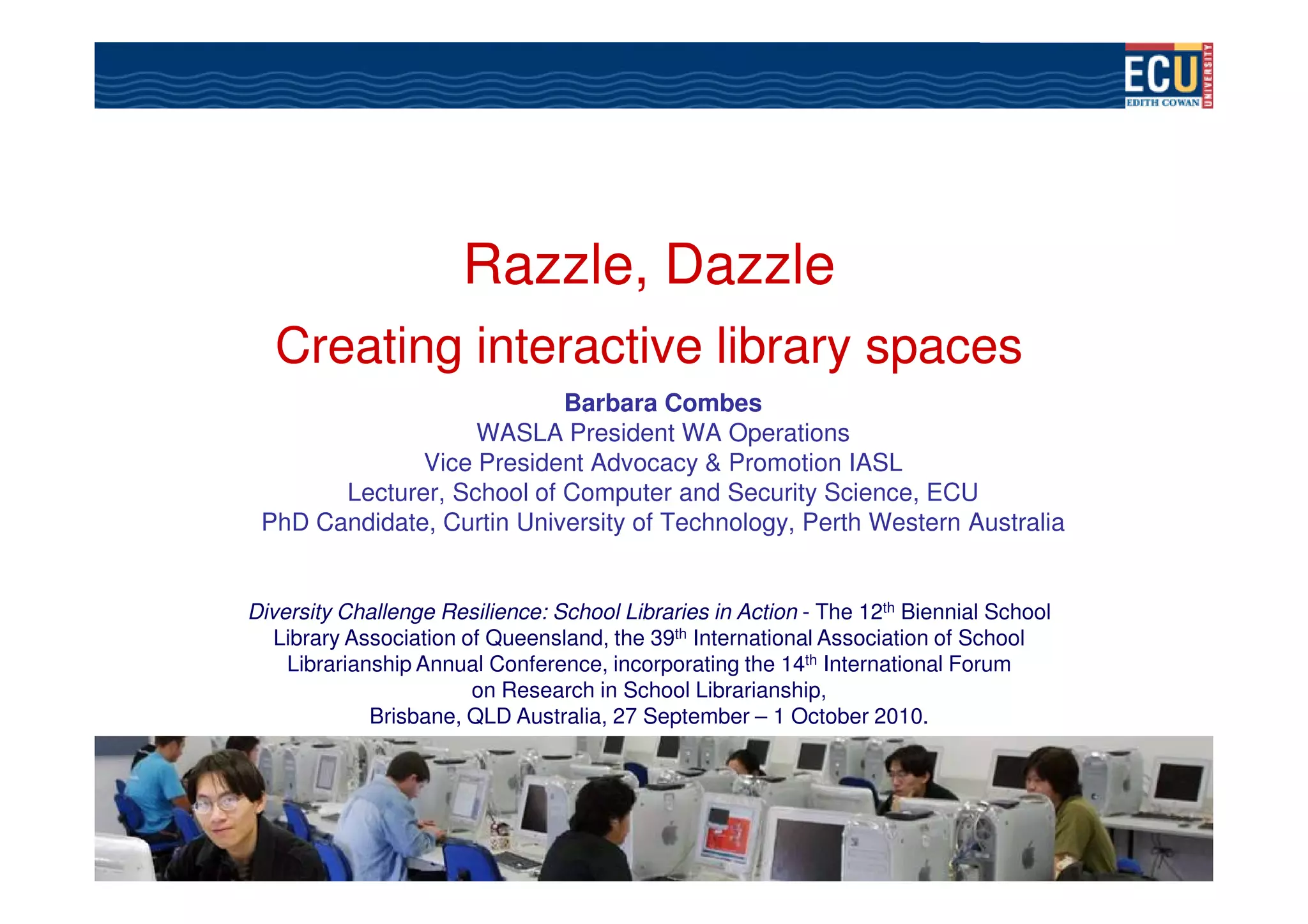
                      Razzle, Dazzle
  Creating interactive library spaces
                           Barbara Combes
                   WASLA President WA Operations
              Vice President Advocacy & Promotion IASL
       Lecturer, School of Computer and Security Science, ECU
 PhD Candidate, Curtin University of Technology, Perth Western Australia


Diversity Challenge Resilience: School Libraries in Action - The 12th Biennial School
   Library Association of Queensland, the 39th International Association of School
    Librarianship Annual Conference, incorporating the 14th International Forum
                        on Research in School Librarianship,
             Brisbane, QLD Australia, 27 September – 1 October 2010.
Design & community building

 Keep in mind:

 “All architecture is shelter, all great architecture is the
    design of space that contains, cuddles, exalts, or
    stimulates the persons in that space.”
                                        (Philip Johnson, 1975)
School libraries in the 21st century

Keep in mind:

• Legacy systems/infrastructure (OPAC + print + Dewey)
• Old architecture (Australia 44% school libraries >20 yrs
  old, 11% are 15 - 20 yrs old)
• Educational change (Australian curriculum vs outcomes +
  lifelong learning/information literate graduates)
• New information landscape characterised by:
   – Technological change (new formats, delivery modes)
   – Differentiation (layered landscape – access denied, costly $$$)
   – Overload, complexity, increasingly dense, decontextualisation
   – Access 24/7
Students in the 21st century
Keep in mind:
   – Technology use (outside vs inside school)
   – Assumptions (digital native or digital refugee?)
   – Social disconnection (divorce, absent parents, physical & emotional
     abuse, safe haven)
   – Learning disengagement (boredom, lack of skills, relevance,
     success)
   – Community disconnection (no sense of belonging)
   – Virtual vs real (cyberbullying, virtual worlds)
   – Communications breakdown
What does the research tell us?

Keep in mind the social context:
   – Teaching-learning dynamic
   – Sense of belonging
   – Community identity
   – Citizenship
   – Lifelong learner
What does the research tell us?
• In FYE studies at university, students who fail to establish
  a sense of belonging and community experience feelings
  of isolation, lack of motivation and anxiety - all major
  factors that lead to disengagement and failure.

• Primary and secondary schools are by the nature of their
  design (architecture) and how they conduct their core
  business (curriculum), compartmentalised and isolationist
  for both teachers, students and administration.

• The library is the one place in this environment that is
  outside this design. It is whole school based and has the
  flexibility to draw together the social and academic
  aspects of the whole school community.
School libraries & community building?

• I do not have all the answers or the ideas.
• Let’s collaborate and share.
• How do we create interesting, engaging spaces
  that resonate with our school community:
  –   Administration (core business = teaching and learning)
  –   Teachers (curriculum design & support)
  –   Students (engagement & relevance)
  –   Parents (lifelong learner & future citizen)
  –   Wider community (status & reputation)
• This does not have to be a costly business.
First things first?
 • Change is an inclusive process:
   – Whole staff
   – New mindset
   – New processes and procedures
   – New service delivery
 • Changing perceptions:
   – Flexible
   – Adaptable
   – Open to challenge & innovation
 • Practising what we preach:
   – Modelling lifelong learning
Physical spaces – opening the door
 The entrance – messages to send?

    – Welcome!
    – Here we are!
    – Great things are happening in here!
    – Come in!


 Your turn - groups of 4
    – 2 ideas to improve the entrance to your library
    – Can we make this flexible ie. change it.
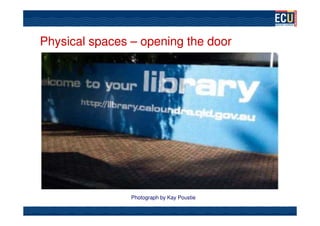
Physical spaces – opening the door


                Photograph by Kay Poustie
Physical spaces – how much?
 Have you ever measured the:
    – Floor space?
    – Spare wall/display space (everything)?
    – Ceiling space?
    – Window space?


 You can’t change your physical space until:
    – You know exactly how much you have.
    – Where the power points/Internet connections are located in
      relation to everything else.
    – Think & plan.
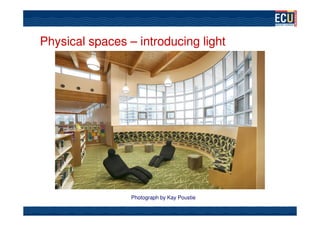
Physical spaces – introducing light


                 Photograph by Kay Poustie
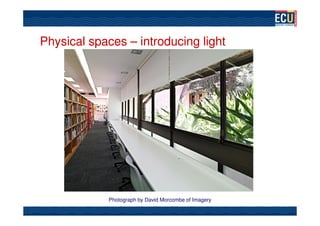
Physical spaces – introducing light


            Photograph by David Morcombe of Imagery
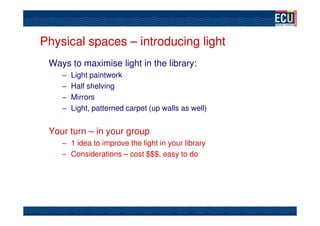
Physical spaces – introducing light
 Ways to maximise light in the library:
    – Light paintwork
    – Half shelving
    – Mirrors
    – Light, patterned carpet (up walls as well)


 Your turn – in your group
    – 1 idea to improve the light in your library
    – Considerations – cost $$$, easy to do
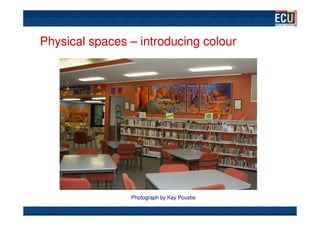
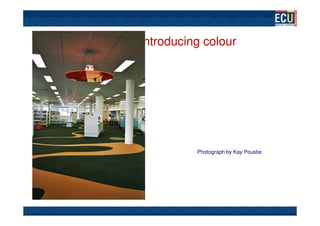
Physical spaces – introducing colour


                Photograph by Kay Poustie
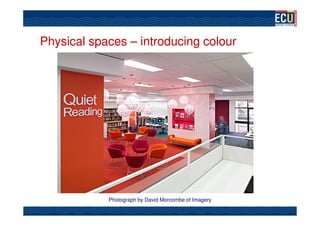
Physical spaces – introducing colour


            Photograph by David Morcombe of Imagery
Physical spaces – introducing colour


                            Photograph by Kay Poustie
Physical spaces – signage
 What message does your library send?
    – Rules, rules, rules!
    – Don’t!
    – Shush!


 Your turn – in your group
    – 3 positive statements to guide behaviour in the library
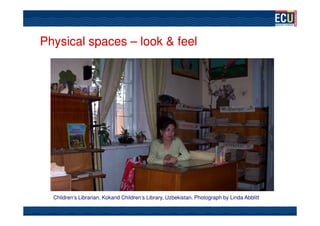
Physical spaces – look & feel


                                                               Photograph by Kay Poustie


  Children’s Librarian, Kokand Children’s Library, Uzbekistan. Photograph by Linda Abblitt
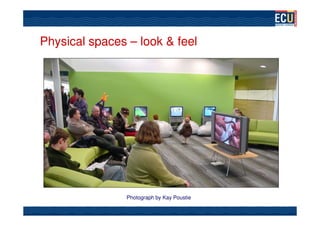
Physical spaces – look & feel


                                           Photograph by Kay Poustie


               Photograph by Kay Poustie
Physical spaces – look & feel


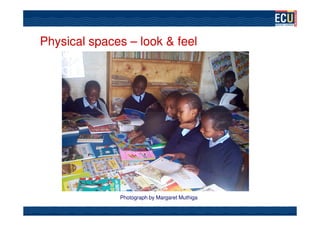
              Photograph by Margaret Muthiga
Physical spaces – look & feel


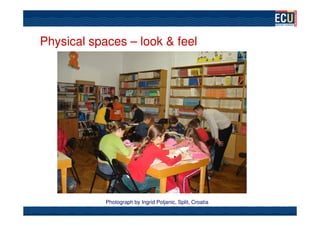
            Photograph by Ingrid Poljanic, Split, Croatia
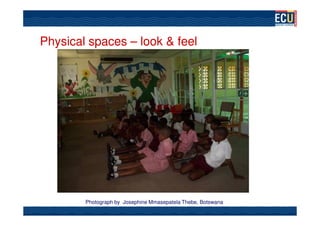
Physical spaces – look & feel


        Photograph by Josephine Mmasepatela Thebe, Botswana
Social spaces – creating a look & feel
 What message does your library send?
    – Ask the kids!
    – Hand over ownership.
    – Flexibility is the key.


 Your turn – in your group
    – 1 idea for creating a look & feel in your library
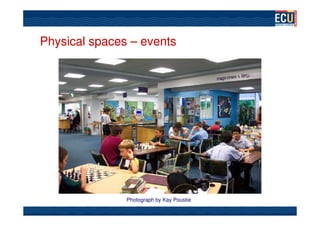
Physical spaces – events


               Photograph by Kay Poustie
Social spaces – events
 Ideas for events:
    – The Great Build (lego creativity at school)
    – Games, Games, Games
    – Twisted Tales
    – Soapbox Corner
    – Readathon


 Your turn – in your group
    – 2 ideas for events in your library
Social spaces – displays
 Good displays:
    – Change regularly, some more than others
    – Are planned in advance
    – Attract, engage and resonate
    – Promotional
    – Informational (curriculum)
    – Services – school and community
    – Are not necessarily in the library!


 Your turn – in your group
    – 2 ideas for displays in your library
Virtual spaces
 Introducing technology – what message does your library
    send?
    – Technology is a solution or a tool?
    – Flexibility?
    – Multiple delivery modes?
    – Multiple formats?
    – Outside use = inside school use?
    – Multiple teaching moments?


 Your turn – in your group
    – 1 idea for using technology in your library
School libraries as community
 All architecture is shelter, all great architecture is the
    design of space that contains, cuddles, exalts, or
    stimulates the persons in that space.”
                                             (Philip Johnson, 1975)
 Does your library architecture/design:
    – Offer shelter?

    – Provide flexible boundaries?

    – Cuddle and enfold all community members?

    – Exalt and stimulate users?

    – Provide exciting, restful and engaging spaces?
School Libraries in Action
              Sharing and collaborating

          IASL – free and members resources
      http://www.iasl-online.org/sla/index.htm

Razzle dazzle: creating interactive library spaces

  • 1.
    Razzle, Razzle, Dazzle Creating interactive library spaces Barbara Combes WASLA President WA Operations Vice President Advocacy & Promotion IASL Lecturer, School of Computer and Security Science, ECU PhD Candidate, Curtin University of Technology, Perth Western Australia Diversity Challenge Resilience: School Libraries in Action - The 12th Biennial School Library Association of Queensland, the 39th International Association of School Librarianship Annual Conference, incorporating the 14th International Forum on Research in School Librarianship, Brisbane, QLD Australia, 27 September – 1 October 2010.
  • 2.
    Design & communitybuilding Keep in mind: “All architecture is shelter, all great architecture is the design of space that contains, cuddles, exalts, or stimulates the persons in that space.” (Philip Johnson, 1975)
  • 3.
    School libraries inthe 21st century Keep in mind: • Legacy systems/infrastructure (OPAC + print + Dewey) • Old architecture (Australia 44% school libraries >20 yrs old, 11% are 15 - 20 yrs old) • Educational change (Australian curriculum vs outcomes + lifelong learning/information literate graduates) • New information landscape characterised by: – Technological change (new formats, delivery modes) – Differentiation (layered landscape – access denied, costly $$$) – Overload, complexity, increasingly dense, decontextualisation – Access 24/7
  • 4.
    Students in the21st century Keep in mind: – Technology use (outside vs inside school) – Assumptions (digital native or digital refugee?) – Social disconnection (divorce, absent parents, physical & emotional abuse, safe haven) – Learning disengagement (boredom, lack of skills, relevance, success) – Community disconnection (no sense of belonging) – Virtual vs real (cyberbullying, virtual worlds) – Communications breakdown
  • 5.
    What does theresearch tell us? Keep in mind the social context: – Teaching-learning dynamic – Sense of belonging – Community identity – Citizenship – Lifelong learner
  • 6.
    What does theresearch tell us? • In FYE studies at university, students who fail to establish a sense of belonging and community experience feelings of isolation, lack of motivation and anxiety - all major factors that lead to disengagement and failure. • Primary and secondary schools are by the nature of their design (architecture) and how they conduct their core business (curriculum), compartmentalised and isolationist for both teachers, students and administration. • The library is the one place in this environment that is outside this design. It is whole school based and has the flexibility to draw together the social and academic aspects of the whole school community.
  • 7.
    School libraries &community building? • I do not have all the answers or the ideas. • Let’s collaborate and share. • How do we create interesting, engaging spaces that resonate with our school community: – Administration (core business = teaching and learning) – Teachers (curriculum design & support) – Students (engagement & relevance) – Parents (lifelong learner & future citizen) – Wider community (status & reputation) • This does not have to be a costly business.
  • 8.
    First things first? • Change is an inclusive process: – Whole staff – New mindset – New processes and procedures – New service delivery • Changing perceptions: – Flexible – Adaptable – Open to challenge & innovation • Practising what we preach: – Modelling lifelong learning
  • 9.
    Physical spaces –opening the door The entrance – messages to send? – Welcome! – Here we are! – Great things are happening in here! – Come in! Your turn - groups of 4 – 2 ideas to improve the entrance to your library – Can we make this flexible ie. change it.
  • 10.
    Physical spaces –opening the door Photograph by Kay Poustie
  • 11.
    Physical spaces –how much? Have you ever measured the: – Floor space? – Spare wall/display space (everything)? – Ceiling space? – Window space? You can’t change your physical space until: – You know exactly how much you have. – Where the power points/Internet connections are located in relation to everything else. – Think & plan.
  • 12.
    Physical spaces –introducing light Photograph by Kay Poustie
  • 13.
    Physical spaces –introducing light Photograph by David Morcombe of Imagery
  • 14.
    Physical spaces –introducing light Ways to maximise light in the library: – Light paintwork – Half shelving – Mirrors – Light, patterned carpet (up walls as well) Your turn – in your group – 1 idea to improve the light in your library – Considerations – cost $$$, easy to do
  • 15.
    Physical spaces –introducing colour Photograph by Kay Poustie
  • 16.
    Physical spaces –introducing colour Photograph by David Morcombe of Imagery
  • 17.
    Physical spaces –introducing colour Photograph by Kay Poustie
  • 18.
    Physical spaces –signage What message does your library send? – Rules, rules, rules! – Don’t! – Shush! Your turn – in your group – 3 positive statements to guide behaviour in the library
  • 19.
    Physical spaces –look & feel Photograph by Kay Poustie Children’s Librarian, Kokand Children’s Library, Uzbekistan. Photograph by Linda Abblitt
  • 20.
    Physical spaces –look & feel Photograph by Kay Poustie Photograph by Kay Poustie
  • 21.
    Physical spaces –look & feel Photograph by Margaret Muthiga
  • 22.
    Physical spaces –look & feel Photograph by Ingrid Poljanic, Split, Croatia
  • 23.
    Physical spaces –look & feel Photograph by Josephine Mmasepatela Thebe, Botswana
  • 24.
    Social spaces –creating a look & feel What message does your library send? – Ask the kids! – Hand over ownership. – Flexibility is the key. Your turn – in your group – 1 idea for creating a look & feel in your library
  • 25.
    Physical spaces –events Photograph by Kay Poustie
  • 26.
    Social spaces –events Ideas for events: – The Great Build (lego creativity at school) – Games, Games, Games – Twisted Tales – Soapbox Corner – Readathon Your turn – in your group – 2 ideas for events in your library
  • 27.
    Social spaces –displays Good displays: – Change regularly, some more than others – Are planned in advance – Attract, engage and resonate – Promotional – Informational (curriculum) – Services – school and community – Are not necessarily in the library! Your turn – in your group – 2 ideas for displays in your library
  • 28.
    Virtual spaces Introducingtechnology – what message does your library send? – Technology is a solution or a tool? – Flexibility? – Multiple delivery modes? – Multiple formats? – Outside use = inside school use? – Multiple teaching moments? Your turn – in your group – 1 idea for using technology in your library
  • 29.
    School libraries ascommunity All architecture is shelter, all great architecture is the design of space that contains, cuddles, exalts, or stimulates the persons in that space.” (Philip Johnson, 1975) Does your library architecture/design: – Offer shelter? – Provide flexible boundaries? – Cuddle and enfold all community members? – Exalt and stimulate users? – Provide exciting, restful and engaging spaces?
  • 30.
    School Libraries inAction Sharing and collaborating IASL – free and members resources http://www.iasl-online.org/sla/index.htm