Introduction to
Makerspaces
Garages for tomorrow’s
innovation
Stephen Carter
Rutgers University
scarter@rutgers.edu
A Rich History
Every slideset must include a quote from Wikipedia…


       Some of today’s hottest companies were started in a garage or
       dorm room. Hewlett Packard, Microsoft, Apple, Facebook.
       Today these companies aren’t too worried about competing
       with each other. What keep’s them up at night is the thought of
       what some geek is doing in some garage.


       We want to build a nation of garages….
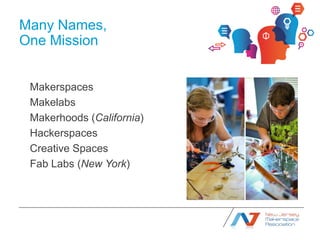
Many Names,
One Mission


 Makerspaces
 Makelabs
 Makerhoods (California)
 Hackerspaces
 Creative Spaces
 Fab Labs (New York)
Simple … but complex
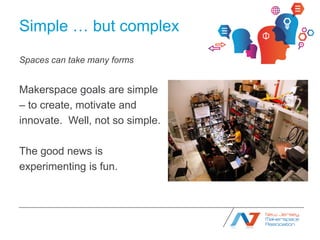
Spaces can take many forms


Makerspace goals are simple
– to create, motivate and
innovate. Well, not so simple.

The good news is
experimenting is fun.
Wikipedia Definition:
What is a Makerspace?
Every slideset must include a quote from Wikipedia…


       A hackerspace or hackspace (also referred to as a hacklab,
       makerspace or creative space) is a location where people with
       common interests, often in computers, technology, science, digital art
       or electronic art, can meet, socialize and/or collaborate. Hackerspaces
       can be viewed as open community labs incorporating elements of
       machine shops, workshops and/or studios where hackers can come
       together to share resources and knowledge to build and make things.
New Jersey help paved
the way…
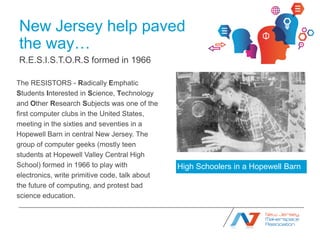
R.E.S.I.S.T.O.R.S formed in 1966

The RESISTORS - Radically Emphatic
Students Interested in Science, Technology
and Other Research Subjects was one of the
first computer clubs in the United States,
meeting in the sixties and seventies in a
Hopewell Barn in central New Jersey. The
group of computer geeks (mostly teen
students at Hopewell Valley Central High
School) formed in 1966 to play with             High Schoolers in a Hopewell Barn
electronics, write primitive code, talk about
the future of computing, and protest bad
science education. Publicly Supported
Two primary types of
Makerspaces
Public and Private

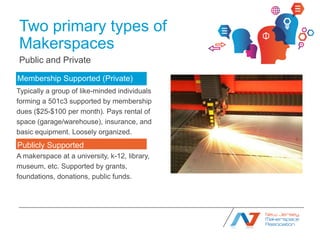
Membership Supported (Private)
Typically a group of like-minded individuals
forming a 501c3 supported by membership
dues ($25-$100 per month). Pays rental of
space (garage/warehouse), insurance, and
basic equipment. Loosely organized.
Publicly Supported
A makerspace at a university, k-12, library,
museum, etc. Supported by grants,
foundations, donations, public funds.

 Publicly Supported
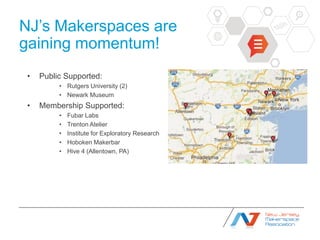
NJ’s Makerspaces are
gaining momentum!
 •   Public Supported:
          • Rutgers University (2)
          • Newark Museum
 •   Membership Supported:
          •   Fubar Labs
          •   Trenton Atelier
          •   Institute for Exploratory Research
          •   Hoboken Makerbar
          •   Hive 4 (Allentown, PA)
What goes on in
Makerspaces?
Not just Pop-tarts and Cheetos

   OPEN HOURS
  Times when facility is open to its members/public for fabrication,
  experimentation, or fixing one's toaster.

   MEETUPS
  Informal seminars (i.e weekly) on some mutual topic of interest.
  Includes 30-60 minute, followed by experimentation.

   CHALLENGES
  Organized competition in various topics. Many including
  commercial sponsorship and prizes.

   DISRUPTIVE EDUCATION
  Using makerspaces as the vehicle for advanced educational
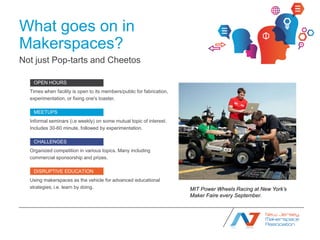
  strategies, i.e. learn by doing.                                     MIT Power Wheels Racing at New York’s
                                                                       Maker Faire every September.
Makeup of a
Makerspace?
Most Makerspaces have common equipment base…


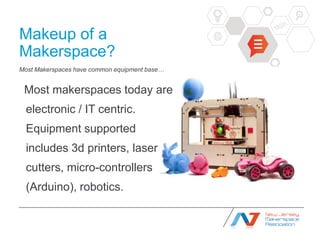
 Most makerspaces today are
  electronic / IT centric.
  Equipment supported
  includes 3d printers, laser
  cutters, micro-controllers
  (Arduino), robotics.
But Also…
 Makerspaces emerge in new focus areas


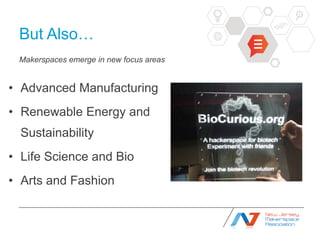
• Advanced Manufacturing
• Renewable Energy and
  Sustainability
• Life Science and Bio
• Arts and Fashion
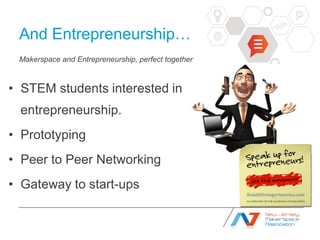
And Entrepreneurship…
 Makerspace and Entrepreneurship, perfect together


• STEM students interested in
  entrepreneurship.
• Prototyping
• Peer to Peer Networking
• Gateway to start-ups
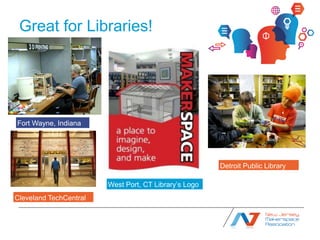
Great for Libraries!


Fort Wayne, Indiana


                                                       Detroit Public Library

                        West Port, CT Library’s Logo
Cleveland TechCentral
Great Opportunities
for Libraries!
•     A Dedicated Hacker Spaces - Each community could have a space to have hackathons that could be
     used for locally driven events as well as a place for out of town organizers to throw events.
•    Hackathon Model - Libraries could adopt a hackathon model for throwing small or large events in any
     area, allowing kids and adults to organize and participate in hackathons in any topic area.
•    Sponsorship - Bring in sponsors much like we do for hackathons, allowing tech and other companies to
     invest in single or ongoing hackathon efforts at libraries in the markets and subject areas that matter to
     them most.
•    Revenue Opportunities - These sponsorship opportunities would allow libraries to create new ways to
     fund their operations based upon the corporate sponsors that reflect the type of space libraries want to
     create.
•    Mentorship - Allow anyone to become a hacker mentor in any subject, allowing them to share expertise
     and knowledge with others in their community.
•    Resources - Libraries could provide access to computers, Internet connectivity, data repositories, code
     repositories, APIs, software and other resources that are essential to hackers.
•    Community Innovation - These new library hacker spaces could be centers for community innovation to
     occur, bringing in outside ideas, and circulating new ideas within existing community leaders.
•    Incubation - Library hacker spaces could be centers of business incubation, providing a rich and fertile
     environment for ideas to take root and find the resources and talent they need to actually become
     businesses, creating desperately needed jobs in communities.


    Source: Random blog at http://www.apievangelist.com/2012/02/07/lets-
    remake-libraries-as-hacker-spaces-and-community-innovation-centers/
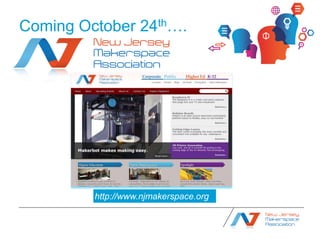
Coming October 24th….


         http://www.njmakerspace.org
Goals of New Jersey
    Makerspace Association
Based at Rutgers University, the New Jersey Makerspace Association will:
•   Encourage collaboration and partnerships among New Jersey's
    makerspaces - both member based and publicly supported;
•   Provide technical guidance and consultation for K-12 and other public
    entities (i.e. libraries) wishing to create new spaces;
•   Seek grant opportunities for equipment and events (i.e. Maker Faires);
•   Promote makerspaces to our elected representatives;
•   Create curriculum for educational related activities.
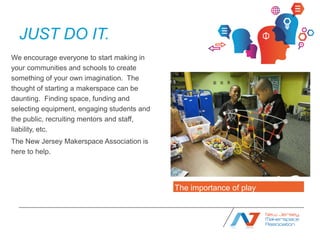
JUST DO IT.
We encourage everyone to start making in
your communities and schools to create
something of your own imagination. The
thought of starting a makerspace can be
daunting. Finding space, funding and
selecting equipment, engaging students and
the public, recruiting mentors and staff,
liability, etc.
The New Jersey Makerspace Association is
here to help. Publicly Supported


                                             The importance of play
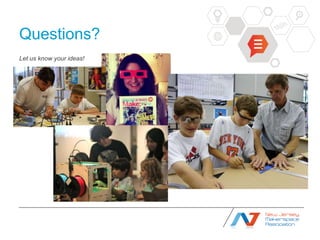
Questions?
Let us know your ideas!

Introduction to Makerspaces: Garages for tomorrows innovation

  • 1.
    Introduction to Makerspaces Garages fortomorrow’s innovation Stephen Carter Rutgers University scarter@rutgers.edu
  • 2.
    A Rich History Everyslideset must include a quote from Wikipedia… Some of today’s hottest companies were started in a garage or dorm room. Hewlett Packard, Microsoft, Apple, Facebook. Today these companies aren’t too worried about competing with each other. What keep’s them up at night is the thought of what some geek is doing in some garage. We want to build a nation of garages….
  • 3.
    Many Names, One Mission Makerspaces Makelabs Makerhoods (California) Hackerspaces Creative Spaces Fab Labs (New York)
  • 4.
    Simple … butcomplex Spaces can take many forms Makerspace goals are simple – to create, motivate and innovate. Well, not so simple. The good news is experimenting is fun.
  • 5.
    Wikipedia Definition: What isa Makerspace? Every slideset must include a quote from Wikipedia… A hackerspace or hackspace (also referred to as a hacklab, makerspace or creative space) is a location where people with common interests, often in computers, technology, science, digital art or electronic art, can meet, socialize and/or collaborate. Hackerspaces can be viewed as open community labs incorporating elements of machine shops, workshops and/or studios where hackers can come together to share resources and knowledge to build and make things.
  • 6.
    New Jersey helppaved the way… R.E.S.I.S.T.O.R.S formed in 1966 The RESISTORS - Radically Emphatic Students Interested in Science, Technology and Other Research Subjects was one of the first computer clubs in the United States, meeting in the sixties and seventies in a Hopewell Barn in central New Jersey. The group of computer geeks (mostly teen students at Hopewell Valley Central High School) formed in 1966 to play with High Schoolers in a Hopewell Barn electronics, write primitive code, talk about the future of computing, and protest bad science education. Publicly Supported
  • 7.
    Two primary typesof Makerspaces Public and Private Membership Supported (Private) Typically a group of like-minded individuals forming a 501c3 supported by membership dues ($25-$100 per month). Pays rental of space (garage/warehouse), insurance, and basic equipment. Loosely organized. Publicly Supported A makerspace at a university, k-12, library, museum, etc. Supported by grants, foundations, donations, public funds. Publicly Supported
  • 8.
    NJ’s Makerspaces are gainingmomentum! • Public Supported: • Rutgers University (2) • Newark Museum • Membership Supported: • Fubar Labs • Trenton Atelier • Institute for Exploratory Research • Hoboken Makerbar • Hive 4 (Allentown, PA)
  • 9.
    What goes onin Makerspaces? Not just Pop-tarts and Cheetos OPEN HOURS Times when facility is open to its members/public for fabrication, experimentation, or fixing one's toaster. MEETUPS Informal seminars (i.e weekly) on some mutual topic of interest. Includes 30-60 minute, followed by experimentation. CHALLENGES Organized competition in various topics. Many including commercial sponsorship and prizes. DISRUPTIVE EDUCATION Using makerspaces as the vehicle for advanced educational strategies, i.e. learn by doing. MIT Power Wheels Racing at New York’s Maker Faire every September.
  • 10.
    Makeup of a Makerspace? MostMakerspaces have common equipment base… Most makerspaces today are electronic / IT centric. Equipment supported includes 3d printers, laser cutters, micro-controllers (Arduino), robotics.
  • 11.
    But Also… Makerspacesemerge in new focus areas • Advanced Manufacturing • Renewable Energy and Sustainability • Life Science and Bio • Arts and Fashion
  • 12.
    And Entrepreneurship… Makerspaceand Entrepreneurship, perfect together • STEM students interested in entrepreneurship. • Prototyping • Peer to Peer Networking • Gateway to start-ups
  • 13.
    Great for Libraries! FortWayne, Indiana Detroit Public Library West Port, CT Library’s Logo Cleveland TechCentral
  • 14.
    Great Opportunities for Libraries! • A Dedicated Hacker Spaces - Each community could have a space to have hackathons that could be used for locally driven events as well as a place for out of town organizers to throw events. • Hackathon Model - Libraries could adopt a hackathon model for throwing small or large events in any area, allowing kids and adults to organize and participate in hackathons in any topic area. • Sponsorship - Bring in sponsors much like we do for hackathons, allowing tech and other companies to invest in single or ongoing hackathon efforts at libraries in the markets and subject areas that matter to them most. • Revenue Opportunities - These sponsorship opportunities would allow libraries to create new ways to fund their operations based upon the corporate sponsors that reflect the type of space libraries want to create. • Mentorship - Allow anyone to become a hacker mentor in any subject, allowing them to share expertise and knowledge with others in their community. • Resources - Libraries could provide access to computers, Internet connectivity, data repositories, code repositories, APIs, software and other resources that are essential to hackers. • Community Innovation - These new library hacker spaces could be centers for community innovation to occur, bringing in outside ideas, and circulating new ideas within existing community leaders. • Incubation - Library hacker spaces could be centers of business incubation, providing a rich and fertile environment for ideas to take root and find the resources and talent they need to actually become businesses, creating desperately needed jobs in communities. Source: Random blog at http://www.apievangelist.com/2012/02/07/lets- remake-libraries-as-hacker-spaces-and-community-innovation-centers/
  • 15.
    Coming October 24th…. http://www.njmakerspace.org
  • 16.
    Goals of NewJersey Makerspace Association Based at Rutgers University, the New Jersey Makerspace Association will: • Encourage collaboration and partnerships among New Jersey's makerspaces - both member based and publicly supported; • Provide technical guidance and consultation for K-12 and other public entities (i.e. libraries) wishing to create new spaces; • Seek grant opportunities for equipment and events (i.e. Maker Faires); • Promote makerspaces to our elected representatives; • Create curriculum for educational related activities.
  • 17.
    JUST DO IT. Weencourage everyone to start making in your communities and schools to create something of your own imagination. The thought of starting a makerspace can be daunting. Finding space, funding and selecting equipment, engaging students and the public, recruiting mentors and staff, liability, etc. The New Jersey Makerspace Association is here to help. Publicly Supported The importance of play
  • 18.