Chronic pain after surgery Bill Macrae, The Pain Service, Ninewells Hospital, Dundee, Scotland [email_address]
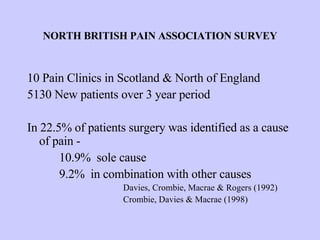
NORTH BRITISH PAIN ASSOCIATION SURVEY 10 Pain Clinics in Scotland & North of England 5130 New patients over 3 year period In 22.5% of patients surgery was identified as a cause of pain -  10.9%  sole cause  9.2%  in combination with other causes  Davies, Crombie, Macrae & Rogers (1992)  Crombie, Davies & Macrae (1998)
BREAST SURGERY   3 weeks 1 year 6 years Phantom breast PAIN  13.3% 12.7% 17.4% Scar pain    35% 22.7% 30.9% Kroner et al. 1992 Post-mastectomy pain syndrome  Incidence  20 - 50% (Neuropathic pain in arm, axilla & chest wall.) Stevens et al 1995,  Wallace et al 1996.
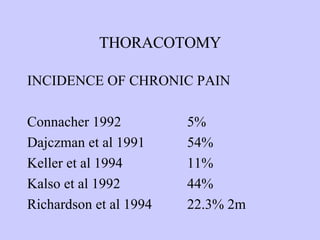
THORACOTOMY INCIDENCE OF CHRONIC PAIN Connacher 1992 5% Dajczman et al 1991 54% Keller et al 1994 11% Kalso et al 1992 44% Richardson et al 1994 22.3% 2m
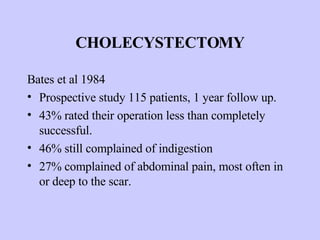
CHOLECYSTECTOMY Bates et al 1984 Prospective study 115 patients, 1 year follow up. 43% rated their operation less than completely successful. 46% still complained of indigestion 27% complained of abdominal pain, most often in or deep to the scar.
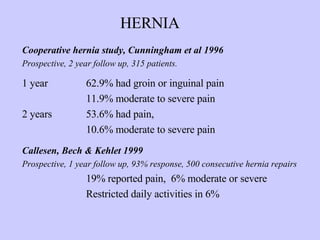
HERNIA Cooperative hernia study, Cunningham et al 1996 Prospective, 2 year follow up, 315 patients. 1 year  62.9% had groin or inguinal pain 11.9% moderate to severe pain 2 years  53.6% had pain,    10.6% moderate to severe pain Callesen, Bech & Kehlet 1999 Prospective, 1 year follow up, 93% response, 500 consecutive hernia repairs 19% reported pain,  6% moderate or severe Restricted daily activities in 6%
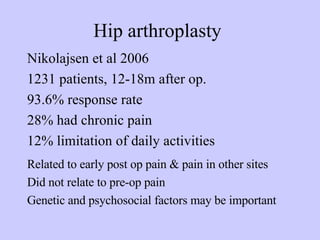
Hip arthroplasty Nikolajsen et al 2006 1231 patients, 12-18m after op. 93.6% response rate 28% had chronic pain 12% limitation of daily activities Related to early post op pain & pain in other sites Did not relate to pre-op pain Genetic and psychosocial factors may be important
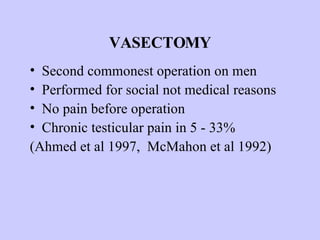
VASECTOMY Second commonest operation on men Performed for social not medical reasons No pain before operation Chronic testicular pain in 5 - 33% (Ahmed et al 1997,  McMahon et al 1992)
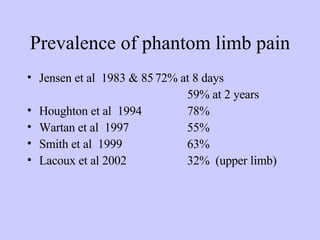
Prevalence of phantom limb pain Jensen et al  1983 & 85 72% at 8 days 59% at 2 years Houghton et al  1994 78% Wartan et al  1997 55% Smith et al  1999  63% Lacoux et al 2002 32%  (upper limb)
Why do patients have pain after surgery?
Because they’ve had an operation stupid! Why do patients have pain after surgery?
Why do patients have surgery? Was the surgery necessary? Was the surgery appropriate? Visceral hyperalgesic syndromes Irritable bowel syndrome Chronic interstitial cystitis Atypical chest pain Can we reduce the number of operations?
Prevention of post amputation pain Avoid amputation
 
Why do people have a mastectomy? Breast cancer Treatment choice What about cosmetic breast surgery?
 
Preventing mastectomy Screening and early detection Appropriate treatment Mastectomy rates (4700 patients with early breast Ca) France 28% UK 31% USA 56% Poland 98%
What causes pain after surgery Peripheral tissue injury Nerve damage and its consequences Functional change Psychological damage
What causes pain after surgery? Tissue injury Skin, subcutaneous tissues Muscles Bones and joints Viscera Nervous system What does peripheral tissue injury do to the nervous system?
Peripheral tissue injury changes the nervous system in two ways. 1. Peripheral sensitisation A reduction in the threshold of peripheral afferent nociceptors 2. Central sensitisation Increased excitability of spinal neurons Rewiring in the spinal cord  Changes in the brain What causes pain after surgery?
What causes pain after surgery It is complex but extremely interesting The pain syndromes are diverse Other factors may influence it Type of operation  Other treatments Genetic factors Anaesthesia and analgesia
BREAST SURGERY Phantom breast - painful - non painful Post-mastectomy pain syndrome Scar pain Numbness Tingling Sensitivity
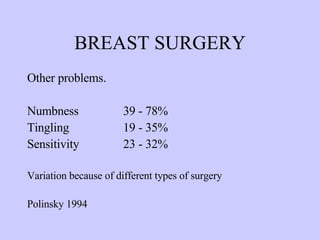
BREAST SURGERY Other problems. Numbness  39 - 78% Tingling    19 - 35% Sensitivity   23 - 32% Variation because of different types of surgery Polinsky 1994
THORACOTOMY Several different types of syndrome: Numbness Mechanical / musculoskeletal pain Neuropathic pain Tumour recurrence
What causes pain after surgery It is complex  The pain syndromes are diverse Other factors may influence it Type of operation Other treatments  Genetic factors Anaesthesia and analgesia
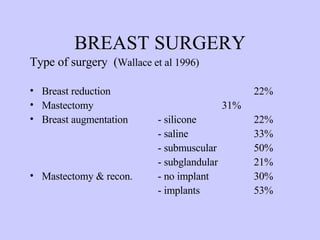
BREAST SURGERY Type of surgery  ( Wallace et al 1996) Breast reduction  22% Mastectomy   31% Breast augmentation - silicone    22%   - saline    33% - submuscular  50% - subglandular  21% Mastectomy & recon.  - no implant   30% - implants   53%
What causes pain after surgery It is complex  The pain syndromes are diverse Other factors may influence it Type of operation Other treatments Genetic factors Anaesthesia and analgesia
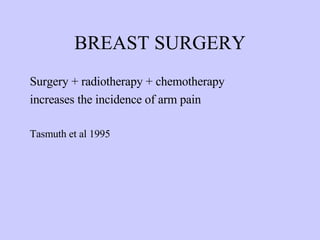
BREAST SURGERY Surgery + radiotherapy + chemotherapy increases the incidence of arm pain Tasmuth et al 1995
Phantom Pain in Children Smith et al  1995  (75 patients) 12% in trauma related amputees 48 %  in cancer patients 12% if no chemotherapy  44% with chemotherapy after  amputation 74% with chemotherapy before or  at the time of amputation
What causes pain after surgery It is complex  The pain syndromes are diverse Other factors may influence it Type of operation Other treatments  Genetic factors Anaesthesia and analgesia
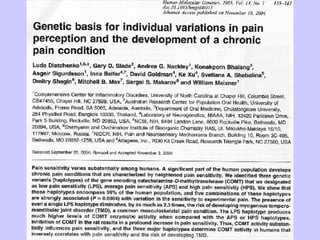
Genetic factors There is inter-individual variation in Pain sensitivity Analgesic response Susceptibility to painful pathology
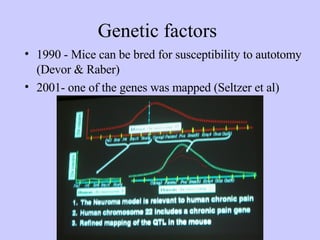
Genetic factors 1990 - Mice can be bred for susceptibility to autotomy (Devor & Raber) 2001- one of the genes was mapped (Seltzer et al)
 
Genetic factors “… it seems to me that given the wide range of variability in pain sensitivity among humans, and since at least some of this variability is inherited, clinicians and others should destigmatize pain-sensitive individuals.  Such patients may indeed be feeling more pain than others do, even with the same ‘objective’ stimulus.” Jeffrey S. Mogil
What causes pain after surgery It is complex  The pain syndromes are diverse Other factors may influence it Type of operation Other treatments   Genetic factors Anaesthesia and analgesia
BREAST SURGERY Remembered intensity of postoperative pain correlated with chronic pain Tasmuth et al 1996
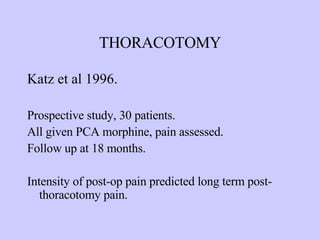
THORACOTOMY Katz et al 1996. Prospective study, 30 patients. All given PCA morphine, pain assessed. Follow up at 18 months. Intensity of post-op pain predicted long term post-thoracotomy pain.
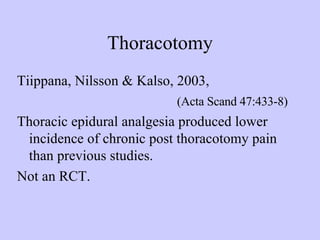
Thoracotomy Tiippana, Nilsson & Kalso, 2003,  (Acta Scand 47:433-8) Thoracic epidural analgesia produced lower incidence of chronic post thoracotomy pain than previous studies. Not an RCT.
Thoracotomy Senturk et al 2002  (Anesth Analg 94:11-15) RCT of 69 patients – 3 groups  All had isoflurane/fentanyl GA Epidural T7-8.  Pre-op bupiv/morphine + infusion   Post-op PCEA Epidural T7-8.  Post-op PCEA IV PCA morphine post-op
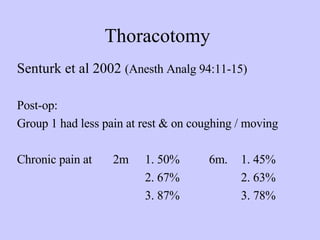
Thoracotomy Senturk et al 2002  (Anesth Analg 94:11-15) Post-op: Group 1 had less pain at rest & on coughing / moving Chronic pain at  2m 1. 50% 6m. 1. 45% 2. 67% 2. 63% 3. 87% 3. 78%
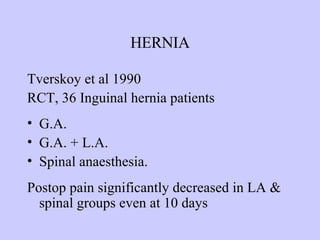
HERNIA Tverskoy et al 1990 RCT, 36 Inguinal hernia patients  G.A.  G.A. + L.A.  Spinal anaesthesia. Postop pain significantly decreased in LA & spinal groups even at 10 days
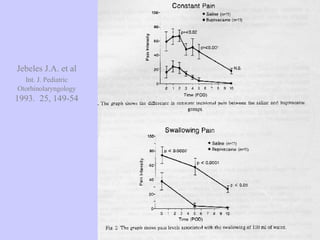
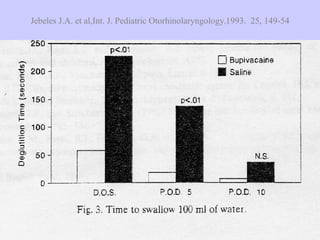
Tonsillectomy & adenoidectomy Jebeles J.A. et al, 1993  22 children having Ts & As under GA Prospective double blind RCT Peritonsillar infiltration with saline or bupivacaine + adrenaline  pre-op   Less pain in LA group up to 10 days
Jebeles J.A. et al Int. J. Pediatric   Otorhinolaryngology 1993.  25, 149-54
Jebeles J.A. et al,Int. J. Pediatric Otorhinolaryngology , 1993.  25, 149-54
Between the painful part and the patient’s  experience of pain lies the nervous system

Chronic Pain After Surgery Magnitude

  • 1.
    Chronic pain aftersurgery Bill Macrae, The Pain Service, Ninewells Hospital, Dundee, Scotland [email_address]
  • 2.
    NORTH BRITISH PAINASSOCIATION SURVEY 10 Pain Clinics in Scotland & North of England 5130 New patients over 3 year period In 22.5% of patients surgery was identified as a cause of pain - 10.9% sole cause 9.2% in combination with other causes Davies, Crombie, Macrae & Rogers (1992) Crombie, Davies & Macrae (1998)
  • 3.
    BREAST SURGERY 3 weeks 1 year 6 years Phantom breast PAIN 13.3% 12.7% 17.4% Scar pain 35% 22.7% 30.9% Kroner et al. 1992 Post-mastectomy pain syndrome Incidence 20 - 50% (Neuropathic pain in arm, axilla & chest wall.) Stevens et al 1995, Wallace et al 1996.
  • 4.
    THORACOTOMY INCIDENCE OFCHRONIC PAIN Connacher 1992 5% Dajczman et al 1991 54% Keller et al 1994 11% Kalso et al 1992 44% Richardson et al 1994 22.3% 2m
  • 5.
    CHOLECYSTECTOMY Bates etal 1984 Prospective study 115 patients, 1 year follow up. 43% rated their operation less than completely successful. 46% still complained of indigestion 27% complained of abdominal pain, most often in or deep to the scar.
  • 6.
    HERNIA Cooperative herniastudy, Cunningham et al 1996 Prospective, 2 year follow up, 315 patients. 1 year 62.9% had groin or inguinal pain 11.9% moderate to severe pain 2 years 53.6% had pain, 10.6% moderate to severe pain Callesen, Bech & Kehlet 1999 Prospective, 1 year follow up, 93% response, 500 consecutive hernia repairs 19% reported pain, 6% moderate or severe Restricted daily activities in 6%
  • 7.
    Hip arthroplasty Nikolajsenet al 2006 1231 patients, 12-18m after op. 93.6% response rate 28% had chronic pain 12% limitation of daily activities Related to early post op pain & pain in other sites Did not relate to pre-op pain Genetic and psychosocial factors may be important
  • 8.
    VASECTOMY Second commonestoperation on men Performed for social not medical reasons No pain before operation Chronic testicular pain in 5 - 33% (Ahmed et al 1997, McMahon et al 1992)
  • 9.
    Prevalence of phantomlimb pain Jensen et al 1983 & 85 72% at 8 days 59% at 2 years Houghton et al 1994 78% Wartan et al 1997 55% Smith et al 1999 63% Lacoux et al 2002 32% (upper limb)
  • 10.
    Why do patientshave pain after surgery?
  • 11.
    Because they’ve hadan operation stupid! Why do patients have pain after surgery?
  • 12.
    Why do patientshave surgery? Was the surgery necessary? Was the surgery appropriate? Visceral hyperalgesic syndromes Irritable bowel syndrome Chronic interstitial cystitis Atypical chest pain Can we reduce the number of operations?
  • 13.
    Prevention of postamputation pain Avoid amputation
  • 14.
  • 15.
    Why do peoplehave a mastectomy? Breast cancer Treatment choice What about cosmetic breast surgery?
  • 16.
  • 17.
    Preventing mastectomy Screeningand early detection Appropriate treatment Mastectomy rates (4700 patients with early breast Ca) France 28% UK 31% USA 56% Poland 98%
  • 18.
    What causes painafter surgery Peripheral tissue injury Nerve damage and its consequences Functional change Psychological damage
  • 19.
    What causes painafter surgery? Tissue injury Skin, subcutaneous tissues Muscles Bones and joints Viscera Nervous system What does peripheral tissue injury do to the nervous system?
  • 20.
    Peripheral tissue injurychanges the nervous system in two ways. 1. Peripheral sensitisation A reduction in the threshold of peripheral afferent nociceptors 2. Central sensitisation Increased excitability of spinal neurons Rewiring in the spinal cord Changes in the brain What causes pain after surgery?
  • 21.
    What causes painafter surgery It is complex but extremely interesting The pain syndromes are diverse Other factors may influence it Type of operation Other treatments Genetic factors Anaesthesia and analgesia
  • 22.
    What causes painafter surgery It is complex but extremely interesting The pain syndromes are diverse Other factors may influence it Type of operation Other treatments Genetic factors Anaesthesia and analgesia
  • 23.
    BREAST SURGERY Phantombreast - painful - non painful Post-mastectomy pain syndrome Scar pain Numbness Tingling Sensitivity
  • 24.
    BREAST SURGERY Otherproblems. Numbness 39 - 78% Tingling 19 - 35% Sensitivity 23 - 32% Variation because of different types of surgery Polinsky 1994
  • 25.
    THORACOTOMY Several differenttypes of syndrome: Numbness Mechanical / musculoskeletal pain Neuropathic pain Tumour recurrence
  • 26.
    What causes painafter surgery It is complex The pain syndromes are diverse Other factors may influence it Type of operation Other treatments Genetic factors Anaesthesia and analgesia
  • 27.
    BREAST SURGERY Typeof surgery ( Wallace et al 1996) Breast reduction 22% Mastectomy 31% Breast augmentation - silicone 22% - saline 33% - submuscular 50% - subglandular 21% Mastectomy & recon. - no implant 30% - implants 53%
  • 28.
    What causes painafter surgery It is complex The pain syndromes are diverse Other factors may influence it Type of operation Other treatments Genetic factors Anaesthesia and analgesia
  • 29.
    BREAST SURGERY Surgery+ radiotherapy + chemotherapy increases the incidence of arm pain Tasmuth et al 1995
  • 30.
    Phantom Pain inChildren Smith et al 1995 (75 patients) 12% in trauma related amputees 48 % in cancer patients 12% if no chemotherapy 44% with chemotherapy after amputation 74% with chemotherapy before or at the time of amputation
  • 31.
    What causes painafter surgery It is complex The pain syndromes are diverse Other factors may influence it Type of operation Other treatments Genetic factors Anaesthesia and analgesia
  • 32.
    Genetic factors Thereis inter-individual variation in Pain sensitivity Analgesic response Susceptibility to painful pathology
  • 33.
    Genetic factors 1990- Mice can be bred for susceptibility to autotomy (Devor & Raber) 2001- one of the genes was mapped (Seltzer et al)
  • 34.
  • 35.
    Genetic factors “…it seems to me that given the wide range of variability in pain sensitivity among humans, and since at least some of this variability is inherited, clinicians and others should destigmatize pain-sensitive individuals. Such patients may indeed be feeling more pain than others do, even with the same ‘objective’ stimulus.” Jeffrey S. Mogil
  • 36.
    What causes painafter surgery It is complex The pain syndromes are diverse Other factors may influence it Type of operation Other treatments Genetic factors Anaesthesia and analgesia
  • 37.
    BREAST SURGERY Rememberedintensity of postoperative pain correlated with chronic pain Tasmuth et al 1996
  • 38.
    THORACOTOMY Katz etal 1996. Prospective study, 30 patients. All given PCA morphine, pain assessed. Follow up at 18 months. Intensity of post-op pain predicted long term post-thoracotomy pain.
  • 39.
    Thoracotomy Tiippana, Nilsson& Kalso, 2003, (Acta Scand 47:433-8) Thoracic epidural analgesia produced lower incidence of chronic post thoracotomy pain than previous studies. Not an RCT.
  • 40.
    Thoracotomy Senturk etal 2002 (Anesth Analg 94:11-15) RCT of 69 patients – 3 groups All had isoflurane/fentanyl GA Epidural T7-8. Pre-op bupiv/morphine + infusion Post-op PCEA Epidural T7-8. Post-op PCEA IV PCA morphine post-op
  • 41.
    Thoracotomy Senturk etal 2002 (Anesth Analg 94:11-15) Post-op: Group 1 had less pain at rest & on coughing / moving Chronic pain at 2m 1. 50% 6m. 1. 45% 2. 67% 2. 63% 3. 87% 3. 78%
  • 42.
    HERNIA Tverskoy etal 1990 RCT, 36 Inguinal hernia patients G.A. G.A. + L.A. Spinal anaesthesia. Postop pain significantly decreased in LA & spinal groups even at 10 days
  • 43.
    Tonsillectomy & adenoidectomyJebeles J.A. et al, 1993 22 children having Ts & As under GA Prospective double blind RCT Peritonsillar infiltration with saline or bupivacaine + adrenaline pre-op Less pain in LA group up to 10 days
  • 44.
    Jebeles J.A. etal Int. J. Pediatric Otorhinolaryngology 1993. 25, 149-54
  • 45.
    Jebeles J.A. etal,Int. J. Pediatric Otorhinolaryngology , 1993. 25, 149-54
  • 46.
    Between the painfulpart and the patient’s experience of pain lies the nervous system