

Assessment Issues in Chronic Pain Spring Scientific Meeting 16 th  May 2008 www.nbpa.org.uk Queen Mother Conference Centre
NBPA May 2008 When to get worried? Missed pathology in the pain clinic
Outline Causes and consequences  Role of Assessor Why diagnose?  Back pain when to worry Conclusion Questions
Causes of missed diagnosis Assessor  Patient  Diagnosis Institution/philosophy
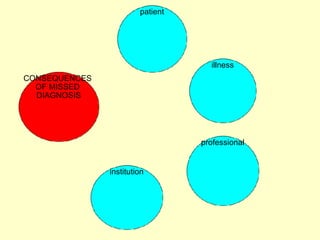
CONSEQUENCES  OF MISSED  DIAGNOSIS patient illness professional institution
Assessment Role of initial assessor Who performs initial assessment?  Triage Single vs. team assessment Goals of assessment Diagnosis vs symptom management
Reasons to pursue diagnosis? Serious illness Treatable diagnosis Disease progression Onward referral Patient anxiety Ability to progress  Therapeutic investigation
Problems with pursuing diagnosis No diagnosable illness Anxiety and catastrophising Fuels cure searching Cost Duplication of investigations False positives Use of resources
Age under 20 or over 55  Bony tenderness Non-mechanical pain (capsular) (Thoracic pain)  PMHx: Ca, steroids, HIV Unwell, wt loss  Structural deformity  Persistent night pain Widespread neurology  bilateral leg signs  Saddle anaesthesia Sphincter disturbance
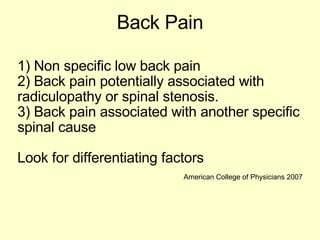
Back Pain 1) Non specific low back pain 2) Back pain potentially associated with radiculopathy or spinal stenosis. 3) Back pain associated with another specific spinal cause Look for differentiating factors American College of Physicians 2007
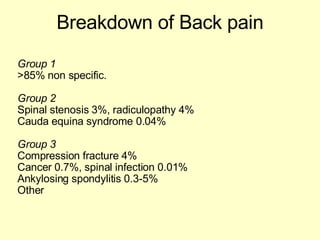
Breakdown of Back pain Group 1 >85% non specific.  Group 2 Spinal stenosis 3%, radiculopathy 4% Cauda equina syndrome 0.04%  Group 3 Compression fracture 4% Cancer 0.7%, spinal infection 0.01% Ankylosing spondylitis 0.3-5% Other
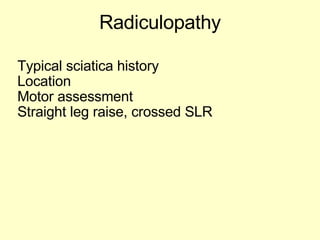
Radiculopathy Typical sciatica history Location Motor assessment Straight leg raise, crossed SLR
Spinal Stenosis Pseudoclaudication Radiating leg pain Downhill treadmill Pain relieved by sitting Age >65
Cauda equina syndrome Rapidly progressive, severe neurological deficit Motor deficits >1 level Faecal incontinence Bladder dysfunction
Malignancy risk factors History of cancer* Unexplained weight loss Failure to improve after 1 month >50 year old
Vertebral infection Fever IV drug use Recent infection Specific Risk factors
Fracture Age Young: traumatic Older: osteoporotic Steroid use
Ankylosing spondylitis Young, male Morning stiffness Improvement with exercise Alternating buttock pain Wakening with pain in the second part of the night
Psychosocial factors Depression Passive coping strategies Job dissatisfaction High disability levels Disputed compensation Somatisation Catastrophising
Group 1  No routine imaging or tests required. Assess psychosocial overlay
Investigation of 2) and 3) Signs of progressive/severe neurological deficits Serious underlying disease Deciding on further treatment (symptoms > 1 month) MRI CT XRay
Resources Diagnosis and Treatment of Low Back Pain: A Joint Clinical Practice Guideline from the American College of Physicians and the American Pain Society. 2007 American College of Physicians International Headache Society Classification Subcommittee. The International Classification of Headache Disorders. 2nd edition. Cephalalgia 2004; 24 (Suppl 1): 1-160 Descriptions of Chronic Pain Syndromes and Definitions of Pain Terms, Second Edition, IASP
Assessment Issues in Chronic Pain Spring Scientific Meeting 16 th  May 2008 www.nbpa.org.uk Queen Mother Conference Centre

When to get worried: Missed pathology in the pain clinic - Dr Andrew Crockett

  • 1.
    Assessment Issues inChronic Pain Spring Scientific Meeting 16 th May 2008 www.nbpa.org.uk Queen Mother Conference Centre
  • 2.
    NBPA May 2008When to get worried? Missed pathology in the pain clinic
  • 3.
    Outline Causes andconsequences Role of Assessor Why diagnose? Back pain when to worry Conclusion Questions
  • 4.
    Causes of misseddiagnosis Assessor Patient Diagnosis Institution/philosophy
  • 5.
    CONSEQUENCES OFMISSED DIAGNOSIS patient illness professional institution
  • 6.
    Assessment Role ofinitial assessor Who performs initial assessment? Triage Single vs. team assessment Goals of assessment Diagnosis vs symptom management
  • 7.
    Reasons to pursuediagnosis? Serious illness Treatable diagnosis Disease progression Onward referral Patient anxiety Ability to progress Therapeutic investigation
  • 8.
    Problems with pursuingdiagnosis No diagnosable illness Anxiety and catastrophising Fuels cure searching Cost Duplication of investigations False positives Use of resources
  • 9.
    Age under 20or over 55 Bony tenderness Non-mechanical pain (capsular) (Thoracic pain) PMHx: Ca, steroids, HIV Unwell, wt loss Structural deformity Persistent night pain Widespread neurology bilateral leg signs Saddle anaesthesia Sphincter disturbance
  • 10.
    Back Pain 1)Non specific low back pain 2) Back pain potentially associated with radiculopathy or spinal stenosis. 3) Back pain associated with another specific spinal cause Look for differentiating factors American College of Physicians 2007
  • 11.
    Breakdown of Backpain Group 1 >85% non specific. Group 2 Spinal stenosis 3%, radiculopathy 4% Cauda equina syndrome 0.04% Group 3 Compression fracture 4% Cancer 0.7%, spinal infection 0.01% Ankylosing spondylitis 0.3-5% Other
  • 12.
    Radiculopathy Typical sciaticahistory Location Motor assessment Straight leg raise, crossed SLR
  • 13.
    Spinal Stenosis PseudoclaudicationRadiating leg pain Downhill treadmill Pain relieved by sitting Age >65
  • 14.
    Cauda equina syndromeRapidly progressive, severe neurological deficit Motor deficits >1 level Faecal incontinence Bladder dysfunction
  • 15.
    Malignancy risk factorsHistory of cancer* Unexplained weight loss Failure to improve after 1 month >50 year old
  • 16.
    Vertebral infection FeverIV drug use Recent infection Specific Risk factors
  • 17.
    Fracture Age Young:traumatic Older: osteoporotic Steroid use
  • 18.
    Ankylosing spondylitis Young,male Morning stiffness Improvement with exercise Alternating buttock pain Wakening with pain in the second part of the night
  • 19.
    Psychosocial factors DepressionPassive coping strategies Job dissatisfaction High disability levels Disputed compensation Somatisation Catastrophising
  • 20.
    Group 1 No routine imaging or tests required. Assess psychosocial overlay
  • 21.
    Investigation of 2)and 3) Signs of progressive/severe neurological deficits Serious underlying disease Deciding on further treatment (symptoms > 1 month) MRI CT XRay
  • 22.
    Resources Diagnosis andTreatment of Low Back Pain: A Joint Clinical Practice Guideline from the American College of Physicians and the American Pain Society. 2007 American College of Physicians International Headache Society Classification Subcommittee. The International Classification of Headache Disorders. 2nd edition. Cephalalgia 2004; 24 (Suppl 1): 1-160 Descriptions of Chronic Pain Syndromes and Definitions of Pain Terms, Second Edition, IASP
  • 23.
    Assessment Issues inChronic Pain Spring Scientific Meeting 16 th May 2008 www.nbpa.org.uk Queen Mother Conference Centre