Spinal Cord Stimulator Service The New Look
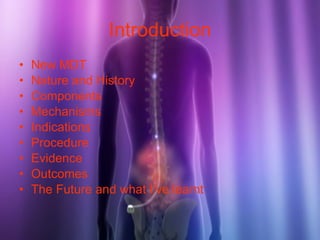
Introduction New MDT Nature and History Components Mechanisms Indications Procedure Evidence Outcomes The Future and what I’ve learnt
Introducing The Team
The new kids on the block
History 1965 Melzack and Wall 1967 Shealy  1970’s indiscriminate use poor follow up Neuropathic pain response EBM/cost effectiveness
Nature Electrical stimulation Direct nerve/field  Nerve root Dorsal column Deep brain Motor cortex
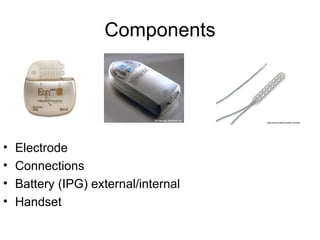
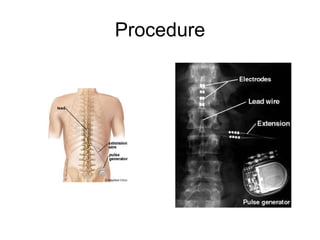
Components Electrode Connections Battery (IPG) external/internal Handset
Mechanisms Neuropathic Sympathetic
Mechanisms Gate theory Spinal segmental inhibition (second order and interneurones)‏ Supraspinal (via posterior columns)‏ Suppressed hyperexcitability in dorsal horns Biochemical increased GABA decreased excitatory glutamate and aspartate Not blocked by naloxone Adenosine dependent systems Increased b-endorphins in CSF
Indications Neuropathic Pain not responding to conventional treatment  Non nociceptive Intact dorsal column
Indications Peripheral neuropathic pain FBSS/FNSS (70:30)‏ CRPS Refractory Angina Critical limb ischaemia Other
Procedure
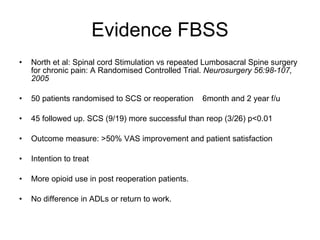
Evidence FBSS North et al: Spinal cord Stimulation vs repeated Lumbosacral Spine surgery for chronic pain: A Randomised Controlled Trial.   Neurosurgery 56:98-107, 2005 50 patients   randomised to SCS or reoperation  6month and 2 year f/u 45 followed up. SCS (9/19) more successful than reop (3/26) p<0.01 Outcome measure: >50% VAS improvement and patient satisfaction Intention to treat More opioid use in post reoperation patients. No difference in ADLs or return to work.
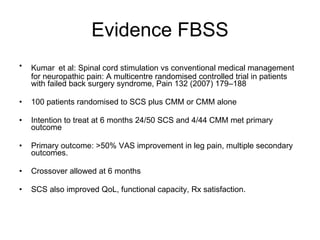
Evidence FBSS Kumar   et al: Spinal cord stimulation vs conventional medical management for neuropathic pain: A multicentre randomised controlled trial in patients with failed back surgery syndrome, Pain 132 (2007) 179–188 100 patients randomised to SCS plus CMM or CMM alone Intention to treat at 6 months 24/50 SCS and 4/44 CMM met primary outcome Primary outcome: >50% VAS improvement in leg pain, multiple secondary outcomes.  Crossover allowed at 6 months SCS also improved QoL, functional capacity, Rx satisfaction.
Evidence: FBSS Two class 2 RCT’s Pooled case series 3307 patients 62% response
Cost effectiveness: FBSS Manca et al 6 month mean total cost 5x higher SCS vs CMT, but hrQoL much improved. Mean EQ-5D diff 0.21 at 6 months Kumar et al  SCS  US$24799 mean cost over 5 years vs US$33722 for  CMM Qol 27% improvement (SCS), 12% improvement (CMM)‏
Cost effectiveness: FBSS North et al. SCS more effective, less expensive than reoperation. Systematic review concluded II-1 or II-2 with1B or 1C/strong recommendation for clinical use on a long term basis.
NICE-FBSS £10480 per QALY gained SCS/CMM vs CMM alone £9219 per QALY gained SCS vs reoperation
Complication rate: FBSS 43% overall one or more Cx Lead problems 27% Infections 6% Extension cable 10% Generator problems 6% Other eg CSF leak 7% No neurological complications
Evidence: CRPS I Kemler et al:  Spinal Cord Stimulation in Patients with Chronic Reflex Sympathetic Dystrophy The New England Journal of Medicine Issue: Volume 343(9), 31 August 2000, pp 618-624 54 patients 36 SCS plus PT, 18 PT alone in Type I CRPS>6 months Assessed 6months/ 2 years/ 5 years VAS 6 months (-2.4cm, 0.2cm), 2 years (-2.1cm, 0cm), 5 years (-1.7cm, -1.0cm)‏ HRQoL change 6 months (6% vs 3%), 2 years (7% vs 12%)‏ Subgroup analysis at 5 years VAS (-2.5 vs -1.0) if received treatment allocated with SCS Pooled case series data (n=561) 67% responders. (CRPS I and II)‏
NICE - CRPS 1 £16596 per QALY gained for SCS vs CMM
Refractory Angina Studies Reviews NICE guidance
Studies 8 medium to high quality studies Variable numbers (n=12- n=104) overall 331 pts. Decrease in anginal attacks Improved functional status Improved QoL No effect on mortality, but less mortality than CABG. Complication rate 12%
Review Generally positive improvement in many outcomes. ESBY study (104 pts) SCS vs CABG showed similar analgesia, mortality, QoL after 5 years. CABG had better exercise capacity.
NICE on RA No study had demonstrated significant differences in pain outcomes. SCS seen to be comparable to CABG and PCI for functional outcomes. Benefits less certain than FBSS and CRPS May be useful for subgroups, but only to be used in the context of clinical studies.
Chronic Limb Ischaemia Non reconstructable limb ischaemia Cochrane review NICE guidance
Cochrane CLI Generally looking at limb salvage. 6 studies with 450 patients Pooled data limb salvage significantly higher in SCS at 1 year vs CMM. Analgesia equal in both groups, higher use of opioids in CMM. Risk of complications 17% (NNH=6)‏ Average 2 year cost: EUR 36500 SCS, EUR 28600 CMM.
NICE on CLI Concluded no studies had shown statistically significant differences in outcomes SCS vs CMM May be subgroups with low peripheral O2 tension that benefit from SCS Insufficient evidence on survival, HRQoL and cost effectiveness. More trials needed.
Case series evidence Diabetic peripheral neuropathy CRPS II Peripheral nerve injury PHN Brachial plexus injury (partial)‏ Amputation Partial spinal cord injury
Pooled Complication rate Overall 33% in CRPS studies, 43% in FBSS Dysfunction of stimulating apparatus mainly Medical complications mainly minor and treatable. Rarely major neurological complication
Lead migration 13.2% Lead breakage 9.1% Infection rate 3.4% Hardware malfunction 2.9% Battery failure 1.6% Unwanted stimulation 2.4%
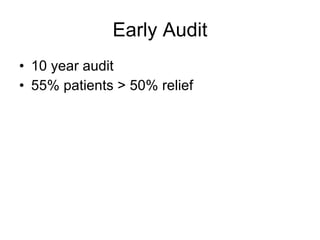
Early Audit 10 year audit  55% patients > 50% relief
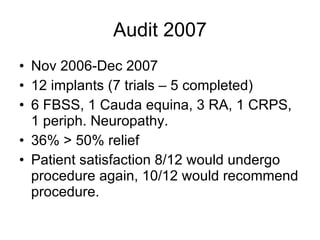
Audit 2007 Nov 2006-Dec 2007 12 implants (7 trials – 5 completed)‏ 6 FBSS, 1 Cauda equina, 3 RA, 1 CRPS, 1 periph. Neuropathy. 36% > 50% relief Patient satisfaction 8/12 would undergo procedure again, 10/12 would recommend procedure.
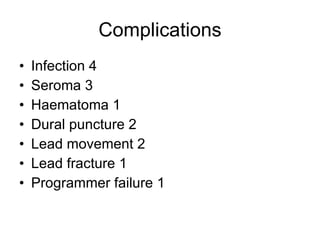
Complications Infection 4 Seroma 3 Haematoma 1 Dural puncture 2 Lead movement 2 Lead fracture 1 Programmer failure 1
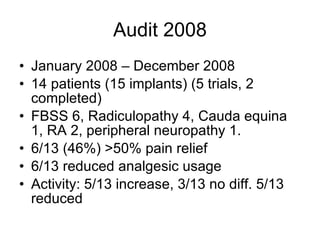
Audit 2008 January 2008 – December 2008 14 patients (15 implants) (5 trials, 2 completed)‏ FBSS 6, Radiculopathy 4, Cauda equina 1, RA 2, peripheral neuropathy 1. 6/13 (46%) >50% pain relief 6/13 reduced analgesic usage Activity: 5/13 increase, 3/13 no diff. 5/13 reduced
Patient satisfaction 10/13 would undergo again, 2/13 would not, 11 would recommend to others 1 would not.
Complications Reaction to implant antibiotic 1 Significant movement artefact 1 Lead movement 1 System damage 1
Revisions Explantation 1 Exploration 1 Lead repostioned 1 Failed revision 1
MDT Data on 37 new patients assessed jointly by psychol/physio. 6 straight to trial 9 not suitable 4 referred back for individ. Physio/psychol. 18 individ physio/psychol Rx (14 went on to trial SCS)‏
MDT assessment Assessment 1.5 hrs HAD TSK ODI Individual work up Trials Post implant physio review 6 weeks Long term F/U Resources: 3 physio sessions, 2 psychology.
Guidelines BPS NICE EFNS
Glasgow set up Referral (GG&C and outside)‏ Triage Assessment MDT discussion Funding approval Trial Completion Follow up
The what I’ve learnt bit! MDT and patient complexity How enjoyable it is to work in a fully integrated MDT setting. Facing your fears, how hard surgery is! Some interventions do work. A good result is not always a good result…the orthopaedic paradigm. How to say no in the face of political pressure How much we owe to Pete, Gavin, Anne and Alison.
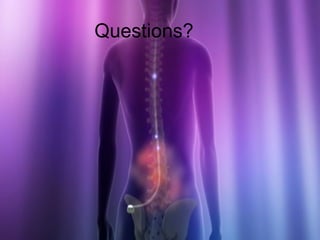
Questions?

Spinal Cord Stimulation Dr Andrew Crockett

  • 1.
    Spinal Cord StimulatorService The New Look
  • 2.
    Introduction New MDTNature and History Components Mechanisms Indications Procedure Evidence Outcomes The Future and what I’ve learnt
  • 3.
  • 4.
    The new kidson the block
  • 5.
    History 1965 Melzackand Wall 1967 Shealy 1970’s indiscriminate use poor follow up Neuropathic pain response EBM/cost effectiveness
  • 6.
    Nature Electrical stimulationDirect nerve/field Nerve root Dorsal column Deep brain Motor cortex
  • 7.
    Components Electrode ConnectionsBattery (IPG) external/internal Handset
  • 8.
  • 9.
    Mechanisms Gate theorySpinal segmental inhibition (second order and interneurones)‏ Supraspinal (via posterior columns)‏ Suppressed hyperexcitability in dorsal horns Biochemical increased GABA decreased excitatory glutamate and aspartate Not blocked by naloxone Adenosine dependent systems Increased b-endorphins in CSF
  • 10.
    Indications Neuropathic Painnot responding to conventional treatment Non nociceptive Intact dorsal column
  • 11.
    Indications Peripheral neuropathicpain FBSS/FNSS (70:30)‏ CRPS Refractory Angina Critical limb ischaemia Other
  • 12.
  • 13.
    Evidence FBSS Northet al: Spinal cord Stimulation vs repeated Lumbosacral Spine surgery for chronic pain: A Randomised Controlled Trial. Neurosurgery 56:98-107, 2005 50 patients randomised to SCS or reoperation 6month and 2 year f/u 45 followed up. SCS (9/19) more successful than reop (3/26) p<0.01 Outcome measure: >50% VAS improvement and patient satisfaction Intention to treat More opioid use in post reoperation patients. No difference in ADLs or return to work.
  • 14.
    Evidence FBSS Kumar et al: Spinal cord stimulation vs conventional medical management for neuropathic pain: A multicentre randomised controlled trial in patients with failed back surgery syndrome, Pain 132 (2007) 179–188 100 patients randomised to SCS plus CMM or CMM alone Intention to treat at 6 months 24/50 SCS and 4/44 CMM met primary outcome Primary outcome: >50% VAS improvement in leg pain, multiple secondary outcomes. Crossover allowed at 6 months SCS also improved QoL, functional capacity, Rx satisfaction.
  • 15.
    Evidence: FBSS Twoclass 2 RCT’s Pooled case series 3307 patients 62% response
  • 16.
    Cost effectiveness: FBSSManca et al 6 month mean total cost 5x higher SCS vs CMT, but hrQoL much improved. Mean EQ-5D diff 0.21 at 6 months Kumar et al SCS US$24799 mean cost over 5 years vs US$33722 for CMM Qol 27% improvement (SCS), 12% improvement (CMM)‏
  • 17.
    Cost effectiveness: FBSSNorth et al. SCS more effective, less expensive than reoperation. Systematic review concluded II-1 or II-2 with1B or 1C/strong recommendation for clinical use on a long term basis.
  • 18.
    NICE-FBSS £10480 perQALY gained SCS/CMM vs CMM alone £9219 per QALY gained SCS vs reoperation
  • 19.
    Complication rate: FBSS43% overall one or more Cx Lead problems 27% Infections 6% Extension cable 10% Generator problems 6% Other eg CSF leak 7% No neurological complications
  • 20.
    Evidence: CRPS IKemler et al: Spinal Cord Stimulation in Patients with Chronic Reflex Sympathetic Dystrophy The New England Journal of Medicine Issue: Volume 343(9), 31 August 2000, pp 618-624 54 patients 36 SCS plus PT, 18 PT alone in Type I CRPS>6 months Assessed 6months/ 2 years/ 5 years VAS 6 months (-2.4cm, 0.2cm), 2 years (-2.1cm, 0cm), 5 years (-1.7cm, -1.0cm)‏ HRQoL change 6 months (6% vs 3%), 2 years (7% vs 12%)‏ Subgroup analysis at 5 years VAS (-2.5 vs -1.0) if received treatment allocated with SCS Pooled case series data (n=561) 67% responders. (CRPS I and II)‏
  • 21.
    NICE - CRPS1 £16596 per QALY gained for SCS vs CMM
  • 22.
    Refractory Angina StudiesReviews NICE guidance
  • 23.
    Studies 8 mediumto high quality studies Variable numbers (n=12- n=104) overall 331 pts. Decrease in anginal attacks Improved functional status Improved QoL No effect on mortality, but less mortality than CABG. Complication rate 12%
  • 24.
    Review Generally positiveimprovement in many outcomes. ESBY study (104 pts) SCS vs CABG showed similar analgesia, mortality, QoL after 5 years. CABG had better exercise capacity.
  • 25.
    NICE on RANo study had demonstrated significant differences in pain outcomes. SCS seen to be comparable to CABG and PCI for functional outcomes. Benefits less certain than FBSS and CRPS May be useful for subgroups, but only to be used in the context of clinical studies.
  • 26.
    Chronic Limb IschaemiaNon reconstructable limb ischaemia Cochrane review NICE guidance
  • 27.
    Cochrane CLI Generallylooking at limb salvage. 6 studies with 450 patients Pooled data limb salvage significantly higher in SCS at 1 year vs CMM. Analgesia equal in both groups, higher use of opioids in CMM. Risk of complications 17% (NNH=6)‏ Average 2 year cost: EUR 36500 SCS, EUR 28600 CMM.
  • 28.
    NICE on CLIConcluded no studies had shown statistically significant differences in outcomes SCS vs CMM May be subgroups with low peripheral O2 tension that benefit from SCS Insufficient evidence on survival, HRQoL and cost effectiveness. More trials needed.
  • 29.
    Case series evidenceDiabetic peripheral neuropathy CRPS II Peripheral nerve injury PHN Brachial plexus injury (partial)‏ Amputation Partial spinal cord injury
  • 30.
    Pooled Complication rateOverall 33% in CRPS studies, 43% in FBSS Dysfunction of stimulating apparatus mainly Medical complications mainly minor and treatable. Rarely major neurological complication
  • 31.
    Lead migration 13.2%Lead breakage 9.1% Infection rate 3.4% Hardware malfunction 2.9% Battery failure 1.6% Unwanted stimulation 2.4%
  • 32.
    Early Audit 10year audit 55% patients > 50% relief
  • 33.
    Audit 2007 Nov2006-Dec 2007 12 implants (7 trials – 5 completed)‏ 6 FBSS, 1 Cauda equina, 3 RA, 1 CRPS, 1 periph. Neuropathy. 36% > 50% relief Patient satisfaction 8/12 would undergo procedure again, 10/12 would recommend procedure.
  • 34.
    Complications Infection 4Seroma 3 Haematoma 1 Dural puncture 2 Lead movement 2 Lead fracture 1 Programmer failure 1
  • 35.
    Audit 2008 January2008 – December 2008 14 patients (15 implants) (5 trials, 2 completed)‏ FBSS 6, Radiculopathy 4, Cauda equina 1, RA 2, peripheral neuropathy 1. 6/13 (46%) >50% pain relief 6/13 reduced analgesic usage Activity: 5/13 increase, 3/13 no diff. 5/13 reduced
  • 36.
    Patient satisfaction 10/13would undergo again, 2/13 would not, 11 would recommend to others 1 would not.
  • 37.
    Complications Reaction toimplant antibiotic 1 Significant movement artefact 1 Lead movement 1 System damage 1
  • 38.
    Revisions Explantation 1Exploration 1 Lead repostioned 1 Failed revision 1
  • 39.
    MDT Data on37 new patients assessed jointly by psychol/physio. 6 straight to trial 9 not suitable 4 referred back for individ. Physio/psychol. 18 individ physio/psychol Rx (14 went on to trial SCS)‏
  • 40.
    MDT assessment Assessment1.5 hrs HAD TSK ODI Individual work up Trials Post implant physio review 6 weeks Long term F/U Resources: 3 physio sessions, 2 psychology.
  • 41.
  • 42.
    Glasgow set upReferral (GG&C and outside)‏ Triage Assessment MDT discussion Funding approval Trial Completion Follow up
  • 43.
    The what I’velearnt bit! MDT and patient complexity How enjoyable it is to work in a fully integrated MDT setting. Facing your fears, how hard surgery is! Some interventions do work. A good result is not always a good result…the orthopaedic paradigm. How to say no in the face of political pressure How much we owe to Pete, Gavin, Anne and Alison.
  • 44.