ANAESTHESIA AND PAIN RELIEF
• Presenter : Dr. Annush Tha
• Moderator: Dr. Devendra Shrestha/ Dr. Puspa raj koirala
• Department of Surgery
• Pokhara Academy of Health Sciences
• 2077-06-19
Learning objectives
• Technique of anaesthesia
• Local and regional anaesthesia
• Methods of providing pain relief
• Management of chronic pain and pain from malignant disease
Anaesthesia
• Greek “an” – without “aesthesis” – no sensation
• Hippocratic corpus – anesthesia–reversible loss of sensation and
unconsciousness
• 16th October 1846 Ether day – 1st time ether used by William Morton
for operation on a vascular tumor on neck
• THE ETHER DOME
• 1853- John snow used chloroform on Queen Victoria for labour pain
• 1926- Jhon Lundy – “Balanced anaestheisa”
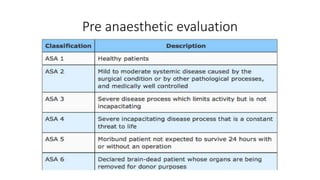
Pre anaesthetic evaluation
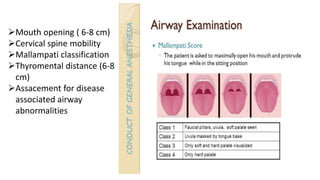
Mouth opening ( 6-8 cm)
Cervical spine mobility
Mallampati classification
Thyromental distance (6-8
cm)
Assacement for disease
associated airway
abnormalities
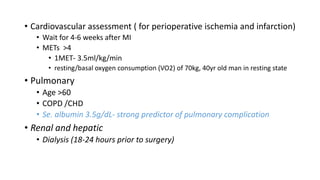
• Cardiovascular assessment ( for perioperative ischemia and infarction)
• Wait for 4-6 weeks after MI
• METs >4
• 1MET- 3.5ml/kg/min
• resting/basal oxygen consumption (VO2) of 70kg, 40yr old man in resting state
• Pulmonary
• Age >60
• COPD /CHD
• Se. albumin 3.5g/dL- strong predictor of pulmonary complication
• Renal and hepatic
• Dialysis (18-24 hours prior to surgery)
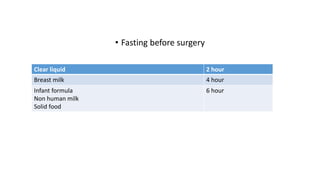
• Fasting before surgery
Clear liquid 2 hour
Breast milk 4 hour
Infant formula
Non human milk
Solid food
6 hour
Selection of the anaesthetic technique
• Operative site
• Patient position
• Duration of surgery
• Pt expected to return home or anticipated for admission
• Cost
• Risk of anaesthiesia
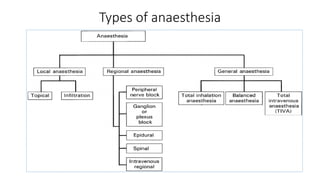
Types of anaesthesia
General anaesthesia
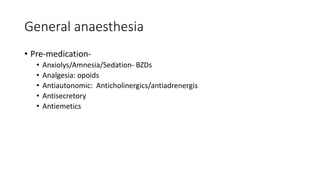
• Pre-medication-
• Anxiolys/Amnesia/Sedation- BZDs
• Analgesia: opoids
• Antiautonomic: Anticholinergics/antiadrenergis
• Antisecretory
• Antiemetics
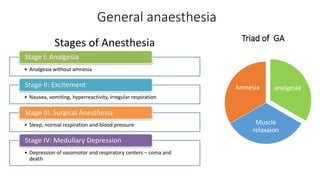
General anaesthesia
analgesia
Muscle
relaxaion
Amnesia
Triad of GA
• Induction – (administration inducing agent to loss of consciousness)
• Done with iv agents
• Eg: propofol, thiopentone sodium, etomidate, ketamine
Muscle relaxation (depolarisng/non depolarizing muscle relaxants)
Mechanical ventilation
• Maintainence – inhalational agents
(isoflurane/desflurane/sevoflurane)
Monitoring
• Pulse oximetry
• ECG – (II-Arrhythymia, V2, V3, V4, V5- ischemia)
• Blood pressure
• Capnography
• Temperature
•
Reversal and post anaesthetic care
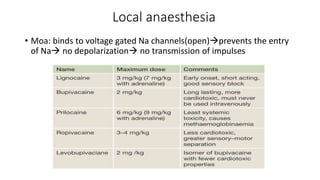
Local anaesthesia
• Moa: binds to voltage gated Na channels(open)prevents the entry
of Na no depolarization no transmission of impulses
Regional anaesthesia
• Neuroaxial or peripheral nerve or plexus block
• Effective where general anaesthesia has higher risk of morbidity and
mortality
• Obstetrics, debilitiating respiratory and cardiovascular dz
• Excellent pain relief in postop period
• Decreases the need of analgesia
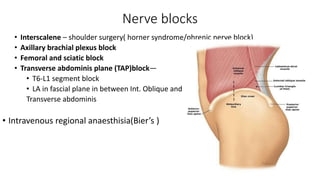
Nerve blocks
• Interscalene – shoulder surgery( horner syndrome/phrenic nerve block)
• Axillary brachial plexus block
• Femoral and sciatic block
• Transverse abdominis plane (TAP)block—
• T6-L1 segment block
• LA in fascial plane in between Int. Oblique and
Transverse abdominis
• Intravenous regional anaesthisia(Bier’s )
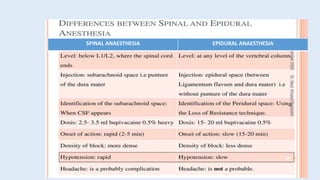
SPINAL ANAESTHESIA EPIDURAL ANAESTHESIA
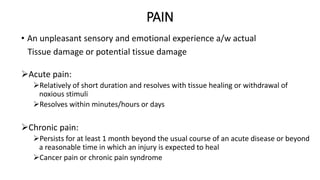
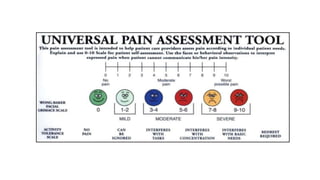
PAIN
• An unpleasant sensory and emotional experience a/w actual
Tissue damage or potential tissue damage
Acute pain:
Relatively of short duration and resolves with tissue healing or withdrawal of
noxious stimuli
Resolves within minutes/hours or days
Chronic pain:
Persists for at least 1 month beyond the usual course of an acute disease or beyond
a reasonable time in which an injury is expected to heal
Cancer pain or chronic pain syndrome
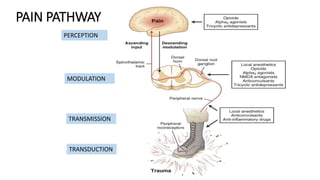
PAIN PATHWAY
TRANSDUCTION
TRANSMISSION
MODULATION
PERCEPTION
• More than 80% of surgical patients experience acute postoperative
pain
• Approx. 75% report the severity as moderate, severe or extreme
• Inadequately controlled pain negatively affects
• quality of life
• function and functional recovery
• Risk of post surgical complications
• Risk of persistent postsurgical pain
Why should we treat pain??
• To provide good quality patient care
• To reduce post operative complication:
• Respiratory : retention of secretion  pneumonia & atelectasis
• Cardiovascular : pain increases sympathetic drive causing increased
• myocardial oxygen demand risk of post operative myocardial ischemia
• Neuroendocrine effects: increased secretion of catecholamines and cortisols
promoting water and Na retention
• Mobilisation : risk of DVTdue to delayed mobilization coz of pain
How to treat post operative pain??
• Multimodal pain management is recommended
• Includes non pharmacological and pharmacological methods
• Preoperative counselling
• About the nature of surgery and post operative pain to patient and caregivers
• Helps to educate patient about post operative pain and devise the treatment
plans
• TENS( Transcutaneous electrical nerve stimulation)
• Acupuncture
Pharmacological treatment
• Methods of analgesia
• Oral route is preferred
• Parenteral for moderate to severe pain –requiring rapid control
• IV route preferred over IM and SC
• IM – painful and erratic absorption
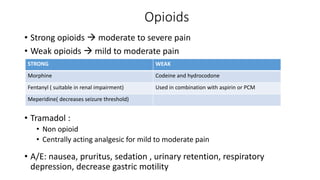
Opioids
• Strong opioids  moderate to severe pain
• Weak opioids  mild to moderate pain
• Tramadol :
• Non opioid
• Centrally acting analgesic for mild to moderate pain
• A/E: nausea, pruritus, sedation , urinary retention, respiratory
depression, decrease gastric motility
STRONG WEAK
Morphine Codeine and hydrocodone
Fentanyl ( suitable in renal impairment) Used in combination with aspirin or PCM
Meperidine( decreases seizure threshold)
NSAIDs
• Inhibits COX enzyme and decreases prostaglandins( potent mediators of
pain acting at nociceptors and increases its sensitivity )
• Part of analgesia regimen that reduces opioid need
• Ketorolac – mild to moderate pain (iv 30 mg)
• Ketorolac + opioid moderate to severe pain
• A/e: gastric ulceration , renal injury and bleeding
• Avoid in platelet dysfunction, thrombocytopenia , renal dysfunction
• Others celecoxib, rofecoxib, valdecoib COX2 inhibitors
Local anaesthesia
• Local infiltration of anaesthetic prior to incision– reduces
sensitization of nociceptors and decreases pain conduction to CNS
• Local infiltration on wound closure may be helpful
• Local anaesthetics via epidural infusion, peripheral nerve infusion
• Decreases postop pain and opioid requirement
Combination of analgesic therapy
• NSAIDs + OPIOIDS
• NSAIDs + OPIOIDS + Local Anaesthesia based regional analgesia
• Acetaminophen + NSAIDs more effective when used together
• Preoperative dose of oral celecoxib in adult patients (200-400 mg – 30-1
hour preoperatively lowers post operative pain score)
• Gabapentin (600-1200 mg) or pregabalin (150-300 mg)preoperatively
1-2 hours preoperative or after 12 hours post operatively – effective
• Neuraxial and peripheral analgesia highly advocated
• Guidelines on Management of postoperative pain
• Management of postoperative pain : a Clinical practice guideline..Roger chou et al. The journal
of pain, 2016
Chronic pain management
• Acute pain after surgery may progress to chronic pain if inadequately
managed
• Types
• Nociceptive pain from musculoskeletal disorders or cancer (cutaneous
nociceptors sensitization and exaggerated response in dorsal horn )
• Neuropathic paindysfunction in peripheral or central nerves
• Burning, shooting or stabbing type
• Poorly responsive to opioids  give gabapentine, tricyclic antidepressants
• Eg: trigeminal neuralgia, diabetic neuropathy, postherpetic neuralgia
• Psychogenic paina/w depressive illness
Chronic pain control in benign dz
• Chronic persistent pain (>3 months duration):
• spontaneous Firing of pain signals at NMDA receptors in ascending
pathway
• Postoperative neuropathic pain
• Nerve injury
• Sympathetic dystrophy
• Phantom limb pain( provide preoperative and post op pain relief to avoid)
• Neuropathic pain management
• Local anaesthetic + steroid injections
• Nerve stimulation procedures (TENS, Accupunture, dorsal column stimulation
with epidural electrodes )
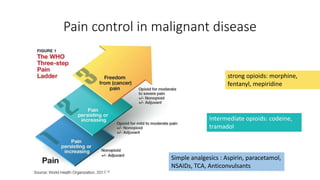
Pain control in malignant disease
Simple analgesics : Aspirin, paracetamol,
NSAIDs, TCA, Anticonvulsants
Intermediate opioids: codeine,
tramadol
strong opioids: morphine,
fentanyl, mepiridine
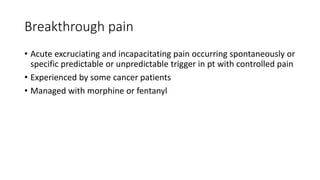
Breakthrough pain
• Acute excruciating and incapacitating pain occurring spontaneously or
specific predictable or unpredictable trigger in pt with controlled pain
• Experienced by some cancer patients
• Managed with morphine or fentanyl
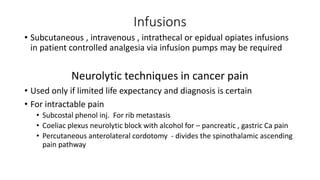
Infusions
• Subcutaneous , intravenous , intrathecal or epidual opiates infusions
in patient controlled analgesia via infusion pumps may be required
Neurolytic techniques in cancer pain
• Used only if limited life expectancy and diagnosis is certain
• For intractable pain
• Subcostal phenol inj. For rib metastasis
• Coeliac plexus neurolytic block with alcohol for – pancreatic , gastric Ca pain
• Percutaneous anterolateral cordotomy - divides the spinothalamic ascending
pain pathway
Take home message
• Anaesthesia techniques must be patient and surgery specific keeping
on mind of the cost
• Pain management should begin preoperatively and continue
postoperatively for quality patient care and avoid complications
• Pain management requires multimodal approach and effective when
combined
• Pain management in malignant condition should follow pain
stepladder
References
• Short practice of surgery, 27 edition , Bailey and love
• Sabiston Textbook of surgey ,19th edition
• Management of the postoperative pain: A clinical practice guideline
from the American pain society,.. Roger chou, et al. The journal of
pain , vol 17.
Thank you

Anaesthesia and pain relif

  • 1.
    ANAESTHESIA AND PAINRELIEF • Presenter : Dr. Annush Tha • Moderator: Dr. Devendra Shrestha/ Dr. Puspa raj koirala • Department of Surgery • Pokhara Academy of Health Sciences • 2077-06-19
  • 2.
    Learning objectives • Techniqueof anaesthesia • Local and regional anaesthesia • Methods of providing pain relief • Management of chronic pain and pain from malignant disease
  • 3.
    Anaesthesia • Greek “an”– without “aesthesis” – no sensation • Hippocratic corpus – anesthesia–reversible loss of sensation and unconsciousness • 16th October 1846 Ether day – 1st time ether used by William Morton for operation on a vascular tumor on neck • THE ETHER DOME • 1853- John snow used chloroform on Queen Victoria for labour pain • 1926- Jhon Lundy – “Balanced anaestheisa”
  • 4.
  • 5.
    Mouth opening (6-8 cm) Cervical spine mobility Mallampati classification Thyromental distance (6-8 cm) Assacement for disease associated airway abnormalities
  • 6.
    • Cardiovascular assessment( for perioperative ischemia and infarction) • Wait for 4-6 weeks after MI • METs >4 • 1MET- 3.5ml/kg/min • resting/basal oxygen consumption (VO2) of 70kg, 40yr old man in resting state • Pulmonary • Age >60 • COPD /CHD • Se. albumin 3.5g/dL- strong predictor of pulmonary complication • Renal and hepatic • Dialysis (18-24 hours prior to surgery)
  • 7.
    • Fasting beforesurgery Clear liquid 2 hour Breast milk 4 hour Infant formula Non human milk Solid food 6 hour
  • 8.
    Selection of theanaesthetic technique • Operative site • Patient position • Duration of surgery • Pt expected to return home or anticipated for admission • Cost • Risk of anaesthiesia
  • 9.
  • 10.
    General anaesthesia • Pre-medication- •Anxiolys/Amnesia/Sedation- BZDs • Analgesia: opoids • Antiautonomic: Anticholinergics/antiadrenergis • Antisecretory • Antiemetics
  • 11.
  • 12.
    • Induction –(administration inducing agent to loss of consciousness) • Done with iv agents • Eg: propofol, thiopentone sodium, etomidate, ketamine Muscle relaxation (depolarisng/non depolarizing muscle relaxants) Mechanical ventilation • Maintainence – inhalational agents (isoflurane/desflurane/sevoflurane)
  • 13.
    Monitoring • Pulse oximetry •ECG – (II-Arrhythymia, V2, V3, V4, V5- ischemia) • Blood pressure • Capnography • Temperature • Reversal and post anaesthetic care
  • 14.
    Local anaesthesia • Moa:binds to voltage gated Na channels(open)prevents the entry of Na no depolarization no transmission of impulses
  • 15.
    Regional anaesthesia • Neuroaxialor peripheral nerve or plexus block • Effective where general anaesthesia has higher risk of morbidity and mortality • Obstetrics, debilitiating respiratory and cardiovascular dz • Excellent pain relief in postop period • Decreases the need of analgesia
  • 16.
    Nerve blocks • Interscalene– shoulder surgery( horner syndrome/phrenic nerve block) • Axillary brachial plexus block • Femoral and sciatic block • Transverse abdominis plane (TAP)block— • T6-L1 segment block • LA in fascial plane in between Int. Oblique and Transverse abdominis • Intravenous regional anaesthisia(Bier’s )
  • 17.
  • 18.
    PAIN • An unpleasantsensory and emotional experience a/w actual Tissue damage or potential tissue damage Acute pain: Relatively of short duration and resolves with tissue healing or withdrawal of noxious stimuli Resolves within minutes/hours or days Chronic pain: Persists for at least 1 month beyond the usual course of an acute disease or beyond a reasonable time in which an injury is expected to heal Cancer pain or chronic pain syndrome
  • 19.
  • 20.
    • More than80% of surgical patients experience acute postoperative pain • Approx. 75% report the severity as moderate, severe or extreme • Inadequately controlled pain negatively affects • quality of life • function and functional recovery • Risk of post surgical complications • Risk of persistent postsurgical pain
  • 22.
    Why should wetreat pain?? • To provide good quality patient care • To reduce post operative complication: • Respiratory : retention of secretion  pneumonia & atelectasis • Cardiovascular : pain increases sympathetic drive causing increased • myocardial oxygen demand risk of post operative myocardial ischemia • Neuroendocrine effects: increased secretion of catecholamines and cortisols promoting water and Na retention • Mobilisation : risk of DVTdue to delayed mobilization coz of pain
  • 23.
    How to treatpost operative pain?? • Multimodal pain management is recommended • Includes non pharmacological and pharmacological methods • Preoperative counselling • About the nature of surgery and post operative pain to patient and caregivers • Helps to educate patient about post operative pain and devise the treatment plans • TENS( Transcutaneous electrical nerve stimulation) • Acupuncture
  • 24.
    Pharmacological treatment • Methodsof analgesia • Oral route is preferred • Parenteral for moderate to severe pain –requiring rapid control • IV route preferred over IM and SC • IM – painful and erratic absorption

  • 25.
    Opioids • Strong opioids moderate to severe pain • Weak opioids  mild to moderate pain • Tramadol : • Non opioid • Centrally acting analgesic for mild to moderate pain • A/E: nausea, pruritus, sedation , urinary retention, respiratory depression, decrease gastric motility STRONG WEAK Morphine Codeine and hydrocodone Fentanyl ( suitable in renal impairment) Used in combination with aspirin or PCM Meperidine( decreases seizure threshold)
  • 26.
    NSAIDs • Inhibits COXenzyme and decreases prostaglandins( potent mediators of pain acting at nociceptors and increases its sensitivity ) • Part of analgesia regimen that reduces opioid need • Ketorolac – mild to moderate pain (iv 30 mg) • Ketorolac + opioid moderate to severe pain • A/e: gastric ulceration , renal injury and bleeding • Avoid in platelet dysfunction, thrombocytopenia , renal dysfunction • Others celecoxib, rofecoxib, valdecoib COX2 inhibitors
  • 27.
    Local anaesthesia • Localinfiltration of anaesthetic prior to incision– reduces sensitization of nociceptors and decreases pain conduction to CNS • Local infiltration on wound closure may be helpful • Local anaesthetics via epidural infusion, peripheral nerve infusion • Decreases postop pain and opioid requirement
  • 28.
    Combination of analgesictherapy • NSAIDs + OPIOIDS • NSAIDs + OPIOIDS + Local Anaesthesia based regional analgesia • Acetaminophen + NSAIDs more effective when used together • Preoperative dose of oral celecoxib in adult patients (200-400 mg – 30-1 hour preoperatively lowers post operative pain score) • Gabapentin (600-1200 mg) or pregabalin (150-300 mg)preoperatively 1-2 hours preoperative or after 12 hours post operatively – effective • Neuraxial and peripheral analgesia highly advocated • Guidelines on Management of postoperative pain • Management of postoperative pain : a Clinical practice guideline..Roger chou et al. The journal of pain, 2016
  • 29.
    Chronic pain management •Acute pain after surgery may progress to chronic pain if inadequately managed • Types • Nociceptive pain from musculoskeletal disorders or cancer (cutaneous nociceptors sensitization and exaggerated response in dorsal horn ) • Neuropathic paindysfunction in peripheral or central nerves • Burning, shooting or stabbing type • Poorly responsive to opioids  give gabapentine, tricyclic antidepressants • Eg: trigeminal neuralgia, diabetic neuropathy, postherpetic neuralgia • Psychogenic paina/w depressive illness
  • 30.
    Chronic pain controlin benign dz • Chronic persistent pain (>3 months duration): • spontaneous Firing of pain signals at NMDA receptors in ascending pathway • Postoperative neuropathic pain • Nerve injury • Sympathetic dystrophy • Phantom limb pain( provide preoperative and post op pain relief to avoid) • Neuropathic pain management • Local anaesthetic + steroid injections • Nerve stimulation procedures (TENS, Accupunture, dorsal column stimulation with epidural electrodes )
  • 31.
    Pain control inmalignant disease Simple analgesics : Aspirin, paracetamol, NSAIDs, TCA, Anticonvulsants Intermediate opioids: codeine, tramadol strong opioids: morphine, fentanyl, mepiridine
  • 32.
    Breakthrough pain • Acuteexcruciating and incapacitating pain occurring spontaneously or specific predictable or unpredictable trigger in pt with controlled pain • Experienced by some cancer patients • Managed with morphine or fentanyl
  • 33.
    Infusions • Subcutaneous ,intravenous , intrathecal or epidual opiates infusions in patient controlled analgesia via infusion pumps may be required Neurolytic techniques in cancer pain • Used only if limited life expectancy and diagnosis is certain • For intractable pain • Subcostal phenol inj. For rib metastasis • Coeliac plexus neurolytic block with alcohol for – pancreatic , gastric Ca pain • Percutaneous anterolateral cordotomy - divides the spinothalamic ascending pain pathway
  • 34.
    Take home message •Anaesthesia techniques must be patient and surgery specific keeping on mind of the cost • Pain management should begin preoperatively and continue postoperatively for quality patient care and avoid complications • Pain management requires multimodal approach and effective when combined • Pain management in malignant condition should follow pain stepladder
  • 35.
    References • Short practiceof surgery, 27 edition , Bailey and love • Sabiston Textbook of surgey ,19th edition • Management of the postoperative pain: A clinical practice guideline from the American pain society,.. Roger chou, et al. The journal of pain , vol 17.
  • 36.