Lesson 1
Cardiovascular testing
Tsegaye Melaku (BPharm, MSc)
[Assistant Professor of Clinical Pharmacy]
tsegayemlk@yahoo.com or tsegaye.melaku@ju.edu.et +251913765609December, 2019
Pharmacotherapy of Cardiovascular Disorders
 Session Tips
 Differentiate types of cardiovascular testing
 Type of murmur (systolic/diastolic) Vs specific valvular abnormalities.
 How echo, EC(K)G used for CVD dx, Rx, prognosis
 Clinical importance of cardiac biomarkers
 Other investigation modalities
 When to order these CV testing
2
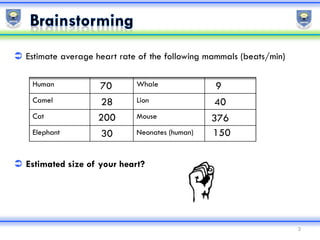
 Estimate average heart rate of the following mammals (beats/min)
 Estimated size of your heart?
3
Human Whale
Camel Lion
Cat Mouse
Elephant Neonates (human)
9
40
376
70
28
200
30 150
 Height? Width ?
 Beats per day?
 Beats 2.5 billion times in an average 70 yrs. Lifetime
 Pumps about of blood each day
 Pumps blood through miles of vessels
 Suffers 7.2 mil. CAD deaths worldwide each year
4
4.8 inches tall 3.35 inches wide   12 x 9 cm
~100,000 times
2000 galloons/7600 liters
62,000
 CO (ml/min) = HR (75 beats/min) x SV (70 ml/beat)
– CO = 5250 ml/min (5.25 L/min)
5
 Components
 Heart: hollow muscular organ
 Blood
 Vessels
– Arteries: Away from heart
– Veins: toward heart
– Capillaries: Link arterioles to veins
» sites of o2, nutrients & waste exchange
• Pinocytosis/diffusion
6
7
 Heart :
– Provides the driving force for the cardiovascular system
– Organ at the center of the circulatory system.
– It pumps blood around the body
– ~ the size of your fist
– Weight ~ 250-300g
8
9
10
11
 Heart walls:
 Epicardium
– Outermost layer
– Fat to cushion heart
 Myocardium
– Middle layer
– Primarily cardiac muscle
 Endocardium
– Innermost layer
– Thin and smooth
– Stretches as the heart pumps
12
13
 CVD afflicts an estimated 80 million people (i.e.~1 in 3 adults)
– Accounts for 35% of all deaths: US data
 Total cost of CVD (HTN, CHD, HF, and stroke)~ $475.3 billion.
 Atherosclerosis: cause of most CVD events.
– Typically present for decades before symptoms appear
14
15
16
 Thorough history,
 Comprehensive P/E
 Appropriate testing,
17
– Identify sub-clinical CVD
– Assess symptomatic CVD for the risk of an adverse event
– Help in appropriate management
 Elements of a comprehensive history:
– Chief complaint,
– Current symptoms, …HPI
– Past medical history,
18
– Family history,
– Social history…..
– Review of systems
 Diet/physical activity/tobacco/alcohol/illicit drug
 Duration/quality/frequency/severity/progression/precipitating &
relieving factors, associated symptoms, & impact on daily activities
 Chest pain: frequent symptom
– Angina/infarction, non-cardiac conditions (esophageal,
pulmonary, or musculoskeletal disorders)
– Quality/location/duration;
– Provoking or relieving factors (ascertain etiology)
– Example:
 Sensation of heaviness/pressure in the retrosternal area
 Radiate to the jaw, left shoulder, back, or left arm
 Typically lasts only a few minutes
19
 Angina pain
– Precipitated by exertion, emotional stress, eating, cigarette
smoking, or exposure to cold,
– Relieved with rest or SL NTG
– Unstable angina pain is ↑ in severity, longer in duration, or
occurring at rest;
» Need prompt medical attention expeditiously.
20
 CHF & pulmonary vascular congestion
– Complain of SOB (dyspnea) with exertion or even at rest
– Orthopnea, PND, and nocturia
 CHF & peripheral venous congestion
– Abdominal swelling (from hepatic congestion or ascites),
– Nausea, vomiting, lower extremity edema, fatigue, & dyspnea
21
22
 With particular attention to the cardiovascular system
 Assessment
– Jugular venous pulse,
– Arterial pulses (Carotid & peripheral arterial pulses),
– Heart & lung exam (i.e., palpation, percussion, & auscultation),
– Inspection of the abdomen and extremities
23
24
25
26
A. JVP:
 Indirect assessment of right atrial pressure
– Normal: 1 to 2 cm above the sternal angle
– Extent of elevation: assess the severity congestion,
– Diminution: assess the response to therapy
27
28
B. Carotid arterial pulse
 Diminished pulsations (indicate):
– In ↓ SV, atherosclerotic narrowing of carotid artery,
– Obstruction to LV outflow, AS or HCM.
 Very forceful/hyperdynamic/"bounding“ pulsations:
– In ↑ stroke volume, Chronic AR,
– High CO [hyperthyroidism, marked anemia]
29
C. Peripheral arterial pulses (Legs & arms)
– Diminished: in ↓ stroke volume, PAD
D. Chest
– Percussion of the posterior chest: pleural effusion
– Auscultation of anterior & posterior lung fields:
» Pneumonia/airway obstruction/pleural effusion/ pulmonary edema.
30
E. Heart Sounds
– Typical "lub-dub" sound of the normal heart
– S1:precedes ventricular contraction
» Due to closure of the mitral & tricuspid valves
– S2: follows ventricular contraction
» Due to closure of the aortic & pulmonic valves
– Others [S3/S4/Murmur/gallop]:presence of underlying heart
disease
31
 S3 sounds
– Aka ventricular gallop,
– Low-pitched sound heard at the cardiac apex
– Occur in early diastole (i.e. immediately after S2).
– Caused by vibrations that occur when blood rapidly rushes
from a "tense" atrium   stiff, noncompliant ventricle.
– Associated with decompensated HF or intravascular volume
overload.
32
 S4 sound
– Dull, low-pitched sound
– Caused by the vibrations that occur when atrial contraction
forces blood into a stiff, noncompliant ventricle.
– Audible at the cardiac apex just before ventricular contraction
(i.e., just before S1)
– Occur with AS/arterial hypertension/HCM/CAD
33
34
 Murmurs
– Auditory vibrations [turbulent blood flow] within the heart
chambers or across the valves.
– Based on timing & duration within cardiac cycle (systolic,
diastolic, or continuous), intensity (grade 1 to 6, from softest to
loudest), pitch (high or low frequency),
– May be some are “Innocent" or "physiologic"
35
36
37
 Systolic murmurs
– Occur during ventricular contraction
– Begin with or after S1 and end at or before S2
– Can be mid-systolic or holosystolic (pansystolic)
 Mid-systolic murmurs: PS/AS/hypertrophic obstructive cardiomyopathy
 Holosystolic murmurs: when blood flows from a chamber of higher
pressure to one of lower pressure throughout systole
– In case of TR, MR, VSD
38
 Diastolic murmurs
– Occur during ventricular filling
– Begin with or after S2
– High pitched: in AR & PR
– Low Pitched: in MS & TS stenosis
39
NB: If murmur detected confirm the cause by Echo/MRI/Angiography
 Markers of Myonecrosis
– Cardiac troponin (cTn) : preferred
– Creatine kinase-MB (CK-MB)
– Myoglobin
40
 Troponin [I & T]
– Contractile proteins found only in cardiac myocytes
– Most sensitive, tissue-specific
– Detectable in the blood 2 to 4 hrs of onset of sxs
– Remains detectable for 5 to 10 days
41
42
43
 Provides supplemental information to the physical examination
 About position & size of the heart & its chambers /adjacent structures
44
 Graphic recording of the electrical potentials generated by the heart
 Signals are detected by using electrodes attached to the extremities and
chest wall
 Used to detect:
– Arrhythmias, conduction disturbances,
– MI, metabolic disturbances (e.g., hyperkalemia),
– Increased susceptibility to sudden cardiac death (e.g., prolonged
QT interval)
45
46
47
48
49
50
12 lead
51
52
 5 wave forms: P, QRS, ST, T, and U
 4 sets of intervals: PR, QRS, QT/QTc, and RR/PP
 3 segments: PR, ST, and TP
53
54
55
 P-wave:
– Depolarization of the atria
– Duration: ~0.12 seconds
 PR segment:
– Passage of impulse through AV node  bundle of His 
its branches
– Duration: 0.12 to 0.20 seconds.
56
 QRS complex
– Electrical depolarization of the ventricles
– -Ve deflection (Q wave)  +Ve deflection (R wave) -ve
deflection(S wave)
– Duration: <0.12 second
 V1, V2: right ventricle: -Ve
 V5, v6: left ventricle: +Ve
57
58
 ST segment
– Plateau phase
– Duration: 0.005- 0.15 sec
 T wave
– Repolarization of the ventricle
– Duration: 0.1 - 0.25 sec
 QT interval
– From QRS complex to end of the T wave
– Time required for ventricular depolarization & repolarization
– Duration: <0.44 second.
– Prolonged: electrolyte disturbances(hypoK+,hypoCa2+,hypoMg2+
59
HR = 300 / (big squares + (0.2 × small squares))
60
Tachycardia
Bradycardia
Asystole
AF
61
Atrial flutter
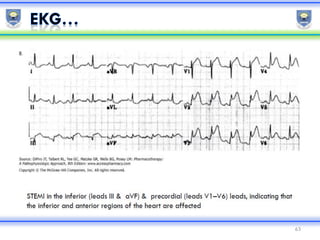
62
63
64
65
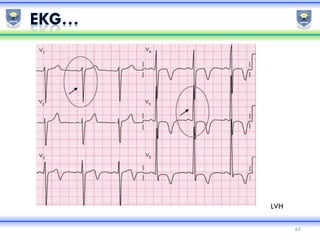
LVH
 Evaluate cardiac function and structure
 Non-invasive, inexpensive, safe, devoid of ionizing radiation, & portable
 Detect valvular abnormalities, intra-cardiac thrombi, pericardial
effusions, & congenital abnormalities.
 Assess chamber sizes, function, and wall thickness
66
 Two approach
– Transthoracic echo (TTE)
– Transesophageal echo (TEE)
67
 CT scan
 Positron Emission Tomography
 MRI
 Cardiac Catheterization & Angiography
– Aortography
– Coronary Angiography
– Left Ventriculography
68
 Nuclear Cardiology
 Endomyocardial Biopsy
 Intravascular Ultrasound
69

Cardiovascular testing

  • 1.
    Lesson 1 Cardiovascular testing TsegayeMelaku (BPharm, MSc) [Assistant Professor of Clinical Pharmacy] tsegayemlk@yahoo.com or tsegaye.melaku@ju.edu.et +251913765609December, 2019 Pharmacotherapy of Cardiovascular Disorders
  • 2.
     Session Tips Differentiate types of cardiovascular testing  Type of murmur (systolic/diastolic) Vs specific valvular abnormalities.  How echo, EC(K)G used for CVD dx, Rx, prognosis  Clinical importance of cardiac biomarkers  Other investigation modalities  When to order these CV testing 2
  • 3.
     Estimate averageheart rate of the following mammals (beats/min)  Estimated size of your heart? 3 Human Whale Camel Lion Cat Mouse Elephant Neonates (human) 9 40 376 70 28 200 30 150
  • 4.
     Height? Width?  Beats per day?  Beats 2.5 billion times in an average 70 yrs. Lifetime  Pumps about of blood each day  Pumps blood through miles of vessels  Suffers 7.2 mil. CAD deaths worldwide each year 4 4.8 inches tall 3.35 inches wide   12 x 9 cm ~100,000 times 2000 galloons/7600 liters 62,000
  • 5.
     CO (ml/min)= HR (75 beats/min) x SV (70 ml/beat) – CO = 5250 ml/min (5.25 L/min) 5
  • 6.
     Components  Heart:hollow muscular organ  Blood  Vessels – Arteries: Away from heart – Veins: toward heart – Capillaries: Link arterioles to veins » sites of o2, nutrients & waste exchange • Pinocytosis/diffusion 6
  • 7.
  • 8.
     Heart : –Provides the driving force for the cardiovascular system – Organ at the center of the circulatory system. – It pumps blood around the body – ~ the size of your fist – Weight ~ 250-300g 8
  • 9.
  • 10.
  • 11.
  • 12.
     Heart walls: Epicardium – Outermost layer – Fat to cushion heart  Myocardium – Middle layer – Primarily cardiac muscle  Endocardium – Innermost layer – Thin and smooth – Stretches as the heart pumps 12
  • 13.
  • 14.
     CVD afflictsan estimated 80 million people (i.e.~1 in 3 adults) – Accounts for 35% of all deaths: US data  Total cost of CVD (HTN, CHD, HF, and stroke)~ $475.3 billion.  Atherosclerosis: cause of most CVD events. – Typically present for decades before symptoms appear 14
  • 15.
  • 16.
  • 17.
     Thorough history, Comprehensive P/E  Appropriate testing, 17 – Identify sub-clinical CVD – Assess symptomatic CVD for the risk of an adverse event – Help in appropriate management
  • 18.
     Elements ofa comprehensive history: – Chief complaint, – Current symptoms, …HPI – Past medical history, 18 – Family history, – Social history….. – Review of systems  Diet/physical activity/tobacco/alcohol/illicit drug  Duration/quality/frequency/severity/progression/precipitating & relieving factors, associated symptoms, & impact on daily activities
  • 19.
     Chest pain:frequent symptom – Angina/infarction, non-cardiac conditions (esophageal, pulmonary, or musculoskeletal disorders) – Quality/location/duration; – Provoking or relieving factors (ascertain etiology) – Example:  Sensation of heaviness/pressure in the retrosternal area  Radiate to the jaw, left shoulder, back, or left arm  Typically lasts only a few minutes 19
  • 20.
     Angina pain –Precipitated by exertion, emotional stress, eating, cigarette smoking, or exposure to cold, – Relieved with rest or SL NTG – Unstable angina pain is ↑ in severity, longer in duration, or occurring at rest; » Need prompt medical attention expeditiously. 20
  • 21.
     CHF &pulmonary vascular congestion – Complain of SOB (dyspnea) with exertion or even at rest – Orthopnea, PND, and nocturia  CHF & peripheral venous congestion – Abdominal swelling (from hepatic congestion or ascites), – Nausea, vomiting, lower extremity edema, fatigue, & dyspnea 21
  • 22.
  • 23.
     With particularattention to the cardiovascular system  Assessment – Jugular venous pulse, – Arterial pulses (Carotid & peripheral arterial pulses), – Heart & lung exam (i.e., palpation, percussion, & auscultation), – Inspection of the abdomen and extremities 23
  • 24.
  • 25.
  • 26.
  • 27.
    A. JVP:  Indirectassessment of right atrial pressure – Normal: 1 to 2 cm above the sternal angle – Extent of elevation: assess the severity congestion, – Diminution: assess the response to therapy 27
  • 28.
  • 29.
    B. Carotid arterialpulse  Diminished pulsations (indicate): – In ↓ SV, atherosclerotic narrowing of carotid artery, – Obstruction to LV outflow, AS or HCM.  Very forceful/hyperdynamic/"bounding“ pulsations: – In ↑ stroke volume, Chronic AR, – High CO [hyperthyroidism, marked anemia] 29
  • 30.
    C. Peripheral arterialpulses (Legs & arms) – Diminished: in ↓ stroke volume, PAD D. Chest – Percussion of the posterior chest: pleural effusion – Auscultation of anterior & posterior lung fields: » Pneumonia/airway obstruction/pleural effusion/ pulmonary edema. 30
  • 31.
    E. Heart Sounds –Typical "lub-dub" sound of the normal heart – S1:precedes ventricular contraction » Due to closure of the mitral & tricuspid valves – S2: follows ventricular contraction » Due to closure of the aortic & pulmonic valves – Others [S3/S4/Murmur/gallop]:presence of underlying heart disease 31
  • 32.
     S3 sounds –Aka ventricular gallop, – Low-pitched sound heard at the cardiac apex – Occur in early diastole (i.e. immediately after S2). – Caused by vibrations that occur when blood rapidly rushes from a "tense" atrium   stiff, noncompliant ventricle. – Associated with decompensated HF or intravascular volume overload. 32
  • 33.
     S4 sound –Dull, low-pitched sound – Caused by the vibrations that occur when atrial contraction forces blood into a stiff, noncompliant ventricle. – Audible at the cardiac apex just before ventricular contraction (i.e., just before S1) – Occur with AS/arterial hypertension/HCM/CAD 33
  • 34.
  • 35.
     Murmurs – Auditoryvibrations [turbulent blood flow] within the heart chambers or across the valves. – Based on timing & duration within cardiac cycle (systolic, diastolic, or continuous), intensity (grade 1 to 6, from softest to loudest), pitch (high or low frequency), – May be some are “Innocent" or "physiologic" 35
  • 36.
  • 37.
  • 38.
     Systolic murmurs –Occur during ventricular contraction – Begin with or after S1 and end at or before S2 – Can be mid-systolic or holosystolic (pansystolic)  Mid-systolic murmurs: PS/AS/hypertrophic obstructive cardiomyopathy  Holosystolic murmurs: when blood flows from a chamber of higher pressure to one of lower pressure throughout systole – In case of TR, MR, VSD 38
  • 39.
     Diastolic murmurs –Occur during ventricular filling – Begin with or after S2 – High pitched: in AR & PR – Low Pitched: in MS & TS stenosis 39 NB: If murmur detected confirm the cause by Echo/MRI/Angiography
  • 40.
     Markers ofMyonecrosis – Cardiac troponin (cTn) : preferred – Creatine kinase-MB (CK-MB) – Myoglobin 40
  • 41.
     Troponin [I& T] – Contractile proteins found only in cardiac myocytes – Most sensitive, tissue-specific – Detectable in the blood 2 to 4 hrs of onset of sxs – Remains detectable for 5 to 10 days 41
  • 42.
  • 43.
  • 44.
     Provides supplementalinformation to the physical examination  About position & size of the heart & its chambers /adjacent structures 44
  • 45.
     Graphic recordingof the electrical potentials generated by the heart  Signals are detected by using electrodes attached to the extremities and chest wall  Used to detect: – Arrhythmias, conduction disturbances, – MI, metabolic disturbances (e.g., hyperkalemia), – Increased susceptibility to sudden cardiac death (e.g., prolonged QT interval) 45
  • 46.
  • 47.
  • 48.
  • 49.
  • 50.
  • 51.
  • 52.
    52  5 waveforms: P, QRS, ST, T, and U  4 sets of intervals: PR, QRS, QT/QTc, and RR/PP  3 segments: PR, ST, and TP
  • 53.
  • 54.
  • 55.
  • 56.
     P-wave: – Depolarizationof the atria – Duration: ~0.12 seconds  PR segment: – Passage of impulse through AV node  bundle of His  its branches – Duration: 0.12 to 0.20 seconds. 56
  • 57.
     QRS complex –Electrical depolarization of the ventricles – -Ve deflection (Q wave)  +Ve deflection (R wave) -ve deflection(S wave) – Duration: <0.12 second  V1, V2: right ventricle: -Ve  V5, v6: left ventricle: +Ve 57
  • 58.
    58  ST segment –Plateau phase – Duration: 0.005- 0.15 sec  T wave – Repolarization of the ventricle – Duration: 0.1 - 0.25 sec  QT interval – From QRS complex to end of the T wave – Time required for ventricular depolarization & repolarization – Duration: <0.44 second. – Prolonged: electrolyte disturbances(hypoK+,hypoCa2+,hypoMg2+
  • 59.
    59 HR = 300/ (big squares + (0.2 × small squares))
  • 60.
  • 61.
  • 62.
  • 63.
  • 64.
  • 65.
  • 66.
     Evaluate cardiacfunction and structure  Non-invasive, inexpensive, safe, devoid of ionizing radiation, & portable  Detect valvular abnormalities, intra-cardiac thrombi, pericardial effusions, & congenital abnormalities.  Assess chamber sizes, function, and wall thickness 66
  • 67.
     Two approach –Transthoracic echo (TTE) – Transesophageal echo (TEE) 67
  • 68.
     CT scan Positron Emission Tomography  MRI  Cardiac Catheterization & Angiography – Aortography – Coronary Angiography – Left Ventriculography 68  Nuclear Cardiology  Endomyocardial Biopsy  Intravascular Ultrasound
  • 69.