Renal Disorders PharmacotherapyRenal Disorders Pharmacotherapy
Chapter 4
Glomerulonephritis
Renal Disorders Pharmacotherapy
By: Tsegaye Melaku
[B.Pharm, MSc, Clinical Pharmacist]
tsegayemlk@yahoo.com or tsegaye.melaku@ju.edu.et ++251913765609251913765609
Chapter 4
Glomerulonephritis
Lesson Objectives
 Upon completion of the chapter, you will be able to:
 Elaborate the pathogenesis of glomerular injury and pathologic manifestations of
common types of glomerulonephritis
 Describe etiology of the common types of glomerulonephritis
 Describe the general clinical presentation of and diagnostic approach for
glomerulonephritis
 Elaborate the key differences between nephritic and nephrotic syndrome
 Discuss the general approach for glomerulonephritis treatment
 Describe the supportive therapy for edema, hypertension, proteinuria,
hyperlipidemia, and coagulopathy
 Describe the key parameters for outcome evaluation
2
 Elaborate the pathogenesis of glomerular injury and pathologic manifestations of
common types of glomerulonephritis
 Describe etiology of the common types of glomerulonephritis
 Describe the general clinical presentation of and diagnostic approach for
glomerulonephritis
 Elaborate the key differences between nephritic and nephrotic syndrome
 Discuss the general approach for glomerulonephritis treatment
 Describe the supportive therapy for edema, hypertension, proteinuria,
hyperlipidemia, and coagulopathy
 Describe the key parameters for outcome evaluation
Mini Case
 A 9-year-old boy was admitted as an emergency with puffiness of the face, eyes and
trunk. A week previously he had complained of a sore throat. On examination, he was
mildly pyrexial (temperature 37.5°C) and hypertensive (BP 170/110). There was
periorbital and scrotal oedema. His urine showed proteinuria, haematuria and red cell
casts. He was anaemic (Hb 10.7g/dL) with a normal white-cell count and differential. A
throat swab grew normal flora but antibodies to streptococcal antigens were present in
high titre: antistreptolysin O titre 1600iu/ml (normal <300iu/ml); antihyaluronidase titre
1/2048; and anti-deoxyribonuclease B titre 1/1360. Serum complement studies done 3
days after admission showed a very low C3 (0.10g/l; NR 0.8-1.40) and a normal C4
(0.23g/l; NR 0.2-0.4). His creatinine clearance was 46ml/min, serum albumin 29g/l and
urinary protein excretion 1.5g/day.
 A 9-year-old boy was admitted as an emergency with puffiness of the face, eyes and
trunk. A week previously he had complained of a sore throat. On examination, he was
mildly pyrexial (temperature 37.5°C) and hypertensive (BP 170/110). There was
periorbital and scrotal oedema. His urine showed proteinuria, haematuria and red cell
casts. He was anaemic (Hb 10.7g/dL) with a normal white-cell count and differential. A
throat swab grew normal flora but antibodies to streptococcal antigens were present in
high titre: antistreptolysin O titre 1600iu/ml (normal <300iu/ml); antihyaluronidase titre
1/2048; and anti-deoxyribonuclease B titre 1/1360. Serum complement studies done 3
days after admission showed a very low C3 (0.10g/l; NR 0.8-1.40) and a normal C4
(0.23g/l; NR 0.2-0.4). His creatinine clearance was 46ml/min, serum albumin 29g/l and
urinary protein excretion 1.5g/day.
3
Clinical Pearl
1. What is your possible Dx?
2. Clinical pictures related to glomerulonephritis?
3. Laboratory data suggestng glomerulonephritis?
4. How approach the patient for management?
1. What is your possible Dx?
2. Clinical pictures related to glomerulonephritis?
3. Laboratory data suggestng glomerulonephritis?
4. How approach the patient for management?
4
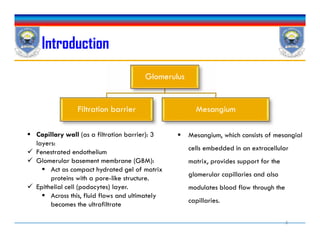
Introduction
Glomerulus
Filtration barrier Mesangium
 Mesangium, which consists of mesangial
cells embedded in an extracellular
matrix, provides support for the
glomerular capillaries and also
modulates blood flow through the
capillaries.
 Capillary wall (as a filtration barrier): 3
layers:
 Fenestrated endothelium
 Glomerular basement membrane (GBM):
 Act as compact hydrated gel of matrix
proteins with a pore-like structure.
 Epithelial cell (podocytes) layer.
 Across this, fluid flows and ultimately
becomes the ultrafiltrate
5
Introduction…
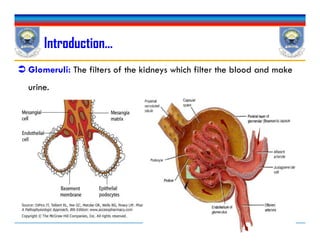
 Glomeruli: The filters of the kidneys which filter the blood and make
urine.
6
Introduction…
 Glomerulonephritis: a collection of glomerular diseases mediated
by different immunologic pathogenic mechanisms.
 The unique capillary bed of the glomerulus allows passage of small
non-protein plasma constituents up to the size of inulin [5.2 kDa];
exclude macromolecules equal to or larger than albumin (69 kDa).
 The precise pathogenetic mechanisms of many glomerular diseases
remain unknown.
 The available therapeutic regimens are still far from optimal.
 Glomerulonephritis: a collection of glomerular diseases mediated
by different immunologic pathogenic mechanisms.
 The unique capillary bed of the glomerulus allows passage of small
non-protein plasma constituents up to the size of inulin [5.2 kDa];
exclude macromolecules equal to or larger than albumin (69 kDa).
 The precise pathogenetic mechanisms of many glomerular diseases
remain unknown.
 The available therapeutic regimens are still far from optimal.
7
Epidemiology and Etiology
 3rd most common cause of ESRD
 Accounting for ~~15% of all the living ESRD patients.
 6.8% of all patients develop stage 5 chronic kidney disease per yr.
 Etiology still unclear
 Humoral and cellular immunologic mechanisms participate in the
pathogenesis of most glomerulonephritis.
 Histopathologic manifestations vary.
 3rd most common cause of ESRD
 Accounting for ~~15% of all the living ESRD patients.
 6.8% of all patients develop stage 5 chronic kidney disease per yr.
 Etiology still unclear
 Humoral and cellular immunologic mechanisms participate in the
pathogenesis of most glomerulonephritis.
 Histopathologic manifestations vary.
8
Pathophysiology
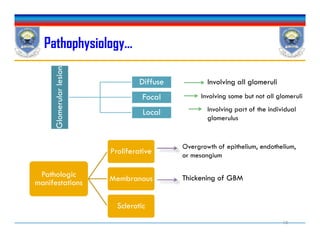
Pathophysiology…
Glomerularlesion
Diffuse
Focal
Local
Involving all glomeruli
Involving some but not all glomeruli
Involving part of the individual
glomerulus
Thickening of GBM
Glomerularlesion
Pathologic
manifestations
Proliferative
Membranous
Sclerotic
Overgrowth of epithelium, endothelium,
or mesangium
10
 The glomerular capillary wall is particularly susceptible to immune-
mediated injury.
Antigen and antibody tend to localize in the glomerulus,
probably because of its high blood flow and capillary
hydrostatic pressure.
 Parenchymal damage can be induced as a result of humoral and
cell-mediated immune reactions.
 Antibodies and sensitized T lymphocytes are the primary mediators
of glomerular injury.
Pathophysiology…
 The glomerular capillary wall is particularly susceptible to immune-
mediated injury.
Antigen and antibody tend to localize in the glomerulus,
probably because of its high blood flow and capillary
hydrostatic pressure.
 Parenchymal damage can be induced as a result of humoral and
cell-mediated immune reactions.
 Antibodies and sensitized T lymphocytes are the primary mediators
of glomerular injury. 11
 Production of antibodies to endogenous or exogenous antigens.
Endogenous antigens[intrinsic glomerular antigens]: Heymann
antigen on the epithelial cell or Goodpasture antigen on the GBM,
or previously sequestered antigens [DNA/thyroglobulin]
Exogenous antigens: viral, bacterial, parasitic, or fungal in origin.
 Complexes of antigens and antibodies may be formed in the
circulation and then passively entrapped in the glomerular capillary
or mesangium.
 The type and extent of glomerular damage are dependent on the
location of the immune complex formation and the rate at which it is
removed.
 Impaired removal facilitates the growth of the complex and thus
increases the likelihood of glomerular damage.
Pathophysiology…
 Production of antibodies to endogenous or exogenous antigens.
Endogenous antigens[intrinsic glomerular antigens]: Heymann
antigen on the epithelial cell or Goodpasture antigen on the GBM,
or previously sequestered antigens [DNA/thyroglobulin]
Exogenous antigens: viral, bacterial, parasitic, or fungal in origin.
 Complexes of antigens and antibodies may be formed in the
circulation and then passively entrapped in the glomerular capillary
or mesangium.
 The type and extent of glomerular damage are dependent on the
location of the immune complex formation and the rate at which it is
removed.
 Impaired removal facilitates the growth of the complex and thus
increases the likelihood of glomerular damage. 12
Immunologic Mechanisms of Glomerular Injury
1. Circulating immune complexes
 In situ antigen–antibody interaction
 Intrinsic glomerular antigen; e.g., glomerular basement
membrane antigen
 Exogenous planted antigens
Pathophysiology…
 In situ antigen–antibody interaction
 Intrinsic glomerular antigen; e.g., glomerular basement
membrane antigen
 Exogenous planted antigens
2. Cell-mediated mechanism
13
14
Clinical Presentation
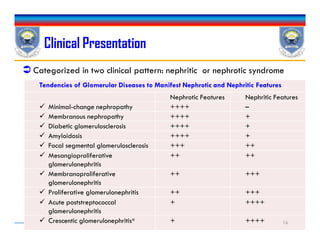
 Categorized in two clinical pattern: nephritic or nephrotic syndrome
Tendencies of Glomerular Diseases to Manifest Nephrotic and Nephritic Features
Nephrotic Features Nephritic Features
 Minimal-change nephropathy ++++ –
 Membranous nephropathy ++++ +
 Diabetic glomerulosclerosis ++++ + Diabetic glomerulosclerosis ++++ +
 Amyloidosis ++++ +
 Focal segmental glomerulosclerosis +++ ++
 Mesangioproliferative
glomerulonephritis
++ ++
 Membranoproliferative
glomerulonephritis
++ +++
 Proliferative glomerulonephritis ++ +++
 Acute poststreptococcal
glomerulonephritis
+ ++++
 Crescentic glomerulonephritisa + ++++ 16
Streptococcal infection of the throat
( strep throat) or skin ( impetigo)
Lupus
Nephritic Syndrome
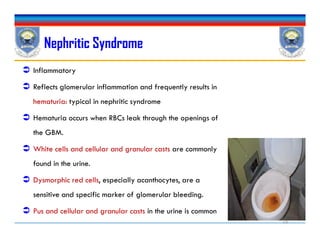
 Inflammatory
 Reflects glomerular inflammation and frequently results in
hematuria: typical in nephritic syndrome
 Hematuria occurs when RBCs leak through the openings of
the GBM.
 White cells and cellular and granular casts are commonly
found in the urine.
 Dysmorphic red cells, especially acanthocytes, are a
sensitive and specific marker of glomerular bleeding.
 Pus and cellular and granular casts in the urine is common
 Inflammatory
 Reflects glomerular inflammation and frequently results in
hematuria: typical in nephritic syndrome
 Hematuria occurs when RBCs leak through the openings of
the GBM.
 White cells and cellular and granular casts are commonly
found in the urine.
 Dysmorphic red cells, especially acanthocytes, are a
sensitive and specific marker of glomerular bleeding.
 Pus and cellular and granular casts in the urine is common
19
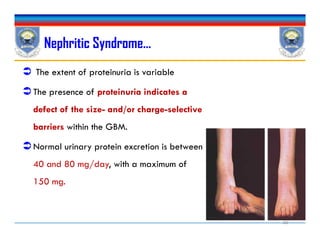
 The extent of proteinuria is variable
The presence of proteinuria indicates a
defect of the size- and/or charge-selective
barriers within the GBM.
Normal urinary protein excretion is between
40 and 80 mg/day, with a maximum of
150 mg.
Nephritic Syndrome…
 The extent of proteinuria is variable
The presence of proteinuria indicates a
defect of the size- and/or charge-selective
barriers within the GBM.
Normal urinary protein excretion is between
40 and 80 mg/day, with a maximum of
150 mg.
20
Nephrotic Syndrome
 Non-inflammatory
 Characterized by proteinuria greater than 3.5 g/day, hypoproteinemia, edema, and
hyperlipidemia.
 Hypercoagulable state in some patients.
 Cause
 Decrease in concentration of the coagulation inhibitor
 antithrombin III is reduced because of increased loss in the urine.
 Proteins C and S
 Increased concentrations of factors V and VIII, fibrinogen concentrations and
abnormal platelet function,
 25% of patients with membranous nephropathy may have renal vein thrombosis.
 Non-inflammatory
 Characterized by proteinuria greater than 3.5 g/day, hypoproteinemia, edema, and
hyperlipidemia.
 Hypercoagulable state in some patients.
 Cause
 Decrease in concentration of the coagulation inhibitor
 antithrombin III is reduced because of increased loss in the urine.
 Proteins C and S
 Increased concentrations of factors V and VIII, fibrinogen concentrations and
abnormal platelet function,
 25% of patients with membranous nephropathy may have renal vein thrombosis.
21
The syndrome may be the result of primary diseases of the
glomerulus, or be associated with systemic diseases such as
diabetes mellitus, lupus, amyloidosis, and preeclampsia.
Albuminuria >3 g daily is associated with a significant increase in
serum cholesterol concentrations [increase in total cholesterol, TG,
VLDL, LDL]
Nephrotic Syndrome…
The syndrome may be the result of primary diseases of the
glomerulus, or be associated with systemic diseases such as
diabetes mellitus, lupus, amyloidosis, and preeclampsia.
Albuminuria >3 g daily is associated with a significant increase in
serum cholesterol concentrations [increase in total cholesterol, TG,
VLDL, LDL]
22
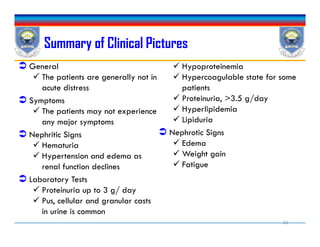
Summary of Clinical Pictures
 General
 The patients are generally not in
acute distress
 Symptoms
 The patients may not experience
any major symptoms
 Nephritic Signs
 Hematuria
 Hypertension and edema as
renal function declines
 Laboratory Tests
 Proteinuria up to 3 g/ day
 Pus, cellular and granular casts
in urine is common
 Hypoproteinemia
 Hypercoagulable state for some
patients
 Proteinuria, >3.5 g/day
 Hyperlipidemia
 Lipiduria
 Nephrotic Signs
 Edema
 Weight gain
 Fatigue
23
 General
 The patients are generally not in
acute distress
 Symptoms
 The patients may not experience
any major symptoms
 Nephritic Signs
 Hematuria
 Hypertension and edema as
renal function declines
 Laboratory Tests
 Proteinuria up to 3 g/ day
 Pus, cellular and granular casts
in urine is common
 Hypoproteinemia
 Hypercoagulable state for some
patients
 Proteinuria, >3.5 g/day
 Hyperlipidemia
 Lipiduria
 Nephrotic Signs
 Edema
 Weight gain
 Fatigue
Diagnostic Evaluation
Extensive medical history obtained to identify potential systemic
causes[see above table].
Medication, environmental, and occupational histories,
Physical examination and laboratory evaluation: for presence of
systemic diseases.
Patient's age, gender, and ethnic background: to pinpoint the
specific type of glomerular disease.
 Proliferative glomerulonephritis <40 yrs
 Membranous glomerulonephritis >50 yrs
Extensive medical history obtained to identify potential systemic
causes[see above table].
Medication, environmental, and occupational histories,
Physical examination and laboratory evaluation: for presence of
systemic diseases.
Patient's age, gender, and ethnic background: to pinpoint the
specific type of glomerular disease.
 Proliferative glomerulonephritis <40 yrs
 Membranous glomerulonephritis >50 yrs
24
Medical history
 To identify symptoms of medical
conditions that may cause
glomerular disease
 Diabetes mellitus
 Amyloidosis
 Systemic lupus erythematosus
 Other familial conditions
associated with renal
disease
 To identify symptoms suggestive
of nephrotic syndrome
 Reduced appetite
 Fatigue
 Weight gain
 Edema
Medication, environmental, and
occupational histories
 To identify possible exposure to
potentially nephrotoxic drugs,
toxins, or chemicals
Physical examination
 To identify signs and symptoms
associated with systemic diseases
 Hypertension
 Rash
 Arthritis
 Retinopathy
 Neuropathy
 Lymphadenopathy
 Hepatomegaly
 Malignancy
Diagnostic Evaluation… Clinical
25
 To identify symptoms of medical
conditions that may cause
glomerular disease
 Diabetes mellitus
 Amyloidosis
 Systemic lupus erythematosus
 Other familial conditions
associated with renal
disease
 To identify symptoms suggestive
of nephrotic syndrome
 Reduced appetite
 Fatigue
 Weight gain
 Edema
Medication, environmental, and
occupational histories
 To identify possible exposure to
potentially nephrotoxic drugs,
toxins, or chemicals
Physical examination
 To identify signs and symptoms
associated with systemic diseases
 Hypertension
 Rash
 Arthritis
 Retinopathy
 Neuropathy
 Lymphadenopathy
 Hepatomegaly
 Malignancy
1. Urinalysis
 To determine nephrotic nature of
glomerular disease
 Proteinuria, >3.5
 Lipiduria
 To determine nephritic nature of
glomerular disease
 Hematuria
 Pyuria
 Cellular, granular casts 4.
2. Glomerular filtration rate
 To determine extent of glomerular
damage
3. Other tests
 To identify type and etiology of
glomerular disease
 Serum complement concentration
 Antinuclear and anti-DNA
antibodies
 Antistreptolysin antibodies
 Circulating antiglomerular
basement membrane antibodies
 Cryoglobulins
Percutaneous renal biopsy
 To provide definitive diagnosis of
glomerular disease
Diagnostic Evaluation… Laboratory
26
1. Urinalysis
 To determine nephrotic nature of
glomerular disease
 Proteinuria, >3.5
 Lipiduria
 To determine nephritic nature of
glomerular disease
 Hematuria
 Pyuria
 Cellular, granular casts 4.
2. Glomerular filtration rate
 To determine extent of glomerular
damage
3. Other tests
 To identify type and etiology of
glomerular disease
 Serum complement concentration
 Antinuclear and anti-DNA
antibodies
 Antistreptolysin antibodies
 Circulating antiglomerular
basement membrane antibodies
 Cryoglobulins
Percutaneous renal biopsy
 To provide definitive diagnosis of
glomerular disease
Diagnostic Evaluation…
27
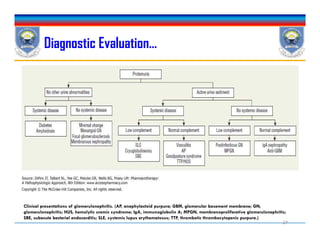
Clinical presentations of glomerulonephritis. (AP, anaphylactoid purpura; GBM, glomerular basement membrane; GN,
glomerulonephritis; HUS, hemolytic uremic syndrome; IgA, immunoglobulin A; MPGN, membranoproliferative glomerulonephritis;
SBE, subacute bacterial endocarditis; SLE, systemic lupus erythematosus; TTP, thrombotic thrombocytopenic purpura.)
Management
Treatment
General Approach
Specific pharmacologic therapy for the glomerular disease
Supportive measures to prevent and/or treat the pathophysiologic
sequelae[hypertension, edema, and progression of renal disease].
Management of extrarenal complications of heavy proteinuria
[hypoalbuminaemia, hyperlipidemia, and thromboembolism].
General Approach
Specific pharmacologic therapy for the glomerular disease
Supportive measures to prevent and/or treat the pathophysiologic
sequelae[hypertension, edema, and progression of renal disease].
Management of extrarenal complications of heavy proteinuria
[hypoalbuminaemia, hyperlipidemia, and thromboembolism].
29
Look for prognosis & response
 The majority of patients with minimal-change disease, IgA nephropathy,
and membranous nephropathy have a fairly good prognosis.
 Focal segmental glomerulosclerosis (FSGS); who are resistant to therapy,
 Rapidly progressive glomerulonephritis (RPGN); who are untreated
 Experience rapid loss of renal function.
 Post-streptococcal glomerulonephritis (PSGN), after the initiating factor is
removed, the prognosis of the renal disease is often good.
 The majority of patients with minimal-change disease, IgA nephropathy,
and membranous nephropathy have a fairly good prognosis.
 Focal segmental glomerulosclerosis (FSGS); who are resistant to therapy,
 Rapidly progressive glomerulonephritis (RPGN); who are untreated
 Experience rapid loss of renal function.
 Post-streptococcal glomerulonephritis (PSGN), after the initiating factor is
removed, the prognosis of the renal disease is often good.
30
Minimal-change nephropathy, are very responsive to treatment.
However, patients with membranous proliferative
glomerulonephritis are rarely responsive to existing therapies.
Look for prognosis & response…
31
Non-pharmacologic Therapy
 Dietary measures: restriction of
Sodium intake to 50 to 100 mEq/day (50 to 100 mmol/day)
– To control of edema, hypertension and proteinuria.
Protein intake of 0.8 to 1 g/day
– To reduce proteinuria, retard the progression of renal disease.
Low-lipid diet of less than 200 mg cholesterol.
Total fat should account for less than 30% of daily total calories.
 Stop smoking: a dose-dependent increase in risk for developing ESRD primary
inflammatory (immunoglobulin A glomerulonephritis) or non-inflammatory
(polycystic kidney disease) renal diseases.
 Dietary measures: restriction of
Sodium intake to 50 to 100 mEq/day (50 to 100 mmol/day)
– To control of edema, hypertension and proteinuria.
Protein intake of 0.8 to 1 g/day
– To reduce proteinuria, retard the progression of renal disease.
Low-lipid diet of less than 200 mg cholesterol.
Total fat should account for less than 30% of daily total calories.
 Stop smoking: a dose-dependent increase in risk for developing ESRD primary
inflammatory (immunoglobulin A glomerulonephritis) or non-inflammatory
(polycystic kidney disease) renal diseases.
32
Plasmapheresis may be used to remove immune
factors/mediators.
Non-pharmacologic Therapy…
33
Pharmacologic Therapy
 Immunosuppressive agents, alone or in combination: used to alter the
immune processes.
 Consider corticosteroids
 Immunosuppressive and anti-inflammatory activities.
 reduce the production and/or release of inflammatory mediators PG, LTs, PAFs, TNF & IL-1.
 Inhibit movement of leukocytes and macrophages to the site of inflammation.
 Cytotoxic agents[cyclophosphamide, Chlorambucil, or azathioprine]
 Cyclosporine: reduce lymphokine production by activated T lymphocytes, and it may
decrease proteinuria by improving the permselectivity of the GBM.
 Mycophenolate mofetil: useful in different glomerulonephritis because of its effects on T- and
B-cell lymphocytes.
Immunosuppressive Agents
 Immunosuppressive agents, alone or in combination: used to alter the
immune processes.
 Consider corticosteroids
 Immunosuppressive and anti-inflammatory activities.
 reduce the production and/or release of inflammatory mediators PG, LTs, PAFs, TNF & IL-1.
 Inhibit movement of leukocytes and macrophages to the site of inflammation.
 Cytotoxic agents[cyclophosphamide, Chlorambucil, or azathioprine]
 Cyclosporine: reduce lymphokine production by activated T lymphocytes, and it may
decrease proteinuria by improving the permselectivity of the GBM.
 Mycophenolate mofetil: useful in different glomerulonephritis because of its effects on T- and
B-cell lymphocytes.
34
Diuretics
 For management of nephrotic edema
 In addition to salt restriction, bed rest, and use of support stockings.
 Delivery of diuretic to the kidney tubules is normal
However, large amounts of protein in the urine promotes drug binding 
reduces the availability of the diuretic to the luminal receptor sites.
 Reduced sodium delivery to the distal tubule secondary to decreased glomerular
perfusion may also alter diuretic effectiveness.
 Large doses of the loop diuretic[ e.g. Furosemide160 to 480 mg], may be
needed for patients with moderate edema
 Thiazide diuretic or metolazone : added to enhance natriuresis.
 For management of nephrotic edema
 In addition to salt restriction, bed rest, and use of support stockings.
 Delivery of diuretic to the kidney tubules is normal
However, large amounts of protein in the urine promotes drug binding 
reduces the availability of the diuretic to the luminal receptor sites.
 Reduced sodium delivery to the distal tubule secondary to decreased glomerular
perfusion may also alter diuretic effectiveness.
 Large doses of the loop diuretic[ e.g. Furosemide160 to 480 mg], may be
needed for patients with moderate edema
 Thiazide diuretic or metolazone : added to enhance natriuresis.
35
 Continuous IV infusion of a loop diuretic, such as Furosemide 160 to 480
mg/day, may be employed.
 For patients with morbid edema,
 Albumin infusion may be used to expand plasma volume and increase
diuretic delivery to the renal tubules  enhancing diuretic effect.
 Its problem is:
May precipitate CHF
May reduce therapeutic response to steroid in minimal-change
nephropathy.
 Goal daily weight loss of 0.45 to 0.9 kg ; until the patient’s desired weight has
been obtained.
Diuretics…
 Continuous IV infusion of a loop diuretic, such as Furosemide 160 to 480
mg/day, may be employed.
 For patients with morbid edema,
 Albumin infusion may be used to expand plasma volume and increase
diuretic delivery to the renal tubules  enhancing diuretic effect.
 Its problem is:
May precipitate CHF
May reduce therapeutic response to steroid in minimal-change
nephropathy.
 Goal daily weight loss of 0.45 to 0.9 kg ; until the patient’s desired weight has
been obtained.
36
Antihypertensive Agents
 Optimal control of hypertension is important.
 Target BP for patients with chronic kidney disease*** <130/80 mm Hg.
 ACEIs and ARBs: delay the loss of renal function for patients with diabetic and
non-diabetic (primarily glomerulonephritis) renal diseases.
 Nondihydropyridine CCBs(e.g., diltiazem, verapamil) reduce proteinuria and
preserve renal function.
 Dihydropyridine CCBs(e.g., Nifedipine, Amlodipine, or nisoldipine) are effective
in lowering blood pressure, but without the benefit of proteinuria reduction.
 Optimal control of hypertension is important.
 Target BP for patients with chronic kidney disease*** <130/80 mm Hg.
 ACEIs and ARBs: delay the loss of renal function for patients with diabetic and
non-diabetic (primarily glomerulonephritis) renal diseases.
 Nondihydropyridine CCBs(e.g., diltiazem, verapamil) reduce proteinuria and
preserve renal function.
 Dihydropyridine CCBs(e.g., Nifedipine, Amlodipine, or nisoldipine) are effective
in lowering blood pressure, but without the benefit of proteinuria reduction.
37
***defined by GFR <60 mL/min or albuminuria >300 mg/day
Antiproteinuria Agents
 Dietary protein restriction :
Reduces proteinuria and may retard renal function deterioration.
 Recommended: 0.6- 0.8 g/kg/day
Decreasing dietary protein also reduces the intake of phosphorus and
potassium.
Drugs:
 ACEIs and ARBs:
Reduction in intraglomerular pressure Decrease in filtration fraction
Reduce the effect of angiotensin II on renal cell proliferation, thereby
reducing sclerosis.
 Dietary protein restriction :
Reduces proteinuria and may retard renal function deterioration.
 Recommended: 0.6- 0.8 g/kg/day
Decreasing dietary protein also reduces the intake of phosphorus and
potassium.
Drugs:
 ACEIs and ARBs:
Reduction in intraglomerular pressure Decrease in filtration fraction
Reduce the effect of angiotensin II on renal cell proliferation, thereby
reducing sclerosis.
38
 Nonsteroidal Anti-inflammatory Agents
Reduce proteinuria through prostaglandin E2 inhibition, resulting in a reduction
of intraglomerular pressure, a decrease in GFR, and restoration of the barrier
size selectivity of the GBM.
Indomethacin and meclofenamate
Their antiproteinuric effect is comparable to that attained with ACEIs, and
combined treatment with an ACEI results in additional proteinuria reduction.
***Adherence to a low-sodium diet or concurrent use of a diuretic is needed to
maximize the antiproteinuric effect****
Because of their potential for nephrotoxicity, long-term use not preferred
Antiproteinuria Agents…
 Nonsteroidal Anti-inflammatory Agents
Reduce proteinuria through prostaglandin E2 inhibition, resulting in a reduction
of intraglomerular pressure, a decrease in GFR, and restoration of the barrier
size selectivity of the GBM.
Indomethacin and meclofenamate
Their antiproteinuric effect is comparable to that attained with ACEIs, and
combined treatment with an ACEI results in additional proteinuria reduction.
***Adherence to a low-sodium diet or concurrent use of a diuretic is needed to
maximize the antiproteinuric effect****
Because of their potential for nephrotoxicity, long-term use not preferred
39
Statins
 An abnormal lipoprotein profile increases the risk of atherosclerosis and coronary
heart.
 A low-fat diet is usually not sufficient to correct hyperlipoproteinemia.
 Includes: Lovastatin, pravastatin, simvastatin, and fluvastatin
 They reduce total cholesterol LDL cholesterol, and TG
 Therapy is especially needed for patients with
 Concurrent atherosclerotic cardiovascular disease, or
 Additional risk factors for atherosclerosis[smoking and hypertension]
 Additionally: they confer renoprotection through
 Reduction of cell proliferation and mesangial matrix accumulation
 Anti-inflammatory and immunomodulatory effects.
 Recent studies: show as if they can reduce proteinuria and delay renal function loss.
 An abnormal lipoprotein profile increases the risk of atherosclerosis and coronary
heart.
 A low-fat diet is usually not sufficient to correct hyperlipoproteinemia.
 Includes: Lovastatin, pravastatin, simvastatin, and fluvastatin
 They reduce total cholesterol LDL cholesterol, and TG
 Therapy is especially needed for patients with
 Concurrent atherosclerotic cardiovascular disease, or
 Additional risk factors for atherosclerosis[smoking and hypertension]
 Additionally: they confer renoprotection through
 Reduction of cell proliferation and mesangial matrix accumulation
 Anti-inflammatory and immunomodulatory effects.
 Recent studies: show as if they can reduce proteinuria and delay renal function loss.
40
Anticoagulants
 Renal vein thrombosis, pulmonary emboli, or other thromboembolic events: serious
and common complications of nephrotic syndrome.
Frequently seen in those with membranous nephropathy.
 In documented thromboembolic episodes: warfarin until remission of nephrotic
syndrome mandatory.
 The use of prophylactic anticoagulation is controversial.
Beneficial for patients with membranous nephropathy.
 A “selective” approach or individualized assessment should be conducted to
identify those at high risk (i.e., those with severe nephrotic syndrome and a
serum albumin concentration <2 to 2.5 g/dL ).
 Renal vein thrombosis, pulmonary emboli, or other thromboembolic events: serious
and common complications of nephrotic syndrome.
Frequently seen in those with membranous nephropathy.
 In documented thromboembolic episodes: warfarin until remission of nephrotic
syndrome mandatory.
 The use of prophylactic anticoagulation is controversial.
Beneficial for patients with membranous nephropathy.
 A “selective” approach or individualized assessment should be conducted to
identify those at high risk (i.e., those with severe nephrotic syndrome and a
serum albumin concentration <2 to 2.5 g/dL ).
41
Aka: nil disease/minimal-change disease
Absence of definitive pathologic changes observed under light
and immunofluorescence microscopy.
Commonly found in children
85% to 90% of all cases of nephrotic syndrome in children[1-4yrs]
2°Cause: drug (e.g., NSAIDs, lithium, interferons), lupus, and various T-
cell–related disorders, such as Hodgkin’s disease and leukemias.
Frequently acute in onset
Minimal-Change Nephropathy
Aka: nil disease/minimal-change disease
Absence of definitive pathologic changes observed under light
and immunofluorescence microscopy.
Commonly found in children
85% to 90% of all cases of nephrotic syndrome in children[1-4yrs]
2°Cause: drug (e.g., NSAIDs, lithium, interferons), lupus, and various T-
cell–related disorders, such as Hodgkin’s disease and leukemias.
Frequently acute in onset
42
Rx:
Most responsive to initial treatment with corticosteroids.
 Prednisone: 60 mg/m2/day initially for 4 to 6 weeks.
The dose is then reduced to 40 mg/m2 per day every other
day for another 4 to 6 weeks
Proteinuria will disappear in 50% of patients after 1 week and
in 90% of patients after 4 weeks of treatment.
Minimal-Change Nephropathy….
Rx:
Most responsive to initial treatment with corticosteroids.
 Prednisone: 60 mg/m2/day initially for 4 to 6 weeks.
The dose is then reduced to 40 mg/m2 per day every other
day for another 4 to 6 weeks
Proteinuria will disappear in 50% of patients after 1 week and
in 90% of patients after 4 weeks of treatment.
43
For adults
Prednisone 1 mg/kg/day is given initially for 4 weeks with a
reduction to 0.75 mg/kg every other day for the next 4 weeks.
Proteinuria will disappear in 50% to 60% of patients after 8
weeks of treatment.
Complete remission will be attained in 80% of patients after
28 weeks of therapy.
Minimal-Change Nephropathy….
For adults
Prednisone 1 mg/kg/day is given initially for 4 weeks with a
reduction to 0.75 mg/kg every other day for the next 4 weeks.
Proteinuria will disappear in 50% to 60% of patients after 8
weeks of treatment.
Complete remission will be attained in 80% of patients after
28 weeks of therapy.
44
45
Levamisole, an immunostimulant, can
promote the maturation of young T cells
and restore the function of T cells
Definition
 AGN that follows an infection with a nephritogenic strain of group A beta
hemolytic streptococci.
 The classic example of the acute nephritic syndrome.
Poststreptococcal Glomerulonephritis
Definition
 AGN that follows an infection with a nephritogenic strain of group A beta
hemolytic streptococci.
 The classic example of the acute nephritic syndrome.
Epidemiology
 121 of the 124 patients had post-streptococcal nephritis.
 Globally - incidence has decreased in the past three decades.
 Most commonly – sporadic.
 Despite that, epidemics and clusters of cases - in some poor or rural communities
 Peak incidence - age 5-12 y/o, uncommon <3y/o.
 121 of the 124 patients had post-streptococcal nephritis.
 Globally - incidence has decreased in the past three decades.
 Most commonly – sporadic.
 Despite that, epidemics and clusters of cases - in some poor or rural communities
 Peak incidence - age 5-12 y/o, uncommon <3y/o.
Etiology and Pathogenesis
 The child gets gets throat or skin infection by nephritogenic strain of group A beta
hemolytic streptococci - serotype 12 , 4 and 1
 Antibodies to streptoccocus (e.g antistreptolysin O) are formed in circulation
 Antigen-antibody circulating immune complexes are subsequently deposited
along the glomerular basement membrane (GBM).
 The child gets gets throat or skin infection by nephritogenic strain of group A beta
hemolytic streptococci - serotype 12 , 4 and 1
 Antibodies to streptoccocus (e.g antistreptolysin O) are formed in circulation
 Antigen-antibody circulating immune complexes are subsequently deposited
along the glomerular basement membrane (GBM).
Streptococcal infection
immune complex formation + deposited in GBM
complement system activated
immune injuries
cellular proliferation GBM fracture
capillary lumen narrowed hematuria
glomerular blood flow decreased proteinuria
oliguria GFR distal sodium reabsorption
retention of water & sodium
blood volume 
edema
hypertension
Low serum complement
Streptococcal infection
immune complex formation + deposited in GBM
complement system activated
immune injuries
cellular proliferation GBM fracture
capillary lumen narrowed hematuria
glomerular blood flow decreased proteinuria
oliguria GFR distal sodium reabsorption
retention of water & sodium
blood volume 
edema
hypertension
 Develop acute nephritic syndrome 1–2 wk after an antecedent
streptococcal pharyngitis or 3–6 wk after a streptococcal pyoderma.
1. Edema
 75% of the patients
 Face, periorbital area  lower extremities  generalized (ascites,
pleural effusions)
2. Proteinuria – usually normalize after 4 weeks
3. Oliguria
4. Gross hematuria (65% of patients)
 Smoky, tea-colored, cola-colored, or fresh bloody urine
 Microscopical hematuria (almost all patients)
 The urine appears normal, but >3 RBCs/HP are found in
centrifuged urine sediment examined microscopically.
Clinical Features…
 Develop acute nephritic syndrome 1–2 wk after an antecedent
streptococcal pharyngitis or 3–6 wk after a streptococcal pyoderma.
1. Edema
 75% of the patients
 Face, periorbital area  lower extremities  generalized (ascites,
pleural effusions)
2. Proteinuria – usually normalize after 4 weeks
3. Oliguria
4. Gross hematuria (65% of patients)
 Smoky, tea-colored, cola-colored, or fresh bloody urine
 Microscopical hematuria (almost all patients)
 The urine appears normal, but >3 RBCs/HP are found in
centrifuged urine sediment examined microscopically.
5. Hypertension (50%) – mild to moderate, typically subsides
promptly after diuresis
6. Nonspecific symptoms: Such as anorexia, vomiting, general
malaise, lethargy, abdominal or flank pain, low-grade fever and
weight gain.
Clinical Features…
5. Hypertension (50%) – mild to moderate, typically subsides
promptly after diuresis
6. Nonspecific symptoms: Such as anorexia, vomiting, general
malaise, lethargy, abdominal or flank pain, low-grade fever and
weight gain.
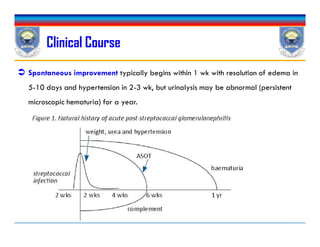
 Spontaneous improvement typically begins within 1 wk with resolution of edema in
5-10 days and hypertension in 2-3 wk, but urinalysis may be abnormal (persistent
microscopic hematuria) for a year.
Clinical Course
Differential Diagnosis
Points to support Points against
Membrano-
proliferative
GN
a) Nephritic syndrome
b) Elevated ASO titer
c) Hypocomplement-
emia
a) Persistent nephritic syndrome
b) Hypocomplementemia (C3) - >6-8w
c) Marked reduced renal fn.
d) Dx – by renal biopsy – “tram-tracking”
GBM
IgA nephropathy
(Berger’s
disease)
a) Hematuria
b) Associated with
respiratory illness
(following viral
syndromes)
a) Recurrent
b) No period of latency
c) Hypertension & edema – uncommon
d) ASO – not elevated
e) ↑ Serum IgA (15%)
f) Normal serum complement values
g) Focal proliferation, diffuse mesangial
IgA deposits
IgA nephropathy
(Berger’s
disease)
a) Hematuria
b) Associated with
respiratory illness
(following viral
syndromes)
a) Recurrent
b) No period of latency
c) Hypertension & edema – uncommon
d) ASO – not elevated
e) ↑ Serum IgA (15%)
f) Normal serum complement values
g) Focal proliferation, diffuse mesangial
IgA deposits
Henoch-
Schönlein
Purpura
a) Hematuria (80%)
b) Mild proteinuria
c) Preceding by URTI
(only 50%)
a) Characteristic skin rash
b) Assoc. symptoms: Abdominal pain,
athritis, athralgia
c) Normal serum complement values
© Hakimah
Differential Diagnosis…
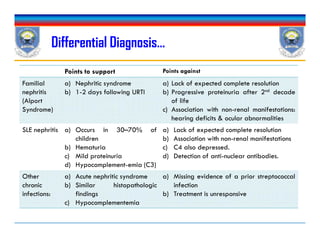
Points to support Points against
Familial
nephritis
(Alport
Syndrome)
a) Nephritic syndrome
b) 1-2 days following URTI
a) Lack of expected complete resolution
b) Progressive proteinuria after 2nd decade
of life
c) Association with non-renal manifestations:
hearing deficits & ocular abnormalities
SLE nephritis a) Occurs in 30–70% of
children
b) Hematuria
c) Mild proteinuria
d) Hypocomplement-emia (C3)
a) Lack of expected complete resolution
b) Association with non-renal manifestations
c) C4 also depressed.
d) Detection of anti-nuclear antibodies.
SLE nephritis a) Occurs in 30–70% of
children
b) Hematuria
c) Mild proteinuria
d) Hypocomplement-emia (C3)
a) Lack of expected complete resolution
b) Association with non-renal manifestations
c) C4 also depressed.
d) Detection of anti-nuclear antibodies.
Other
chronic
infections:
a) Acute nephritic syndrome
b) Similar histopathologic
findings
c) Hypocomplementemia
a) Missing evidence of a prior streptococcal
infection
b) Treatment is unresponsive
Treatment
Treatment of APSGN is largely that of supportive care.
Usually, patients undergo a spontaneous diuresis within 7 to 10 days
after the onset of their illness - strict monitoring – nephrotic chart +
fluid restriction until diuresis
Management is directed at treating the acute effects of renal
insufficiency and hypertension
Treatment of APSGN is largely that of supportive care.
Usually, patients undergo a spontaneous diuresis within 7 to 10 days
after the onset of their illness - strict monitoring – nephrotic chart +
fluid restriction until diuresis
Management is directed at treating the acute effects of renal
insufficiency and hypertension
 Diuretics
 Diet
 Fluid restriction – during oliguric phase
 Sodium restriction is necessary
 Protein restriction is unnecessary
 Antibiotics
 A 10-day course of systemic antibiotic therapy with penicillin V is
recommended to limit the spread of the nephritogenic organisms.
 Antibiotic therapy does not affect the natural history of glomerulonephritis.
Treatment…
 Diuretics
 Diet
 Fluid restriction – during oliguric phase
 Sodium restriction is necessary
 Protein restriction is unnecessary
 Antibiotics
 A 10-day course of systemic antibiotic therapy with penicillin V is
recommended to limit the spread of the nephritogenic organisms.
 Antibiotic therapy does not affect the natural history of glomerulonephritis.
Treatment for complications
Bed
rest
Recheck
BP ½
hour
later
Oral
Nifedipine
Add
Furosemide
Other oral
AntiHTN
Significant asymptomatic hypertensionSignificant asymptomatic hypertension
Look for
signs and
symptoms
Emergency
management
indicated
Target BP
control
Reduce BP by
25% of target
BP over 3-12
hrs
Next reduction
of 75% over
48 hrs
symptomatic, severe hypertension or hypertensive emergency / encephalopathy
Treatment for complications…
Evaluation of Therapeutic Outcomes
 Renal function
– Serum creatinine concentration
– 24-h urine collection for creatinine clearance determination
– 24-h urine collection for urinary protein excretion
– Urine protein-to-creatinine ratio
 Clinical signs and symptoms
– Nephrotic syndrome
• Proteinuria
• Serum lipid concentrations
 Edema
– Nephritic presentations
• Hematuria
• Urinalysis
• Complete blood count
– Blood pressure
– General well-being: appetite, energy level
 Kidney biopsy to assess disease progression and response to therapy
 Assessment of drug therapy adverse reactions and toxicities
 Renal function
– Serum creatinine concentration
– 24-h urine collection for creatinine clearance determination
– 24-h urine collection for urinary protein excretion
– Urine protein-to-creatinine ratio
 Clinical signs and symptoms
– Nephrotic syndrome
• Proteinuria
• Serum lipid concentrations
 Edema
– Nephritic presentations
• Hematuria
• Urinalysis
• Complete blood count
– Blood pressure
– General well-being: appetite, energy level
 Kidney biopsy to assess disease progression and response to therapy
 Assessment of drug therapy adverse reactions and toxicities
59
Thank you!Thank you!
60

Glomerulonephritis

  • 1.
    Renal Disorders PharmacotherapyRenalDisorders Pharmacotherapy Chapter 4 Glomerulonephritis Renal Disorders Pharmacotherapy By: Tsegaye Melaku [B.Pharm, MSc, Clinical Pharmacist] tsegayemlk@yahoo.com or tsegaye.melaku@ju.edu.et ++251913765609251913765609 Chapter 4 Glomerulonephritis
  • 2.
    Lesson Objectives  Uponcompletion of the chapter, you will be able to:  Elaborate the pathogenesis of glomerular injury and pathologic manifestations of common types of glomerulonephritis  Describe etiology of the common types of glomerulonephritis  Describe the general clinical presentation of and diagnostic approach for glomerulonephritis  Elaborate the key differences between nephritic and nephrotic syndrome  Discuss the general approach for glomerulonephritis treatment  Describe the supportive therapy for edema, hypertension, proteinuria, hyperlipidemia, and coagulopathy  Describe the key parameters for outcome evaluation 2  Elaborate the pathogenesis of glomerular injury and pathologic manifestations of common types of glomerulonephritis  Describe etiology of the common types of glomerulonephritis  Describe the general clinical presentation of and diagnostic approach for glomerulonephritis  Elaborate the key differences between nephritic and nephrotic syndrome  Discuss the general approach for glomerulonephritis treatment  Describe the supportive therapy for edema, hypertension, proteinuria, hyperlipidemia, and coagulopathy  Describe the key parameters for outcome evaluation
  • 3.
    Mini Case  A9-year-old boy was admitted as an emergency with puffiness of the face, eyes and trunk. A week previously he had complained of a sore throat. On examination, he was mildly pyrexial (temperature 37.5°C) and hypertensive (BP 170/110). There was periorbital and scrotal oedema. His urine showed proteinuria, haematuria and red cell casts. He was anaemic (Hb 10.7g/dL) with a normal white-cell count and differential. A throat swab grew normal flora but antibodies to streptococcal antigens were present in high titre: antistreptolysin O titre 1600iu/ml (normal <300iu/ml); antihyaluronidase titre 1/2048; and anti-deoxyribonuclease B titre 1/1360. Serum complement studies done 3 days after admission showed a very low C3 (0.10g/l; NR 0.8-1.40) and a normal C4 (0.23g/l; NR 0.2-0.4). His creatinine clearance was 46ml/min, serum albumin 29g/l and urinary protein excretion 1.5g/day.  A 9-year-old boy was admitted as an emergency with puffiness of the face, eyes and trunk. A week previously he had complained of a sore throat. On examination, he was mildly pyrexial (temperature 37.5°C) and hypertensive (BP 170/110). There was periorbital and scrotal oedema. His urine showed proteinuria, haematuria and red cell casts. He was anaemic (Hb 10.7g/dL) with a normal white-cell count and differential. A throat swab grew normal flora but antibodies to streptococcal antigens were present in high titre: antistreptolysin O titre 1600iu/ml (normal <300iu/ml); antihyaluronidase titre 1/2048; and anti-deoxyribonuclease B titre 1/1360. Serum complement studies done 3 days after admission showed a very low C3 (0.10g/l; NR 0.8-1.40) and a normal C4 (0.23g/l; NR 0.2-0.4). His creatinine clearance was 46ml/min, serum albumin 29g/l and urinary protein excretion 1.5g/day. 3
  • 4.
    Clinical Pearl 1. Whatis your possible Dx? 2. Clinical pictures related to glomerulonephritis? 3. Laboratory data suggestng glomerulonephritis? 4. How approach the patient for management? 1. What is your possible Dx? 2. Clinical pictures related to glomerulonephritis? 3. Laboratory data suggestng glomerulonephritis? 4. How approach the patient for management? 4
  • 5.
    Introduction Glomerulus Filtration barrier Mesangium Mesangium, which consists of mesangial cells embedded in an extracellular matrix, provides support for the glomerular capillaries and also modulates blood flow through the capillaries.  Capillary wall (as a filtration barrier): 3 layers:  Fenestrated endothelium  Glomerular basement membrane (GBM):  Act as compact hydrated gel of matrix proteins with a pore-like structure.  Epithelial cell (podocytes) layer.  Across this, fluid flows and ultimately becomes the ultrafiltrate 5
  • 6.
    Introduction…  Glomeruli: Thefilters of the kidneys which filter the blood and make urine. 6
  • 7.
    Introduction…  Glomerulonephritis: acollection of glomerular diseases mediated by different immunologic pathogenic mechanisms.  The unique capillary bed of the glomerulus allows passage of small non-protein plasma constituents up to the size of inulin [5.2 kDa]; exclude macromolecules equal to or larger than albumin (69 kDa).  The precise pathogenetic mechanisms of many glomerular diseases remain unknown.  The available therapeutic regimens are still far from optimal.  Glomerulonephritis: a collection of glomerular diseases mediated by different immunologic pathogenic mechanisms.  The unique capillary bed of the glomerulus allows passage of small non-protein plasma constituents up to the size of inulin [5.2 kDa]; exclude macromolecules equal to or larger than albumin (69 kDa).  The precise pathogenetic mechanisms of many glomerular diseases remain unknown.  The available therapeutic regimens are still far from optimal. 7
  • 8.
    Epidemiology and Etiology 3rd most common cause of ESRD  Accounting for ~~15% of all the living ESRD patients.  6.8% of all patients develop stage 5 chronic kidney disease per yr.  Etiology still unclear  Humoral and cellular immunologic mechanisms participate in the pathogenesis of most glomerulonephritis.  Histopathologic manifestations vary.  3rd most common cause of ESRD  Accounting for ~~15% of all the living ESRD patients.  6.8% of all patients develop stage 5 chronic kidney disease per yr.  Etiology still unclear  Humoral and cellular immunologic mechanisms participate in the pathogenesis of most glomerulonephritis.  Histopathologic manifestations vary. 8
  • 9.
  • 10.
    Pathophysiology… Glomerularlesion Diffuse Focal Local Involving all glomeruli Involvingsome but not all glomeruli Involving part of the individual glomerulus Thickening of GBM Glomerularlesion Pathologic manifestations Proliferative Membranous Sclerotic Overgrowth of epithelium, endothelium, or mesangium 10
  • 11.
     The glomerularcapillary wall is particularly susceptible to immune- mediated injury. Antigen and antibody tend to localize in the glomerulus, probably because of its high blood flow and capillary hydrostatic pressure.  Parenchymal damage can be induced as a result of humoral and cell-mediated immune reactions.  Antibodies and sensitized T lymphocytes are the primary mediators of glomerular injury. Pathophysiology…  The glomerular capillary wall is particularly susceptible to immune- mediated injury. Antigen and antibody tend to localize in the glomerulus, probably because of its high blood flow and capillary hydrostatic pressure.  Parenchymal damage can be induced as a result of humoral and cell-mediated immune reactions.  Antibodies and sensitized T lymphocytes are the primary mediators of glomerular injury. 11
  • 12.
     Production ofantibodies to endogenous or exogenous antigens. Endogenous antigens[intrinsic glomerular antigens]: Heymann antigen on the epithelial cell or Goodpasture antigen on the GBM, or previously sequestered antigens [DNA/thyroglobulin] Exogenous antigens: viral, bacterial, parasitic, or fungal in origin.  Complexes of antigens and antibodies may be formed in the circulation and then passively entrapped in the glomerular capillary or mesangium.  The type and extent of glomerular damage are dependent on the location of the immune complex formation and the rate at which it is removed.  Impaired removal facilitates the growth of the complex and thus increases the likelihood of glomerular damage. Pathophysiology…  Production of antibodies to endogenous or exogenous antigens. Endogenous antigens[intrinsic glomerular antigens]: Heymann antigen on the epithelial cell or Goodpasture antigen on the GBM, or previously sequestered antigens [DNA/thyroglobulin] Exogenous antigens: viral, bacterial, parasitic, or fungal in origin.  Complexes of antigens and antibodies may be formed in the circulation and then passively entrapped in the glomerular capillary or mesangium.  The type and extent of glomerular damage are dependent on the location of the immune complex formation and the rate at which it is removed.  Impaired removal facilitates the growth of the complex and thus increases the likelihood of glomerular damage. 12
  • 13.
    Immunologic Mechanisms ofGlomerular Injury 1. Circulating immune complexes  In situ antigen–antibody interaction  Intrinsic glomerular antigen; e.g., glomerular basement membrane antigen  Exogenous planted antigens Pathophysiology…  In situ antigen–antibody interaction  Intrinsic glomerular antigen; e.g., glomerular basement membrane antigen  Exogenous planted antigens 2. Cell-mediated mechanism 13
  • 14.
  • 15.
  • 16.
    Clinical Presentation  Categorizedin two clinical pattern: nephritic or nephrotic syndrome Tendencies of Glomerular Diseases to Manifest Nephrotic and Nephritic Features Nephrotic Features Nephritic Features  Minimal-change nephropathy ++++ –  Membranous nephropathy ++++ +  Diabetic glomerulosclerosis ++++ + Diabetic glomerulosclerosis ++++ +  Amyloidosis ++++ +  Focal segmental glomerulosclerosis +++ ++  Mesangioproliferative glomerulonephritis ++ ++  Membranoproliferative glomerulonephritis ++ +++  Proliferative glomerulonephritis ++ +++  Acute poststreptococcal glomerulonephritis + ++++  Crescentic glomerulonephritisa + ++++ 16
  • 17.
    Streptococcal infection ofthe throat ( strep throat) or skin ( impetigo)
  • 18.
  • 19.
    Nephritic Syndrome  Inflammatory Reflects glomerular inflammation and frequently results in hematuria: typical in nephritic syndrome  Hematuria occurs when RBCs leak through the openings of the GBM.  White cells and cellular and granular casts are commonly found in the urine.  Dysmorphic red cells, especially acanthocytes, are a sensitive and specific marker of glomerular bleeding.  Pus and cellular and granular casts in the urine is common  Inflammatory  Reflects glomerular inflammation and frequently results in hematuria: typical in nephritic syndrome  Hematuria occurs when RBCs leak through the openings of the GBM.  White cells and cellular and granular casts are commonly found in the urine.  Dysmorphic red cells, especially acanthocytes, are a sensitive and specific marker of glomerular bleeding.  Pus and cellular and granular casts in the urine is common 19
  • 20.
     The extentof proteinuria is variable The presence of proteinuria indicates a defect of the size- and/or charge-selective barriers within the GBM. Normal urinary protein excretion is between 40 and 80 mg/day, with a maximum of 150 mg. Nephritic Syndrome…  The extent of proteinuria is variable The presence of proteinuria indicates a defect of the size- and/or charge-selective barriers within the GBM. Normal urinary protein excretion is between 40 and 80 mg/day, with a maximum of 150 mg. 20
  • 21.
    Nephrotic Syndrome  Non-inflammatory Characterized by proteinuria greater than 3.5 g/day, hypoproteinemia, edema, and hyperlipidemia.  Hypercoagulable state in some patients.  Cause  Decrease in concentration of the coagulation inhibitor  antithrombin III is reduced because of increased loss in the urine.  Proteins C and S  Increased concentrations of factors V and VIII, fibrinogen concentrations and abnormal platelet function,  25% of patients with membranous nephropathy may have renal vein thrombosis.  Non-inflammatory  Characterized by proteinuria greater than 3.5 g/day, hypoproteinemia, edema, and hyperlipidemia.  Hypercoagulable state in some patients.  Cause  Decrease in concentration of the coagulation inhibitor  antithrombin III is reduced because of increased loss in the urine.  Proteins C and S  Increased concentrations of factors V and VIII, fibrinogen concentrations and abnormal platelet function,  25% of patients with membranous nephropathy may have renal vein thrombosis. 21
  • 22.
    The syndrome maybe the result of primary diseases of the glomerulus, or be associated with systemic diseases such as diabetes mellitus, lupus, amyloidosis, and preeclampsia. Albuminuria >3 g daily is associated with a significant increase in serum cholesterol concentrations [increase in total cholesterol, TG, VLDL, LDL] Nephrotic Syndrome… The syndrome may be the result of primary diseases of the glomerulus, or be associated with systemic diseases such as diabetes mellitus, lupus, amyloidosis, and preeclampsia. Albuminuria >3 g daily is associated with a significant increase in serum cholesterol concentrations [increase in total cholesterol, TG, VLDL, LDL] 22
  • 23.
    Summary of ClinicalPictures  General  The patients are generally not in acute distress  Symptoms  The patients may not experience any major symptoms  Nephritic Signs  Hematuria  Hypertension and edema as renal function declines  Laboratory Tests  Proteinuria up to 3 g/ day  Pus, cellular and granular casts in urine is common  Hypoproteinemia  Hypercoagulable state for some patients  Proteinuria, >3.5 g/day  Hyperlipidemia  Lipiduria  Nephrotic Signs  Edema  Weight gain  Fatigue 23  General  The patients are generally not in acute distress  Symptoms  The patients may not experience any major symptoms  Nephritic Signs  Hematuria  Hypertension and edema as renal function declines  Laboratory Tests  Proteinuria up to 3 g/ day  Pus, cellular and granular casts in urine is common  Hypoproteinemia  Hypercoagulable state for some patients  Proteinuria, >3.5 g/day  Hyperlipidemia  Lipiduria  Nephrotic Signs  Edema  Weight gain  Fatigue
  • 24.
    Diagnostic Evaluation Extensive medicalhistory obtained to identify potential systemic causes[see above table]. Medication, environmental, and occupational histories, Physical examination and laboratory evaluation: for presence of systemic diseases. Patient's age, gender, and ethnic background: to pinpoint the specific type of glomerular disease.  Proliferative glomerulonephritis <40 yrs  Membranous glomerulonephritis >50 yrs Extensive medical history obtained to identify potential systemic causes[see above table]. Medication, environmental, and occupational histories, Physical examination and laboratory evaluation: for presence of systemic diseases. Patient's age, gender, and ethnic background: to pinpoint the specific type of glomerular disease.  Proliferative glomerulonephritis <40 yrs  Membranous glomerulonephritis >50 yrs 24
  • 25.
    Medical history  Toidentify symptoms of medical conditions that may cause glomerular disease  Diabetes mellitus  Amyloidosis  Systemic lupus erythematosus  Other familial conditions associated with renal disease  To identify symptoms suggestive of nephrotic syndrome  Reduced appetite  Fatigue  Weight gain  Edema Medication, environmental, and occupational histories  To identify possible exposure to potentially nephrotoxic drugs, toxins, or chemicals Physical examination  To identify signs and symptoms associated with systemic diseases  Hypertension  Rash  Arthritis  Retinopathy  Neuropathy  Lymphadenopathy  Hepatomegaly  Malignancy Diagnostic Evaluation… Clinical 25  To identify symptoms of medical conditions that may cause glomerular disease  Diabetes mellitus  Amyloidosis  Systemic lupus erythematosus  Other familial conditions associated with renal disease  To identify symptoms suggestive of nephrotic syndrome  Reduced appetite  Fatigue  Weight gain  Edema Medication, environmental, and occupational histories  To identify possible exposure to potentially nephrotoxic drugs, toxins, or chemicals Physical examination  To identify signs and symptoms associated with systemic diseases  Hypertension  Rash  Arthritis  Retinopathy  Neuropathy  Lymphadenopathy  Hepatomegaly  Malignancy
  • 26.
    1. Urinalysis  Todetermine nephrotic nature of glomerular disease  Proteinuria, >3.5  Lipiduria  To determine nephritic nature of glomerular disease  Hematuria  Pyuria  Cellular, granular casts 4. 2. Glomerular filtration rate  To determine extent of glomerular damage 3. Other tests  To identify type and etiology of glomerular disease  Serum complement concentration  Antinuclear and anti-DNA antibodies  Antistreptolysin antibodies  Circulating antiglomerular basement membrane antibodies  Cryoglobulins Percutaneous renal biopsy  To provide definitive diagnosis of glomerular disease Diagnostic Evaluation… Laboratory 26 1. Urinalysis  To determine nephrotic nature of glomerular disease  Proteinuria, >3.5  Lipiduria  To determine nephritic nature of glomerular disease  Hematuria  Pyuria  Cellular, granular casts 4. 2. Glomerular filtration rate  To determine extent of glomerular damage 3. Other tests  To identify type and etiology of glomerular disease  Serum complement concentration  Antinuclear and anti-DNA antibodies  Antistreptolysin antibodies  Circulating antiglomerular basement membrane antibodies  Cryoglobulins Percutaneous renal biopsy  To provide definitive diagnosis of glomerular disease
  • 27.
    Diagnostic Evaluation… 27 Clinical presentationsof glomerulonephritis. (AP, anaphylactoid purpura; GBM, glomerular basement membrane; GN, glomerulonephritis; HUS, hemolytic uremic syndrome; IgA, immunoglobulin A; MPGN, membranoproliferative glomerulonephritis; SBE, subacute bacterial endocarditis; SLE, systemic lupus erythematosus; TTP, thrombotic thrombocytopenic purpura.)
  • 28.
  • 29.
    Treatment General Approach Specific pharmacologictherapy for the glomerular disease Supportive measures to prevent and/or treat the pathophysiologic sequelae[hypertension, edema, and progression of renal disease]. Management of extrarenal complications of heavy proteinuria [hypoalbuminaemia, hyperlipidemia, and thromboembolism]. General Approach Specific pharmacologic therapy for the glomerular disease Supportive measures to prevent and/or treat the pathophysiologic sequelae[hypertension, edema, and progression of renal disease]. Management of extrarenal complications of heavy proteinuria [hypoalbuminaemia, hyperlipidemia, and thromboembolism]. 29
  • 30.
    Look for prognosis& response  The majority of patients with minimal-change disease, IgA nephropathy, and membranous nephropathy have a fairly good prognosis.  Focal segmental glomerulosclerosis (FSGS); who are resistant to therapy,  Rapidly progressive glomerulonephritis (RPGN); who are untreated  Experience rapid loss of renal function.  Post-streptococcal glomerulonephritis (PSGN), after the initiating factor is removed, the prognosis of the renal disease is often good.  The majority of patients with minimal-change disease, IgA nephropathy, and membranous nephropathy have a fairly good prognosis.  Focal segmental glomerulosclerosis (FSGS); who are resistant to therapy,  Rapidly progressive glomerulonephritis (RPGN); who are untreated  Experience rapid loss of renal function.  Post-streptococcal glomerulonephritis (PSGN), after the initiating factor is removed, the prognosis of the renal disease is often good. 30
  • 31.
    Minimal-change nephropathy, arevery responsive to treatment. However, patients with membranous proliferative glomerulonephritis are rarely responsive to existing therapies. Look for prognosis & response… 31
  • 32.
    Non-pharmacologic Therapy  Dietarymeasures: restriction of Sodium intake to 50 to 100 mEq/day (50 to 100 mmol/day) – To control of edema, hypertension and proteinuria. Protein intake of 0.8 to 1 g/day – To reduce proteinuria, retard the progression of renal disease. Low-lipid diet of less than 200 mg cholesterol. Total fat should account for less than 30% of daily total calories.  Stop smoking: a dose-dependent increase in risk for developing ESRD primary inflammatory (immunoglobulin A glomerulonephritis) or non-inflammatory (polycystic kidney disease) renal diseases.  Dietary measures: restriction of Sodium intake to 50 to 100 mEq/day (50 to 100 mmol/day) – To control of edema, hypertension and proteinuria. Protein intake of 0.8 to 1 g/day – To reduce proteinuria, retard the progression of renal disease. Low-lipid diet of less than 200 mg cholesterol. Total fat should account for less than 30% of daily total calories.  Stop smoking: a dose-dependent increase in risk for developing ESRD primary inflammatory (immunoglobulin A glomerulonephritis) or non-inflammatory (polycystic kidney disease) renal diseases. 32
  • 33.
    Plasmapheresis may beused to remove immune factors/mediators. Non-pharmacologic Therapy… 33
  • 34.
    Pharmacologic Therapy  Immunosuppressiveagents, alone or in combination: used to alter the immune processes.  Consider corticosteroids  Immunosuppressive and anti-inflammatory activities.  reduce the production and/or release of inflammatory mediators PG, LTs, PAFs, TNF & IL-1.  Inhibit movement of leukocytes and macrophages to the site of inflammation.  Cytotoxic agents[cyclophosphamide, Chlorambucil, or azathioprine]  Cyclosporine: reduce lymphokine production by activated T lymphocytes, and it may decrease proteinuria by improving the permselectivity of the GBM.  Mycophenolate mofetil: useful in different glomerulonephritis because of its effects on T- and B-cell lymphocytes. Immunosuppressive Agents  Immunosuppressive agents, alone or in combination: used to alter the immune processes.  Consider corticosteroids  Immunosuppressive and anti-inflammatory activities.  reduce the production and/or release of inflammatory mediators PG, LTs, PAFs, TNF & IL-1.  Inhibit movement of leukocytes and macrophages to the site of inflammation.  Cytotoxic agents[cyclophosphamide, Chlorambucil, or azathioprine]  Cyclosporine: reduce lymphokine production by activated T lymphocytes, and it may decrease proteinuria by improving the permselectivity of the GBM.  Mycophenolate mofetil: useful in different glomerulonephritis because of its effects on T- and B-cell lymphocytes. 34
  • 35.
    Diuretics  For managementof nephrotic edema  In addition to salt restriction, bed rest, and use of support stockings.  Delivery of diuretic to the kidney tubules is normal However, large amounts of protein in the urine promotes drug binding  reduces the availability of the diuretic to the luminal receptor sites.  Reduced sodium delivery to the distal tubule secondary to decreased glomerular perfusion may also alter diuretic effectiveness.  Large doses of the loop diuretic[ e.g. Furosemide160 to 480 mg], may be needed for patients with moderate edema  Thiazide diuretic or metolazone : added to enhance natriuresis.  For management of nephrotic edema  In addition to salt restriction, bed rest, and use of support stockings.  Delivery of diuretic to the kidney tubules is normal However, large amounts of protein in the urine promotes drug binding  reduces the availability of the diuretic to the luminal receptor sites.  Reduced sodium delivery to the distal tubule secondary to decreased glomerular perfusion may also alter diuretic effectiveness.  Large doses of the loop diuretic[ e.g. Furosemide160 to 480 mg], may be needed for patients with moderate edema  Thiazide diuretic or metolazone : added to enhance natriuresis. 35
  • 36.
     Continuous IVinfusion of a loop diuretic, such as Furosemide 160 to 480 mg/day, may be employed.  For patients with morbid edema,  Albumin infusion may be used to expand plasma volume and increase diuretic delivery to the renal tubules  enhancing diuretic effect.  Its problem is: May precipitate CHF May reduce therapeutic response to steroid in minimal-change nephropathy.  Goal daily weight loss of 0.45 to 0.9 kg ; until the patient’s desired weight has been obtained. Diuretics…  Continuous IV infusion of a loop diuretic, such as Furosemide 160 to 480 mg/day, may be employed.  For patients with morbid edema,  Albumin infusion may be used to expand plasma volume and increase diuretic delivery to the renal tubules  enhancing diuretic effect.  Its problem is: May precipitate CHF May reduce therapeutic response to steroid in minimal-change nephropathy.  Goal daily weight loss of 0.45 to 0.9 kg ; until the patient’s desired weight has been obtained. 36
  • 37.
    Antihypertensive Agents  Optimalcontrol of hypertension is important.  Target BP for patients with chronic kidney disease*** <130/80 mm Hg.  ACEIs and ARBs: delay the loss of renal function for patients with diabetic and non-diabetic (primarily glomerulonephritis) renal diseases.  Nondihydropyridine CCBs(e.g., diltiazem, verapamil) reduce proteinuria and preserve renal function.  Dihydropyridine CCBs(e.g., Nifedipine, Amlodipine, or nisoldipine) are effective in lowering blood pressure, but without the benefit of proteinuria reduction.  Optimal control of hypertension is important.  Target BP for patients with chronic kidney disease*** <130/80 mm Hg.  ACEIs and ARBs: delay the loss of renal function for patients with diabetic and non-diabetic (primarily glomerulonephritis) renal diseases.  Nondihydropyridine CCBs(e.g., diltiazem, verapamil) reduce proteinuria and preserve renal function.  Dihydropyridine CCBs(e.g., Nifedipine, Amlodipine, or nisoldipine) are effective in lowering blood pressure, but without the benefit of proteinuria reduction. 37 ***defined by GFR <60 mL/min or albuminuria >300 mg/day
  • 38.
    Antiproteinuria Agents  Dietaryprotein restriction : Reduces proteinuria and may retard renal function deterioration.  Recommended: 0.6- 0.8 g/kg/day Decreasing dietary protein also reduces the intake of phosphorus and potassium. Drugs:  ACEIs and ARBs: Reduction in intraglomerular pressure Decrease in filtration fraction Reduce the effect of angiotensin II on renal cell proliferation, thereby reducing sclerosis.  Dietary protein restriction : Reduces proteinuria and may retard renal function deterioration.  Recommended: 0.6- 0.8 g/kg/day Decreasing dietary protein also reduces the intake of phosphorus and potassium. Drugs:  ACEIs and ARBs: Reduction in intraglomerular pressure Decrease in filtration fraction Reduce the effect of angiotensin II on renal cell proliferation, thereby reducing sclerosis. 38
  • 39.
     Nonsteroidal Anti-inflammatoryAgents Reduce proteinuria through prostaglandin E2 inhibition, resulting in a reduction of intraglomerular pressure, a decrease in GFR, and restoration of the barrier size selectivity of the GBM. Indomethacin and meclofenamate Their antiproteinuric effect is comparable to that attained with ACEIs, and combined treatment with an ACEI results in additional proteinuria reduction. ***Adherence to a low-sodium diet or concurrent use of a diuretic is needed to maximize the antiproteinuric effect**** Because of their potential for nephrotoxicity, long-term use not preferred Antiproteinuria Agents…  Nonsteroidal Anti-inflammatory Agents Reduce proteinuria through prostaglandin E2 inhibition, resulting in a reduction of intraglomerular pressure, a decrease in GFR, and restoration of the barrier size selectivity of the GBM. Indomethacin and meclofenamate Their antiproteinuric effect is comparable to that attained with ACEIs, and combined treatment with an ACEI results in additional proteinuria reduction. ***Adherence to a low-sodium diet or concurrent use of a diuretic is needed to maximize the antiproteinuric effect**** Because of their potential for nephrotoxicity, long-term use not preferred 39
  • 40.
    Statins  An abnormallipoprotein profile increases the risk of atherosclerosis and coronary heart.  A low-fat diet is usually not sufficient to correct hyperlipoproteinemia.  Includes: Lovastatin, pravastatin, simvastatin, and fluvastatin  They reduce total cholesterol LDL cholesterol, and TG  Therapy is especially needed for patients with  Concurrent atherosclerotic cardiovascular disease, or  Additional risk factors for atherosclerosis[smoking and hypertension]  Additionally: they confer renoprotection through  Reduction of cell proliferation and mesangial matrix accumulation  Anti-inflammatory and immunomodulatory effects.  Recent studies: show as if they can reduce proteinuria and delay renal function loss.  An abnormal lipoprotein profile increases the risk of atherosclerosis and coronary heart.  A low-fat diet is usually not sufficient to correct hyperlipoproteinemia.  Includes: Lovastatin, pravastatin, simvastatin, and fluvastatin  They reduce total cholesterol LDL cholesterol, and TG  Therapy is especially needed for patients with  Concurrent atherosclerotic cardiovascular disease, or  Additional risk factors for atherosclerosis[smoking and hypertension]  Additionally: they confer renoprotection through  Reduction of cell proliferation and mesangial matrix accumulation  Anti-inflammatory and immunomodulatory effects.  Recent studies: show as if they can reduce proteinuria and delay renal function loss. 40
  • 41.
    Anticoagulants  Renal veinthrombosis, pulmonary emboli, or other thromboembolic events: serious and common complications of nephrotic syndrome. Frequently seen in those with membranous nephropathy.  In documented thromboembolic episodes: warfarin until remission of nephrotic syndrome mandatory.  The use of prophylactic anticoagulation is controversial. Beneficial for patients with membranous nephropathy.  A “selective” approach or individualized assessment should be conducted to identify those at high risk (i.e., those with severe nephrotic syndrome and a serum albumin concentration <2 to 2.5 g/dL ).  Renal vein thrombosis, pulmonary emboli, or other thromboembolic events: serious and common complications of nephrotic syndrome. Frequently seen in those with membranous nephropathy.  In documented thromboembolic episodes: warfarin until remission of nephrotic syndrome mandatory.  The use of prophylactic anticoagulation is controversial. Beneficial for patients with membranous nephropathy.  A “selective” approach or individualized assessment should be conducted to identify those at high risk (i.e., those with severe nephrotic syndrome and a serum albumin concentration <2 to 2.5 g/dL ). 41
  • 42.
    Aka: nil disease/minimal-changedisease Absence of definitive pathologic changes observed under light and immunofluorescence microscopy. Commonly found in children 85% to 90% of all cases of nephrotic syndrome in children[1-4yrs] 2°Cause: drug (e.g., NSAIDs, lithium, interferons), lupus, and various T- cell–related disorders, such as Hodgkin’s disease and leukemias. Frequently acute in onset Minimal-Change Nephropathy Aka: nil disease/minimal-change disease Absence of definitive pathologic changes observed under light and immunofluorescence microscopy. Commonly found in children 85% to 90% of all cases of nephrotic syndrome in children[1-4yrs] 2°Cause: drug (e.g., NSAIDs, lithium, interferons), lupus, and various T- cell–related disorders, such as Hodgkin’s disease and leukemias. Frequently acute in onset 42
  • 43.
    Rx: Most responsive toinitial treatment with corticosteroids.  Prednisone: 60 mg/m2/day initially for 4 to 6 weeks. The dose is then reduced to 40 mg/m2 per day every other day for another 4 to 6 weeks Proteinuria will disappear in 50% of patients after 1 week and in 90% of patients after 4 weeks of treatment. Minimal-Change Nephropathy…. Rx: Most responsive to initial treatment with corticosteroids.  Prednisone: 60 mg/m2/day initially for 4 to 6 weeks. The dose is then reduced to 40 mg/m2 per day every other day for another 4 to 6 weeks Proteinuria will disappear in 50% of patients after 1 week and in 90% of patients after 4 weeks of treatment. 43
  • 44.
    For adults Prednisone 1mg/kg/day is given initially for 4 weeks with a reduction to 0.75 mg/kg every other day for the next 4 weeks. Proteinuria will disappear in 50% to 60% of patients after 8 weeks of treatment. Complete remission will be attained in 80% of patients after 28 weeks of therapy. Minimal-Change Nephropathy…. For adults Prednisone 1 mg/kg/day is given initially for 4 weeks with a reduction to 0.75 mg/kg every other day for the next 4 weeks. Proteinuria will disappear in 50% to 60% of patients after 8 weeks of treatment. Complete remission will be attained in 80% of patients after 28 weeks of therapy. 44
  • 45.
    45 Levamisole, an immunostimulant,can promote the maturation of young T cells and restore the function of T cells
  • 46.
    Definition  AGN thatfollows an infection with a nephritogenic strain of group A beta hemolytic streptococci.  The classic example of the acute nephritic syndrome. Poststreptococcal Glomerulonephritis Definition  AGN that follows an infection with a nephritogenic strain of group A beta hemolytic streptococci.  The classic example of the acute nephritic syndrome.
  • 47.
    Epidemiology  121 ofthe 124 patients had post-streptococcal nephritis.  Globally - incidence has decreased in the past three decades.  Most commonly – sporadic.  Despite that, epidemics and clusters of cases - in some poor or rural communities  Peak incidence - age 5-12 y/o, uncommon <3y/o.  121 of the 124 patients had post-streptococcal nephritis.  Globally - incidence has decreased in the past three decades.  Most commonly – sporadic.  Despite that, epidemics and clusters of cases - in some poor or rural communities  Peak incidence - age 5-12 y/o, uncommon <3y/o.
  • 48.
    Etiology and Pathogenesis The child gets gets throat or skin infection by nephritogenic strain of group A beta hemolytic streptococci - serotype 12 , 4 and 1  Antibodies to streptoccocus (e.g antistreptolysin O) are formed in circulation  Antigen-antibody circulating immune complexes are subsequently deposited along the glomerular basement membrane (GBM).  The child gets gets throat or skin infection by nephritogenic strain of group A beta hemolytic streptococci - serotype 12 , 4 and 1  Antibodies to streptoccocus (e.g antistreptolysin O) are formed in circulation  Antigen-antibody circulating immune complexes are subsequently deposited along the glomerular basement membrane (GBM).
  • 49.
    Streptococcal infection immune complexformation + deposited in GBM complement system activated immune injuries cellular proliferation GBM fracture capillary lumen narrowed hematuria glomerular blood flow decreased proteinuria oliguria GFR distal sodium reabsorption retention of water & sodium blood volume  edema hypertension Low serum complement Streptococcal infection immune complex formation + deposited in GBM complement system activated immune injuries cellular proliferation GBM fracture capillary lumen narrowed hematuria glomerular blood flow decreased proteinuria oliguria GFR distal sodium reabsorption retention of water & sodium blood volume  edema hypertension
  • 50.
     Develop acutenephritic syndrome 1–2 wk after an antecedent streptococcal pharyngitis or 3–6 wk after a streptococcal pyoderma. 1. Edema  75% of the patients  Face, periorbital area  lower extremities  generalized (ascites, pleural effusions) 2. Proteinuria – usually normalize after 4 weeks 3. Oliguria 4. Gross hematuria (65% of patients)  Smoky, tea-colored, cola-colored, or fresh bloody urine  Microscopical hematuria (almost all patients)  The urine appears normal, but >3 RBCs/HP are found in centrifuged urine sediment examined microscopically. Clinical Features…  Develop acute nephritic syndrome 1–2 wk after an antecedent streptococcal pharyngitis or 3–6 wk after a streptococcal pyoderma. 1. Edema  75% of the patients  Face, periorbital area  lower extremities  generalized (ascites, pleural effusions) 2. Proteinuria – usually normalize after 4 weeks 3. Oliguria 4. Gross hematuria (65% of patients)  Smoky, tea-colored, cola-colored, or fresh bloody urine  Microscopical hematuria (almost all patients)  The urine appears normal, but >3 RBCs/HP are found in centrifuged urine sediment examined microscopically.
  • 51.
    5. Hypertension (50%)– mild to moderate, typically subsides promptly after diuresis 6. Nonspecific symptoms: Such as anorexia, vomiting, general malaise, lethargy, abdominal or flank pain, low-grade fever and weight gain. Clinical Features… 5. Hypertension (50%) – mild to moderate, typically subsides promptly after diuresis 6. Nonspecific symptoms: Such as anorexia, vomiting, general malaise, lethargy, abdominal or flank pain, low-grade fever and weight gain.
  • 52.
     Spontaneous improvementtypically begins within 1 wk with resolution of edema in 5-10 days and hypertension in 2-3 wk, but urinalysis may be abnormal (persistent microscopic hematuria) for a year. Clinical Course
  • 53.
    Differential Diagnosis Points tosupport Points against Membrano- proliferative GN a) Nephritic syndrome b) Elevated ASO titer c) Hypocomplement- emia a) Persistent nephritic syndrome b) Hypocomplementemia (C3) - >6-8w c) Marked reduced renal fn. d) Dx – by renal biopsy – “tram-tracking” GBM IgA nephropathy (Berger’s disease) a) Hematuria b) Associated with respiratory illness (following viral syndromes) a) Recurrent b) No period of latency c) Hypertension & edema – uncommon d) ASO – not elevated e) ↑ Serum IgA (15%) f) Normal serum complement values g) Focal proliferation, diffuse mesangial IgA deposits IgA nephropathy (Berger’s disease) a) Hematuria b) Associated with respiratory illness (following viral syndromes) a) Recurrent b) No period of latency c) Hypertension & edema – uncommon d) ASO – not elevated e) ↑ Serum IgA (15%) f) Normal serum complement values g) Focal proliferation, diffuse mesangial IgA deposits Henoch- Schönlein Purpura a) Hematuria (80%) b) Mild proteinuria c) Preceding by URTI (only 50%) a) Characteristic skin rash b) Assoc. symptoms: Abdominal pain, athritis, athralgia c) Normal serum complement values © Hakimah
  • 54.
    Differential Diagnosis… Points tosupport Points against Familial nephritis (Alport Syndrome) a) Nephritic syndrome b) 1-2 days following URTI a) Lack of expected complete resolution b) Progressive proteinuria after 2nd decade of life c) Association with non-renal manifestations: hearing deficits & ocular abnormalities SLE nephritis a) Occurs in 30–70% of children b) Hematuria c) Mild proteinuria d) Hypocomplement-emia (C3) a) Lack of expected complete resolution b) Association with non-renal manifestations c) C4 also depressed. d) Detection of anti-nuclear antibodies. SLE nephritis a) Occurs in 30–70% of children b) Hematuria c) Mild proteinuria d) Hypocomplement-emia (C3) a) Lack of expected complete resolution b) Association with non-renal manifestations c) C4 also depressed. d) Detection of anti-nuclear antibodies. Other chronic infections: a) Acute nephritic syndrome b) Similar histopathologic findings c) Hypocomplementemia a) Missing evidence of a prior streptococcal infection b) Treatment is unresponsive
  • 55.
    Treatment Treatment of APSGNis largely that of supportive care. Usually, patients undergo a spontaneous diuresis within 7 to 10 days after the onset of their illness - strict monitoring – nephrotic chart + fluid restriction until diuresis Management is directed at treating the acute effects of renal insufficiency and hypertension Treatment of APSGN is largely that of supportive care. Usually, patients undergo a spontaneous diuresis within 7 to 10 days after the onset of their illness - strict monitoring – nephrotic chart + fluid restriction until diuresis Management is directed at treating the acute effects of renal insufficiency and hypertension
  • 56.
     Diuretics  Diet Fluid restriction – during oliguric phase  Sodium restriction is necessary  Protein restriction is unnecessary  Antibiotics  A 10-day course of systemic antibiotic therapy with penicillin V is recommended to limit the spread of the nephritogenic organisms.  Antibiotic therapy does not affect the natural history of glomerulonephritis. Treatment…  Diuretics  Diet  Fluid restriction – during oliguric phase  Sodium restriction is necessary  Protein restriction is unnecessary  Antibiotics  A 10-day course of systemic antibiotic therapy with penicillin V is recommended to limit the spread of the nephritogenic organisms.  Antibiotic therapy does not affect the natural history of glomerulonephritis.
  • 57.
    Treatment for complications Bed rest Recheck BP½ hour later Oral Nifedipine Add Furosemide Other oral AntiHTN Significant asymptomatic hypertensionSignificant asymptomatic hypertension Look for signs and symptoms Emergency management indicated Target BP control Reduce BP by 25% of target BP over 3-12 hrs Next reduction of 75% over 48 hrs symptomatic, severe hypertension or hypertensive emergency / encephalopathy
  • 58.
  • 59.
    Evaluation of TherapeuticOutcomes  Renal function – Serum creatinine concentration – 24-h urine collection for creatinine clearance determination – 24-h urine collection for urinary protein excretion – Urine protein-to-creatinine ratio  Clinical signs and symptoms – Nephrotic syndrome • Proteinuria • Serum lipid concentrations  Edema – Nephritic presentations • Hematuria • Urinalysis • Complete blood count – Blood pressure – General well-being: appetite, energy level  Kidney biopsy to assess disease progression and response to therapy  Assessment of drug therapy adverse reactions and toxicities  Renal function – Serum creatinine concentration – 24-h urine collection for creatinine clearance determination – 24-h urine collection for urinary protein excretion – Urine protein-to-creatinine ratio  Clinical signs and symptoms – Nephrotic syndrome • Proteinuria • Serum lipid concentrations  Edema – Nephritic presentations • Hematuria • Urinalysis • Complete blood count – Blood pressure – General well-being: appetite, energy level  Kidney biopsy to assess disease progression and response to therapy  Assessment of drug therapy adverse reactions and toxicities 59
  • 60.