1
The world leader in serving science
Complete Inorganic Elemental
Speciation Solutions for Environmental
Applications
Mr. Kristan Bahten
Thermo Scientific, Sunnyvale, CA, USA
Dr. Shona McSheehy
Thermo Scientific, Bremen, Germany
2
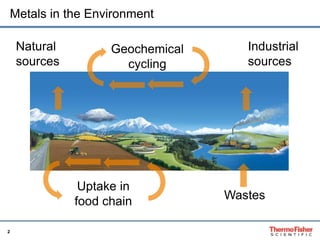
Metals in the Environment
Natural
sources
Industrial
sources
Geochemical
cycling
Uptake in
food chain Wastes
3
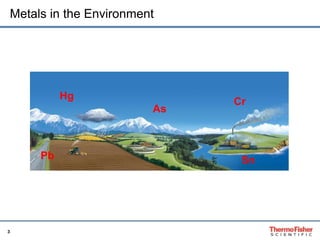
Metals in the Environment
Hg
As
Cr
Pb Sn
4
Metals in the Environment and Speciation
HO-As-OH
|
OH
O
||
H3C-As-CH3
|
OH
Environmental Fate
Mobility Toxicity
Bioavailability
Reactivity
[Cr(H2O)6]3+
H3C-Hg+
Hg0
Cr2O7
2-
5
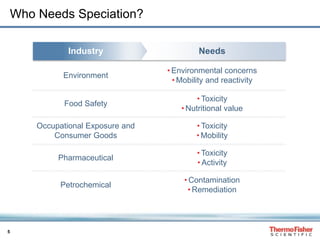
Who Needs Speciation?
Industry Needs
Environment
• Environmental concerns
• Mobility and reactivity
Food Safety
• Toxicity
• Nutritional value
Occupational Exposure and
Consumer Goods
• Toxicity
• Mobility
Pharmaceutical
• Toxicity
• Activity
Petrochemical
• Contamination
• Remediation
6
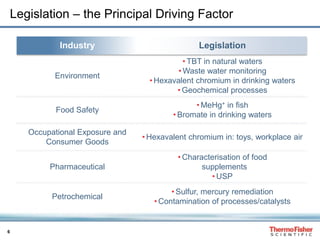
Legislation – the Principal Driving Factor
Industry Legislation
Environment
• TBT in natural waters
• Waste water monitoring
• Hexavalent chromium in drinking waters
• Geochemical processes
Food Safety
• MeHg+ in fish
• Bromate in drinking waters
Occupational Exposure and
Consumer Goods
• Hexavalent chromium in: toys, workplace air
Pharmaceutical
• Characterisation of food
supplements
• USP
Petrochemical
• Sulfur, mercury remediation
• Contamination of processes/catalysts
7
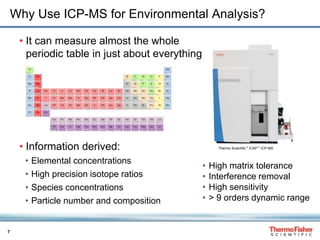
Why Use ICP-MS for Environmental Analysis?
• It can measure almost the whole
periodic table in just about everything
• Information derived:
• Elemental concentrations
• High precision isotope ratios
• Species concentrations
• Particle number and composition
• High matrix tolerance
• Interference removal
• High sensitivity
• > 9 orders dynamic range
Thermo Scientific™ iCAP™ ICP-MS
8
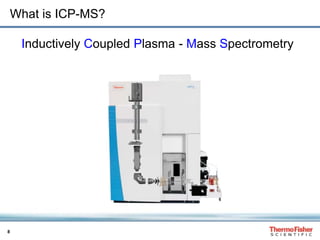
What is ICP-MS?
Inductively Coupled Plasma - Mass Spectrometry
9
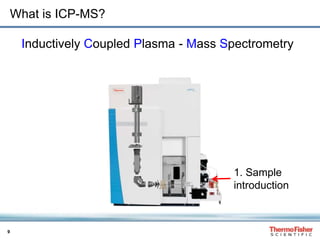
What is ICP-MS?
1. Sample
introduction
Inductively Coupled Plasma - Mass Spectrometry
10
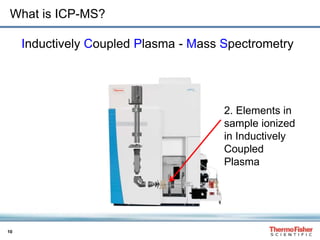
What is ICP-MS?
2. Elements in
sample ionized
in Inductively
Coupled
Plasma
Inductively Coupled Plasma - Mass Spectrometry
11
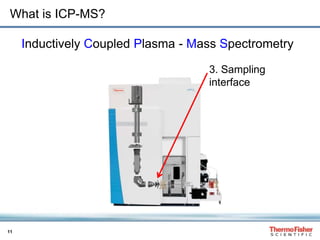
What is ICP-MS?
3. Sampling
interface
Inductively Coupled Plasma - Mass Spectrometry
12
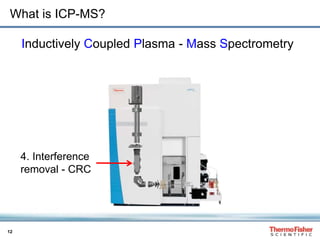
What is ICP-MS?
4. Interference
removal - CRC
Inductively Coupled Plasma - Mass Spectrometry
13
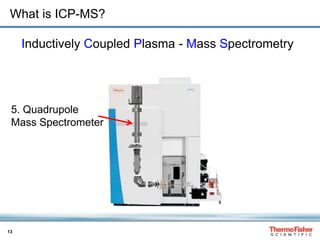
What is ICP-MS?
5. Quadrupole
Mass Spectrometer
Inductively Coupled Plasma - Mass Spectrometry
14
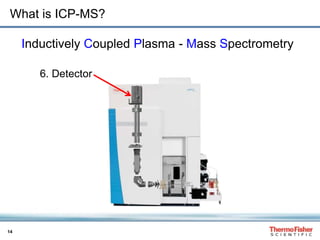
What is ICP-MS?
6. Detector
Inductively Coupled Plasma - Mass Spectrometry
15
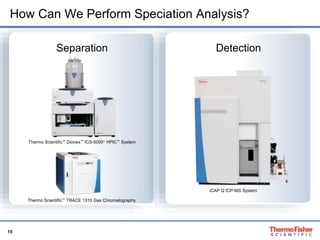
How Can We Perform Speciation Analysis?
Separation Detection
Thermo Scientific™ Dionex™ ICS-5000+ HPIC™ System
iCAP Q ICP-MS System
Thermo Scientific™ TRACE 1310 Gas Chromatography
16
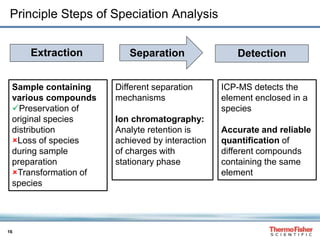
Principle Steps of Speciation Analysis
Extraction DetectionSeparation
Sample containing
various compounds
Preservation of
original species
distribution
Loss of species
during sample
preparation
Transformation of
species
Different separation
mechanisms
Ion chromatography:
Analyte retention is
achieved by interaction
of charges with
stationary phase
ICP-MS detects the
element enclosed in a
species
Accurate and reliable
quantification of
different compounds
containing the same
element
17
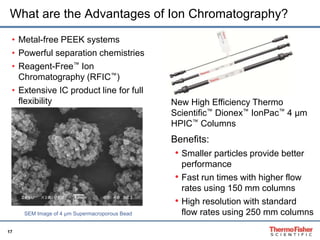
SEM Image of 4 µm Supermacroporous Bead
What are the Advantages of Ion Chromatography?
• Metal-free PEEK systems
• Powerful separation chemistries
• Reagent-Free™ Ion
Chromatography (RFIC™)
• Extensive IC product line for full
flexibility
• Smaller particles provide better
performance
• Fast run times with higher flow
rates using 150 mm columns
• High resolution with standard
flow rates using 250 mm columns
New High Efficiency Thermo
Scientific™ Dionex™ IonPac™ 4 µm
HPIC™ Columns
Benefits:
18
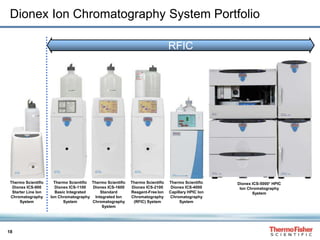
Dionex Ion Chromatography System Portfolio
Thermo Scientific
Thermo Scientific
Dionex ICS-1100
Basic Integrated
Ion Chromatography
System
Thermo Scientific
Thermo Scientific
Dionex ICS-900
Starter Line Ion
Chromatography
System
Thermo Scientific
Thermo Scientific
Dionex ICS-1600
Standard
Integrated Ion
Chromatography
System
Thermo Scientific™
Thermo Scientific
Dionex ICS-2100
Reagent-Free Ion
Chromatography
(RFIC) System
Dionex ICS-5000+ HPIC
Ion Chromatography
System
Thermo Scientific
Thermo Scientific
Dionex ICS-4000
Capillary HPIC Ion
Chromatography
System
RFIC
19
Speciation with IC-ICP-MS
• Fully integrated software:
• Thermo Scientific™ Qtegra™ Intelligent
Scientific Data Solution ISDS with
Thermo Scientific™ Dionex™
Chromeleon™ Chromatography Data
System (CDS) plug-in drivers to control
IC or HPLC
• No need for external hardware trigger
• Fully integrated chromatographic data
processing software
• Automated peak integration, species
quantification and internal standard
correction
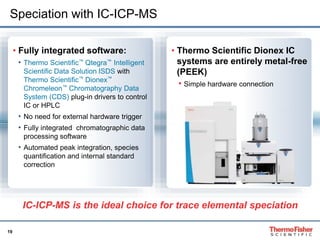
• Thermo Scientific Dionex IC
systems are entirely metal-free
(PEEK)
• Simple hardware connection
IC-ICP-MS is the ideal choice for trace elemental speciation
20
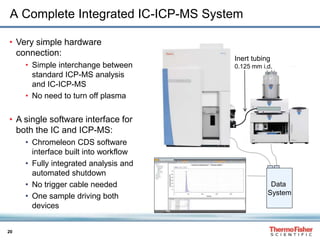
Data
System
• Very simple hardware
connection:
• Simple interchange between
standard ICP-MS analysis
and IC-ICP-MS
• No need to turn off plasma
• A single software interface for
both the IC and ICP-MS:
• Chromeleon CDS software
interface built into workflow
• Fully integrated analysis and
automated shutdown
• No trigger cable needed
• One sample driving both
devices
Inert tubing
0.125 mm i.d.
A Complete Integrated IC-ICP-MS System
21
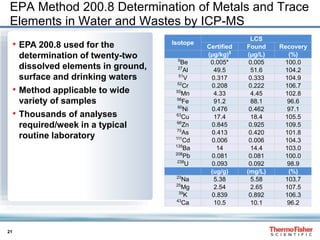
EPA Method 200.8 Determination of Metals and Trace
Elements in Water and Wastes by ICP-MS
• EPA 200.8 used for the
determination of twenty-two
dissolved elements in ground,
surface and drinking waters
• Method applicable to wide
variety of samples
• Thousands of analyses
required/week in a typical
routine laboratory
Isotope
LCS
Certified Found Recovery
(µg/kg)$
(µg/L) (%)
9
Be 0.005* 0.005 100.0
27
Al 49.5 51.6 104.2
51
V 0.317 0.333 104.9
52
Cr 0.208 0.222 106.7
55
Mn 4.33 4.45 102.8
56
Fe 91.2 88.1 96.6
60
Ni 0.476 0.462 97.1
63
Cu 17.4 18.4 105.5
66
Zn 0.845 0.925 109.5
75
As 0.413 0.420 101.8
111
Cd 0.006 0.006 104.3
135
Ba 14 14.4 103.0
208
Pb 0.081 0.081 100.0
238
U 0.093 0.092 98.9
(ug/g) (mg/L) (%)
23
Na 5.38 5.58 103.7
25
Mg 2.54 2.65 107.5
39
K 0.839 0.892 106.3
43
Ca 10.5 10.1 96.2
22
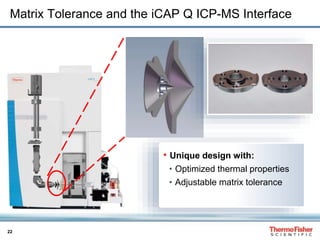
Matrix Tolerance and the iCAP Q ICP-MS Interface
• Unique design with:
• Optimized thermal properties
• Adjustable matrix tolerance
23
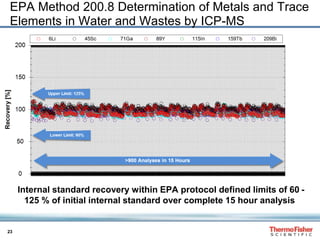
EPA Method 200.8 Determination of Metals and Trace
Elements in Water and Wastes by ICP-MS
Internal standard recovery within EPA protocol defined limits of 60 -
125 % of initial internal standard over complete 15 hour analysis
24
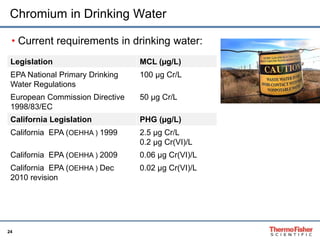
Chromium in Drinking Water
• Current requirements in drinking water:
Legislation MCL (µg/L)
EPA National Primary Drinking
Water Regulations
100 µg Cr/L
European Commission Directive
1998/83/EC
50 µg Cr/L
California Legislation PHG (µg/L)
California EPA (OEHHA ) 1999 2.5 µg Cr/L
0.2 µg Cr(VI)/L
California EPA (OEHHA ) 2009 0.06 µg Cr(VI)/L
California EPA (OEHHA ) Dec
2010 revision
0.02 µg Cr(VI)/L
25
Considerations for HPLC-ICP-MS Parameters
• The determination of Cr by ICP-MS is complicated by
polyatomic interferences:
• 40Ar12C+ on 52Cr
• 37Cl16O+ on 53Cr
• IC and sample preparation parameters need to be chosen
carefully due to the complex redox chemistry of Cr
Chemical forms of Cr as a function of pH and potential
HCrO4
- CrO4
2-
H2CrO4
[Cr(H2O)6]3+
Cr3+
Cr(OH)3(s) Cr(OH)4
-
Cr(OH)2+
Cr(OH)2
+
Cr(OH)3
°
Cr(VI)
Cr(III)
pH
0,7
964
6,5
Eh
Cr2O7
2-
26
QCell - Interference Removal by Collision/Reaction Cell
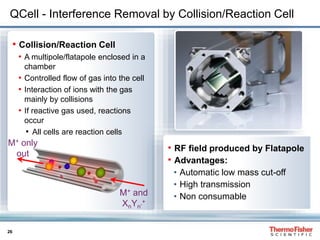
• Collision/Reaction Cell
• A multipole/flatapole enclosed in a
chamber
• Controlled flow of gas into the cell
• Interaction of ions with the gas
mainly by collisions
• If reactive gas used, reactions
occur
• All cells are reaction cells
M+ and
XnYn’
+
M+ only
out
• RF field produced by Flatapole
• Advantages:
• Automatic low mass cut-off
• High transmission
• Non consumable
27
QCell - Interference Removal by Collision/Reaction Cell
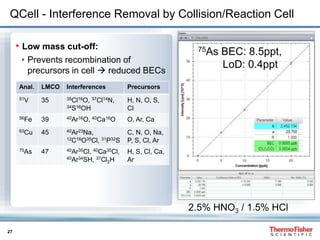
• Low mass cut-off:
• Prevents recombination of
precursors in cell  reduced BECs
Anal. LMCO Interferences Precursors
51V 35 35Cl16O, 37Cl14N,
34S16OH
H, N, O, S,
Cl
56Fe 39 40Ar16O, 40Ca16O O, Ar, Ca
63Cu 45 40Ar23Na,
12C16O35Cl, 31P32S
C, N, O, Na,
P, S, Cl, Ar
75As 47 40Ar35Cl, 40Ca35Cl,
40Ar34SH, 37Cl2H
H, S, Cl, Ca,
Ar
2.5% HNO3 / 1.5% HCl
75As BEC: 8.5ppt,
LoD: 0.4ppt
28
QCell - Interference Removal by Collision/Reaction Cell
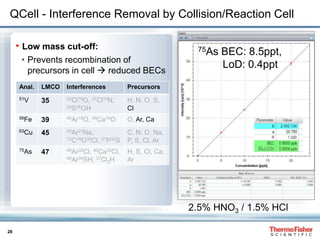
• Low mass cut-off:
• Prevents recombination of
precursors in cell  reduced BECs
Anal. LMCO Interferences Precursors
51V 35 35Cl16O, 37Cl14N,
34S16OH
H, N, O, S,
Cl
56Fe 39 40Ar16O, 40Ca16O O, Ar, Ca
63Cu 45 40Ar23Na,
12C16O35Cl, 31P32S
C, N, O, Na,
P, S, Cl, Ar
75As 47 40Ar35Cl, 40Ca35Cl,
40Ar34SH, 37Cl2H
H, S, Cl, Ca,
Ar
2.5% HNO3 / 1.5% HCl
75As BEC: 8.5ppt,
LoD: 0.4ppt
29
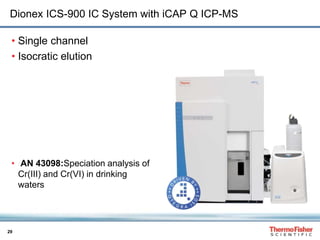
Dionex ICS-900 IC System with iCAP Q ICP-MS
• Single channel
• Isocratic elution
• AN 43098:Speciation analysis of
Cr(III) and Cr(VI) in drinking
waters
30
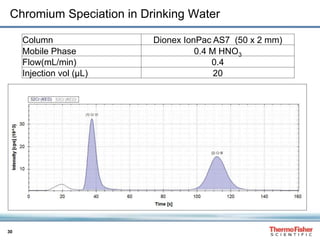
Chromium Speciation in Drinking Water
Column Dionex IonPac AS7 (50 x 2 mm)
Mobile Phase 0.4 M HNO3
Flow(mL/min) 0.4
Injection vol (µL) 20
31
IC-ICP-MS for the Speciation of Cr(III) and Cr(VI)
• Both chromium isotopes, 52, 53Cr,
can be monitored
• Cr(III) and Cr(VI) are completely
baseline separated
• Limits of detection:
• 0.20 ng L-1 [Cr(VI)]
• 0.38 ng L-1 [Cr(III)]
• Isocratic chromatography
performed in less than 3 minutes
32
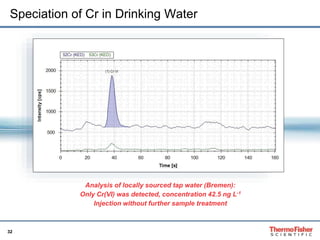
Speciation of Cr in Drinking Water
Analysis of locally sourced tap water (Bremen):
Only Cr(VI) was detected, concentration 42.5 ng L-1
Injection without further sample treatment
33
Chromium Speciation Analysis of Drinking Water
• A sensitive and fast method based on ion chromatography
for the speciation of Cr has been developed
• No need for the addition of EDTA or other charge pairing agents
necessary, no additional sample preparation, no additional spectral
interferences in the mass spectra
• The IC eluent, dilute HNO3, is relatively cheap, easily sourced and
allows detection of Cr species in the single digit ppt range
• Reduced column dimensions allow reduction of the mobile phase flow
rate to 0.4 mL min-1
34
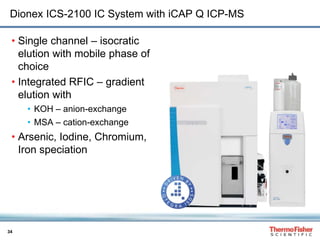
Dionex ICS-2100 IC System with iCAP Q ICP-MS
• Single channel – isocratic
elution with mobile phase of
choice
• Integrated RFIC – gradient
elution with
• KOH – anion-exchange
• MSA – cation-exchange
• Arsenic, Iodine, Chromium,
Iron speciation
35
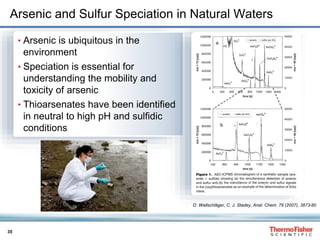
Arsenic and Sulfur Speciation in Natural Waters
• Arsenic is ubiquitous in the
environment
• Speciation is essential for
understanding the mobility and
toxicity of arsenic
• Thioarsenates have been identified
in neutral to high pH and sulfidic
conditions
D. Wallschläger, C. J. Stadey, Anal. Chem. 79 (2007), 3873-80
36
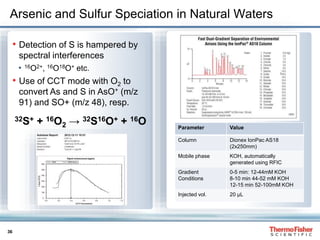
Arsenic and Sulfur Speciation in Natural Waters
• Detection of S is hampered by
spectral interferences
• 16O2+, 16O18O+ etc.
• Use of CCT mode with O2 to
convert As and S in AsO+ (m/z
91) and SO+ (m/z 48), resp.
Parameter Value
Column Dionex IonPac AS18
(2x250mm)
Mobile phase KOH, automatically
generated using RFIC
Gradient
Conditions
0-5 min: 12-44mM KOH
8-10 min 44-52 mM KOH
12-15 min 52-100mM KOH
Injected vol. 20 µL
32S+ + 16O2 → 32S16O+ + 16O
37
Arsenic and Sulfur Speciation in Natural Waters
• Different As and S containing anions separated and individually detected
• Simultaneously, also metal based species as MoO4
2- can be detected
Instrumental
Performance:
LOD [SO4
2-]:
4.8 ng g-1
BEC: 2.5 ng g-1
LOD [As(III)]:
0.02 ng g-1
BEC: 0.08 ng g-1
48SO+ 91AsO+ 114MoO+
Standards
38
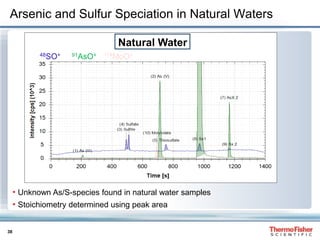
Arsenic and Sulfur Speciation in Natural Waters
• Unknown As/S-species found in natural water samples
• Stoichiometry determined using peak area
48SO+ 91AsO+ 114MoO+
Natural Water
39
Arsenic and Sulfur Speciation in Natural Waters
• A multi-elemental speciation method has been developed for
the simultaneous characterization of sulfur and arsenic
containing species:
• A simple autotune procedure configures the instrument for optimal
detection of sulfur and arsenic using reaction with O2 in Qcell
• RFIC with a KOH gradient significantly simplifies set-up and ensures
separation of eight sulfur/arsenic containing species in under 15 mins
• Narrow bore column (2 mm i.d.) allows reduction of the mobile phase
flow rate to 0.4 mL min-1
• Oxyanions containing other species can also be measured
simultaneously
40
IC-ICP-MS: A Powerful Tool for Elemental Speciation
• IC-ICP-MS is a fully integrated technique
• One software, no triggering, simple hardware connection
• The completely metal free ICS product line eradicates
possibility of contamination
• Large range of IC systems and columns
• IC tailored for your application
• Flexibility and support for developing applications
• For many elemental speciation applications IC is the
preferred chromatographic choice for ICP-MS:
• Mobile phases are simpler/cleaner for lower interferences, lower
background and lower limits of detection
• Narrower bore columns (2 mm ID) for higher efficiency separation and
lower mobile phase consumption
41
iCAP Q ICP-MS for Environmental Analysis
• Proprietary interface designed for matrix
tolerance
• Increases productivity by minimizing QC
failure and increasing analysis periods
between maintenance
• Collision Reaction Cell technology with
• Low mass cut-off for accurate analysis at
low concentrations
• Single mode He-KED for simplicity and
high throughput
• Flexibility of CCT mode for challenging
applications
42
iCAP Q ICP-MS for Environmental Analysis
• Minimal bench space requirements
• 66 cm wide
• Easy to use and maintain
• Quick connect sample introduction system
• Pop out interface for easy access
• Intuitive Qtegra software platform
• Common to iCAP ICP-OES
• Integrated Get Ready, Workflows and QC
• Fully integrated IC-ICP-MS package with
full set of chromatographic data evaluation
features
43
Thank You!
WS71159_E 06/14S

Chromatography: Complete Inorganic Elemental Speciation Analysis Solutions for Environmental Applications

  • 1.
    1 The world leaderin serving science Complete Inorganic Elemental Speciation Solutions for Environmental Applications Mr. Kristan Bahten Thermo Scientific, Sunnyvale, CA, USA Dr. Shona McSheehy Thermo Scientific, Bremen, Germany
  • 2.
    2 Metals in theEnvironment Natural sources Industrial sources Geochemical cycling Uptake in food chain Wastes
  • 3.
    3 Metals in theEnvironment Hg As Cr Pb Sn
  • 4.
    4 Metals in theEnvironment and Speciation HO-As-OH | OH O || H3C-As-CH3 | OH Environmental Fate Mobility Toxicity Bioavailability Reactivity [Cr(H2O)6]3+ H3C-Hg+ Hg0 Cr2O7 2-
  • 5.
    5 Who Needs Speciation? IndustryNeeds Environment • Environmental concerns • Mobility and reactivity Food Safety • Toxicity • Nutritional value Occupational Exposure and Consumer Goods • Toxicity • Mobility Pharmaceutical • Toxicity • Activity Petrochemical • Contamination • Remediation
  • 6.
    6 Legislation – thePrincipal Driving Factor Industry Legislation Environment • TBT in natural waters • Waste water monitoring • Hexavalent chromium in drinking waters • Geochemical processes Food Safety • MeHg+ in fish • Bromate in drinking waters Occupational Exposure and Consumer Goods • Hexavalent chromium in: toys, workplace air Pharmaceutical • Characterisation of food supplements • USP Petrochemical • Sulfur, mercury remediation • Contamination of processes/catalysts
  • 7.
    7 Why Use ICP-MSfor Environmental Analysis? • It can measure almost the whole periodic table in just about everything • Information derived: • Elemental concentrations • High precision isotope ratios • Species concentrations • Particle number and composition • High matrix tolerance • Interference removal • High sensitivity • > 9 orders dynamic range Thermo Scientific™ iCAP™ ICP-MS
  • 8.
    8 What is ICP-MS? InductivelyCoupled Plasma - Mass Spectrometry
  • 9.
    9 What is ICP-MS? 1.Sample introduction Inductively Coupled Plasma - Mass Spectrometry
  • 10.
    10 What is ICP-MS? 2.Elements in sample ionized in Inductively Coupled Plasma Inductively Coupled Plasma - Mass Spectrometry
  • 11.
    11 What is ICP-MS? 3.Sampling interface Inductively Coupled Plasma - Mass Spectrometry
  • 12.
    12 What is ICP-MS? 4.Interference removal - CRC Inductively Coupled Plasma - Mass Spectrometry
  • 13.
    13 What is ICP-MS? 5.Quadrupole Mass Spectrometer Inductively Coupled Plasma - Mass Spectrometry
  • 14.
    14 What is ICP-MS? 6.Detector Inductively Coupled Plasma - Mass Spectrometry
  • 15.
    15 How Can WePerform Speciation Analysis? Separation Detection Thermo Scientific™ Dionex™ ICS-5000+ HPIC™ System iCAP Q ICP-MS System Thermo Scientific™ TRACE 1310 Gas Chromatography
  • 16.
    16 Principle Steps ofSpeciation Analysis Extraction DetectionSeparation Sample containing various compounds Preservation of original species distribution Loss of species during sample preparation Transformation of species Different separation mechanisms Ion chromatography: Analyte retention is achieved by interaction of charges with stationary phase ICP-MS detects the element enclosed in a species Accurate and reliable quantification of different compounds containing the same element
  • 17.
    17 SEM Image of4 µm Supermacroporous Bead What are the Advantages of Ion Chromatography? • Metal-free PEEK systems • Powerful separation chemistries • Reagent-Free™ Ion Chromatography (RFIC™) • Extensive IC product line for full flexibility • Smaller particles provide better performance • Fast run times with higher flow rates using 150 mm columns • High resolution with standard flow rates using 250 mm columns New High Efficiency Thermo Scientific™ Dionex™ IonPac™ 4 µm HPIC™ Columns Benefits:
  • 18.
    18 Dionex Ion ChromatographySystem Portfolio Thermo Scientific Thermo Scientific Dionex ICS-1100 Basic Integrated Ion Chromatography System Thermo Scientific Thermo Scientific Dionex ICS-900 Starter Line Ion Chromatography System Thermo Scientific Thermo Scientific Dionex ICS-1600 Standard Integrated Ion Chromatography System Thermo Scientific™ Thermo Scientific Dionex ICS-2100 Reagent-Free Ion Chromatography (RFIC) System Dionex ICS-5000+ HPIC Ion Chromatography System Thermo Scientific Thermo Scientific Dionex ICS-4000 Capillary HPIC Ion Chromatography System RFIC
  • 19.
    19 Speciation with IC-ICP-MS •Fully integrated software: • Thermo Scientific™ Qtegra™ Intelligent Scientific Data Solution ISDS with Thermo Scientific™ Dionex™ Chromeleon™ Chromatography Data System (CDS) plug-in drivers to control IC or HPLC • No need for external hardware trigger • Fully integrated chromatographic data processing software • Automated peak integration, species quantification and internal standard correction • Thermo Scientific Dionex IC systems are entirely metal-free (PEEK) • Simple hardware connection IC-ICP-MS is the ideal choice for trace elemental speciation
  • 20.
    20 Data System • Very simplehardware connection: • Simple interchange between standard ICP-MS analysis and IC-ICP-MS • No need to turn off plasma • A single software interface for both the IC and ICP-MS: • Chromeleon CDS software interface built into workflow • Fully integrated analysis and automated shutdown • No trigger cable needed • One sample driving both devices Inert tubing 0.125 mm i.d. A Complete Integrated IC-ICP-MS System
  • 21.
    21 EPA Method 200.8Determination of Metals and Trace Elements in Water and Wastes by ICP-MS • EPA 200.8 used for the determination of twenty-two dissolved elements in ground, surface and drinking waters • Method applicable to wide variety of samples • Thousands of analyses required/week in a typical routine laboratory Isotope LCS Certified Found Recovery (µg/kg)$ (µg/L) (%) 9 Be 0.005* 0.005 100.0 27 Al 49.5 51.6 104.2 51 V 0.317 0.333 104.9 52 Cr 0.208 0.222 106.7 55 Mn 4.33 4.45 102.8 56 Fe 91.2 88.1 96.6 60 Ni 0.476 0.462 97.1 63 Cu 17.4 18.4 105.5 66 Zn 0.845 0.925 109.5 75 As 0.413 0.420 101.8 111 Cd 0.006 0.006 104.3 135 Ba 14 14.4 103.0 208 Pb 0.081 0.081 100.0 238 U 0.093 0.092 98.9 (ug/g) (mg/L) (%) 23 Na 5.38 5.58 103.7 25 Mg 2.54 2.65 107.5 39 K 0.839 0.892 106.3 43 Ca 10.5 10.1 96.2
  • 22.
    22 Matrix Tolerance andthe iCAP Q ICP-MS Interface • Unique design with: • Optimized thermal properties • Adjustable matrix tolerance
  • 23.
    23 EPA Method 200.8Determination of Metals and Trace Elements in Water and Wastes by ICP-MS Internal standard recovery within EPA protocol defined limits of 60 - 125 % of initial internal standard over complete 15 hour analysis
  • 24.
    24 Chromium in DrinkingWater • Current requirements in drinking water: Legislation MCL (µg/L) EPA National Primary Drinking Water Regulations 100 µg Cr/L European Commission Directive 1998/83/EC 50 µg Cr/L California Legislation PHG (µg/L) California EPA (OEHHA ) 1999 2.5 µg Cr/L 0.2 µg Cr(VI)/L California EPA (OEHHA ) 2009 0.06 µg Cr(VI)/L California EPA (OEHHA ) Dec 2010 revision 0.02 µg Cr(VI)/L
  • 25.
    25 Considerations for HPLC-ICP-MSParameters • The determination of Cr by ICP-MS is complicated by polyatomic interferences: • 40Ar12C+ on 52Cr • 37Cl16O+ on 53Cr • IC and sample preparation parameters need to be chosen carefully due to the complex redox chemistry of Cr Chemical forms of Cr as a function of pH and potential HCrO4 - CrO4 2- H2CrO4 [Cr(H2O)6]3+ Cr3+ Cr(OH)3(s) Cr(OH)4 - Cr(OH)2+ Cr(OH)2 + Cr(OH)3 ° Cr(VI) Cr(III) pH 0,7 964 6,5 Eh Cr2O7 2-
  • 26.
    26 QCell - InterferenceRemoval by Collision/Reaction Cell • Collision/Reaction Cell • A multipole/flatapole enclosed in a chamber • Controlled flow of gas into the cell • Interaction of ions with the gas mainly by collisions • If reactive gas used, reactions occur • All cells are reaction cells M+ and XnYn’ + M+ only out • RF field produced by Flatapole • Advantages: • Automatic low mass cut-off • High transmission • Non consumable
  • 27.
    27 QCell - InterferenceRemoval by Collision/Reaction Cell • Low mass cut-off: • Prevents recombination of precursors in cell  reduced BECs Anal. LMCO Interferences Precursors 51V 35 35Cl16O, 37Cl14N, 34S16OH H, N, O, S, Cl 56Fe 39 40Ar16O, 40Ca16O O, Ar, Ca 63Cu 45 40Ar23Na, 12C16O35Cl, 31P32S C, N, O, Na, P, S, Cl, Ar 75As 47 40Ar35Cl, 40Ca35Cl, 40Ar34SH, 37Cl2H H, S, Cl, Ca, Ar 2.5% HNO3 / 1.5% HCl 75As BEC: 8.5ppt, LoD: 0.4ppt
  • 28.
    28 QCell - InterferenceRemoval by Collision/Reaction Cell • Low mass cut-off: • Prevents recombination of precursors in cell  reduced BECs Anal. LMCO Interferences Precursors 51V 35 35Cl16O, 37Cl14N, 34S16OH H, N, O, S, Cl 56Fe 39 40Ar16O, 40Ca16O O, Ar, Ca 63Cu 45 40Ar23Na, 12C16O35Cl, 31P32S C, N, O, Na, P, S, Cl, Ar 75As 47 40Ar35Cl, 40Ca35Cl, 40Ar34SH, 37Cl2H H, S, Cl, Ca, Ar 2.5% HNO3 / 1.5% HCl 75As BEC: 8.5ppt, LoD: 0.4ppt
  • 29.
    29 Dionex ICS-900 ICSystem with iCAP Q ICP-MS • Single channel • Isocratic elution • AN 43098:Speciation analysis of Cr(III) and Cr(VI) in drinking waters
  • 30.
    30 Chromium Speciation inDrinking Water Column Dionex IonPac AS7 (50 x 2 mm) Mobile Phase 0.4 M HNO3 Flow(mL/min) 0.4 Injection vol (µL) 20
  • 31.
    31 IC-ICP-MS for theSpeciation of Cr(III) and Cr(VI) • Both chromium isotopes, 52, 53Cr, can be monitored • Cr(III) and Cr(VI) are completely baseline separated • Limits of detection: • 0.20 ng L-1 [Cr(VI)] • 0.38 ng L-1 [Cr(III)] • Isocratic chromatography performed in less than 3 minutes
  • 32.
    32 Speciation of Crin Drinking Water Analysis of locally sourced tap water (Bremen): Only Cr(VI) was detected, concentration 42.5 ng L-1 Injection without further sample treatment
  • 33.
    33 Chromium Speciation Analysisof Drinking Water • A sensitive and fast method based on ion chromatography for the speciation of Cr has been developed • No need for the addition of EDTA or other charge pairing agents necessary, no additional sample preparation, no additional spectral interferences in the mass spectra • The IC eluent, dilute HNO3, is relatively cheap, easily sourced and allows detection of Cr species in the single digit ppt range • Reduced column dimensions allow reduction of the mobile phase flow rate to 0.4 mL min-1
  • 34.
    34 Dionex ICS-2100 ICSystem with iCAP Q ICP-MS • Single channel – isocratic elution with mobile phase of choice • Integrated RFIC – gradient elution with • KOH – anion-exchange • MSA – cation-exchange • Arsenic, Iodine, Chromium, Iron speciation
  • 35.
    35 Arsenic and SulfurSpeciation in Natural Waters • Arsenic is ubiquitous in the environment • Speciation is essential for understanding the mobility and toxicity of arsenic • Thioarsenates have been identified in neutral to high pH and sulfidic conditions D. Wallschläger, C. J. Stadey, Anal. Chem. 79 (2007), 3873-80
  • 36.
    36 Arsenic and SulfurSpeciation in Natural Waters • Detection of S is hampered by spectral interferences • 16O2+, 16O18O+ etc. • Use of CCT mode with O2 to convert As and S in AsO+ (m/z 91) and SO+ (m/z 48), resp. Parameter Value Column Dionex IonPac AS18 (2x250mm) Mobile phase KOH, automatically generated using RFIC Gradient Conditions 0-5 min: 12-44mM KOH 8-10 min 44-52 mM KOH 12-15 min 52-100mM KOH Injected vol. 20 µL 32S+ + 16O2 → 32S16O+ + 16O
  • 37.
    37 Arsenic and SulfurSpeciation in Natural Waters • Different As and S containing anions separated and individually detected • Simultaneously, also metal based species as MoO4 2- can be detected Instrumental Performance: LOD [SO4 2-]: 4.8 ng g-1 BEC: 2.5 ng g-1 LOD [As(III)]: 0.02 ng g-1 BEC: 0.08 ng g-1 48SO+ 91AsO+ 114MoO+ Standards
  • 38.
    38 Arsenic and SulfurSpeciation in Natural Waters • Unknown As/S-species found in natural water samples • Stoichiometry determined using peak area 48SO+ 91AsO+ 114MoO+ Natural Water
  • 39.
    39 Arsenic and SulfurSpeciation in Natural Waters • A multi-elemental speciation method has been developed for the simultaneous characterization of sulfur and arsenic containing species: • A simple autotune procedure configures the instrument for optimal detection of sulfur and arsenic using reaction with O2 in Qcell • RFIC with a KOH gradient significantly simplifies set-up and ensures separation of eight sulfur/arsenic containing species in under 15 mins • Narrow bore column (2 mm i.d.) allows reduction of the mobile phase flow rate to 0.4 mL min-1 • Oxyanions containing other species can also be measured simultaneously
  • 40.
    40 IC-ICP-MS: A PowerfulTool for Elemental Speciation • IC-ICP-MS is a fully integrated technique • One software, no triggering, simple hardware connection • The completely metal free ICS product line eradicates possibility of contamination • Large range of IC systems and columns • IC tailored for your application • Flexibility and support for developing applications • For many elemental speciation applications IC is the preferred chromatographic choice for ICP-MS: • Mobile phases are simpler/cleaner for lower interferences, lower background and lower limits of detection • Narrower bore columns (2 mm ID) for higher efficiency separation and lower mobile phase consumption
  • 41.
    41 iCAP Q ICP-MSfor Environmental Analysis • Proprietary interface designed for matrix tolerance • Increases productivity by minimizing QC failure and increasing analysis periods between maintenance • Collision Reaction Cell technology with • Low mass cut-off for accurate analysis at low concentrations • Single mode He-KED for simplicity and high throughput • Flexibility of CCT mode for challenging applications
  • 42.
    42 iCAP Q ICP-MSfor Environmental Analysis • Minimal bench space requirements • 66 cm wide • Easy to use and maintain • Quick connect sample introduction system • Pop out interface for easy access • Intuitive Qtegra software platform • Common to iCAP ICP-OES • Integrated Get Ready, Workflows and QC • Fully integrated IC-ICP-MS package with full set of chromatographic data evaluation features
  • 43.