Presented by:
S. ArunKumar,
1st Year, Pharm D,
JKKN College of Pharmacy,
Kumarapalayam.
*
(i) Textbook of Pharmaceutical Chemistry by
Bently and Driver’s.
(ii) Textbook of Pharmaceutical Inorganic Chemistry By
V. N. Rajasekaran.
(iii) Textbook of Pharmaceutical Inorganic Chemistry
By G. R. Chatwal.
(iv) Textbook of Medicinal Inorganic Chemistry By
P. Gundu Rao.
(v) Textbook of Principle of Inorganic Chemistry by
Late B. R. Puri, L. R. Shama, K. C. Kalia.
*
Refer net websides:
(i) https://www.slideshare.net/mszennie/water-analysis-
31234955
(ii) https://www.slideshare.net/chewmeyellow/water-
analysis-for-drinking-water
(iii) https://www.slideshare.net/ManikantanGangathara/water-
analysis-test-method
(iv) https://www.slideshare.net/pharmaguideline/purified-
water-system-in-pharmaceuticals
(v) https://www.slideshare.net/03064049291/water-analysis
*
Molecular Formula: H2O
Molecular weight : 18g/mole
Category: Pharmaceutical Aid
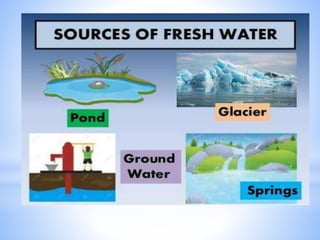
Purified water is obtained from two
major sources namely:
(i) Natural source
(ii) Filterate source
(or)
Artificial source
*
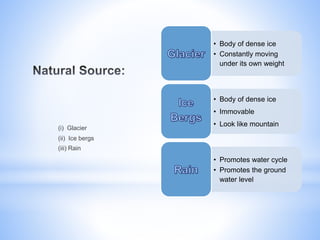
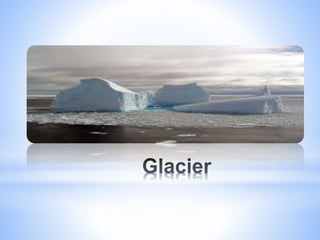
• Body of dense ice
• Constantly moving
under its own weight
• Body of dense ice
• Immovable
• Look like mountain
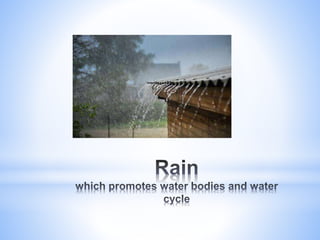
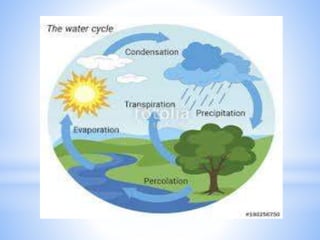
• Promotes water cycle
• Promotes the ground
water level
(i) Glacier
(ii) Ice bergs
(iii) Rain
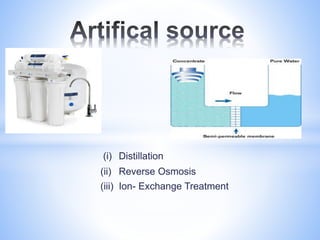
(i) Distillation
(ii) Reverse Osmosis
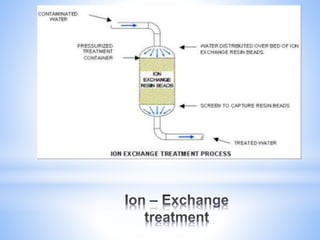
(iii) Ion- Exchange Treatment
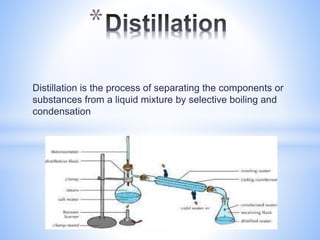
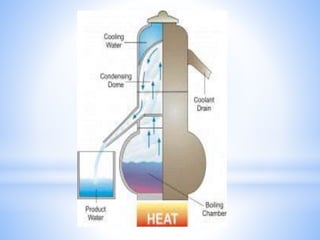
Distillation is the process of separating the components or
substances from a liquid mixture by selective boiling and
condensation
*
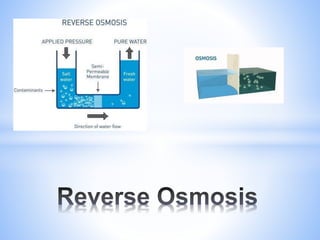
A Process by which a solvent passes through
a porous membrane in the direction opposite to that for
natural osmosis when subjected to a hydrostatic pressure
greater than the osmotic pressure.
(or)
Reverse Osmosis is one of the process of
water purification technology that uses a semipermeable
membrane to remove ions, molecules and larger particles
from drinking water.
ADVANTAGES OF ION-EXCHANGE TREATMENT:
(i) Removed dissolved contaminants
(ii) Involving the water softening process
*
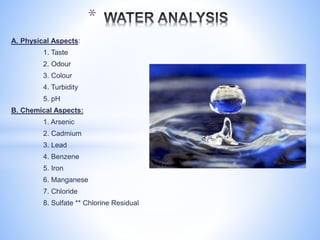
A. Physical Aspects:
1. Taste
2. Odour
3. Colour
4. Turbidity
5. pH
B. Chemical Aspects:
1. Arsenic
2. Cadmium
3. Lead
4. Benzene
5. Iron
6. Manganese
7. Chloride
8. Sulfate ** Chlorine Residual
*
C. Radiological Aspects:
1. Gross Alpha Activity
2. Gross Beta Activity
3. Radon
D. Microbiological Aspects:
1. Multiple Tube Fermentation Technique
2. Membrane Filter Technique
3. Chromogenic Substrate Test
4. Heterotrophic Plate Count
*
(i) Refers to the gustatory sensations:
◦ Bitter – caffeine ( Strong coffee)
◦ Salty – sodium chloride (Chlorinated water)
◦ Sour – citric acid (lemon juice)
◦ Sweet – sugar (syrup)
(ii) Flavor – gustatory, olfactory and trigeminal sensations
(iii) Methods:
◦ Sensory Evaluation Technique
(iv) Only used on samples known to be safe for ingestion
(v) Standard:
No Objectionable Taste
*
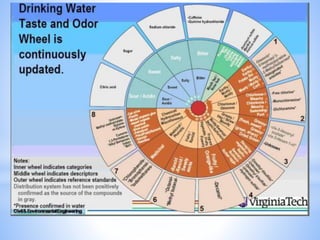
(i) Affected by organic and inorganic chemicals
present in water.
(ii) Provide qualitative descriptions of odour
intensity.
(ii) Method:
Sensory Evaluation Technique
(iii) Standard:
No Objectionable Odour
*
(i) True Colour:
◦ Colour of water from which the turbidity has been
removed
◦ Standard:
NMT ≦ 5 Colour Units
(ii) Apparent Colour
◦ Colour due to substances in the solution and suspended
matter
◦ Contributed principally by colloidal or suspended material
(iii) Standard:
NMT ≦ 10 Colour Units
(iv) Methods:
Visual Comparison Colorimetry Method.
*
(i) Caused by suspended and colloidal material :
(i) Clay
(ii) Silt
finely divided organic and inorganic matter, plankton and
other microbes.
(ii) Method:
Turbidimetry (r) Precipitation Method (r) Argentrometric
method.
(iii) Standard:
5 NTU
*
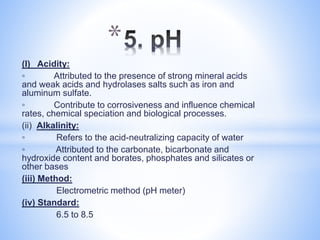
(I) Acidity:
◦ Attributed to the presence of strong mineral acids
and weak acids and hydrolases salts such as iron and
aluminum sulfate.
◦ Contribute to corrosiveness and influence chemical
rates, chemical speciation and biological processes.
(ii) Alkalinity:
◦ Refers to the acid-neutralizing capacity of water
◦ Attributed to the carbonate, bicarbonate and
hydroxide content and borates, phosphates and silicates or
other bases
(iii) Method:
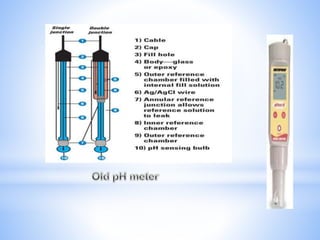
Electrometric method (pH meter)
(iv) Standard:
6.5 to 8.5
*
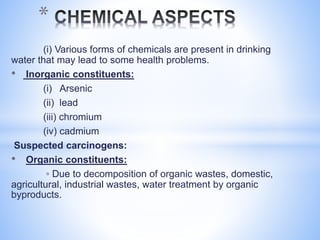
(i) Various forms of chemicals are present in drinking
water that may lead to some health problems.
• Inorganic constituents:
(i) Arsenic
(ii) lead
(iii) chromium
(iv) cadmium
Suspected carcinogens:
• Organic constituents:
◦ Due to decomposition of organic wastes, domestic,
agricultural, industrial wastes, water treatment by organic
byproducts.
*
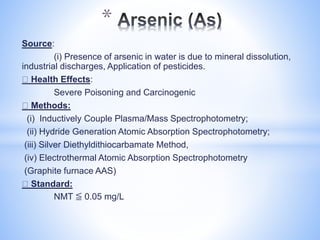
Source:
(i) Presence of arsenic in water is due to mineral dissolution,
industrial discharges, Application of pesticides.
Health Effects:
Severe Poisoning and Carcinogenic
Methods:
(i) Inductively Couple Plasma/Mass Spectrophotometry;
(ii) Hydride Generation Atomic Absorption Spectrophotometry;
(iii) Silver Diethyldithiocarbamate Method,
(iv) Electrothermal Atomic Absorption Spectrophotometry
(Graphite furnace AAS)
Standard:
NMT ≦ 0.05 mg/L
*
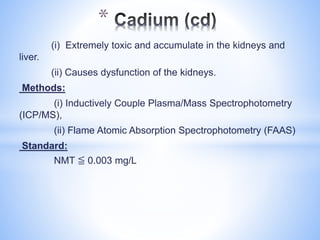
(i) Extremely toxic and accumulate in the kidneys and
liver.
(ii) Causes dysfunction of the kidneys.
Methods:
(i) Inductively Couple Plasma/Mass Spectrophotometry
(ICP/MS),
(ii) Flame Atomic Absorption Spectrophotometry (FAAS)
Standard:
NMT ≦ 0.003 mg/L
*
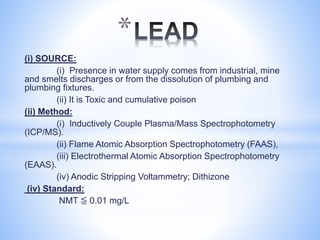
(i) SOURCE:
(i) Presence in water supply comes from industrial, mine
and smelts discharges or from the dissolution of plumbing and
plumbing fixtures.
(ii) It is Toxic and cumulative poison
(ii) Method:
(i) Inductively Couple Plasma/Mass Spectrophotometry
(ICP/MS).
(ii) Flame Atomic Absorption Spectrophotometry (FAAS),
(iii) Electrothermal Atomic Absorption Spectrophotometry
(EAAS).
(iv) Anodic Stripping Voltammetry; Dithizone
(iv) Standard:
NMT ≦ 0.01 mg/L
*
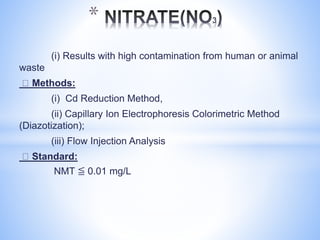
(i) Results with high contamination from human or animal
waste
Methods:
(i) Cd Reduction Method,
(ii) Capillary Ion Electrophoresis Colorimetric Method
(Diazotization);
(iii) Flow Injection Analysis
Standard:
NMT ≦ 0.01 mg/L
*
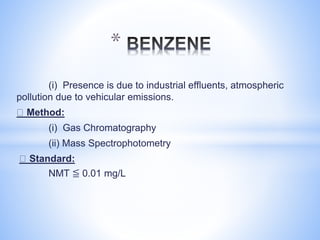
(i) Presence is due to industrial effluents, atmospheric
pollution due to vehicular emissions.
Method:
(i) Gas Chromatography
(ii) Mass Spectrophotometry
Standard:
NMT ≦ 0.01 mg/L
*
(i) Elevated iron levels can cause stains in plumbing,
laundry, and cooking utensils.
(ii) Imparts objectionable taste and colour.
(iii) Ferrous state -> oxidized -> ferric state (reddish
precipitate)
Method:
(i) Phenanthroline Atomic Absorption
Spectrophotometry.
(ii) Colorimetric Method.
Standard:
NMT ≦ 0.01 mg/L
*
(i) Elevated manganese can cause stains in plumbing,
laundry, cooking utensils.
(ii) Mn2+ -> oxidized -> MnO2 black precipitate.
Methods:
(i) Perforate Method,
(ii) Atomic Absorption Spectrophotometry,
(iii) Inductively Color Plasma Spectrophotometry
(iv) Mass Spectrophotometry
Standard:
NMT≦ 0.04 mg/L
*
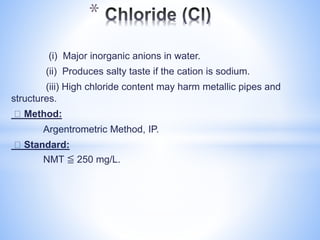
(i) Major inorganic anions in water.
(ii) Produces salty taste if the cation is sodium.
(iii) High chloride content may harm metallic pipes and
structures.
Method:
Argentrometric Method, IP.
Standard:
NMT ≦ 250 mg/L.
*
(i) Occurs naturally in water
Method:
(i) Turbidimetric Method
(ii) Ion Chromatography
(iii) Gravimetric Method
Standard:
NMT ≦ 250 mg/L
*
(i)Chlorine if not within limits may produce adverse
effects.
(ii) Taste and color of water is intensified.
(iii) Potential organic chloroform may be form in the
process of chlorination.
Methods:
(i) Iodometric
(ii) Amperometric Titrations
(iii) DPD Colorimetric Method
Standard:
0.3 to 1.5 mg/L
*
One useful and often used way of
determining the concentration of a
chemical in a solution, if it has a
colour, is to measure the intensity of
the colour and relate the intensity of
the colour to the concentration of
the solution.
*
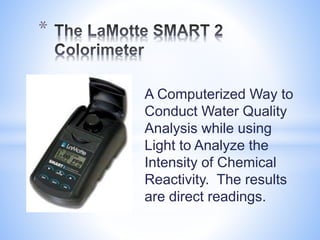
A Computerized Way to
Conduct Water Quality
Analysis while using
Light to Analyze the
Intensity of Chemical
Reactivity. The results
are direct readings.
*
 The entire multi-LED optical system is
embedded in the light chamber and optimized
for LaMotte test reagent systems.
 Wavelengths are set (preprogrammed for 50
tests).
 Can standardize with sample water and run
multiple tests.
*
It focuses on these wavelengths of light…430nm,
520nm, 570nm, 620nm
Specific chemical testing is done with kits that are
colorimetric – producing a color intensive reaction
The meter measures the intensity of the color and
calculates most values in parts per million (ppm)
*
 pH is a measure of the increase of
Hydrogen ions in water
 Additional carbon dioxide in freshwater can
decrease the pH, making the water body
more acidic (dissolved gases)
 Runoff including the addition on ions in
water is also important (i.e. – phosphates,
chlorides, etc… that are dissolved solids)
*
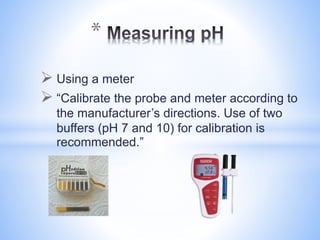
 Using a meter
 “Calibrate the probe and meter according to
the manufacturer’s directions. Use of two
buffers (pH 7 and 10) for calibration is
recommended.”
*
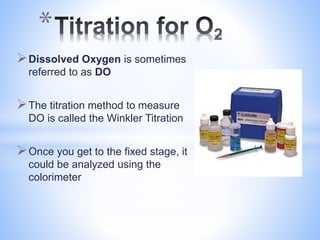
Dissolved Oxygen is sometimes
referred to as DO
The titration method to measure
DO is called the Winkler Titration
Once you get to the fixed stage, it
could be analyzed using the
colorimeter
*
The Winkler Method uses titration to determine
dissolved oxygen in the water sample. A sample bottle
is filled completely with water (no air is left to skew the
results). The dissolved oxygen in the sample is then
"fixed" by adding a series of reagents that form an acid
compound that is then titrated with a neutralizing
compound that results in a colour change. The point of
colour change is called the "endpoint" which coincides
with the dissolved oxygen concentration in the sample.
Dissolved oxygen analysis is best done in the field, as
the sample will be less altered by atmospheric
equilibration.
*
Dissolved oxygen analysis can be used to
determine:
(i) The health or cleanliness of a lake or
stream,
The amount and type of biomass a freshwater
system can support.
The amount of decomposition occurring in the
lake or stream.
*
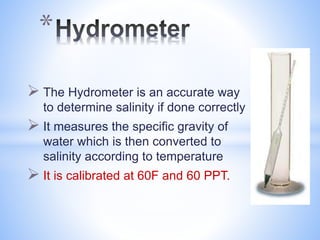
 The Hydrometer is an accurate way
to determine salinity if done correctly
 It measures the specific gravity of
water which is then converted to
salinity according to temperature
 It is calibrated at 60F and 60 PPT.
*
*
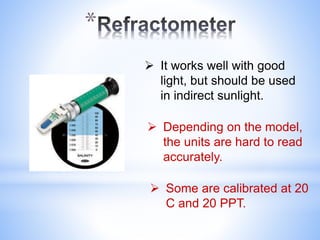
 It works well with good
light, but should be used
in indirect sunlight.
 Depending on the model,
the units are hard to read
accurately.
 Some are calibrated at 20
C and 20 PPT.
*
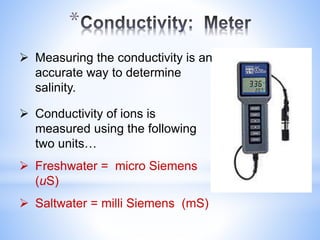
 Measuring the conductivity is an
accurate way to determine
salinity.
 Conductivity of ions is
measured using the following
two units…
 Freshwater = micro Siemens
(uS)
 Saltwater = milli Siemens (mS)
Labelling:
Mostly used in
laboratory only.
*
Purified water

Purified water

  • 1.
    Presented by: S. ArunKumar, 1stYear, Pharm D, JKKN College of Pharmacy, Kumarapalayam. *
  • 2.
    (i) Textbook ofPharmaceutical Chemistry by Bently and Driver’s. (ii) Textbook of Pharmaceutical Inorganic Chemistry By V. N. Rajasekaran. (iii) Textbook of Pharmaceutical Inorganic Chemistry By G. R. Chatwal. (iv) Textbook of Medicinal Inorganic Chemistry By P. Gundu Rao. (v) Textbook of Principle of Inorganic Chemistry by Late B. R. Puri, L. R. Shama, K. C. Kalia. *
  • 3.
    Refer net websides: (i)https://www.slideshare.net/mszennie/water-analysis- 31234955 (ii) https://www.slideshare.net/chewmeyellow/water- analysis-for-drinking-water (iii) https://www.slideshare.net/ManikantanGangathara/water- analysis-test-method (iv) https://www.slideshare.net/pharmaguideline/purified- water-system-in-pharmaceuticals (v) https://www.slideshare.net/03064049291/water-analysis *
  • 4.
    Molecular Formula: H2O Molecularweight : 18g/mole Category: Pharmaceutical Aid
  • 5.
    Purified water isobtained from two major sources namely: (i) Natural source (ii) Filterate source (or) Artificial source *
  • 7.
    • Body ofdense ice • Constantly moving under its own weight • Body of dense ice • Immovable • Look like mountain • Promotes water cycle • Promotes the ground water level (i) Glacier (ii) Ice bergs (iii) Rain
  • 11.
    (i) Distillation (ii) ReverseOsmosis (iii) Ion- Exchange Treatment
  • 12.
    Distillation is theprocess of separating the components or substances from a liquid mixture by selective boiling and condensation *
  • 14.
    A Process bywhich a solvent passes through a porous membrane in the direction opposite to that for natural osmosis when subjected to a hydrostatic pressure greater than the osmotic pressure. (or) Reverse Osmosis is one of the process of water purification technology that uses a semipermeable membrane to remove ions, molecules and larger particles from drinking water.
  • 16.
    ADVANTAGES OF ION-EXCHANGETREATMENT: (i) Removed dissolved contaminants (ii) Involving the water softening process *
  • 18.
    A. Physical Aspects: 1.Taste 2. Odour 3. Colour 4. Turbidity 5. pH B. Chemical Aspects: 1. Arsenic 2. Cadmium 3. Lead 4. Benzene 5. Iron 6. Manganese 7. Chloride 8. Sulfate ** Chlorine Residual *
  • 19.
    C. Radiological Aspects: 1.Gross Alpha Activity 2. Gross Beta Activity 3. Radon D. Microbiological Aspects: 1. Multiple Tube Fermentation Technique 2. Membrane Filter Technique 3. Chromogenic Substrate Test 4. Heterotrophic Plate Count *
  • 20.
    (i) Refers tothe gustatory sensations: ◦ Bitter – caffeine ( Strong coffee) ◦ Salty – sodium chloride (Chlorinated water) ◦ Sour – citric acid (lemon juice) ◦ Sweet – sugar (syrup) (ii) Flavor – gustatory, olfactory and trigeminal sensations (iii) Methods: ◦ Sensory Evaluation Technique (iv) Only used on samples known to be safe for ingestion (v) Standard: No Objectionable Taste *
  • 21.
    (i) Affected byorganic and inorganic chemicals present in water. (ii) Provide qualitative descriptions of odour intensity. (ii) Method: Sensory Evaluation Technique (iii) Standard: No Objectionable Odour *
  • 23.
    (i) True Colour: ◦Colour of water from which the turbidity has been removed ◦ Standard: NMT ≦ 5 Colour Units (ii) Apparent Colour ◦ Colour due to substances in the solution and suspended matter ◦ Contributed principally by colloidal or suspended material (iii) Standard: NMT ≦ 10 Colour Units (iv) Methods: Visual Comparison Colorimetry Method. *
  • 24.
    (i) Caused bysuspended and colloidal material : (i) Clay (ii) Silt finely divided organic and inorganic matter, plankton and other microbes. (ii) Method: Turbidimetry (r) Precipitation Method (r) Argentrometric method. (iii) Standard: 5 NTU *
  • 25.
    (I) Acidity: ◦ Attributedto the presence of strong mineral acids and weak acids and hydrolases salts such as iron and aluminum sulfate. ◦ Contribute to corrosiveness and influence chemical rates, chemical speciation and biological processes. (ii) Alkalinity: ◦ Refers to the acid-neutralizing capacity of water ◦ Attributed to the carbonate, bicarbonate and hydroxide content and borates, phosphates and silicates or other bases (iii) Method: Electrometric method (pH meter) (iv) Standard: 6.5 to 8.5 *
  • 26.
    (i) Various formsof chemicals are present in drinking water that may lead to some health problems. • Inorganic constituents: (i) Arsenic (ii) lead (iii) chromium (iv) cadmium Suspected carcinogens: • Organic constituents: ◦ Due to decomposition of organic wastes, domestic, agricultural, industrial wastes, water treatment by organic byproducts. *
  • 27.
    Source: (i) Presence ofarsenic in water is due to mineral dissolution, industrial discharges, Application of pesticides. Health Effects: Severe Poisoning and Carcinogenic Methods: (i) Inductively Couple Plasma/Mass Spectrophotometry; (ii) Hydride Generation Atomic Absorption Spectrophotometry; (iii) Silver Diethyldithiocarbamate Method, (iv) Electrothermal Atomic Absorption Spectrophotometry (Graphite furnace AAS) Standard: NMT ≦ 0.05 mg/L *
  • 28.
    (i) Extremely toxicand accumulate in the kidneys and liver. (ii) Causes dysfunction of the kidneys. Methods: (i) Inductively Couple Plasma/Mass Spectrophotometry (ICP/MS), (ii) Flame Atomic Absorption Spectrophotometry (FAAS) Standard: NMT ≦ 0.003 mg/L *
  • 29.
    (i) SOURCE: (i) Presencein water supply comes from industrial, mine and smelts discharges or from the dissolution of plumbing and plumbing fixtures. (ii) It is Toxic and cumulative poison (ii) Method: (i) Inductively Couple Plasma/Mass Spectrophotometry (ICP/MS). (ii) Flame Atomic Absorption Spectrophotometry (FAAS), (iii) Electrothermal Atomic Absorption Spectrophotometry (EAAS). (iv) Anodic Stripping Voltammetry; Dithizone (iv) Standard: NMT ≦ 0.01 mg/L *
  • 30.
    (i) Results withhigh contamination from human or animal waste Methods: (i) Cd Reduction Method, (ii) Capillary Ion Electrophoresis Colorimetric Method (Diazotization); (iii) Flow Injection Analysis Standard: NMT ≦ 0.01 mg/L *
  • 31.
    (i) Presence isdue to industrial effluents, atmospheric pollution due to vehicular emissions. Method: (i) Gas Chromatography (ii) Mass Spectrophotometry Standard: NMT ≦ 0.01 mg/L *
  • 32.
    (i) Elevated ironlevels can cause stains in plumbing, laundry, and cooking utensils. (ii) Imparts objectionable taste and colour. (iii) Ferrous state -> oxidized -> ferric state (reddish precipitate) Method: (i) Phenanthroline Atomic Absorption Spectrophotometry. (ii) Colorimetric Method. Standard: NMT ≦ 0.01 mg/L *
  • 33.
    (i) Elevated manganesecan cause stains in plumbing, laundry, cooking utensils. (ii) Mn2+ -> oxidized -> MnO2 black precipitate. Methods: (i) Perforate Method, (ii) Atomic Absorption Spectrophotometry, (iii) Inductively Color Plasma Spectrophotometry (iv) Mass Spectrophotometry Standard: NMT≦ 0.04 mg/L *
  • 34.
    (i) Major inorganicanions in water. (ii) Produces salty taste if the cation is sodium. (iii) High chloride content may harm metallic pipes and structures. Method: Argentrometric Method, IP. Standard: NMT ≦ 250 mg/L. *
  • 35.
    (i) Occurs naturallyin water Method: (i) Turbidimetric Method (ii) Ion Chromatography (iii) Gravimetric Method Standard: NMT ≦ 250 mg/L *
  • 36.
    (i)Chlorine if notwithin limits may produce adverse effects. (ii) Taste and color of water is intensified. (iii) Potential organic chloroform may be form in the process of chlorination. Methods: (i) Iodometric (ii) Amperometric Titrations (iii) DPD Colorimetric Method Standard: 0.3 to 1.5 mg/L *
  • 38.
    One useful andoften used way of determining the concentration of a chemical in a solution, if it has a colour, is to measure the intensity of the colour and relate the intensity of the colour to the concentration of the solution. *
  • 39.
    A Computerized Wayto Conduct Water Quality Analysis while using Light to Analyze the Intensity of Chemical Reactivity. The results are direct readings. *
  • 40.
     The entiremulti-LED optical system is embedded in the light chamber and optimized for LaMotte test reagent systems.  Wavelengths are set (preprogrammed for 50 tests).  Can standardize with sample water and run multiple tests. *
  • 41.
    It focuses onthese wavelengths of light…430nm, 520nm, 570nm, 620nm Specific chemical testing is done with kits that are colorimetric – producing a color intensive reaction The meter measures the intensity of the color and calculates most values in parts per million (ppm) *
  • 42.
     pH isa measure of the increase of Hydrogen ions in water  Additional carbon dioxide in freshwater can decrease the pH, making the water body more acidic (dissolved gases)  Runoff including the addition on ions in water is also important (i.e. – phosphates, chlorides, etc… that are dissolved solids) *
  • 43.
     Using ameter  “Calibrate the probe and meter according to the manufacturer’s directions. Use of two buffers (pH 7 and 10) for calibration is recommended.” *
  • 45.
    Dissolved Oxygen issometimes referred to as DO The titration method to measure DO is called the Winkler Titration Once you get to the fixed stage, it could be analyzed using the colorimeter *
  • 46.
    The Winkler Methoduses titration to determine dissolved oxygen in the water sample. A sample bottle is filled completely with water (no air is left to skew the results). The dissolved oxygen in the sample is then "fixed" by adding a series of reagents that form an acid compound that is then titrated with a neutralizing compound that results in a colour change. The point of colour change is called the "endpoint" which coincides with the dissolved oxygen concentration in the sample. Dissolved oxygen analysis is best done in the field, as the sample will be less altered by atmospheric equilibration. *
  • 47.
    Dissolved oxygen analysiscan be used to determine: (i) The health or cleanliness of a lake or stream, The amount and type of biomass a freshwater system can support. The amount of decomposition occurring in the lake or stream. *
  • 48.
     The Hydrometeris an accurate way to determine salinity if done correctly  It measures the specific gravity of water which is then converted to salinity according to temperature  It is calibrated at 60F and 60 PPT. *
  • 49.
    *  It workswell with good light, but should be used in indirect sunlight.  Depending on the model, the units are hard to read accurately.  Some are calibrated at 20 C and 20 PPT.
  • 50.
    *  Measuring theconductivity is an accurate way to determine salinity.  Conductivity of ions is measured using the following two units…  Freshwater = micro Siemens (uS)  Saltwater = milli Siemens (mS)
  • 51.