Chromatography
Chromatography
• Chromatography is a method of separation in which the components to be separated
are distributed between two phases, one of these is called a stationary phase and the
other is a mobile phase which moves on stationary phase in a definite direction. The
component of the mixture redistribute themselves between two phases by a process
which may be adsorption, partition, ion exchange or size exclusion.
• The stationary phase can be solid or a liquid and the mobile phase can be liquid, gas
or a supercritical fluid.
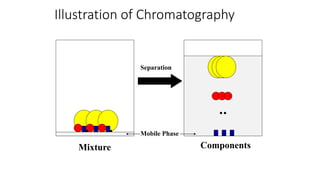
Illustration of Chromatography
Separation
Mobile Phase
Mixture Components
Examples of Chromatography
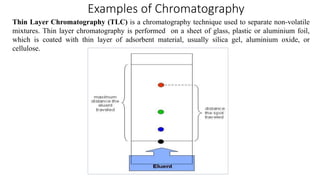
Thin Layer Chromatography (TLC) is a chromatography technique used to separate non-volatile
mixtures. Thin layer chromatography is performed on a sheet of glass, plastic or aluminium foil,
which is coated with thin layer of adsorbent material, usually silica gel, aluminium oxide, or
cellulose.
Examples of Chromatography
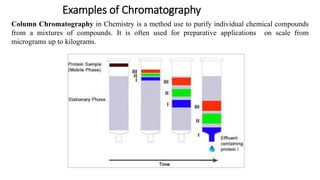
Column Chromatography in Chemistry is a method use to purify individual chemical compounds
from a mixtures of compounds. It is often used for preparative applications on scale from
micrograms up to kilograms.
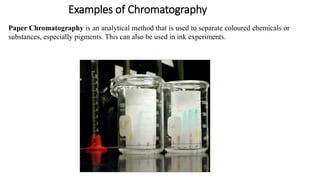
Paper Chromatography is an analytical method that is used to separate coloured chemicals or
substances, especially pigments. This can also be used in ink experiments.
Examples of Chromatography
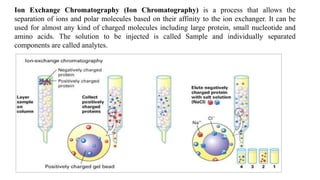
Ion Exchange Chromatography (Ion Chromatography) is a process that allows the
separation of ions and polar molecules based on their affinity to the ion exchanger. It can be
used for almost any kind of charged molecules including large protein, small nucleotide and
amino acids. The solution to be injected is called Sample and individually separated
components are called analytes.
Examples of Chromatography
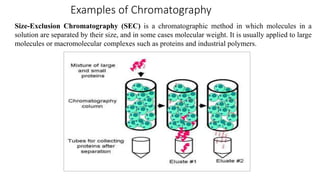
Size-Exclusion Chromatography (SEC) is a chromatographic method in which molecules in a
solution are separated by their size, and in some cases molecular weight. It is usually applied to large
molecules or macromolecular complexes such as proteins and industrial polymers.
Introduction
• The Term Chromatography (chroma = a colour; graphein = to write) is the collective term for a set
of laboratory techniques for the separation of mixtures.
• Chromatography involves a sample (or sample extract) being dissolved in a mobile phase (which
may be a gas, a liquid or a supercritical fluid).
• The mobile phase is then forced through an immobile, immiscible stationary phase.
• The phases are chosen such that components of the sample have differing solubilities in each
phase.
• A component which is quite soluble in the stationary phase will take longer to travel through it than
a component which is not very soluble in the stationary phase but very soluble in the mobile phase.
• As a result of these differences in mobilities, sample components will become separated from each
other as they travel through the stationary phase.
• Techniques such as H.P.L.C. (High Performance Liquid Chromatography) and G.C. (Gas
Chromatography) use columns - narrow tubes packed with stationary phase, through which the
mobile phase is forced.
• The sample is transported through the column by continuous addition of mobile phase. This process
is called elution.
History
• The subject of Chromatography was introduced into scientific world in a very modest
way by M. Tswett in 1906.
• He employed a technique to separate various pigments such as chlorophylls and
xanthophylls by passing the solution of these compounds into the glass column which was
packed with finely divided calcium carbonate.
• After the later, Thompson and Way had realized the Ion Exchange properties of soils.
• Almost after three decades, in 1935 Adams and Holmes observed the Ion Exchange
characteristics in crushed phonograph. This observation opened the field for preparation
of Ion Exchanged resins.
• The concept of Gas-Liquid Chromatography was first introduced by Martin and Synge in
1941.
• They were also responsible for the development in Liquid- Liquid chromatography.
• In 1944, from Martin laboratory, the separation of amino acid by paper chromatography
was reported.
• In 1952, the importance of the chromatography was observed when both Synge and Martin
were awarded with Nobel Prize.
• In 1959, a technique known as Gel Filtration chromatography was observed which is used
to separate low molecular weight substances from high molecular substances.
• In 1960, further improvement in liquid chromatography led to the development of High
Performance Liquid Chromatography.
• The following decade of 1970’s saw an improvement in the field of adsorption
chromatography in the form of Affinity chromatography which was mainly based on
biological interactions.
• A new field was originated which was supercritical fluid chromatography.
• Supercritical fluid chromatography is a hybrid of gas and liquid chromatography and
combine advantageous feature of the both gas and liquid chromatography.
• It will not be wrong to say that the entire twentieth century can be named as the century of
chromatography.
Classification Of Chromatography
On the basis of interaction of
solute to the stationary phase
On the basis of
chromatographic bed shape
On the basis of physical
state of mobile phase
Adsorption
Chromatography
Partition
Chromatography
Ion Exchange
Chromatography
Size Exclusion
Chromatography
Two
Dimensional
Three
Dimensional
Thin Layer
Chromatography
Paper
Chromatography
Column
Chromatography
Liquid
Chromatography
Gas
Chromatography
Super Critical
Fluid
Chromatography
On the basis of interaction of solute to the stationary
phase
Adsorption Chromatography
Partition Chromatography
Ion Exchange Chromatography
Size Exclusion Chromatography
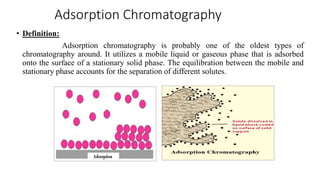
Adsorption Chromatography
• Definition:
Adsorption chromatography is probably one of the oldest types of
chromatography around. It utilizes a mobile liquid or gaseous phase that is adsorbed
onto the surface of a stationary solid phase. The equilibration between the mobile and
stationary phase accounts for the separation of different solutes.
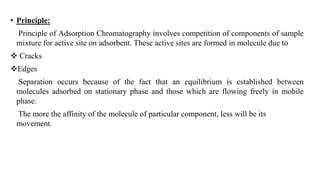
• Principle:
Principle of Adsorption Chromatography involves competition of components of sample
mixture for active site on adsorbent. These active sites are formed in molecule due to
 Cracks
Edges
Separation occurs because of the fact that an equilibrium is established between
molecules adsorbed on stationary phase and those which are flowing freely in mobile
phase.
The more the affinity of the molecule of particular component, less will be its
movement.
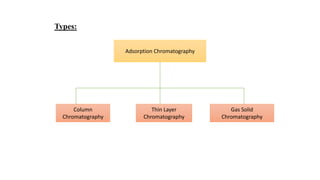
Adsorption Chromatography
Column
Chromatography
Thin Layer
Chromatography
Gas Solid
Chromatography
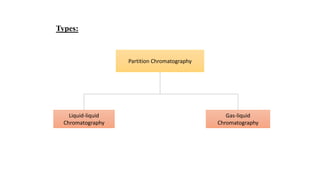
Types:
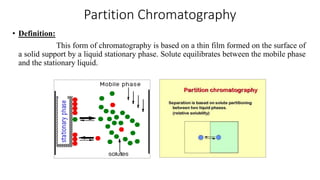
Partition Chromatography
• Definition:
This form of chromatography is based on a thin film formed on the surface of
a solid support by a liquid stationary phase. Solute equilibrates between the mobile phase
and the stationary liquid.
• Principle:
Separation of components of a sample mixture occurs because of partition. Stationary phase
is coated with a liquid which is immiscible in mobile phase.
Partition of component of sample between sample and liquid/ gas stationary phase retard
some components of sample more as compared to others. This gives basis for separation.
The stationary phase immobilizes the liquid surface layer, which becomes stationary phase.
Mobile phase passes over the coated adsorbent and depending upon relative solubility in the
coated liquid, separation occurs. The component of sample mixture appear separated
because of differences in their partition coefficient.
Partition Chromatography
Liquid-liquid
Chromatography
Gas-liquid
Chromatography
Types:
Ion Exchange Chromatography
• Definition:
Ion Exchange Chromatography (Ion Chromatography) is a process that
allows the separation of ions and polar molecules based on their affinity to the ion
exchanger. It can be used for almost any kind of charged molecules including large protein,
small nucleotide and amino acids. The solution to be injected is called Sample and
individually separated components are called analytes. It is often used in protein
purification, water analysis, and quality control.
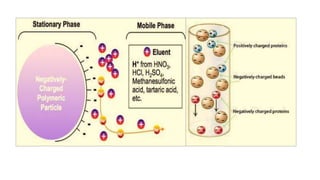
• Principle:
Ion Exchange Chromatography is based on the relative retention of the ions during their
progress through an ion exchange column which has functional group of opposite charge
attached to its surface. The stronger the charge on the ion, the greater is the retention
time in the column.
Ion chromatography is used to separate organic or inorganic charged substances. The
stationary phases used are based on typical ion exchange resins.
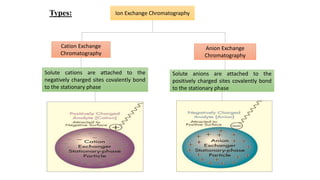
Ion Exchange Chromatography
Cation Exchange
Chromatography
Anion Exchange
Chromatography
Solute cations are attached to the
negatively charged sites covalently bond
to the stationary phase
Solute anions are attached to the
positively charged sites covalently bond
to the stationary phase
Types:
Size Exclusion Chromatography
• Definition:
Size-Exclusion Chromatography (SEC) is a chromatographic method in
which molecules in a solution are separated by their size, and in some cases molecular
weight. It is usually applied to large molecules or macromolecular complexes such as
proteins and industrial polymers. Typically, when an aqueous solution is used to
transport the sample through the column, the technique is known as gel-filtration
chromatography, versus the name gel- permeation chromatography, which is used
when an organic solvent is used as a mobile phase.
Size Exclusion Chromatography
• Principle:
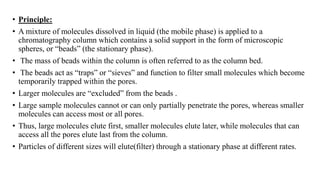
• A mixture of molecules dissolved in liquid (the mobile phase) is applied to a
chromatography column which contains a solid support in the form of microscopic
spheres, or “beads” (the stationary phase).
• The mass of beads within the column is often referred to as the column bed.
• The beads act as “traps” or “sieves” and function to filter small molecules which become
temporarily trapped within the pores.
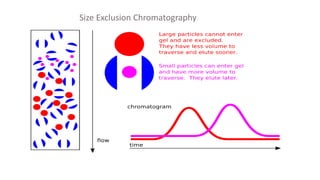
• Larger molecules are “excluded” from the beads .
• Large sample molecules cannot or can only partially penetrate the pores, whereas smaller
molecules can access most or all pores.
• Thus, large molecules elute first, smaller molecules elute later, while molecules that can
access all the pores elute last from the column.
• Particles of different sizes will elute(filter) through a stationary phase at different rates.
 Two dimensional
i. Thin Layer Chromatography
ii. Paper Chromatography
 Three dimensional
i. Column Chromatography
Thin Layer Chromatography
• Definition:
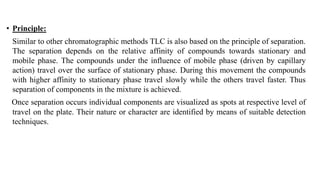
Thin-layer chromatography (TLC) is a chromatographic technique that is useful
for separating organic compounds. Because of the simplicity and rapidity of TLC, it is often
used to monitor the progress of organic reactions and to check the purity of products.
• Principle:
Similar to other chromatographic methods TLC is also based on the principle of separation.
The separation depends on the relative affinity of compounds towards stationary and
mobile phase. The compounds under the influence of mobile phase (driven by capillary
action) travel over the surface of stationary phase. During this movement the compounds
with higher affinity to stationary phase travel slowly while the others travel faster. Thus
separation of components in the mixture is achieved.
Once separation occurs individual components are visualized as spots at respective level of
travel on the plate. Their nature or character are identified by means of suitable detection
techniques.
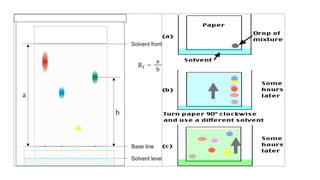
Paper Chromatography
• Definition:
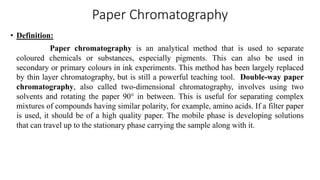
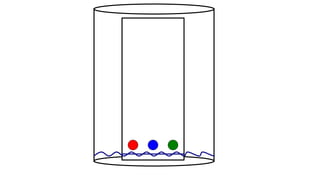
Paper chromatography is an analytical method that is used to separate
coloured chemicals or substances, especially pigments. This can also be used in
secondary or primary colours in ink experiments. This method has been largely replaced
by thin layer chromatography, but is still a powerful teaching tool. Double-way paper
chromatography, also called two-dimensional chromatography, involves using two
solvents and rotating the paper 90° in between. This is useful for separating complex
mixtures of compounds having similar polarity, for example, amino acids. If a filter paper
is used, it should be of a high quality paper. The mobile phase is developing solutions
that can travel up to the stationary phase carrying the sample along with it.
• Principle:
The principle involved is partition chromatography where in the substances are
distributed or partitioned between to liquid phases. One phase is the water which is held
in pores of filter paper used and other phase is that of mobile phase which moves over
the paper. The compounds in the mixture get separated due to differences in their affinity
towards water(in stationary phase) and mobile phase solvents during the movement of
mobile phase under the capillary action of pores in the paper.
The principle can also be adsorption chromatography between solid and liquid phases,
where in the stationary phase is the solid surface of paper and the liquid phase is of
mobile phase. But most of the applications of paper chromatography work on the
principle of partition chromatography i.e. partitioned between two liquid phases.
On the base of physical state of mobile phase
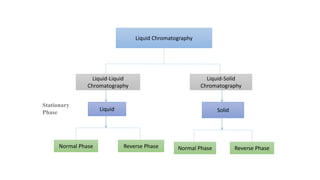
Liquid Chromatography
Gas Chromatography
Super Critical Fluid Chromatography
Liquid Chromatography
• Liquid chromatography is a technique used to separate a sample into its individual
parts. This separation occurs based on the interactions of the sample with the mobile
and stationary phases. Because there are many stationary/mobile phase combinations
that can be employed when separating a mixture, there are several different types of
chromatography that are classified based on the physical states of those phases.
Liquid-solid column chromatography, the most popular chromatography technique,
features a liquid mobile phase which slowly filters down through the solid stationary
phase, bringing the separated components with it.
Liquid Chromatography
Liquid-Liquid
Chromatography
Liquid-Solid
Chromatography
Stationary
Phase
Liquid Solid
Normal Phase Reverse Phase Normal Phase Reverse Phase
• Normal Phase Chromatography:
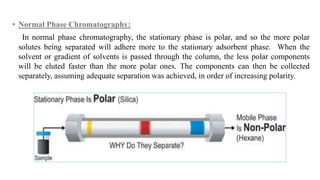
In normal phase chromatography, the stationary phase is polar, and so the more polar
solutes being separated will adhere more to the stationary adsorbent phase. When the
solvent or gradient of solvents is passed through the column, the less polar components
will be eluted faster than the more polar ones. The components can then be collected
separately, assuming adequate separation was achieved, in order of increasing polarity.
• Reverse Phase Chromatography:
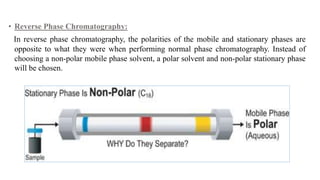
In reverse phase chromatography, the polarities of the mobile and stationary phases are
opposite to what they were when performing normal phase chromatography. Instead of
choosing a non-polar mobile phase solvent, a polar solvent and non-polar stationary phase
will be chosen.
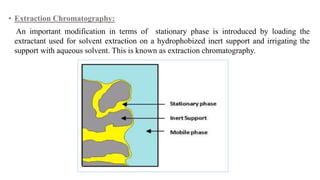
• Extraction Chromatography:
An important modification in terms of stationary phase is introduced by loading the
extractant used for solvent extraction on a hydrophobized inert support and irrigating the
support with aqueous solvent. This is known as extraction chromatography.
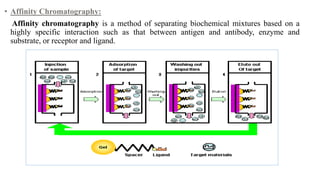
• Affinity Chromatography:
Affinity chromatography is a method of separating biochemical mixtures based on a
highly specific interaction such as that between antigen and antibody, enzyme and
substrate, or receptor and ligand.
• Principle:
The stationary phase is typically a gel matrix, often of agarose; a linear sugar molecule
derived from algae. Usually the starting point is an undefined heterogeneous group of
molecules in solution, such as a cell lysate, growth medium or blood serum. The
molecule of interest will have a well known and defined property, and can be exploited
during the affinity purification process. The process itself can be thought of as an
entrapment, with the target molecule becoming trapped on a solid or stationary phase or
medium. The other molecules in the mobile phase will not become trapped as they do not
possess this property. The stationary phase can then be removed from the mixture,
washed and the target molecule released from the entrapment in a process known as
elution. Possibly the most common use of affinity chromatography is for the purification
of recombinant proteins.
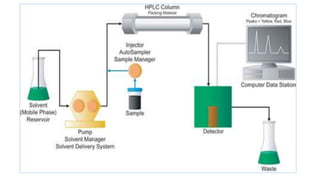
High Performance Liquid Chromatography
• High-performance liquid chromatography (HPLC; formerly referred to as high-
pressure liquid chromatography), is a technique in analytic chemistry used to separate
the components in a mixture, to identify each component, and to quantify each
component.
• It relies on pumps to pass a pressurized liquid solvent containing the sample mixture
through a column filled with a solid adsorbent material.
• Each component in the sample interacts slightly differently with the adsorbent material,
causing different flow rates for the different components and leading to the separation of
the components as they flow out the column.
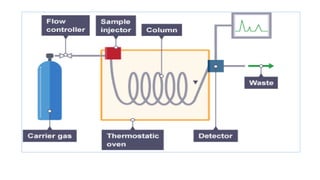
Gas Chromatography
• Gas chromatography (GC), is a common type of chromatography used in analytical
chemistry for separating & analyzing compounds that can
be vaporized without decomposition.
• Typical uses of GC include testing the purity of a particular substance, or separating the
different components of a mixture (the relative amounts of such components can also be
determined).
• In some situations, GC may help in identifying a compound. In preparative
chromatography, GC can be used to prepare pure compounds from a mixture.
• Two types of gas chromatography are encountered
a. Gas-Solid Chromatography (GSC)
b. Gas-Liquid Chromatography (GLC)
Supercritical Fluid Chromatography
• Supercritical Fluid Chromatography (SFC) is a form of normal phase
chromatography, that is used for the analysis and purification of low to moderate
molecular weight, thermally labile molecules.
• It can also be used for the separation of chiral compounds.
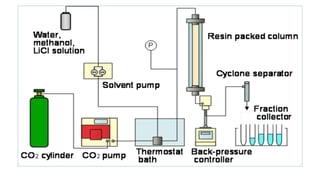
• Principles are similar to those of high performance liquid chromatography (HPLC),
however SFC typically utilizes carbon dioxide as the mobile phase; therefore the entire
chromatographic flow path must be pressurized.
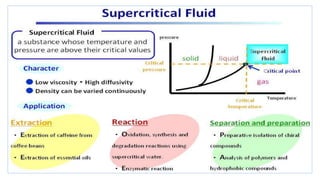
• The supercritical phase represents a state in which liquid and gas properties converge,
supercritical fluid chromatography is sometimes called "convergence chromatography."
Chromatography.666666666666666666666pptx

Chromatography.666666666666666666666pptx

  • 1.
  • 2.
    Chromatography • Chromatography isa method of separation in which the components to be separated are distributed between two phases, one of these is called a stationary phase and the other is a mobile phase which moves on stationary phase in a definite direction. The component of the mixture redistribute themselves between two phases by a process which may be adsorption, partition, ion exchange or size exclusion. • The stationary phase can be solid or a liquid and the mobile phase can be liquid, gas or a supercritical fluid.
  • 3.
  • 4.
    Examples of Chromatography ThinLayer Chromatography (TLC) is a chromatography technique used to separate non-volatile mixtures. Thin layer chromatography is performed on a sheet of glass, plastic or aluminium foil, which is coated with thin layer of adsorbent material, usually silica gel, aluminium oxide, or cellulose.
  • 5.
    Examples of Chromatography ColumnChromatography in Chemistry is a method use to purify individual chemical compounds from a mixtures of compounds. It is often used for preparative applications on scale from micrograms up to kilograms.
  • 6.
    Paper Chromatography isan analytical method that is used to separate coloured chemicals or substances, especially pigments. This can also be used in ink experiments. Examples of Chromatography
  • 7.
    Ion Exchange Chromatography(Ion Chromatography) is a process that allows the separation of ions and polar molecules based on their affinity to the ion exchanger. It can be used for almost any kind of charged molecules including large protein, small nucleotide and amino acids. The solution to be injected is called Sample and individually separated components are called analytes.
  • 8.
    Examples of Chromatography Size-ExclusionChromatography (SEC) is a chromatographic method in which molecules in a solution are separated by their size, and in some cases molecular weight. It is usually applied to large molecules or macromolecular complexes such as proteins and industrial polymers.
  • 9.
    Introduction • The TermChromatography (chroma = a colour; graphein = to write) is the collective term for a set of laboratory techniques for the separation of mixtures. • Chromatography involves a sample (or sample extract) being dissolved in a mobile phase (which may be a gas, a liquid or a supercritical fluid). • The mobile phase is then forced through an immobile, immiscible stationary phase. • The phases are chosen such that components of the sample have differing solubilities in each phase. • A component which is quite soluble in the stationary phase will take longer to travel through it than a component which is not very soluble in the stationary phase but very soluble in the mobile phase. • As a result of these differences in mobilities, sample components will become separated from each other as they travel through the stationary phase. • Techniques such as H.P.L.C. (High Performance Liquid Chromatography) and G.C. (Gas Chromatography) use columns - narrow tubes packed with stationary phase, through which the mobile phase is forced. • The sample is transported through the column by continuous addition of mobile phase. This process is called elution.
  • 10.
    History • The subjectof Chromatography was introduced into scientific world in a very modest way by M. Tswett in 1906. • He employed a technique to separate various pigments such as chlorophylls and xanthophylls by passing the solution of these compounds into the glass column which was packed with finely divided calcium carbonate. • After the later, Thompson and Way had realized the Ion Exchange properties of soils. • Almost after three decades, in 1935 Adams and Holmes observed the Ion Exchange characteristics in crushed phonograph. This observation opened the field for preparation of Ion Exchanged resins. • The concept of Gas-Liquid Chromatography was first introduced by Martin and Synge in 1941. • They were also responsible for the development in Liquid- Liquid chromatography.
  • 11.
    • In 1944,from Martin laboratory, the separation of amino acid by paper chromatography was reported. • In 1952, the importance of the chromatography was observed when both Synge and Martin were awarded with Nobel Prize. • In 1959, a technique known as Gel Filtration chromatography was observed which is used to separate low molecular weight substances from high molecular substances. • In 1960, further improvement in liquid chromatography led to the development of High Performance Liquid Chromatography. • The following decade of 1970’s saw an improvement in the field of adsorption chromatography in the form of Affinity chromatography which was mainly based on biological interactions. • A new field was originated which was supercritical fluid chromatography. • Supercritical fluid chromatography is a hybrid of gas and liquid chromatography and combine advantageous feature of the both gas and liquid chromatography. • It will not be wrong to say that the entire twentieth century can be named as the century of chromatography.
  • 12.
    Classification Of Chromatography Onthe basis of interaction of solute to the stationary phase On the basis of chromatographic bed shape On the basis of physical state of mobile phase Adsorption Chromatography Partition Chromatography Ion Exchange Chromatography Size Exclusion Chromatography Two Dimensional Three Dimensional Thin Layer Chromatography Paper Chromatography Column Chromatography Liquid Chromatography Gas Chromatography Super Critical Fluid Chromatography
  • 13.
    On the basisof interaction of solute to the stationary phase Adsorption Chromatography Partition Chromatography Ion Exchange Chromatography Size Exclusion Chromatography
  • 14.
    Adsorption Chromatography • Definition: Adsorptionchromatography is probably one of the oldest types of chromatography around. It utilizes a mobile liquid or gaseous phase that is adsorbed onto the surface of a stationary solid phase. The equilibration between the mobile and stationary phase accounts for the separation of different solutes.
  • 15.
    • Principle: Principle ofAdsorption Chromatography involves competition of components of sample mixture for active site on adsorbent. These active sites are formed in molecule due to  Cracks Edges Separation occurs because of the fact that an equilibrium is established between molecules adsorbed on stationary phase and those which are flowing freely in mobile phase. The more the affinity of the molecule of particular component, less will be its movement.
  • 16.
  • 17.
    Partition Chromatography • Definition: Thisform of chromatography is based on a thin film formed on the surface of a solid support by a liquid stationary phase. Solute equilibrates between the mobile phase and the stationary liquid.
  • 18.
    • Principle: Separation ofcomponents of a sample mixture occurs because of partition. Stationary phase is coated with a liquid which is immiscible in mobile phase. Partition of component of sample between sample and liquid/ gas stationary phase retard some components of sample more as compared to others. This gives basis for separation. The stationary phase immobilizes the liquid surface layer, which becomes stationary phase. Mobile phase passes over the coated adsorbent and depending upon relative solubility in the coated liquid, separation occurs. The component of sample mixture appear separated because of differences in their partition coefficient.
  • 19.
  • 20.
    Ion Exchange Chromatography •Definition: Ion Exchange Chromatography (Ion Chromatography) is a process that allows the separation of ions and polar molecules based on their affinity to the ion exchanger. It can be used for almost any kind of charged molecules including large protein, small nucleotide and amino acids. The solution to be injected is called Sample and individually separated components are called analytes. It is often used in protein purification, water analysis, and quality control.
  • 22.
    • Principle: Ion ExchangeChromatography is based on the relative retention of the ions during their progress through an ion exchange column which has functional group of opposite charge attached to its surface. The stronger the charge on the ion, the greater is the retention time in the column. Ion chromatography is used to separate organic or inorganic charged substances. The stationary phases used are based on typical ion exchange resins.
  • 23.
    Ion Exchange Chromatography CationExchange Chromatography Anion Exchange Chromatography Solute cations are attached to the negatively charged sites covalently bond to the stationary phase Solute anions are attached to the positively charged sites covalently bond to the stationary phase Types:
  • 24.
    Size Exclusion Chromatography •Definition: Size-Exclusion Chromatography (SEC) is a chromatographic method in which molecules in a solution are separated by their size, and in some cases molecular weight. It is usually applied to large molecules or macromolecular complexes such as proteins and industrial polymers. Typically, when an aqueous solution is used to transport the sample through the column, the technique is known as gel-filtration chromatography, versus the name gel- permeation chromatography, which is used when an organic solvent is used as a mobile phase.
  • 25.
  • 26.
    • Principle: • Amixture of molecules dissolved in liquid (the mobile phase) is applied to a chromatography column which contains a solid support in the form of microscopic spheres, or “beads” (the stationary phase). • The mass of beads within the column is often referred to as the column bed. • The beads act as “traps” or “sieves” and function to filter small molecules which become temporarily trapped within the pores. • Larger molecules are “excluded” from the beads . • Large sample molecules cannot or can only partially penetrate the pores, whereas smaller molecules can access most or all pores. • Thus, large molecules elute first, smaller molecules elute later, while molecules that can access all the pores elute last from the column. • Particles of different sizes will elute(filter) through a stationary phase at different rates.
  • 27.
     Two dimensional i.Thin Layer Chromatography ii. Paper Chromatography  Three dimensional i. Column Chromatography
  • 28.
    Thin Layer Chromatography •Definition: Thin-layer chromatography (TLC) is a chromatographic technique that is useful for separating organic compounds. Because of the simplicity and rapidity of TLC, it is often used to monitor the progress of organic reactions and to check the purity of products.
  • 29.
    • Principle: Similar toother chromatographic methods TLC is also based on the principle of separation. The separation depends on the relative affinity of compounds towards stationary and mobile phase. The compounds under the influence of mobile phase (driven by capillary action) travel over the surface of stationary phase. During this movement the compounds with higher affinity to stationary phase travel slowly while the others travel faster. Thus separation of components in the mixture is achieved. Once separation occurs individual components are visualized as spots at respective level of travel on the plate. Their nature or character are identified by means of suitable detection techniques.
  • 30.
    Paper Chromatography • Definition: Paperchromatography is an analytical method that is used to separate coloured chemicals or substances, especially pigments. This can also be used in secondary or primary colours in ink experiments. This method has been largely replaced by thin layer chromatography, but is still a powerful teaching tool. Double-way paper chromatography, also called two-dimensional chromatography, involves using two solvents and rotating the paper 90° in between. This is useful for separating complex mixtures of compounds having similar polarity, for example, amino acids. If a filter paper is used, it should be of a high quality paper. The mobile phase is developing solutions that can travel up to the stationary phase carrying the sample along with it.
  • 32.
    • Principle: The principleinvolved is partition chromatography where in the substances are distributed or partitioned between to liquid phases. One phase is the water which is held in pores of filter paper used and other phase is that of mobile phase which moves over the paper. The compounds in the mixture get separated due to differences in their affinity towards water(in stationary phase) and mobile phase solvents during the movement of mobile phase under the capillary action of pores in the paper. The principle can also be adsorption chromatography between solid and liquid phases, where in the stationary phase is the solid surface of paper and the liquid phase is of mobile phase. But most of the applications of paper chromatography work on the principle of partition chromatography i.e. partitioned between two liquid phases.
  • 34.
    On the baseof physical state of mobile phase Liquid Chromatography Gas Chromatography Super Critical Fluid Chromatography
  • 35.
    Liquid Chromatography • Liquidchromatography is a technique used to separate a sample into its individual parts. This separation occurs based on the interactions of the sample with the mobile and stationary phases. Because there are many stationary/mobile phase combinations that can be employed when separating a mixture, there are several different types of chromatography that are classified based on the physical states of those phases. Liquid-solid column chromatography, the most popular chromatography technique, features a liquid mobile phase which slowly filters down through the solid stationary phase, bringing the separated components with it.
  • 36.
  • 37.
    • Normal PhaseChromatography: In normal phase chromatography, the stationary phase is polar, and so the more polar solutes being separated will adhere more to the stationary adsorbent phase. When the solvent or gradient of solvents is passed through the column, the less polar components will be eluted faster than the more polar ones. The components can then be collected separately, assuming adequate separation was achieved, in order of increasing polarity.
  • 38.
    • Reverse PhaseChromatography: In reverse phase chromatography, the polarities of the mobile and stationary phases are opposite to what they were when performing normal phase chromatography. Instead of choosing a non-polar mobile phase solvent, a polar solvent and non-polar stationary phase will be chosen.
  • 39.
    • Extraction Chromatography: Animportant modification in terms of stationary phase is introduced by loading the extractant used for solvent extraction on a hydrophobized inert support and irrigating the support with aqueous solvent. This is known as extraction chromatography.
  • 40.
    • Affinity Chromatography: Affinitychromatography is a method of separating biochemical mixtures based on a highly specific interaction such as that between antigen and antibody, enzyme and substrate, or receptor and ligand.
  • 41.
    • Principle: The stationaryphase is typically a gel matrix, often of agarose; a linear sugar molecule derived from algae. Usually the starting point is an undefined heterogeneous group of molecules in solution, such as a cell lysate, growth medium or blood serum. The molecule of interest will have a well known and defined property, and can be exploited during the affinity purification process. The process itself can be thought of as an entrapment, with the target molecule becoming trapped on a solid or stationary phase or medium. The other molecules in the mobile phase will not become trapped as they do not possess this property. The stationary phase can then be removed from the mixture, washed and the target molecule released from the entrapment in a process known as elution. Possibly the most common use of affinity chromatography is for the purification of recombinant proteins.
  • 42.
    High Performance LiquidChromatography • High-performance liquid chromatography (HPLC; formerly referred to as high- pressure liquid chromatography), is a technique in analytic chemistry used to separate the components in a mixture, to identify each component, and to quantify each component. • It relies on pumps to pass a pressurized liquid solvent containing the sample mixture through a column filled with a solid adsorbent material. • Each component in the sample interacts slightly differently with the adsorbent material, causing different flow rates for the different components and leading to the separation of the components as they flow out the column.
  • 44.
    Gas Chromatography • Gaschromatography (GC), is a common type of chromatography used in analytical chemistry for separating & analyzing compounds that can be vaporized without decomposition. • Typical uses of GC include testing the purity of a particular substance, or separating the different components of a mixture (the relative amounts of such components can also be determined). • In some situations, GC may help in identifying a compound. In preparative chromatography, GC can be used to prepare pure compounds from a mixture. • Two types of gas chromatography are encountered a. Gas-Solid Chromatography (GSC) b. Gas-Liquid Chromatography (GLC)
  • 46.
    Supercritical Fluid Chromatography •Supercritical Fluid Chromatography (SFC) is a form of normal phase chromatography, that is used for the analysis and purification of low to moderate molecular weight, thermally labile molecules. • It can also be used for the separation of chiral compounds. • Principles are similar to those of high performance liquid chromatography (HPLC), however SFC typically utilizes carbon dioxide as the mobile phase; therefore the entire chromatographic flow path must be pressurized. • The supercritical phase represents a state in which liquid and gas properties converge, supercritical fluid chromatography is sometimes called "convergence chromatography."