GROWTH AND
DEVELOPMENT
VEGETATIVE GROWTH AND
            DEVELOPMENT
   Shoot and Root Systems
       Crop plants must yield for profit
   Root functions
       Anchor
       Absorb
       Conduct
       Store

    As the shoot system enlarges, the root system must
      also increase to meet demands of leaves/stems
MEASURING GROWTH

   Increase in fresh weight
   Increase in dry weight
   Volume
   Length
   Height
   Surface area
MEASURING GROWTH

   Definition:

       Size increase by cell division and enlargement,
        including synthesis of new cellular material and
        organization of subcellular organelles.
MEASURING GROWTH

   Classifying shoot growth

       Determinate – flower buds initiate terminally;
        shoot elongation stops; e.g. bush snap beans
       Indeterminate – flower buds born laterally;
        shoot terminals remain vegetative; e.g. pole beans
SHOOT GROWTH PATTERNS

   Annuals

       Herbaceous (nonwoody) plants
       Complete life cycle in one growing season
       See general growth curve; fig. 9-1
           Note times of flower initiation
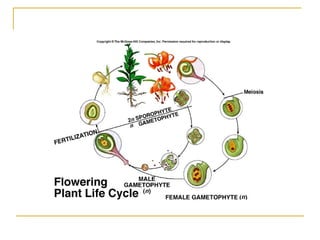
       See life cycle of angiosperm annual; fig. 9-3
           Note events over 120-day period
SHOOT GROWTH PATTERNS

   Biennials

       Herbaceous plants
       Require two growing seasons to complete their
        life cycle (not necessarily two full years)
       Stem growth limited during first growing season;
        see fig. 9-4; Note vegetative growth vs. flowering
        e.g. celery, beets, cabbage, Brussels sprouts
SHOOT GROWTH PATTERNS

   Perennials

       Either herbaceous or woody
       Herbaceous roots live indefinitely (shoots can)
           Shoot growth resumes in spring from adventitious buds in
            crown
           Many grown as annuals
       Woody roots and shoots live indefinitely
           Growth varies with annual environment and zone
           Pronounced diurnal variation in shoot growth; night greater
ROOT GROWTH PATTERNS

   Variation in pattern with species and season
   Growth peaks in spring, late summer/early fall
       Spring growth from previous year’s foods
       Fall growth from summer’s accumulated foods
   Some species roots grow during winter
   Some species have some roots ‘resting’ while,
    in the same plant, others are growing
HOW PLANTS GROW

   Meristems
       Dicots
           Apical meristems – vegetative buds
               shoot tips
               axils of leaves
           Cells divide/redivide by mitosis/cytokinesis
           Cell division/elongation causes shoot growth
           Similar meristematic cells at root tips
HOW PLANTS GROW

   Meristems (cont)

        Secondary growth in woody perennials
            Increase in diameter
              due to meristematic regions
            vascular cambium
              xylem to inside, phloem to outside
            cork cambium
              external to vascular cambium
              produces cork in the bark layer
GENETIC FACTORS AFFECTING
GROWTH AND DEVELOPMENT
   DNA directs growth and differentiation
       Enzymes catalyze biochemical reactions
   Structural genes
       Genes involved in protein synthesis
   Operator genes
       Regulate structural genes
   Regulatory genes
       Regulate operator genes
GENETIC FACTORS AFFECTING
GROWTH AND DEVELOPMENT
   What signals trigger these genes?

       Believed to include:
           Growth regulators
           Inorganic ions
           Coenzymes
           Environmental factors; e.g. temperature, light

           Therefore . . .
               Genetics directs the final form and size of the plant as
                altered by the environment
ENVIRONMENTAL FACTORS
INFLUENCING PLANT GROWTH
   Light
   Temperature
   Water
   Gases
ENVIRONMENTAL FACTORS
INFLUENCING PLANT GROWTH
   Light
       Sun’s radiation
           not all reaches earth; atmosphere absorbs much
           visible (and some invisible) rays pass, warming surface
           reradiation warms atmosphere
       Intensity
           high in deserts; no clouds, dry air
           low in cloudy, humid regions
           earth tilted on axis; rays strike more directly in summer
           day length varies during year due to tilt
ENVIRONMENTAL FACTORS
INFLUENCING PLANT GROWTH
   Light (cont)
       narrow band affects plant photoreaction processes
       PAR (Photosynthetically Active Radiation)
           400-700nm
       stomates regulated by red (660nm), blue (440nm)
       photomorphogenesis – shape determined by light
           controlled by pigment phytochrome
           phytochrome absorbs red (660nm) and far-red (730nm)
            but not at same time
           pigment changes form as it absorbs each wavelength
ENVIRONMENTAL FACTORS
INFLUENCING PLANT GROWTH
   Light (cont)
       importance of phytochrome in plant responses
           plants detect ratio of red:far-red light
           red light – full sun
               yields sturdy, branched, compact, dark green plants
           far-red light – crowded, shaded fields/greenhouses
               plants tall, spindly, weak, few branches; leaves light green
ENVIRONMENTAL FACTORS
INFLUENCING PLANT GROWTH
   Light (cont)
       Phototropism – movement toward light
           hormone auxin accumulates on shaded side
           cell growth from auxin effect bends plant
           blue light most active in process
           pigment uncertain
ENVIRONMENTAL FACTORS
INFLUENCING PLANT GROWTH
   Light (cont)
       Photoperiodism – response to varying length of
        light and dark
           shorter days (longer nights)
               onset of dormancy
               fall leaf color
               flower initiation in strawberry, poinsettia, chrysanthemum
               tubers/tuberous roots begin to form
           longer days (shorter nights)
               bulbs of onion begin to form
               flower initiation in spinach, sugar beets, winter barley
ENVIRONMENTAL FACTORS
INFLUENCING PLANT GROWTH
   Temperature
       correlates with seasonal variation of light intensity
       temperate-region growth between 39°F and 122°F
       high light intensity creates heat; sunburned
       low temp injury associated with frosts; heat loss
        by radiation contributes
           opaque cover reduces radiation heat loss
           burning smudge pots radiate heat to citrus trees
           wind machines circulate warm air from temperature
            inversions
ENVIRONMENTAL FACTORS
INFLUENCING PLANT GROWTH
   Water
       most growing plants contain about 90% water
       amount needed for growth varies with plant and
        light intensity
       transpiration drives water uptake from soil
           water pulled through xylem
           exits via stomates
       evapotranspiration - total loss of water from soil
           loss from soil evaporation and plant transpiration
ENVIRONMENTAL FACTORS
INFLUENCING PLANT GROWTH
   Gases
       Nitrogen is most abundant
       Oxygen and carbon dioxide are most important
           plants use CO2 for photosynthesis; give off O2
           plants use O2 for respiration; give off CO2
           stomatal opening and closing related to CO2 levels?
           oxygen for respiration limited in waterlogged soils
           increased CO2 levels in atmosphere associated with
            global warming
           additional pollutants harm plants
PHASE CHANGE: JUVENILITY,
MATURATION, SENESCENCE
   Phasic development
       embryonic growth
       juvenility
       transition stage
       maturity
       senescence
       death
   During maturation, seedlings of many woody
    perennials differ strikingly in appearance at
    various stages of development
PHASE CHANGE: JUVENILITY,
MATURATION, SENESCENCE
   Juvenility
       terminated by flowering and fruiting
       may be extensive in certain forest species
   Maturity
       loss or reduction in ability of cuttings to form adventitious
        roots
   Physiologically related
       lower part of plant may be oldest chronologically, yet be
        youngest physiologically (e.g. some woody plants)
       top part of plant may be youngest in days, yet develop into
        the part that matures and bears flowers and fruit
AGING AND SENESCENCE
   Life spans among plants differ greatly
       range from few months to thousands of years
           e.g. bristlecone pine (over 4000 years old)
           e.g. California redwoods (over 3000 years old)
       clones should be able to exist indefinately
   Senescence
       a physiological aging process in which tissues in an
        organism deteriorate and finally die
       considered to be terminal, irreversible
       can be postponed by removing flowers before seeds start
        to form
REPRODUCTIVE GROWTH
AND DEVELOPMENT
   Phases
       Flower induction and initiation
       Flower differentiation and development
       Pollination
       Fertilization
       Fruit set and seed formation
       Growth and maturation of fruit and seed
       Fruit senescence
REPRODUCTIVE GROWTH
AND DEVELOPMENT
   Flower induction and initiation

       What causes a plant to flower?

           Daylength (photoperiod)

           Low temperatures (vernalization)

           Neither
REPRODUCTIVE GROWTH
AND DEVELOPMENT
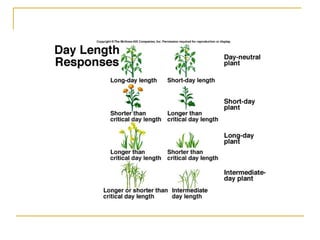
   Photoperiodism (see table 9-5)
       Short-day plants (long-night; need darkness)
       Long-day plants (need sufficient light)
       Day-neutral plants (flowering unaffected by period)
   Change from vegetative to reproductive
   Manipulations enable year-round production
       Market may dictate; consumer’s expectations
        associated with seasons, e.g. poinsettias at
        Christmas
REPRODUCTIVE GROWTH
AND DEVELOPMENT
   Photoperiodism (cont)
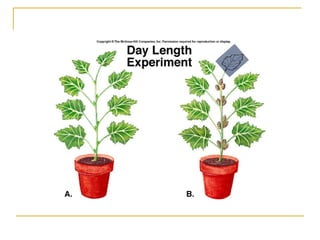
       Stimulus transported from leaves to meristems
           Cocklebur
           Leaf removal – failed to flower
           Isolated leaf, dark exposure – flowering initiated
       Believed to be hormone related
       Interruption of night with light affects flowering
           Cocklebur
           Red light, 660 nm, inhibits
           Far-red, 730 nm, restores
           Discovery of Phytochrome
REPRODUCTIVE GROWTH
AND DEVELOPMENT
   Low temperature induction
   Vernalization
       “making ready for spring”
       Any temperature treatment that induces or
        promotes flowering
       First observed in winter wheat; many biennials
       Temperature and exposure varies among species
       Note difference/relationship to dormancy
        Many plants do not respond to changed
        daylength or low temperature; agricultural
REPRODUCTIVE GROWTH
AND DEVELOPMENT

   Flower development
       Stimulus from leaves to apical meristem changes
        vegetative to flowering
       Some SDPs require only limited stimulus to
        induce flowering; e.g. cocklebur – one day (night)
       Once changed the process is not reversible
       Environmental conditions must be favorable for
        full flower development
REPRODUCTIVE GROWTH
AND DEVELOPMENT

   Pollination
       Transfer of pollen from anther to stigma
       May be:
           Same flower (self-pollination)
           Different flowers, but same plant (self-pollination)
           Different flowers/plants, same cultivar (self-pollination)
           Different flowers, different cultivars (cross-pollination)
REPRODUCTIVE GROWTH
AND DEVELOPMENT

   Self-fertile plant produces fruit and seed with
    its own pollen
   Self-sterile plant requires pollen from another
    cultivar to set fruit and seed
       Often due to incompatibility; pollen will not grow
        through style to embryo sac
       Sometimes cross-pollination incompatibility
REPRODUCTIVE GROWTH
AND DEVELOPMENT
   Pollen transferred by:
       Insects; chiefly honeybees
           Bright flowers
           Attractive nectar
       Wind
           Important for plants with inconspicuous flowers
           e.g. grasses, cereal grain crops, forest tree species, some
            fruit and nut crops
       Other minor agents – water, snails, slugs, birds, bats
REPRODUCTIVE GROWTH
AND DEVELOPMENT
   What if pollination and fertilization fail to
    occur?
   Fruit and seed don’t develop
   Exception: Parthenocarpy
       Formation of fruit without pollination/fertilization
       Parthenocarpic fruit are seedless
           e.g. ‘Washington Navel’ orange, many fig cultivars
       Note: not all seedless fruits are parthenocarpic
           Certain seedless grapes – fruit forms but embryo aborts
REPRODUCTIVE GROWTH
AND DEVELOPMENT

   Fertilization
       Angiosperms (flowering plants)
           Termed double fertilization
       Gymnosperms (cone-bearing plants)
           Staminate, pollen-producing cones
           Ovulate cones produce “naked” seed on cone scales
REPRODUCTIVE GROWTH
AND DEVELOPMENT
   Fruit setting
       Accessory tissues often involved
           e.g. enlarged, fleshy receptacle of apple and pear
           True fruit is enlarged ovary
       Not all flowers develop into fruit
       Certain plant hormones involved
       Optimum level of fruit setting
           Remove excess by hand, machine, or chemical
           Some species self-thinning; Washington Navel Orange
       Temperature strongly influences fruit set
REPRODUCTIVE GROWTH
AND DEVELOPMENT

   Fruit growth and development
       After set, true fruit and associated tissues begin to
        grow
       Food moves from other plant parts into fruit tissue
       Hormones from seeds and fruit affect growth
       Auxin relation in strawberry fruits
       Gibberellins in grape (fig. 9-21, 9-22)
       Patterns of growth vary with fruits (fig. 9-16, 9-17)
PLANT GROWTH REGULATORS

   Plant hormones are natural
   Plant growth regulators include:
       Plant hormones (natural)
       Plant hormones (synthetic)
       Non-nutrient chemicals
   Five groups of natural plant hormones:
       Auxins, Gibberellins, Cytokinins, Ethylene, and
        Abscisic acid

Chp9 growthanddevelopment

  • 1.
  • 2.
    VEGETATIVE GROWTH AND DEVELOPMENT  Shoot and Root Systems  Crop plants must yield for profit  Root functions  Anchor  Absorb  Conduct  Store As the shoot system enlarges, the root system must also increase to meet demands of leaves/stems
  • 3.
    MEASURING GROWTH  Increase in fresh weight  Increase in dry weight  Volume  Length  Height  Surface area
  • 4.
    MEASURING GROWTH  Definition:  Size increase by cell division and enlargement, including synthesis of new cellular material and organization of subcellular organelles.
  • 5.
    MEASURING GROWTH  Classifying shoot growth  Determinate – flower buds initiate terminally; shoot elongation stops; e.g. bush snap beans  Indeterminate – flower buds born laterally; shoot terminals remain vegetative; e.g. pole beans
  • 6.
    SHOOT GROWTH PATTERNS  Annuals  Herbaceous (nonwoody) plants  Complete life cycle in one growing season  See general growth curve; fig. 9-1  Note times of flower initiation  See life cycle of angiosperm annual; fig. 9-3  Note events over 120-day period
  • 8.
    SHOOT GROWTH PATTERNS  Biennials  Herbaceous plants  Require two growing seasons to complete their life cycle (not necessarily two full years)  Stem growth limited during first growing season; see fig. 9-4; Note vegetative growth vs. flowering e.g. celery, beets, cabbage, Brussels sprouts
  • 9.
    SHOOT GROWTH PATTERNS  Perennials  Either herbaceous or woody  Herbaceous roots live indefinitely (shoots can)  Shoot growth resumes in spring from adventitious buds in crown  Many grown as annuals  Woody roots and shoots live indefinitely  Growth varies with annual environment and zone  Pronounced diurnal variation in shoot growth; night greater
  • 10.
    ROOT GROWTH PATTERNS  Variation in pattern with species and season  Growth peaks in spring, late summer/early fall  Spring growth from previous year’s foods  Fall growth from summer’s accumulated foods  Some species roots grow during winter  Some species have some roots ‘resting’ while, in the same plant, others are growing
  • 11.
    HOW PLANTS GROW  Meristems  Dicots  Apical meristems – vegetative buds  shoot tips  axils of leaves  Cells divide/redivide by mitosis/cytokinesis  Cell division/elongation causes shoot growth  Similar meristematic cells at root tips
  • 12.
    HOW PLANTS GROW  Meristems (cont)  Secondary growth in woody perennials  Increase in diameter  due to meristematic regions  vascular cambium  xylem to inside, phloem to outside  cork cambium  external to vascular cambium  produces cork in the bark layer
  • 13.
    GENETIC FACTORS AFFECTING GROWTHAND DEVELOPMENT  DNA directs growth and differentiation  Enzymes catalyze biochemical reactions  Structural genes  Genes involved in protein synthesis  Operator genes  Regulate structural genes  Regulatory genes  Regulate operator genes
  • 14.
    GENETIC FACTORS AFFECTING GROWTHAND DEVELOPMENT  What signals trigger these genes?  Believed to include:  Growth regulators  Inorganic ions  Coenzymes  Environmental factors; e.g. temperature, light  Therefore . . .  Genetics directs the final form and size of the plant as altered by the environment
  • 15.
    ENVIRONMENTAL FACTORS INFLUENCING PLANTGROWTH  Light  Temperature  Water  Gases
  • 16.
    ENVIRONMENTAL FACTORS INFLUENCING PLANTGROWTH  Light  Sun’s radiation  not all reaches earth; atmosphere absorbs much  visible (and some invisible) rays pass, warming surface  reradiation warms atmosphere  Intensity  high in deserts; no clouds, dry air  low in cloudy, humid regions  earth tilted on axis; rays strike more directly in summer  day length varies during year due to tilt
  • 17.
    ENVIRONMENTAL FACTORS INFLUENCING PLANTGROWTH  Light (cont)  narrow band affects plant photoreaction processes  PAR (Photosynthetically Active Radiation)  400-700nm  stomates regulated by red (660nm), blue (440nm)  photomorphogenesis – shape determined by light  controlled by pigment phytochrome  phytochrome absorbs red (660nm) and far-red (730nm) but not at same time  pigment changes form as it absorbs each wavelength
  • 18.
    ENVIRONMENTAL FACTORS INFLUENCING PLANTGROWTH  Light (cont)  importance of phytochrome in plant responses  plants detect ratio of red:far-red light  red light – full sun  yields sturdy, branched, compact, dark green plants  far-red light – crowded, shaded fields/greenhouses  plants tall, spindly, weak, few branches; leaves light green
  • 19.
    ENVIRONMENTAL FACTORS INFLUENCING PLANTGROWTH  Light (cont)  Phototropism – movement toward light  hormone auxin accumulates on shaded side  cell growth from auxin effect bends plant  blue light most active in process  pigment uncertain
  • 20.
    ENVIRONMENTAL FACTORS INFLUENCING PLANTGROWTH  Light (cont)  Photoperiodism – response to varying length of light and dark  shorter days (longer nights)  onset of dormancy  fall leaf color  flower initiation in strawberry, poinsettia, chrysanthemum  tubers/tuberous roots begin to form  longer days (shorter nights)  bulbs of onion begin to form  flower initiation in spinach, sugar beets, winter barley
  • 21.
    ENVIRONMENTAL FACTORS INFLUENCING PLANTGROWTH  Temperature  correlates with seasonal variation of light intensity  temperate-region growth between 39°F and 122°F  high light intensity creates heat; sunburned  low temp injury associated with frosts; heat loss by radiation contributes  opaque cover reduces radiation heat loss  burning smudge pots radiate heat to citrus trees  wind machines circulate warm air from temperature inversions
  • 22.
    ENVIRONMENTAL FACTORS INFLUENCING PLANTGROWTH  Water  most growing plants contain about 90% water  amount needed for growth varies with plant and light intensity  transpiration drives water uptake from soil  water pulled through xylem  exits via stomates  evapotranspiration - total loss of water from soil  loss from soil evaporation and plant transpiration
  • 23.
    ENVIRONMENTAL FACTORS INFLUENCING PLANTGROWTH  Gases  Nitrogen is most abundant  Oxygen and carbon dioxide are most important  plants use CO2 for photosynthesis; give off O2  plants use O2 for respiration; give off CO2  stomatal opening and closing related to CO2 levels?  oxygen for respiration limited in waterlogged soils  increased CO2 levels in atmosphere associated with global warming  additional pollutants harm plants
  • 24.
    PHASE CHANGE: JUVENILITY, MATURATION,SENESCENCE  Phasic development  embryonic growth  juvenility  transition stage  maturity  senescence  death  During maturation, seedlings of many woody perennials differ strikingly in appearance at various stages of development
  • 25.
    PHASE CHANGE: JUVENILITY, MATURATION,SENESCENCE  Juvenility  terminated by flowering and fruiting  may be extensive in certain forest species  Maturity  loss or reduction in ability of cuttings to form adventitious roots  Physiologically related  lower part of plant may be oldest chronologically, yet be youngest physiologically (e.g. some woody plants)  top part of plant may be youngest in days, yet develop into the part that matures and bears flowers and fruit
  • 26.
    AGING AND SENESCENCE  Life spans among plants differ greatly  range from few months to thousands of years  e.g. bristlecone pine (over 4000 years old)  e.g. California redwoods (over 3000 years old)  clones should be able to exist indefinately  Senescence  a physiological aging process in which tissues in an organism deteriorate and finally die  considered to be terminal, irreversible  can be postponed by removing flowers before seeds start to form
  • 27.
    REPRODUCTIVE GROWTH AND DEVELOPMENT  Phases  Flower induction and initiation  Flower differentiation and development  Pollination  Fertilization  Fruit set and seed formation  Growth and maturation of fruit and seed  Fruit senescence
  • 28.
    REPRODUCTIVE GROWTH AND DEVELOPMENT  Flower induction and initiation  What causes a plant to flower?  Daylength (photoperiod)  Low temperatures (vernalization)  Neither
  • 29.
    REPRODUCTIVE GROWTH AND DEVELOPMENT  Photoperiodism (see table 9-5)  Short-day plants (long-night; need darkness)  Long-day plants (need sufficient light)  Day-neutral plants (flowering unaffected by period)  Change from vegetative to reproductive  Manipulations enable year-round production  Market may dictate; consumer’s expectations associated with seasons, e.g. poinsettias at Christmas
  • 31.
    REPRODUCTIVE GROWTH AND DEVELOPMENT  Photoperiodism (cont)  Stimulus transported from leaves to meristems  Cocklebur  Leaf removal – failed to flower  Isolated leaf, dark exposure – flowering initiated  Believed to be hormone related  Interruption of night with light affects flowering  Cocklebur  Red light, 660 nm, inhibits  Far-red, 730 nm, restores  Discovery of Phytochrome
  • 33.
    REPRODUCTIVE GROWTH AND DEVELOPMENT  Low temperature induction  Vernalization  “making ready for spring”  Any temperature treatment that induces or promotes flowering  First observed in winter wheat; many biennials  Temperature and exposure varies among species  Note difference/relationship to dormancy Many plants do not respond to changed daylength or low temperature; agricultural
  • 34.
    REPRODUCTIVE GROWTH AND DEVELOPMENT  Flower development  Stimulus from leaves to apical meristem changes vegetative to flowering  Some SDPs require only limited stimulus to induce flowering; e.g. cocklebur – one day (night)  Once changed the process is not reversible  Environmental conditions must be favorable for full flower development
  • 35.
    REPRODUCTIVE GROWTH AND DEVELOPMENT  Pollination  Transfer of pollen from anther to stigma  May be:  Same flower (self-pollination)  Different flowers, but same plant (self-pollination)  Different flowers/plants, same cultivar (self-pollination)  Different flowers, different cultivars (cross-pollination)
  • 36.
    REPRODUCTIVE GROWTH AND DEVELOPMENT  Self-fertile plant produces fruit and seed with its own pollen  Self-sterile plant requires pollen from another cultivar to set fruit and seed  Often due to incompatibility; pollen will not grow through style to embryo sac  Sometimes cross-pollination incompatibility
  • 37.
    REPRODUCTIVE GROWTH AND DEVELOPMENT  Pollen transferred by:  Insects; chiefly honeybees  Bright flowers  Attractive nectar  Wind  Important for plants with inconspicuous flowers  e.g. grasses, cereal grain crops, forest tree species, some fruit and nut crops  Other minor agents – water, snails, slugs, birds, bats
  • 38.
    REPRODUCTIVE GROWTH AND DEVELOPMENT  What if pollination and fertilization fail to occur?  Fruit and seed don’t develop  Exception: Parthenocarpy  Formation of fruit without pollination/fertilization  Parthenocarpic fruit are seedless  e.g. ‘Washington Navel’ orange, many fig cultivars  Note: not all seedless fruits are parthenocarpic  Certain seedless grapes – fruit forms but embryo aborts
  • 39.
    REPRODUCTIVE GROWTH AND DEVELOPMENT  Fertilization  Angiosperms (flowering plants)  Termed double fertilization  Gymnosperms (cone-bearing plants)  Staminate, pollen-producing cones  Ovulate cones produce “naked” seed on cone scales
  • 40.
    REPRODUCTIVE GROWTH AND DEVELOPMENT  Fruit setting  Accessory tissues often involved  e.g. enlarged, fleshy receptacle of apple and pear  True fruit is enlarged ovary  Not all flowers develop into fruit  Certain plant hormones involved  Optimum level of fruit setting  Remove excess by hand, machine, or chemical  Some species self-thinning; Washington Navel Orange  Temperature strongly influences fruit set
  • 41.
    REPRODUCTIVE GROWTH AND DEVELOPMENT  Fruit growth and development  After set, true fruit and associated tissues begin to grow  Food moves from other plant parts into fruit tissue  Hormones from seeds and fruit affect growth  Auxin relation in strawberry fruits  Gibberellins in grape (fig. 9-21, 9-22)  Patterns of growth vary with fruits (fig. 9-16, 9-17)
  • 42.
    PLANT GROWTH REGULATORS  Plant hormones are natural  Plant growth regulators include:  Plant hormones (natural)  Plant hormones (synthetic)  Non-nutrient chemicals  Five groups of natural plant hormones:  Auxins, Gibberellins, Cytokinins, Ethylene, and Abscisic acid