Amity International Business School 
E-Commerce Vs Traditional Marketing 
National Bank Vs International Bank
Amity International Business School 
E-Commerce: Commonly known as Electronic Marketing Buying and 
selling of goods or services through Internet. without using any paper 
documents. A type of business model, or segment of a larger business 
model, that enables a firm or individual to conduct business over an 
electronic network, typically the internet.
Amity International Business School 
There are no guarantees for purchased goods as online product 
is intangible until the product is at hand.
Amity International Business School 
The consumer browses the catalog 
of products featured on the site and 
selects items to purchase. The 
selected items are placed in the 
electronic equivalent of a shopping 
cart & provides a bill and ship-to 
address for purchase and delivery.
Amity International Business School 
• B to B 
• B to C 
B2B 
• C to B 
• C to C B2C C2C 
C2B
Amity International Business School 
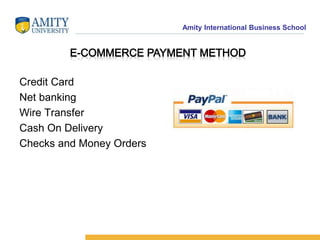
Credit Card 
Net banking 
Wire Transfer 
Cash On Delivery 
Checks and Money Orders
Amity International Business School
Amity International Business School 
1) More products and services: EC provides with more choices; they 
can select from many vendors and from more products. 
2) Cheaper products: EC frequently provides consumers with less 
expensive products and services by allowing them to shop in many 
places and conduct quick comparisons. 
3)No Middlemen- There is a direct contact with customers in e-commerce 
through internet without any intermediation. Companies 
can now focus more on specific customers by adopting different one-to- 
one marketing strategy 
4) You can shop anywhere in the world 
5) Easy access 24 hours a day
Amity International Business School 
Not everyone is connected to the Internet 
There is the possibility of credit card number theft (There is an increase 
amount of fraud on the Internet) 
There are no guarantees for purchased goods as online shopping 
(Because Product is intangible until the product is at hand)
Amity International Business School 
Traditional Marketing: Traditional Commerce is the process of 
buying, selling or exchanging products, services or information is 
physical, Marketing is the process of communicating the value of a 
product, Traditional marketing is the directly meet customers, 
Traditional marketing activities typically involve advertising, publicity, 
sales, merchandising and distribution.
Amity International Business School 
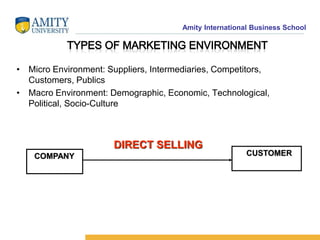
• Micro Environment: Suppliers, Intermediaries, Competitors, 
Customers, Publics 
• Macro Environment: Demographic, Economic, Technological, 
Political, Socio-Culture 
DIRECT SELLING 
COMPANY CUSTOMER
Amity International Business School 
Easy to pick and choose whatever you 
like and eliminate what you don’t like 
Goods are tangible, therefore we can 
see the exact appearance of the product
Amity International Business School 
The 4 P’s involved with a 
communications giant is very 
important as they are directly linked 
to the customer’s preference
Amity International Business School 
Marketing Mix - A mixture of several ideas and plans 
followed by a marketing representative to promote 
a particular product or brand is called marketing 
mix. Several concepts and ideas combined together to 
formulate final strategies helpful in making a brand 
popular amongst the masses form marketing mix. 
1 Product 
2 Price 
3 Place 
4 Promotion
Amity International Business School 
Product 
Goods manufactured by organizations for the end-users are called 
products. 
Products can be of two types - Tangible Product and Intangible Product 
(Services) 
An individual can see, touch and feel tangible products as compared to 
intangible products. 
A product in a market place is something which a seller sells to the buyers 
in exchange of money. 
Price 
The money which a buyer pays for a product is called as price of the 
product. The price of a product is indirectly proportional to its availability in 
the market. Lesser its availability, more would be its price and vice a versa. 
Retail stores which stock unique products (not available at any other store) 
quote a higher price from the buyers.
Amity International Business School 
Place 
Place refers to the location where the products are available and can be 
sold or purchased. Buyers can purchase products either from physical 
markets or from virtual markets. In a physical market, buyers and sellers 
can physically meet and interact with each other whereas in a virtual 
market buyers and sellers meet through internet. 
Promotion 
Promotion refers to the various strategies and ideas implemented by the 
marketers to make the end - users aware of their brand. Promotion 
includes various techniques employed to promote and make a brand 
popular amongst the masses.
Amity International Business School 
• We can get the product on time. 
• Many Choice. 
• Free from shipping cost. 
• Free from tax. 
• It is tangible. We can see the exact appearance of the 
product. 
• We can make sure the size as we can try the product before 
we purchase it.
Amity International Business School 
•It may takes time for us to find parking. 
• Some appliances need transportation cost to 
send it to our home. Example, a refrigerator. 
• We have to queue and wait for our turn to pay 
at the counter.
Amity International Business School 
Sunil Kr Ahirwar 
Amity International Business School 
Amity University, Noida- 125 
Eamil- sunil.ahirwar@student.amity.edu 
Mo- +91-9871836819

E-Commerce Vs Traditional Marketing

  • 1.
    Amity International BusinessSchool E-Commerce Vs Traditional Marketing National Bank Vs International Bank
  • 2.
    Amity International BusinessSchool E-Commerce: Commonly known as Electronic Marketing Buying and selling of goods or services through Internet. without using any paper documents. A type of business model, or segment of a larger business model, that enables a firm or individual to conduct business over an electronic network, typically the internet.
  • 3.
    Amity International BusinessSchool There are no guarantees for purchased goods as online product is intangible until the product is at hand.
  • 4.
    Amity International BusinessSchool The consumer browses the catalog of products featured on the site and selects items to purchase. The selected items are placed in the electronic equivalent of a shopping cart & provides a bill and ship-to address for purchase and delivery.
  • 5.
    Amity International BusinessSchool • B to B • B to C B2B • C to B • C to C B2C C2C C2B
  • 6.
    Amity International BusinessSchool Credit Card Net banking Wire Transfer Cash On Delivery Checks and Money Orders
  • 7.
  • 8.
    Amity International BusinessSchool 1) More products and services: EC provides with more choices; they can select from many vendors and from more products. 2) Cheaper products: EC frequently provides consumers with less expensive products and services by allowing them to shop in many places and conduct quick comparisons. 3)No Middlemen- There is a direct contact with customers in e-commerce through internet without any intermediation. Companies can now focus more on specific customers by adopting different one-to- one marketing strategy 4) You can shop anywhere in the world 5) Easy access 24 hours a day
  • 9.
    Amity International BusinessSchool Not everyone is connected to the Internet There is the possibility of credit card number theft (There is an increase amount of fraud on the Internet) There are no guarantees for purchased goods as online shopping (Because Product is intangible until the product is at hand)
  • 10.
    Amity International BusinessSchool Traditional Marketing: Traditional Commerce is the process of buying, selling or exchanging products, services or information is physical, Marketing is the process of communicating the value of a product, Traditional marketing is the directly meet customers, Traditional marketing activities typically involve advertising, publicity, sales, merchandising and distribution.
  • 11.
    Amity International BusinessSchool • Micro Environment: Suppliers, Intermediaries, Competitors, Customers, Publics • Macro Environment: Demographic, Economic, Technological, Political, Socio-Culture DIRECT SELLING COMPANY CUSTOMER
  • 12.
    Amity International BusinessSchool Easy to pick and choose whatever you like and eliminate what you don’t like Goods are tangible, therefore we can see the exact appearance of the product
  • 13.
    Amity International BusinessSchool The 4 P’s involved with a communications giant is very important as they are directly linked to the customer’s preference
  • 14.
    Amity International BusinessSchool Marketing Mix - A mixture of several ideas and plans followed by a marketing representative to promote a particular product or brand is called marketing mix. Several concepts and ideas combined together to formulate final strategies helpful in making a brand popular amongst the masses form marketing mix. 1 Product 2 Price 3 Place 4 Promotion
  • 15.
    Amity International BusinessSchool Product Goods manufactured by organizations for the end-users are called products. Products can be of two types - Tangible Product and Intangible Product (Services) An individual can see, touch and feel tangible products as compared to intangible products. A product in a market place is something which a seller sells to the buyers in exchange of money. Price The money which a buyer pays for a product is called as price of the product. The price of a product is indirectly proportional to its availability in the market. Lesser its availability, more would be its price and vice a versa. Retail stores which stock unique products (not available at any other store) quote a higher price from the buyers.
  • 16.
    Amity International BusinessSchool Place Place refers to the location where the products are available and can be sold or purchased. Buyers can purchase products either from physical markets or from virtual markets. In a physical market, buyers and sellers can physically meet and interact with each other whereas in a virtual market buyers and sellers meet through internet. Promotion Promotion refers to the various strategies and ideas implemented by the marketers to make the end - users aware of their brand. Promotion includes various techniques employed to promote and make a brand popular amongst the masses.
  • 17.
    Amity International BusinessSchool • We can get the product on time. • Many Choice. • Free from shipping cost. • Free from tax. • It is tangible. We can see the exact appearance of the product. • We can make sure the size as we can try the product before we purchase it.
  • 18.
    Amity International BusinessSchool •It may takes time for us to find parking. • Some appliances need transportation cost to send it to our home. Example, a refrigerator. • We have to queue and wait for our turn to pay at the counter.
  • 19.
    Amity International BusinessSchool Sunil Kr Ahirwar Amity International Business School Amity University, Noida- 125 Eamil- sunil.ahirwar@student.amity.edu Mo- +91-9871836819