


























































































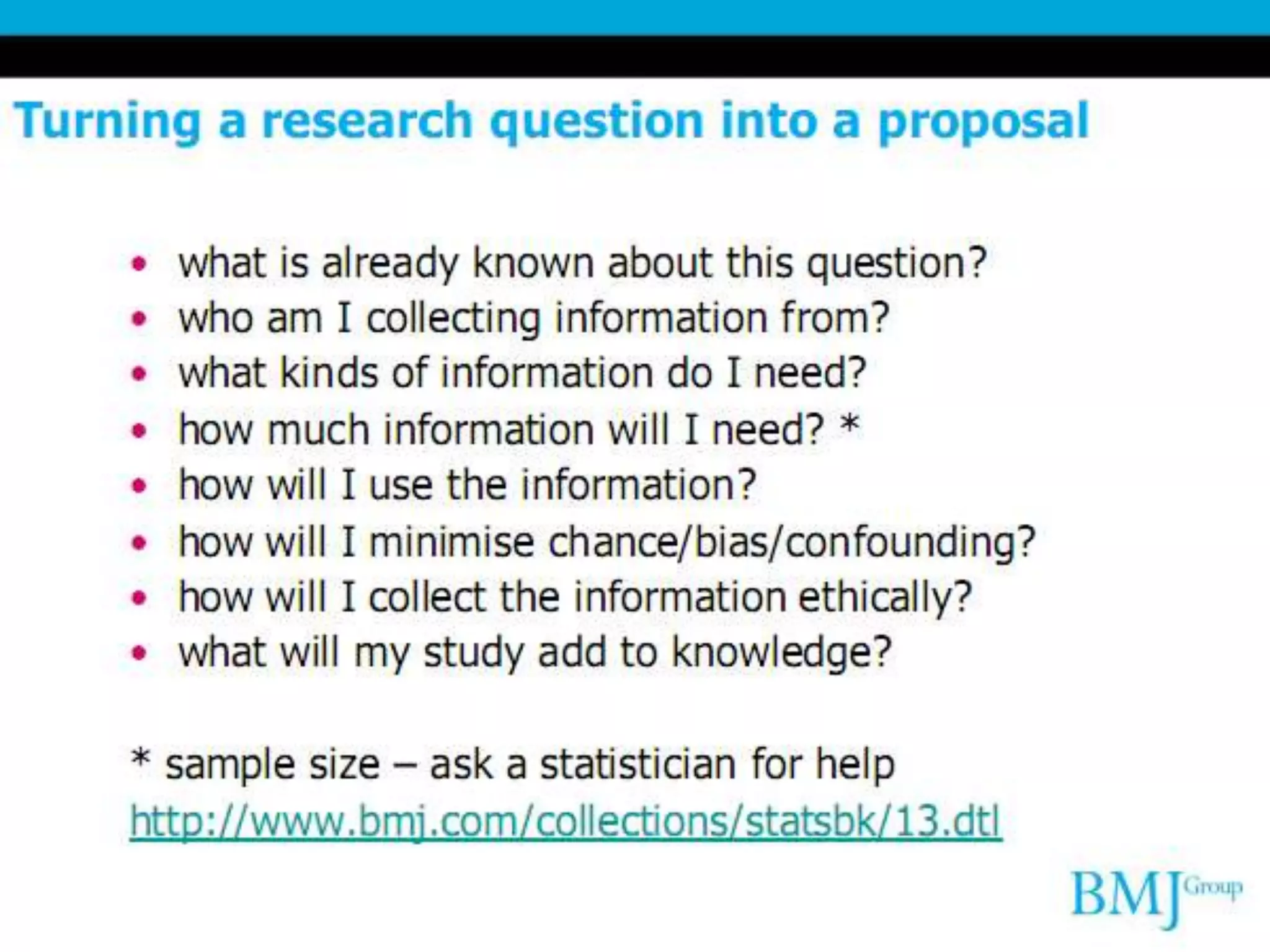
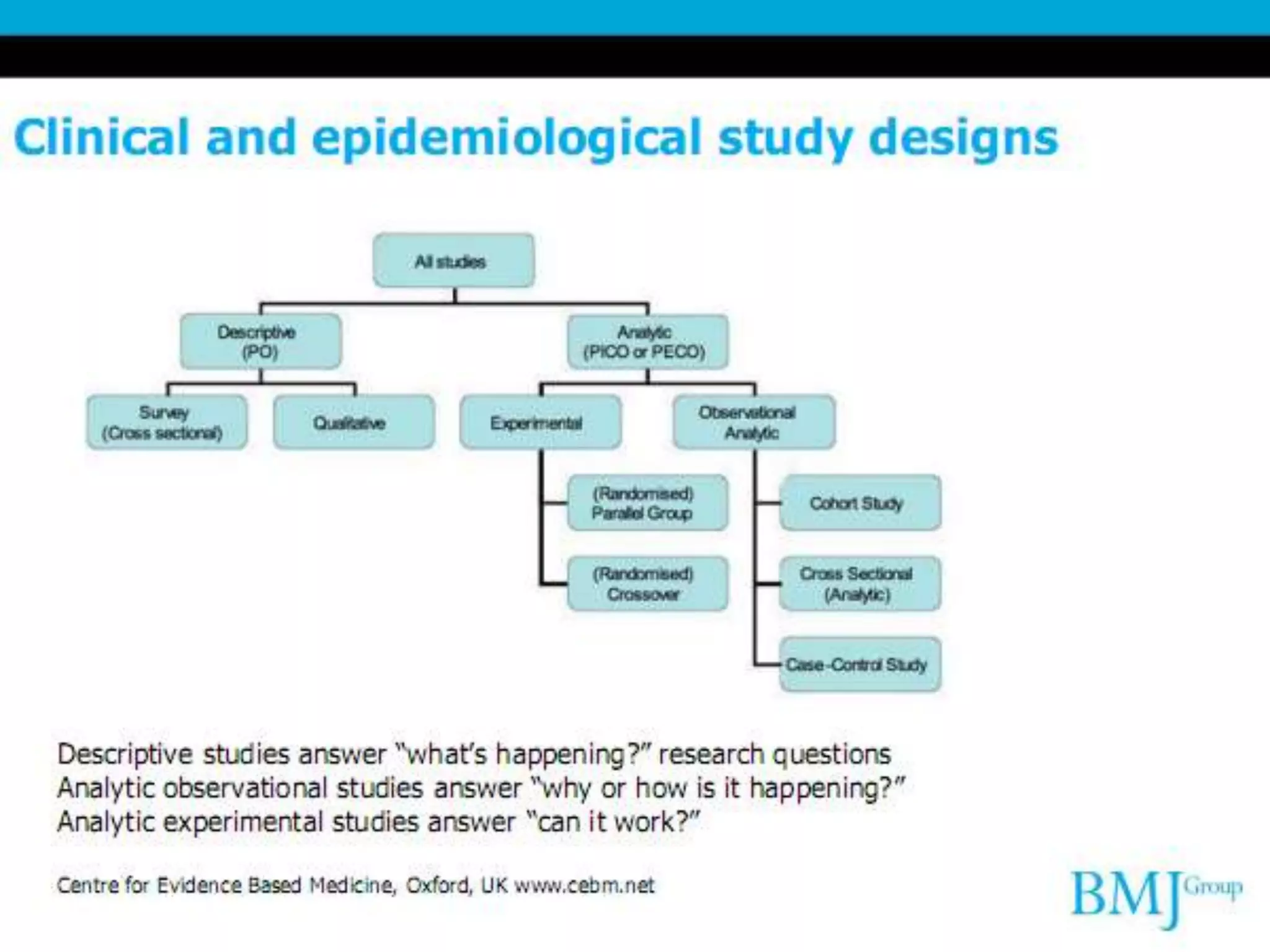
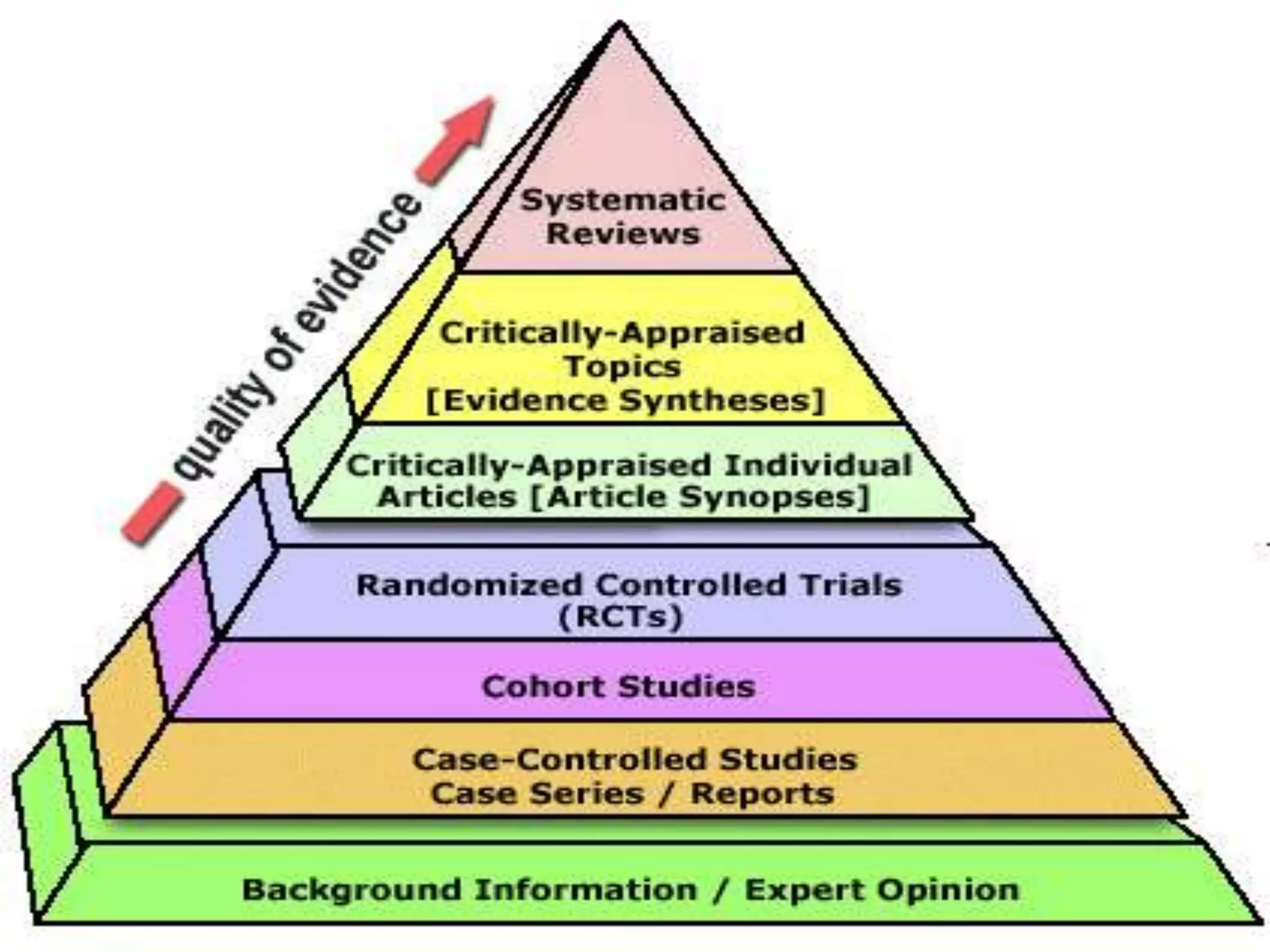





*
*Development of scientific attitude -
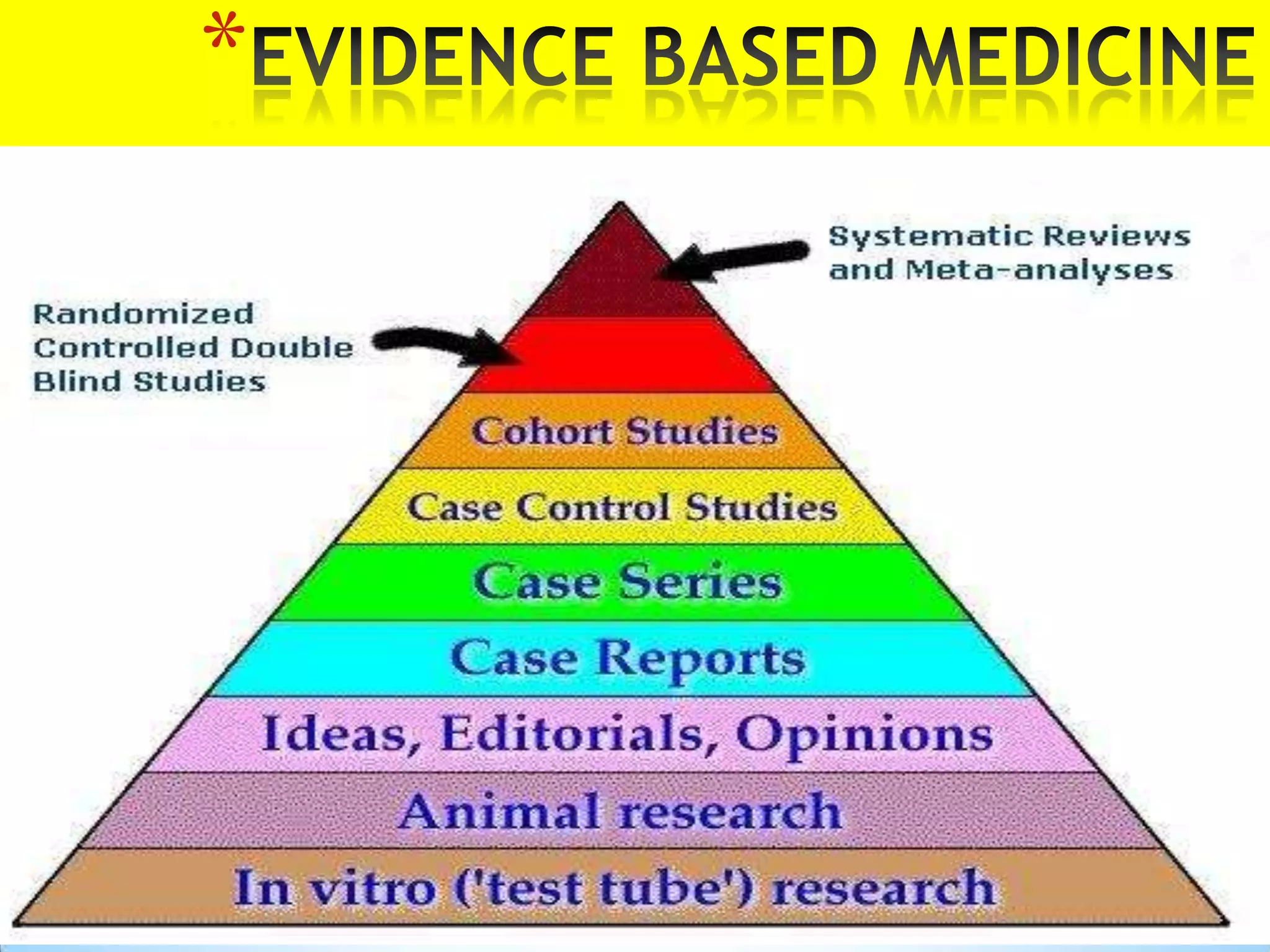
 Evidence based medicine
*Learning research methodology
*Curricular requirement
*publication


                *
*
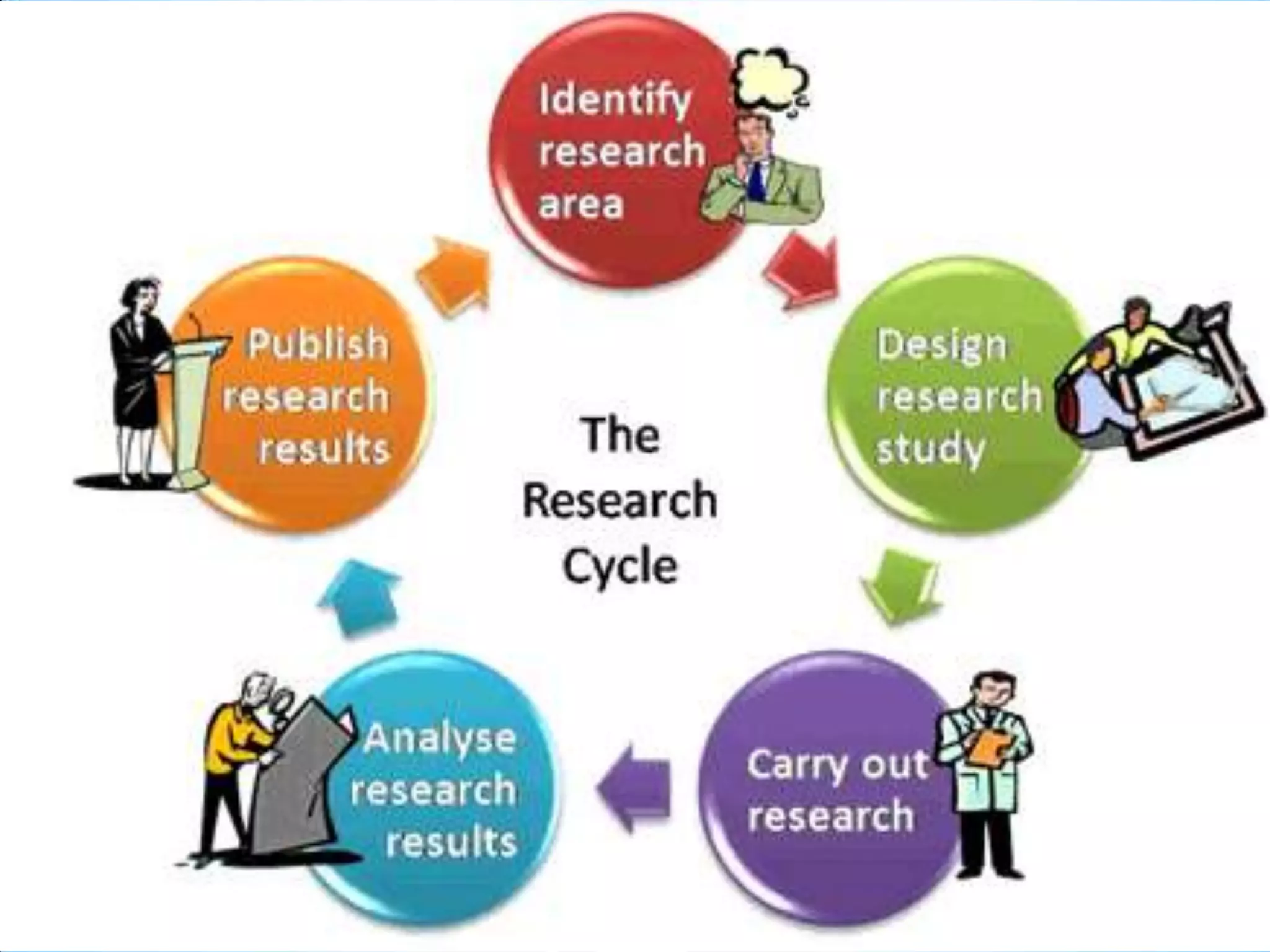
*It Is a systematic and
 organised scientific
 process
*To find answers to
 questions
* Research is to see what everybody else has
    seen, and to think what nobody else has
                              thought……….
                          ----Albert Szent-Gyorgyi
*is an important and complex part
 of the research process


*You will need to do some research
 and reading


          *
CHOOSING THE APPROPRIATE
RESEARCH TOPIC
             Dr. V. Sathyanarayanan M.D.,
             Professor of Pharmacology
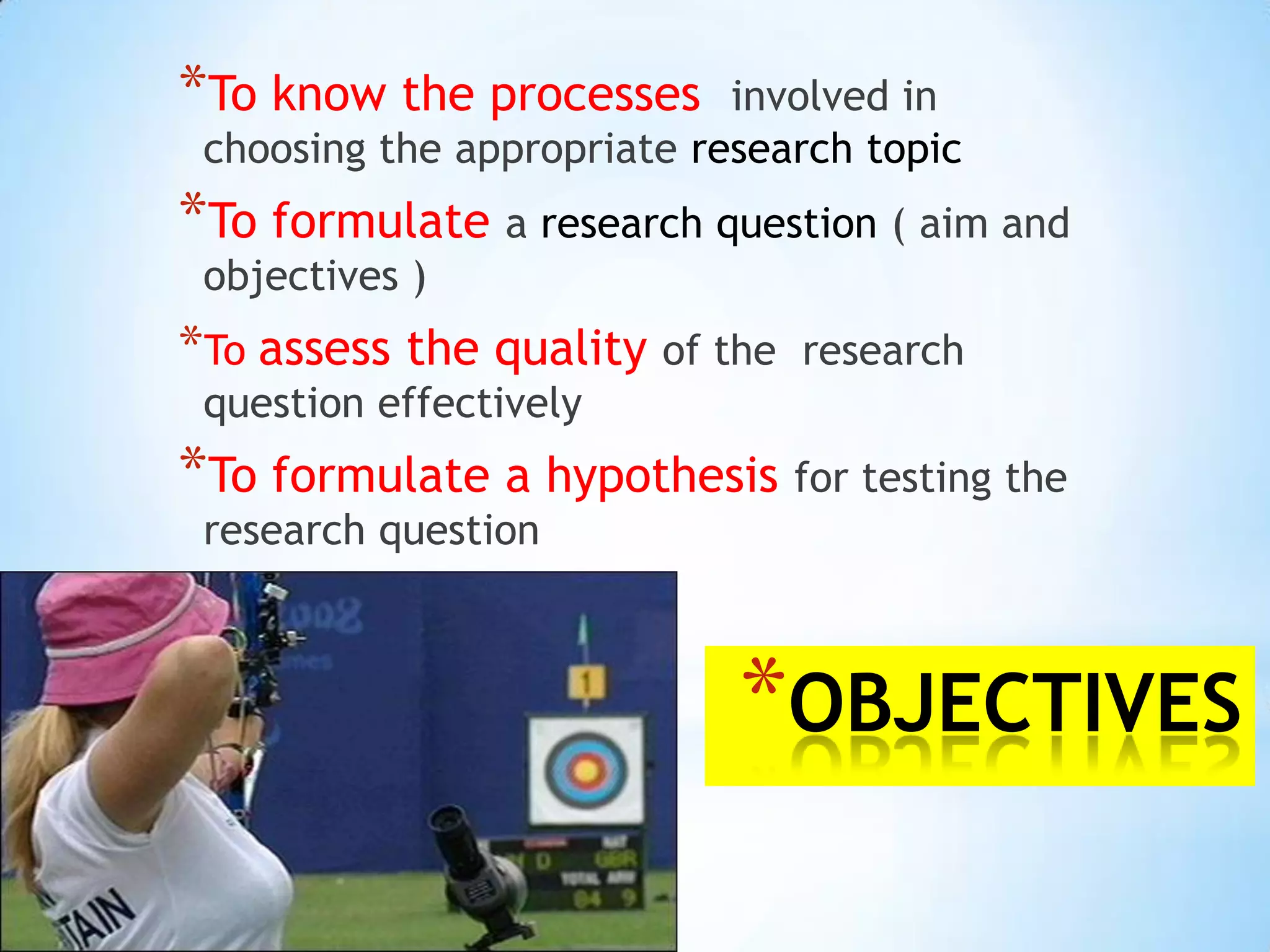
*To know the processes      involved in
 choosing the appropriate research topic
*To formulate a research question ( aim and
 objectives )
*To assess the quality of the   research
 question effectively
*To formulate a hypothesis for testing the
 research question


                            *OBJECTIVES
*First and foremost, it must be interesting
*You should learn something of value to you
*It should be productive


              *
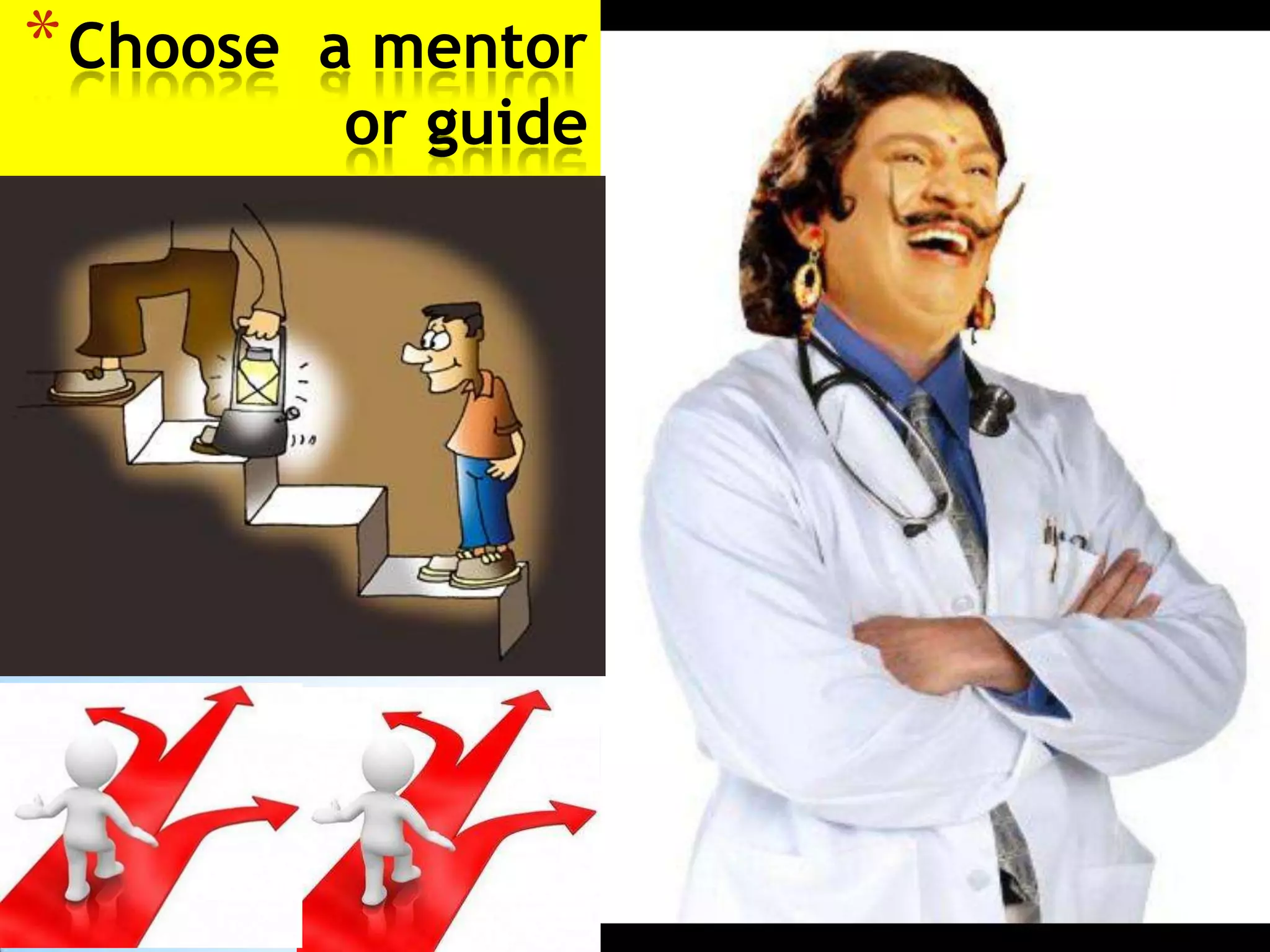
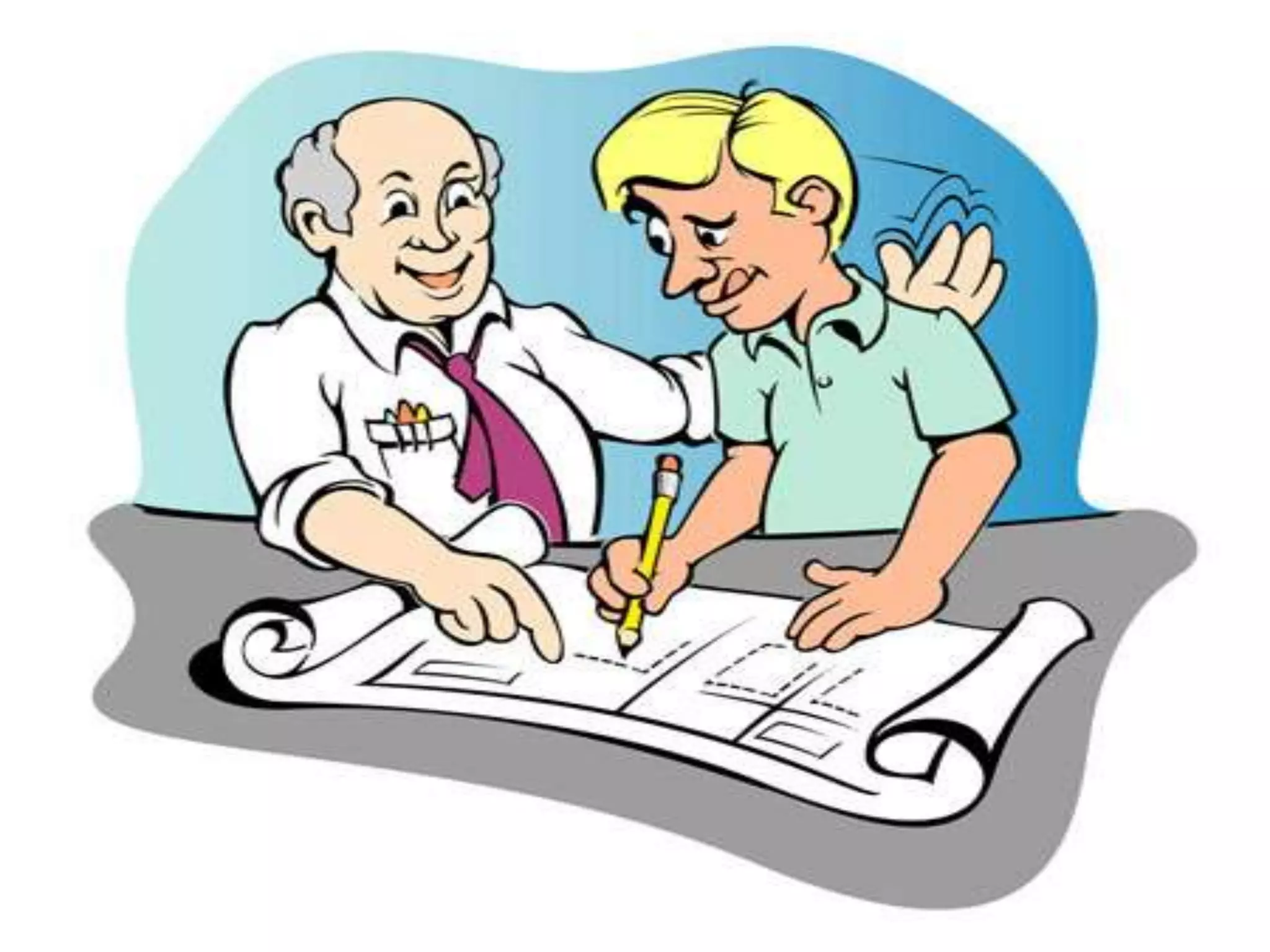
* Choose   a mentor
            or guide
and then…
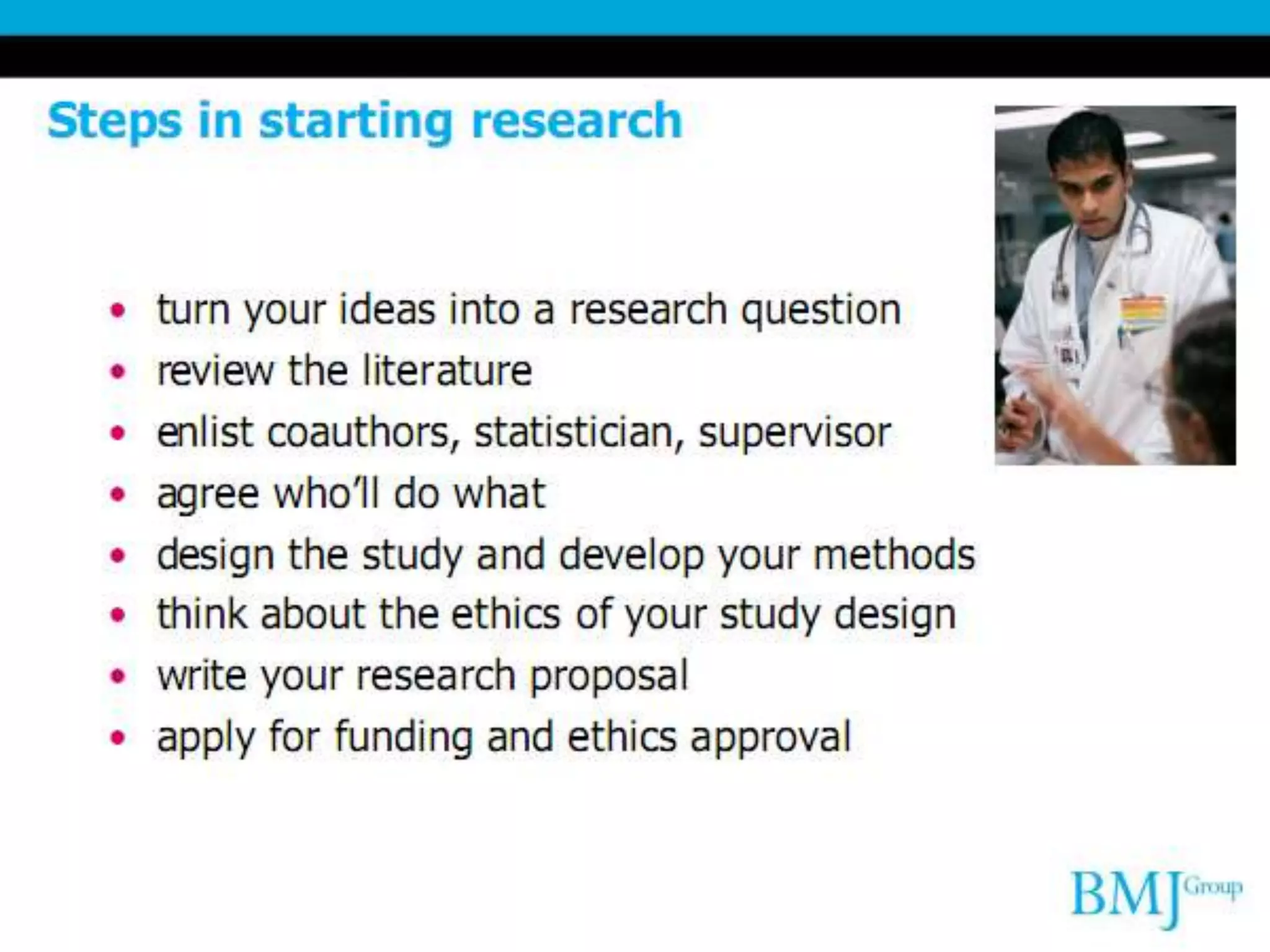
1. Develop a research question
      *   Do a thorough search of medical literature
      *   Identify the edge of knowledge related to that
          question and gaps in knowledge
      *   Be certain that your question has not already
          been answered AND that filling the gaps is
          important
2.   Develop a testable hypothesis


  *
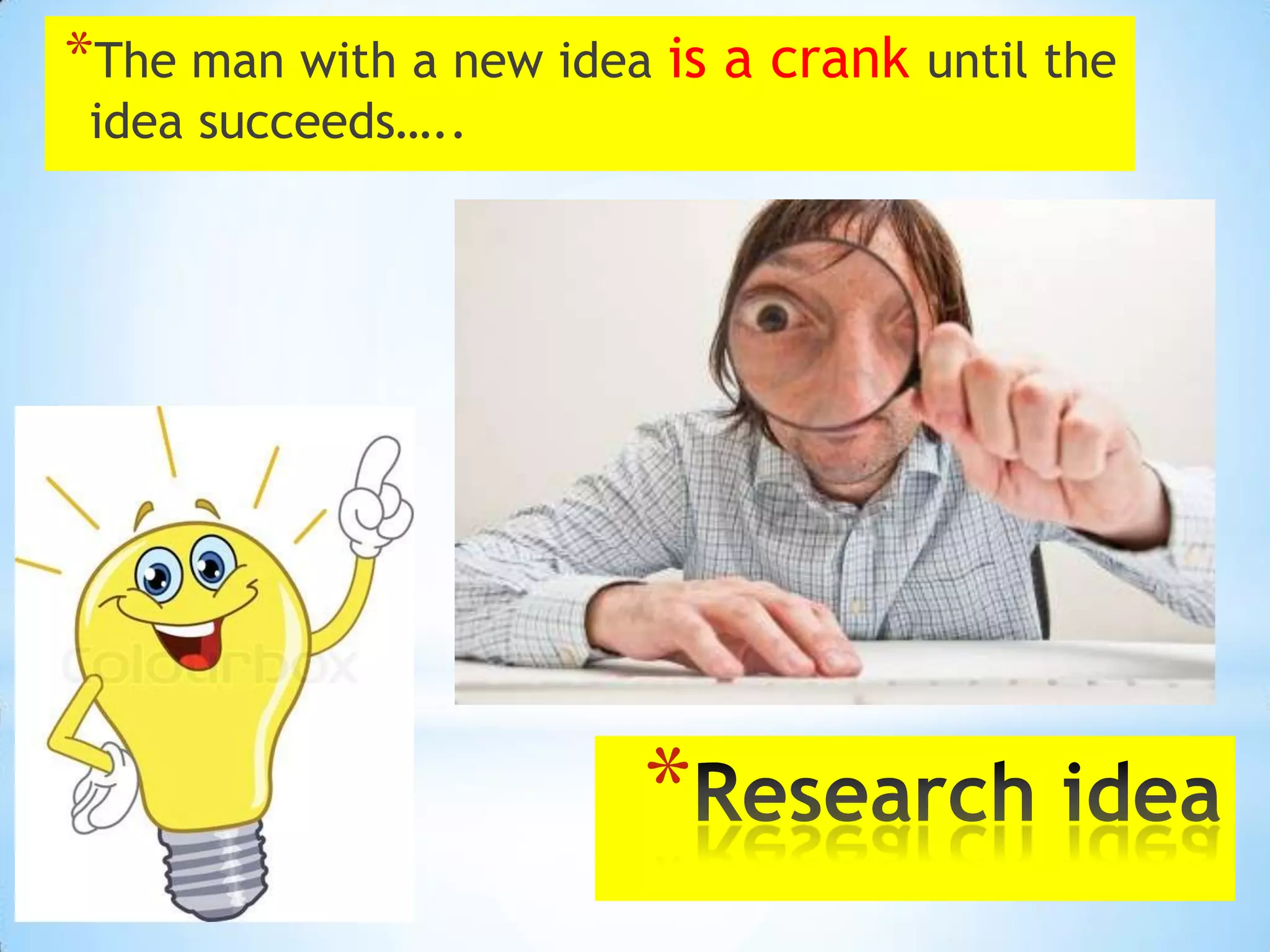
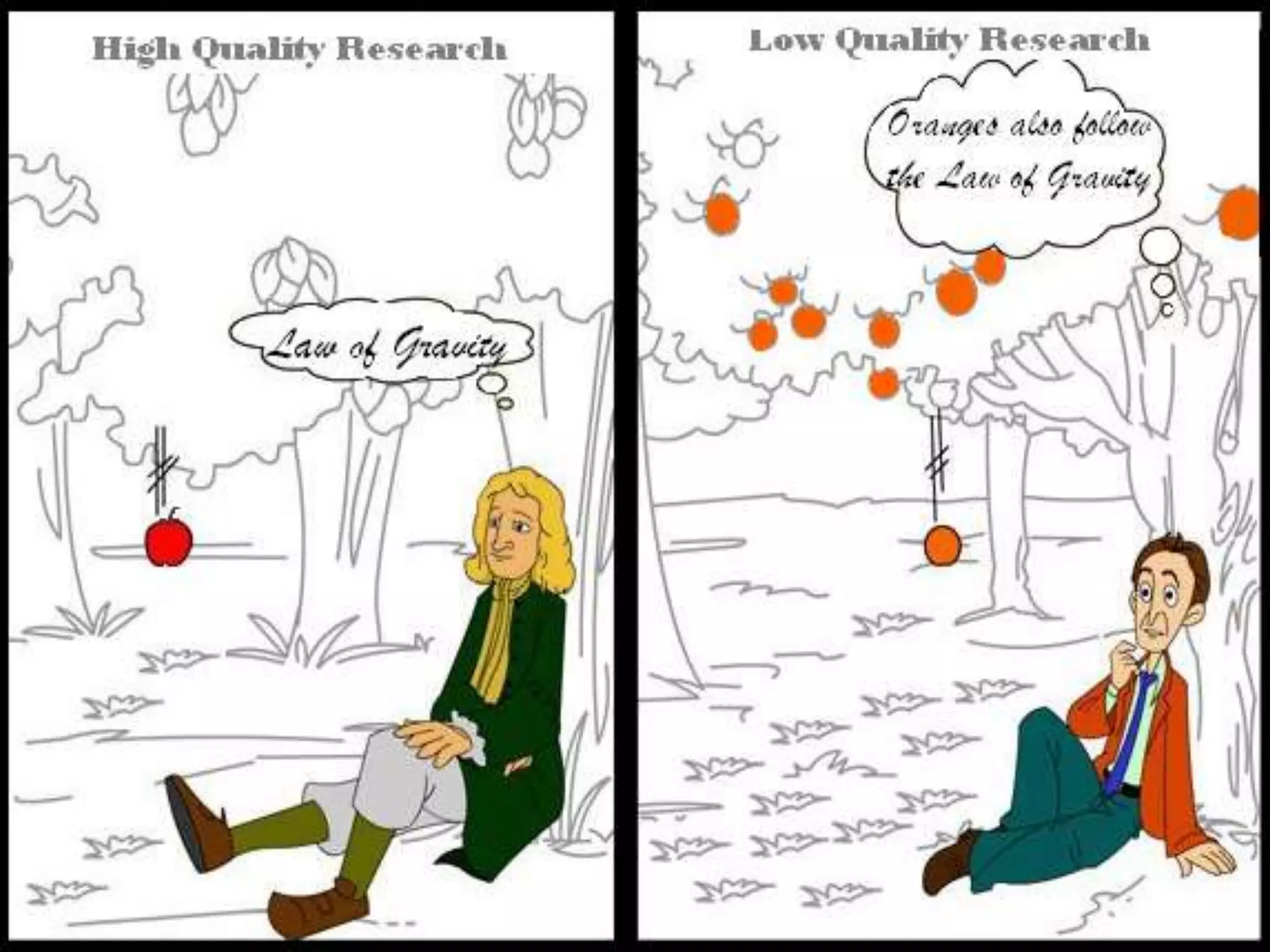
*The man with a new idea is a crank until the
 idea succeeds…..


                        *
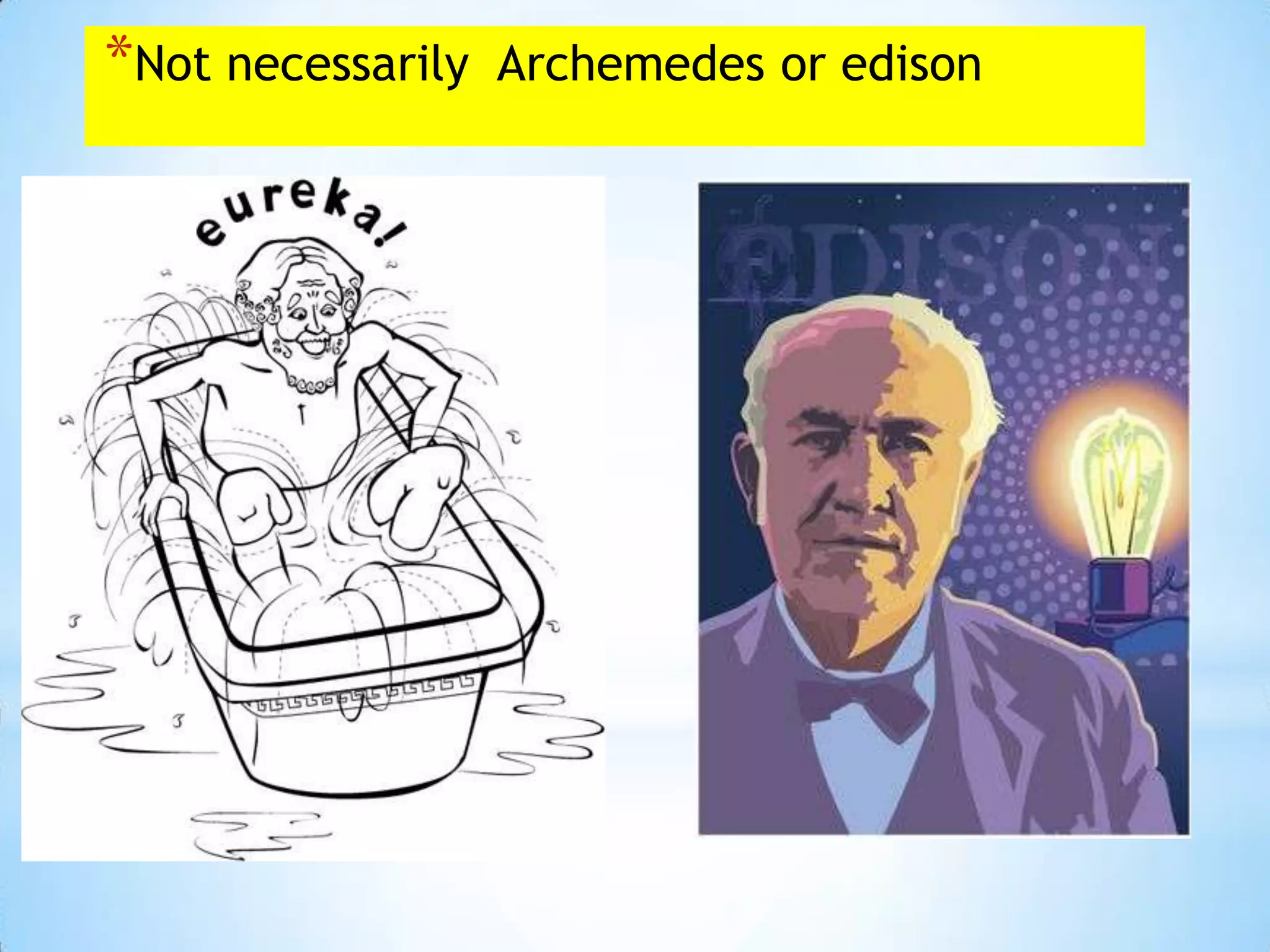
*Not necessarily   Archemedes or edison
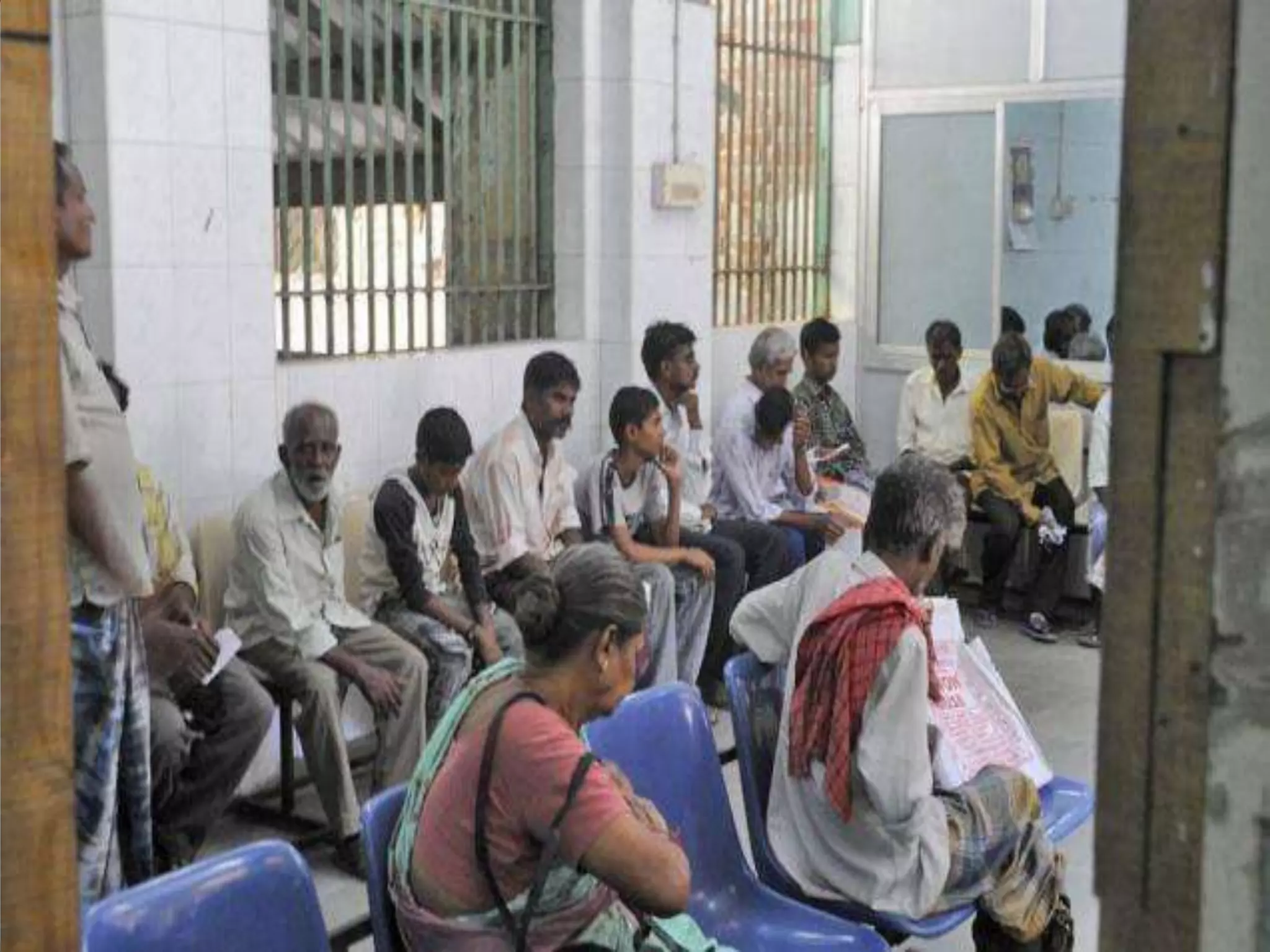
*as you go about your daily clinical practice
* observe with curiosity and       enquire…..
* Sometimes it is the result of having a disagree
 ment with a colleague

*Define the problem well


         *
*Etiology and       *Elucidate mechanisms
 pathogenesis
*Pathophysiology
*Diagnosis          *Diagnostic approaches
                    *Therapeutic
*Treatment           interventions
*prognosis          *Research into the
                     prognostic factors


                *
*Consider personal interests
*Engage in conversations with the
 mentor, colleagues, teachers and experts
*Read articles
*Browse recent issues of journals or magazines
*Browse the shelves for books on your subject
*Identify the research question area
*Aware of overuse of ideas
*Concluding sections in the      critically examined
 individual studies, systematic review
*Remaining gaps    in literature
*Further define the research question

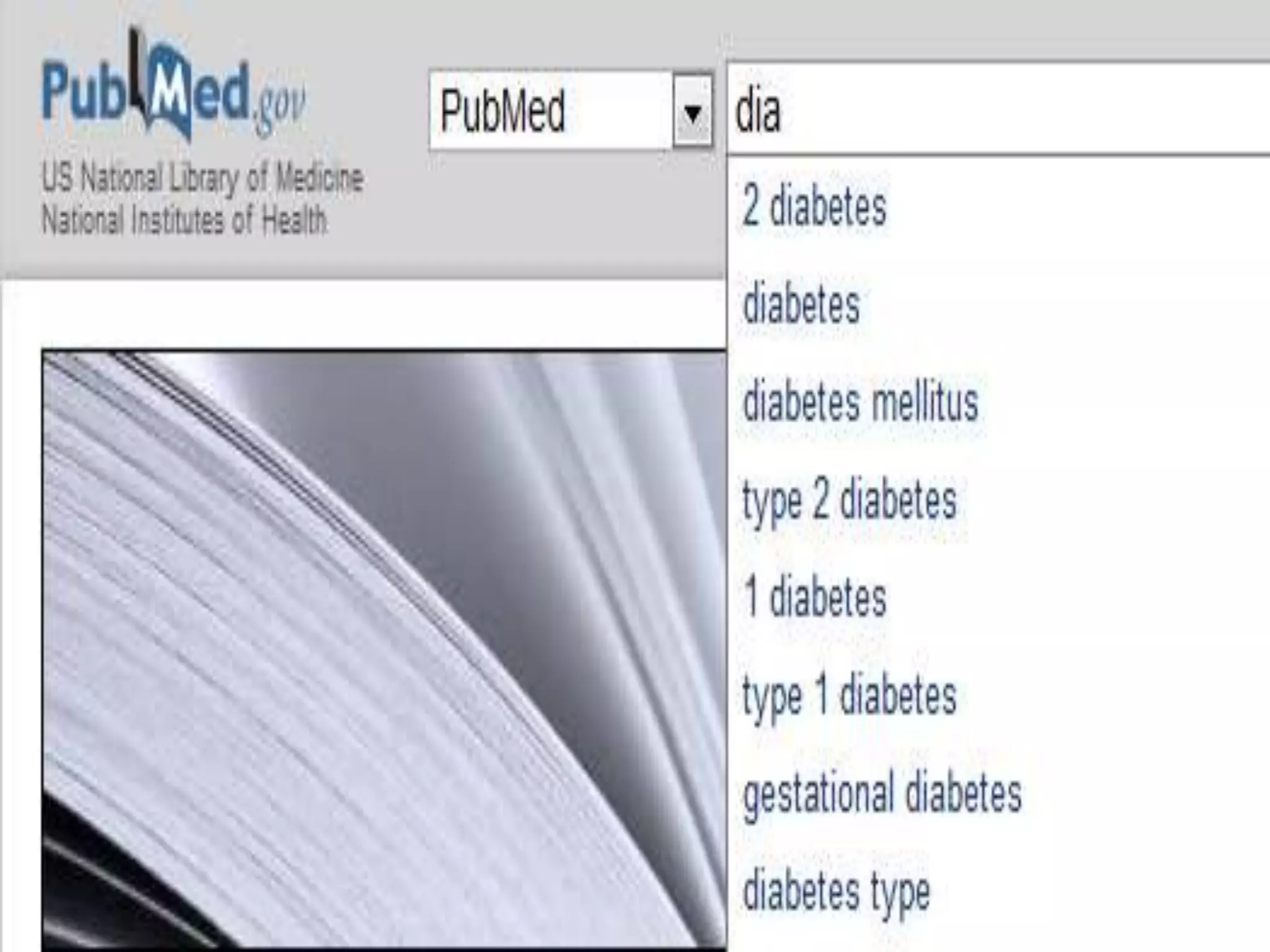
*MEDLINE, PUBMED, SCIENCEDIRECT,
* MEDSCAPE


   *
*From standard text books

*Use article databases to scan current
 magazine, journal or newspaper articles on the
 topic


* Use Web search engines to find Web sites on
 the topic


    *
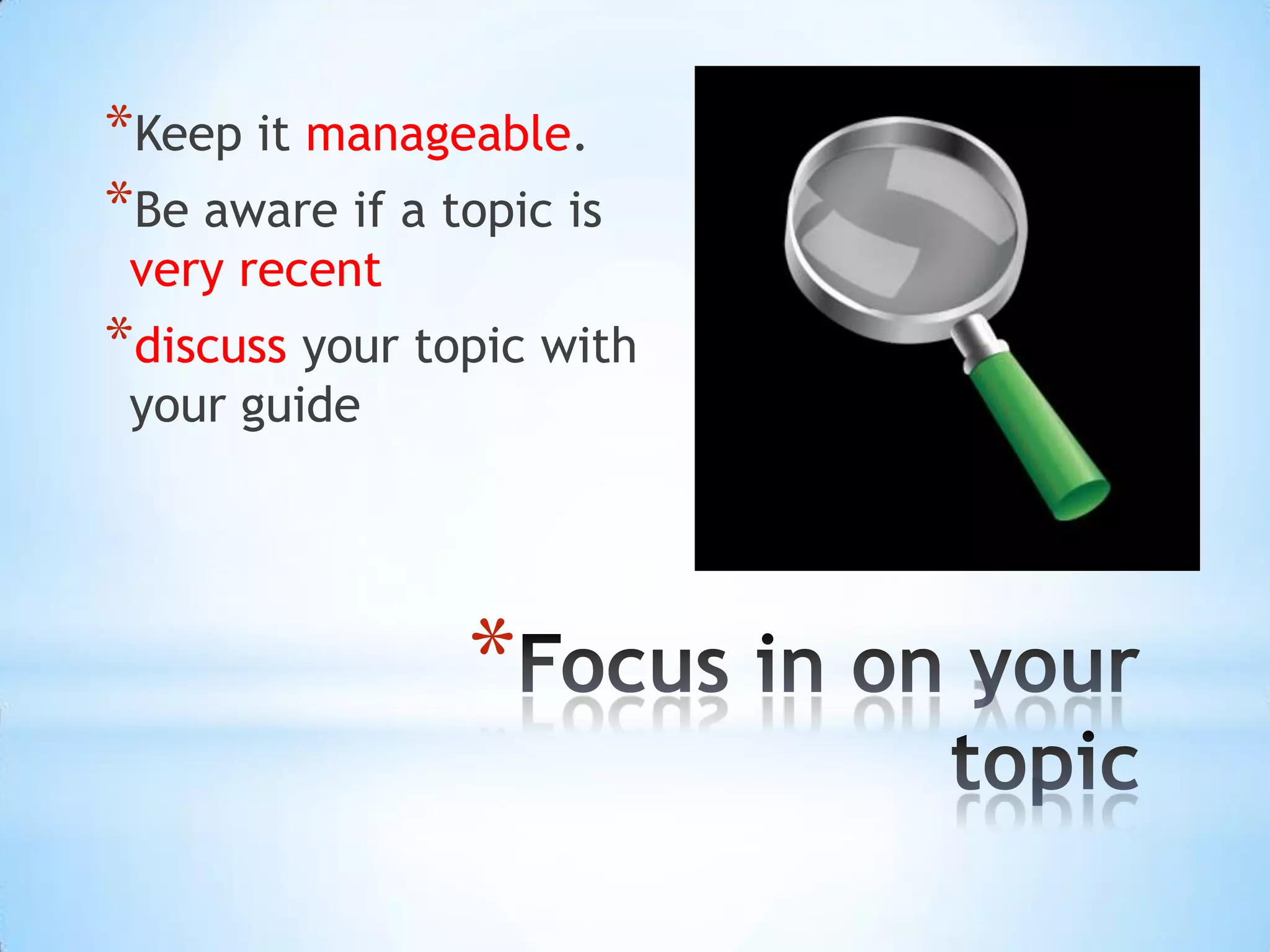
*Keep it manageable.
*Be aware if a topic is
 very recent
*discuss your topic with
 your guide


                *
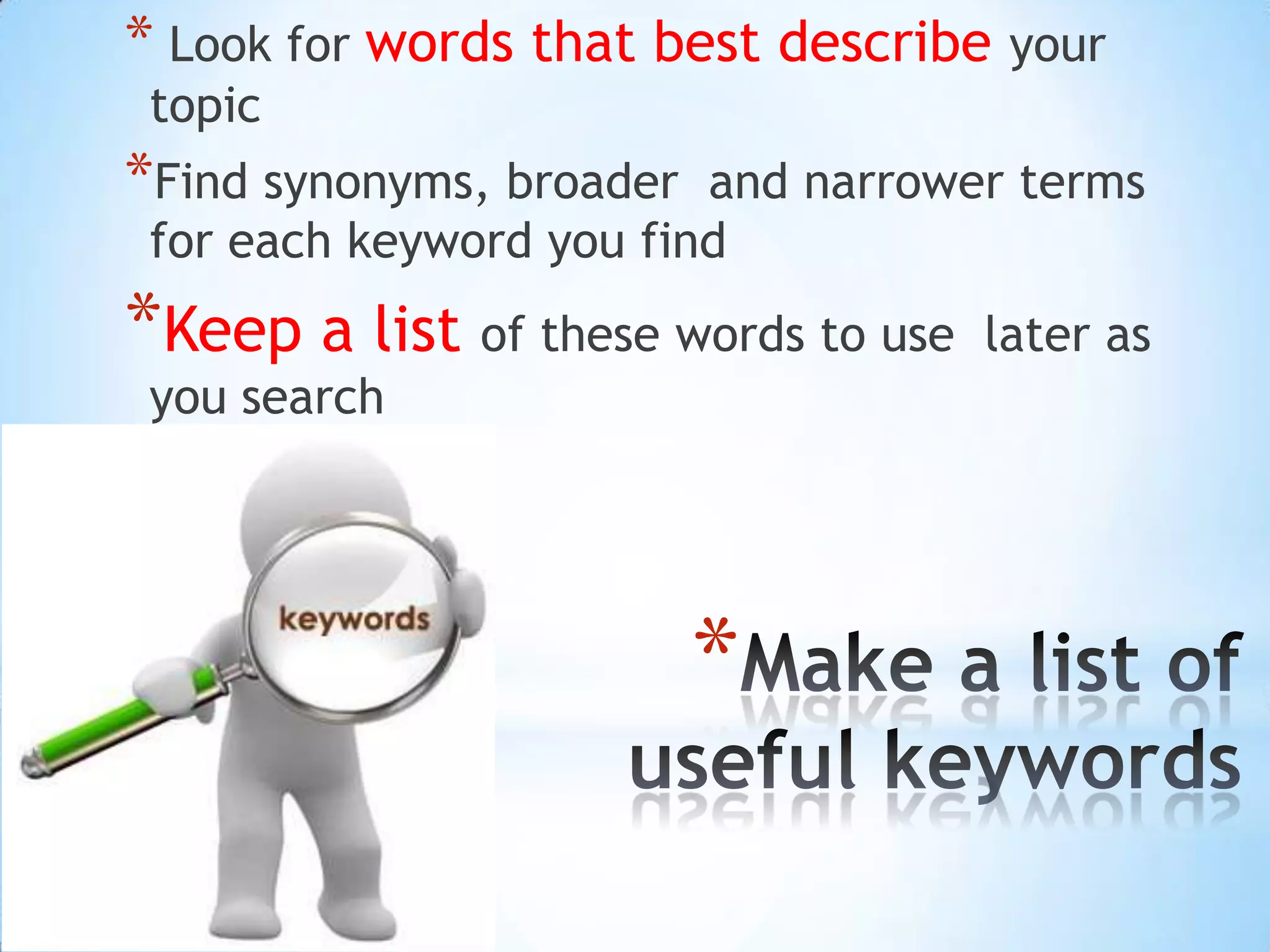
* Look for words that best describe your
 topic
*Find synonyms, broader  and narrower terms
 for each keyword you find
*Keep a list of these words to use   later as
 you search


                          *
* it is common to modify your topic during the
 research process
* Be aware of the depth of coverage needed
 and the due date.
*Your guide     will probably provide specific
 requirements


                            *
*You will often begin with a word,
*develop a more focused interest in an
 aspect of something relating to that word,
* then begin to have questions about the
 topic.
*Significance of the research question must
 be identified


     *
*Use the key words you have gathered to
 research in the
* catalog, article databases
* and Internet search engines.
* Find more information to help answer your
 research question.


   *
* To steal from one is plagiarism.to steal from
                           many is research…
                                   ---Steven Right
* This may be the answer   to your research question
* and/or a way to clearly state the purpose of your
 research.
* Your thesis statement will usually be one or two
  sentences
* that states precisely what is to be
 answered, proven, or what you will inform your
 audience about your topic.


             *
* Trying to turn a statement
  into a real question


             *
*Possibly the most difficult part
* is to come up with a reasonable question
*and focus it to the point
*where it can be answered


*
* defining the goal of your research,
    * identifying objectives,
    * refining and refining it some more and
    * refining it even more until
    * you have a neat and simple question
    * that is feasible to answer.


*
* stated in broad terms
    * and covers the topic that
      interests you


*
* more focused
* There could be more than one
*but all would contribute to the overall goal

*Define it


*
* one of the on going topics in recent years is
* whether medical marijuana has any place in the mains
 tream medical world.
* The goal of research in this area would be

*to assess whether medical marijuana is
  a useful treatment


                               *
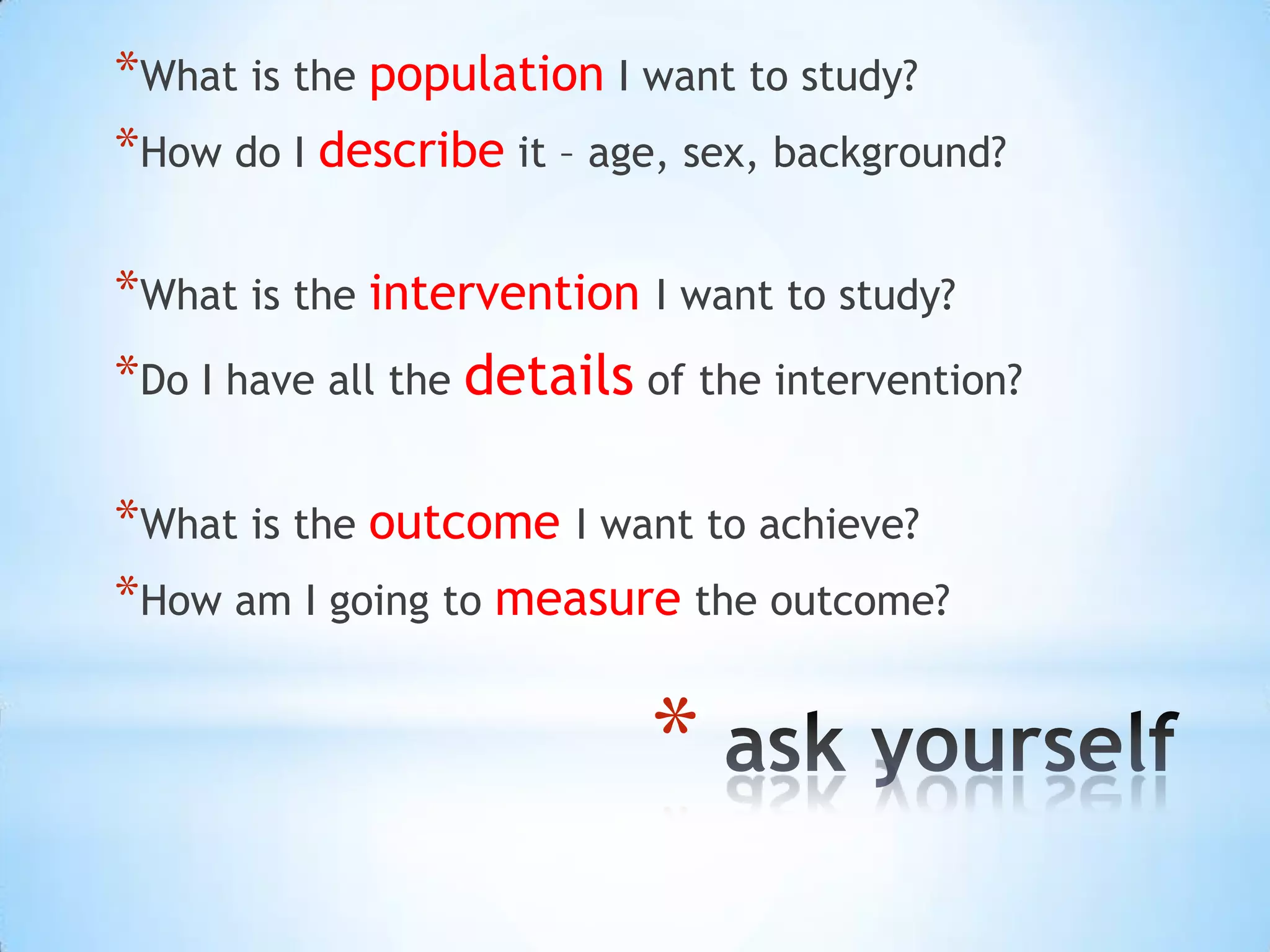
*What is the population I want to study?
*How do I describe it – age, sex, background?

*What is the intervention I want to study?
*Do I have all the details of the intervention?

*What is the outcome I want to achieve?
*How am I going to measure the outcome?

                           *
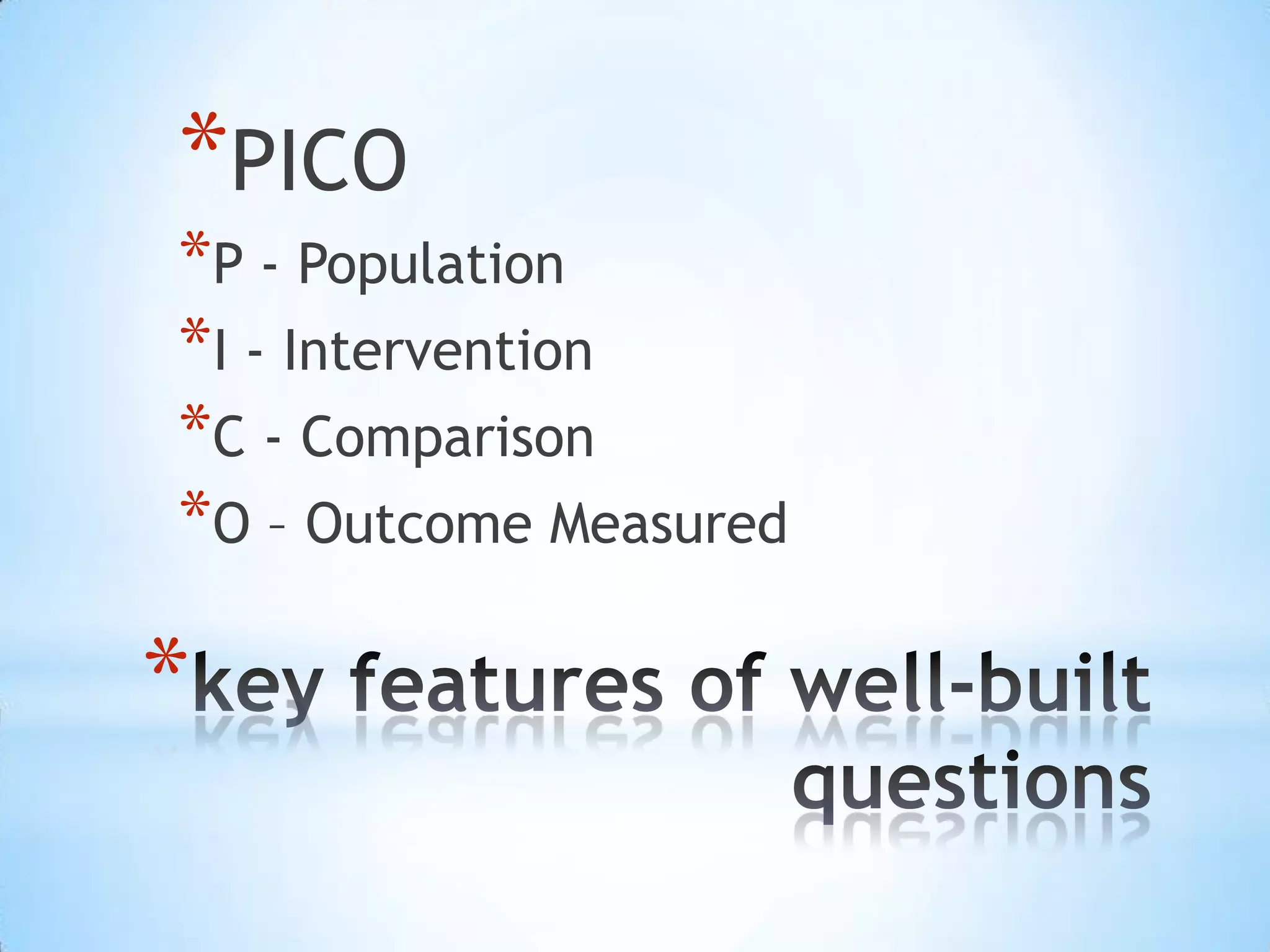
*PICO
*P ‐ Population
*I ‐ Intervention
*C ‐ Comparison
*O – Outcome Measured

*
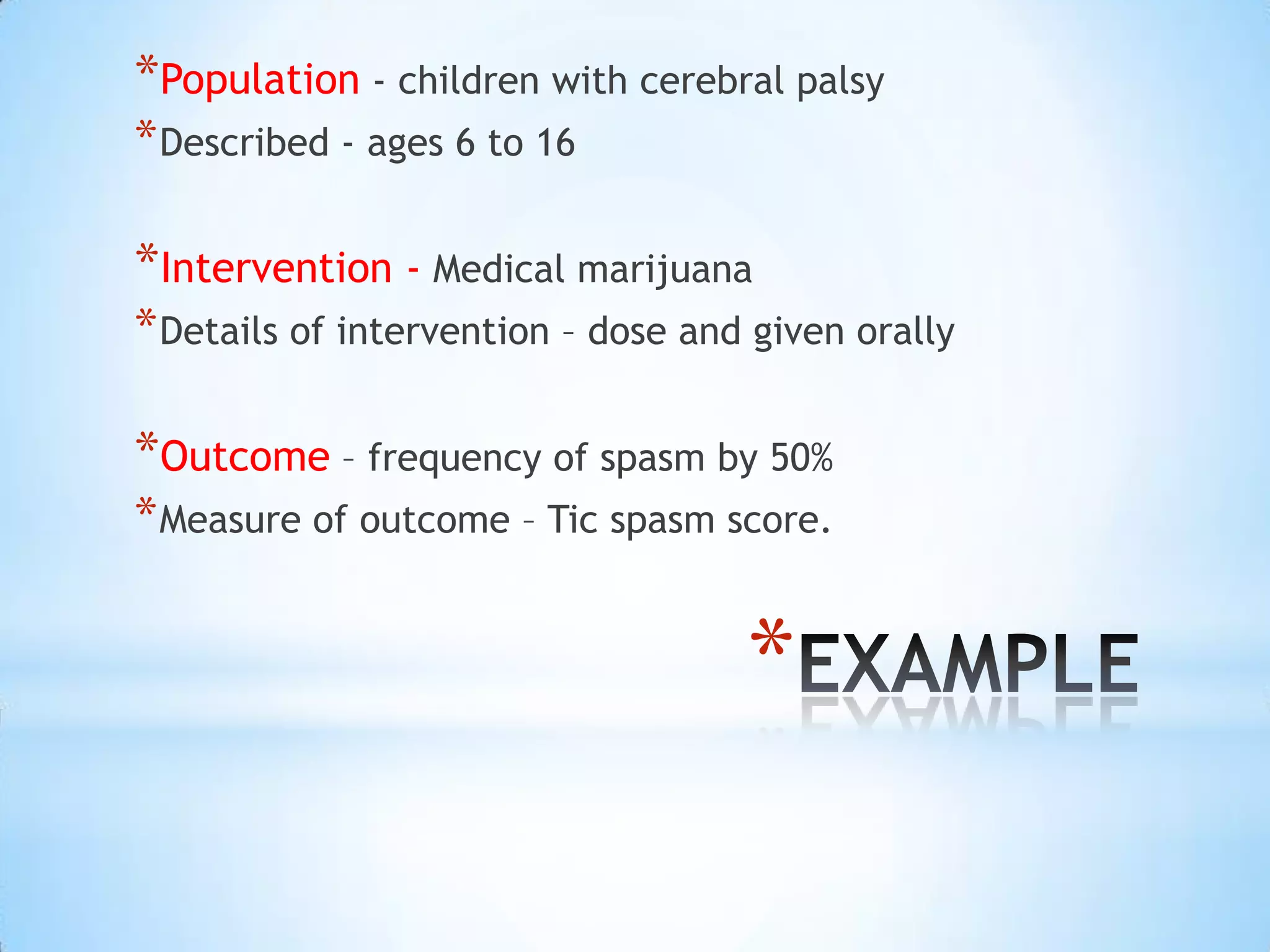
*Population ‐ children with cerebral palsy
* Described ‐ ages 6 to 16

*Intervention ‐ Medical marijuana
* Details of intervention – dose and given orally

*Outcome – frequency of spasm by 50%
* Measure of outcome – Tic spasm score.


                                    *
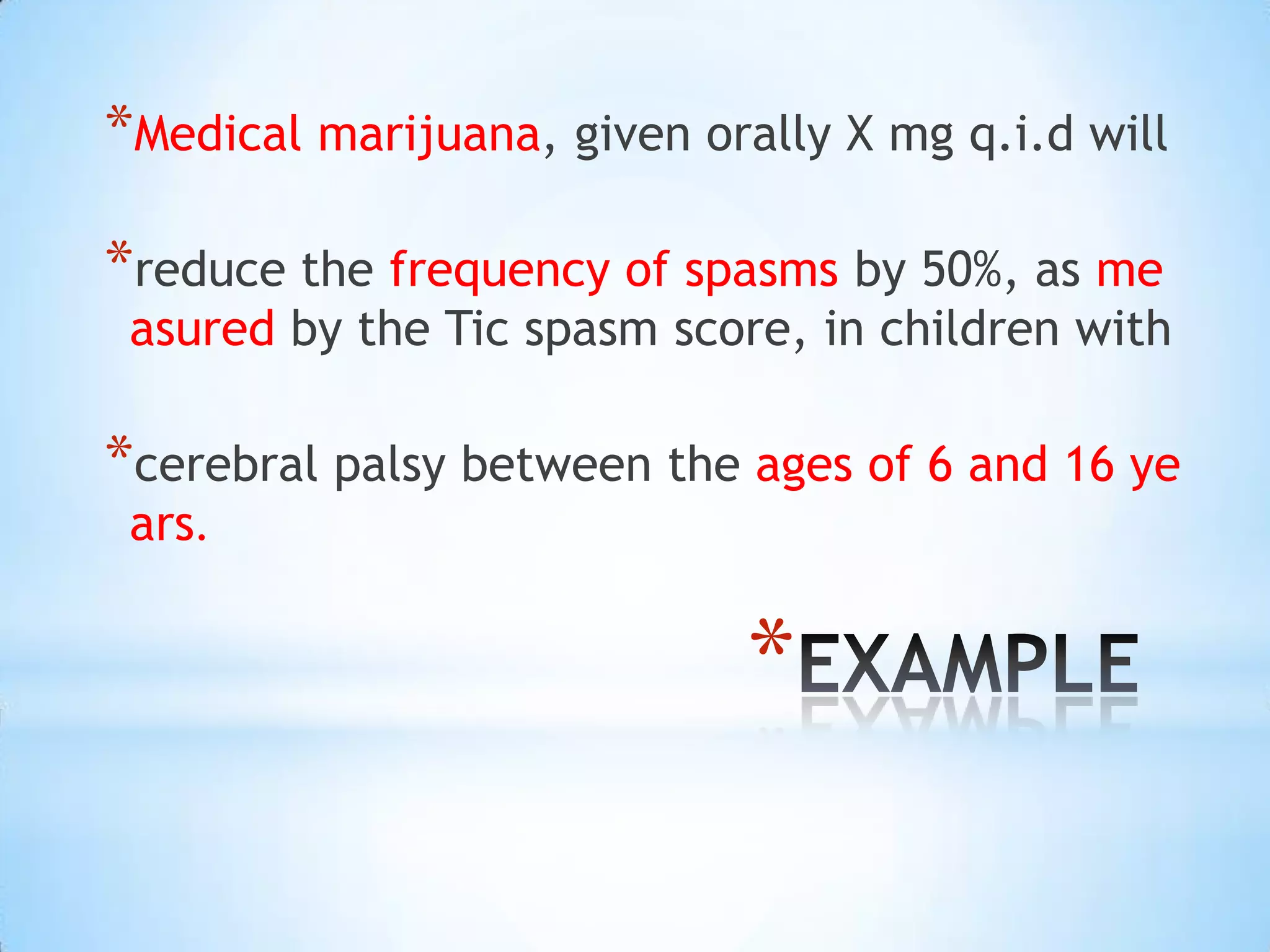
*Medical marijuana, given orally X mg q.i.d will

*reduce the frequency of spasms by 50%, as me
 asured by the Tic spasm score, in children with

*cerebral palsy between the ages of 6 and 16 ye
 ars.


                            *
* single statement that contains
  sufficient information that
  it can be tested using
*statistical methodology
* are procedures for making rational
 decisions about
*what is real and what is opinion


           *
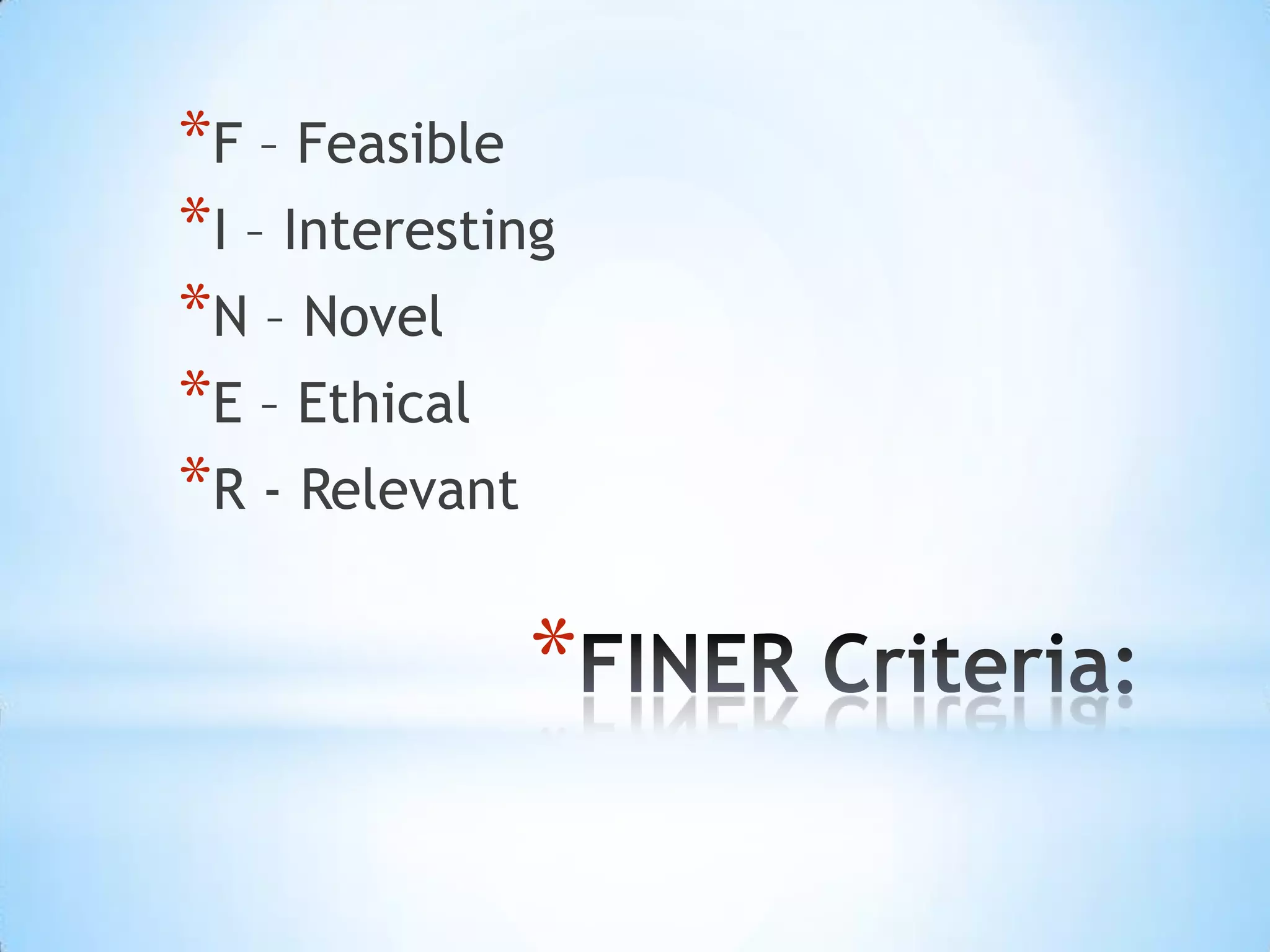
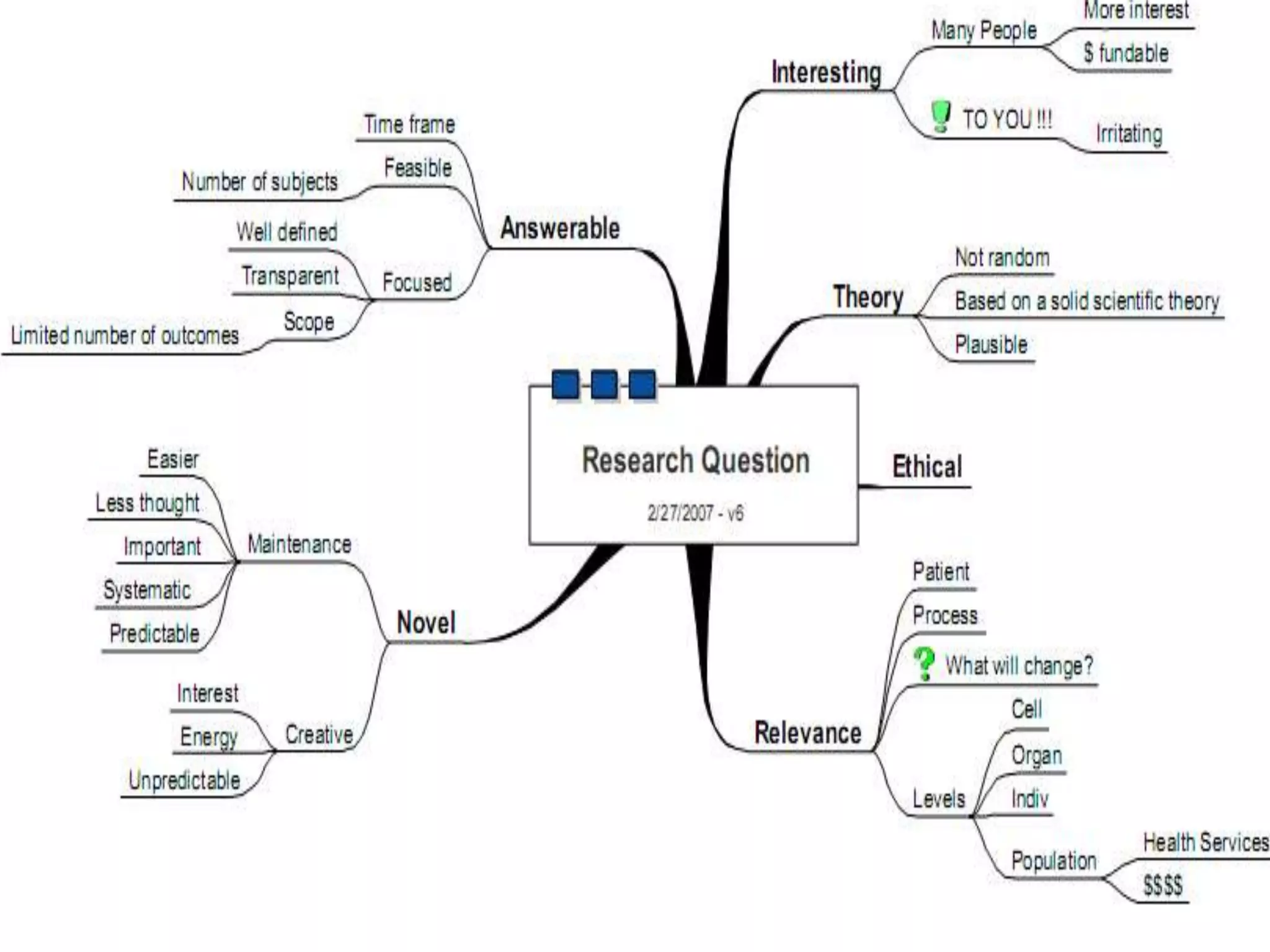
*F – Feasible
*I – Interesting
*N – Novel
*E – Ethical
*R ‐ Relevant

              *
*Number of subjects
*Alter inclusion and exclusion criteria
*Equipment
*cost


                     *
*To you
*To the guide
*To the peers
*Editors of the journals
*Reviewers


                   *
*Newer topic or idea
*Not duplicated
*Duplicated Will have a lower rating


                             *
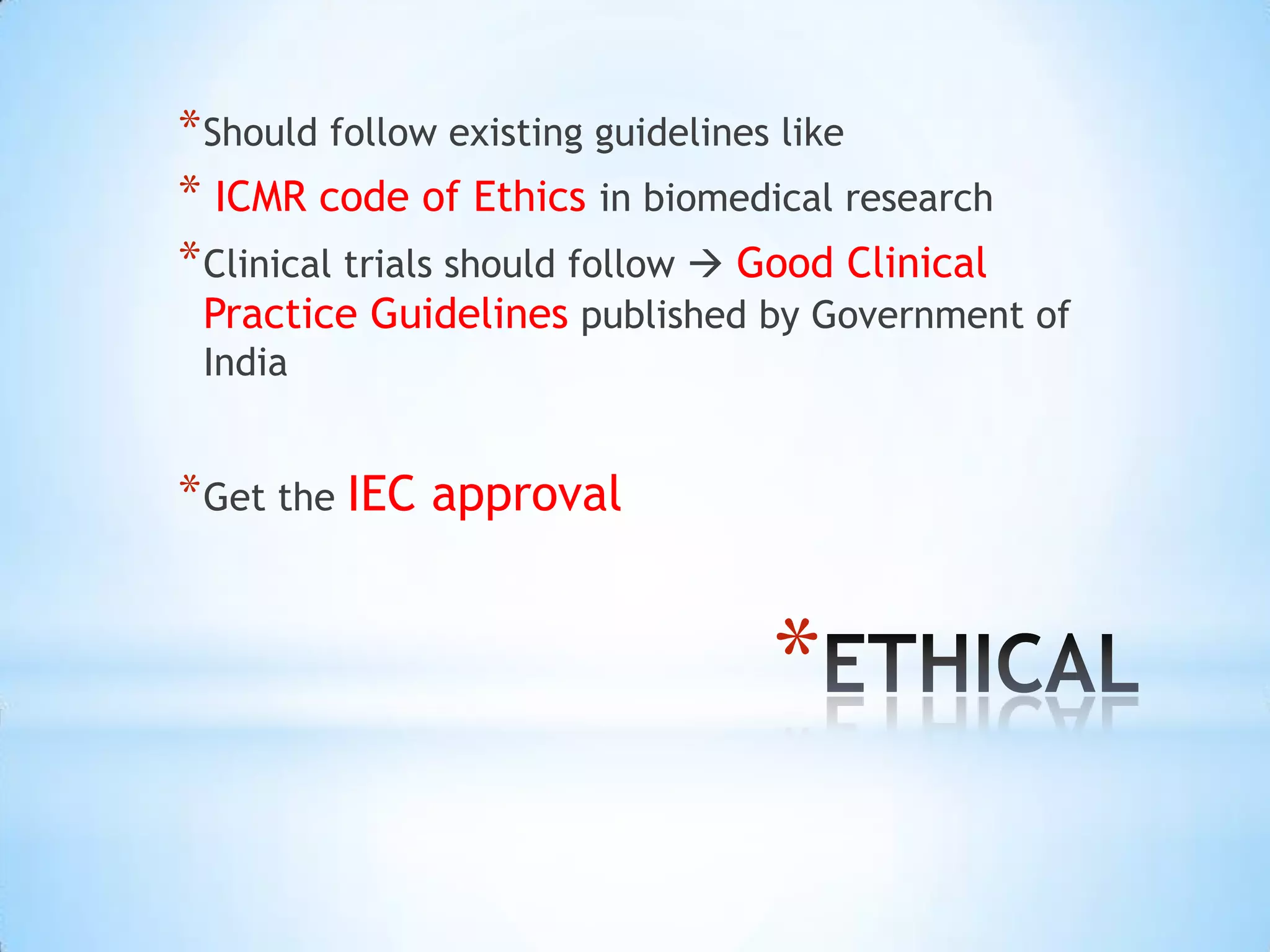
* Should follow existing guidelines like
* ICMR code of Ethics in biomedical research
* Clinical trials should follow  Good Clinical
 Practice Guidelines published by Government of
 India


* Get the IEC approval


                                  *
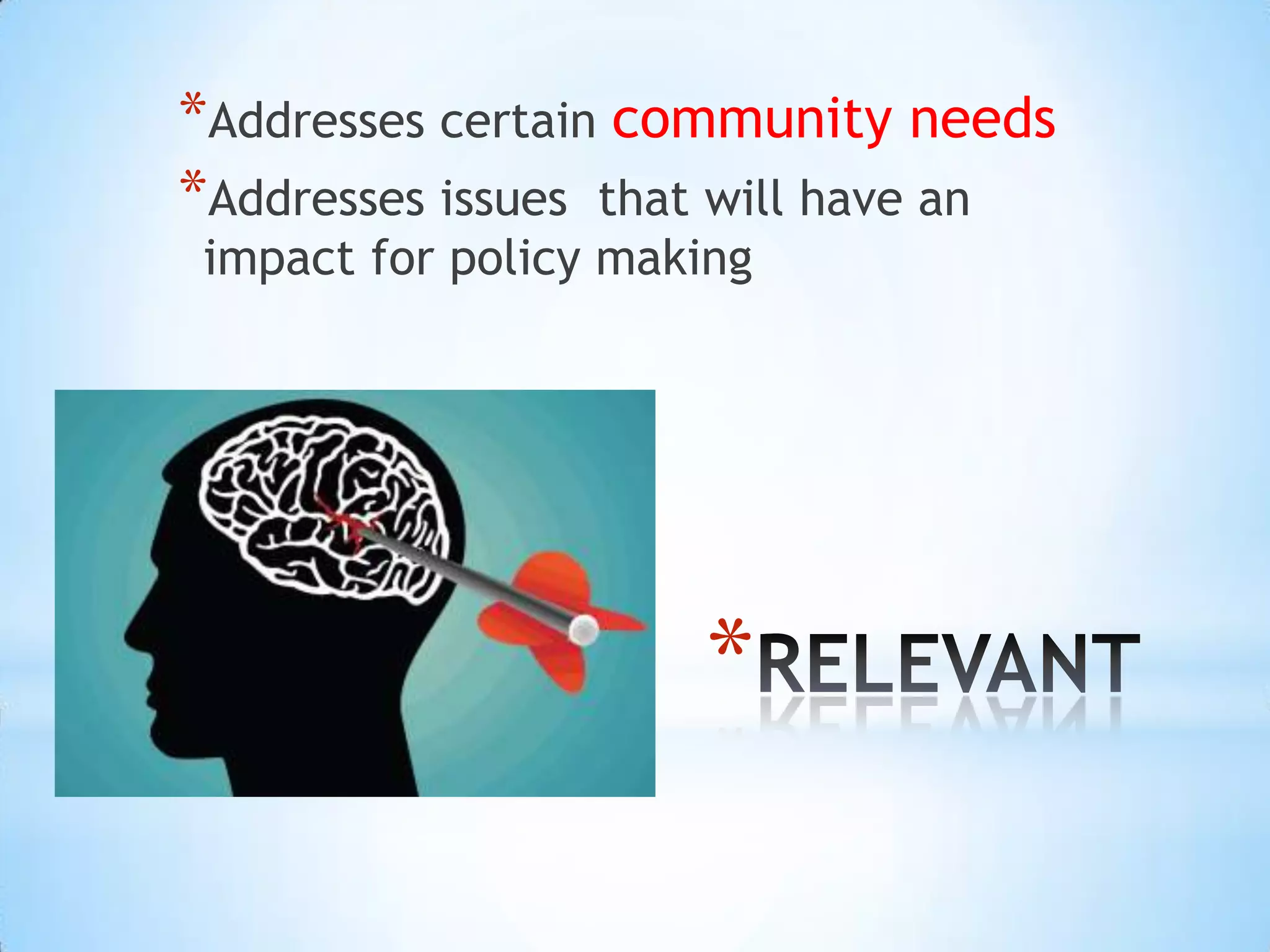
*Addresses certain community needs
*Addresses issues that will have an
 impact for policy making


                      *
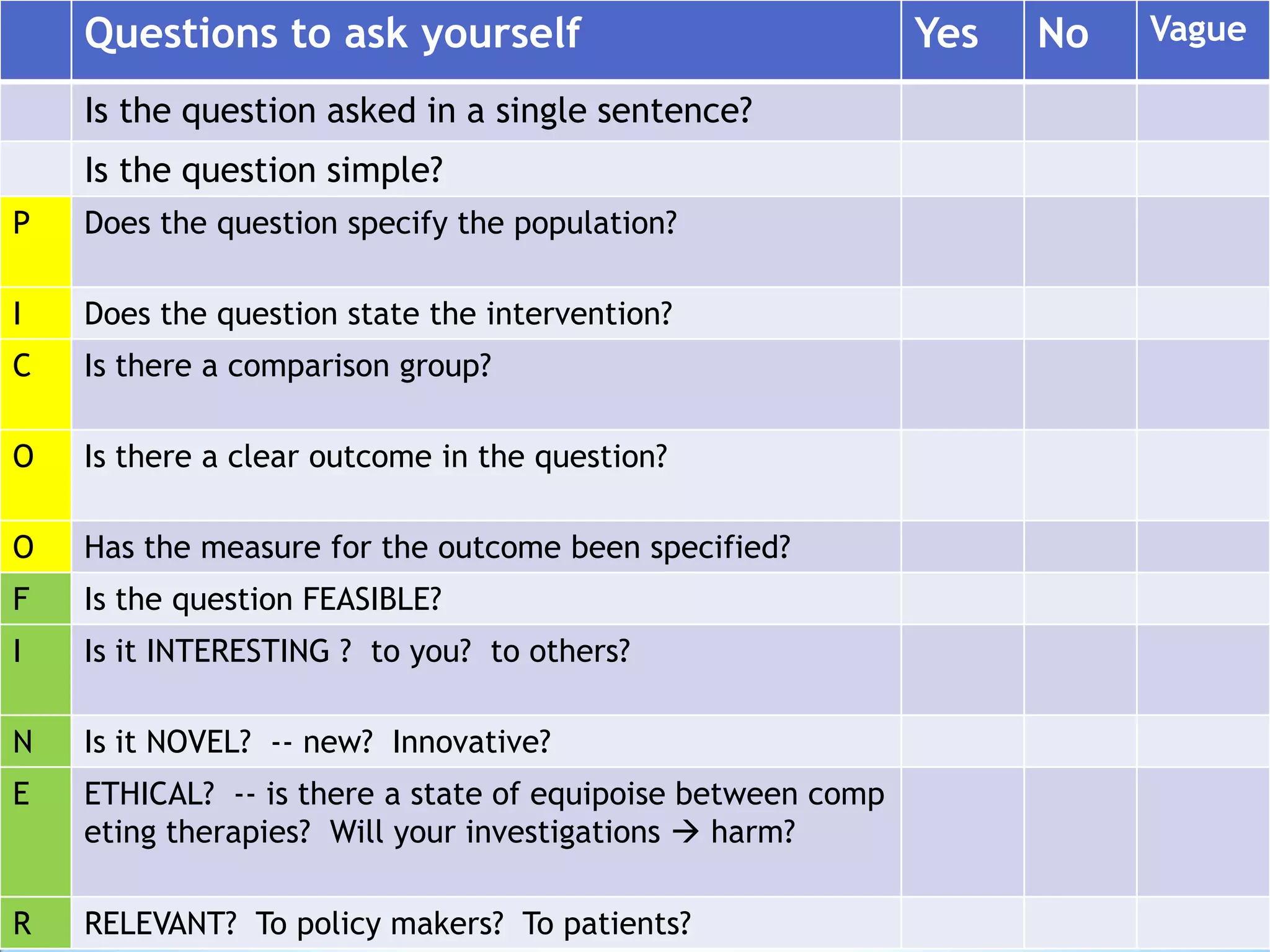
Questions to ask yourself                                Yes   No   Vague

    Is the question asked in a single sentence?
    Is the question simple?
P   Does the question specify the population?

I   Does the question state the intervention?
C   Is there a comparison group?

O   Is there a clear outcome in the question?

O   Has the measure for the outcome been specified?
F   Is the question FEASIBLE?
I   Is it INTERESTING ? to you? to others?

N   Is it NOVEL? ‐‐ new? Innovative?
E   ETHICAL? ‐‐ is there a state of equipoise between comp
    eting therapies? Will your investigations  harm?

R   RELEVANT? To policy makers? To patients?
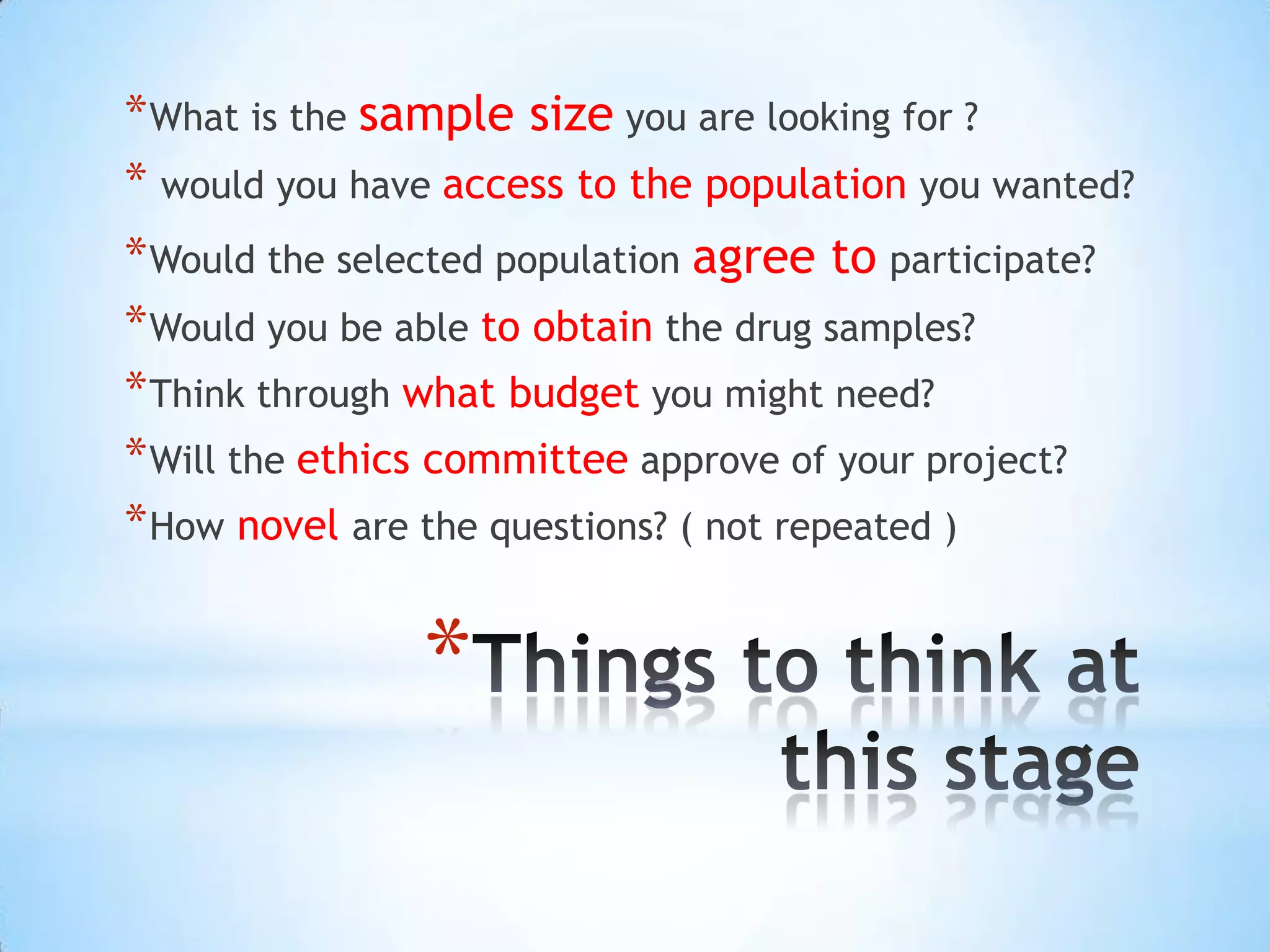
* What is the sample size you are looking for ?
* would you have access to the population you wanted?
* Would the selected population agree to participate?
* Would you be able to obtain the drug samples?
* Think through what budget you might need?
* Will the ethics committee approve of your project?
* How novel are the questions? ( not repeated )


               *
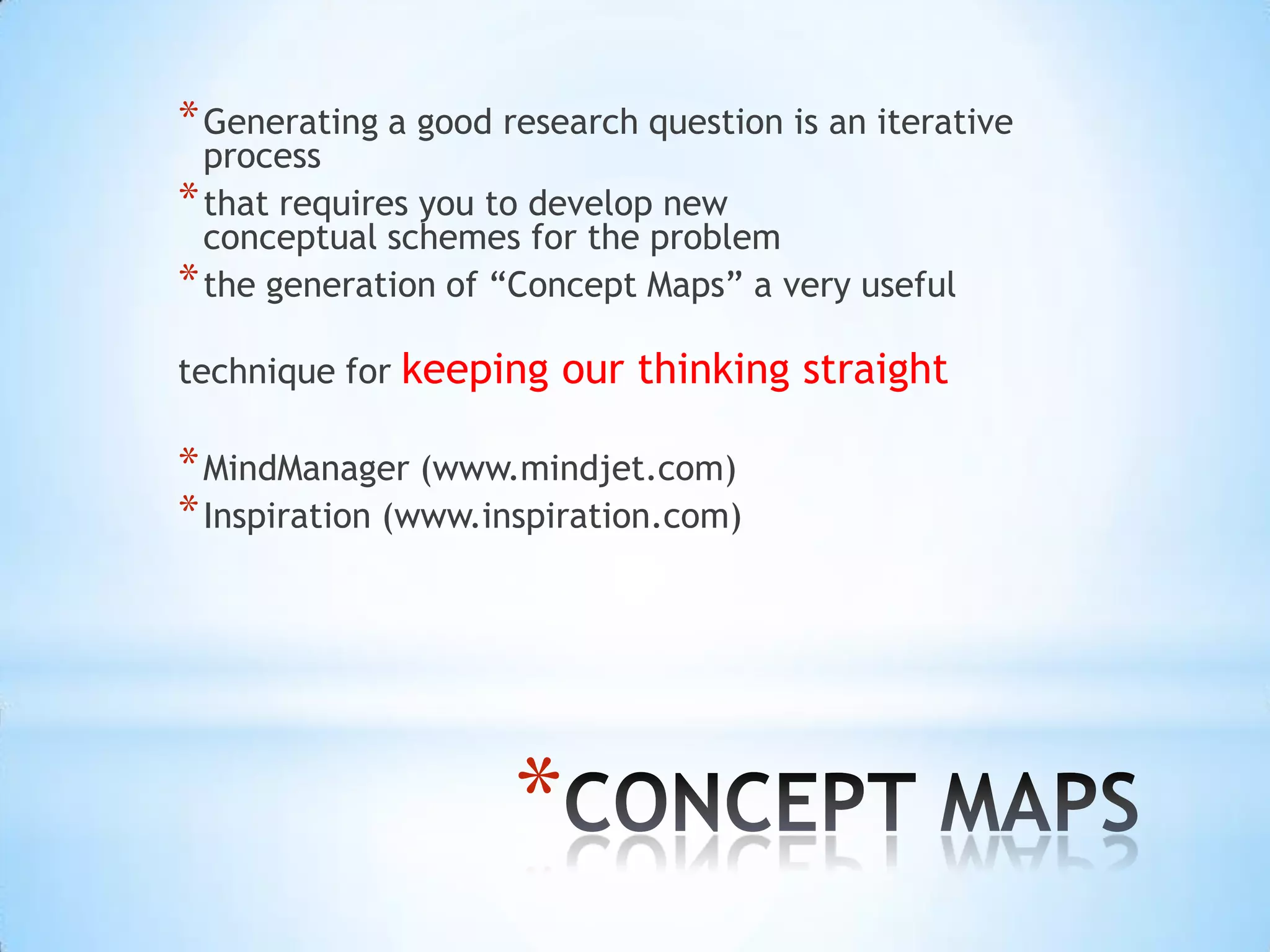
* Generating a good research question is an iterative
  process
* that requires you to develop new
  conceptual schemes for the problem
* the generation of “Concept Maps” a very useful
technique for keeping our thinking straight

* MindManager (www.mindjet.com)
* Inspiration (www.inspiration.com)


                     *
* you can write the one page description required for the assi
 gnment.
* should write the goal of the research,
* what the general objective of the research is,
* try to formulate specific aims which can be your refined que
 stion(s) and then,
* if you have a hypothesis that can be tested,
   write that down.
* summarize your thinking on the feasibility
* and general plans you have for conducting the research.

                                 *
* Hulley SB, Cummings SR. “Designing Clinical Research: An
 epidemiological approach.
* Centre for Health Evidence: “Users’ Guides to Evidence
  Based Practice”
* http://www.cche.net/usersguides/start.asp#Questions
* Guidelines for graduate students: “Choosing and refining a
  research topic”
           http://www.fiu.edu/~kowert/topic.html
* How to write Specific Aims:
     http://www.theresearchassistant.com/tutorial/4‐4.asp

                             *
Even thousands of miles of journey
starts with a single step……..
         lao tzu a chinese mystic

Choosing the appropriate research topic. satya pptx

  • 3.
  • 7.
    *Development of scientificattitude - Evidence based medicine *Learning research methodology *Curricular requirement *publication *
  • 10.
  • 16.
    *It Is asystematic and organised scientific process *To find answers to questions
  • 17.
    * Research isto see what everybody else has seen, and to think what nobody else has thought………. ----Albert Szent-Gyorgyi
  • 27.
    *is an importantand complex part of the research process *You will need to do some research and reading *
  • 28.
    CHOOSING THE APPROPRIATE RESEARCHTOPIC Dr. V. Sathyanarayanan M.D., Professor of Pharmacology
  • 29.
    *To know theprocesses involved in choosing the appropriate research topic *To formulate a research question ( aim and objectives ) *To assess the quality of the research question effectively *To formulate a hypothesis for testing the research question *OBJECTIVES
  • 30.
    *First and foremost,it must be interesting *You should learn something of value to you *It should be productive *
  • 32.
    * Choose a mentor or guide
  • 37.
    and then… 1. Developa research question * Do a thorough search of medical literature * Identify the edge of knowledge related to that question and gaps in knowledge * Be certain that your question has not already been answered AND that filling the gaps is important 2. Develop a testable hypothesis *
  • 44.
    *The man witha new idea is a crank until the idea succeeds….. *
  • 48.
    *Not necessarily Archemedes or edison
  • 49.
    *as you goabout your daily clinical practice * observe with curiosity and enquire….. * Sometimes it is the result of having a disagree ment with a colleague *Define the problem well *
  • 50.
    *Etiology and *Elucidate mechanisms pathogenesis *Pathophysiology *Diagnosis *Diagnostic approaches *Therapeutic *Treatment interventions *prognosis *Research into the prognostic factors *
  • 60.
    *Consider personal interests *Engagein conversations with the mentor, colleagues, teachers and experts *Read articles *Browse recent issues of journals or magazines *Browse the shelves for books on your subject *Identify the research question area *Aware of overuse of ideas
  • 70.
    *Concluding sections inthe critically examined individual studies, systematic review *Remaining gaps in literature *Further define the research question *MEDLINE, PUBMED, SCIENCEDIRECT, * MEDSCAPE *
  • 75.
    *From standard textbooks *Use article databases to scan current magazine, journal or newspaper articles on the topic * Use Web search engines to find Web sites on the topic *
  • 79.
    *Keep it manageable. *Beaware if a topic is very recent *discuss your topic with your guide *
  • 83.
    * Look forwords that best describe your topic *Find synonyms, broader and narrower terms for each keyword you find *Keep a list of these words to use later as you search *
  • 88.
    * it iscommon to modify your topic during the research process * Be aware of the depth of coverage needed and the due date. *Your guide will probably provide specific requirements *
  • 93.
    *You will oftenbegin with a word, *develop a more focused interest in an aspect of something relating to that word, * then begin to have questions about the topic. *Significance of the research question must be identified *
  • 98.
    *Use the keywords you have gathered to research in the * catalog, article databases * and Internet search engines. * Find more information to help answer your research question. *
  • 105.
    * To stealfrom one is plagiarism.to steal from many is research… ---Steven Right
  • 106.
    * This maybe the answer to your research question * and/or a way to clearly state the purpose of your research. * Your thesis statement will usually be one or two sentences * that states precisely what is to be answered, proven, or what you will inform your audience about your topic. *
  • 111.
    * Trying toturn a statement into a real question *
  • 112.
    *Possibly the mostdifficult part * is to come up with a reasonable question *and focus it to the point *where it can be answered *
  • 114.
    * defining thegoal of your research, * identifying objectives, * refining and refining it some more and * refining it even more until * you have a neat and simple question * that is feasible to answer. *
  • 115.
    * stated inbroad terms * and covers the topic that interests you *
  • 117.
    * more focused *There could be more than one *but all would contribute to the overall goal *Define it *
  • 120.
    * one ofthe on going topics in recent years is * whether medical marijuana has any place in the mains tream medical world. * The goal of research in this area would be *to assess whether medical marijuana is a useful treatment *
  • 121.
    *What is thepopulation I want to study? *How do I describe it – age, sex, background? *What is the intervention I want to study? *Do I have all the details of the intervention? *What is the outcome I want to achieve? *How am I going to measure the outcome? *
  • 122.
    *PICO *P ‐ Population *I‐ Intervention *C ‐ Comparison *O – Outcome Measured *
  • 123.
    *Population ‐ childrenwith cerebral palsy * Described ‐ ages 6 to 16 *Intervention ‐ Medical marijuana * Details of intervention – dose and given orally *Outcome – frequency of spasm by 50% * Measure of outcome – Tic spasm score. *
  • 124.
    *Medical marijuana, givenorally X mg q.i.d will *reduce the frequency of spasms by 50%, as me asured by the Tic spasm score, in children with *cerebral palsy between the ages of 6 and 16 ye ars. *
  • 125.
    * single statementthat contains sufficient information that it can be tested using *statistical methodology
  • 126.
    * are proceduresfor making rational decisions about *what is real and what is opinion *
  • 130.
    *F – Feasible *I– Interesting *N – Novel *E – Ethical *R ‐ Relevant *
  • 131.
    *Number of subjects *Alterinclusion and exclusion criteria *Equipment *cost *
  • 133.
    *To you *To theguide *To the peers *Editors of the journals *Reviewers *
  • 138.
    *Newer topic oridea *Not duplicated *Duplicated Will have a lower rating *
  • 146.
    * Should followexisting guidelines like * ICMR code of Ethics in biomedical research * Clinical trials should follow  Good Clinical Practice Guidelines published by Government of India * Get the IEC approval *
  • 149.
    *Addresses certain communityneeds *Addresses issues that will have an impact for policy making *
  • 151.
    Questions to askyourself Yes No Vague Is the question asked in a single sentence? Is the question simple? P Does the question specify the population? I Does the question state the intervention? C Is there a comparison group? O Is there a clear outcome in the question? O Has the measure for the outcome been specified? F Is the question FEASIBLE? I Is it INTERESTING ? to you? to others? N Is it NOVEL? ‐‐ new? Innovative? E ETHICAL? ‐‐ is there a state of equipoise between comp eting therapies? Will your investigations  harm? R RELEVANT? To policy makers? To patients?
  • 157.
    * What isthe sample size you are looking for ? * would you have access to the population you wanted? * Would the selected population agree to participate? * Would you be able to obtain the drug samples? * Think through what budget you might need? * Will the ethics committee approve of your project? * How novel are the questions? ( not repeated ) *
  • 158.
    * Generating agood research question is an iterative process * that requires you to develop new conceptual schemes for the problem * the generation of “Concept Maps” a very useful technique for keeping our thinking straight * MindManager (www.mindjet.com) * Inspiration (www.inspiration.com) *
  • 167.
    * you canwrite the one page description required for the assi gnment. * should write the goal of the research, * what the general objective of the research is, * try to formulate specific aims which can be your refined que stion(s) and then, * if you have a hypothesis that can be tested, write that down. * summarize your thinking on the feasibility * and general plans you have for conducting the research. *
  • 168.
    * Hulley SB,Cummings SR. “Designing Clinical Research: An epidemiological approach. * Centre for Health Evidence: “Users’ Guides to Evidence Based Practice” * http://www.cche.net/usersguides/start.asp#Questions * Guidelines for graduate students: “Choosing and refining a research topic” http://www.fiu.edu/~kowert/topic.html * How to write Specific Aims: http://www.theresearchassistant.com/tutorial/4‐4.asp *
  • 170.
    Even thousands ofmiles of journey starts with a single step…….. lao tzu a chinese mystic