6. Ethic in Health Research
1
Ethical Considerations
• In designing research, especially research that
involves human subjects, it is important to
consider the underlying ethical principles
• Proposal for such research must be reviewed by
the relevant Ethical board/Committee
2
Ethical Considerations cont..
The main principles include:
a) Scientific merit: any research should be merited, and
the method must be appropriate to the aims of the
investigation
b) Equitable selection of subjects
c) Informed consent: individuals must understand the
nature of the study and possible implications
d) Confidentiality
e) Coercion: the rights of individuals must be protected,
Coercion must be avoided at all costs
f) Field trials must obtain informed consent
3
Ethical Considerations cont..
g) Enhance the benefits and eliminate harms
 Describe potential ethical concerns and mechanisms to
minimize harm and maximize benefits
 Professional obligation to safeguard the safety of study
subjects
h) Provision of incentives: no hard rule should exist
i) Feedback of the Results: the concerned
stakeholders must know the findings
• This should reinforce future interest in
community-based research
j) Anonymity of communities: i.e. a community’s
right to confidentiality is important
4
Ethical consideration cont….
 Research Ethics principles
 Respect person
 Confidentiality
 Benefit /no harm
 Informed consent
 Justice
5
The following should be clearly stated:
•Known benefits, risks and disadvantages
•Information to be provided to subjects and how
•Extent and alternative to participation
•Incentives to be provided to subjects if any
•Treatment to be provided to subjects if any
•Information confidentiality
6
7.Work plan, Budget and reference writing
7
Work plan for the research project
The work plan is the timeline that shows when
specific tasks will have been accomplished and the
responsible body to each activity
A work plan informs the reader how long it will
take to achieve the objectives/answer the
questions
8
Work plan …con’d
It is a schedule, chart or graph that summarizes
the different components of a research proposal
and how they will be implemented in a coherent
way within a specific time-span
Work plan includes:
– Tasks to be performed
– When these tasks will be performed
– Who will perform the task
9
Work plan …con’d
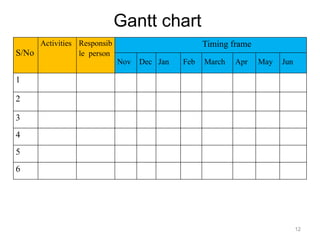
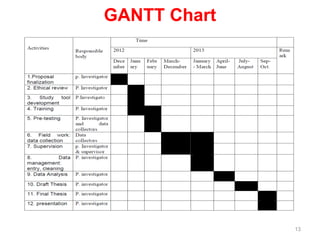
The GANTT Chart
It is a planning tool which depicts graphically the order
in which various tasks must be completed and their
duration of activity
A typical Gantt chart includes the following information:
The tasks to be performed
Who is responsible for each task
The time each task is expected to take
10
A work plan can serve as:
A management tool
A tool for monitoring and evaluation
A visual picture of the sequence of the project
operations (interrelationship among activities)
11
Gantt chart
S/No
Activities Responsib
le person
Timing frame
Nov Dec Jan Feb March Apr May Jun
1
2
3
4
5
6
12
GANTT Chart
13
Budget
To conduct research, it is necessary to obtain
funding for the research project
When drawing up a budget, be realistic!
Do no attempt to be too economical to
demonstrate how cheaply you can run the project
At the same time, do not be too expensive so as
not to discourage the fund providers
14
Budget …con’d
How should a budget be prepared?
It is necessary to use the work plan as a starting point
Specify, for each activity in the work plan, what
resources are required
Determine for each resource needed the unit cost and the
total cost
15
Budget …con’d
The budget format and justification
The type of budget format to be used may vary
Most donor organizations have their own special
project forms, which include a budget format
Include 5%-10% contingency fund for market
inflation
16
Budget
•Itemize and justify the budget
•Types of expenses include:
– Personnel cost (include names and contributions to
project),
– Material cost (Equipment, supplies, data processing,
secretarial expenses etc)
– Transport cost
– Communications cost
– Publication/dissemination of research findings
17
Referencing
 Referencing is a standard way of acknowledging
the sources of information
It is important to be consistent when you are
referencing
18
Major sources of literatures
–Books
–Journals
–Report paper
–Conference paper
–Website etc...
19
Methods of citations in preparing LR:
 Vancouver system
 Harvard system
 American Psychological Association (APA)
 Chicago/Turabian (CMS)
 Modern Language Association (MLA)
 American Medical Association (AMA)
 American Sociological Association (ASA)
20
The Vancouver system
In the Vancouver style, citations within the text of
the essay/paper are identified by Arabic numbers
in round brackets or Arabic numbers in
superscript.
Example:
Although an increasing number of countries have succeeded in
improving the health and well being of mothers and children, some
countries with the highest burden of mortality made little progress
during the 1990s (1).
21
Vancouver…con’d
When you use the Vancouver system, you will use consecutive
numbers in the text to indicate your references
At the end, you will then list your references in that order, using
the format described above
For a book
Author(s)’ Surname followed by initials. Title of book. Place: Publisher;
Year, Edition.
Example:
Abramson H. Survey methods in community Health. Edinburgh: Churchill
Livingstone ; 1990, 4th ed.
22
Journal:
Author(s) Family name and initials. Title of article. Title
of journal abbreviated. Publication year, month, day
(month and day if available); volume(issue): pages.
Example:
Paul K. Maternal mortality in Africa from1980-87. Social
Science and Medicine.1993;37(2):745-52.
23
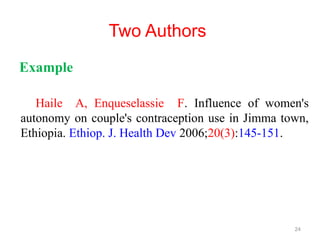
Two Authors
Example
Haile A, Enqueselassie F. Influence of women's
autonomy on couple's contraception use in Jimma town,
Ethiopia. Ethiop. J. Health Dev 2006;20(3):145-151.
24
More than Six authors:
Write the first three authors, and et al.
Example:
Tsega E, Mengesha B, Nordenfelt E, et al. Serological
survey of HIV infection in Ethiopia. Ethiop Med J
1998;26(4):179-84.
25
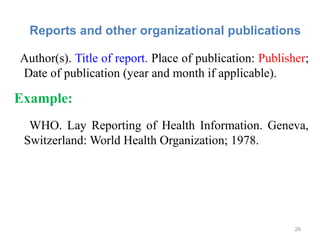
Reports and other organizational publications
Author(s). Title of report. Place of publication: Publisher;
Date of publication (year and month if applicable).
Example:
WHO. Lay Reporting of Health Information. Geneva,
Switzerland: World Health Organization; 1978.
26
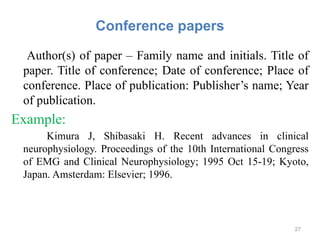
Conference papers
Author(s) of paper – Family name and initials. Title of
paper. Title of conference; Date of conference; Place of
conference. Place of publication: Publisher’s name; Year
of publication.
Example:
Kimura J, Shibasaki H. Recent advances in clinical
neurophysiology. Proceedings of the 10th International Congress
of EMG and Clinical Neurophysiology; 1995 Oct 15-19; Kyoto,
Japan. Amsterdam: Elsevier; 1996.
27
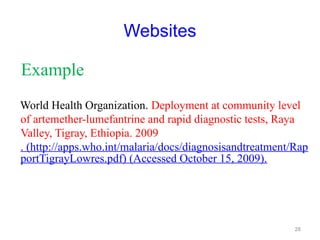
Websites
Example
World Health Organization. Deployment at community level
of artemether-lumefantrine and rapid diagnostic tests, Raya
Valley, Tigray, Ethiopia. 2009
. (http://apps.who.int/malaria/docs/diagnosisandtreatment/Rap
portTigrayLowres.pdf) (Accessed October 15, 2009).
28
The Harvard System
In other journals and books it is common to put the year,
between brackets, straight after the name of the author(s)
If this system of citation is used, the references at the end
of the proposal, should be listed in Alphabetical order
In Harvard System, put the surname of the author, year of
publication in brackets, (E.g. Shiva 1998)
29
Harvard…con’d
Example :
Many patients with malaria have limited access to the new
recommended first-line treatment because of poor
communication, lack of knowledge, as well as distance
and transport costs to reach the health services (Whitty et
al. 2008).
30
Harvard…con’d
Thus, WHO recommends combination therapies,
preferably those including an artemisinin derivative, as
treatment for uncomplicated P. falciparum malaria for
achieving a rapid cure, reducing parasiteinfectivity
(WHO 2008) and countering the threat of resistance to P.
falciparum (CDC 2006).
31
Harvard…con’d
Example:
Abramson JH (1990), 4th
ed. Survey methods in
community medicine. Edinburgh: Churchill Livingstone.
32
Annexes
Annexes may include the following:
Information sheet
Informed consent form
Data collection tools and procedures
Dummy table
Sampling procedure
Map of the study area
33
8. Writing Research Report
RESULT WRITING
34
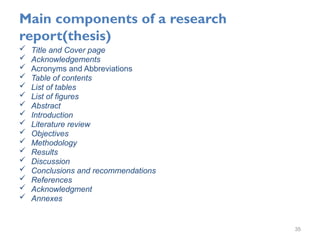
Main components of a research
report(thesis)
 Title and Cover page
 Acknowledgements
 Acronyms and Abbreviations
 Table of contents
 List of tables
 List of figures
 Abstract
 Introduction
 Literature review
 Objectives
 Methodology
 Results
 Discussion
 Conclusions and recommendations
 References
 Acknowledgment
 Annexes
35
• Research paper includes all proposal contents
AND including :
– Result
– Discussion
– Conclusion and recommendation
• Data collection and report writing is the main concern
in the result part
36
Thesis Report
• Components of the research report
1. Preliminary Section: includes
– Title page
– Acknowledgments
– Table of contents
– List of table
– List of figures
– List of abbreviations
– Abstract page
37
2. The body of research
– Introduction (Background, statement of the problem and
rational of the study)
– Literature review
– Research hypothesis /Questions
– Objectives
– Methods and
– Results
– Discussion
– Conclusion and recommendations
– References
– Annex/es
• Preliminary Section and Literature review, Research
hypothesis/Questions, Objectives, Methods and Materials
are almost similar with the proposal
38
Abstract: is a short comprehensive summary of a study
written at the beginning of an article.
• An abstract quickly focuses the reader on the main
points of a study
• Vary in length from 250 to 350 words
• More detailed abstracts with specific headings
39
Introduction- Describes:
– Central phenomena, concepts, or variables
– Statement of purpose, research questions
– Study significance
40
All component of Method section
41
RESULT
• The collected data will be presented here
numerically or in words, tables and graphs
• The function of the Results section is to
objectively present
– The key results, without interpretation
– in an orderly and logical sequence using both
illustrative materials (Tables and Figures) and text.
42
Quantitative Studies:
• Descriptive information (e.g., description of subjects)
• Results of statistical analyses
– Names of statistical tests
– Value of calculated statistic
– Level of statistical significance
• The Results section should be organized around a series
of Tables and/or Figures sequenced to present your key
findings in a logical order.
• The text of the results section follows this sequence and
highlights the answers to the questions/hypotheses you
investigated
43
• Each Table or Figure must include a brief description of
the results being presented and other necessary
information in a legend.
– Table legends go above the Table; tables are read
from top to bottom
– Figure legends go below the figure; figures are
usually viewed from bottom to top
Qualitative Studies:
• Findings often organized according to major themes,
processes, or categories identified in the analysis
• Almost always includes raw data—quotes directly from
study participants
44
DISCUSSION
• Includes:
– Interpretation of the results
– Implication(inference)
• Interpretation and elaboration of the result takes
place here.
• The possible reasons and justifications are
explained in detail
• Gives opportunity to explain the meaning of your
results and why the findings are important
• State the major findings of the Study
45
• Relate the findings to those of similar studies
• State the clinical relevance of the findings
• Acknowledge the study’s limitations
• Make suggestions for further research
• Give the “Take-Home Message” in the Form of a
conclusion
• Things to Avoid When Writing the Discussion
– Over interpretation of the Results
– Unwarranted assumption
– Inflating the Importance of the Findings
46
Conclusions
• Conclusions can be short, as they have already
been elaborately discussed in the discussion
section
• As the discussion will follow the sequence in
which the findings have been presented (which
in turn depends on your objectives) the
conclusions should logically follow the same
order
47
Recommendations
• There are two types of recommendations
• Action taken immediately
• Action taken in the long run by the
government or NGO
48
Recommendations…..
• Recommendations should be supported by the
results
• Recommendations are usually placed in roughly
the same sequence as the conclusion
• Specify the recommendations towards which they
are directed
Example
– Policy makers
– Managers at district or lower level
– Staff who could implement the activities
– The community at large
– Researchers
49
Acknowledgements
 It is important to acknowledge the source
of research funding
 Failure to do so may constitute a
violation of the conditions under which an
award has been given
 Acknowledge those whose work enabled
the study to proceed
50
Annexes or appendices
• The annexes should contain any additional
information needed to enable professionals to
follow research procedures
51
Annex…
Annexes may include the following:
Consent form and information sheet
Data collection tools
Dummy table
Sampling procedure
Map of the study area
Letter of support (cooperation letter)
 Copy of the ethical approval letter
Curriculum vitae (CV) of the principal investigator
Tables referred to in the text but not included in
order to keep the report short
52
53

Research methdology ethics. Research methodology ethica

  • 1.
    6. Ethic inHealth Research 1
  • 2.
    Ethical Considerations • Indesigning research, especially research that involves human subjects, it is important to consider the underlying ethical principles • Proposal for such research must be reviewed by the relevant Ethical board/Committee 2
  • 3.
    Ethical Considerations cont.. Themain principles include: a) Scientific merit: any research should be merited, and the method must be appropriate to the aims of the investigation b) Equitable selection of subjects c) Informed consent: individuals must understand the nature of the study and possible implications d) Confidentiality e) Coercion: the rights of individuals must be protected, Coercion must be avoided at all costs f) Field trials must obtain informed consent 3
  • 4.
    Ethical Considerations cont.. g)Enhance the benefits and eliminate harms  Describe potential ethical concerns and mechanisms to minimize harm and maximize benefits  Professional obligation to safeguard the safety of study subjects h) Provision of incentives: no hard rule should exist i) Feedback of the Results: the concerned stakeholders must know the findings • This should reinforce future interest in community-based research j) Anonymity of communities: i.e. a community’s right to confidentiality is important 4
  • 5.
    Ethical consideration cont…. Research Ethics principles  Respect person  Confidentiality  Benefit /no harm  Informed consent  Justice 5
  • 6.
    The following shouldbe clearly stated: •Known benefits, risks and disadvantages •Information to be provided to subjects and how •Extent and alternative to participation •Incentives to be provided to subjects if any •Treatment to be provided to subjects if any •Information confidentiality 6
  • 7.
    7.Work plan, Budgetand reference writing 7
  • 8.
    Work plan forthe research project The work plan is the timeline that shows when specific tasks will have been accomplished and the responsible body to each activity A work plan informs the reader how long it will take to achieve the objectives/answer the questions 8
  • 9.
    Work plan …con’d Itis a schedule, chart or graph that summarizes the different components of a research proposal and how they will be implemented in a coherent way within a specific time-span Work plan includes: – Tasks to be performed – When these tasks will be performed – Who will perform the task 9
  • 10.
    Work plan …con’d TheGANTT Chart It is a planning tool which depicts graphically the order in which various tasks must be completed and their duration of activity A typical Gantt chart includes the following information: The tasks to be performed Who is responsible for each task The time each task is expected to take 10
  • 11.
    A work plancan serve as: A management tool A tool for monitoring and evaluation A visual picture of the sequence of the project operations (interrelationship among activities) 11
  • 12.
    Gantt chart S/No Activities Responsib leperson Timing frame Nov Dec Jan Feb March Apr May Jun 1 2 3 4 5 6 12
  • 13.
  • 14.
    Budget To conduct research,it is necessary to obtain funding for the research project When drawing up a budget, be realistic! Do no attempt to be too economical to demonstrate how cheaply you can run the project At the same time, do not be too expensive so as not to discourage the fund providers 14
  • 15.
    Budget …con’d How shoulda budget be prepared? It is necessary to use the work plan as a starting point Specify, for each activity in the work plan, what resources are required Determine for each resource needed the unit cost and the total cost 15
  • 16.
    Budget …con’d The budgetformat and justification The type of budget format to be used may vary Most donor organizations have their own special project forms, which include a budget format Include 5%-10% contingency fund for market inflation 16
  • 17.
    Budget •Itemize and justifythe budget •Types of expenses include: – Personnel cost (include names and contributions to project), – Material cost (Equipment, supplies, data processing, secretarial expenses etc) – Transport cost – Communications cost – Publication/dissemination of research findings 17
  • 18.
    Referencing  Referencing isa standard way of acknowledging the sources of information It is important to be consistent when you are referencing 18
  • 19.
    Major sources ofliteratures –Books –Journals –Report paper –Conference paper –Website etc... 19
  • 20.
    Methods of citationsin preparing LR:  Vancouver system  Harvard system  American Psychological Association (APA)  Chicago/Turabian (CMS)  Modern Language Association (MLA)  American Medical Association (AMA)  American Sociological Association (ASA) 20
  • 21.
    The Vancouver system Inthe Vancouver style, citations within the text of the essay/paper are identified by Arabic numbers in round brackets or Arabic numbers in superscript. Example: Although an increasing number of countries have succeeded in improving the health and well being of mothers and children, some countries with the highest burden of mortality made little progress during the 1990s (1). 21
  • 22.
    Vancouver…con’d When you usethe Vancouver system, you will use consecutive numbers in the text to indicate your references At the end, you will then list your references in that order, using the format described above For a book Author(s)’ Surname followed by initials. Title of book. Place: Publisher; Year, Edition. Example: Abramson H. Survey methods in community Health. Edinburgh: Churchill Livingstone ; 1990, 4th ed. 22
  • 23.
    Journal: Author(s) Family nameand initials. Title of article. Title of journal abbreviated. Publication year, month, day (month and day if available); volume(issue): pages. Example: Paul K. Maternal mortality in Africa from1980-87. Social Science and Medicine.1993;37(2):745-52. 23
  • 24.
    Two Authors Example Haile A,Enqueselassie F. Influence of women's autonomy on couple's contraception use in Jimma town, Ethiopia. Ethiop. J. Health Dev 2006;20(3):145-151. 24
  • 25.
    More than Sixauthors: Write the first three authors, and et al. Example: Tsega E, Mengesha B, Nordenfelt E, et al. Serological survey of HIV infection in Ethiopia. Ethiop Med J 1998;26(4):179-84. 25
  • 26.
    Reports and otherorganizational publications Author(s). Title of report. Place of publication: Publisher; Date of publication (year and month if applicable). Example: WHO. Lay Reporting of Health Information. Geneva, Switzerland: World Health Organization; 1978. 26
  • 27.
    Conference papers Author(s) ofpaper – Family name and initials. Title of paper. Title of conference; Date of conference; Place of conference. Place of publication: Publisher’s name; Year of publication. Example: Kimura J, Shibasaki H. Recent advances in clinical neurophysiology. Proceedings of the 10th International Congress of EMG and Clinical Neurophysiology; 1995 Oct 15-19; Kyoto, Japan. Amsterdam: Elsevier; 1996. 27
  • 28.
    Websites Example World Health Organization.Deployment at community level of artemether-lumefantrine and rapid diagnostic tests, Raya Valley, Tigray, Ethiopia. 2009 . (http://apps.who.int/malaria/docs/diagnosisandtreatment/Rap portTigrayLowres.pdf) (Accessed October 15, 2009). 28
  • 29.
    The Harvard System Inother journals and books it is common to put the year, between brackets, straight after the name of the author(s) If this system of citation is used, the references at the end of the proposal, should be listed in Alphabetical order In Harvard System, put the surname of the author, year of publication in brackets, (E.g. Shiva 1998) 29
  • 30.
    Harvard…con’d Example : Many patientswith malaria have limited access to the new recommended first-line treatment because of poor communication, lack of knowledge, as well as distance and transport costs to reach the health services (Whitty et al. 2008). 30
  • 31.
    Harvard…con’d Thus, WHO recommendscombination therapies, preferably those including an artemisinin derivative, as treatment for uncomplicated P. falciparum malaria for achieving a rapid cure, reducing parasiteinfectivity (WHO 2008) and countering the threat of resistance to P. falciparum (CDC 2006). 31
  • 32.
    Harvard…con’d Example: Abramson JH (1990),4th ed. Survey methods in community medicine. Edinburgh: Churchill Livingstone. 32
  • 33.
    Annexes Annexes may includethe following: Information sheet Informed consent form Data collection tools and procedures Dummy table Sampling procedure Map of the study area 33
  • 34.
    8. Writing ResearchReport RESULT WRITING 34
  • 35.
    Main components ofa research report(thesis)  Title and Cover page  Acknowledgements  Acronyms and Abbreviations  Table of contents  List of tables  List of figures  Abstract  Introduction  Literature review  Objectives  Methodology  Results  Discussion  Conclusions and recommendations  References  Acknowledgment  Annexes 35
  • 36.
    • Research paperincludes all proposal contents AND including : – Result – Discussion – Conclusion and recommendation • Data collection and report writing is the main concern in the result part 36
  • 37.
    Thesis Report • Componentsof the research report 1. Preliminary Section: includes – Title page – Acknowledgments – Table of contents – List of table – List of figures – List of abbreviations – Abstract page 37
  • 38.
    2. The bodyof research – Introduction (Background, statement of the problem and rational of the study) – Literature review – Research hypothesis /Questions – Objectives – Methods and – Results – Discussion – Conclusion and recommendations – References – Annex/es • Preliminary Section and Literature review, Research hypothesis/Questions, Objectives, Methods and Materials are almost similar with the proposal 38
  • 39.
    Abstract: is ashort comprehensive summary of a study written at the beginning of an article. • An abstract quickly focuses the reader on the main points of a study • Vary in length from 250 to 350 words • More detailed abstracts with specific headings 39
  • 40.
    Introduction- Describes: – Centralphenomena, concepts, or variables – Statement of purpose, research questions – Study significance 40
  • 41.
    All component ofMethod section 41
  • 42.
    RESULT • The collecteddata will be presented here numerically or in words, tables and graphs • The function of the Results section is to objectively present – The key results, without interpretation – in an orderly and logical sequence using both illustrative materials (Tables and Figures) and text. 42
  • 43.
    Quantitative Studies: • Descriptiveinformation (e.g., description of subjects) • Results of statistical analyses – Names of statistical tests – Value of calculated statistic – Level of statistical significance • The Results section should be organized around a series of Tables and/or Figures sequenced to present your key findings in a logical order. • The text of the results section follows this sequence and highlights the answers to the questions/hypotheses you investigated 43
  • 44.
    • Each Tableor Figure must include a brief description of the results being presented and other necessary information in a legend. – Table legends go above the Table; tables are read from top to bottom – Figure legends go below the figure; figures are usually viewed from bottom to top Qualitative Studies: • Findings often organized according to major themes, processes, or categories identified in the analysis • Almost always includes raw data—quotes directly from study participants 44
  • 45.
    DISCUSSION • Includes: – Interpretationof the results – Implication(inference) • Interpretation and elaboration of the result takes place here. • The possible reasons and justifications are explained in detail • Gives opportunity to explain the meaning of your results and why the findings are important • State the major findings of the Study 45
  • 46.
    • Relate thefindings to those of similar studies • State the clinical relevance of the findings • Acknowledge the study’s limitations • Make suggestions for further research • Give the “Take-Home Message” in the Form of a conclusion • Things to Avoid When Writing the Discussion – Over interpretation of the Results – Unwarranted assumption – Inflating the Importance of the Findings 46
  • 47.
    Conclusions • Conclusions canbe short, as they have already been elaborately discussed in the discussion section • As the discussion will follow the sequence in which the findings have been presented (which in turn depends on your objectives) the conclusions should logically follow the same order 47
  • 48.
    Recommendations • There aretwo types of recommendations • Action taken immediately • Action taken in the long run by the government or NGO 48
  • 49.
    Recommendations….. • Recommendations shouldbe supported by the results • Recommendations are usually placed in roughly the same sequence as the conclusion • Specify the recommendations towards which they are directed Example – Policy makers – Managers at district or lower level – Staff who could implement the activities – The community at large – Researchers 49
  • 50.
    Acknowledgements  It isimportant to acknowledge the source of research funding  Failure to do so may constitute a violation of the conditions under which an award has been given  Acknowledge those whose work enabled the study to proceed 50
  • 51.
    Annexes or appendices •The annexes should contain any additional information needed to enable professionals to follow research procedures 51
  • 52.
    Annex… Annexes may includethe following: Consent form and information sheet Data collection tools Dummy table Sampling procedure Map of the study area Letter of support (cooperation letter)  Copy of the ethical approval letter Curriculum vitae (CV) of the principal investigator Tables referred to in the text but not included in order to keep the report short 52
  • 53.