GUT HORMONES
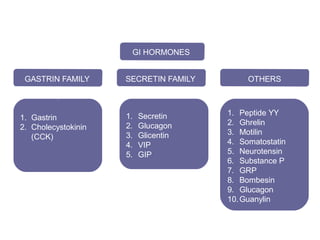
GI HORMONES
GASTRIN FAMILY SECRETIN FAMILY OTHERS
1. Secretin
2. Glucagon
3. Glicentin
4. VIP
5. GIP
1. Gastrin
2. Cholecystokinin
(CCK)
1. Peptide YY
2. Ghrelin
3. Motilin
4. Somatostatin
5. Neurotensin
6. Substance P
7. GRP
8. Bombesin
9. Glucagon
10.Guanylin
Gastrin
• pyloric glands (G Cells)-antral portion of the
stomach
• Also found in the pancreatic islets in fetal life
anterior & intermediate lobes of the pituitary
gland, in the hypothalamus, medulla
oblongata, & in the vagus & sciatic nerves
• G 34, G 17, G 14 (depending on number of
AA)
• G 17- principal gastrin secreted from the
stomach
Functions
• Stimulation of gastric acid & pepsin secretion
• Stimulates growth of gastric mucosa & mucosa of
intestine
• Increases gastric motility
• Contraction of muscles at the gastro-esophageal
junction
• Exocrine pancreatic secretion
• Insulin secretion
• Stimulates mass movement of large intestine
• Colonic contraction that initiates gastrocolic reflex after
a meal
Factors stimulating Gastrin secretion
• Luminal
– Peptides & amino acids
– Distension
• Neural
– Increased vagal discharge via GRP
• Blood-borne
– Calcium
– Epinephrine
Factors inhibiting Gastrin secretion
• Luminal
– Acid
– Somatostatin
• Blood-borne
– Secretin, GIP, VIP, Glucagon
Cholecystokinin-Pancreozymin
(CCK-PZ or CCK)
• I cells in the upper intestine
• neurons in brain ( cerebral cortex) & in nerves in
many part of the body
• CCK 58, CCK 39, CCK 33, CCK 12, CCK 8, CCK 4
– Duodenum & jejunum CCK 12, CCK 8
– Enteric & pancreatic nerves CCK 4
– Brain CCK 58, CCK 8
• half-life of CCK is about 5 minutes
Functions
• Pancreatic secretion rich in enzymes
• Augments the action of secretin to produce alkaline
pancreatic secretion
• Relaxation of sphincter of Oddi
• Stimulate growth of pancreas
• Inhibits gastric acid secretion
• Inhibits gastric motility-delays gastric emptying
• causes contraction of gall bladder
• ↑ secretion of enterokinase
• enhance motility of small intestine
• stimulates colonic movements
• augments contraction of pyloric sphincter
• stimulates glucagon secretion
Secretin
• S cells – upper small intestine (Argentaffin cells).
• Polypeptide hormone (27 AA)
• Acid chyme (PH 4.5-5.0)- Stimulates secretin
secretion
Functions
• ↑ secretion of pancreatic juice rich in bicarbonate
• ↑ alkaline bile secretion
• augments the action of CCK to produce pancreatic
secretion rich in enzymes
• ↓ gastric acid secretion & motility
• contraction of pyloric sphincter
Glucagon & Glicentin
• Preproglucagon (179 aa)
•
•
• A cells L cells
pancreatic islets lower Git
upper GIT Glicentin
Glucagon
• polypeptide containing 28 AA
• nerves in the GIT
• also found in blood
• also found in the brain & autonomic nerves
Vasoactive intestinal polypeptide
• ↑ intestinal secretion rich in electrolytes & water
• causes vasodilation
• ↓ GI motility
• potentiates the action of acetylcholine on salivary
glands
• inhibits gastric acid secretion
Functions
• polypeptide hormone containing 42 AA
• K cells present in the mucosa of duodenum &
jejunum
• inhibits gastric acid secretion & motility
• stimulate insulin secretion
Gastric inhibitory polypeptide
• polypeptide hormone containing 22 AA
• enterochromaffin cells & Mo cells present in the
mucosa of GIT
• ↑ GI motility (interdigestive phase)
• a major regulator of MMC
Motilin
Neurotensin
• a polypeptide hormone containing 13 AA
• neurons & mucosal cells of ileum
• inhibits gastric acid secretion but ↑ ileal blood flow
Substance P
• Endocrine & nerve cells in the GIT
• Increased intestinal motility of the small intestine
Somatostatin
• a polypeptide containing either SS 14 or SS 28
• D cells in GIT, hypothalamus, D cells of pancreas
• inhibits secretion of gastrin, VIP, GIP, secretin &
• motilin
• inhibits pancreatic exocrine secretion; gastric acid
secretion & motility; gall bladder contraction; &
absorption of glucose, amino acids & triglycerides
Gastrin releasing peptide
• polypeptide containing 27 AA
• vagal nerve endings that terminate on G cells
• ↑ gastrin secretion
Guanylin
• polypeptide hormone containing 15 AA
• secreted form the paneth cells
• ↑ secretion of Cl- into the intestinal lumen
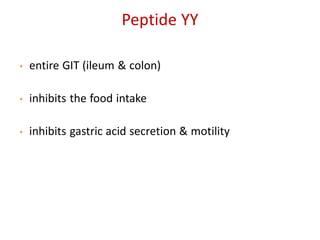
Peptide YY
• entire GIT (ileum & colon)
• inhibits the food intake
• inhibits gastric acid secretion & motility
Growth Hormone Release Inducing =
Ghrelin
• Ghrelin has emerged as the first identified
circulating hunger hormone
• Ghrelin is both a hormone in the endocrine
system and a neurotransmitter in the nervous
system
• 28 amino-acid polypeptide.
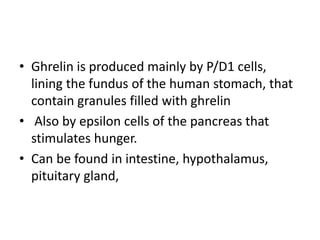
• Ghrelin is produced mainly by P/D1 cells,
lining the fundus of the human stomach, that
contain granules filled with ghrelin
• Also by epsilon cells of the pancreas that
stimulates hunger.
• Can be found in intestine, hypothalamus,
pituitary gland,
Ghrelin receptor
• Bind to GH-secretgogue-receptor 1a (GHS-
R1a)
• G-protein coupled receptor
Factors influencing ghrelin secretion
• Food intake
• Ghrelin level increases 1-2 hr prior to meal,
max just before eating and decreases
dramatically within 1 hr after meal.
• Degree of ghrelin level decrease is in
proportion with calories and composition of
food (CHO can decrease ghrelin > fat)
Increase Ghrelin secretion
• leptin
• Fasting
• GHRH, thyroid hormone
• Testosterone
• Sleep
• Lean people/ low BMI
• Anorexia nervosa
Decrease Ghrelin secretion
• Food intake
• Glucose/lipid
• Insulin
• Somatostatin
• PYY/PP
• Obese people/high BMI
Physiological roles of ghrelin
• Hormonal effect
Stimulation of GH secretion
Synergistic of GHRH
Decrease somatostatin secretion from
hypothalamus
• ↑ ACTH, PRL, cortisol
• Appetite
• Acting at arcuate nucleus by stimulation of
NPY/AGRP neurons (neuropeptide Y/ Agouti-
related peptide) →↑ appetite (orexigenic effect)
• Gastric effects
↑ gastric acid secretion and motility
(acting through vagus nerve which also has
GHS-R1a receptor)
Other effects of ghrelin
• Inhibit proinflammatory cytokin (IL-1, IL-6,
TNF)
• Increase bone mineral density
• Decrease MAP by decreasing peripheral
vascular resistance
• THANK YOU.....

Gut hormones

  • 1.
  • 2.
    GI HORMONES GASTRIN FAMILYSECRETIN FAMILY OTHERS 1. Secretin 2. Glucagon 3. Glicentin 4. VIP 5. GIP 1. Gastrin 2. Cholecystokinin (CCK) 1. Peptide YY 2. Ghrelin 3. Motilin 4. Somatostatin 5. Neurotensin 6. Substance P 7. GRP 8. Bombesin 9. Glucagon 10.Guanylin
  • 3.
    Gastrin • pyloric glands(G Cells)-antral portion of the stomach • Also found in the pancreatic islets in fetal life anterior & intermediate lobes of the pituitary gland, in the hypothalamus, medulla oblongata, & in the vagus & sciatic nerves
  • 4.
    • G 34,G 17, G 14 (depending on number of AA) • G 17- principal gastrin secreted from the stomach
  • 5.
    Functions • Stimulation ofgastric acid & pepsin secretion • Stimulates growth of gastric mucosa & mucosa of intestine • Increases gastric motility • Contraction of muscles at the gastro-esophageal junction • Exocrine pancreatic secretion • Insulin secretion • Stimulates mass movement of large intestine • Colonic contraction that initiates gastrocolic reflex after a meal
  • 6.
    Factors stimulating Gastrinsecretion • Luminal – Peptides & amino acids – Distension • Neural – Increased vagal discharge via GRP • Blood-borne – Calcium – Epinephrine
  • 7.
    Factors inhibiting Gastrinsecretion • Luminal – Acid – Somatostatin • Blood-borne – Secretin, GIP, VIP, Glucagon
  • 8.
    Cholecystokinin-Pancreozymin (CCK-PZ or CCK) •I cells in the upper intestine • neurons in brain ( cerebral cortex) & in nerves in many part of the body • CCK 58, CCK 39, CCK 33, CCK 12, CCK 8, CCK 4 – Duodenum & jejunum CCK 12, CCK 8 – Enteric & pancreatic nerves CCK 4 – Brain CCK 58, CCK 8 • half-life of CCK is about 5 minutes
  • 9.
    Functions • Pancreatic secretionrich in enzymes • Augments the action of secretin to produce alkaline pancreatic secretion • Relaxation of sphincter of Oddi • Stimulate growth of pancreas • Inhibits gastric acid secretion • Inhibits gastric motility-delays gastric emptying
  • 10.
    • causes contractionof gall bladder • ↑ secretion of enterokinase • enhance motility of small intestine • stimulates colonic movements • augments contraction of pyloric sphincter • stimulates glucagon secretion
  • 11.
    Secretin • S cells– upper small intestine (Argentaffin cells). • Polypeptide hormone (27 AA) • Acid chyme (PH 4.5-5.0)- Stimulates secretin secretion
  • 12.
    Functions • ↑ secretionof pancreatic juice rich in bicarbonate • ↑ alkaline bile secretion • augments the action of CCK to produce pancreatic secretion rich in enzymes • ↓ gastric acid secretion & motility • contraction of pyloric sphincter
  • 13.
    Glucagon & Glicentin •Preproglucagon (179 aa) • • • A cells L cells pancreatic islets lower Git upper GIT Glicentin Glucagon
  • 14.
    • polypeptide containing28 AA • nerves in the GIT • also found in blood • also found in the brain & autonomic nerves Vasoactive intestinal polypeptide
  • 15.
    • ↑ intestinalsecretion rich in electrolytes & water • causes vasodilation • ↓ GI motility • potentiates the action of acetylcholine on salivary glands • inhibits gastric acid secretion Functions
  • 16.
    • polypeptide hormonecontaining 42 AA • K cells present in the mucosa of duodenum & jejunum • inhibits gastric acid secretion & motility • stimulate insulin secretion Gastric inhibitory polypeptide
  • 17.
    • polypeptide hormonecontaining 22 AA • enterochromaffin cells & Mo cells present in the mucosa of GIT • ↑ GI motility (interdigestive phase) • a major regulator of MMC Motilin
  • 18.
    Neurotensin • a polypeptidehormone containing 13 AA • neurons & mucosal cells of ileum • inhibits gastric acid secretion but ↑ ileal blood flow
  • 19.
    Substance P • Endocrine& nerve cells in the GIT • Increased intestinal motility of the small intestine
  • 20.
    Somatostatin • a polypeptidecontaining either SS 14 or SS 28 • D cells in GIT, hypothalamus, D cells of pancreas • inhibits secretion of gastrin, VIP, GIP, secretin & • motilin • inhibits pancreatic exocrine secretion; gastric acid secretion & motility; gall bladder contraction; & absorption of glucose, amino acids & triglycerides
  • 21.
    Gastrin releasing peptide •polypeptide containing 27 AA • vagal nerve endings that terminate on G cells • ↑ gastrin secretion
  • 22.
    Guanylin • polypeptide hormonecontaining 15 AA • secreted form the paneth cells • ↑ secretion of Cl- into the intestinal lumen
  • 23.
    Peptide YY • entireGIT (ileum & colon) • inhibits the food intake • inhibits gastric acid secretion & motility
  • 24.
    Growth Hormone ReleaseInducing = Ghrelin • Ghrelin has emerged as the first identified circulating hunger hormone • Ghrelin is both a hormone in the endocrine system and a neurotransmitter in the nervous system • 28 amino-acid polypeptide.
  • 25.
    • Ghrelin isproduced mainly by P/D1 cells, lining the fundus of the human stomach, that contain granules filled with ghrelin • Also by epsilon cells of the pancreas that stimulates hunger. • Can be found in intestine, hypothalamus, pituitary gland,
  • 26.
    Ghrelin receptor • Bindto GH-secretgogue-receptor 1a (GHS- R1a) • G-protein coupled receptor
  • 27.
    Factors influencing ghrelinsecretion • Food intake • Ghrelin level increases 1-2 hr prior to meal, max just before eating and decreases dramatically within 1 hr after meal. • Degree of ghrelin level decrease is in proportion with calories and composition of food (CHO can decrease ghrelin > fat)
  • 28.
    Increase Ghrelin secretion •leptin • Fasting • GHRH, thyroid hormone • Testosterone • Sleep • Lean people/ low BMI • Anorexia nervosa
  • 29.
    Decrease Ghrelin secretion •Food intake • Glucose/lipid • Insulin • Somatostatin • PYY/PP • Obese people/high BMI
  • 30.
    Physiological roles ofghrelin • Hormonal effect Stimulation of GH secretion Synergistic of GHRH Decrease somatostatin secretion from hypothalamus • ↑ ACTH, PRL, cortisol • Appetite • Acting at arcuate nucleus by stimulation of NPY/AGRP neurons (neuropeptide Y/ Agouti- related peptide) →↑ appetite (orexigenic effect)
  • 31.
    • Gastric effects ↑gastric acid secretion and motility (acting through vagus nerve which also has GHS-R1a receptor)
  • 33.
    Other effects ofghrelin • Inhibit proinflammatory cytokin (IL-1, IL-6, TNF) • Increase bone mineral density • Decrease MAP by decreasing peripheral vascular resistance
  • 34.