Obesity
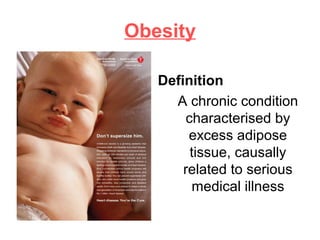
Definition
A chronic condition
characterised by
excess adipose
tissue, causally
related to serious
medical illness
Obesity Diagnostic Tools
• Percentile on Growth Charts
• Body Mass Index (BMI)
• Triceps Skin fold Thickness
(TST)
• Waist-hip ratio
Diagnosis of Obesity
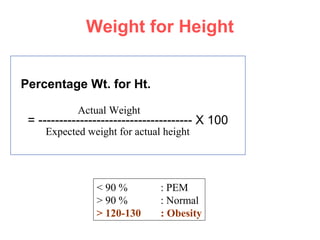
• Weight for height >120%
• Age specific growth charts
• Skin fold thickness: >85%centile for sex
and age
• Waist : >40” in males & 35” in females
• WHR : >0.8 women & 0.9 in males
Percentage Wt. for Ht.
= ------------------------------------- X 100
Weight for Height
Actual Weight
Expected weight for actual height
< 90 % : PEM
> 90 % : Normal
> 120-130 : Obesity
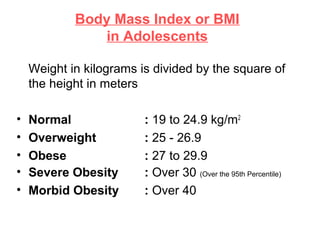
Body Mass Index or BMI
in Adolescents
Weight in kilograms is divided by the square of
the height in meters
• Normal : 19 to 24.9 kg/m2
• Overweight : 25 - 26.9
• Obese : 27 to 29.9
• Severe Obesity : Over 30 (Over the 95th Percentile)
• Morbid Obesity : Over 40
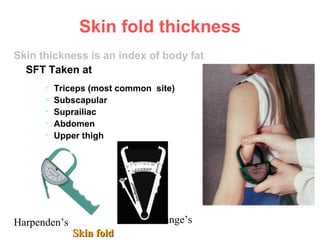
Skin fold thickness
Skin thickness is an index of body fat
SFT Taken at

Triceps (most common site)

Subscapular

Suprailiac

Abdomen

Upper thigh
Lange’sHarpenden’s
Skin foldSkin fold
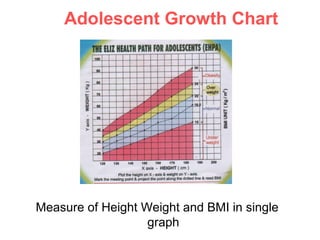
Adolescent Growth Chart
Measure of Height Weight and BMI in single
graph
Types of Obesity
• Simple obesity
• Pathologic obesity
– Dysmorphic syndromes
– Endocrine
– CNS
– Drugs
– Leptin deficiency
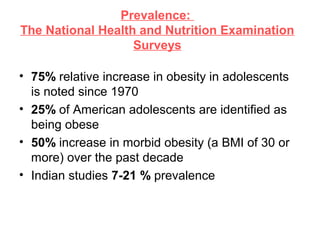
Prevalence:
The National Health and Nutrition Examination
Surveys
• 75% relative increase in obesity in adolescents
is noted since 1970
• 25% of American adolescents are identified as
being obese
• 50% increase in morbid obesity (a BMI of 30 or
more) over the past decade
• Indian studies 7-21 % prevalence
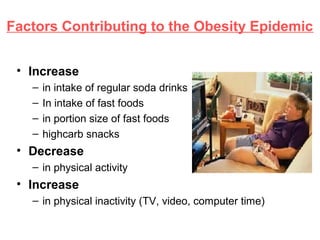
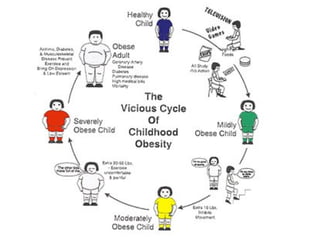
Factors Contributing to the Obesity Epidemic
• Increase
– in intake of regular soda drinks
– In intake of fast foods
– in portion size of fast foods
– highcarb snacks
• Decrease
– in physical activity
• Increase
– in physical inactivity (TV, video, computer time)
Why is it important?
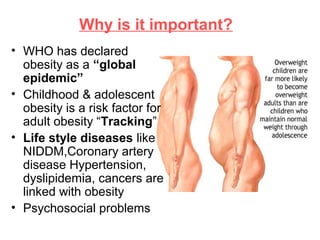
• WHO has declared
obesity as a “global
epidemic”
• Childhood & adolescent
obesity is a risk factor for
adult obesity “Tracking”
• Life style diseases like
NIDDM,Coronary artery
disease Hypertension,
dyslipidemia, cancers are
linked with obesity
• Psychosocial problems
Obesity: Complications
• Psychological
– Disturbed body image
– Poor self-image/self-esteem
– Poor family relations: scapegoat and source
of embarrassment
– Poor peer relations and social isolation
– Exclusion from activities, especially dating
– Acting out and depression
Obesity: Complications
• Medical
– Coronary artery disease
– Cerebrovascular disease
– Gallstones
– Orthopedic problems
– Sleep apnoea
– Increased cancer risks (colon, rectum, prostate)
– Diabetes mellitus
Overweight Screening Procedure
Screening includes evaluation for:
– Family history
– Blood pressure
– Total Cholesterol (≥ 200 mg/dl)
– Large change in BMI (≥ 2 points in previous
year)
– Concern about weight
– Smoking history
Family History
• Positive Family History includes history of:
– Cardiovascular Disease
– Parental hypercholesterolemia
– Hypertension
– Diabetes
– Parental Obesity
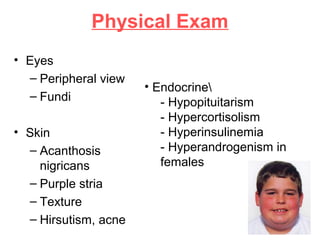
Physical Exam
• Eyes
– Peripheral view
– Fundi
• Skin
– Acanthosis
nigricans
– Purple stria
– Texture
– Hirsutism, acne
• Endocrine
- Hypopituitarism
- Hypercortisolism
- Hyperinsulinemia
- Hyperandrogenism in
females
Lab Work-Up
• T4, TSH
• Free testosterone (in females)
• Fasting insulin and glucose
• Lipid profile
• 24 hour urine for free cortisol
• DHEA-S
• Sleep studies
• Chest x-ray; EKG
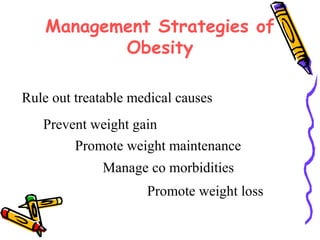
Management Strategies of
Obesity
Prevent weight gain
Promote weight maintenance
Manage co morbidities
Promote weight loss
Rule out treatable medical causes
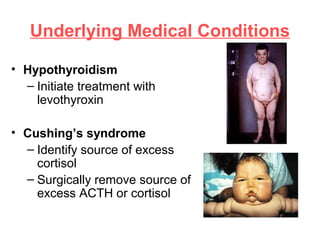
Underlying Medical Conditions
• Hypothyroidism
– Initiate treatment with
levothyroxin
• Cushing’s syndrome
– Identify source of excess
cortisol
– Surgically remove source of
excess ACTH or cortisol
Treatment Content
 Diet / Nutrition Plan
 Physical Activity
 Controlling the environment
 Self-monitoring
 Goal setting and contacting
 Parenting skills
 Managing high-risk situations
 Maintenance and relapse prevention
General Management Principles
 Can start with weight stabilization
 Eventually a 10% weight reduction
 Can decrease by 500 calories/day
with low fat/high fiber diet
 Set realistic goals
 2% decrease in 2500 calories: 5 lb
to drop in one year (use skim milk)
Physical Activity
 Providing and choice of activities
appears to be superior to providing
a specific exercise prescription
 Recent research suggests that
reducing sedentary behaviors may
be more effective than promoting
physical activity in promoting weight
loss
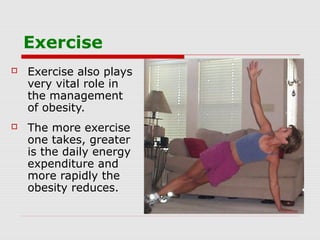
Exercise
 Exercise also plays
very vital role in
the management
of obesity.
 The more exercise
one takes, greater
is the daily energy
expenditure and
more rapidly the
obesity reduces.
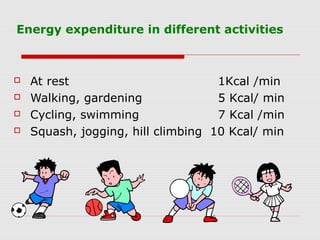
Energy expenditure in different activities
 At rest 1Kcal /min
 Walking, gardening 5 Kcal/ min
 Cycling, swimming 7 Kcal /min
 Squash, jogging, hill climbing 10 Kcal/ min
Benefits of exercise
• Obese people with a heavier body to
move, spend more energy for same
amount of work.
• It is valuable as a diversion from sitting
indoors and being tempted to eat.
• Exercise reduces appetite.
• After exercise the resting B.M.R. may
increase for some hours.
Controlling the Environment
Help reduce cues
 (e.g., taking TV out of bedroom)
Limit access to high calorie foods
Encourage family activities (e.g.,
family walks)
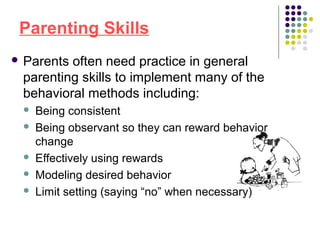
Parenting Skills
 Parents often need practice in general
parenting skills to implement many of the
behavioral methods including:
 Being consistent
 Being observant so they can reward behavior
change
 Effectively using rewards
 Modeling desired behavior
 Limit setting (saying “no” when necessary)
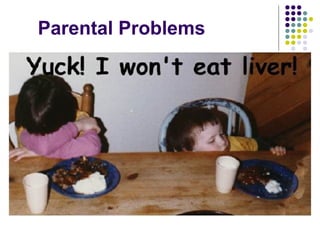
Parental Problems
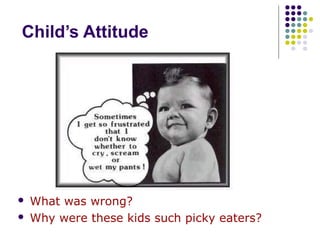
Child’s Attitude
 What was wrong?
 Why were these kids such picky eaters?
Management Options
 Behavioural
interventions
 Mealtime
suggestions
Tactics for Toddlers
To tempt littleTo tempt little
taste budstaste buds
&&
minimizeminimize
mealtimemealtime
hassles.hassles.
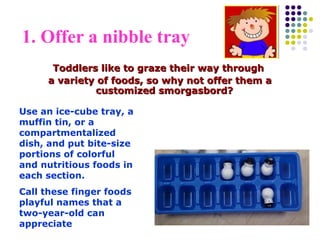
1. Offer a nibble tray
Toddlers like to graze their way throughToddlers like to graze their way through
a variety of foods, so why not offer them aa variety of foods, so why not offer them a
customized smorgasbord?customized smorgasbord?
Use an ice-cube tray, a
muffin tin, or a
compartmentalized
dish, and put bite-size
portions of colorful
and nutritious foods in
each section.
Call these finger foods
playful names that a
two-year-old can
appreciate
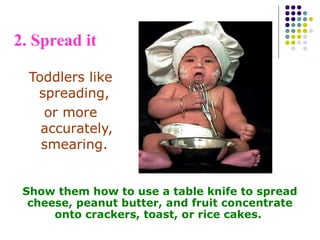
2. Spread it
Toddlers like
spreading,
or more
accurately,
smearing.
Show them how to use a table knife to spread
cheese, peanut butter, and fruit concentrate
onto crackers, toast, or rice cakes.
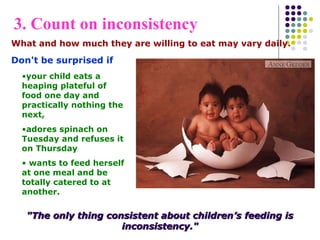
What and how much they are willing to eat may vary daily.
Don't be surprised if
"The only thing consistent about children’s feeding is"The only thing consistent about children’s feeding is
inconsistency."inconsistency."
•your child eats a
heaping plateful of
food one day and
practically nothing the
next,
•adores spinach on
Tuesday and refuses it
on Thursday
• wants to feed herself
at one meal and be
totally catered to at
another.
3. Count on inconsistency
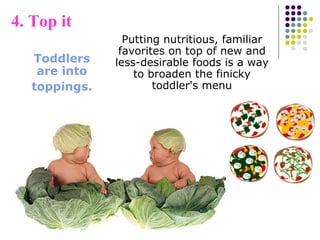
Toddlers
are into
toppings.
4. Top it
Putting nutritious, familiar
favorites on top of new and
less-desirable foods is a way
to broaden the finicky
toddler's menu
Make a smoothie – together.
Milk and fruit – along with
supplements such as juice, egg
powder, wheat germ, yogurt,
honey, and peanut butter –
can be the basis of very healthy
meals.
5. Drink it..
If your youngster would
rather drink than eat,
don't despair
So what if they are consumed through a straw?
One note of caution: Avoid any drinks with raw eggs
or you'll risk salmonella poisoning.
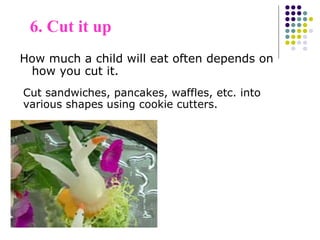
How much a child will eat often depends on
how you cut it.
6. Cut it up
Cut sandwiches, pancakes, waffles, etc. into
various shapes using cookie cutters.
7. Package it
Our kids enjoy the unexpected and fanciful when it comes to
serving dishes – anything from plastic measuring cups to ice-
cream cones.
"Doctor, he won't eat his vegetables"
8. Become a veggie vendor
So if you aren't the proud parent of a veggie lover, try
the following tricks
•Plant a garden with your child.
•Slip grated or diced vegetables
into favorite foods
•Use vegetables as finger foods
and dip them in a favorite sauce
or dip.
•Concoct creative camouflages.
•Cut the vegetables into
interesting shapes (Make veggie
art).
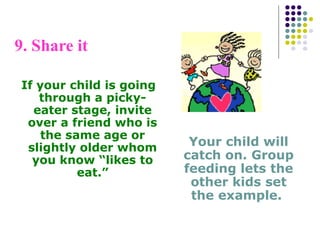
9. Share it
If your child is going
through a picky-
eater stage, invite
over a friend who is
the same age or
slightly older whom
you know “likes to
eat.”
Your child will
catch on. Group
feeding lets the
other kids set
the example.
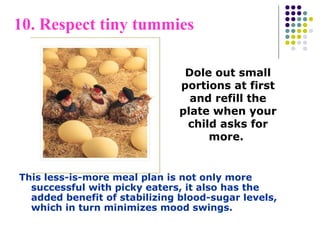
10. Respect tiny tummies
This less-is-more meal plan is not only more
successful with picky eaters, it also has the
added benefit of stabilizing blood-sugar levels,
which in turn minimizes mood swings.
Dole out small
portions at first
and refill the
plate when your
child asks for
more.
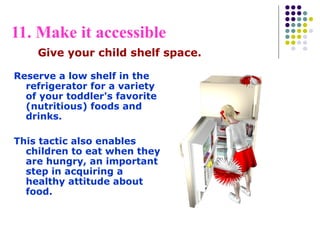
11. Make it accessible
Reserve a low shelf in the
refrigerator for a variety
of your toddler's favorite
(nutritious) foods and
drinks.
This tactic also enables
children to eat when they
are hungry, an important
step in acquiring a
healthy attitude about
food.
Give your child shelf space.
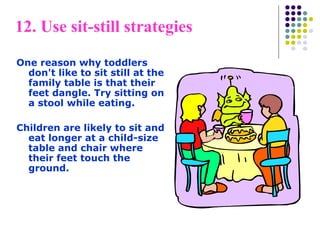
12. Use sit-still strategies
One reason why toddlers
don't like to sit still at the
family table is that their
feet dangle. Try sitting on
a stool while eating.
Children are likely to sit and
eat longer at a child-size
table and chair where
their feet touch the
ground.
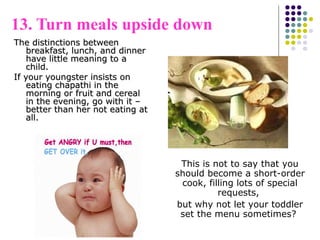
13. Turn meals upside down
The distinctions betweenThe distinctions between
breakfast, lunch, and dinnerbreakfast, lunch, and dinner
have little meaning to ahave little meaning to a
child.child.
If your youngster insists onIf your youngster insists on
eating chapathi in theeating chapathi in the
morning or fruit and cerealmorning or fruit and cereal
in the evening, go with it –in the evening, go with it –
better than her not eating atbetter than her not eating at
all.all.
This is not to say that you
should become a short-order
cook, filling lots of special
requests,
but why not let your toddler
set the menu sometimes?
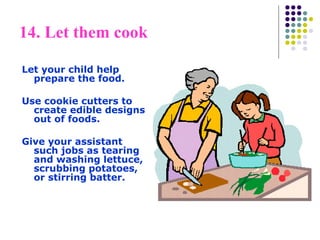
14. Let them cook
Let your child help
prepare the food.
Use cookie cutters to
create edible designs
out of foods.
Give your assistant
such jobs as tearing
and washing lettuce,
scrubbing potatoes,
or stirring batter.
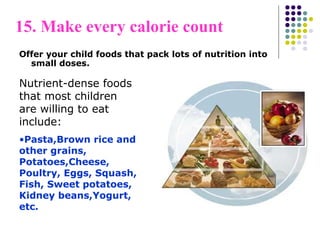
15. Make every calorie count
Offer your child foods that pack lots of nutrition into
small doses.
Nutrient-dense foods
that most children
are willing to eat
include:
•Pasta,Brown rice and
other grains,
Potatoes,Cheese,
Poultry, Eggs, Squash,
Fish, Sweet potatoes,
Kidney beans,Yogurt,
etc.
Behaviour Modification -
Adolescents
 Aimed at changing
behaviour
 useful while
treating obesity
Flash Card Technique
• Increases motivation
• involves writing
reasons for wanting to
lose weight
• I will look better
• I will feel better
• I will be be healthier
• I will fit into my
favourite pair of jeans
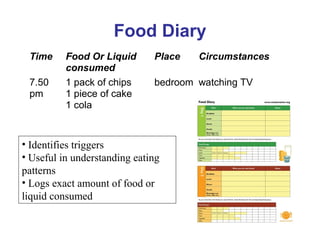
Food Diary
Time Food Or Liquid
consumed
Place Circumstances
7.50
pm
1 pack of chips
1 piece of cake
1 cola
bedroom watching TV
• Identifies triggers
• Useful in understanding eating
patterns
• Logs exact amount of food or
liquid consumed
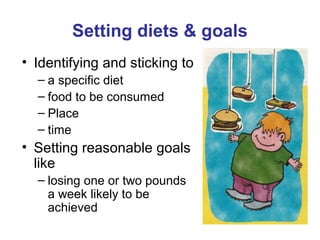
Setting diets & goals
• Identifying and sticking to
– a specific diet
– food to be consumed
– Place
– time
• Setting reasonable goals
like
– losing one or two pounds
a week likely to be
achieved
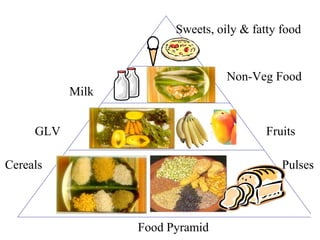
Food Pyramid
Cereals Pulses
GLV Fruits
Non-Veg Food
Milk
Sweets, oily & fatty food
Ways of controlling urges
• Removal of tempting foods
• Use of distractors like engaging in
another activity
• Using positive self-statements like
I can do this, I must
control myself, I will be fine, The urge
will pass
Use of Reinforcement
• Positive reinforcement :
Rewarding oneself as goals are met
e.g. going for a film with a friend
• Negative reinforcement : escape
unpleasant stimulus to increase desired
behaviour > missing a favourite TV
programme if overeaten
Obesity Treatment
Strategies NOT
recommended
 Surgery
 Drug Treatment
(including herbal
treatments)
 Quick Weight Loss Diets
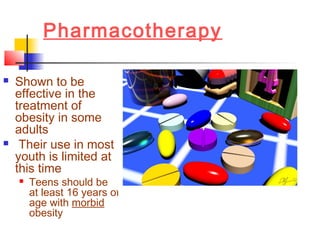
Pharmacotherapy
 Shown to be
effective in the
treatment of
obesity in some
adults
 Their use in most
youth is limited at
this time
 Teens should be
at least 16 years of
age with morbid
obesity
Failure of
Obesity Treatment
• Lack of family involvement and
support
• lack of flexibility
• Lack of emphasis on increasing
physical activity
• Lack of a maintenance phase
Diets may produce weight loss but do
not cure obesity; weight regain is
common.
Eat less; eat 2/3 or ½ the
calories you have been eating
Target is to eat about 1200-2000 kcal/d,
depending on the age of the child
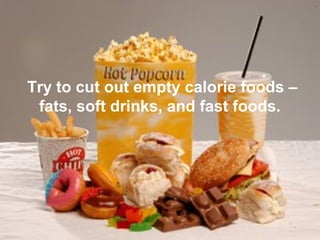
Try to cut out empty calorie foods –
fats, soft drinks, and fast foods.
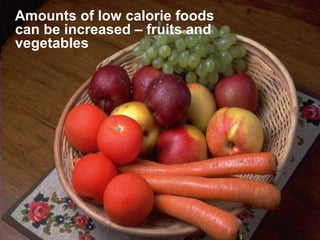
Amounts of low calorie foods
can be increased – fruits and
vegetables
Avoid other activities while
eating (except conversation)
• Meal or food should not be
provided as reward.
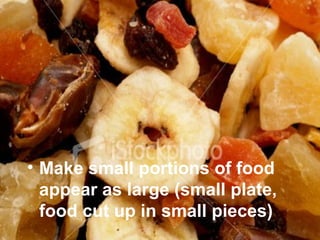
• Make small portions of food
appear as large (small plate,
food cut up in small pieces)
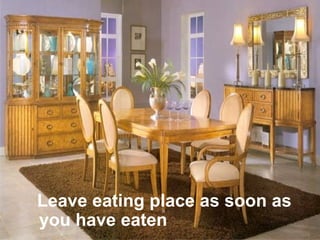
Leave eating place as soon as
you have eaten
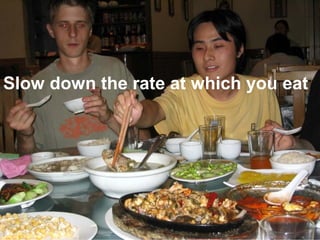
Slow down the rate at which you eat
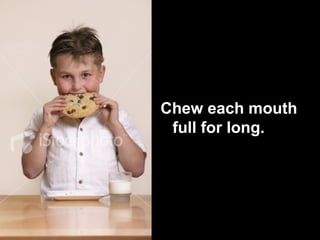
Chew each mouth
full for long.
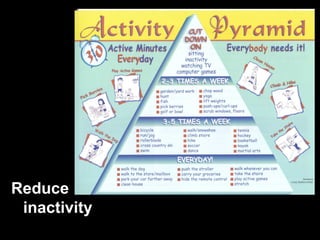
Reduce
inactivity
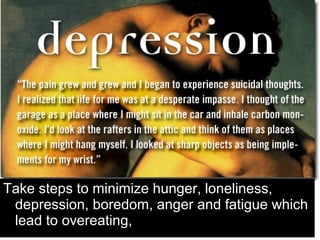
Take steps to minimize hunger, loneliness,
depression, boredom, anger and fatigue which
lead to overeating,
Think positively
WHAT can we do to prevent
obesity ?
Right from childhood into
adolescence into adulthood we must
encourage
•Exercise,
•Physical activity
•Physical Fitness
•Life style modification
•Nutritional intervention
• v
• C.S.N.VittalC.S.N.Vittal

Chldhood obesity

  • 2.
    Obesity Definition A chronic condition characterisedby excess adipose tissue, causally related to serious medical illness
  • 3.
    Obesity Diagnostic Tools •Percentile on Growth Charts • Body Mass Index (BMI) • Triceps Skin fold Thickness (TST) • Waist-hip ratio
  • 4.
    Diagnosis of Obesity •Weight for height >120% • Age specific growth charts • Skin fold thickness: >85%centile for sex and age • Waist : >40” in males & 35” in females • WHR : >0.8 women & 0.9 in males
  • 5.
    Percentage Wt. forHt. = ------------------------------------- X 100 Weight for Height Actual Weight Expected weight for actual height < 90 % : PEM > 90 % : Normal > 120-130 : Obesity
  • 6.
    Body Mass Indexor BMI in Adolescents Weight in kilograms is divided by the square of the height in meters • Normal : 19 to 24.9 kg/m2 • Overweight : 25 - 26.9 • Obese : 27 to 29.9 • Severe Obesity : Over 30 (Over the 95th Percentile) • Morbid Obesity : Over 40
  • 7.
    Skin fold thickness Skinthickness is an index of body fat SFT Taken at  Triceps (most common site)  Subscapular  Suprailiac  Abdomen  Upper thigh Lange’sHarpenden’s Skin foldSkin fold
  • 8.
    Adolescent Growth Chart Measureof Height Weight and BMI in single graph
  • 9.
    Types of Obesity •Simple obesity • Pathologic obesity – Dysmorphic syndromes – Endocrine – CNS – Drugs – Leptin deficiency
  • 10.
    Prevalence: The National Healthand Nutrition Examination Surveys • 75% relative increase in obesity in adolescents is noted since 1970 • 25% of American adolescents are identified as being obese • 50% increase in morbid obesity (a BMI of 30 or more) over the past decade • Indian studies 7-21 % prevalence
  • 11.
    Factors Contributing tothe Obesity Epidemic • Increase – in intake of regular soda drinks – In intake of fast foods – in portion size of fast foods – highcarb snacks • Decrease – in physical activity • Increase – in physical inactivity (TV, video, computer time)
  • 13.
    Why is itimportant? • WHO has declared obesity as a “global epidemic” • Childhood & adolescent obesity is a risk factor for adult obesity “Tracking” • Life style diseases like NIDDM,Coronary artery disease Hypertension, dyslipidemia, cancers are linked with obesity • Psychosocial problems
  • 14.
    Obesity: Complications • Psychological –Disturbed body image – Poor self-image/self-esteem – Poor family relations: scapegoat and source of embarrassment – Poor peer relations and social isolation – Exclusion from activities, especially dating – Acting out and depression
  • 15.
    Obesity: Complications • Medical –Coronary artery disease – Cerebrovascular disease – Gallstones – Orthopedic problems – Sleep apnoea – Increased cancer risks (colon, rectum, prostate) – Diabetes mellitus
  • 16.
    Overweight Screening Procedure Screeningincludes evaluation for: – Family history – Blood pressure – Total Cholesterol (≥ 200 mg/dl) – Large change in BMI (≥ 2 points in previous year) – Concern about weight – Smoking history
  • 17.
    Family History • PositiveFamily History includes history of: – Cardiovascular Disease – Parental hypercholesterolemia – Hypertension – Diabetes – Parental Obesity
  • 18.
    Physical Exam • Eyes –Peripheral view – Fundi • Skin – Acanthosis nigricans – Purple stria – Texture – Hirsutism, acne • Endocrine - Hypopituitarism - Hypercortisolism - Hyperinsulinemia - Hyperandrogenism in females
  • 19.
    Lab Work-Up • T4,TSH • Free testosterone (in females) • Fasting insulin and glucose • Lipid profile • 24 hour urine for free cortisol • DHEA-S • Sleep studies • Chest x-ray; EKG
  • 20.
    Management Strategies of Obesity Preventweight gain Promote weight maintenance Manage co morbidities Promote weight loss Rule out treatable medical causes
  • 21.
    Underlying Medical Conditions •Hypothyroidism – Initiate treatment with levothyroxin • Cushing’s syndrome – Identify source of excess cortisol – Surgically remove source of excess ACTH or cortisol
  • 22.
    Treatment Content  Diet/ Nutrition Plan  Physical Activity  Controlling the environment  Self-monitoring  Goal setting and contacting  Parenting skills  Managing high-risk situations  Maintenance and relapse prevention
  • 23.
    General Management Principles Can start with weight stabilization  Eventually a 10% weight reduction  Can decrease by 500 calories/day with low fat/high fiber diet  Set realistic goals  2% decrease in 2500 calories: 5 lb to drop in one year (use skim milk)
  • 24.
    Physical Activity  Providingand choice of activities appears to be superior to providing a specific exercise prescription  Recent research suggests that reducing sedentary behaviors may be more effective than promoting physical activity in promoting weight loss
  • 25.
    Exercise  Exercise alsoplays very vital role in the management of obesity.  The more exercise one takes, greater is the daily energy expenditure and more rapidly the obesity reduces.
  • 26.
    Energy expenditure indifferent activities  At rest 1Kcal /min  Walking, gardening 5 Kcal/ min  Cycling, swimming 7 Kcal /min  Squash, jogging, hill climbing 10 Kcal/ min
  • 27.
    Benefits of exercise •Obese people with a heavier body to move, spend more energy for same amount of work. • It is valuable as a diversion from sitting indoors and being tempted to eat. • Exercise reduces appetite. • After exercise the resting B.M.R. may increase for some hours.
  • 28.
    Controlling the Environment Helpreduce cues  (e.g., taking TV out of bedroom) Limit access to high calorie foods Encourage family activities (e.g., family walks)
  • 29.
    Parenting Skills  Parentsoften need practice in general parenting skills to implement many of the behavioral methods including:  Being consistent  Being observant so they can reward behavior change  Effectively using rewards  Modeling desired behavior  Limit setting (saying “no” when necessary)
  • 30.
  • 31.
    Child’s Attitude  Whatwas wrong?  Why were these kids such picky eaters?
  • 32.
  • 33.
    Tactics for Toddlers Totempt littleTo tempt little taste budstaste buds && minimizeminimize mealtimemealtime hassles.hassles.
  • 34.
    1. Offer anibble tray Toddlers like to graze their way throughToddlers like to graze their way through a variety of foods, so why not offer them aa variety of foods, so why not offer them a customized smorgasbord?customized smorgasbord? Use an ice-cube tray, a muffin tin, or a compartmentalized dish, and put bite-size portions of colorful and nutritious foods in each section. Call these finger foods playful names that a two-year-old can appreciate
  • 35.
    2. Spread it Toddlerslike spreading, or more accurately, smearing. Show them how to use a table knife to spread cheese, peanut butter, and fruit concentrate onto crackers, toast, or rice cakes.
  • 36.
    What and howmuch they are willing to eat may vary daily. Don't be surprised if "The only thing consistent about children’s feeding is"The only thing consistent about children’s feeding is inconsistency."inconsistency." •your child eats a heaping plateful of food one day and practically nothing the next, •adores spinach on Tuesday and refuses it on Thursday • wants to feed herself at one meal and be totally catered to at another. 3. Count on inconsistency
  • 37.
    Toddlers are into toppings. 4. Topit Putting nutritious, familiar favorites on top of new and less-desirable foods is a way to broaden the finicky toddler's menu
  • 38.
    Make a smoothie– together. Milk and fruit – along with supplements such as juice, egg powder, wheat germ, yogurt, honey, and peanut butter – can be the basis of very healthy meals. 5. Drink it.. If your youngster would rather drink than eat, don't despair So what if they are consumed through a straw? One note of caution: Avoid any drinks with raw eggs or you'll risk salmonella poisoning.
  • 39.
    How much achild will eat often depends on how you cut it. 6. Cut it up Cut sandwiches, pancakes, waffles, etc. into various shapes using cookie cutters.
  • 40.
    7. Package it Ourkids enjoy the unexpected and fanciful when it comes to serving dishes – anything from plastic measuring cups to ice- cream cones.
  • 41.
    "Doctor, he won'teat his vegetables" 8. Become a veggie vendor So if you aren't the proud parent of a veggie lover, try the following tricks •Plant a garden with your child. •Slip grated or diced vegetables into favorite foods •Use vegetables as finger foods and dip them in a favorite sauce or dip. •Concoct creative camouflages. •Cut the vegetables into interesting shapes (Make veggie art).
  • 42.
    9. Share it Ifyour child is going through a picky- eater stage, invite over a friend who is the same age or slightly older whom you know “likes to eat.” Your child will catch on. Group feeding lets the other kids set the example.
  • 43.
    10. Respect tinytummies This less-is-more meal plan is not only more successful with picky eaters, it also has the added benefit of stabilizing blood-sugar levels, which in turn minimizes mood swings. Dole out small portions at first and refill the plate when your child asks for more.
  • 44.
    11. Make itaccessible Reserve a low shelf in the refrigerator for a variety of your toddler's favorite (nutritious) foods and drinks. This tactic also enables children to eat when they are hungry, an important step in acquiring a healthy attitude about food. Give your child shelf space.
  • 45.
    12. Use sit-stillstrategies One reason why toddlers don't like to sit still at the family table is that their feet dangle. Try sitting on a stool while eating. Children are likely to sit and eat longer at a child-size table and chair where their feet touch the ground.
  • 46.
    13. Turn mealsupside down The distinctions betweenThe distinctions between breakfast, lunch, and dinnerbreakfast, lunch, and dinner have little meaning to ahave little meaning to a child.child. If your youngster insists onIf your youngster insists on eating chapathi in theeating chapathi in the morning or fruit and cerealmorning or fruit and cereal in the evening, go with it –in the evening, go with it – better than her not eating atbetter than her not eating at all.all. This is not to say that you should become a short-order cook, filling lots of special requests, but why not let your toddler set the menu sometimes?
  • 47.
    14. Let themcook Let your child help prepare the food. Use cookie cutters to create edible designs out of foods. Give your assistant such jobs as tearing and washing lettuce, scrubbing potatoes, or stirring batter.
  • 48.
    15. Make everycalorie count Offer your child foods that pack lots of nutrition into small doses. Nutrient-dense foods that most children are willing to eat include: •Pasta,Brown rice and other grains, Potatoes,Cheese, Poultry, Eggs, Squash, Fish, Sweet potatoes, Kidney beans,Yogurt, etc.
  • 49.
    Behaviour Modification - Adolescents Aimed at changing behaviour  useful while treating obesity
  • 50.
    Flash Card Technique •Increases motivation • involves writing reasons for wanting to lose weight • I will look better • I will feel better • I will be be healthier • I will fit into my favourite pair of jeans
  • 51.
    Food Diary Time FoodOr Liquid consumed Place Circumstances 7.50 pm 1 pack of chips 1 piece of cake 1 cola bedroom watching TV • Identifies triggers • Useful in understanding eating patterns • Logs exact amount of food or liquid consumed
  • 52.
    Setting diets &goals • Identifying and sticking to – a specific diet – food to be consumed – Place – time • Setting reasonable goals like – losing one or two pounds a week likely to be achieved
  • 53.
    Food Pyramid Cereals Pulses GLVFruits Non-Veg Food Milk Sweets, oily & fatty food
  • 54.
    Ways of controllingurges • Removal of tempting foods • Use of distractors like engaging in another activity • Using positive self-statements like I can do this, I must control myself, I will be fine, The urge will pass
  • 55.
    Use of Reinforcement •Positive reinforcement : Rewarding oneself as goals are met e.g. going for a film with a friend • Negative reinforcement : escape unpleasant stimulus to increase desired behaviour > missing a favourite TV programme if overeaten
  • 56.
    Obesity Treatment Strategies NOT recommended Surgery  Drug Treatment (including herbal treatments)  Quick Weight Loss Diets
  • 57.
    Pharmacotherapy  Shown tobe effective in the treatment of obesity in some adults  Their use in most youth is limited at this time  Teens should be at least 16 years of age with morbid obesity
  • 58.
    Failure of Obesity Treatment •Lack of family involvement and support • lack of flexibility • Lack of emphasis on increasing physical activity • Lack of a maintenance phase
  • 60.
    Diets may produceweight loss but do not cure obesity; weight regain is common.
  • 61.
    Eat less; eat2/3 or ½ the calories you have been eating
  • 62.
    Target is toeat about 1200-2000 kcal/d, depending on the age of the child
  • 63.
    Try to cutout empty calorie foods – fats, soft drinks, and fast foods.
  • 64.
    Amounts of lowcalorie foods can be increased – fruits and vegetables
  • 65.
    Avoid other activitieswhile eating (except conversation)
  • 66.
    • Meal orfood should not be provided as reward.
  • 67.
    • Make smallportions of food appear as large (small plate, food cut up in small pieces)
  • 68.
    Leave eating placeas soon as you have eaten
  • 69.
    Slow down therate at which you eat
  • 70.
  • 71.
  • 72.
    Take steps tominimize hunger, loneliness, depression, boredom, anger and fatigue which lead to overeating,
  • 73.
  • 74.
    WHAT can wedo to prevent obesity ? Right from childhood into adolescence into adulthood we must encourage •Exercise, •Physical activity •Physical Fitness •Life style modification •Nutritional intervention
  • 81.
  • 83.