


Micro-Palaeontology
BY- Mr. Suren N Kamble
P.G. Geology Dept. Deogiri College,
Aurangabad, Maharashtra.
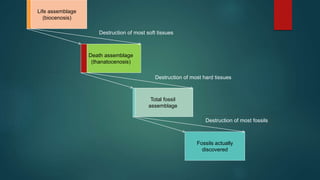
Life assemblage
(biocenosis)
Death assemblage
(thanatocenosis)
Total fossil
assemblage
Fossils actually
discovered
Destruction of most soft tissues
Destruction of most hard tissues
Destruction of most fossils
Palaeontology = Palaios- Ancient,ontos-life, Logy-Study
(Palaeontology was proposed by the de Blanville & don Waldhelm
in1834)
A fossil is an impression, cast, original material or track of any animal
or plant that is preserved in rock after the original organic material is
transformed or removed.
Fossil - remains or traces of a once-living organism.
“Fossil” (Latin prefix “Fodere” refers to digging/excavation) in its most general
sense refers to any preserved evidence of ancient biological organisms in the
rock record that is obtained through digging/extraction from the host rock.
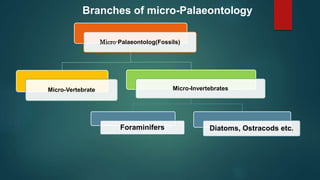
Branches of micro-Palaeontology
Micro-Palaeontolog(Fossils)
Micro-Vertebrate Micro-Invertebrates
Foraminifers Diatoms, Ostracods etc.
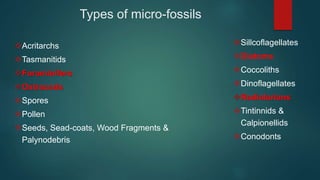
Types of micro-fossils
Acritarchs
Tasmanitids
Foraminifers
Ostracods
Spores
Pollen
Seeds, Sead-coats, Wood Fragments &
Palynodebris
Sillcoflagellates
Diatoms
Coccoliths
Dinoflagellates
Radiolarians
Tintinnids &
Calpionellids
Conodonts
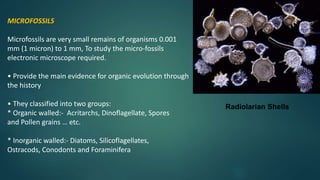
Radiolarian Shells
MICROFOSSILS
Microfossils are very small remains of organisms 0.001
mm (1 micron) to 1 mm, To study the micro-fossils
electronic microscope required.
• Provide the main evidence for organic evolution through
the history
• They classified into two groups:
* Organic walled:- Acritarchs, Dinoflagellate, Spores
and Pollen grains … etc.
* Inorganic walled:- Diatoms, Silicoflagellates,
Ostracods, Conodonts and Foraminifera
 AGE DETERMINATION OF FOSSILS
MAKING OF BIOZONATION
PALAEOECOLOGY
PALAEOCURRENT
PETROLEUM DEPOSITS
TO STUDY HYDROTHERMAL ACCUMULATION
TO STUDY CONTINENTAL DRIFT THEORY
IMPORTANCE OF MICRO-
FOSSILS
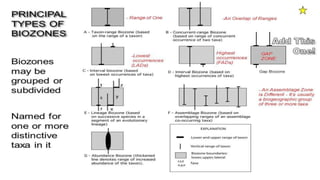
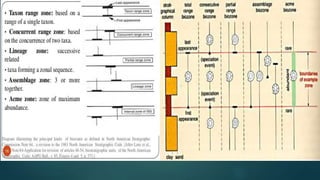
Biostratigraphic units or biozones are intervals of
geological strata that are defined on the basis of their
characteristic fossil taxa.
If one or more specific kind of fossils present in a zone ,
such fossils are known as Zone fossils.
MAKING OF BIOZONATION
Foraminifers
General Introduction
 foraminifera the name derived from the Latin word i.e. “Forams- Hole
bearers”
 They recognized as Protists(Single celled eukaryotes) by Schultze(1854)
 The foraminifers are the single cell organism
 The shell of foraminifers made up from calcium carbonate (CaCo3) which is
known as Test
 They range in the size from 50-400µm
 Generally they are marine as Planktonic and Benthic.
 Over 50,000 species of foraminifers are recognized both living (10000) and
non living or fossil form (40000)
EcologyHabitatGeologic RangeMineralogyType of Protista
photosynthetic/various heterotrophe/carnivorousaquaticSilurian? – RecentorganicDinoflagellates
unknownmarinePrecambrian –RecentorganicAcritarchs
photosyntheticany wetCretaceous– RecentOppaline silicaDiatoms
photosynthetic/various
heterotrophe
marineCretaceous – RecentOppaline silicaSilicoflagellates
various heterotrophe
marineCambrian – RecentOppaline silicaRadiolarians
photosynthetic
marineJurassic – RecentcalciteCalcareous
nannoplankton
various heterotrophe, some with symbionts
marineCambrian – Recentorganic, agglutinated,
calcareous, some
otherBenthic forams
various heterotrophe
marineJurassic – Recentorganic, agglutinated,
calcareous, some
otherPlanktonic forams
SYSTEMATIC CLASSIFICATION OF FORAMINIFERA
 Kingdom :- Protista
 Subkingdom :- Protoctista
 Phylum :- Sarcodina
 Class :-Rhizopoda
 Order :- Foraminiferida
 Suborder :- Textulariina, Fusuliniria,
Miliolina, Rotaliina
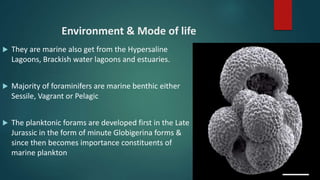
Environment & Mode of life
 They are marine also get from the Hypersaline
Lagoons, Brackish water lagoons and estuaries.
 Majority of foraminifers are marine benthic either
Sessile, Vagrant or Pelagic
 The planktonic forams are developed first in the Late
Jurassic in the form of minute Globigerina forms &
since then becomes importance constituents of
marine plankton
Composition of test
1. Organic walled Test:- Protein secreted matter called Tectin by the sub order Allogromiina. They are
gelatinous, psedochitinous and chitinous, they rarely preserved as fossils
2. Agglutinated test :- These test built by the cementing forein particles called agglutinated test usually
quarts grains, mica flakes, spicules are used. Ex. Psammoshaera parva
3. Siliceous test:- Some miliolids secret a test partly composed of silica but tests entirely made up of
silica are rare
4. Calcareous Tests:- Majority of the foraminifers secret calcareous tests made uo of calcite or aragonite
and may show porcelaneous, microgranular (pseudofibrous), hyaline (glassy) wall structure. Ex.
Miliolina
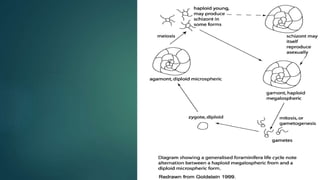
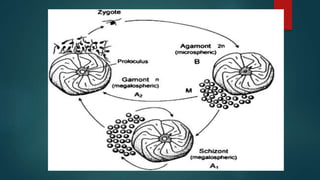
Reproduction & Dimorphism
 Both the sexual and asexual reproduction in the foraminifers
 The alteration between the two generations called as Gamont & Schizont
 Gamont generation produces sexually and Schizont asexually
 We get two different test by this process as an Megalospheric &
microspheric test
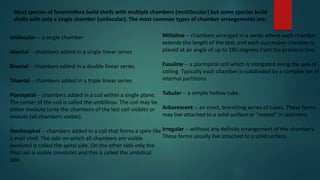
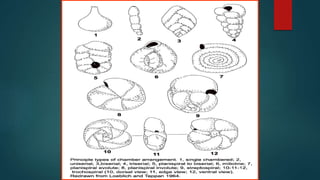
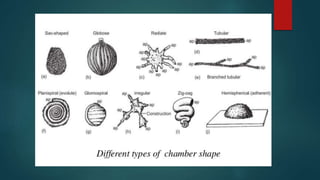
Unilocular -- a single chamber
Uiserial -- chambers added in a single linear series
Biserial -- chambers added in a double linear series
Triserial -- chambers added in a triple linear series
Planispiral -- chambers added in a coil within a single plane.
The center of the coil is called the umbilicus. The coil may be
either involute (only the chambers of the last coil visible) or
evolute (all chambers visible).
Trochospiral -- chambers added in a coil that forms a spire like
a snail shell. The side on which all chambers are visible
(evolute) is called the spiral side. On the other side only the
final coil is visible (involute) and this is called the umbilical
side.
Milioline -- chambers arranged in a series where each chamber
extends the length of the test, and each successive chamber is
placed at an angle of up to 180 degrees from the previous one.
Fusuline -- a planispiral coil which is elongated along the axis of
coiling. Typically each chamber is subdivided by a complex set of
internal partitions.
Tubular -- a simple hollow tube.
Arborescent -- an erect, branching series of tubes. These forms
may live attached to a solid surface or "rooted" in sediment.
Irregular -- without any definite arrangement of the chambers.
These forms usually live attached to a solid surface.
Most species of foraminifera build shells with multiple chambers (multilocular) but some species build
shells with only a single chamber (unilocular). The most common types of chamber arrangements are:
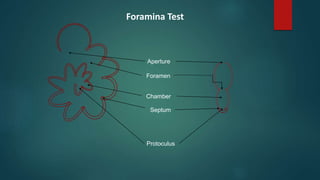
Protoculus
Aperture
Foramen
Chamber
Septum
Foramina Test
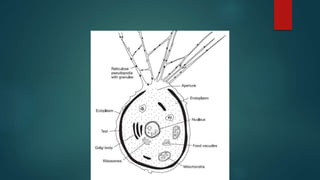
Aperture
Aperture is the opening of the test other than the pore
of the wall
It is usually situated at the base of the final (last)
chamber
It shows different shape, size and structure in different
test
It is used to intake food, suitably release daughter cells
& to connect pseudopodia to endoplasm
THANK YOU

Micro fossils

  • 1.
    Micro-Palaeontology BY- Mr. SurenN Kamble P.G. Geology Dept. Deogiri College, Aurangabad, Maharashtra.
  • 2.
    Life assemblage (biocenosis) Death assemblage (thanatocenosis) Totalfossil assemblage Fossils actually discovered Destruction of most soft tissues Destruction of most hard tissues Destruction of most fossils
  • 3.
    Palaeontology = Palaios-Ancient,ontos-life, Logy-Study (Palaeontology was proposed by the de Blanville & don Waldhelm in1834) A fossil is an impression, cast, original material or track of any animal or plant that is preserved in rock after the original organic material is transformed or removed. Fossil - remains or traces of a once-living organism. “Fossil” (Latin prefix “Fodere” refers to digging/excavation) in its most general sense refers to any preserved evidence of ancient biological organisms in the rock record that is obtained through digging/extraction from the host rock.
  • 4.
    Branches of micro-Palaeontology Micro-Palaeontolog(Fossils) Micro-VertebrateMicro-Invertebrates Foraminifers Diatoms, Ostracods etc.
  • 5.
    Types of micro-fossils Acritarchs Tasmanitids Foraminifers Ostracods Spores Pollen Seeds,Sead-coats, Wood Fragments & Palynodebris Sillcoflagellates Diatoms Coccoliths Dinoflagellates Radiolarians Tintinnids & Calpionellids Conodonts
  • 6.
    Radiolarian Shells MICROFOSSILS Microfossils arevery small remains of organisms 0.001 mm (1 micron) to 1 mm, To study the micro-fossils electronic microscope required. • Provide the main evidence for organic evolution through the history • They classified into two groups: * Organic walled:- Acritarchs, Dinoflagellate, Spores and Pollen grains … etc. * Inorganic walled:- Diatoms, Silicoflagellates, Ostracods, Conodonts and Foraminifera
  • 7.
     AGE DETERMINATIONOF FOSSILS MAKING OF BIOZONATION PALAEOECOLOGY PALAEOCURRENT PETROLEUM DEPOSITS TO STUDY HYDROTHERMAL ACCUMULATION TO STUDY CONTINENTAL DRIFT THEORY IMPORTANCE OF MICRO- FOSSILS
  • 8.
    Biostratigraphic units orbiozones are intervals of geological strata that are defined on the basis of their characteristic fossil taxa. If one or more specific kind of fossils present in a zone , such fossils are known as Zone fossils. MAKING OF BIOZONATION
  • 11.
  • 12.
    General Introduction  foraminiferathe name derived from the Latin word i.e. “Forams- Hole bearers”  They recognized as Protists(Single celled eukaryotes) by Schultze(1854)  The foraminifers are the single cell organism  The shell of foraminifers made up from calcium carbonate (CaCo3) which is known as Test  They range in the size from 50-400µm  Generally they are marine as Planktonic and Benthic.  Over 50,000 species of foraminifers are recognized both living (10000) and non living or fossil form (40000)
  • 13.
    EcologyHabitatGeologic RangeMineralogyType ofProtista photosynthetic/various heterotrophe/carnivorousaquaticSilurian? – RecentorganicDinoflagellates unknownmarinePrecambrian –RecentorganicAcritarchs photosyntheticany wetCretaceous– RecentOppaline silicaDiatoms photosynthetic/various heterotrophe marineCretaceous – RecentOppaline silicaSilicoflagellates various heterotrophe marineCambrian – RecentOppaline silicaRadiolarians photosynthetic marineJurassic – RecentcalciteCalcareous nannoplankton various heterotrophe, some with symbionts marineCambrian – Recentorganic, agglutinated, calcareous, some otherBenthic forams various heterotrophe marineJurassic – Recentorganic, agglutinated, calcareous, some otherPlanktonic forams
  • 14.
    SYSTEMATIC CLASSIFICATION OFFORAMINIFERA  Kingdom :- Protista  Subkingdom :- Protoctista  Phylum :- Sarcodina  Class :-Rhizopoda  Order :- Foraminiferida  Suborder :- Textulariina, Fusuliniria, Miliolina, Rotaliina
  • 15.
    Environment & Modeof life  They are marine also get from the Hypersaline Lagoons, Brackish water lagoons and estuaries.  Majority of foraminifers are marine benthic either Sessile, Vagrant or Pelagic  The planktonic forams are developed first in the Late Jurassic in the form of minute Globigerina forms & since then becomes importance constituents of marine plankton
  • 17.
    Composition of test 1.Organic walled Test:- Protein secreted matter called Tectin by the sub order Allogromiina. They are gelatinous, psedochitinous and chitinous, they rarely preserved as fossils 2. Agglutinated test :- These test built by the cementing forein particles called agglutinated test usually quarts grains, mica flakes, spicules are used. Ex. Psammoshaera parva 3. Siliceous test:- Some miliolids secret a test partly composed of silica but tests entirely made up of silica are rare 4. Calcareous Tests:- Majority of the foraminifers secret calcareous tests made uo of calcite or aragonite and may show porcelaneous, microgranular (pseudofibrous), hyaline (glassy) wall structure. Ex. Miliolina
  • 18.
    Reproduction & Dimorphism Both the sexual and asexual reproduction in the foraminifers  The alteration between the two generations called as Gamont & Schizont  Gamont generation produces sexually and Schizont asexually  We get two different test by this process as an Megalospheric & microspheric test
  • 21.
    Unilocular -- asingle chamber Uiserial -- chambers added in a single linear series Biserial -- chambers added in a double linear series Triserial -- chambers added in a triple linear series Planispiral -- chambers added in a coil within a single plane. The center of the coil is called the umbilicus. The coil may be either involute (only the chambers of the last coil visible) or evolute (all chambers visible). Trochospiral -- chambers added in a coil that forms a spire like a snail shell. The side on which all chambers are visible (evolute) is called the spiral side. On the other side only the final coil is visible (involute) and this is called the umbilical side. Milioline -- chambers arranged in a series where each chamber extends the length of the test, and each successive chamber is placed at an angle of up to 180 degrees from the previous one. Fusuline -- a planispiral coil which is elongated along the axis of coiling. Typically each chamber is subdivided by a complex set of internal partitions. Tubular -- a simple hollow tube. Arborescent -- an erect, branching series of tubes. These forms may live attached to a solid surface or "rooted" in sediment. Irregular -- without any definite arrangement of the chambers. These forms usually live attached to a solid surface. Most species of foraminifera build shells with multiple chambers (multilocular) but some species build shells with only a single chamber (unilocular). The most common types of chamber arrangements are:
  • 23.
  • 24.
    Aperture Aperture is theopening of the test other than the pore of the wall It is usually situated at the base of the final (last) chamber It shows different shape, size and structure in different test It is used to intake food, suitably release daughter cells & to connect pseudopodia to endoplasm
  • 26.