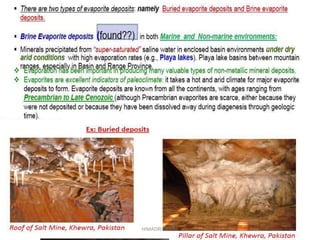
• Evaporite ( /ᵻˈvæpəraɪt/) is a name for a water-soluble mineral
sediment that results from concentration and crystallization by
evaporation from an aqueous solution.
• Evaporites are considered sedimentary rocks and are formed by
chemical sediments.
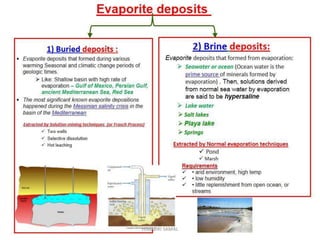
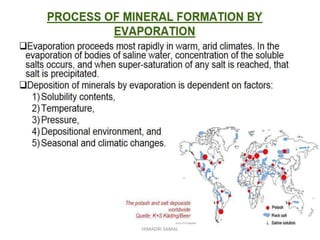
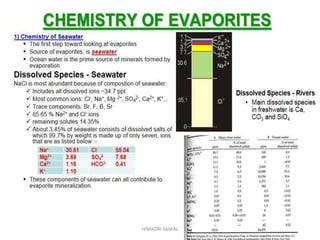
• Although all water bodies on the surface and in aquifers contain
dissolved salts, the water must evaporate into the atmosphere for
the minerals to precipitate. For this to happen, the water body must
enter a restricted environment where water input into this
environment remains below the net rate of evaporation.
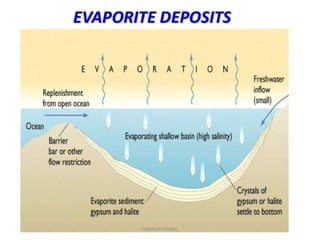
• This is usually an arid environment with a small basin fed by a limited
input of water. When evaporation occurs, the remaining water is
enriched in salts, and they precipitate when the water becomes
supersaturated. HIMADRI SAMAL
HIMADRI SAMAL
HIMADRI SAMAL
HIMADRI SAMAL
• Marine evaporites
• Marine evaporites tend to have thicker .They also
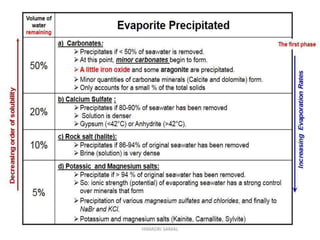
• have a system of evaporation. In a lab test, the minerals are
deposited in a defined order that was first demonstrated by Usiglio
in 1884.
• The first phase of the experiment begins when about 50% of the
original water depth remains. At this point, minor carbonates begin
to form.The next phase in the sequence comes when the
experiment is left with about 20% of its original level.
• At this point, the mineral gypsum begins to form, which is then
followed by halite at 10%, excluding carbonate minerals that tend
not to be evaporates.
• The most common minerals that are generally considered to be the
most representative of marine evaporates are calcite, gypsum and
anhydrite, halite, sylvite, carnallite, langbeinite, polyhalite, and
kainite. HIMADRI SAMAL
• Non-marine evaporites
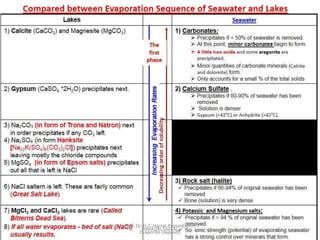
• Non-marine evaporites are usually composed of
minerals that are not common in marine environments
because in general the water from which non-marine
evaporite precipitates has proportions of chemical
elements different from those found in the marine
environments.
• Common minerals that are found in these deposits
include blödite, borax, epsomite, gaylussite, glauberite,
mirabilite, thenardite and trona. Non-marine deposits
may also contain halite, gypsum, and anhydrite
• Ex:Great Salt Lake in Utah and the Dead Sea, which lies
between Jordan and Israel.
HIMADRI SAMAL
Evaporite depositional environments that meet the
above conditions include:
• Graben areas and half-grabens within continental rift
environments fed by limited riverine drainage, usually
in subtropical or tropical environments
• Graben environments in oceanic rift environments fed
by limited oceanic input, leading to eventual isolation
and evaporation
• Internal drainage basins in arid to semi-arid temperate
to tropical environments fed by ephemeral drainage
• Non-basin areas fed exclusively by groundwater
seepage from artesian waters
• Restricted coastal plains in regressive sea environments
• Drainage basins feeding into extremely arid
environments HIMADRI SAMAL
HIMADRI SAMAL
HIMADRI SAMAL
HIMADRI SAMAL
HIMADRI SAMAL
HIMADRI SAMAL
HIMADRI SAMAL
Economic importance of evaporites
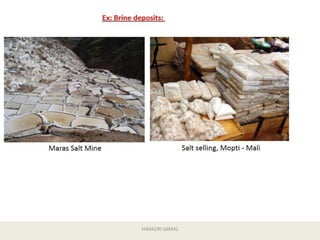
• Evaporites are important economically because of their
mineralogy, their physical properties in-situ, and their behaviour
within the subsurface.
• Evaporite minerals, especially nitrate minerals, are economically
important in Peru and Chile. Nitrate minerals are often mined
for use in the production on fertilizer and explosives.
• Thick halite deposits are expected to become an important
location for the disposal of nuclear waste because of their
geologic stability, predictable engineering and physical
behaviour, and imperviousness to groundwater.
• Halite formations are famous for their ability to form diapirs,
which produce ideal locations for trapping petroleum deposits.
• Halite deposits are often mined for use as salt.
HIMADRI SAMAL
Reference
• Wikipedia
• Google.Com
• Slideshare.
ComHIMADRI SAMAL
HIMADRI SAMAL

Evaporites

  • 2.
    • Evaporite (/ᵻˈvæpəraɪt/) is a name for a water-soluble mineral sediment that results from concentration and crystallization by evaporation from an aqueous solution. • Evaporites are considered sedimentary rocks and are formed by chemical sediments. • Although all water bodies on the surface and in aquifers contain dissolved salts, the water must evaporate into the atmosphere for the minerals to precipitate. For this to happen, the water body must enter a restricted environment where water input into this environment remains below the net rate of evaporation. • This is usually an arid environment with a small basin fed by a limited input of water. When evaporation occurs, the remaining water is enriched in salts, and they precipitate when the water becomes supersaturated. HIMADRI SAMAL
  • 3.
  • 4.
  • 5.
  • 6.
    • Marine evaporites •Marine evaporites tend to have thicker .They also • have a system of evaporation. In a lab test, the minerals are deposited in a defined order that was first demonstrated by Usiglio in 1884. • The first phase of the experiment begins when about 50% of the original water depth remains. At this point, minor carbonates begin to form.The next phase in the sequence comes when the experiment is left with about 20% of its original level. • At this point, the mineral gypsum begins to form, which is then followed by halite at 10%, excluding carbonate minerals that tend not to be evaporates. • The most common minerals that are generally considered to be the most representative of marine evaporates are calcite, gypsum and anhydrite, halite, sylvite, carnallite, langbeinite, polyhalite, and kainite. HIMADRI SAMAL
  • 7.
    • Non-marine evaporites •Non-marine evaporites are usually composed of minerals that are not common in marine environments because in general the water from which non-marine evaporite precipitates has proportions of chemical elements different from those found in the marine environments. • Common minerals that are found in these deposits include blödite, borax, epsomite, gaylussite, glauberite, mirabilite, thenardite and trona. Non-marine deposits may also contain halite, gypsum, and anhydrite • Ex:Great Salt Lake in Utah and the Dead Sea, which lies between Jordan and Israel. HIMADRI SAMAL
  • 8.
    Evaporite depositional environmentsthat meet the above conditions include: • Graben areas and half-grabens within continental rift environments fed by limited riverine drainage, usually in subtropical or tropical environments • Graben environments in oceanic rift environments fed by limited oceanic input, leading to eventual isolation and evaporation • Internal drainage basins in arid to semi-arid temperate to tropical environments fed by ephemeral drainage • Non-basin areas fed exclusively by groundwater seepage from artesian waters • Restricted coastal plains in regressive sea environments • Drainage basins feeding into extremely arid environments HIMADRI SAMAL
  • 9.
  • 10.
  • 11.
  • 12.
  • 13.
  • 14.
  • 15.
    Economic importance ofevaporites • Evaporites are important economically because of their mineralogy, their physical properties in-situ, and their behaviour within the subsurface. • Evaporite minerals, especially nitrate minerals, are economically important in Peru and Chile. Nitrate minerals are often mined for use in the production on fertilizer and explosives. • Thick halite deposits are expected to become an important location for the disposal of nuclear waste because of their geologic stability, predictable engineering and physical behaviour, and imperviousness to groundwater. • Halite formations are famous for their ability to form diapirs, which produce ideal locations for trapping petroleum deposits. • Halite deposits are often mined for use as salt. HIMADRI SAMAL
  • 16.
    Reference • Wikipedia • Google.Com •Slideshare. ComHIMADRI SAMAL
  • 17.