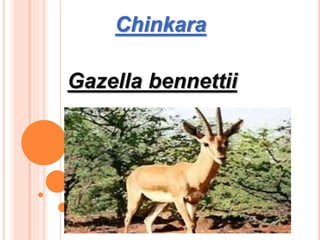
Chinkara
Gazella bennettii
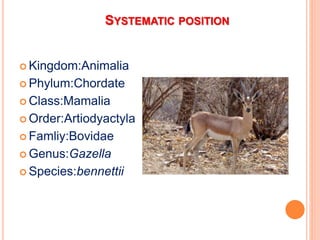
SYSTEMATIC POSITION
 Kingdom:Animalia
 Phylum:Chordate
 Class:Mamalia
 Order:Artiodyactyla
 Famliy:Bovidae
 Genus:Gazella
 Species:bennettii
INTRODUCTION
 The chinkara or Indian gazelleis a species of gazelle
found in South asia.
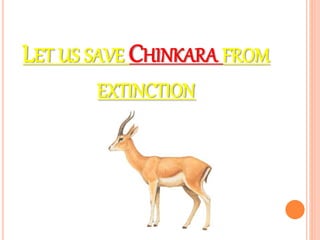
 Characterized by a sandy,yellowish and red coloured
fur with a pale white ventral region.
 They have straight horns with prominent rings and
tips that are slightly out turned.
 Horns are found on both male and female,but
slightly small in females.
 Male weighs approx 23 kgs and female weighs
between 15-18 kgs.
 It is preyed upon leopards and Asiatic cheetahs.
GENUS GAZELLA AND ITS SPECIES
Gazella is widely considered to contain about 7
species and 2 extinct species.
7 species: 2 species:extinct
~Cuviers gazelle ~Arabian gazelle
~Dorcas gazelle ~Saudi gazelle
~Goitered gazelle
~indian gazelle (chinkara)
~Rhim gazelle
~Mountain gazelle
~Spekes gazelle
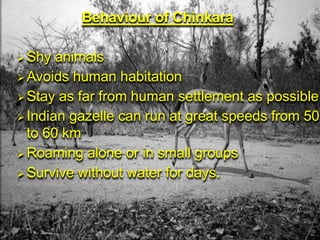
Behaviour of Chinkara
 Shy animals
 Avoids human habitation
 Stay as far from human settlement as possible
 Indian gazelle can run at great speeds from 50
to 60 km
 Roaming alone or in small groups
 Survive without water for days.
DISTRIBUTION AND HABITAT OF CHINKARA
 Habitat:
 Mostly found in grasslands, dessert lands, wood lands.
 Commonly seen in ranthambore national park, gir national park, dessert
national park
 Distribution :
 Mainly it is found in India and Bangladesh and in parts of Iran and
Pakistan.
 Widely distributed in India and it is present in 9 states
Rajasthan, Madhya Pradesh, Uttar Pradesh, Gujarat, Haryana, Bihar,
Karnataka, Maharashtra.
Diet and feeding of chinkara
• Diet in wild
• Grasses
• Green leaves
• Buds of flowers and fruits like melon and pumpkins
• Majority of their metabolic water intake comes from the
vegetation they consume.
• Mating behaviour
• Do not have specific time for breeding
• Though autumn and spring season are preferred as mating
period.
• Mating system is polygandrous.
• Gestation lasts for 5-6 months and female gives births to 1 or
2 young ones
Interesting facts
 Young baby of an Indian gazelle is called a Calf.
 Indian gazelle is known as state animal of Rajasthan.
 In 1994 the species was considered vulnerable .
 In 1996 species was considered a species of lower risk.
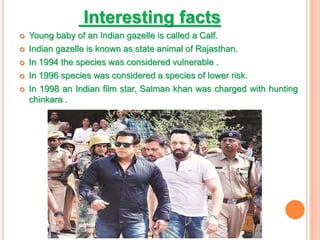
 In 1998 an Indian film star, Salman khan was charged with hunting
chinkara .
Major threats of Chinkara
 Indiscriminate hunting and habitat loss.
 Hunted for meat and to a lesser degree for trophies.
 Habitat loss through: over grazing.
conversion to agriculture.
Industrial development.
CONSERVATION STATUS OF CHINKARA
 Considered as a species of least concern by the
International union for conservation of nature (IUCN).
 Indian country has enacted laws against killing of
gazelles.
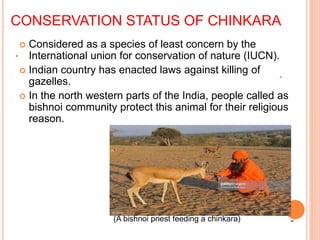
 In the north western parts of the India, people called as
bishnoi community protect this animal for their religious
reason.
(A bishnoi priest feeding a chinkara)
LET US SAVE CHINKARA FROM
EXTINCTION

Chinkara

  • 1.
  • 2.
    SYSTEMATIC POSITION  Kingdom:Animalia Phylum:Chordate  Class:Mamalia  Order:Artiodyactyla  Famliy:Bovidae  Genus:Gazella  Species:bennettii
  • 3.
    INTRODUCTION  The chinkaraor Indian gazelleis a species of gazelle found in South asia.  Characterized by a sandy,yellowish and red coloured fur with a pale white ventral region.  They have straight horns with prominent rings and tips that are slightly out turned.  Horns are found on both male and female,but slightly small in females.  Male weighs approx 23 kgs and female weighs between 15-18 kgs.  It is preyed upon leopards and Asiatic cheetahs.
  • 4.
    GENUS GAZELLA ANDITS SPECIES Gazella is widely considered to contain about 7 species and 2 extinct species. 7 species: 2 species:extinct ~Cuviers gazelle ~Arabian gazelle ~Dorcas gazelle ~Saudi gazelle ~Goitered gazelle ~indian gazelle (chinkara) ~Rhim gazelle ~Mountain gazelle ~Spekes gazelle
  • 5.
    Behaviour of Chinkara Shy animals  Avoids human habitation  Stay as far from human settlement as possible  Indian gazelle can run at great speeds from 50 to 60 km  Roaming alone or in small groups  Survive without water for days.
  • 6.
    DISTRIBUTION AND HABITATOF CHINKARA  Habitat:  Mostly found in grasslands, dessert lands, wood lands.  Commonly seen in ranthambore national park, gir national park, dessert national park  Distribution :  Mainly it is found in India and Bangladesh and in parts of Iran and Pakistan.  Widely distributed in India and it is present in 9 states Rajasthan, Madhya Pradesh, Uttar Pradesh, Gujarat, Haryana, Bihar, Karnataka, Maharashtra.
  • 7.
    Diet and feedingof chinkara • Diet in wild • Grasses • Green leaves • Buds of flowers and fruits like melon and pumpkins • Majority of their metabolic water intake comes from the vegetation they consume. • Mating behaviour • Do not have specific time for breeding • Though autumn and spring season are preferred as mating period. • Mating system is polygandrous. • Gestation lasts for 5-6 months and female gives births to 1 or 2 young ones
  • 8.
    Interesting facts  Youngbaby of an Indian gazelle is called a Calf.  Indian gazelle is known as state animal of Rajasthan.  In 1994 the species was considered vulnerable .  In 1996 species was considered a species of lower risk.  In 1998 an Indian film star, Salman khan was charged with hunting chinkara .
  • 9.
    Major threats ofChinkara  Indiscriminate hunting and habitat loss.  Hunted for meat and to a lesser degree for trophies.  Habitat loss through: over grazing. conversion to agriculture. Industrial development.
  • 10.
    CONSERVATION STATUS OFCHINKARA  Considered as a species of least concern by the International union for conservation of nature (IUCN).  Indian country has enacted laws against killing of gazelles.  In the north western parts of the India, people called as bishnoi community protect this animal for their religious reason. (A bishnoi priest feeding a chinkara)
  • 11.
    LET US SAVECHINKARA FROM EXTINCTION