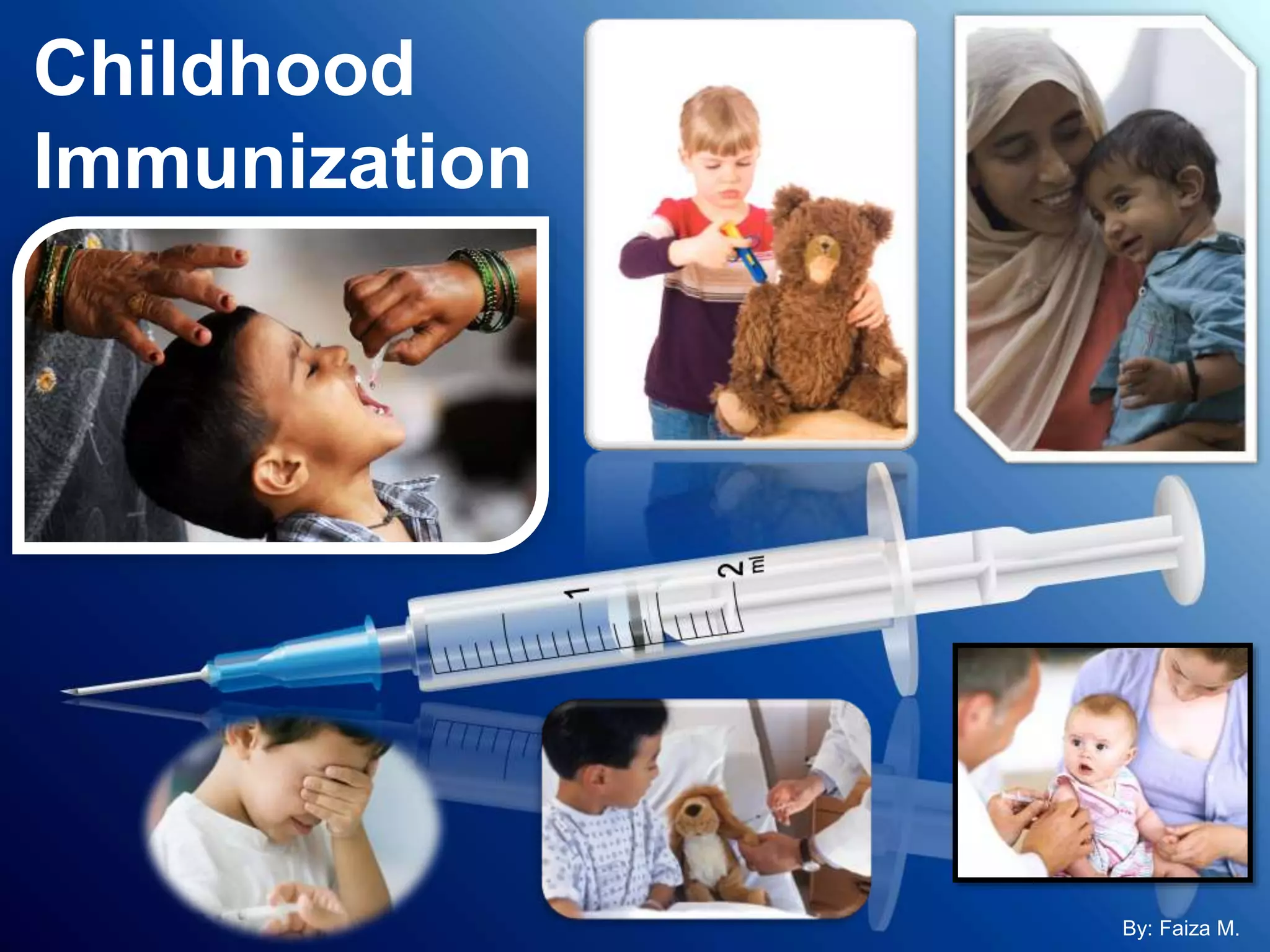
Childhood
Immunization
By: Faiza M.
Outline
Intro
– What is immunization?
Main Topics
– History
– How do vaccines work?
– Types of vaccines
– Global incidence of diseases
– 5 important reasons to vaccinate your child
– Importance of vaccines in Pregnancy
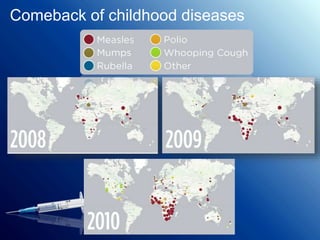
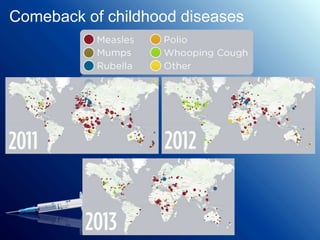
– Comeback of childhood diseases
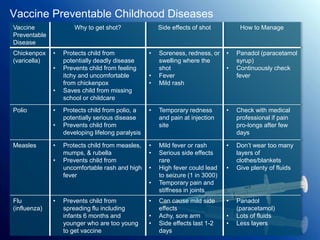
– Vaccine Preventable Childhood Diseases
– Influenza throughout history
– Flu vaccine
– Dubai Health Authority
– National immunization schedule
– Vaccine storage and the cold chain
– Ongoing vaccine debate
– Myth or Fact
Conclusion
– Questions
What is Immunization?
• Immunization, or immunization, is the process by
which an individual's immune system becomes protected
against an agent (known as the immunogen).
https://www.youtube.com/watch?v=SduMbjW2V9A
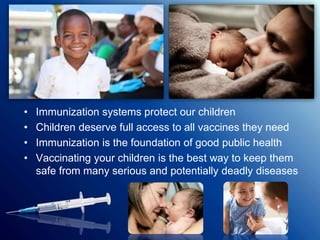
• Immunization systems protect our children
• Children deserve full access to all vaccines they need
• Immunization is the foundation of good public health
• Vaccinating your children is the best way to keep them
safe from many serious and potentially deadly diseases
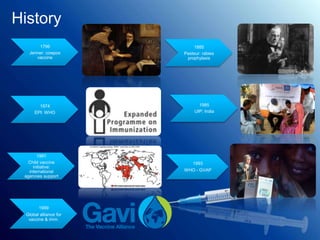
History
1796
Jenner: cowpox
vaccine
1885
Pasteur: rabies
prophylaxis
1974
EPI: WHO
1985
UIP: India
1991
Child vaccine
initiative:
international
agencies support
1993
WHO - GVAP
1999
Global alliance for
vaccine & imm.
• https://www.youtube.com/watch?v=rb7TVW77ZCs
How do vaccines work?
Types of Vaccines
Type of Vaccine Description
Live attenuated vaccines
[eg. Mumps, rubella, chickenpox]
• Contain modified version of the living microbe
that has been weakened in the lab so it can’t
cause disease
Inactivated Viral or Bacterial vaccine
[eg. ]
• More stable and safer than live vaccines
• Stimulate weaker immune system response
Subunit vaccines • Include only the antigens that best stimulate
the immune system
• Adverse reactions to the vaccine lower
Toxoid vaccines • Used when a bacterial toxin is main cause of
illness
Conjugate vaccines • Used to get around problem of polysaccharide
coatings
DNA vaccines • Take vaccines to a new technological level
• Dispense with both the whole organism and
its parts
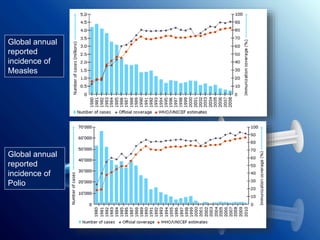
Global annual
reported
incidence of
Measles
Global annual
reported
incidence of
Polio
5 Important Reasons to Vaccinate Your
Child
• 1. Immunzations can save your child’s life
https://www.youtube.com/watch?v=pFIHQMN-
2NE
5 Important Reasons to Vaccinate Your
Child
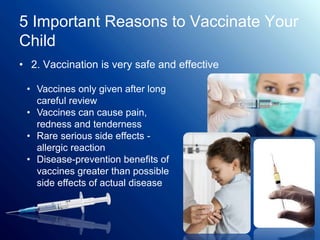
• 2. Vaccination is very safe and effective
• Vaccines only given after long
careful review
• Vaccines can cause pain,
redness and tenderness
• Rare serious side effects -
allergic reaction
• Disease-prevention benefits of
vaccines greater than possible
side effects of actual disease
5 Important Reasons to Vaccinate Your
Child
• 3. Immunization protects others you care about
5 Important Reasons to Vaccinate Your
Child
• 4. Immunizations can save your family time and money
• Child with vaccine-preventable
disease could be denied
attendance at certain schools
• Some diseases can result in
long-lasting disabilities
• Diseases can be expensive
and time consuming to treat
• Getting vaccinated is a more
beneficial investment
5 Important Reasons to Vaccinate Your
Child
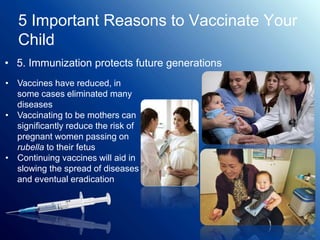
• 5. Immunization protects future generations
• Vaccines have reduced, in
some cases eliminated many
diseases
• Vaccinating to be mothers can
significantly reduce the risk of
pregnant women passing on
rubella to their fetus
• Continuing vaccines will aid in
slowing the spread of diseases
and eventual eradication
Importance of vaccines before and
during pregnancy
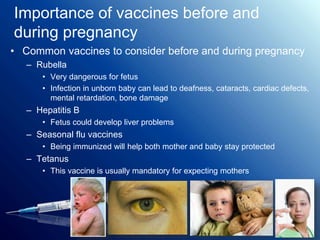
• Common vaccines to consider before and during pregnancy
– Rubella
• Very dangerous for fetus
• Infection in unborn baby can lead to deafness, cataracts, cardiac defects,
mental retardation, bone damage
– Hepatitis B
• Fetus could develop liver problems
– Seasonal flu vaccines
• Being immunized will help both mother and baby stay protected
– Tetanus
• This vaccine is usually mandatory for expecting mothers
Comeback of childhood diseases
Vaccine Preventable Childhood Diseases
Vaccine
Preventable
Disease
Why to get shot? Side effects of shot How to Manage
Chickenpox
(varicella)
• Protects child from
potentially deadly disease
• Prevents child from feeling
itchy and uncomfortable
from chickenpox
• Saves child from missing
school or childcare
• Soreness, redness, or
swelling where the
shot
• Fever
• Mild rash
• Panadol (paracetamol
syrup)
• Continuously check
fever
Polio • Protects child from polio, a
potentially serious disease
• Prevents child from
developing lifelong paralysis
• Temporary redness
and pain at injection
site
• Check with medical
professional if pain
pro-longs after few
days
Measles • Protects child from measles,
mumps, & rubella
• Prevents child from
uncomfortable rash and high
fever
• Mild fever or rash
• Serious side effects
rare
• High fever could lead
to seizure (1 in 3000)
• Temporary pain and
stiffness in joints
• Don’t wear too many
layers of
clothes/blankets
• Give plenty of fluids
Flu
(influenza)
• Prevents child from
spreading flu including
infants 6 months and
younger who are too young
to get vaccine
• Can cause mild side
effects
• Achy, sore arm
• Side effects last 1-2
days
• Panadol
(paracetamol)
• Lots of fluids
• Less layers
Influenza [flu] throughout History
• Spanish Influenza: 1918 – 1919
• Illness and mortality rates high among young adults
• Waves of infection spread fast through nations and continents
• Killed approx. 50 million people worldwide
• Asian Influenza: 1957 -1958
• Surfaced in China
• Killed approx. 2 million
• Hong Kong Flu: 1968 – 1969
• Spread from Asia to North America
• Vaccine made but not produced early enough
• Avian Flu Threat 1997 – present
• Virus passed from birds to humans
• Number of people did die
• H1N1 Influenza: 2009
• First appeared in Mexico and spread to US
• Virus origin from pigs
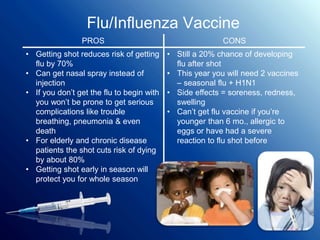
Flu/Influenza Vaccine
PROS CONS
• Getting shot reduces risk of getting
flu by 70%
• Can get nasal spray instead of
injection
• If you don’t get the flu to begin with
you won’t be prone to get serious
complications like trouble
breathing, pneumonia & even
death
• For elderly and chronic disease
patients the shot cuts risk of dying
by about 80%
• Getting shot early in season will
protect you for whole season
• Still a 20% chance of developing
flu after shot
• This year you will need 2 vaccines
– seasonal flu + H1N1
• Side effects = soreness, redness,
swelling
• Can’t get flu vaccine if you’re
younger than 6 mo., allergic to
eggs or have had a severe
reaction to flu shot before
Dubai Health Authority [DHA] –
Immunization Guidelines
• Routes of Administrating Vaccines
– Intradermal injections
• Delivered into dermis (top layer of skin)
– Subcutaneous injections
• needle given in top layers of skin
• area of insertion does not need to be rubbed or moved
– Intramuscular injections
• given in muscle tissue below the dermis and subcutaneous tissue of skin
• area of insertion does need to be rubbed and moved to make sure the liquid
does not stay in one area
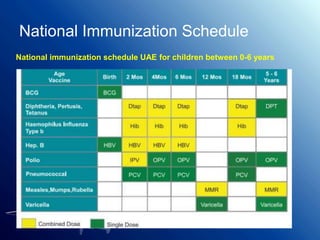
National Immunization Schedule
National immunization schedule UAE for children between 0-6 years
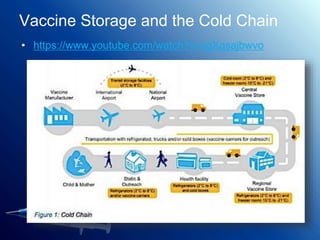
Vaccine Storage and the Cold Chain
• https://www.youtube.com/watch?v=xgXqsajbwvo
Ongoing Vaccine Debate
• https://www.youtube.com/watch?v=HJEiNZBYatw
MYTH OR FACT
1. Better hygiene and sanitation will make diseases
disappear – vaccines are not needed. =
2. Vaccines interact with the immune system to produce
an immune response similar to that produced by the
natural infection, but they do not cause the disease. =
3. Influenza is much more serious than people believe.
Pregnant women, small children, elderly people with
poor health and people suffering with chronic conditions
are at a higher risk for severe infection and death. =
4. Some diseases are almost eliminated from my country,
so there is no reason to be vaccinated. =
Childhood Immunization

Childhood Immunization

  • 1.
  • 2.
    Outline Intro – What isimmunization? Main Topics – History – How do vaccines work? – Types of vaccines – Global incidence of diseases – 5 important reasons to vaccinate your child – Importance of vaccines in Pregnancy – Comeback of childhood diseases – Vaccine Preventable Childhood Diseases – Influenza throughout history – Flu vaccine – Dubai Health Authority – National immunization schedule – Vaccine storage and the cold chain – Ongoing vaccine debate – Myth or Fact Conclusion – Questions
  • 3.
    What is Immunization? •Immunization, or immunization, is the process by which an individual's immune system becomes protected against an agent (known as the immunogen). https://www.youtube.com/watch?v=SduMbjW2V9A
  • 4.
    • Immunization systemsprotect our children • Children deserve full access to all vaccines they need • Immunization is the foundation of good public health • Vaccinating your children is the best way to keep them safe from many serious and potentially deadly diseases
  • 5.
    History 1796 Jenner: cowpox vaccine 1885 Pasteur: rabies prophylaxis 1974 EPI:WHO 1985 UIP: India 1991 Child vaccine initiative: international agencies support 1993 WHO - GVAP 1999 Global alliance for vaccine & imm.
  • 6.
  • 7.
    Types of Vaccines Typeof Vaccine Description Live attenuated vaccines [eg. Mumps, rubella, chickenpox] • Contain modified version of the living microbe that has been weakened in the lab so it can’t cause disease Inactivated Viral or Bacterial vaccine [eg. ] • More stable and safer than live vaccines • Stimulate weaker immune system response Subunit vaccines • Include only the antigens that best stimulate the immune system • Adverse reactions to the vaccine lower Toxoid vaccines • Used when a bacterial toxin is main cause of illness Conjugate vaccines • Used to get around problem of polysaccharide coatings DNA vaccines • Take vaccines to a new technological level • Dispense with both the whole organism and its parts
  • 8.
    Global annual reported incidence of Measles Globalannual reported incidence of Polio
  • 9.
    5 Important Reasonsto Vaccinate Your Child • 1. Immunzations can save your child’s life https://www.youtube.com/watch?v=pFIHQMN- 2NE
  • 10.
    5 Important Reasonsto Vaccinate Your Child • 2. Vaccination is very safe and effective • Vaccines only given after long careful review • Vaccines can cause pain, redness and tenderness • Rare serious side effects - allergic reaction • Disease-prevention benefits of vaccines greater than possible side effects of actual disease
  • 11.
    5 Important Reasonsto Vaccinate Your Child • 3. Immunization protects others you care about
  • 12.
    5 Important Reasonsto Vaccinate Your Child • 4. Immunizations can save your family time and money • Child with vaccine-preventable disease could be denied attendance at certain schools • Some diseases can result in long-lasting disabilities • Diseases can be expensive and time consuming to treat • Getting vaccinated is a more beneficial investment
  • 13.
    5 Important Reasonsto Vaccinate Your Child • 5. Immunization protects future generations • Vaccines have reduced, in some cases eliminated many diseases • Vaccinating to be mothers can significantly reduce the risk of pregnant women passing on rubella to their fetus • Continuing vaccines will aid in slowing the spread of diseases and eventual eradication
  • 14.
    Importance of vaccinesbefore and during pregnancy • Common vaccines to consider before and during pregnancy – Rubella • Very dangerous for fetus • Infection in unborn baby can lead to deafness, cataracts, cardiac defects, mental retardation, bone damage – Hepatitis B • Fetus could develop liver problems – Seasonal flu vaccines • Being immunized will help both mother and baby stay protected – Tetanus • This vaccine is usually mandatory for expecting mothers
  • 15.
  • 16.
  • 17.
    Vaccine Preventable ChildhoodDiseases Vaccine Preventable Disease Why to get shot? Side effects of shot How to Manage Chickenpox (varicella) • Protects child from potentially deadly disease • Prevents child from feeling itchy and uncomfortable from chickenpox • Saves child from missing school or childcare • Soreness, redness, or swelling where the shot • Fever • Mild rash • Panadol (paracetamol syrup) • Continuously check fever Polio • Protects child from polio, a potentially serious disease • Prevents child from developing lifelong paralysis • Temporary redness and pain at injection site • Check with medical professional if pain pro-longs after few days Measles • Protects child from measles, mumps, & rubella • Prevents child from uncomfortable rash and high fever • Mild fever or rash • Serious side effects rare • High fever could lead to seizure (1 in 3000) • Temporary pain and stiffness in joints • Don’t wear too many layers of clothes/blankets • Give plenty of fluids Flu (influenza) • Prevents child from spreading flu including infants 6 months and younger who are too young to get vaccine • Can cause mild side effects • Achy, sore arm • Side effects last 1-2 days • Panadol (paracetamol) • Lots of fluids • Less layers
  • 18.
    Influenza [flu] throughoutHistory • Spanish Influenza: 1918 – 1919 • Illness and mortality rates high among young adults • Waves of infection spread fast through nations and continents • Killed approx. 50 million people worldwide • Asian Influenza: 1957 -1958 • Surfaced in China • Killed approx. 2 million • Hong Kong Flu: 1968 – 1969 • Spread from Asia to North America • Vaccine made but not produced early enough • Avian Flu Threat 1997 – present • Virus passed from birds to humans • Number of people did die • H1N1 Influenza: 2009 • First appeared in Mexico and spread to US • Virus origin from pigs
  • 19.
    Flu/Influenza Vaccine PROS CONS •Getting shot reduces risk of getting flu by 70% • Can get nasal spray instead of injection • If you don’t get the flu to begin with you won’t be prone to get serious complications like trouble breathing, pneumonia & even death • For elderly and chronic disease patients the shot cuts risk of dying by about 80% • Getting shot early in season will protect you for whole season • Still a 20% chance of developing flu after shot • This year you will need 2 vaccines – seasonal flu + H1N1 • Side effects = soreness, redness, swelling • Can’t get flu vaccine if you’re younger than 6 mo., allergic to eggs or have had a severe reaction to flu shot before
  • 20.
    Dubai Health Authority[DHA] – Immunization Guidelines • Routes of Administrating Vaccines – Intradermal injections • Delivered into dermis (top layer of skin) – Subcutaneous injections • needle given in top layers of skin • area of insertion does not need to be rubbed or moved – Intramuscular injections • given in muscle tissue below the dermis and subcutaneous tissue of skin • area of insertion does need to be rubbed and moved to make sure the liquid does not stay in one area
  • 21.
    National Immunization Schedule Nationalimmunization schedule UAE for children between 0-6 years
  • 22.
    Vaccine Storage andthe Cold Chain • https://www.youtube.com/watch?v=xgXqsajbwvo
  • 23.
    Ongoing Vaccine Debate •https://www.youtube.com/watch?v=HJEiNZBYatw
  • 25.
    MYTH OR FACT 1.Better hygiene and sanitation will make diseases disappear – vaccines are not needed. = 2. Vaccines interact with the immune system to produce an immune response similar to that produced by the natural infection, but they do not cause the disease. = 3. Influenza is much more serious than people believe. Pregnant women, small children, elderly people with poor health and people suffering with chronic conditions are at a higher risk for severe infection and death. = 4. Some diseases are almost eliminated from my country, so there is no reason to be vaccinated. =