PULSE POLIO
PROGRAM
AND
MICRO PLANNING
Dr.Aishwarya.R.G
1st year MPH
RGIPH & CDC
11/30/2020 1
Index
• Pulse polio immunization
1. Introduction
2. Objectives
3. Steps taken
4. Progress
5. Risks or challenges in strategy
6. Program priorities
• Micro planning
1. Introduction
2. Micro-planning and implementing NID’s/SNID’s
3. Other key components of planning and
implementation
11/30/2020 2
PULSE
POLIO
PROGRAM
11/30/2020 3
INTRODUCTION
• With the global initiative of eradication of polio in 1988 following
World Health Assembly resolution in 1988, Pulse Polio Immunization
programme was launched in India in 1995.
• Children in the age group of 0-5 years administered polio drops
during National and Sub-national immunization rounds (in high risk
areas) every year.
• About 172 million children are immunized during each National
Immunization Day (NID).
• The last polio case in the country was reported from Howrah district
of West Bengal with date of onset 13th January 2011.
• WHO on 24th February 2012 removed India from the list of
countries with active endemic wild polio virus transmission.
11/30/2020 4
OBJECTIVES
• The Pulse Polio Initiative was started with an objective of achieving hundred per cent coverage
under Oral Polio Vaccine.
• It aimed to immunize children through improved social mobilization, plan mop-up operations
in areas where poliovirus has almost disappeared and maintain high level of morale among
the public.
11/30/2020 https://www.nhp.gov.in/pulse-polio-programme_pg 5
Steps taken by the Government to maintain polio free status in
India
• Maintaining community immunity through high quality National and Sub National polio rounds each year.
• An extremely high level of vigilance through surveillance across the country for any importation or
circulation of poliovirus and VDPV is being maintained.
• Environmental surveillance (sewage sampling) have been established to detect poliovirus transmission and
as a surrogate indicator of the progress as well for any programmatic interventions strategically in Mumbai,
Delhi, Patna, Kolkata, Punjab and Gujarat.
• All States and Union Territories in the country have developed a Rapid Response Team (RRT) to respond to
any polio outbreak in the country.
• An Emergency Preparedness and Response Plan (EPRP) has also been
developed by all States indicating steps to be undertaken in case of detection of a polio case.
11/30/2020 https://main.mohfw.gov.in/sites/default/files/Pulse%20Polio%20Programme.pdf 6
…CONTINUED
• To reduce risk of importation from neighbouring countries, international border vaccination is being
provided through continuous vaccination teams (CVT) to all eligible children round the clock.
• These are provided through special booths set up at the international borders that India shares with
Pakistan, Bangladesh, Bhutan Nepal and Myanmar.
• Government of India has issued guidelines for mandatory requirement of polio vaccination to all
international travellers before their departure from India to polio affected countries namely: Afghanistan,
Nigeria, Pakistan, Ethiopia, Kenya, Somalia, Syria and Cameroon.
• The mandatory requirement is effective for travellers from 1st March 2014.
• A rolling emergency stock of OPV is being maintained to respond to detection/importation of wild poliovirus
(WPV) or emergence of circulating vaccine derived poliovirus (c-VDPV).
• National Technical Advisory Group on Immunization (NTAGI) has recommended Injectable Polio Vaccine (IPV)
introduction as an additional dose along with 3rd dose of DPT in the entire country in the last quarter of
2015 as a part of polio endgame strategy.
11/30/2020 7
Progress
• South-East Asia Region of WHO including India has been certified polio free by “The Regional Certification
Commission (RCC)” on 27th March 2014.
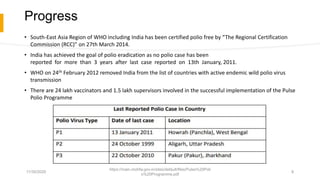
• India has achieved the goal of polio eradication as no polio case has been
reported for more than 3 years after last case reported on 13th January, 2011.
• WHO on 24th February 2012 removed India from the list of countries with active endemic wild polio virus
transmission
• There are 24 lakh vaccinators and 1.5 lakh supervisors involved in the successful implementation of the Pulse
Polio Programme
11/30/2020
https://main.mohfw.gov.in/sites/default/files/Pulse%20Poli
o%20Programme.pdf
8
…CONTINUED
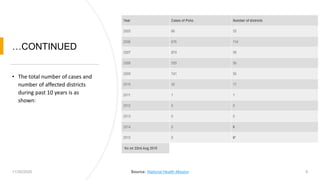
• The total number of cases and
number of affected districts
during past 10 years is as
shown:
11/30/2020 Source: National Health Mission 9
Risks/Challenges to Polio Eradication Strategy
• International Importation of wild polio virus. Neighbouring countries like Afghanistan, Pakistan and China
has had a major outbreak of Wild Polio Virus in the recent past who pose a major threat to Polio
Eradication.
• Complacency both for public & system.
• Gaps in AFP (acute flaccid paralysis) Surveillance or delays in detection of wild polio virus.
• Delayed and or inadequate response to importation.
• Areas with low population immunity.
• Gaps in Routine Immunization & SIA (supplementary immunization activity) especially in High Risk Areas.
• Various resident societies are not allowing vaccinators to enter their premises and immunize children in
these societies.
11/30/2020 10
Current program priorities
• Intensify AFP Surveillance including environmental surveillance
• Maintain Intensified program in High Risk Areas
• Fully and consistently cover Migrant and Mobile populations.
• Strengthening Routine Immunization.
• Prepare for Emergency: rapid and effective response to any wild polio virus
11/30/2020
http://health.delhigovt.nic.in/wps/wcm/connect/3956e00048b5b90793a
c93c185840765/PPD.pdf?MOD=AJPERES&lmod=-382194844 11
MICRO PLANNING
AND PULSE POLIO
PROGRAM
11/30/2020 12
INTRODUCTION
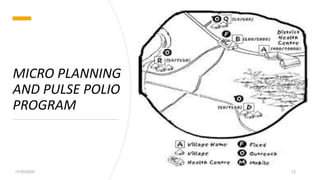
• Microplanning is one of the tools that health workers use to ensure that
immunization services reach every community. Microplanning is used to
identify priority communities, to address barriers, and to develop
workplans with solutions.
• In the broadest sense, micro-planning covers all planning activities at
sub-national level; that is, regional, local and institutional, so as to enable
the successful attainment of the set goals.
• It is a planning process that focuses on local characteristics and needs
and builds local capacities.
11/30/2020 • https://agora.unicef.org/course/info.php?id=6730
• https://learningportal.iiep.unesco.org/en/glossary/educational-micro-planning
13
MICRO PLANNING
AND IMPLEMENTING
NIDs/SNIDs
• Successful implementation of SIAs requires meticulous
microplanning . Important components of micro plan are
as under :
1. Booth activity.
2. House-to-house activity.
3. Transit site activity.
4. Activity in high risk and underserved areas
5. Activity at Brick kilns, construction sites, congregation
sites, urban areas.
11/30/2020 14
Booth activity
• Booths will be setup on day 1 of the NID/SNID campaign to take advantage of IEC/ Social Mobilization
efforts.
• On this day OPV vaccine shall be provided to all children aged 0 – 5 years (including new-borns) who are
brought to the booth.
• All departments of the government (e.g. education, social welfare, ICDS, panchayat raj institutions, civil
defence, revenue etc.) as well as NGOs and the community participate.
• Therefore it is essential that adequate social mobilization (refer to the section on social mobilization)
measures are undertaken prior to the NIDs/SNIDs so that parents are fully informed about the:
 Dates of immunization at the booth.
 The locations of the booths.
 The benefits of receiving OPV
11/30/2020 15
…CONTINUED
11/30/2020 16
Setting up of booths.
Location/placements of booth.
Booth management and logistics.
Booth functioning and administration of
OPV.
Essential steps for increasing booth
coverage.
MARKING OF CHILDREN
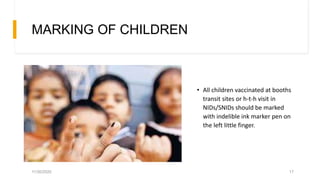
• All children vaccinated at booths
transit sites or h-t-h visit in
NIDs/SNIDs should be marked
with indelible ink marker pen on
the left little finger.
11/30/2020 17
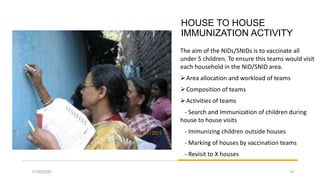
HOUSE TO HOUSE
IMMUNIZATION ACTIVITY
The aim of the NIDs/SNIDs is to vaccinate all
under 5 children. To ensure this teams would visit
each household in the NID/SNID area.
Area allocation and workload of teams
Composition of teams
Activities of teams
- Search and Immunization of children during
house to house visits
- Immunizing children outside houses
- Marking of houses by vaccination teams
- Revisit to X houses
11/30/2020 18
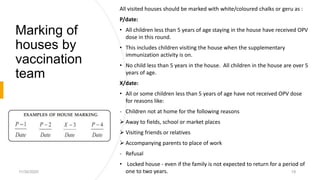
Marking of
houses by
vaccination
team
All visited houses should be marked with white/coloured chalks or geru as :
P/date:
• All children less than 5 years of age staying in the house have received OPV
dose in this round.
• This includes children visiting the house when the supplementary
immunization activity is on.
• No child less than 5 years in the house. All children in the house are over 5
years of age.
X/date:
• All or some children less than 5 years of age have not received OPV dose
for reasons like:
- Children not at home for the following reasons
 Away to fields, school or market places
 Visiting friends or relatives
 Accompanying parents to place of work
- Refusal
• Locked house - even if the family is not expected to return for a period of
one to two years.11/30/2020 19
Planning and immunizing children in transit
• Large number of children would be in transit during NIDs/SNIDs.
• It is essential to cover all these children through Transit teams.
• Transit teams should be present at major railway stations, bus terminuses, ferry crossings, highways and
airports.
• Transit teams should also be deployed at prominent road crossings in cities and major tourist attraction
points.
• Vaccinators must be proactive in seeking and immunizing children at Transit points, Melas and other
Congregation sites
11/30/2020 20
Indicators for High-risk areas and underserved population
• A wild poliovirus confirmed case in the recent past (year 2005 onwards).
• Problems in surveillance like non-reporting/ late reporting of AFP cases, non-collection/ late collection of stool specimens.
• Large immunity gap (large proportion of children who have received less than 4 doses of OPV) as determined by proportion of less
than 5 years old Non Polio AFP cases having less than 4 doses.
• Low routine immunization coverage.
• Urban slums or peri urban areas not recognized by district authorities.
• Remote, sparse and difficult to reach population groups like nomadic tribes, boat people, isolated families living along riverbanks
for farming, river islands etc.
• Mobile population and tribes
• People with working hours that do not coincide with the visit of teams (for example children going to the fields along with their
parents during harvesting and sowing seasons are simply missed because teams do not reach either before they leave or after they
come back from the fields).
• Children living at construction sites, brick kilns
11/30/2020 21
…CONTINUED
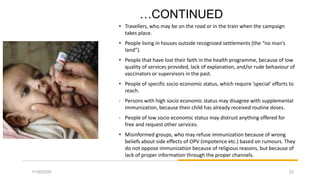
• Travellers, who may be on the road or in the train when the campaign
takes place.
• People living in houses outside recognized settlements (the “no man’s
land”).
• People that have lost their faith in the health programme, because of low
quality of services provided, lack of explanation, and/or rude behaviour of
vaccinators or supervisors in the past.
• People of specific socio economic status, which require ‘special’ efforts to
reach.
- Persons with high socio economic status may disagree with supplemental
immunization, because their child has already received routine doses.
- People of low socio economic status may distrust anything offered for
free and request other services.
• Misinformed groups, who may refuse immunization because of wrong
beliefs about side effects of OPV (impotence etc.) based on rumours. They
do not oppose immunization because of religious reasons, but because of
lack of proper information through the proper channels.
11/30/2020 22
…CONTINUED
• Special efforts for high risk areas and underserved populations
• Immunizing children of misinformed groups.
• Brick kilns, construction sites may be covered by either house-to-house immunization teams or mobile
teams specifically constituted for this purpose.
• Mobile teams.
• Coverage of children in major melas and religious congregations should be included in the micro-plan.
11/30/2020 23
MICRO-PLANNING FOR URBAN AREAS
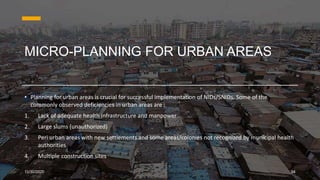
• Planning for urban areas is crucial for successful implementation of NIDs/SNIDs. Some of the
commonly observed deficiencies in urban areas are :
1. Lack of adequate health infrastructure and manpower
2. Large slums (unauthorized)
3. Peri urban areas with new settlements and some areas/colonies not recognized by municipal health
authorities
4. Multiple construction sites
11/30/2020 24
Micro planning for urban areas
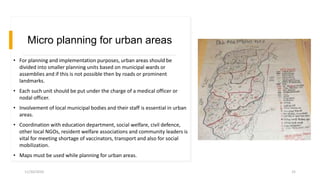
• For planning and implementation purposes, urban areas should be
divided into smaller planning units based on municipal wards or
assemblies and if this is not possible then by roads or prominent
landmarks.
• Each such unit should be put under the charge of a medical officer or
nodal officer.
• Involvement of local municipal bodies and their staff is essential in urban
areas.
• Coordination with education department, social welfare, civil defence,
other local NGOs, resident welfare associations and community leaders is
vital for meeting shortage of vaccinators, transport and also for social
mobilization.
• Maps must be used while planning for urban areas.
11/30/2020 25
11/30/2020 26
video
OTHER KEY COMPONENTS OF PLANNING AND
IMPLEMENTATION
Besides planning and implementation of activity at booths, house-to-house, transit site etc. other key
components which require planning and implementation are as under
 Supervision
 Mapping of areas
 Orientation training of vaccinators and supervisors
 Vaccine, cold chain maintenance, other logistics and transportation
 IEC/Social Mobilization
 Recording and reporting
 Review of micro plans and data analysis for planning interventions
 Use of data for planning actions
11/30/2020 27
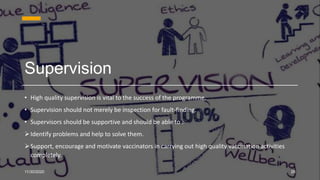
Supervision
• High quality supervision is vital to the success of the programme.
• Supervision should not merely be inspection for fault-finding.
• Supervisors should be supportive and should be able to :
Identify problems and help to solve them.
Support, encourage and motivate vaccinators in carrying out high quality vaccination activities
completely.
11/30/2020 28
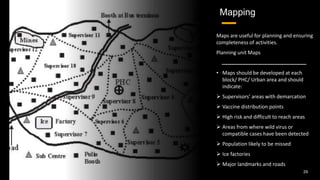
Mapping
Maps are useful for planning and ensuring
completeness of activities.
Planning unit Maps
• Maps should be developed at each
block/ PHC/ Urban area and should
indicate:
 Supervisors’ areas with demarcation
 Vaccine distribution points
 High risk and difficult to reach areas
 Areas from where wild virus or
compatible cases have been detected
 Population likely to be missed
 Ice factories
 Major landmarks and roads
11/30/2020 29
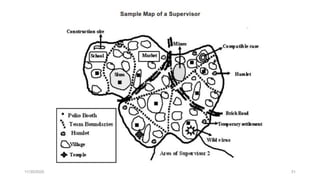
Supervisor Maps
Every
supervisor
should
also have
a map that
indicates
Team areas with demarcation and day wise work plan
Location of Booths
Villages /urban wards / Mohalla's/ urban slums / hamlets
High risk areas
Areas from where wild virus or compatible cases have been detected
Population likely to be missed
Major landmarks and roads
11/30/2020 30
11/30/2020 31
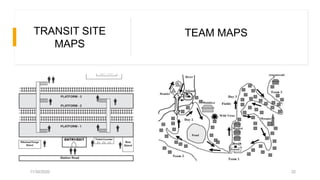
TEAM MAPSTRANSIT SITE
MAPS
11/30/2020 32
Orientation Training of Supervisors and Vaccinators
• Orientation of Vaccinators
The briefing will be organised in
batches of 40 – 50 vaccinators per
session and will last for about half a
day.
• Orientation of Supervisors
The District training team /Block
Medical Officers/Urban Health
Officials/ Surveillance Medical Officers
of NPSP should undertake a half-day
orientation of the supervisors.
11/30/2020 33
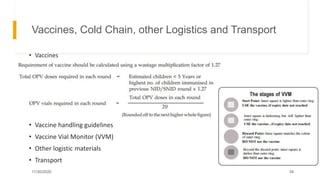
Vaccines, Cold Chain, other Logistics and Transport
• Vaccines
• Vaccine handling guidelines
• Vaccine Vial Monitor (VVM)
• Other logistic materials
• Transport
11/30/2020 34
Recording and Reporting
• A tally sheet (Form 8 A ) should be used for recording number of children immunized and houses visited.
No other system of recording should be used.
• Areas that have conducted mop-ups and have experience of using different tally sheets on booth (Form
8C) and house to house days (Form 8D) should continue to use the same tally sheets.
• At the end of each day, each supervisor should go through the tally sheets of all his/her teams, compile
the information and submit a consolidated report using the reporting form for supervisors (Form 9A).
11/30/2020 35
IEC and Social Mobilization
• Key Strategies
• Messages
• Branding of the campaign
• Central level activities
- Television
- Radio
- Print
• Preparation and Distribution of IEC materials
• District-Level Activities
• Block Level Activities
Mobilize local cable-operators and cinema theatres in urban/peri-urban areas to screen polio messages in the local
cable-TV network and cinema theatres
11/30/2020 36
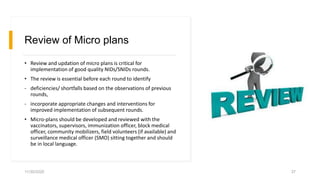
Review of Micro plans
• Review and updation of micro plans is critical for
implementation of good quality NIDs/SNIDs rounds.
• The review is essential before each round to identify
- deficiencies/ shortfalls based on the observations of previous
rounds,
- incorporate appropriate changes and interventions for
improved implementation of subsequent rounds.
• Micro-plans should be developed and reviewed with the
vaccinators, supervisors, immunization officer, block medical
officer, community mobilizers, field volunteers (if available) and
surveillance medical officer (SMO) sitting together and should
be in local language.
11/30/2020 37
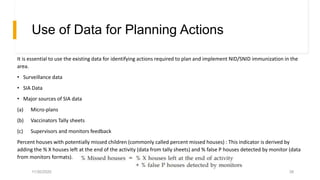
Use of Data for Planning Actions
It is essential to use the existing data for identifying actions required to plan and implement NID/SNID immunization in the
area.
• Surveillance data
• SIA Data
• Major sources of SIA data
(a) Micro-plans
(b) Vaccinators Tally sheets
(c) Supervisors and monitors feedback
Percent houses with potentially missed children (commonly called percent missed houses) : This indicator is derived by
adding the % X houses left at the end of the activity (data from tally sheets) and % false P houses detected by monitor (data
from monitors formats).
11/30/2020 38
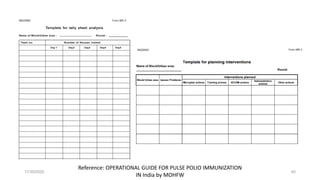
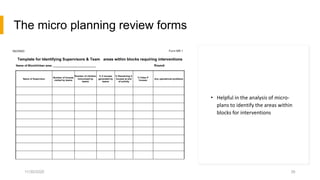
The micro planning review forms
• Helpful in the analysis of micro-
plans to identify the areas within
blocks for interventions
11/30/2020 39
11/30/2020
Reference: OPERATIONAL GUIDE FOR PULSE POLIO IMMUNIZATION
IN India by MOHFW
40
Slogans
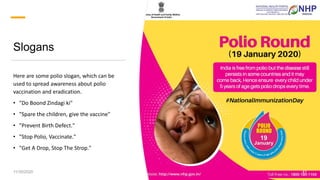
Here are some polio slogan, which can be
used to spread awareness about polio
vaccination and eradication.
• "Do Boond Zindagi ki"
• "Spare the children, give the vaccine"
• "Prevent Birth Defect."
• "Stop Polio, Vaccinate."
• "Get A Drop, Stop The Strop."
11/30/2020 41
11/30/2020 42
Rotary club – What polio eradication means to me?
THANK YOU
11/30/2020 43

Pulse polio program and microplanning

  • 1.
  • 2.
    Index • Pulse polioimmunization 1. Introduction 2. Objectives 3. Steps taken 4. Progress 5. Risks or challenges in strategy 6. Program priorities • Micro planning 1. Introduction 2. Micro-planning and implementing NID’s/SNID’s 3. Other key components of planning and implementation 11/30/2020 2
  • 3.
  • 4.
    INTRODUCTION • With theglobal initiative of eradication of polio in 1988 following World Health Assembly resolution in 1988, Pulse Polio Immunization programme was launched in India in 1995. • Children in the age group of 0-5 years administered polio drops during National and Sub-national immunization rounds (in high risk areas) every year. • About 172 million children are immunized during each National Immunization Day (NID). • The last polio case in the country was reported from Howrah district of West Bengal with date of onset 13th January 2011. • WHO on 24th February 2012 removed India from the list of countries with active endemic wild polio virus transmission. 11/30/2020 4
  • 5.
    OBJECTIVES • The PulsePolio Initiative was started with an objective of achieving hundred per cent coverage under Oral Polio Vaccine. • It aimed to immunize children through improved social mobilization, plan mop-up operations in areas where poliovirus has almost disappeared and maintain high level of morale among the public. 11/30/2020 https://www.nhp.gov.in/pulse-polio-programme_pg 5
  • 6.
    Steps taken bythe Government to maintain polio free status in India • Maintaining community immunity through high quality National and Sub National polio rounds each year. • An extremely high level of vigilance through surveillance across the country for any importation or circulation of poliovirus and VDPV is being maintained. • Environmental surveillance (sewage sampling) have been established to detect poliovirus transmission and as a surrogate indicator of the progress as well for any programmatic interventions strategically in Mumbai, Delhi, Patna, Kolkata, Punjab and Gujarat. • All States and Union Territories in the country have developed a Rapid Response Team (RRT) to respond to any polio outbreak in the country. • An Emergency Preparedness and Response Plan (EPRP) has also been developed by all States indicating steps to be undertaken in case of detection of a polio case. 11/30/2020 https://main.mohfw.gov.in/sites/default/files/Pulse%20Polio%20Programme.pdf 6
  • 7.
    …CONTINUED • To reducerisk of importation from neighbouring countries, international border vaccination is being provided through continuous vaccination teams (CVT) to all eligible children round the clock. • These are provided through special booths set up at the international borders that India shares with Pakistan, Bangladesh, Bhutan Nepal and Myanmar. • Government of India has issued guidelines for mandatory requirement of polio vaccination to all international travellers before their departure from India to polio affected countries namely: Afghanistan, Nigeria, Pakistan, Ethiopia, Kenya, Somalia, Syria and Cameroon. • The mandatory requirement is effective for travellers from 1st March 2014. • A rolling emergency stock of OPV is being maintained to respond to detection/importation of wild poliovirus (WPV) or emergence of circulating vaccine derived poliovirus (c-VDPV). • National Technical Advisory Group on Immunization (NTAGI) has recommended Injectable Polio Vaccine (IPV) introduction as an additional dose along with 3rd dose of DPT in the entire country in the last quarter of 2015 as a part of polio endgame strategy. 11/30/2020 7
  • 8.
    Progress • South-East AsiaRegion of WHO including India has been certified polio free by “The Regional Certification Commission (RCC)” on 27th March 2014. • India has achieved the goal of polio eradication as no polio case has been reported for more than 3 years after last case reported on 13th January, 2011. • WHO on 24th February 2012 removed India from the list of countries with active endemic wild polio virus transmission • There are 24 lakh vaccinators and 1.5 lakh supervisors involved in the successful implementation of the Pulse Polio Programme 11/30/2020 https://main.mohfw.gov.in/sites/default/files/Pulse%20Poli o%20Programme.pdf 8
  • 9.
    …CONTINUED • The totalnumber of cases and number of affected districts during past 10 years is as shown: 11/30/2020 Source: National Health Mission 9
  • 10.
    Risks/Challenges to PolioEradication Strategy • International Importation of wild polio virus. Neighbouring countries like Afghanistan, Pakistan and China has had a major outbreak of Wild Polio Virus in the recent past who pose a major threat to Polio Eradication. • Complacency both for public & system. • Gaps in AFP (acute flaccid paralysis) Surveillance or delays in detection of wild polio virus. • Delayed and or inadequate response to importation. • Areas with low population immunity. • Gaps in Routine Immunization & SIA (supplementary immunization activity) especially in High Risk Areas. • Various resident societies are not allowing vaccinators to enter their premises and immunize children in these societies. 11/30/2020 10
  • 11.
    Current program priorities •Intensify AFP Surveillance including environmental surveillance • Maintain Intensified program in High Risk Areas • Fully and consistently cover Migrant and Mobile populations. • Strengthening Routine Immunization. • Prepare for Emergency: rapid and effective response to any wild polio virus 11/30/2020 http://health.delhigovt.nic.in/wps/wcm/connect/3956e00048b5b90793a c93c185840765/PPD.pdf?MOD=AJPERES&lmod=-382194844 11
  • 12.
    MICRO PLANNING AND PULSEPOLIO PROGRAM 11/30/2020 12
  • 13.
    INTRODUCTION • Microplanning isone of the tools that health workers use to ensure that immunization services reach every community. Microplanning is used to identify priority communities, to address barriers, and to develop workplans with solutions. • In the broadest sense, micro-planning covers all planning activities at sub-national level; that is, regional, local and institutional, so as to enable the successful attainment of the set goals. • It is a planning process that focuses on local characteristics and needs and builds local capacities. 11/30/2020 • https://agora.unicef.org/course/info.php?id=6730 • https://learningportal.iiep.unesco.org/en/glossary/educational-micro-planning 13
  • 14.
    MICRO PLANNING AND IMPLEMENTING NIDs/SNIDs •Successful implementation of SIAs requires meticulous microplanning . Important components of micro plan are as under : 1. Booth activity. 2. House-to-house activity. 3. Transit site activity. 4. Activity in high risk and underserved areas 5. Activity at Brick kilns, construction sites, congregation sites, urban areas. 11/30/2020 14
  • 15.
    Booth activity • Boothswill be setup on day 1 of the NID/SNID campaign to take advantage of IEC/ Social Mobilization efforts. • On this day OPV vaccine shall be provided to all children aged 0 – 5 years (including new-borns) who are brought to the booth. • All departments of the government (e.g. education, social welfare, ICDS, panchayat raj institutions, civil defence, revenue etc.) as well as NGOs and the community participate. • Therefore it is essential that adequate social mobilization (refer to the section on social mobilization) measures are undertaken prior to the NIDs/SNIDs so that parents are fully informed about the:  Dates of immunization at the booth.  The locations of the booths.  The benefits of receiving OPV 11/30/2020 15
  • 16.
    …CONTINUED 11/30/2020 16 Setting upof booths. Location/placements of booth. Booth management and logistics. Booth functioning and administration of OPV. Essential steps for increasing booth coverage.
  • 17.
    MARKING OF CHILDREN •All children vaccinated at booths transit sites or h-t-h visit in NIDs/SNIDs should be marked with indelible ink marker pen on the left little finger. 11/30/2020 17
  • 18.
    HOUSE TO HOUSE IMMUNIZATIONACTIVITY The aim of the NIDs/SNIDs is to vaccinate all under 5 children. To ensure this teams would visit each household in the NID/SNID area. Area allocation and workload of teams Composition of teams Activities of teams - Search and Immunization of children during house to house visits - Immunizing children outside houses - Marking of houses by vaccination teams - Revisit to X houses 11/30/2020 18
  • 19.
    Marking of houses by vaccination team Allvisited houses should be marked with white/coloured chalks or geru as : P/date: • All children less than 5 years of age staying in the house have received OPV dose in this round. • This includes children visiting the house when the supplementary immunization activity is on. • No child less than 5 years in the house. All children in the house are over 5 years of age. X/date: • All or some children less than 5 years of age have not received OPV dose for reasons like: - Children not at home for the following reasons  Away to fields, school or market places  Visiting friends or relatives  Accompanying parents to place of work - Refusal • Locked house - even if the family is not expected to return for a period of one to two years.11/30/2020 19
  • 20.
    Planning and immunizingchildren in transit • Large number of children would be in transit during NIDs/SNIDs. • It is essential to cover all these children through Transit teams. • Transit teams should be present at major railway stations, bus terminuses, ferry crossings, highways and airports. • Transit teams should also be deployed at prominent road crossings in cities and major tourist attraction points. • Vaccinators must be proactive in seeking and immunizing children at Transit points, Melas and other Congregation sites 11/30/2020 20
  • 21.
    Indicators for High-riskareas and underserved population • A wild poliovirus confirmed case in the recent past (year 2005 onwards). • Problems in surveillance like non-reporting/ late reporting of AFP cases, non-collection/ late collection of stool specimens. • Large immunity gap (large proportion of children who have received less than 4 doses of OPV) as determined by proportion of less than 5 years old Non Polio AFP cases having less than 4 doses. • Low routine immunization coverage. • Urban slums or peri urban areas not recognized by district authorities. • Remote, sparse and difficult to reach population groups like nomadic tribes, boat people, isolated families living along riverbanks for farming, river islands etc. • Mobile population and tribes • People with working hours that do not coincide with the visit of teams (for example children going to the fields along with their parents during harvesting and sowing seasons are simply missed because teams do not reach either before they leave or after they come back from the fields). • Children living at construction sites, brick kilns 11/30/2020 21
  • 22.
    …CONTINUED • Travellers, whomay be on the road or in the train when the campaign takes place. • People living in houses outside recognized settlements (the “no man’s land”). • People that have lost their faith in the health programme, because of low quality of services provided, lack of explanation, and/or rude behaviour of vaccinators or supervisors in the past. • People of specific socio economic status, which require ‘special’ efforts to reach. - Persons with high socio economic status may disagree with supplemental immunization, because their child has already received routine doses. - People of low socio economic status may distrust anything offered for free and request other services. • Misinformed groups, who may refuse immunization because of wrong beliefs about side effects of OPV (impotence etc.) based on rumours. They do not oppose immunization because of religious reasons, but because of lack of proper information through the proper channels. 11/30/2020 22
  • 23.
    …CONTINUED • Special effortsfor high risk areas and underserved populations • Immunizing children of misinformed groups. • Brick kilns, construction sites may be covered by either house-to-house immunization teams or mobile teams specifically constituted for this purpose. • Mobile teams. • Coverage of children in major melas and religious congregations should be included in the micro-plan. 11/30/2020 23
  • 24.
    MICRO-PLANNING FOR URBANAREAS • Planning for urban areas is crucial for successful implementation of NIDs/SNIDs. Some of the commonly observed deficiencies in urban areas are : 1. Lack of adequate health infrastructure and manpower 2. Large slums (unauthorized) 3. Peri urban areas with new settlements and some areas/colonies not recognized by municipal health authorities 4. Multiple construction sites 11/30/2020 24
  • 25.
    Micro planning forurban areas • For planning and implementation purposes, urban areas should be divided into smaller planning units based on municipal wards or assemblies and if this is not possible then by roads or prominent landmarks. • Each such unit should be put under the charge of a medical officer or nodal officer. • Involvement of local municipal bodies and their staff is essential in urban areas. • Coordination with education department, social welfare, civil defence, other local NGOs, resident welfare associations and community leaders is vital for meeting shortage of vaccinators, transport and also for social mobilization. • Maps must be used while planning for urban areas. 11/30/2020 25
  • 26.
  • 27.
    OTHER KEY COMPONENTSOF PLANNING AND IMPLEMENTATION Besides planning and implementation of activity at booths, house-to-house, transit site etc. other key components which require planning and implementation are as under  Supervision  Mapping of areas  Orientation training of vaccinators and supervisors  Vaccine, cold chain maintenance, other logistics and transportation  IEC/Social Mobilization  Recording and reporting  Review of micro plans and data analysis for planning interventions  Use of data for planning actions 11/30/2020 27
  • 28.
    Supervision • High qualitysupervision is vital to the success of the programme. • Supervision should not merely be inspection for fault-finding. • Supervisors should be supportive and should be able to : Identify problems and help to solve them. Support, encourage and motivate vaccinators in carrying out high quality vaccination activities completely. 11/30/2020 28
  • 29.
    Mapping Maps are usefulfor planning and ensuring completeness of activities. Planning unit Maps • Maps should be developed at each block/ PHC/ Urban area and should indicate:  Supervisors’ areas with demarcation  Vaccine distribution points  High risk and difficult to reach areas  Areas from where wild virus or compatible cases have been detected  Population likely to be missed  Ice factories  Major landmarks and roads 11/30/2020 29
  • 30.
    Supervisor Maps Every supervisor should also have amap that indicates Team areas with demarcation and day wise work plan Location of Booths Villages /urban wards / Mohalla's/ urban slums / hamlets High risk areas Areas from where wild virus or compatible cases have been detected Population likely to be missed Major landmarks and roads 11/30/2020 30
  • 31.
  • 32.
  • 33.
    Orientation Training ofSupervisors and Vaccinators • Orientation of Vaccinators The briefing will be organised in batches of 40 – 50 vaccinators per session and will last for about half a day. • Orientation of Supervisors The District training team /Block Medical Officers/Urban Health Officials/ Surveillance Medical Officers of NPSP should undertake a half-day orientation of the supervisors. 11/30/2020 33
  • 34.
    Vaccines, Cold Chain,other Logistics and Transport • Vaccines • Vaccine handling guidelines • Vaccine Vial Monitor (VVM) • Other logistic materials • Transport 11/30/2020 34
  • 35.
    Recording and Reporting •A tally sheet (Form 8 A ) should be used for recording number of children immunized and houses visited. No other system of recording should be used. • Areas that have conducted mop-ups and have experience of using different tally sheets on booth (Form 8C) and house to house days (Form 8D) should continue to use the same tally sheets. • At the end of each day, each supervisor should go through the tally sheets of all his/her teams, compile the information and submit a consolidated report using the reporting form for supervisors (Form 9A). 11/30/2020 35
  • 36.
    IEC and SocialMobilization • Key Strategies • Messages • Branding of the campaign • Central level activities - Television - Radio - Print • Preparation and Distribution of IEC materials • District-Level Activities • Block Level Activities Mobilize local cable-operators and cinema theatres in urban/peri-urban areas to screen polio messages in the local cable-TV network and cinema theatres 11/30/2020 36
  • 37.
    Review of Microplans • Review and updation of micro plans is critical for implementation of good quality NIDs/SNIDs rounds. • The review is essential before each round to identify - deficiencies/ shortfalls based on the observations of previous rounds, - incorporate appropriate changes and interventions for improved implementation of subsequent rounds. • Micro-plans should be developed and reviewed with the vaccinators, supervisors, immunization officer, block medical officer, community mobilizers, field volunteers (if available) and surveillance medical officer (SMO) sitting together and should be in local language. 11/30/2020 37
  • 38.
    Use of Datafor Planning Actions It is essential to use the existing data for identifying actions required to plan and implement NID/SNID immunization in the area. • Surveillance data • SIA Data • Major sources of SIA data (a) Micro-plans (b) Vaccinators Tally sheets (c) Supervisors and monitors feedback Percent houses with potentially missed children (commonly called percent missed houses) : This indicator is derived by adding the % X houses left at the end of the activity (data from tally sheets) and % false P houses detected by monitor (data from monitors formats). 11/30/2020 38
  • 39.
    The micro planningreview forms • Helpful in the analysis of micro- plans to identify the areas within blocks for interventions 11/30/2020 39
  • 40.
    11/30/2020 Reference: OPERATIONAL GUIDEFOR PULSE POLIO IMMUNIZATION IN India by MOHFW 40
  • 41.
    Slogans Here are somepolio slogan, which can be used to spread awareness about polio vaccination and eradication. • "Do Boond Zindagi ki" • "Spare the children, give the vaccine" • "Prevent Birth Defect." • "Stop Polio, Vaccinate." • "Get A Drop, Stop The Strop." 11/30/2020 41
  • 42.
    11/30/2020 42 Rotary club– What polio eradication means to me?
  • 43.