INTERNATIONAL UNIVERSITY OF THE
CARIBBEAN
BY: TANECIA STEVENS
2/26/2015 1Tanecia Stevens BA G&C
Early Childhood Development
 What is early childhood development?
2/26/2015 2Tanecia Stevens BA G&C
Early childhood development
 Early childhood is a stage in human development.
 In psychology, the term early childhood is usually
defined as the time period from the age of two until
the age of six or seven years.
 Play age is an unspecific designation approximately
within the scope of early childhood.
 There are three simultaneous development stages:
 Physical
 Cognitive
 Emotional and Social
2/26/2015 3Tanecia Stevens BA G&C
Physical Development
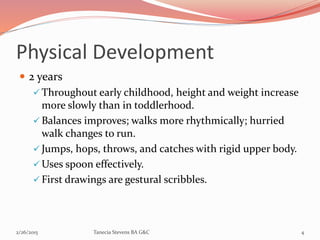
 2 years
 Throughout early childhood, height and weight increase
more slowly than in toddlerhood.
 Balances improves; walks more rhythmically; hurried
walk changes to run.
 Jumps, hops, throws, and catches with rigid upper body.
 Uses spoon effectively.
 First drawings are gestural scribbles.
2/26/2015 4Tanecia Stevens BA G&C
Balancing
2/26/2015 5Tanecia Stevens BA G&C
 3-4 years
 Running, jumping, hopping,
throwing, and catching become
better coordinated.
 Galloping and one foot skipping
appear.
 Pedals and steers tricycle.
 Uses scissors.
 Fastens and unfastens large
buttons
 Uses for effectively.
 Uses tadpole images to draw
pictures of persons
2/26/2015 6Tanecia Stevens BA G&C
 5-6 years
 Starts to lose primary teeth.
 Increase running speed, gallops more smoothly, and
engages in true skipping.
 Display more throwing and catching patterns.
 Copies some numbers and simple words.
 Draws more complex pictures.
 Uses knife to cut soft food.
 Tie shoes lace.
2/26/2015 7Tanecia Stevens BA G&C
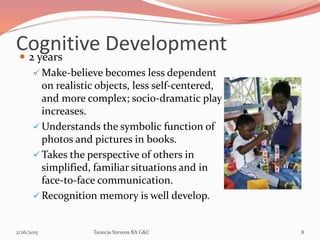
Cognitive Development 2 years
 Make-believe becomes less dependent
on realistic objects, less self-centered,
and more complex; socio-dramatic play
increases.
 Understands the symbolic function of
photos and pictures in books.
 Takes the perspective of others in
simplified, familiar situations and in
face-to-face communication.
 Recognition memory is well develop.
2/26/2015 8Tanecia Stevens BA G&C
 Shows awareness of the distinction between inner
mental and outer physical events.
 Begins to count.
2/26/2015 9Tanecia Stevens BA G&C
• 3-4 years
 Understand the symbolic functions of drawing and of
models of real-world spaces.
 Grasps conversation, reasons about transformations,
reverse thinking, and understands cause-and-effect
relationships in familiar contexts.
 Distinguishes appearance from reality.
 Sorts familiar objects into hierarchically organized
categories.
 Uses private speech to guide behavior during
challenging tasks.
 Sustained attention and planning improve.
2/26/2015 10Tanecia Stevens BA G&C
 Uses scripts to recall
familiar experiences.
 Understands that both
beliefs and desires
determine behavior.
 Knowing meaning of
numbers up to ten,
counts correctly, grasps
principle of cardinality.
2/26/2015 11Tanecia Stevens BA G&C
• 5-6 years
 Magical belief decline.
 Ability to distinguish
appearance from reality
improves.
 Attention and planning
continue to improve.
 Recognition, recall, scripted
memory, and autobiographical
memory improve.
 Understanding of false belief
strengthens.
2/26/2015 12Tanecia Stevens BA G&C
Emotional & Social Development
 2 years
Understands causes, consequences, and behavioral
signs of basic emotions.
Begins to develop self-concept and self-esteem.
Shows early signs of developing moral sense – verbal
evaluations of own and others actions and distress at
harmful behaviors.
May display proactive (instrumental) aggression.
Gender-stereotyped belief and behavior increase.
2/26/2015 13Tanecia Stevens BA G&C
2/26/2015 14Tanecia Stevens BA G&C
 3-4 years
Describes self in terms of observable characteristics
and typical emotions and attitudes.
Has several self-esteems, such as learning things in
school, making friends, and getting along with
parents,
Emotional self-regulation improves.
Experiences self-conscious emotions more often.
Relies more on language to express empathy.
Proactive aggression declines, while reactive
aggression (verbal and relational) increases.
Distinguishes truthfulness from lying.
2/26/2015 15Tanecia Stevens BA G&C
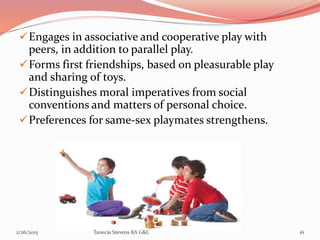
Engages in associative and cooperative play with
peers, in addition to parallel play.
Forms first friendships, based on pleasurable play
and sharing of toys.
Distinguishes moral imperatives from social
conventions and matters of personal choice.
Preferences for same-sex playmates strengthens.
2/26/2015 16Tanecia Stevens BA G&C
 5-6 years
Emotional understanding (the ability to interpret
predict, and influence others’ emotional reactions)
improves.
Empathic responding increases
Has acquired many morally relevant rules and
behaviors.
Gender-stereotyped beliefs and behavior and
preference of same-sex play mates continues to
strengthen.
Understand gender constancy.
2/26/2015 17Tanecia Stevens BA G&C
Language Development
 2 years
Vocabulary increases rapidly.
Uses a coalition of cues – perceptual and increasingly,
social and linguistic-to figure out words meanings.
Speak in simple sentences that follow basic word order
of native language.
Adds grammatical markers
Displays effective conversation skills.
2/26/2015 18Tanecia Stevens BA G&C
Children having conversation
2/26/2015 19Tanecia Stevens BA G&C
 3-4 years
Aware of some meaningful features of written
language.
Coins new words based on known words; extends
language meaning through metaphor.
Masters increasingly complex grammatical structure.
Occasion overextends grammatical rules to exceptions.
Adjust speech problem to fit the age, sex, and social
status
2/26/2015 20Tanecia Stevens BA G&C
 5-6 years
Understands that letters
and sounds are linked in
systematic ways
Uses invented spellings
By age 6, vocabulary
reaches about 10,000
words
Uses most grammatical
constructions
competently.
2/26/2015 21Tanecia Stevens BA G&C
Thank You2/26/2015 22Tanecia Stevens BA G&C

Childhood development

  • 1.
    INTERNATIONAL UNIVERSITY OFTHE CARIBBEAN BY: TANECIA STEVENS 2/26/2015 1Tanecia Stevens BA G&C
  • 2.
    Early Childhood Development What is early childhood development? 2/26/2015 2Tanecia Stevens BA G&C
  • 3.
    Early childhood development Early childhood is a stage in human development.  In psychology, the term early childhood is usually defined as the time period from the age of two until the age of six or seven years.  Play age is an unspecific designation approximately within the scope of early childhood.  There are three simultaneous development stages:  Physical  Cognitive  Emotional and Social 2/26/2015 3Tanecia Stevens BA G&C
  • 4.
    Physical Development  2years  Throughout early childhood, height and weight increase more slowly than in toddlerhood.  Balances improves; walks more rhythmically; hurried walk changes to run.  Jumps, hops, throws, and catches with rigid upper body.  Uses spoon effectively.  First drawings are gestural scribbles. 2/26/2015 4Tanecia Stevens BA G&C
  • 5.
  • 6.
     3-4 years Running, jumping, hopping, throwing, and catching become better coordinated.  Galloping and one foot skipping appear.  Pedals and steers tricycle.  Uses scissors.  Fastens and unfastens large buttons  Uses for effectively.  Uses tadpole images to draw pictures of persons 2/26/2015 6Tanecia Stevens BA G&C
  • 7.
     5-6 years Starts to lose primary teeth.  Increase running speed, gallops more smoothly, and engages in true skipping.  Display more throwing and catching patterns.  Copies some numbers and simple words.  Draws more complex pictures.  Uses knife to cut soft food.  Tie shoes lace. 2/26/2015 7Tanecia Stevens BA G&C
  • 8.
    Cognitive Development 2years  Make-believe becomes less dependent on realistic objects, less self-centered, and more complex; socio-dramatic play increases.  Understands the symbolic function of photos and pictures in books.  Takes the perspective of others in simplified, familiar situations and in face-to-face communication.  Recognition memory is well develop. 2/26/2015 8Tanecia Stevens BA G&C
  • 9.
     Shows awarenessof the distinction between inner mental and outer physical events.  Begins to count. 2/26/2015 9Tanecia Stevens BA G&C
  • 10.
    • 3-4 years Understand the symbolic functions of drawing and of models of real-world spaces.  Grasps conversation, reasons about transformations, reverse thinking, and understands cause-and-effect relationships in familiar contexts.  Distinguishes appearance from reality.  Sorts familiar objects into hierarchically organized categories.  Uses private speech to guide behavior during challenging tasks.  Sustained attention and planning improve. 2/26/2015 10Tanecia Stevens BA G&C
  • 11.
     Uses scriptsto recall familiar experiences.  Understands that both beliefs and desires determine behavior.  Knowing meaning of numbers up to ten, counts correctly, grasps principle of cardinality. 2/26/2015 11Tanecia Stevens BA G&C
  • 12.
    • 5-6 years Magical belief decline.  Ability to distinguish appearance from reality improves.  Attention and planning continue to improve.  Recognition, recall, scripted memory, and autobiographical memory improve.  Understanding of false belief strengthens. 2/26/2015 12Tanecia Stevens BA G&C
  • 13.
    Emotional & SocialDevelopment  2 years Understands causes, consequences, and behavioral signs of basic emotions. Begins to develop self-concept and self-esteem. Shows early signs of developing moral sense – verbal evaluations of own and others actions and distress at harmful behaviors. May display proactive (instrumental) aggression. Gender-stereotyped belief and behavior increase. 2/26/2015 13Tanecia Stevens BA G&C
  • 14.
  • 15.
     3-4 years Describesself in terms of observable characteristics and typical emotions and attitudes. Has several self-esteems, such as learning things in school, making friends, and getting along with parents, Emotional self-regulation improves. Experiences self-conscious emotions more often. Relies more on language to express empathy. Proactive aggression declines, while reactive aggression (verbal and relational) increases. Distinguishes truthfulness from lying. 2/26/2015 15Tanecia Stevens BA G&C
  • 16.
    Engages in associativeand cooperative play with peers, in addition to parallel play. Forms first friendships, based on pleasurable play and sharing of toys. Distinguishes moral imperatives from social conventions and matters of personal choice. Preferences for same-sex playmates strengthens. 2/26/2015 16Tanecia Stevens BA G&C
  • 17.
     5-6 years Emotionalunderstanding (the ability to interpret predict, and influence others’ emotional reactions) improves. Empathic responding increases Has acquired many morally relevant rules and behaviors. Gender-stereotyped beliefs and behavior and preference of same-sex play mates continues to strengthen. Understand gender constancy. 2/26/2015 17Tanecia Stevens BA G&C
  • 18.
    Language Development  2years Vocabulary increases rapidly. Uses a coalition of cues – perceptual and increasingly, social and linguistic-to figure out words meanings. Speak in simple sentences that follow basic word order of native language. Adds grammatical markers Displays effective conversation skills. 2/26/2015 18Tanecia Stevens BA G&C
  • 19.
  • 20.
     3-4 years Awareof some meaningful features of written language. Coins new words based on known words; extends language meaning through metaphor. Masters increasingly complex grammatical structure. Occasion overextends grammatical rules to exceptions. Adjust speech problem to fit the age, sex, and social status 2/26/2015 20Tanecia Stevens BA G&C
  • 21.
     5-6 years Understandsthat letters and sounds are linked in systematic ways Uses invented spellings By age 6, vocabulary reaches about 10,000 words Uses most grammatical constructions competently. 2/26/2015 21Tanecia Stevens BA G&C
  • 22.