@ClaudiaMegele
Senior Lecturer & Programme Leader for CPD & PQ
Middlesex University
 Most of the literature refers to ‘early
childhood’ as the period between 2 ½ to 6
with some of the (international) literature
noting 8.
 Infancy from birth to 2 ½
 Toddlers years from 1 year to 3 years
 On a piece of paper note down some of your
thoughts regarding:
 Physical changes that occur during 1 -3
 Brain developments that occur during 1-3
 Psychosocial developments that occur during 1-3
 Identity changes that occur during 1-3
 Ability to use and control their body grows by leaps and
bounds;
 Appearance changes & body proportions change
drastically;
 Body growing, bone development occurs when new bone
tissue is formed through a process of ossification;
 Generating new bone tissue, ossification is associated with
bones’ becoming harder and stronger (Kalkwarf et al.,
2007; Rauch & Schoenau, 2001);
 Vulnerable to fractures etc.
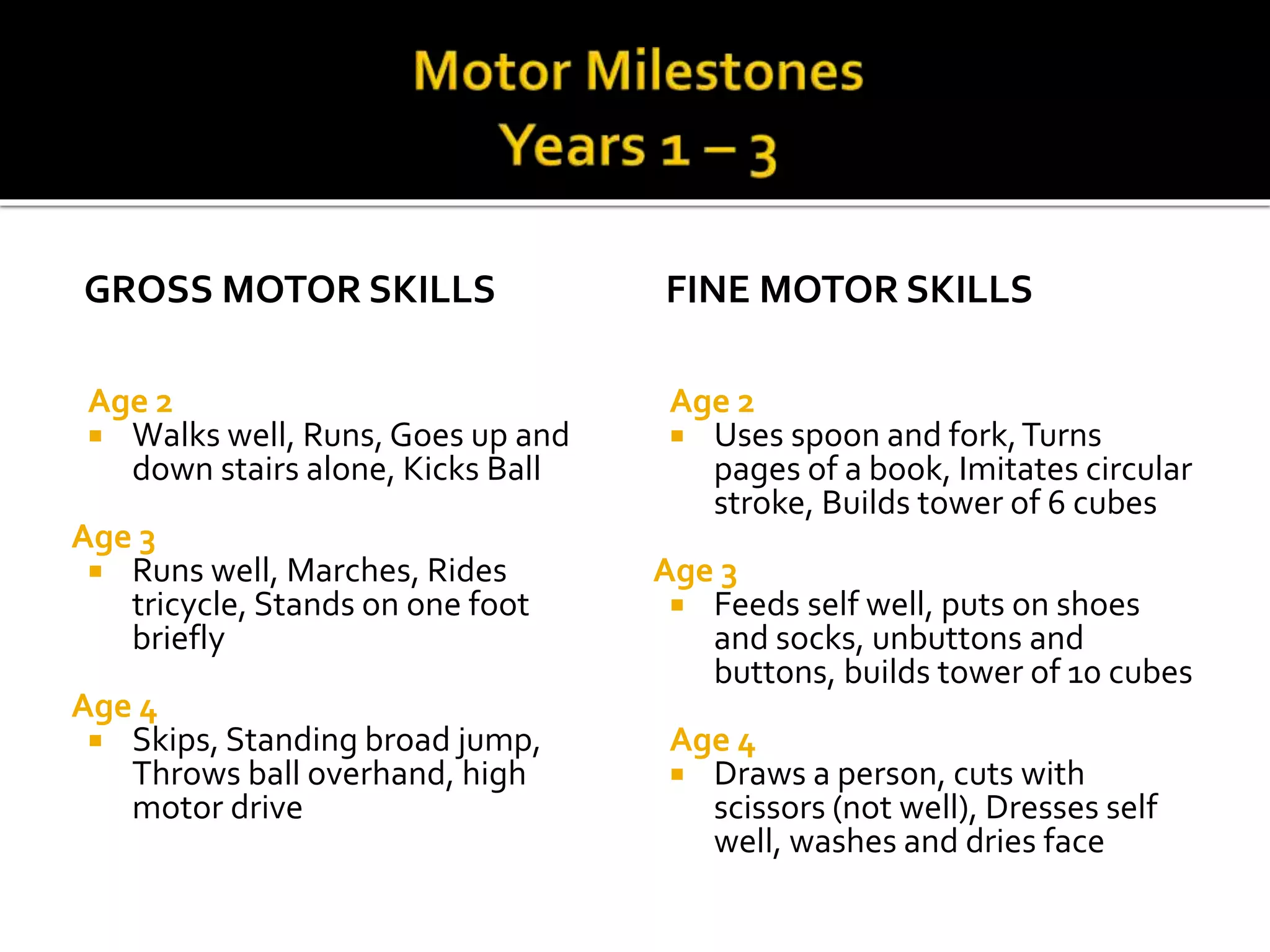
GROSS MOTOR SKILLS
Age 2
 Walks well, Runs, Goes up and
down stairs alone, Kicks Ball
Age 3
 Runs well, Marches, Rides
tricycle, Stands on one foot
briefly
Age 4
 Skips, Standing broad jump,
Throws ball overhand, high
motor drive
FINE MOTOR SKILLS
Age 2
 Uses spoon and fork,Turns
pages of a book, Imitates circular
stroke, Builds tower of 6 cubes
Age 3
 Feeds self well, puts on shoes
and socks, unbuttons and
buttons, builds tower of 10 cubes
Age 4
 Draws a person, cuts with
scissors (not well), Dresses self
well, washes and dries face
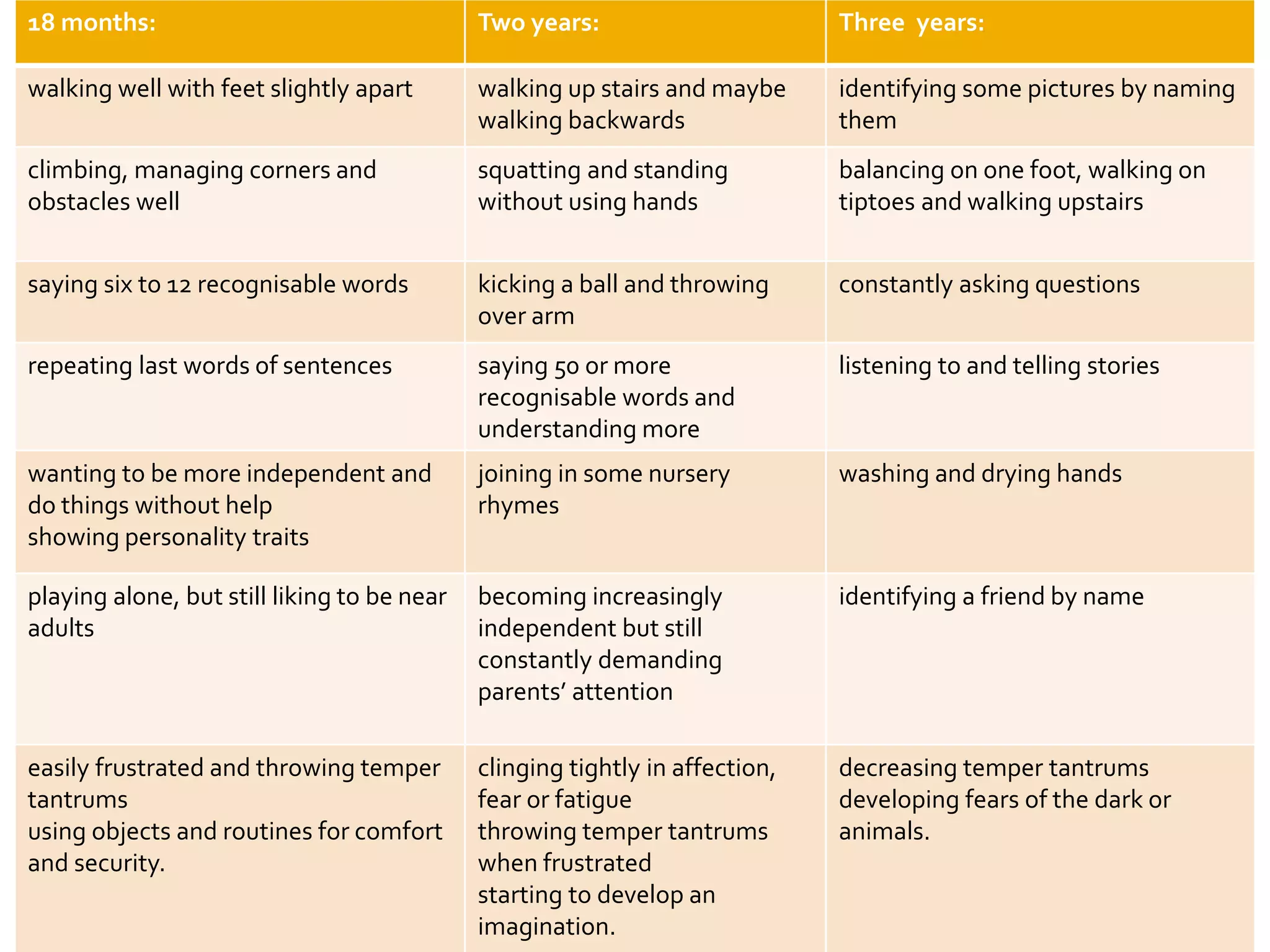
18 months: Two years: Three years:
walking well with feet slightly apart walking up stairs and maybe
walking backwards
identifying some pictures by naming
them
climbing, managing corners and
obstacles well
squatting and standing
without using hands
balancing on one foot, walking on
tiptoes and walking upstairs
saying six to 12 recognisable words kicking a ball and throwing
over arm
constantly asking questions
repeating last words of sentences saying 50 or more
recognisable words and
understanding more
listening to and telling stories
wanting to be more independent and
do things without help
showing personality traits
joining in some nursery
rhymes
washing and drying hands
playing alone, but still liking to be near
adults
becoming increasingly
independent but still
constantly demanding
parents’ attention
identifying a friend by name
easily frustrated and throwing temper
tantrums
using objects and routines for comfort
and security.
clinging tightly in affection,
fear or fatigue
throwing temper tantrums
when frustrated
starting to develop an
imagination.
decreasing temper tantrums
developing fears of the dark or
animals.
 12 to 15 hours of sleep a night (2-5 year olds) but
Acebo and colleagues found that this group slept on
average 8.7 hours of sleep a night (Acebo et al., 2005).
 Children from low-income families woke more
frequently during the night.
 Effects of early sleep deprivation on later
development have yet to be determined. Concern
that the pace of modern life may be taking its toll on
sleep patterns for young children.
 The slowed pace of physical growth during early childhood
is reflected in the decreased & at times finicky appetites
(Dubois et al., 2006)
 But, new levels of physical activity (increased motor
development & control) place significant demands on the
young body for appropriate amounts of sleep & nutrition.
 Nutritional views is influenced by culture: Eg. Breast
feeding;
 Economic status: food-secure vs. food-insecure (Fiese etc.
al., 2011);
 New problems include childhood obesity;
 After infancy, the brain’s development slows considerably
until adolescence, when it undergoes another growth
spurt.
 At the start of early childhood, the brain has attained
about 80 % of its adult weight, by age 5, it has grown to
90% of its full weight. (Huttenlocher, 1994).
 Even with these changes the brain is immature, which may
account for the limitations of children’s problem solving
abilities.
 Hippocampus and frontal cortex is still far from complete,
which contributes to children’s difficulties in keeping
several things in mind.
Picture Source: Judy DeLoache
 Children between 18 – 30 months frequently commit
scale errors;
 Failure to integrate information about the size of an
object into decisions about how to use it;
 The result amusing attempts at trying to do the
impossible;
 Judy DeLoache: ‘disconnect’ between children’s use of
visual information and their ability to plan and control
their actions;
 These actions may be due to the immature cortical
functioning of the brain.
Video of scale errors :
https://www.youtube.com/watch?v=OtngSHtz-cc
 ‘Shopping cart’; ‘RoughTest’ and ‘Mirror Self-RecognitionTest’
experiments are all aimed at examining toddlers' development of body
self-awareness.
 Shopping cart experiment based on observations by Piaget (1953/1977)
and theoretical work from Povinelli and Cant (1995).
 Child asked to push the cart to mother but in attempting to do so they
have to step on the mat which is attached to the back of the cart and
consequently their body weight prevents the cart from moving.
 Researchers examined children of 16 and 21 months both when the self
was the obstacle and when a heavy weight was the obstacle.
 Results showed toddlers develop an objective awareness of the self
during the 2nd year.
 Video of shopping cart experiment:
https://www.youtube.com/watch?v=k-rWB1jOt9s
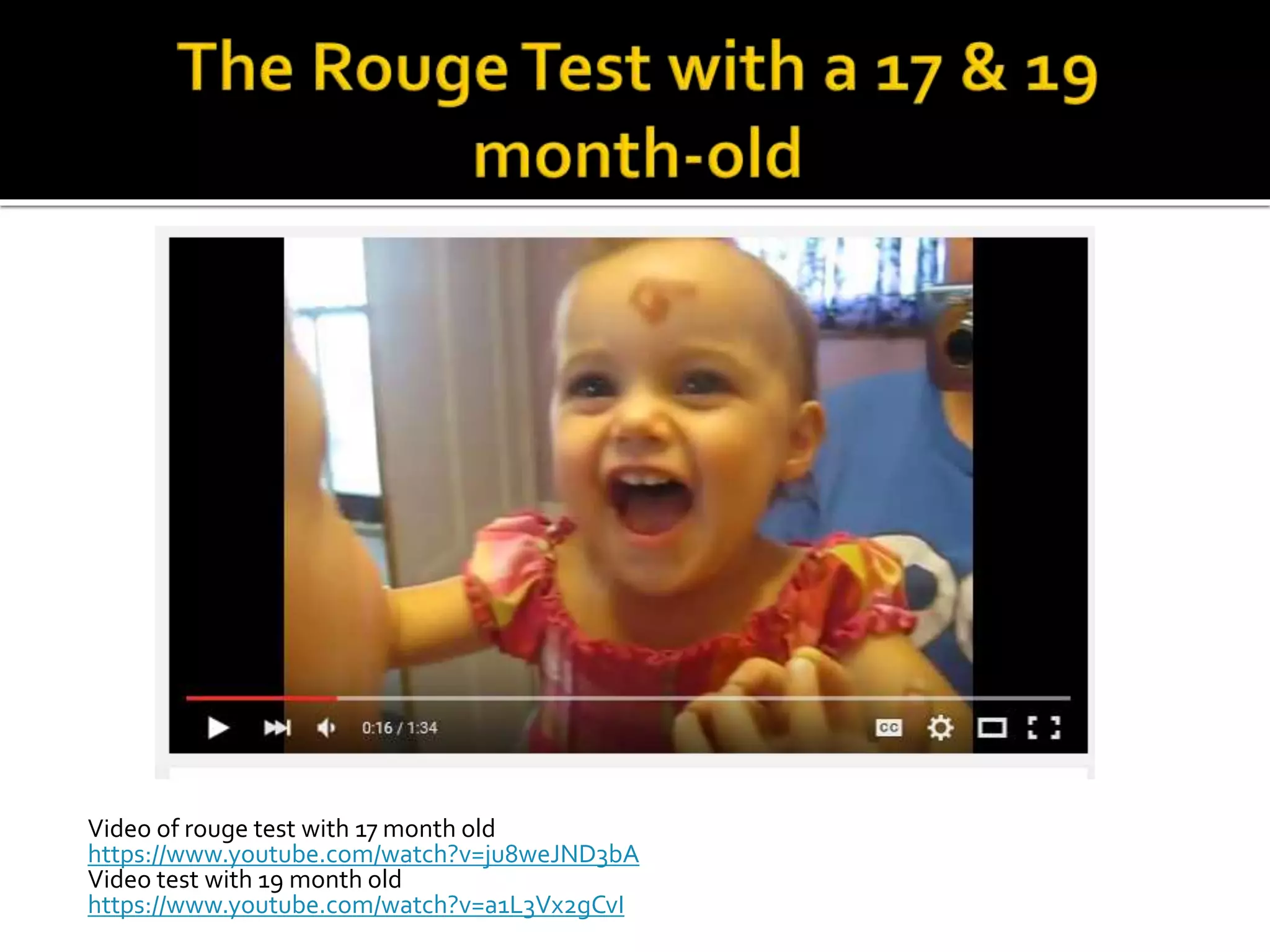
Video of rouge test with 17 month old
https://www.youtube.com/watch?v=ju8weJND3bA
Video test with 19 month old
https://www.youtube.com/watch?v=a1L3Vx2gCvI
 The mirror test is a self recognition test
designed to determine if a child is able to
recognize a reflection in a mirror as being of
him or herself.
 Operationalised through drawing a mark
somewhere on the child’s face, and recording
any reactions to the mark when seeing him or
herself in the mirror. Reactions are
categorised.
 Two-years-old, children become conscious of the
physical gender differences.
 Before 3rd birthday, children are able to label
themselves as either a boy or a girl.Can differentiate
between toys typically used by boys or girls. Usually
play with children of their own gender.
 By age four, most children have a stable sense of their
gender identity. Children learn gender role behavior—
that is, doing "things that boys do" or "things that girls
do."
“Young children can represent reality to
themselves through the use of symbols,
including mental images, words and gestures.
Objects and events no longer have to be
present to be thought about, but children often
fail to distinguish their point of view from that
of others; become easily captured by surface
appearances; and are often confused about
causal relations.” (Lightfoot,C., Cole. S., & Cole.
C.: 2013:278)
 Centration: the tendency to focus on the most salient aspect of
whatever one is trying to think about. A manifestation of this is
egocentrism.
 Egocentric: inability to see a situation from another person's point of
view.
 Confusion of appearance and reality.
 Precausal reasoning: characterized by illogical thinking and an
indifference to cause-and-effect relations.
 Symbolic Representation: to make one thing - a word or an object -
stand for something other than itself.
 Pretend (or symbolic) play: pretend to be people they are not (e.g.
superman, policeman).
 Collective monologues rather than dialogues, in each
other’s company.
 Children have difficulty taking a listener's knowledge
into account in order to communicate effectively.
 Children fail to consider both the height and width of
containers in order to compare their volumes.
 Children confuse classes with subclasses, they cannot
reliably say whether there are more wooden beads or
more brown beads in a set of all wooden beads.
 Jean Piaget used the three mountains task to
explore whether children were egocentric.
 Children act as if a Halloween mask actually
changes the identify of the person wearing it.
 Children may believe that a straight stick
partially submerged in water actually does
become bent.
 First child: Pretend there’s a monster coming,
okay?
 Second child: No. Let’s not pretend that.
 First child: Okay.Why?
 Second child: ‘Cause it’s too scary, that’s why.
(Garvey & Berndt, 1977: 107)
 Deduction: reasoning from general premises
to particular cases;
 Induction: from specific cases to general
principles;
 Children think transductively, from one
particular to another. This reasoning
precedes true causal reasoning.
 A child may think a graveyard is a cause of
death because dead people are buried there.
 The above is an example of how transductive
reasoning can lead a young child to confuse
cause and effect.
 See handout notes from (Lightfoot,C., Cole.
S., & Cole. C.: 2013:283)
 Try on parents shoes and clothing;
 Showing himself and parent that he's aware he's
growing bigger and that he wants to be like
his/her parent;
 S/He'll take over the "parenting" role by feeding
his stuffed animal a "banana" (which is actually a
yellow wooden block) or by tucking the animal
under a blanket and singing it a lullaby;
 Pretend play like this is a great example of
imitation.
 During early childhood children construct theories
about how people’s beliefs and desires shape their
actions – that is, they develop a theory of mind.
 To determine when children develop a mature theory
of mind, developmentlists use a technique called the
false – belief task.Which assesses a child’s ability to
recognize that others can have and act according to
beliefs that are contrary to the facts as the child
knows them.
Lightfoot,C., Cole. S., & Cole. C: 2013:283
 Story: once there was a little boy who liked candy.
One day he put a chocolate bar in a drawer and went
out to play for a while.While he was gone, his mother
came. She took the candy out of the drawer and put it
in the kitchen.When the little boy came back, he was
hungry and went to get his candy.
 Question: where do you think the little boy will look
for his candy?
Lightfoot,C., Cole. S., & Cole. C: 2013:283
 When 3 year olds are asked this question
what do you think the response is?
 When 5 year olds are asked this question
what do you think the response is?
 When 3 year olds are asked this question
what do you think the response is?
Answer: Kitchen
 When 5 year olds are asked this question
what do you think the response is?
Answer: Draw
“Crisis” periods for the child
Struggle for the Child’s position in relation to
family social structures
 Although many of Freud's specific hypotheses about
development have not been substantiated, his theories
remain influential.
 “When I grow up,” says (4 year old) Jimmy at the dinner
table, “I’m going to marry Mama.”
 “Jimmy’s nuts,” says the sensible voice of 8 year old Jane.
“You can’t marry Mama and anyway, what would happen
to Daddy?”
 “He’ll be old.” says (Jimmy), through a mouthful of string
beans. “And he’ll be dead.”
Then , awed by the enormity of his words, (Jimmy) adds
hastily, “But he might not be dead, and maybe I’ll mary
Marcia instead.”
Fraiberg, 1959, pp. 202 – 203
 Psychodynamic: Boys differentiate from their
mothers and identify with their fathers
through resolution of the Oedipus complex.
 Girls’ resolution of the Electra complex
results in identification with the mother, with
the attempt to differentiate from her being
short – circuited.
 Acebo. Et al. Sleep/wake patterns derived from activity monitoring and maternal report for healthy 1- to 5-year-
old children. Sleep. 2005 Dec;28(12):1568-77.
 Fraiberg, S. (1959)The MagicYears: Understanding & Handling the Problems of Early Childhood. Charles
Scribner's Sons (NY)
 Fiese BH, Winter MA, Botti JC.The ABCs of Family Mealtimes: Observational Lessons for Promoting Healthy
Outcomes for Children With Persistent Asthma. Child Development. 2011;82(1):133–145. Article. [PMC free
article] [PubMed]
 Garvey, C., & R.Berndt (1977)The organization of pretend play. JSAS Catalogue of Selected Documents in
Psychology, 1977,Vol. I, page 107, No. 1589.
 Huttenlocher, J., Newcombe, N., & Sandberg, E. (1994). The coding of spatial location in young
children. Cognitive Psychology., 27, 115-147.
 Kalkwarf HJ, Zemel BS, GilsanzV, Lapp JM, Horlick M, Obersfield S, Mahboubi S, Fan B, Frederick MM, Winer K
and Shepherd JA.The bone mineral density in childhood study: bone mineral content and density according to
age, sex, and race. JClin Endocrinol Metab 2007;92:20872099
 Lightfoot,C.,Cole. S., & Cole. C: (2013) The Development of Children. Worth Publishers
 Rauch F., Schoenau E. (2001) Changes in bone density during childhood and adolescence: an approach based on
bone’s biological organization. J Bone Miner Res 16: 597–604 [PubMed]

Lifespan development early childhood

  • 1.
    @ClaudiaMegele Senior Lecturer &Programme Leader for CPD & PQ Middlesex University
  • 2.
     Most ofthe literature refers to ‘early childhood’ as the period between 2 ½ to 6 with some of the (international) literature noting 8.  Infancy from birth to 2 ½  Toddlers years from 1 year to 3 years
  • 3.
     On apiece of paper note down some of your thoughts regarding:  Physical changes that occur during 1 -3  Brain developments that occur during 1-3  Psychosocial developments that occur during 1-3  Identity changes that occur during 1-3
  • 4.
     Ability touse and control their body grows by leaps and bounds;  Appearance changes & body proportions change drastically;  Body growing, bone development occurs when new bone tissue is formed through a process of ossification;  Generating new bone tissue, ossification is associated with bones’ becoming harder and stronger (Kalkwarf et al., 2007; Rauch & Schoenau, 2001);  Vulnerable to fractures etc.
  • 5.
    GROSS MOTOR SKILLS Age2  Walks well, Runs, Goes up and down stairs alone, Kicks Ball Age 3  Runs well, Marches, Rides tricycle, Stands on one foot briefly Age 4  Skips, Standing broad jump, Throws ball overhand, high motor drive FINE MOTOR SKILLS Age 2  Uses spoon and fork,Turns pages of a book, Imitates circular stroke, Builds tower of 6 cubes Age 3  Feeds self well, puts on shoes and socks, unbuttons and buttons, builds tower of 10 cubes Age 4  Draws a person, cuts with scissors (not well), Dresses self well, washes and dries face
  • 6.
    18 months: Twoyears: Three years: walking well with feet slightly apart walking up stairs and maybe walking backwards identifying some pictures by naming them climbing, managing corners and obstacles well squatting and standing without using hands balancing on one foot, walking on tiptoes and walking upstairs saying six to 12 recognisable words kicking a ball and throwing over arm constantly asking questions repeating last words of sentences saying 50 or more recognisable words and understanding more listening to and telling stories wanting to be more independent and do things without help showing personality traits joining in some nursery rhymes washing and drying hands playing alone, but still liking to be near adults becoming increasingly independent but still constantly demanding parents’ attention identifying a friend by name easily frustrated and throwing temper tantrums using objects and routines for comfort and security. clinging tightly in affection, fear or fatigue throwing temper tantrums when frustrated starting to develop an imagination. decreasing temper tantrums developing fears of the dark or animals.
  • 7.
     12 to15 hours of sleep a night (2-5 year olds) but Acebo and colleagues found that this group slept on average 8.7 hours of sleep a night (Acebo et al., 2005).  Children from low-income families woke more frequently during the night.  Effects of early sleep deprivation on later development have yet to be determined. Concern that the pace of modern life may be taking its toll on sleep patterns for young children.
  • 8.
     The slowedpace of physical growth during early childhood is reflected in the decreased & at times finicky appetites (Dubois et al., 2006)  But, new levels of physical activity (increased motor development & control) place significant demands on the young body for appropriate amounts of sleep & nutrition.  Nutritional views is influenced by culture: Eg. Breast feeding;  Economic status: food-secure vs. food-insecure (Fiese etc. al., 2011);  New problems include childhood obesity;
  • 9.
     After infancy,the brain’s development slows considerably until adolescence, when it undergoes another growth spurt.  At the start of early childhood, the brain has attained about 80 % of its adult weight, by age 5, it has grown to 90% of its full weight. (Huttenlocher, 1994).  Even with these changes the brain is immature, which may account for the limitations of children’s problem solving abilities.  Hippocampus and frontal cortex is still far from complete, which contributes to children’s difficulties in keeping several things in mind.
  • 10.
  • 11.
     Children between18 – 30 months frequently commit scale errors;  Failure to integrate information about the size of an object into decisions about how to use it;  The result amusing attempts at trying to do the impossible;  Judy DeLoache: ‘disconnect’ between children’s use of visual information and their ability to plan and control their actions;  These actions may be due to the immature cortical functioning of the brain.
  • 12.
    Video of scaleerrors : https://www.youtube.com/watch?v=OtngSHtz-cc
  • 13.
     ‘Shopping cart’;‘RoughTest’ and ‘Mirror Self-RecognitionTest’ experiments are all aimed at examining toddlers' development of body self-awareness.  Shopping cart experiment based on observations by Piaget (1953/1977) and theoretical work from Povinelli and Cant (1995).  Child asked to push the cart to mother but in attempting to do so they have to step on the mat which is attached to the back of the cart and consequently their body weight prevents the cart from moving.  Researchers examined children of 16 and 21 months both when the self was the obstacle and when a heavy weight was the obstacle.  Results showed toddlers develop an objective awareness of the self during the 2nd year.
  • 14.
     Video ofshopping cart experiment: https://www.youtube.com/watch?v=k-rWB1jOt9s
  • 15.
    Video of rougetest with 17 month old https://www.youtube.com/watch?v=ju8weJND3bA Video test with 19 month old https://www.youtube.com/watch?v=a1L3Vx2gCvI
  • 16.
     The mirrortest is a self recognition test designed to determine if a child is able to recognize a reflection in a mirror as being of him or herself.  Operationalised through drawing a mark somewhere on the child’s face, and recording any reactions to the mark when seeing him or herself in the mirror. Reactions are categorised.
  • 17.
     Two-years-old, childrenbecome conscious of the physical gender differences.  Before 3rd birthday, children are able to label themselves as either a boy or a girl.Can differentiate between toys typically used by boys or girls. Usually play with children of their own gender.  By age four, most children have a stable sense of their gender identity. Children learn gender role behavior— that is, doing "things that boys do" or "things that girls do."
  • 18.
    “Young children canrepresent reality to themselves through the use of symbols, including mental images, words and gestures. Objects and events no longer have to be present to be thought about, but children often fail to distinguish their point of view from that of others; become easily captured by surface appearances; and are often confused about causal relations.” (Lightfoot,C., Cole. S., & Cole. C.: 2013:278)
  • 19.
     Centration: thetendency to focus on the most salient aspect of whatever one is trying to think about. A manifestation of this is egocentrism.  Egocentric: inability to see a situation from another person's point of view.  Confusion of appearance and reality.  Precausal reasoning: characterized by illogical thinking and an indifference to cause-and-effect relations.  Symbolic Representation: to make one thing - a word or an object - stand for something other than itself.  Pretend (or symbolic) play: pretend to be people they are not (e.g. superman, policeman).
  • 20.
     Collective monologuesrather than dialogues, in each other’s company.  Children have difficulty taking a listener's knowledge into account in order to communicate effectively.  Children fail to consider both the height and width of containers in order to compare their volumes.  Children confuse classes with subclasses, they cannot reliably say whether there are more wooden beads or more brown beads in a set of all wooden beads.
  • 22.
     Jean Piagetused the three mountains task to explore whether children were egocentric.
  • 23.
     Children actas if a Halloween mask actually changes the identify of the person wearing it.  Children may believe that a straight stick partially submerged in water actually does become bent.
  • 24.
     First child:Pretend there’s a monster coming, okay?  Second child: No. Let’s not pretend that.  First child: Okay.Why?  Second child: ‘Cause it’s too scary, that’s why. (Garvey & Berndt, 1977: 107)
  • 25.
     Deduction: reasoningfrom general premises to particular cases;  Induction: from specific cases to general principles;  Children think transductively, from one particular to another. This reasoning precedes true causal reasoning.
  • 26.
     A childmay think a graveyard is a cause of death because dead people are buried there.  The above is an example of how transductive reasoning can lead a young child to confuse cause and effect.  See handout notes from (Lightfoot,C., Cole. S., & Cole. C.: 2013:283)
  • 27.
     Try onparents shoes and clothing;  Showing himself and parent that he's aware he's growing bigger and that he wants to be like his/her parent;  S/He'll take over the "parenting" role by feeding his stuffed animal a "banana" (which is actually a yellow wooden block) or by tucking the animal under a blanket and singing it a lullaby;  Pretend play like this is a great example of imitation.
  • 28.
     During earlychildhood children construct theories about how people’s beliefs and desires shape their actions – that is, they develop a theory of mind.  To determine when children develop a mature theory of mind, developmentlists use a technique called the false – belief task.Which assesses a child’s ability to recognize that others can have and act according to beliefs that are contrary to the facts as the child knows them. Lightfoot,C., Cole. S., & Cole. C: 2013:283
  • 29.
     Story: oncethere was a little boy who liked candy. One day he put a chocolate bar in a drawer and went out to play for a while.While he was gone, his mother came. She took the candy out of the drawer and put it in the kitchen.When the little boy came back, he was hungry and went to get his candy.  Question: where do you think the little boy will look for his candy? Lightfoot,C., Cole. S., & Cole. C: 2013:283
  • 30.
     When 3year olds are asked this question what do you think the response is?  When 5 year olds are asked this question what do you think the response is?
  • 31.
     When 3year olds are asked this question what do you think the response is? Answer: Kitchen  When 5 year olds are asked this question what do you think the response is? Answer: Draw
  • 33.
    “Crisis” periods forthe child Struggle for the Child’s position in relation to family social structures
  • 34.
     Although manyof Freud's specific hypotheses about development have not been substantiated, his theories remain influential.  “When I grow up,” says (4 year old) Jimmy at the dinner table, “I’m going to marry Mama.”  “Jimmy’s nuts,” says the sensible voice of 8 year old Jane. “You can’t marry Mama and anyway, what would happen to Daddy?”  “He’ll be old.” says (Jimmy), through a mouthful of string beans. “And he’ll be dead.” Then , awed by the enormity of his words, (Jimmy) adds hastily, “But he might not be dead, and maybe I’ll mary Marcia instead.” Fraiberg, 1959, pp. 202 – 203
  • 36.
     Psychodynamic: Boysdifferentiate from their mothers and identify with their fathers through resolution of the Oedipus complex.  Girls’ resolution of the Electra complex results in identification with the mother, with the attempt to differentiate from her being short – circuited.
  • 37.
     Acebo. Etal. Sleep/wake patterns derived from activity monitoring and maternal report for healthy 1- to 5-year- old children. Sleep. 2005 Dec;28(12):1568-77.  Fraiberg, S. (1959)The MagicYears: Understanding & Handling the Problems of Early Childhood. Charles Scribner's Sons (NY)  Fiese BH, Winter MA, Botti JC.The ABCs of Family Mealtimes: Observational Lessons for Promoting Healthy Outcomes for Children With Persistent Asthma. Child Development. 2011;82(1):133–145. Article. [PMC free article] [PubMed]  Garvey, C., & R.Berndt (1977)The organization of pretend play. JSAS Catalogue of Selected Documents in Psychology, 1977,Vol. I, page 107, No. 1589.  Huttenlocher, J., Newcombe, N., & Sandberg, E. (1994). The coding of spatial location in young children. Cognitive Psychology., 27, 115-147.  Kalkwarf HJ, Zemel BS, GilsanzV, Lapp JM, Horlick M, Obersfield S, Mahboubi S, Fan B, Frederick MM, Winer K and Shepherd JA.The bone mineral density in childhood study: bone mineral content and density according to age, sex, and race. JClin Endocrinol Metab 2007;92:20872099  Lightfoot,C.,Cole. S., & Cole. C: (2013) The Development of Children. Worth Publishers  Rauch F., Schoenau E. (2001) Changes in bone density during childhood and adolescence: an approach based on bone’s biological organization. J Bone Miner Res 16: 597–604 [PubMed]

Editor's Notes

  • #15 https://www.youtube.com/watch?v=k-rWB1jOt9s
  • #22 https://www.youtube.com/watch?v=3sKdDyyanGk
  • #23 https://www.youtube.com/watch?v=OinqFgsIbh0