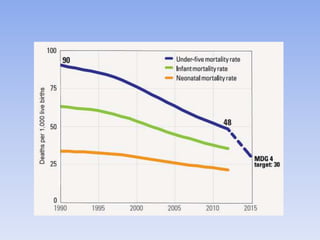
Probability of dying between
exact ages one and five
CHILDREN DYING BETWEEN BIRTH AND ONE YEAR IS
INFANT MORTALITY
CHILD MORTALITY
 About 29,000 children under the age of five die
every day, mainly from preventable causes
 7 out of 10 childhood deaths result from just 5
causes: pneumonia, diarrhoea, measles, malaria,
malnutrition. The knowledge and capacity to
prevent and treat all five causes exist.
MILLENNIUM DEVELOPMENT GOAL
The Millennium Development Goals (MDGs) are 8
International Development Goals
These were established following the Millennium
Summit of the United Nations in 2000, following the
adoption of the United Nations millennium Declaration.
United Nations committed to achieve these goals by the
year 2015.
MILLENNIUM DEVELOPMENT GOAL
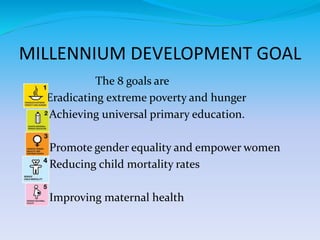
The 8 goals are
Eradicating extreme poverty and hunger
Achieving universal primary education.
Promote gender equality and empower women
Reducing child mortality rates
Improving maternal health
MILLENNIUM DEVELOPMENT GOAL
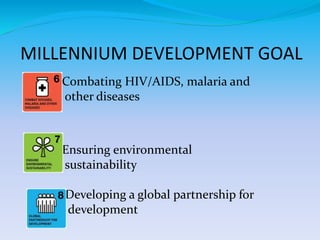
Combating HIV/AIDS, malaria and
other diseases
Ensuring environmental
sustainability
Developing a global partnership for
development
MILLENNIUM DEVELOPMENT GOAL
Goal 4 of Millennium Development is
REDUCING CHILD MORTALITY RATES
CHILD MORTALITY
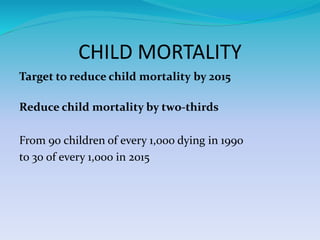
Target to reduce child mortality by 2015
Reduce child mortality by two-thirds
From 90 children of every 1,000 dying in 1990
to 30 of every 1,000 in 2015
CHILD MORTALITY
INDIA
CHILD MORTALITY
INDIA
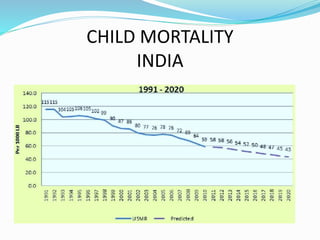
 There has been a consistent decline in Child Mortality
Rate in INDIA
 The rate of decline in current decade is higher than
in the previous
 Tamil Nadu is likely to achieve the target of Child
Mortality Rate as per the Millennium Development
Goal of UN
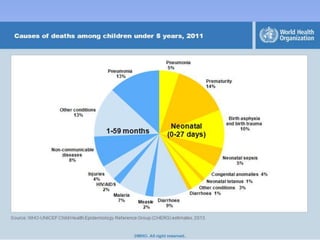
More than 70 per cent of almost 11
million child deaths every year are
attributable to seven causes
• Diarrhoea
• Malaria
• Neonatal infection
• Pneumonia
• Preterm delivery
• Lack of oxygen at birth
• Malnutrition
CHILD MORTALITY - IMPACTS
 Malnutrition has a far more powerful impact on child
mortality
 Poverty-related malnutrition is the key factor in over
half of all childhood deaths as per World Health
Organization
Malnutrition
Malnutrition is a condition, which occurs when the body
requirements for one or more nutrients are not met.
This can be either due to inadequate dietary intake of
nutrients or due to non-availability of these nutrients to
the body or due to frequent infections or other metabolic
causes
Effects of Malnutrition
Poor or no physical growth
Reduced capacity to fight infection
Muscle wasting
Loss of appetite
Low IQ and mental dullness (Less alert)
Reduced learning ability & school performance
Tiredness, inactive and irritable
Takes time to recover
Low immunity
Causes of Malnutrition
Related to Nutrition
 Discarding colostrum
 Delayed introduction of breast milk
 Delayed introduction of complementary foods
 Bottle feeding
 Low intake of food providing protein and energy
 Unhygienic feeding practices
 Not feeding the child properly during illnesses
Causes of Malnutrition
Related to Health
 Diarrhoea – Loss of nutrients
 Frequent illness – loss of appetite
 Low birth weight child
 Inadequate care of children, women and adolescents
 Lack of personal hygiene
 Lack of access to basic health services
 Poor environmental sanitation
Causes of Malnutrition
Related to Social Issues
 Early marriage
 Traditional beliefs and taboos
 Large family size
 Lack of resources (poverty and inability to buy
food)
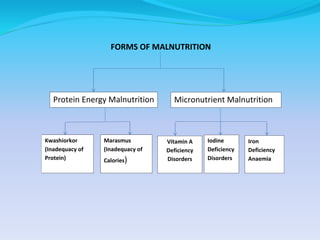
FORMS OF MALNUTRITION
Protein Energy Malnutrition
Iodine
Deficiency
Disorders
Kwashiorkor
(Inadequacy of
Protein)
Marasmus
(Inadequacy of
Calories)
Vitamin A
Deficiency
Disorders
Micronutrient Malnutrition
Iron
Deficiency
Anaemia
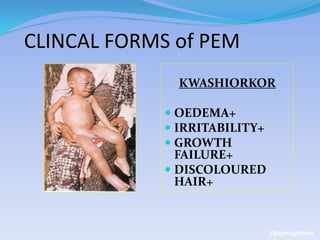
CLINCAL FORMS of PEM
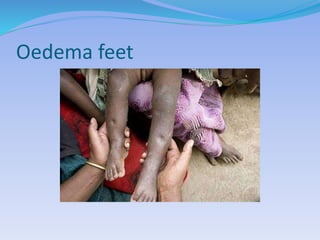
KWASHIORKOR
 OEDEMA+
 IRRITABILITY+
 GROWTH
FAILURE+
 DISCOLOURED
HAIR+
Vijayaraghavan
Oedema feet
CLINCAL FORMS of PEM
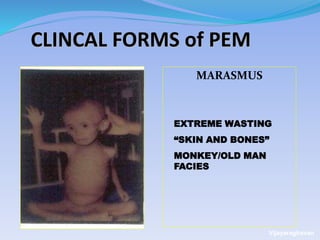
MARASMUS
EXTREME WASTING
“SKIN AND BONES”
MONKEY/OLD MAN
FACIES
Vijayaraghavan
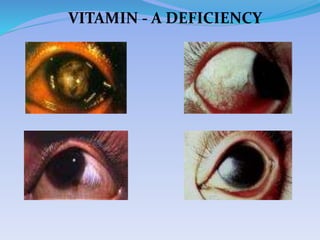
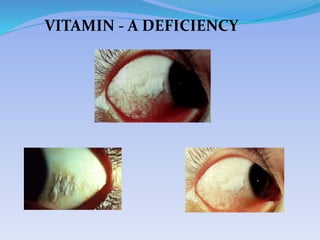
VITAMIN - A DEFICIENCY
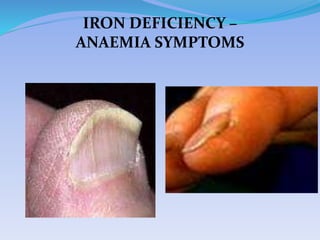
IRON DEFICIENCY –
ANAEMIA SYMPTOMS
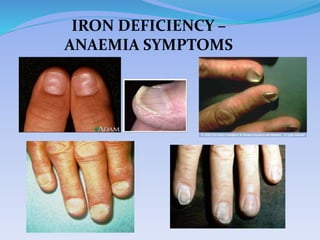
IRON DEFICIENCY –
ANAEMIA SYMPTOMS
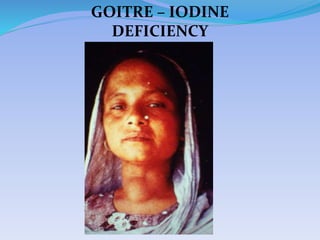
GOITRE – IODINE
DEFICIENCY
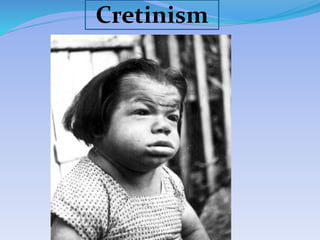
Cretinism
CHILDREN ‘AT RISK’
 Infants with low birth weights (less than 2.5 kg)
 When breastfeeding has not been established or is
insufficient from the very beginning of infant’s life
 Weight below 70% of expected weight ( grade II
malnutrition)
 Children having repeated infections especially
diarrhoea
 Birth order of five or more
 The only child born after a long married life
CHILDREN ‘AT RISK’
 One parent
 History of death of more than two siblings during
the first two years of life
 Illness of parents
 Alcoholic parents
 Twins
NUTRITION
Nutrition is the process by which human body ingests,
digests, absorbs & utilizes nutrients present in the food and
disposes of the end products.
SIX nutrients present in the food are
 Carbohydrates
 Proteins
 Fats
 Vitamins
 Minerals
 water
BALANCED DIET
Balanced diet is a diet in which all the nutrients are
present in the right amount as required by the
body
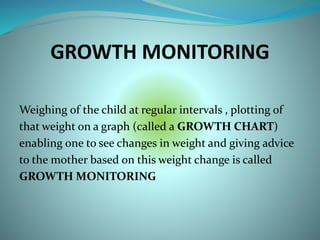
GROWTH MONITORING
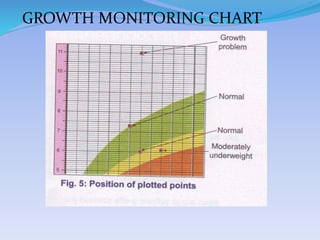
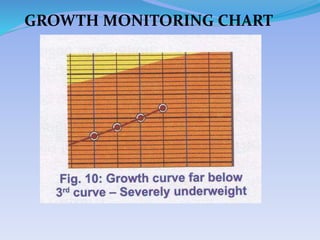
Weighing of the child at regular intervals , plotting of
that weight on a graph (called a GROWTH CHART)
enabling one to see changes in weight and giving advice
to the mother based on this weight change is called
GROWTH MONITORING
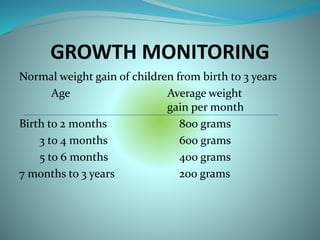
GROWTH MONITORING
Normal weight gain of children from birth to 3 years
Age Average weight
gain per month
Birth to 2 months 800 grams
3 to 4 months 600 grams
5 to 6 months 400 grams
7 months to 3 years 200 grams
GROWTH MONITORING CHART
Information Communication
Technologies (ICT)
 Information and Communication Technologies (ICTs)
can play a critical role
 The challenge: ICT and other health system
improvements need to go hand in hand
 Information Communication Technologies (ICT) to
support health
 Tracking maternal health: Health tracking systems to
ensure complete immunization of women and children and
safe deliveries with essential post natal care
 Capturing health data: System through mobile phones
that can be used for data capture and also for interacting
with pregnant women.
Information Communication
Technologies (ICT)
 Training health workers: Mobile Academy for training
health workers through an audio based training course
delivered via mobile phones
 Mapping health facilities: Resource mapping system of
all health facilities to keep abreast of existing shortfalls and
future requirements.
 GPS tracking of ambulances
 Data integration in health sector where one can get one
point information
 Global Information Infrastructure
 Telemedicine
• Every child needs a series of immunizations during first year
• Poor nutrition during pregnancy or child’s first 2 years can
slow a child’s mental and physical development
• Breastmilk alone is the only food an infant needs up to 6
months
• A child with diarrhoea needs to drink plenty of right liquids
• A child with cough, if breaths rapidly or with difficulty, the
child is in danger and require immediate treatment.
• Many illnesses can be prevented by good hygiene practices
• Malaria, which is e transmitted through mosquito bites,
can be fatal. Preventive measures to be adopted.
• AIDS is a fatal but preventable disease. HIV infected
woman transmit the disease to her child during
pregnancy, childbirth or breastfeeding.
• Many serious accidents can be prevented if parents
watch young children carefully nd keep their
environment safe.
• In developing countries, child mortality accounts for a
relatively higher proportion of all deaths
• More than half of all child deaths are associated with
malnutrition, which weakens the body’s resistance
• From the age of 6 months to 2 years, children need to be
fed 5 times a day, in addition to sustained breastfeeding
• Children need vitamin A to resist illness and prevent
visual impairments
• Iodized salt is essential to prevent learning disabilities
and delayed development in children
• During illness, children need to continue eat regularly.
After an illness, children need at least one extra meal
everyday for at least a week
• Children need iron-rich foods to protect physical and
mental abilities
Child mortality

Child mortality

  • 1.
    Probability of dyingbetween exact ages one and five CHILDREN DYING BETWEEN BIRTH AND ONE YEAR IS INFANT MORTALITY
  • 2.
    CHILD MORTALITY  About29,000 children under the age of five die every day, mainly from preventable causes  7 out of 10 childhood deaths result from just 5 causes: pneumonia, diarrhoea, measles, malaria, malnutrition. The knowledge and capacity to prevent and treat all five causes exist.
  • 3.
    MILLENNIUM DEVELOPMENT GOAL TheMillennium Development Goals (MDGs) are 8 International Development Goals These were established following the Millennium Summit of the United Nations in 2000, following the adoption of the United Nations millennium Declaration. United Nations committed to achieve these goals by the year 2015.
  • 4.
    MILLENNIUM DEVELOPMENT GOAL The8 goals are Eradicating extreme poverty and hunger Achieving universal primary education. Promote gender equality and empower women Reducing child mortality rates Improving maternal health
  • 5.
    MILLENNIUM DEVELOPMENT GOAL CombatingHIV/AIDS, malaria and other diseases Ensuring environmental sustainability Developing a global partnership for development
  • 6.
    MILLENNIUM DEVELOPMENT GOAL Goal4 of Millennium Development is REDUCING CHILD MORTALITY RATES
  • 7.
    CHILD MORTALITY Target toreduce child mortality by 2015 Reduce child mortality by two-thirds From 90 children of every 1,000 dying in 1990 to 30 of every 1,000 in 2015
  • 9.
  • 10.
    CHILD MORTALITY INDIA  Therehas been a consistent decline in Child Mortality Rate in INDIA  The rate of decline in current decade is higher than in the previous  Tamil Nadu is likely to achieve the target of Child Mortality Rate as per the Millennium Development Goal of UN
  • 11.
    More than 70per cent of almost 11 million child deaths every year are attributable to seven causes • Diarrhoea • Malaria • Neonatal infection • Pneumonia • Preterm delivery • Lack of oxygen at birth • Malnutrition
  • 13.
    CHILD MORTALITY -IMPACTS  Malnutrition has a far more powerful impact on child mortality  Poverty-related malnutrition is the key factor in over half of all childhood deaths as per World Health Organization
  • 14.
    Malnutrition Malnutrition is acondition, which occurs when the body requirements for one or more nutrients are not met. This can be either due to inadequate dietary intake of nutrients or due to non-availability of these nutrients to the body or due to frequent infections or other metabolic causes
  • 15.
    Effects of Malnutrition Pooror no physical growth Reduced capacity to fight infection Muscle wasting Loss of appetite Low IQ and mental dullness (Less alert) Reduced learning ability & school performance Tiredness, inactive and irritable Takes time to recover Low immunity
  • 16.
    Causes of Malnutrition Relatedto Nutrition  Discarding colostrum  Delayed introduction of breast milk  Delayed introduction of complementary foods  Bottle feeding  Low intake of food providing protein and energy  Unhygienic feeding practices  Not feeding the child properly during illnesses
  • 17.
    Causes of Malnutrition Relatedto Health  Diarrhoea – Loss of nutrients  Frequent illness – loss of appetite  Low birth weight child  Inadequate care of children, women and adolescents  Lack of personal hygiene  Lack of access to basic health services  Poor environmental sanitation
  • 18.
    Causes of Malnutrition Relatedto Social Issues  Early marriage  Traditional beliefs and taboos  Large family size  Lack of resources (poverty and inability to buy food)
  • 19.
    FORMS OF MALNUTRITION ProteinEnergy Malnutrition Iodine Deficiency Disorders Kwashiorkor (Inadequacy of Protein) Marasmus (Inadequacy of Calories) Vitamin A Deficiency Disorders Micronutrient Malnutrition Iron Deficiency Anaemia
  • 20.
    CLINCAL FORMS ofPEM KWASHIORKOR  OEDEMA+  IRRITABILITY+  GROWTH FAILURE+  DISCOLOURED HAIR+ Vijayaraghavan
  • 21.
  • 22.
    CLINCAL FORMS ofPEM MARASMUS EXTREME WASTING “SKIN AND BONES” MONKEY/OLD MAN FACIES Vijayaraghavan
  • 23.
    VITAMIN - ADEFICIENCY
  • 24.
    VITAMIN - ADEFICIENCY
  • 25.
  • 26.
  • 27.
  • 28.
  • 29.
    CHILDREN ‘AT RISK’ Infants with low birth weights (less than 2.5 kg)  When breastfeeding has not been established or is insufficient from the very beginning of infant’s life  Weight below 70% of expected weight ( grade II malnutrition)  Children having repeated infections especially diarrhoea  Birth order of five or more  The only child born after a long married life
  • 30.
    CHILDREN ‘AT RISK’ One parent  History of death of more than two siblings during the first two years of life  Illness of parents  Alcoholic parents  Twins
  • 31.
    NUTRITION Nutrition is theprocess by which human body ingests, digests, absorbs & utilizes nutrients present in the food and disposes of the end products. SIX nutrients present in the food are  Carbohydrates  Proteins  Fats  Vitamins  Minerals  water
  • 32.
    BALANCED DIET Balanced dietis a diet in which all the nutrients are present in the right amount as required by the body
  • 33.
    GROWTH MONITORING Weighing ofthe child at regular intervals , plotting of that weight on a graph (called a GROWTH CHART) enabling one to see changes in weight and giving advice to the mother based on this weight change is called GROWTH MONITORING
  • 34.
    GROWTH MONITORING Normal weightgain of children from birth to 3 years Age Average weight gain per month Birth to 2 months 800 grams 3 to 4 months 600 grams 5 to 6 months 400 grams 7 months to 3 years 200 grams
  • 35.
  • 36.
  • 37.
    Information Communication Technologies (ICT) Information and Communication Technologies (ICTs) can play a critical role  The challenge: ICT and other health system improvements need to go hand in hand  Information Communication Technologies (ICT) to support health  Tracking maternal health: Health tracking systems to ensure complete immunization of women and children and safe deliveries with essential post natal care  Capturing health data: System through mobile phones that can be used for data capture and also for interacting with pregnant women.
  • 38.
    Information Communication Technologies (ICT) Training health workers: Mobile Academy for training health workers through an audio based training course delivered via mobile phones  Mapping health facilities: Resource mapping system of all health facilities to keep abreast of existing shortfalls and future requirements.  GPS tracking of ambulances  Data integration in health sector where one can get one point information  Global Information Infrastructure  Telemedicine
  • 39.
    • Every childneeds a series of immunizations during first year • Poor nutrition during pregnancy or child’s first 2 years can slow a child’s mental and physical development • Breastmilk alone is the only food an infant needs up to 6 months • A child with diarrhoea needs to drink plenty of right liquids • A child with cough, if breaths rapidly or with difficulty, the child is in danger and require immediate treatment. • Many illnesses can be prevented by good hygiene practices
  • 40.
    • Malaria, whichis e transmitted through mosquito bites, can be fatal. Preventive measures to be adopted. • AIDS is a fatal but preventable disease. HIV infected woman transmit the disease to her child during pregnancy, childbirth or breastfeeding. • Many serious accidents can be prevented if parents watch young children carefully nd keep their environment safe.
  • 41.
    • In developingcountries, child mortality accounts for a relatively higher proportion of all deaths • More than half of all child deaths are associated with malnutrition, which weakens the body’s resistance • From the age of 6 months to 2 years, children need to be fed 5 times a day, in addition to sustained breastfeeding • Children need vitamin A to resist illness and prevent visual impairments
  • 42.
    • Iodized saltis essential to prevent learning disabilities and delayed development in children • During illness, children need to continue eat regularly. After an illness, children need at least one extra meal everyday for at least a week • Children need iron-rich foods to protect physical and mental abilities