Infant Mortality Rate in India
Meaning of I.M.RInfant mortality rate (IMR) is the number of newborns dying under a year of age divided by the number of live births during the year times 1000. The infant mortality rate is also called the infant death rate. It is the number of deaths that occur in the first year of life for 1000 live births.In past times, infant mortality claimed a considerable percentage of children born, but the rates have significantly declined in the West in modern times, mainly due to improvements in basic health care, though high technology .Infant mortality rate is commonly included as a part of standard of living evaluations in economics.
Comparing infant mortality ratesThe infant mortality rate correlates very strongly with and is among the best predictors of state failure.IMR is also a useful indicator of a country's level of health or development, and is a component of the physical quality of life index. But the method of calculating IMR often varies widely between countries based on the way they define a live birth and how many premature infants are born in the country.The World Health Organization (WHO) defines a live birth as any born human being who demonstrates independent signs of life, including breathing, voluntary muscle movement, or heartbeat. Many countries, however, including certain European states and Japan, only count as live births cases where an infant breathes at birth, which makes their reported IMR numbers somewhat lower and raises their rates of perinatal mortality.
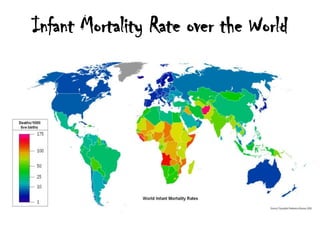
Global infant mortality trendsFor the world, and for both Less Developed Countries (LDCs) and More Developed Countries (MDCs), IMR declined significantly between 1960 and 2001. World infant mortality rate declined from 126 in 1960 to 57 in 2001.The Infant Mortality Rate for Less Developed Countries (91) was about 10 times as large as it was for More Developed Countries (8). For Least Developed Countries, the Infant Mortality Rate is 17 times as high as it is for More Developed Countries.
Infant Mortality Rate over the World
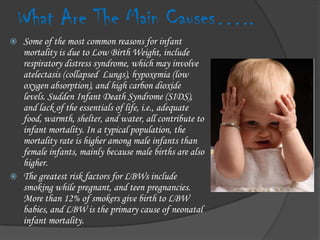
What Are The Main Causes…..Some of the most common reasons for infant mortality is due to Low Birth Weight, include respiratory distress syndrome, which may involve atelectasis (collapsed  Lungs), hypoxemia (low oxygen absorption), and high carbon dioxide levels. Sudden Infant Death Syndrome (SIDS), and lack of the essentials of life, i.e., adequate food, warmth, shelter, and water, all contribute to infant mortality. In a typical population, the mortality rate is higher among male infants than female infants, mainly because male births are also higher.The greatest risk factors for LBWs include smoking while pregnant, and teen pregnancies. More than 12% of smokers give birth to LBW babies, and LBW is the primary cause of neonatal infant mortality.
Other reasons for Infant Mortality RateInfanticide, child abuse, child abandonment, and neglect may also contribute to infant mortality. Related statistical categories:Prenatal mortality only includes deaths between the foetal    viability (22 weeks gestation) and the end of the 7th day after delivery.
Neonatal mortality only includes deaths in the first 28 days of life.
Postneonatal mortality only includes deaths after 28 days of life but before one year.
Child mortality includes deaths within the first five years after birth.
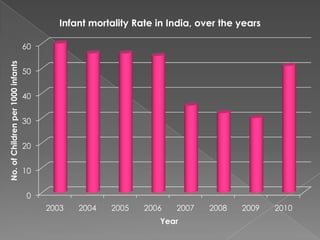
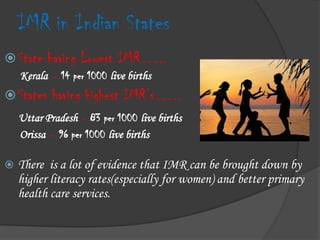
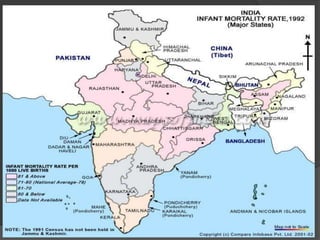
IMR in Indian StatesState having Lowest IMR….. Kerala– 14 per 1000 live birthsStates having highest IMR’s…..Uttar Pradesh  -83 per 1000 live birthsOrissa–96 per 1000 live birthsThere  is a lot of evidence that IMR can be brought down by higher literacy rates(especially for women) and better primary health care services.
Prevention of Infant MortalityAs part of its broader efforts to reduce infant mortality, the Department of Health and Human Services (HHS) agencies support a wide range of outreach and education efforts aimed at reducing behavior that increases the risks of infant mortality. These efforts include: Folic acid campaign"Back to Sleep" campaignBy Reducing mother-to-child HIV transmission By Providing Maternal and Child Health Services (MCH)

Infant mortality rate

  • 1.
  • 2.
    Meaning of I.M.RInfantmortality rate (IMR) is the number of newborns dying under a year of age divided by the number of live births during the year times 1000. The infant mortality rate is also called the infant death rate. It is the number of deaths that occur in the first year of life for 1000 live births.In past times, infant mortality claimed a considerable percentage of children born, but the rates have significantly declined in the West in modern times, mainly due to improvements in basic health care, though high technology .Infant mortality rate is commonly included as a part of standard of living evaluations in economics.
  • 3.
    Comparing infant mortalityratesThe infant mortality rate correlates very strongly with and is among the best predictors of state failure.IMR is also a useful indicator of a country's level of health or development, and is a component of the physical quality of life index. But the method of calculating IMR often varies widely between countries based on the way they define a live birth and how many premature infants are born in the country.The World Health Organization (WHO) defines a live birth as any born human being who demonstrates independent signs of life, including breathing, voluntary muscle movement, or heartbeat. Many countries, however, including certain European states and Japan, only count as live births cases where an infant breathes at birth, which makes their reported IMR numbers somewhat lower and raises their rates of perinatal mortality.
  • 4.
    Global infant mortalitytrendsFor the world, and for both Less Developed Countries (LDCs) and More Developed Countries (MDCs), IMR declined significantly between 1960 and 2001. World infant mortality rate declined from 126 in 1960 to 57 in 2001.The Infant Mortality Rate for Less Developed Countries (91) was about 10 times as large as it was for More Developed Countries (8). For Least Developed Countries, the Infant Mortality Rate is 17 times as high as it is for More Developed Countries.
  • 5.
    Infant Mortality Rateover the World
  • 6.
    What Are TheMain Causes…..Some of the most common reasons for infant mortality is due to Low Birth Weight, include respiratory distress syndrome, which may involve atelectasis (collapsed Lungs), hypoxemia (low oxygen absorption), and high carbon dioxide levels. Sudden Infant Death Syndrome (SIDS), and lack of the essentials of life, i.e., adequate food, warmth, shelter, and water, all contribute to infant mortality. In a typical population, the mortality rate is higher among male infants than female infants, mainly because male births are also higher.The greatest risk factors for LBWs include smoking while pregnant, and teen pregnancies. More than 12% of smokers give birth to LBW babies, and LBW is the primary cause of neonatal infant mortality.
  • 7.
    Other reasons forInfant Mortality RateInfanticide, child abuse, child abandonment, and neglect may also contribute to infant mortality. Related statistical categories:Prenatal mortality only includes deaths between the foetal viability (22 weeks gestation) and the end of the 7th day after delivery.
  • 8.
    Neonatal mortality onlyincludes deaths in the first 28 days of life.
  • 9.
    Postneonatal mortality onlyincludes deaths after 28 days of life but before one year.
  • 10.
    Child mortality includesdeaths within the first five years after birth.
  • 11.
    IMR in IndianStatesState having Lowest IMR….. Kerala– 14 per 1000 live birthsStates having highest IMR’s…..Uttar Pradesh -83 per 1000 live birthsOrissa–96 per 1000 live birthsThere is a lot of evidence that IMR can be brought down by higher literacy rates(especially for women) and better primary health care services.
  • 13.
    Prevention of InfantMortalityAs part of its broader efforts to reduce infant mortality, the Department of Health and Human Services (HHS) agencies support a wide range of outreach and education efforts aimed at reducing behavior that increases the risks of infant mortality. These efforts include: Folic acid campaign"Back to Sleep" campaignBy Reducing mother-to-child HIV transmission By Providing Maternal and Child Health Services (MCH)
  • 14.
    Please click insidethe red box to preview
  • 15.
    Thank youMade by:-ShivanshJaggaAnuragKarnaBenson MartinSimarKohliAnirudhMeenaMayank