UNDERNOURISHED CHILDREN
(under weight <5 years)
Outline
Understanding Undernutrition
Burden : Global
National
Various Intervention
Call for Action
It includes
-under weight for one’s age.
-too short for one’s age (stunted).
-very thin for one’s height (wasted).
-micronutrient malnutrition. ”
“ Under nutrition is defined as the outcome of
insufficient food intake & repeated infectious
diseases.
WHO ARE UNDER WEIGHT CHILDREN?
“The prevalence of underweight children under 5years of age is defined
as the percentage of children aged 0-59 months, whose weights are less
than 2 standard deviations below the median weight for age groups in
the international reference population.”
- It is an internationally recognised public health indicator for monitoring
nutritional status & health in populations.
- It’s a composite indicator influenced both by wasting & stunting. Hence
includes both acute and chronic health condition.
- Its composite nature complicates its interpretation. Recent surveys
hence include mainly Wasting & Stunting.
EPIDEMIOLOGICA
L TRIAD
HOST
ENVIRONMENTAGENT
- Age & Sex
- Low birth weight
- Prev. nutritional status
- Immunization status
- Bacteria
- Virus
-Parasites
- Physical & Chemical
hazards
- Socioeconomic Status
- Geographic area
- Cultural Factors
- Degree of Urbanization
- Availability of essential services
RISK FACTORS - UNDER NUTRITION
Socio economic •Lower socioeconomic status
•Patriarchal society
•Educational level
•Cultural influence & social taboos
Biological
•Low birth weight baby
•Poor Infant feeding practices
•Poor Maternal Health
•Diseases
Miscellaneous • Natural Calamities
• Adulteration of food & uneven
distribution of food
• Unhygienic practices & food habits
• Access & Quality of essential services
CHALLENGE OF INTER-GENERATIONAL CYCLE
OF SURVIVAL, GROWTH AND DEVELOPMENT
-Early & frequent pregnancy
-improper child spacing
-Inadequate care during
pregnancy
-Inadequate child care
-Improper feeding practices
-Burden of diseases &
infections
-Gender discrimination
-Inadequate growth & Education
-Early marriage, early &
frequent pregnancies with
improper child spacing
-Poor diet & inadequate care
during pregnancy
Low birth
weight
Under nourished,
less aware,
vulnerable
adolescent girls.
Under nourished
mothers
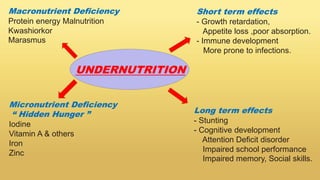
UNDERNUTRITION
Macronutrient Deficiency
Protein energy Malnutrition
Kwashiorkor
Marasmus
Micronutrient Deficiency
“ Hidden Hunger ”
Iodine
Vitamin A & others
Iron
Zinc
Short term effects
- Growth retardation,
Appetite loss ,poor absorption.
- Immune development
More prone to infections.
Long term effects
- Stunting
- Cognitive development
Attention Deficit disorder
Impaired school performance
Impaired memory, Social skills.
Under nutrition is particularly lethal in combination with
infectious diseases.
Leads to Vicious cycle of repeated infections,
reduced immunity & deteriorating nutritional status.
Under
nutrition Impaired child
development &
immunity
Infection
Disease
Energy
Loss
Decreased
Productivity
Poverty
Impaired development of
Education & Health
System
Socio-Economic +
Political instability
WORLD 12.5%
DEVELOPED WORLD 1.4% DEVELOPING WORLD 14.9%
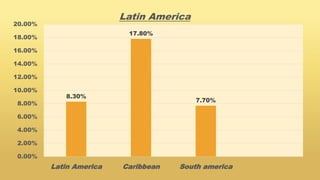
LATIN AMERICA
8.3%
AFRICA
22.9% ASIA
13.9%
Under nutrition causes more than half of all child death worldwide
8.30%
17.80%
7.70%
0.00%
2.00%
4.00%
6.00%
8.00%
10.00%
12.00%
14.00%
16.00%
18.00%
20.00%
Latin America Caribbean South america
Latin America
22.90%
2.70%
26.80%
0.00%
5.00%
10.00%
15.00%
20.00%
25.00%
30.00%
Africa North Africa Sub Saharan
Africa & it’s region
13.90%
10.10%
17.60%
7.40%
11.50%
10.90%
0.00%
2.00%
4.00%
6.00%
8.00%
10.00%
12.00%
14.00%
16.00%
18.00%
20.00%
Asia Western Southern Central Eastern South
Eastern
Asia & it’s region
THE
SOUTH
ASIAN
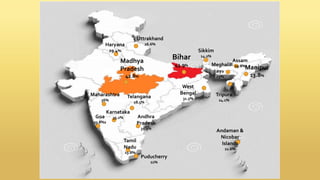
ENIGMA
>30% Indian babies
are born with Low
birth weight
compared with 16%
Sub Saharan Africa.
South Asian women
have lower status &
less decision
making power.
Hygiene/
Sanitation
standards are
below in South
Asia than Sub
Saharan Africa.
THE INDIAN PROFILE
NFHS 4 (2015-2016) <5 under weight data is taken in terms of weight for age.
Total household
291431
Total children
728532.5
Under nutrition in <5 years child
241365
(averaged as per 18 states)
33.13% of Indian children <5years is under weight.
NFHS 4 data (from 18 states)
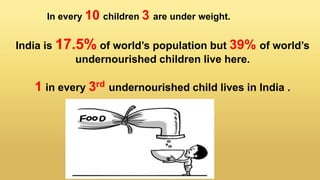
India is 17.5% of world’s population but 39% of world’s
undernourished children live here.
1 in every 3rd undernourished child lives in India .
In every 10 children 3 are under weight.
Bihar
43.9%
Uttrakhand
26.6%Haryana
29.4%
Madhya
Pradesh
42.8%
Maharashtra
36%
West
Bengal
31.5%Telangana
28.5%
Karnataka
35.2%Goa
23.8%z
Andhra
Pradesh
31.9%
Tamil
Nadu
23.8%
Andaman &
Nicobar
Islands
21.6%
Puducherry
22%
Sikkim
14.2%
Assam
29.8%
Manipur
13.8%
Tripura
24.1%
Meghal
aya
29%
Rural, 50%
Urban, 38%
Girls, 48.9%
Boys, 45.5%
0%
10%
20%
30%
40%
50%
60%
Rural Urban Girls Boys
%Prevalence % Prevalence under weight<5 INDIA
GOVERNMENT SCHEMES TO ADDRESS UNDERNUTRITION
TARGET GROUP MAJOR SCHEMES SERVICES FROM SCHEMES
Pregnant and
lactating mothers
• Integrated Child
Developmental
Scheme ICDS
• National Health
Mission
• Reproductive Child
Health RCH-II
• Janani Suraksha
Yojana JSY
• Janani Shishu
Suraksha
Karyakaram
• ICDS:-Promotion of Exclusive
Breastfeeding, Supplementary
Nutrition, Immunization, Nutritional
Education to Mothers, Preschool
Education, Health Check up &
Conditional maternity benefits.
• NHM:- Antenatal care , Iron
supplementation , Immunization,
Transportation for institutional
delivery, cash benefit, post natal
care, counselling for spacing of
children.
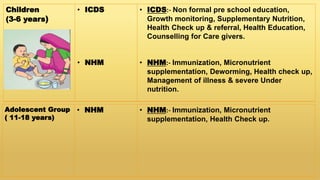
Children
( 0-3 years)
• Integrated Child
Development Scheme
• NHM
• ICDS:- Supplementary nutrition ,
Growth monitoring, Health education
of mother on child care, Promotion of
infant & young child feeding, Home
based counselling, referral & follow
up of under nourished & sick
children.
• NHM:- Home based new born care,
immunisation, micronutrient
supplementation, Deworming,
Management of childhood illness &
sever under nutrition, referral and
cash less treatment for 1st month of
life, care of Sick newborns, follow up.
Children
(3-6 years)
• ICDS
• NHM
• ICDS:- Non formal pre school education,
Growth monitoring, Supplementary Nutrition,
Health Check up & referral, Health Education,
Counselling for Care givers.
• NHM:- Immunization, Micronutrient
supplementation, Deworming, Health check up,
Management of illness & severe Under
nutrition.
Adolescent Group
( 11-18 years)
• NHM • NHM:- Immunization, Micronutrient
supplementation, Health Check up.
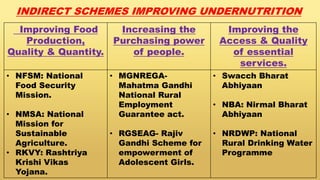
INDIRECT SCHEMES IMPROVING UNDERNUTRITION
Improving Food
Production,
Quality & Quantity.
Increasing the
Purchasing power
of people.
Improving the
Access & Quality
of essential
services.
• NFSM: National
Food Security
Mission.
• NMSA: National
Mission for
Sustainable
Agriculture.
• RKVY: Rashtriya
Krishi Vikas
Yojana.
• MGNREGA-
Mahatma Gandhi
National Rural
Employment
Guarantee act.
• RGSEAG- Rajiv
Gandhi Scheme for
empowerment of
Adolescent Girls.
• Swacch Bharat
Abhiyaan
• NBA: Nirmal Bharat
Abhiyaan
• NRDWP: National
Rural Drinking Water
Programme
FOOD FORTIFICATION
To maintain nutritional
quality of food
To increase the added
nutrition value of food
INDIA INTEGRATED FOOD FORTIFICATION
• Fortifying Complementary food with : Iron, Iodine, Zinc, Vitamin A, Vit.
B complex, Folic Acid.
• Technical & Financial Support is received from GAIN i.e. Global Alliance
for Improved Nutrition.
• Example : Salt fortifying with Iodine.
- Milk with Vitamin A/D.
- Flour , Bread , Rice with vitamin B complex.
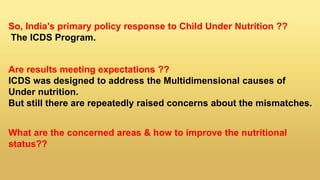
So, India’s primary policy response to Child Under Nutrition ??
The ICDS Program.
Are results meeting expectations ??
ICDS was designed to address the Multidimensional causes of
Under nutrition.
But still there are repeatedly raised concerns about the mismatches.
What are the concerned areas & how to improve the nutritional
status??
CONCERNED AREAS? HOW TO IMPROVE THE
EFFECTIVENESS
1. Poor Target Based
Approach:- Designed to
address the
Intergenerational cycle
but focused more on
older children i.e. 3-6
years.
2. Mismatch between
Original intention &
Actual implementation
i.e. focusing more on
food supplementation.
• Increase focus on Pregnant women &
Young children of age 0-3 years.
• Strengthen Nutrition & health Educational
activities.
• Targeting more on high risk groups.
• Improve the childcare behaviours.
• Counselling Parents about proper
nutritional requirements with
Demonstration Education to mothers.
3. Lack of Coordination
between AWW & ANM,
hampering the early detection
& treatment.
4. Design is standardised.
• Improve the Coordination, home visits,
outreach activities.
• Strong Monitoring & Evaluation
system.
• Introduce flexibility & Decentralise
responsibility according to local needs
& area.
• More Funding to poorer state with high
under nutrition prevalence.
• Improving the Anganwadi centre
infrastructure.
WHAT MORE CAN BE DONE?
1. Inter department Synergy
(ICDS+NHM+MGNREGA, Primary Education + RCH)
2. Community Participation in service delivery (Mahila mandal with AWW)
3. Improve Opportunity: Developing small & medium scale enterprises.
4. Increase Use of science & technology In Agriculture to enhance food
Production and Supply.
5. All these require Political , Social & Economic efforts and Commitment.
6. More active & Strengthening Mass Media Campaign.
“ We are guilty of many errors and many faults
But our worst crime is abandoning children,
Neglecting the foundation of life.
Many of things we can wait.
The Child cannot.
Right now is the time his bones are being formed ,
his blood is being made
and his senses are being developed.
To him we cannot answer tomorrow.
His name is today. ”
Gabriela Mistral.
1948
ZERO
HUNGER
CHALLENGE
“ IN THE FIGHT AGAINST MALNUTRITION, KNOWLEDGE IS POWER ”
-UNICEF

Epidemiology undernutrition

  • 1.
  • 2.
    Outline Understanding Undernutrition Burden :Global National Various Intervention Call for Action
  • 3.
    It includes -under weightfor one’s age. -too short for one’s age (stunted). -very thin for one’s height (wasted). -micronutrient malnutrition. ” “ Under nutrition is defined as the outcome of insufficient food intake & repeated infectious diseases.
  • 4.
    WHO ARE UNDERWEIGHT CHILDREN? “The prevalence of underweight children under 5years of age is defined as the percentage of children aged 0-59 months, whose weights are less than 2 standard deviations below the median weight for age groups in the international reference population.” - It is an internationally recognised public health indicator for monitoring nutritional status & health in populations. - It’s a composite indicator influenced both by wasting & stunting. Hence includes both acute and chronic health condition. - Its composite nature complicates its interpretation. Recent surveys hence include mainly Wasting & Stunting.
  • 5.
    EPIDEMIOLOGICA L TRIAD HOST ENVIRONMENTAGENT - Age& Sex - Low birth weight - Prev. nutritional status - Immunization status - Bacteria - Virus -Parasites - Physical & Chemical hazards - Socioeconomic Status - Geographic area - Cultural Factors - Degree of Urbanization - Availability of essential services
  • 6.
    RISK FACTORS -UNDER NUTRITION Socio economic •Lower socioeconomic status •Patriarchal society •Educational level •Cultural influence & social taboos Biological •Low birth weight baby •Poor Infant feeding practices •Poor Maternal Health •Diseases Miscellaneous • Natural Calamities • Adulteration of food & uneven distribution of food • Unhygienic practices & food habits • Access & Quality of essential services
  • 7.
    CHALLENGE OF INTER-GENERATIONALCYCLE OF SURVIVAL, GROWTH AND DEVELOPMENT
  • 8.
    -Early & frequentpregnancy -improper child spacing -Inadequate care during pregnancy -Inadequate child care -Improper feeding practices -Burden of diseases & infections -Gender discrimination -Inadequate growth & Education -Early marriage, early & frequent pregnancies with improper child spacing -Poor diet & inadequate care during pregnancy Low birth weight Under nourished, less aware, vulnerable adolescent girls. Under nourished mothers
  • 9.
    UNDERNUTRITION Macronutrient Deficiency Protein energyMalnutrition Kwashiorkor Marasmus Micronutrient Deficiency “ Hidden Hunger ” Iodine Vitamin A & others Iron Zinc Short term effects - Growth retardation, Appetite loss ,poor absorption. - Immune development More prone to infections. Long term effects - Stunting - Cognitive development Attention Deficit disorder Impaired school performance Impaired memory, Social skills.
  • 10.
    Under nutrition isparticularly lethal in combination with infectious diseases. Leads to Vicious cycle of repeated infections, reduced immunity & deteriorating nutritional status.
  • 11.
    Under nutrition Impaired child development& immunity Infection Disease Energy Loss Decreased Productivity Poverty Impaired development of Education & Health System Socio-Economic + Political instability
  • 12.
    WORLD 12.5% DEVELOPED WORLD1.4% DEVELOPING WORLD 14.9% LATIN AMERICA 8.3% AFRICA 22.9% ASIA 13.9% Under nutrition causes more than half of all child death worldwide
  • 13.
  • 14.
  • 15.
  • 16.
    THE SOUTH ASIAN ENIGMA >30% Indian babies areborn with Low birth weight compared with 16% Sub Saharan Africa. South Asian women have lower status & less decision making power. Hygiene/ Sanitation standards are below in South Asia than Sub Saharan Africa.
  • 17.
    THE INDIAN PROFILE NFHS4 (2015-2016) <5 under weight data is taken in terms of weight for age. Total household 291431 Total children 728532.5 Under nutrition in <5 years child 241365 (averaged as per 18 states) 33.13% of Indian children <5years is under weight. NFHS 4 data (from 18 states)
  • 18.
    India is 17.5%of world’s population but 39% of world’s undernourished children live here. 1 in every 3rd undernourished child lives in India . In every 10 children 3 are under weight.
  • 19.
  • 21.
    Rural, 50% Urban, 38% Girls,48.9% Boys, 45.5% 0% 10% 20% 30% 40% 50% 60% Rural Urban Girls Boys %Prevalence % Prevalence under weight<5 INDIA
  • 22.
    GOVERNMENT SCHEMES TOADDRESS UNDERNUTRITION TARGET GROUP MAJOR SCHEMES SERVICES FROM SCHEMES Pregnant and lactating mothers • Integrated Child Developmental Scheme ICDS • National Health Mission • Reproductive Child Health RCH-II • Janani Suraksha Yojana JSY • Janani Shishu Suraksha Karyakaram • ICDS:-Promotion of Exclusive Breastfeeding, Supplementary Nutrition, Immunization, Nutritional Education to Mothers, Preschool Education, Health Check up & Conditional maternity benefits. • NHM:- Antenatal care , Iron supplementation , Immunization, Transportation for institutional delivery, cash benefit, post natal care, counselling for spacing of children.
  • 23.
    Children ( 0-3 years) •Integrated Child Development Scheme • NHM • ICDS:- Supplementary nutrition , Growth monitoring, Health education of mother on child care, Promotion of infant & young child feeding, Home based counselling, referral & follow up of under nourished & sick children. • NHM:- Home based new born care, immunisation, micronutrient supplementation, Deworming, Management of childhood illness & sever under nutrition, referral and cash less treatment for 1st month of life, care of Sick newborns, follow up.
  • 24.
    Children (3-6 years) • ICDS •NHM • ICDS:- Non formal pre school education, Growth monitoring, Supplementary Nutrition, Health Check up & referral, Health Education, Counselling for Care givers. • NHM:- Immunization, Micronutrient supplementation, Deworming, Health check up, Management of illness & severe Under nutrition. Adolescent Group ( 11-18 years) • NHM • NHM:- Immunization, Micronutrient supplementation, Health Check up.
  • 25.
    INDIRECT SCHEMES IMPROVINGUNDERNUTRITION Improving Food Production, Quality & Quantity. Increasing the Purchasing power of people. Improving the Access & Quality of essential services. • NFSM: National Food Security Mission. • NMSA: National Mission for Sustainable Agriculture. • RKVY: Rashtriya Krishi Vikas Yojana. • MGNREGA- Mahatma Gandhi National Rural Employment Guarantee act. • RGSEAG- Rajiv Gandhi Scheme for empowerment of Adolescent Girls. • Swacch Bharat Abhiyaan • NBA: Nirmal Bharat Abhiyaan • NRDWP: National Rural Drinking Water Programme
  • 26.
    FOOD FORTIFICATION To maintainnutritional quality of food To increase the added nutrition value of food INDIA INTEGRATED FOOD FORTIFICATION • Fortifying Complementary food with : Iron, Iodine, Zinc, Vitamin A, Vit. B complex, Folic Acid. • Technical & Financial Support is received from GAIN i.e. Global Alliance for Improved Nutrition. • Example : Salt fortifying with Iodine. - Milk with Vitamin A/D. - Flour , Bread , Rice with vitamin B complex.
  • 27.
    So, India’s primarypolicy response to Child Under Nutrition ?? The ICDS Program. Are results meeting expectations ?? ICDS was designed to address the Multidimensional causes of Under nutrition. But still there are repeatedly raised concerns about the mismatches. What are the concerned areas & how to improve the nutritional status??
  • 28.
    CONCERNED AREAS? HOWTO IMPROVE THE EFFECTIVENESS 1. Poor Target Based Approach:- Designed to address the Intergenerational cycle but focused more on older children i.e. 3-6 years. 2. Mismatch between Original intention & Actual implementation i.e. focusing more on food supplementation. • Increase focus on Pregnant women & Young children of age 0-3 years. • Strengthen Nutrition & health Educational activities. • Targeting more on high risk groups. • Improve the childcare behaviours. • Counselling Parents about proper nutritional requirements with Demonstration Education to mothers.
  • 29.
    3. Lack ofCoordination between AWW & ANM, hampering the early detection & treatment. 4. Design is standardised. • Improve the Coordination, home visits, outreach activities. • Strong Monitoring & Evaluation system. • Introduce flexibility & Decentralise responsibility according to local needs & area. • More Funding to poorer state with high under nutrition prevalence. • Improving the Anganwadi centre infrastructure.
  • 30.
    WHAT MORE CANBE DONE? 1. Inter department Synergy (ICDS+NHM+MGNREGA, Primary Education + RCH) 2. Community Participation in service delivery (Mahila mandal with AWW) 3. Improve Opportunity: Developing small & medium scale enterprises. 4. Increase Use of science & technology In Agriculture to enhance food Production and Supply. 5. All these require Political , Social & Economic efforts and Commitment. 6. More active & Strengthening Mass Media Campaign.
  • 31.
    “ We areguilty of many errors and many faults But our worst crime is abandoning children, Neglecting the foundation of life. Many of things we can wait. The Child cannot. Right now is the time his bones are being formed , his blood is being made and his senses are being developed. To him we cannot answer tomorrow. His name is today. ” Gabriela Mistral. 1948
  • 32.
    ZERO HUNGER CHALLENGE “ IN THEFIGHT AGAINST MALNUTRITION, KNOWLEDGE IS POWER ” -UNICEF