Downloaded 165 times
![1. Universals state what is possible in human language and what is not.
2. They help us to understand brain and principles that govern interpersonal communication in
all cultures.
3. They help us to understand what in the human brain and social organization of everyday life
enables people to communicate through language.
Finegan (1994) also mentions some cautions to postulate language universals. First of all he says
that universals are statements to the effect that some characteristics are found in all the worlds'
languages, while the others are not found in any. This can be exemplified by the possibility of
the existence of fricatives in a sound system of a language whereas there are no languages
without voiced consonants. And another caution for the postulates is that these universal
principles must be applicable to any human language from any language family. And one should
always have in mind that languages fulfill many functions and are part of the society. Therefore
some facts about human language should derive from these functions of language. For example
if there exists 'I' and 'You' as the basic pronoun it is because of the nature of the
communication. There has to be someone talking and one listening to the other.
2.2- How do the two approaches differ from each other?
Now we are going to see how the two approaches differentiate and what the methods they use
are.
B. Comrie (1981: 1) states the that the two approaches can be contrasted on a number of
parameters and states the most important of these as follows:
The data base for research on language universals (a wide range of languages, or just a single
language.); the degree of abstractness of analysis that is required in order to state language
universals (for instance, in terms of surface syntactic structures or in terms of deep syntactic
structures); and the kinds of explanations advanced for the existence of language
universals[which was stated in section 1. previously.]
Now we are going to have a look at what kind of differences these parameters create.](https://image.slidesharecdn.com/languageuniversals-131109081602-phpapp01/85/Language-universals-4-320.jpg)
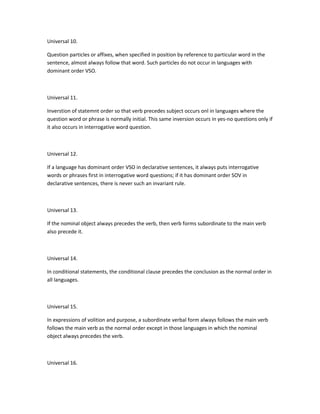
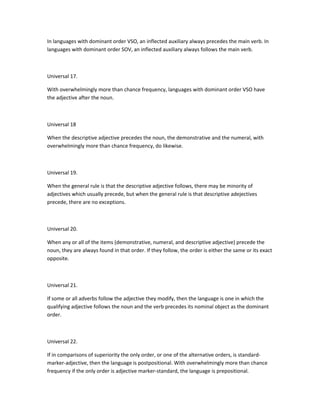
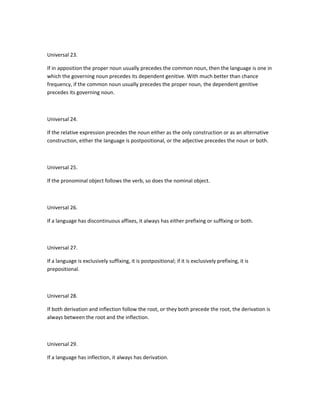
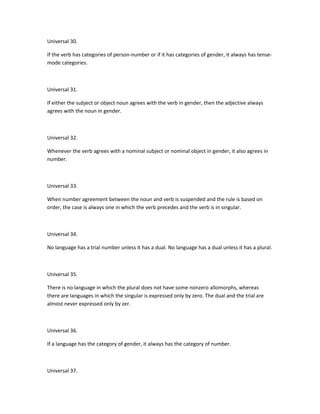
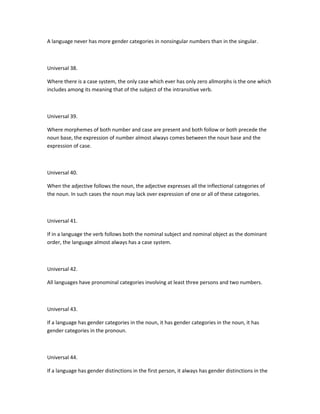
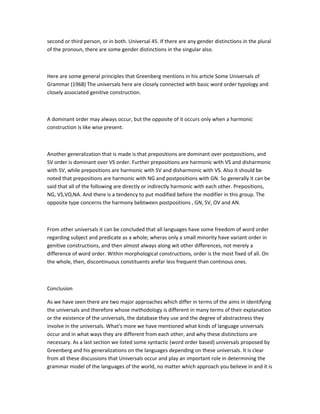


This document discusses two major approaches to language universals proposed by Noam Chomsky and Joseph Greenberg. Chomsky's approach claims that language universals are innate properties of human language that allow humans to acquire language. Greenberg examined 30 languages and found general principles that govern all human languages, like morphologic and syntactic patterns. The two approaches differ in their data sources - Chomsky focuses on one language's abstract structures while Greenberg compares surface structures across many languages. They also propose different explanations for why language universals exist, like innate properties versus reflecting human cognition and social interaction.


