name                                                                        per                date
BULGRIN Integrated Physical Science
                                      Chemthink: CHEMICAL REACTIONS
a)    Go to www.chemthink.com. Log in using your user name and password. (If you forgot, you need to WAIT
      QUIETLY until your teacher is done introducing the lesson)
b)    Scroll to CHEMICAL REACTIONS then the tutorial under the Chemical Reactions menu.
c)    Complete the tutorial. As you complete the tutorial, write down the answers to the questions below.
d)    Once you have successfully completed the tutorial and this worksheet, complete the Question Set.

CHEMICAL REACTIONS TUTORIAL QUESTIONS:
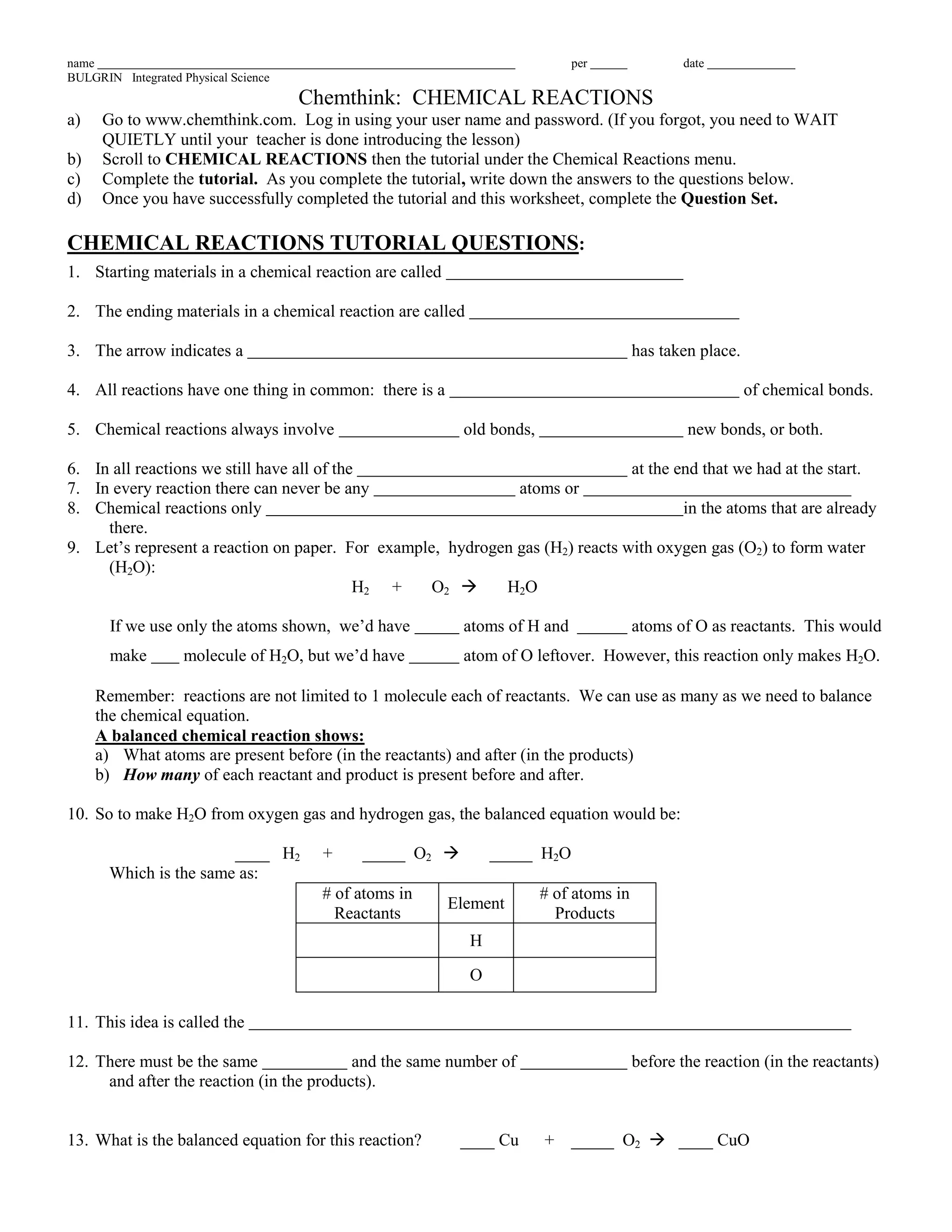
1. Starting materials in a chemical reaction are called

2. The ending materials in a chemical reaction are called

3. The arrow indicates a                                                                has taken place.

4. All reactions have one thing in common: there is a                                                      of chemical bonds.

5. Chemical reactions always involve                       old bonds,                           new bonds, or both.

6. In all reactions we still have all of the                                   at the end that we had at the start.
7. In every reaction there can never be any                   atoms or
8. Chemical reactions only                                                             in the atoms that are already
     there.
9. Let’s represent a reaction on paper. For example, hydrogen gas (H2) reacts with oxygen gas (O2) to form water
     (H2O):
                                            H2 +   O2      H2O

       If we use only the atoms shown, we’d have           atoms of H and               atoms of O as reactants. This would
       make         molecule of H2O, but we’d have         atom of O leftover. However, this reaction only makes H2O.

     Remember: reactions are not limited to 1 molecule each of reactants. We can use as many as we need to balance
     the chemical equation.
     A balanced chemical reaction shows:
     a) What atoms are present before (in the reactants) and after (in the products)
     b) How many of each reactant and product is present before and after.

10. So to make H2O from oxygen gas and hydrogen gas, the balanced equation would be:

                        ____ H2        +    _____ O2           _____ H2O
       Which is the same as:
                                       # of atoms in                    # of atoms in
                                                          Element
                                         Reactants                        Products
                                                            H

                                                            O

11. This idea is called the

12. There must be the same                and the same number of                        before the reaction (in the reactants)
     and after the reaction (in the products).


13. What is the balanced equation for this reaction?       ____ Cu      + _____ O2  ____ CuO
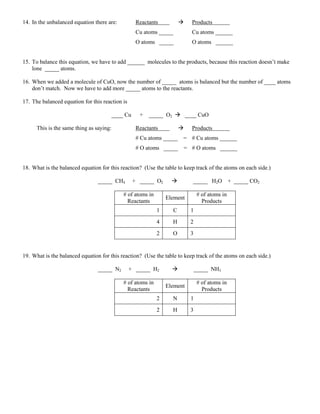
14. In the unbalanced equation there are:            Reactants             Products
                                                     Cu atoms _____         Cu atoms ______
                                                     O atoms _____          O atoms ______


15. To balance this equation, we have to add ______ molecules to the products, because this reaction doesn’t make
    lone _____ atoms.

16. When we added a molecule of CuO, now the number of _____ atoms is balanced but the number of ____ atoms
    don’t match. Now we have to add more _____ atoms to the reactants.

17. The balanced equation for this reaction is

                                          ____ Cu     + _____ O2  ____ CuO

      This is the same thing as saying:              Reactants             Products
                                                     # Cu atoms _____ = # Cu atoms ______
                                                     # O atoms _____ = # O atoms ______


18. What is the balanced equation for this reaction? (Use the table to keep track of the atoms on each side.)

                                 _____ CH4          + _____ O2             _____ H2O + _____ CO2

                                              # of atoms in                     # of atoms in
                                                                  Element
                                                Reactants                         Products
                                                              1     C       1

                                                              4     H       2

                                                              2     O       3


19. What is the balanced equation for this reaction? (Use the table to keep track of the atoms on each side.)

                                 _____ N2        + _____ H2                    _____ NH3

                                              # of atoms in                     # of atoms in
                                                                  Element
                                                Reactants                         Products
                                                              2     N       1

                                                              2     H       3
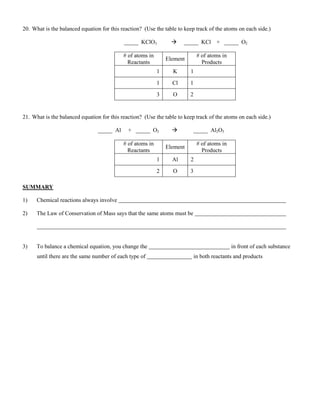
20. What is the balanced equation for this reaction? (Use the table to keep track of the atoms on each side.)

                                            _____ KClO3               _____ KCl + _____ O2

                                            # of atoms in                      # of atoms in
                                                                Element
                                              Reactants                          Products
                                                            1     K       1

                                                            1     Cl      1
                                                            3     O       2


21. What is the balanced equation for this reaction? (Use the table to keep track of the atoms on each side.)

                                 _____ Al     + _____ O2                  _____ Al2O3

                                            # of atoms in                      # of atoms in
                                                                Element
                                              Reactants                          Products
                                                            1     Al      2
                                                            2     O       3

SUMMARY

1)    Chemical reactions always involve

2)    The Law of Conservation of Mass says that the same atoms must be


3)    To balance a chemical equation, you change the                                           in front of each substance
      until there are the same number of each type of                         in both reactants and products

Chemthink: Chemical Reactions Tutorial guide

  • 1.
    name per date BULGRIN Integrated Physical Science Chemthink: CHEMICAL REACTIONS a) Go to www.chemthink.com. Log in using your user name and password. (If you forgot, you need to WAIT QUIETLY until your teacher is done introducing the lesson) b) Scroll to CHEMICAL REACTIONS then the tutorial under the Chemical Reactions menu. c) Complete the tutorial. As you complete the tutorial, write down the answers to the questions below. d) Once you have successfully completed the tutorial and this worksheet, complete the Question Set. CHEMICAL REACTIONS TUTORIAL QUESTIONS: 1. Starting materials in a chemical reaction are called 2. The ending materials in a chemical reaction are called 3. The arrow indicates a has taken place. 4. All reactions have one thing in common: there is a of chemical bonds. 5. Chemical reactions always involve old bonds, new bonds, or both. 6. In all reactions we still have all of the at the end that we had at the start. 7. In every reaction there can never be any atoms or 8. Chemical reactions only in the atoms that are already there. 9. Let’s represent a reaction on paper. For example, hydrogen gas (H2) reacts with oxygen gas (O2) to form water (H2O): H2 + O2  H2O If we use only the atoms shown, we’d have atoms of H and atoms of O as reactants. This would make molecule of H2O, but we’d have atom of O leftover. However, this reaction only makes H2O. Remember: reactions are not limited to 1 molecule each of reactants. We can use as many as we need to balance the chemical equation. A balanced chemical reaction shows: a) What atoms are present before (in the reactants) and after (in the products) b) How many of each reactant and product is present before and after. 10. So to make H2O from oxygen gas and hydrogen gas, the balanced equation would be: ____ H2 + _____ O2  _____ H2O Which is the same as: # of atoms in # of atoms in Element Reactants Products H O 11. This idea is called the 12. There must be the same and the same number of before the reaction (in the reactants) and after the reaction (in the products). 13. What is the balanced equation for this reaction? ____ Cu + _____ O2  ____ CuO
  • 2.
    14. In theunbalanced equation there are: Reactants  Products Cu atoms _____ Cu atoms ______ O atoms _____ O atoms ______ 15. To balance this equation, we have to add ______ molecules to the products, because this reaction doesn’t make lone _____ atoms. 16. When we added a molecule of CuO, now the number of _____ atoms is balanced but the number of ____ atoms don’t match. Now we have to add more _____ atoms to the reactants. 17. The balanced equation for this reaction is ____ Cu + _____ O2  ____ CuO This is the same thing as saying: Reactants  Products # Cu atoms _____ = # Cu atoms ______ # O atoms _____ = # O atoms ______ 18. What is the balanced equation for this reaction? (Use the table to keep track of the atoms on each side.) _____ CH4 + _____ O2  _____ H2O + _____ CO2 # of atoms in # of atoms in Element Reactants Products 1 C 1 4 H 2 2 O 3 19. What is the balanced equation for this reaction? (Use the table to keep track of the atoms on each side.) _____ N2 + _____ H2  _____ NH3 # of atoms in # of atoms in Element Reactants Products 2 N 1 2 H 3
  • 3.
    20. What isthe balanced equation for this reaction? (Use the table to keep track of the atoms on each side.) _____ KClO3  _____ KCl + _____ O2 # of atoms in # of atoms in Element Reactants Products 1 K 1 1 Cl 1 3 O 2 21. What is the balanced equation for this reaction? (Use the table to keep track of the atoms on each side.) _____ Al + _____ O2  _____ Al2O3 # of atoms in # of atoms in Element Reactants Products 1 Al 2 2 O 3 SUMMARY 1) Chemical reactions always involve 2) The Law of Conservation of Mass says that the same atoms must be 3) To balance a chemical equation, you change the in front of each substance until there are the same number of each type of in both reactants and products