

NEXT


        CHEMICAL REATIONS AND
             EQUATIONS

SUBMITTED BY:          SUBMITTED TO:
   KSHITIJ SHARMA             MENU MAM
PREVIOUS                                                               NEXT
               CHEMICAL REACTIONS
 You should be able to

     Classify reactions by type.

     Write a balanced molecular equation, complete ionic equation,
        and a net ionic equation.

     Balance oxidation-reduction reactions.

     Predict if a precipitate will form using the solubility rules.

     Predict products of reactions given the chemical names of the
        reactants.
PREVIOUS                                                                              NEXT
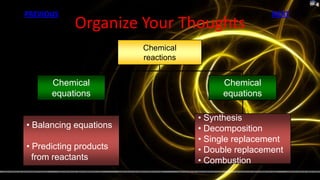
                                       Organize Your Thoughts
                                                                   Chemical
                                                                   reactions


                          Chemical                                                  Chemical
                          equations                                                 equations

                                                                               • Synthesis
           • Balancing equations                                               • Decomposition
                                                                               • Single replacement
           • Predicting products                                               • Double replacement
             from reactants                                                    • Combustion
Packard, Jacobs, Marshall, Chemistry Pearson AGS Globe, page 175
PREVIOUS                                     NEXT

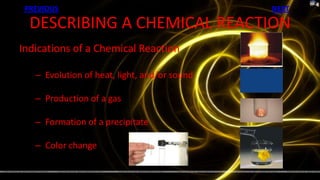
  DESCRIBING A CHEMICAL REACTION
Indications of a Chemical Reaction

   – Evolution of heat, light, and/or sound

   – Production of a gas

   – Formation of a precipitate

   – Color change
PREVIOUS                                                                            NEXT

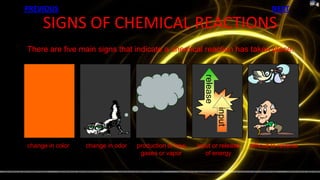
     SIGNS OF CHEMICAL REACTIONS
There are five main signs that indicate a chemical reaction has taken place:


                                                         release
                                                                   input
change in color   change in odor   production of new   input or release    difficult to reverse
                                    gases or vapor        of energy
PREVIOUS    NEXT

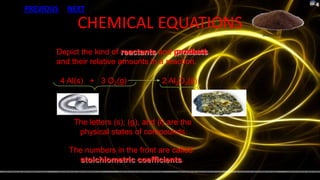
               CHEMICAL EQUATIONS                     aluminum oxide


                                          product
       Depict the kind of reactants and products
       and their relative amounts in a reaction.

           4 Al(s) + 3 O2(g)             2 Al2O3(s)


              The letters (s), (g), and (l) are the
               physical states of compounds.

             The numbers in the front are called
               stoichiometric coefficients.
PREVIOUS    NEXT

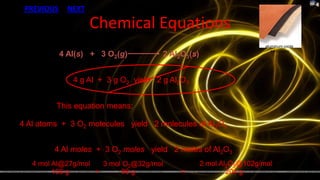
                    Chemical Equations
                                                                      aluminum oxide
                                                                         sandpaper
            4 Al(s) + 3 O2(g)          2 Al2O3(s)


               4 g Al + 3 g O2 yield 2 g Al2O3


         This equation means:

4 Al atoms + 3 O2 molecules yield 2 molecules of Al2O3
                                 or
         4 Al moles + 3 O2 moles yield 2 moles of Al2O3
   4 mol Al@27g/mol   3 mol O2@32g/mol              2 mol Al2O3@102g/mol
         108 g      +      96 g            =                204 g
PREVIOUS                                      NEXT
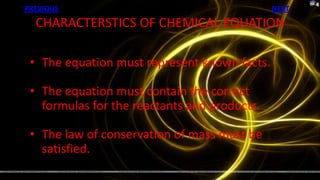
  CHARACTERSTICS OF CHEMICAL EQUATION

 • The equation must represent known facts.

 • The equation must contain the correct
   formulas for the reactants and products.

 • The law of conservation of mass must be
   satisfied.
PREVIOUS                                             NEXT
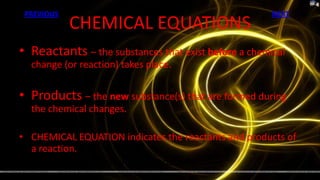
            CHEMICAL EQUATIONS
• Reactants – the substances that exist before a chemical
  change (or reaction) takes place.

• Products – the new substance(s) that are formed during
  the chemical changes.

• CHEMICAL EQUATION indicates the reactants and products of
  a reaction.
              REACTANTS  PRODUCTS
PREVIOUS                                                               NEXT
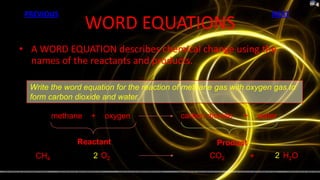
                   WORD EQUATIONS
• A WORD EQUATION describes chemical change using the
  names of the reactants and products.

  Write the word equation for the reaction of methane gas with oxygen gas to
  form carbon dioxide and water.

         methane   +   oxygen               carbon dioxide   +       water


               Reactant                               Product
   CH4        +    2 O2                             CO2          +       2 H2O
PREVIOUS                                                           NEXT

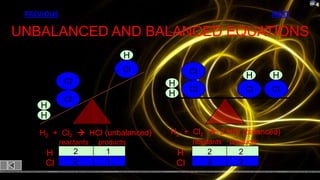
UNBALANCED AND BALANCED EQUATIONS
                               H
                               Cl            Cl
                                                               H    H
             Cl                     H
                                             Cl                Cl   Cl
                                    H
             Cl
    H
    H
    H2 + Cl2  HCl (unbalanced)     H2 + Cl2  2 HCl (balanced)
            reactants   products             reactants   products
      H           2       1             H         2        2
      Cl          2       1             Cl        2        2
PREVIOUS                                          NEXT
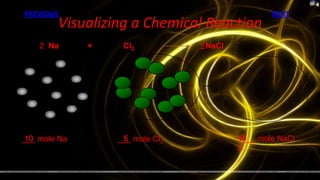
        Visualizing a Chemical Reaction
    2 Na      +    Cl2           2 NaCl


 10
___ mole Na        5
                  ___ mole Cl2            1___ mole NaCl
                                          10
                                           ?
                                          0
PREVIOUS                                                                                NEXT

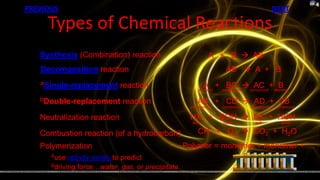
     Types of Chemical Reactions
   Synthesis (Combination) reaction                         A + B  AB
   Decomposition reaction                                          AB  A + B
   ASingle-replacement       reaction                      A + compound compound +element
                                                       element
                                                                 BC        AC        B
   BDouble-replacement       reaction                 AB + CD  AD + CB
                                                    compound      compound   compound   compound

   Neutralization reaction                         HX + BOH  BX + HOH
                                                    acid          base         salt       water

   Combustion reaction (of a hydrocarbon)             CH + O2  CO2 + H2O
   Polymerization                                 Polymer = monomer + monomer + …
      Ause  activity series to predict
      Bdriving force…water, gas, or precipitate
PREVIOUS                                          NEXT

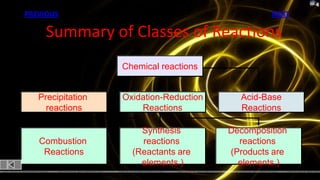
     Summary of Classes of Reactions
                   Chemical reactions


   Precipitation   Oxidation-Reduction     Acid-Base
     reactions         Reactions           Reactions

                       Synthesis         Decomposition
   Combustion          reactions           reactions
    Reactions        (Reactants are      (Products are
                       elements.)          elements.)
PREVIOUS                                          NEXT

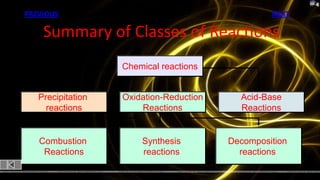
    Summary of Classes of Reactions
                   Chemical reactions


   Precipitation   Oxidation-Reduction     Acid-Base
     reactions         Reactions           Reactions


   Combustion          Synthesis         Decomposition
    Reactions          reactions           reactions
PREVIOUS                                                     NEXT
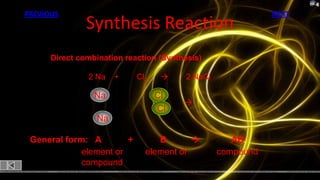
               Synthesis Reaction
      Direct combination reaction (Synthesis)

               2 Na   +     Cl2         2 NaCl

                 Na               Cl
                                        
                                  Cl
                 Na

 General form: A        +        B                  AB
             element or       element or          compound
             compound
PREVIOUS                                                       NEXT
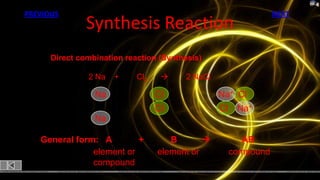
               Synthesis Reaction
      Direct combination reaction (Synthesis)

               2 Na   +     Cl2         2 NaCl

                 Na               Cl              Na+ Cl -
                                  Cl              Cl - Na+
                 Na

   General form: A        +          B                AB
               element or         element or        compound
               compound
PREVIOUS                                                   NEXT
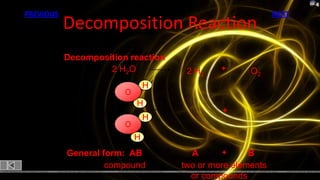
           Decomposition Reaction
           Decomposition reaction
                    2 H 2O           2 H2    +      O2
                                H
                        O
                            H
                                             +
                                H
                        O
                            H
           General form: AB           A       +     B
                    compound        two or more elements
                                      or compounds
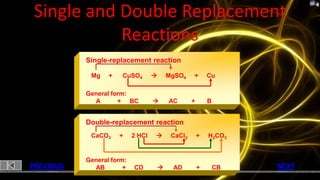
Single and Double Replacement
           Reactions
           Single-replacement reaction

            Mg    +   CuSO4               MgSO4    +       Cu

           General form:
             A       + BC                 AC       +       B


           Double-replacement reaction
            CaCO3     +    2 HCl           CaCl2       +   H2CO3


           General form:
PREVIOUS     AB        +   CD              AD          +       CB   NEXT
PREVIOUS                                                                                           NEXT

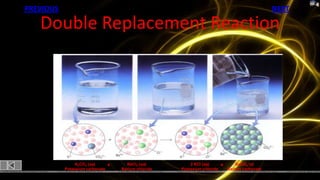
   Double Replacement Reaction


                K2CO3 (aq)       +     BaCl2 (aq)          2 KCl (aq)       +       BaCO3 (s)
           Potassium carbonate       Barium chloride   Potassium chloride       Barium carbonate
PREVIOUS                                                            NEXT

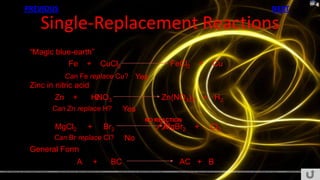
    Single-Replacement Reactions
 “Magic blue-earth”
           Fe + CuCl2                            FeCl2   +    Cu
              Can Fe replace Cu? Yes
 Zinc in nitric acid
         Zn     +       2
                       HNO3                   Zn(NO3)2       + H2
        Can Zn replace H?           Yes
                                          NO REACTION
         MgCl2       +       Br2               MgBr2     +    Cl2
        Can Br replace Cl?          No
 General Form
                 A       +     BC                   AC + B
PREVIOUS                                                                                                                                             NEXT

                        OXIDATION & REDUCTION
Oxidation, in its original sense, refers to the combination of oxygen with another substance to produce a compound called an oxide. Iron, in the presence of water,
combines with atmospheric oxygen to form a hydrated iron oxide, commonly called rust.
   Oxidation-reduction reactions combine a chemical wanting to gain electrons with a chemical willing to give up electrons. Such a reaction may be generally represented as
   follows: X·+ Y ⇄ XY· (where · represents an electron). The material that loses electrons is said to be oxidized and is called a reducing agent; the material that gains electrons
   is reduced and is called an oxidizing agent (see Chemical Reaction). The most common examples of oxidation are those reactions involving the combination of materials with
   the element oxygen, such as the rusting of iron or the burning of any combustible material in air. The equation for the burning of magnesium is: 2Mg(s) + O2(g) → 2MgO(s).
       When magnesium reacts with oxygen, each magnesium atom gives two electrons to oxygen. The positive magnesium ions (Mg 2+) then combine with negative oxygen ions (O2-)
       to form solid magnesium oxide (MgO). In this reaction, magnesium (the reducing agent) is oxidized, and oxygen (the oxidizing agent) is reduced.
      The reaction between metallic sodium and chlorine gas is an oxidation-reduction reaction that does not involve oxygen:

      This way of writing the oxidation-reduction reaction illustrates that both elements attain a noble-gas configuration (completely filled outer
      shells). Sodium loses an electron, achieving the noble gas configuration of neon, and chlorine gains an electron, achieving the noble gas
      configuration of argon.
PREVIOUS                                                                                                                                               NEXT
                                                                 CORROSION
Corrosion, partial or complete wearing away, dissolving, or softening of any substance by chemical or electrochemical reaction with its environment. The term corrosion specifically
applies to the gradual action of natural agents, such as air or salt water, on metals.
The most familiar example of corrosion is the rusting of iron, a complex chemical reaction in which the iron combines with both oxygen and water to form hydrated iron oxide. The oxide is
a solid that retains the same general form as the metal from which it is formed but, porous and somewhat bulkier, is relatively weak and brittle.
Three methods may be used to prevent the rusting of iron: (1) alloying the iron so that it will be chemically resistant to corrosion; (2) coating it with a material that will react with the
corroding substances more readily than the iron does and thus, while being consumed, protect the iron; and (3) covering it with an impermeable surface coating so that air and water
cannot reach it. The alloying method is the most satisfactory but the most expensive. A good example is stainless steel, in which chromium or chromium and nickel are alloyed with the
iron; this alloy is not only absolutely rustproof but will even resist the action of such corrosive chemicals as hot, concentrated nitric acid. The second method, protection with an active
metal, is also satisfactory, but expensive. The most common example of this method is galvanizing, in which iron is covered with zinc. In the presence of corrosive solutions, an electric
potential is set up between the iron and the zinc, causing the zinc to dissolve but protecting the iron as long as any zinc remains. The third method, protection by coating the surface with
an impermeable layer, is the least expensive and therefore the most common. It is satisfactory as long as no crack appears in the coating. Once the coating cracks, however, rusting
proceeds at least as fast as it would have with no protection. If the protective layer is an inactive metal, such as tin or chromium, an electric potential is set up, protecting the layer but
acting on the iron and causing the rusting to proceed at an accelerated rate. The most satisfactory coatings are baked enamels; the least expensive are such paints as red lead.
Some metals, such as aluminium, although very active chemically, appear not to corrode under normal atmospheric conditions. Actually, aluminium corrodes rapidly, and a thin,
continuous, transparent layer of oxide forms on the surface of the metal, protecting it from further rapid corrosion. Lead and zinc, although less active than aluminium, are protected by
similar oxide films. Copper, a comparatively inactive metal, is slowly corroded by air and water in the presence of such weak acids as carbonic acid, producing a green, porous, basic
carbonate of copper. Green corrosion products, called verdures or patina, appear on such copper alloys as brass and bronze, as well as on pure copper.
Some metals, called noble metals, are so inactive chemically that they do not suffer corrosion from the atmosphere; among them are silver, gold, and platinum. A combination of air,
water, and hydrogen sulphide will act on silver, but the amount of hydrogen sulphide normally present in the atmosphere is so small that the degree of corrosion is negligible except for
the black discoloration, called tarnishing, produced by the formation of silver sulphide.
The corrosion of metals is more of a problem than that of other materials. Glass is corroded by strongly alkaline solutions and concrete by sulphate-bearing waters. The corrosion
resistance of glass and concrete can be greatly increased by changes in their composition.
PREVIOUS                                                                                                                                               NEXT
                                                              RANCIDITY
Rancidity is the chemical decomposition of fats, oils and other lipids. There are three basic types of rancidity. Hydrolytic rancidity occurs when water splits
fatty acid chains away from the glycerol backbone in glycerines. Oxidative rancidity occurs when the double bonds of an unsaturated fatty acid react
chemically with oxygen. Microbial rancidity refers to a process in which microorganisms such as bacteria use their enzymes, including lipases, to break down
chemical structures in the fat. In each case, these chemical reactions result in undesirable doors and flavours.
       Rancidity refers to the spoilage of a food in such a way that it becomes undesirable (and usually unsafe) for consumption. When people say that a food has "gone bad," what they
       're usually talking about is rancidity. Most of the time, but not always, rancidity can change the doors or flavours of a food in such a way that it becomes very unpleasant to smell
       or taste.
PREVIOUS

Chemical equation & reactions

  • 1.
    NEXT CHEMICAL REATIONS AND EQUATIONS SUBMITTED BY: SUBMITTED TO: KSHITIJ SHARMA MENU MAM
  • 2.
    PREVIOUS NEXT CHEMICAL REACTIONS You should be able to Classify reactions by type. Write a balanced molecular equation, complete ionic equation, and a net ionic equation. Balance oxidation-reduction reactions. Predict if a precipitate will form using the solubility rules. Predict products of reactions given the chemical names of the reactants.
  • 3.
    PREVIOUS NEXT Organize Your Thoughts Chemical reactions Chemical Chemical equations equations • Synthesis • Balancing equations • Decomposition • Single replacement • Predicting products • Double replacement from reactants • Combustion Packard, Jacobs, Marshall, Chemistry Pearson AGS Globe, page 175
  • 4.
    PREVIOUS NEXT DESCRIBING A CHEMICAL REACTION Indications of a Chemical Reaction – Evolution of heat, light, and/or sound – Production of a gas – Formation of a precipitate – Color change
  • 5.
    PREVIOUS NEXT SIGNS OF CHEMICAL REACTIONS There are five main signs that indicate a chemical reaction has taken place: release input change in color change in odor production of new input or release difficult to reverse gases or vapor of energy
  • 6.
    PREVIOUS NEXT CHEMICAL EQUATIONS aluminum oxide product Depict the kind of reactants and products and their relative amounts in a reaction. 4 Al(s) + 3 O2(g) 2 Al2O3(s) The letters (s), (g), and (l) are the physical states of compounds. The numbers in the front are called stoichiometric coefficients.
  • 7.
    PREVIOUS NEXT Chemical Equations aluminum oxide sandpaper 4 Al(s) + 3 O2(g) 2 Al2O3(s) 4 g Al + 3 g O2 yield 2 g Al2O3 This equation means: 4 Al atoms + 3 O2 molecules yield 2 molecules of Al2O3 or 4 Al moles + 3 O2 moles yield 2 moles of Al2O3 4 mol Al@27g/mol 3 mol O2@32g/mol 2 mol Al2O3@102g/mol 108 g + 96 g = 204 g
  • 8.
    PREVIOUS NEXT CHARACTERSTICS OF CHEMICAL EQUATION • The equation must represent known facts. • The equation must contain the correct formulas for the reactants and products. • The law of conservation of mass must be satisfied.
  • 9.
    PREVIOUS NEXT CHEMICAL EQUATIONS • Reactants – the substances that exist before a chemical change (or reaction) takes place. • Products – the new substance(s) that are formed during the chemical changes. • CHEMICAL EQUATION indicates the reactants and products of a reaction. REACTANTS  PRODUCTS
  • 10.
    PREVIOUS NEXT WORD EQUATIONS • A WORD EQUATION describes chemical change using the names of the reactants and products. Write the word equation for the reaction of methane gas with oxygen gas to form carbon dioxide and water. methane + oxygen carbon dioxide + water Reactant Product CH4 + 2 O2 CO2 + 2 H2O
  • 11.
    PREVIOUS NEXT UNBALANCED AND BALANCED EQUATIONS H Cl Cl H H Cl H Cl Cl Cl H Cl H H H2 + Cl2  HCl (unbalanced) H2 + Cl2  2 HCl (balanced) reactants products reactants products H 2 1 H 2 2 Cl 2 1 Cl 2 2
  • 12.
    PREVIOUS NEXT Visualizing a Chemical Reaction 2 Na + Cl2 2 NaCl 10 ___ mole Na 5 ___ mole Cl2 1___ mole NaCl 10 ? 0
  • 13.
    PREVIOUS NEXT Types of Chemical Reactions Synthesis (Combination) reaction A + B  AB Decomposition reaction AB  A + B ASingle-replacement reaction A + compound compound +element element BC AC B BDouble-replacement reaction AB + CD  AD + CB compound compound compound compound Neutralization reaction HX + BOH  BX + HOH acid base salt water Combustion reaction (of a hydrocarbon) CH + O2  CO2 + H2O Polymerization Polymer = monomer + monomer + … Ause activity series to predict Bdriving force…water, gas, or precipitate
  • 14.
    PREVIOUS NEXT Summary of Classes of Reactions Chemical reactions Precipitation Oxidation-Reduction Acid-Base reactions Reactions Reactions Synthesis Decomposition Combustion reactions reactions Reactions (Reactants are (Products are elements.) elements.)
  • 15.
    PREVIOUS NEXT Summary of Classes of Reactions Chemical reactions Precipitation Oxidation-Reduction Acid-Base reactions Reactions Reactions Combustion Synthesis Decomposition Reactions reactions reactions
  • 16.
    PREVIOUS NEXT Synthesis Reaction Direct combination reaction (Synthesis) 2 Na + Cl2  2 NaCl Na Cl  Cl Na General form: A + B  AB element or element or compound compound
  • 17.
    PREVIOUS NEXT Synthesis Reaction Direct combination reaction (Synthesis) 2 Na + Cl2  2 NaCl Na Cl Na+ Cl - Cl Cl - Na+ Na General form: A + B  AB element or element or compound compound
  • 18.
    PREVIOUS NEXT Decomposition Reaction Decomposition reaction 2 H 2O 2 H2 + O2 H O H + H O H General form: AB A + B compound two or more elements or compounds
  • 19.
    Single and DoubleReplacement Reactions Single-replacement reaction Mg + CuSO4  MgSO4 + Cu General form: A + BC  AC + B Double-replacement reaction CaCO3 + 2 HCl  CaCl2 + H2CO3 General form: PREVIOUS AB + CD  AD + CB NEXT
  • 20.
    PREVIOUS NEXT Double Replacement Reaction K2CO3 (aq) + BaCl2 (aq) 2 KCl (aq) + BaCO3 (s) Potassium carbonate Barium chloride Potassium chloride Barium carbonate
  • 21.
    PREVIOUS NEXT Single-Replacement Reactions “Magic blue-earth” Fe + CuCl2 FeCl2 + Cu Can Fe replace Cu? Yes Zinc in nitric acid Zn + 2 HNO3 Zn(NO3)2 + H2 Can Zn replace H? Yes NO REACTION MgCl2 + Br2 MgBr2 + Cl2 Can Br replace Cl? No General Form A + BC AC + B
  • 22.
    PREVIOUS NEXT OXIDATION & REDUCTION Oxidation, in its original sense, refers to the combination of oxygen with another substance to produce a compound called an oxide. Iron, in the presence of water, combines with atmospheric oxygen to form a hydrated iron oxide, commonly called rust. Oxidation-reduction reactions combine a chemical wanting to gain electrons with a chemical willing to give up electrons. Such a reaction may be generally represented as follows: X·+ Y ⇄ XY· (where · represents an electron). The material that loses electrons is said to be oxidized and is called a reducing agent; the material that gains electrons is reduced and is called an oxidizing agent (see Chemical Reaction). The most common examples of oxidation are those reactions involving the combination of materials with the element oxygen, such as the rusting of iron or the burning of any combustible material in air. The equation for the burning of magnesium is: 2Mg(s) + O2(g) → 2MgO(s). When magnesium reacts with oxygen, each magnesium atom gives two electrons to oxygen. The positive magnesium ions (Mg 2+) then combine with negative oxygen ions (O2-) to form solid magnesium oxide (MgO). In this reaction, magnesium (the reducing agent) is oxidized, and oxygen (the oxidizing agent) is reduced. The reaction between metallic sodium and chlorine gas is an oxidation-reduction reaction that does not involve oxygen: This way of writing the oxidation-reduction reaction illustrates that both elements attain a noble-gas configuration (completely filled outer shells). Sodium loses an electron, achieving the noble gas configuration of neon, and chlorine gains an electron, achieving the noble gas configuration of argon.
  • 23.
    PREVIOUS NEXT CORROSION Corrosion, partial or complete wearing away, dissolving, or softening of any substance by chemical or electrochemical reaction with its environment. The term corrosion specifically applies to the gradual action of natural agents, such as air or salt water, on metals. The most familiar example of corrosion is the rusting of iron, a complex chemical reaction in which the iron combines with both oxygen and water to form hydrated iron oxide. The oxide is a solid that retains the same general form as the metal from which it is formed but, porous and somewhat bulkier, is relatively weak and brittle. Three methods may be used to prevent the rusting of iron: (1) alloying the iron so that it will be chemically resistant to corrosion; (2) coating it with a material that will react with the corroding substances more readily than the iron does and thus, while being consumed, protect the iron; and (3) covering it with an impermeable surface coating so that air and water cannot reach it. The alloying method is the most satisfactory but the most expensive. A good example is stainless steel, in which chromium or chromium and nickel are alloyed with the iron; this alloy is not only absolutely rustproof but will even resist the action of such corrosive chemicals as hot, concentrated nitric acid. The second method, protection with an active metal, is also satisfactory, but expensive. The most common example of this method is galvanizing, in which iron is covered with zinc. In the presence of corrosive solutions, an electric potential is set up between the iron and the zinc, causing the zinc to dissolve but protecting the iron as long as any zinc remains. The third method, protection by coating the surface with an impermeable layer, is the least expensive and therefore the most common. It is satisfactory as long as no crack appears in the coating. Once the coating cracks, however, rusting proceeds at least as fast as it would have with no protection. If the protective layer is an inactive metal, such as tin or chromium, an electric potential is set up, protecting the layer but acting on the iron and causing the rusting to proceed at an accelerated rate. The most satisfactory coatings are baked enamels; the least expensive are such paints as red lead. Some metals, such as aluminium, although very active chemically, appear not to corrode under normal atmospheric conditions. Actually, aluminium corrodes rapidly, and a thin, continuous, transparent layer of oxide forms on the surface of the metal, protecting it from further rapid corrosion. Lead and zinc, although less active than aluminium, are protected by similar oxide films. Copper, a comparatively inactive metal, is slowly corroded by air and water in the presence of such weak acids as carbonic acid, producing a green, porous, basic carbonate of copper. Green corrosion products, called verdures or patina, appear on such copper alloys as brass and bronze, as well as on pure copper. Some metals, called noble metals, are so inactive chemically that they do not suffer corrosion from the atmosphere; among them are silver, gold, and platinum. A combination of air, water, and hydrogen sulphide will act on silver, but the amount of hydrogen sulphide normally present in the atmosphere is so small that the degree of corrosion is negligible except for the black discoloration, called tarnishing, produced by the formation of silver sulphide. The corrosion of metals is more of a problem than that of other materials. Glass is corroded by strongly alkaline solutions and concrete by sulphate-bearing waters. The corrosion resistance of glass and concrete can be greatly increased by changes in their composition.
  • 24.
    PREVIOUS NEXT RANCIDITY Rancidity is the chemical decomposition of fats, oils and other lipids. There are three basic types of rancidity. Hydrolytic rancidity occurs when water splits fatty acid chains away from the glycerol backbone in glycerines. Oxidative rancidity occurs when the double bonds of an unsaturated fatty acid react chemically with oxygen. Microbial rancidity refers to a process in which microorganisms such as bacteria use their enzymes, including lipases, to break down chemical structures in the fat. In each case, these chemical reactions result in undesirable doors and flavours. Rancidity refers to the spoilage of a food in such a way that it becomes undesirable (and usually unsafe) for consumption. When people say that a food has "gone bad," what they 're usually talking about is rancidity. Most of the time, but not always, rancidity can change the doors or flavours of a food in such a way that it becomes very unpleasant to smell or taste.
  • 25.