ROLE OF CHEMOTHERAPY &
RADIOTHERAPY IN CARCINOMA
BLADDER
Dept of Urology
Govt Royapettah Hospital and Kilpauk Medical College
Chennai
1
Moderators:
Professors:
• Prof. Dr. G. Sivasankar, M.S., M.Ch.,
• Prof. Dr. A. Senthilvel, M.S., M.Ch.,
Asst Professors:
• Dr. J. Sivabalan, M.S., M.Ch.,
• Dr. R. Bhargavi, M.S., M.Ch.,
• Dr. S. Raju, M.S., M.Ch.,
• Dr. K. Muthurathinam, M.S., M.Ch.,
• Dr. D. Tamilselvan, M.S., M.Ch.,
• Dr. K. Senthilkumar, M.S., M.Ch.
Dept of Urology, GRH and KMC, Chennai. 2
OPTIONS
• Chemotherapy-neoadjuvant&adjuvant
• Radiotherapy-preoperative& postoperative
• Bladder Conservation Protocol
3
Dept of Urology, GRH and KMC, Chennai.
Peri-operative chemotherapy
Rationale
• Deaths from TCC are generally not local events
• Patients die as a result of metastatic disease
• Local interventions will not deal with micro-
metastatic disease
• Systemic therapy must be given to eradicate
micrometastatic disease in order to improve
cure rates
4
Dept of Urology, GRH and KMC, Chennai.
Adjuvant Chemotherapy
• Basis : 50% develop distant mets despite
adequate local therapy within 2 years
• Survival advantage seen in locally advanced
disease & limited nodal metastatic disease
(Skinner 1991, Stockle 1992)
• Does not delay local treatment
5
Dept of Urology, GRH and KMC, Chennai.
WHEN is Adjuvant therapy indicated
presence of High Risk Factors After Cystectomy
• Deep muscle invasion or extravesical spread
• Prostate or adjacent organ involvement
• High grade or undiff histology
• Lymphatic or vascular emboli
• Lymph node metastases
• +ve surgical cut margins (Residual)
6
Dept of Urology, GRH and KMC, Chennai.
• Stockle et al noted a difference was noted in
the 80 patients who received adjuvant
chemotherapy as compared with 86 patients
who underwent cystectomy alone.
• adjuvant chemotherapy was most effective in
patients with N-1 disease
• usefulness of adjuvant chemotherapy is now
being tested in an EORTC/intergroup trial
7
Dept of Urology, GRH and KMC, Chennai.
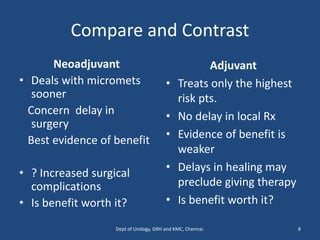
Compare and Contrast
Neoadjuvant
• Deals with micromets
sooner
Concern delay in
surgery
Best evidence of benefit
• ? Increased surgical
complications
• Is benefit worth it?
Adjuvant
• Treats only the highest
risk pts.
• No delay in local Rx
• Evidence of benefit is
weaker
• Delays in healing may
preclude giving therapy
• Is benefit worth it?
8
Dept of Urology, GRH and KMC, Chennai.
Chemo in Invasive bladder cancer
• Adjuncts to standard surgical therapy
• Alternatives to standard surgical therapy
9
Dept of Urology, GRH and KMC, Chennai.
Neoadjuvant CT
10
Dept of Urology, GRH and KMC, Chennai.
Rationale for Neoadjuvant Therapy
• Give systemic therapy when the pelvic blood
supply is intact
• in vivo chemo-sensitivity trial
• Deal with micrometastatic disease
immediately
• Patient is fitter and more able to tolerate
chemotherapy
11
Dept of Urology, GRH and KMC, Chennai.
Bladder Cancer
Neoadjuvant Chemotherapy
Rationale :
• Treatment of micrometastases to improve overall survival
• Treatment of local tumour permitting organ preservation
• Determination of chemosensitivity in vivo
• More efficient & higher drug delivery
Problems :
• Progression of disease
• Delay in curative local therapies
• Toxicity of chemo
• Accurate staging not obtained
12
Dept of Urology, GRH and KMC, Chennai.
Advantages of Neoadjuvant Therapy
• Give systemic therapy when the pelvic blood
supply is intact
• in vivo chemo-sensitivity trial
• Deal with micrometastatic disease
immediately
• Patient is fitter and more able to tolerate
chemotherapy
13
Dept of Urology, GRH and KMC, Chennai.
• study by Grossman et al
• the Nordic Cystectomy Trial 1
• The Nordic Cystectomy Trial 2
• Raghavan et al.
• Patients with muscularis propria invasive bladder
cancer (stage T2 to T4a) were randomly assigned
to radical cystectomy alone or three cycles of
MVAC followed by radical cystectomy.
14
Dept of Urology, GRH and KMC, Chennai.
Neoadjuvant chemotherapy
• MRC trial (European)
– 967 patients randomized to CMV vs no
chemotherapy
– Definitive management of primary either
cystectomy or RT
– 7 yr follow shows statistically significant benefit
with neoadjuvant chemotherapy
Lancet 354 (9178): 533-40, 1999 15
Dept of Urology, GRH and KMC, Chennai.
• Black et al. make the case for risk-adapted
neoadjuvant chemotherapy, that is, offering
neoadjuvant chemotherapy to patients who are
at highest risk the tumor biology, the tumor
grade, the histologic subtype and biomarkers
size, clinical TNM stage, location in the bladder,
ureteral obstruction and extravesical extension
• pTo status was the only factor independently
predictive of overall survival in multivariate
analyses of four trials
16
Dept of Urology, GRH and KMC, Chennai.
Molecular Markers in Neoadjuvant
Chemotherapy
• Takata et al studied gene expression profiles from
biopsies prior to neoadjuvant MVAC and identified 14
genes that were expressed differently in responders
and nonresponders.
SWOG phase III trial, evaluates the therapeutic and
prognostic significance of altered p53 expression by
the tumor p53 following radical cystectomy in pT1 or
pT2
with p53-negative tumors, the treatment is
observation.
with p53-positive tumors, MVAC or observation
17
Dept of Urology, GRH and KMC, Chennai.
regime
• three 28-day cycles of MVAC as follows:
• methotrexate (30 mg/m2 on days 1, 15, and
22),
• vinblastine (3 mg/m2 on days 2, 15, and 22),
• doxorubicin (30 mg/m2 on day 2),
• and cisplatin (70 mg/m2 on day 2).
18
Dept of Urology, GRH and KMC, Chennai.
Conclusions of trials
• (1) The survival benefit associated with MVAC related to
down-staging of the tumor to pTo.
• Thirty-eight percent of the chemotherapy-treated patients
had no evidence of cancer at cystectomy as compared with
15% of patients in the cystectomy-only group
• (2) The median survival was 77 months for the
chemotherapy-treated patients compared with 46 months
for the cystectomy-only group.
• (3) The 5-year actuarial survival was 43% in the cystectomy
group, 57% in the chemotherapy-treated group
19
Dept of Urology, GRH and KMC, Chennai.
conclusions:
• single-agent neoadjuvant chemotherapy is
ineffective and should not be used;
• current combination chemotherapy regimens
improve the 5-year survival by 5%, which reduces
the risk of death by 13% compared with the use
of definitive local treatment alone (i.e., from 43%
to 38%).
• patients should be informed of the potential
benefits versus the risks of neoadjuvant
chemotherapy
20
Dept of Urology, GRH and KMC, Chennai.
Adjuvant chemotherapy
21
Dept of Urology, GRH and KMC, Chennai.
Combination therapy
• the combination of methotrexate, vinblastine,
and cisplatin (MCV), a total of three 28-day
cycles
• four cycles of cisplatin, gemcitabine, and
paclitaxel,
22
Dept of Urology, GRH and KMC, Chennai.
Combined Modality Treatment of
Locoregionally Advanced Disease
Caseselection
• patients with locally advanced unresectable
bladder cancer with
• 1) an excellent performance status
• (2) locally advanced measurable disease
• (3) a normal hemogram and kidney function tests
• (4) no evidence of distant metastases beyond the
common iliac lymph nodes.
23
Dept of Urology, GRH and KMC, Chennai.
• four to six cycles of combination chemotherapy,
usually MCV, or gemcitabine-cisplatin.
• If significant regression of tumor was achieved,
radiation treatment was administered in
combination with radiosensitizing chemotherapy,
usually cisplatin-paclitaxel.
• When gemcitabine was used avoid gemcitabine-
radiation interactions by using a waiting period of
at least 2 months from the completion of
gemcitabine treatment to the start of radiation
24
Dept of Urology, GRH and KMC, Chennai.
Metastatic Bladder Cancer
• The prognosis of metastatic bladder cancer, as
with other metastatic solid tumors, is poor, with a
median survival of only12 Months transitional
cell cancer is chemosensitive
• . In phase II clinical trials, radiographic response
rates -70% to 80%, and in phase III clinical trials, -
50%
• duration of response in TCC is short, with a
median of 4 to 6 months, and therefore the
impact of chemotherapy on survival has been
disappointing
25
Dept of Urology, GRH and KMC, Chennai.
Cisplatin -single drug therapy
• the response rate to single-agent cisplatin has
been lower than that of cisplatin-containing
combination therapy.
26
Dept of Urology, GRH and KMC, Chennai.
Cisplatin-Based Combination Chemotherapy
• The standard chemotherapy regimen for
advanced bladder cancer
• methotrexate, vinblastine, doxorubicin, and
cisplatin (MVAC).
• MVAC is administered in 28-day cycles
methotrexate 30 mg/m2 (days 1, 15, and 22),
vinblastine 3 mg/m2 (days 2, 15, and 22),
doxorubicin 30 mg/m2 (day 2),
cisplatin 70 mg/m2 (day 2).
27
Dept of Urology, GRH and KMC, Chennai.
CMV, regime
• omits doxorubicin and has less toxicity.
• Cisplatin 70 mg/m2 d 2
Methotrexate 30 mg/m2 d 1, 8
Vinblastine 4mg/m2 d 1, 8
GC regime
• Gemcitabine 1000 mg/m2 d 1, 8, 15
Cisplatin 70 mg/m2 d 2
• response rate of 42% to 66% and a CR rate of 18% to 28%
•
.
28
Dept of Urology, GRH and KMC, Chennai.
• The response rate to MVAC is 40% to 65%and
there is improved progression-free and median
survival of 12 months
29
Dept of Urology, GRH and KMC, Chennai.
Toxic effects of MVAC
• neutropenia, anemia, thrombocytopenia,
stomatitis, nausea, and fatigue
• grade 3 or 4 myelosuppression
• grade 3 or 4 gastrointestinal toxicity .
• neutropenic sepsis .
• Primary toxicity of GC was hematologic, febrile
neutropenia
30
Dept of Urology, GRH and KMC, Chennai.
• Toxic deaths (1% vs. 3%),
• neutropenic fevers (2% vs. 14%),
• grade 3/4 neutropenia (71% vs. 82%), grade 3/4
mucositis (1% vs. 22%), and
• alopecia (11% vs. 55%), were all lower in the GC group.
• Patients receiving GC gained more weight, reported
less fatigue, and had better performance status than
patients receiving MVAC.
• GC is generally considered the current standard of care
for metastatic bladder cancer.
31
Dept of Urology, GRH and KMC, Chennai.
• GC was compared with standard MVAC in a
multicenter phase III study
• more adverse factors on the GC arm.
• Median survival was 14.0 months with GC
and 15.2 months with MVAC,
• Median progression-free survivals were 7.7
and 8.3 months with GC and MVAC
32
Dept of Urology, GRH and KMC, Chennai.
Taxane- and Platinum-Containing
Regimens
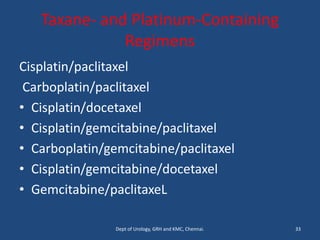
Cisplatin/paclitaxel
Carboplatin/paclitaxel
• Cisplatin/docetaxel
• Cisplatin/gemcitabine/paclitaxel
• Carboplatin/gemcitabine/paclitaxel
• Cisplatin/gemcitabine/docetaxel
• Gemcitabine/paclitaxeL
33
Dept of Urology, GRH and KMC, Chennai.
summary
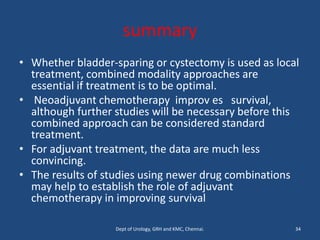
• Whether bladder-sparing or cystectomy is used as local
treatment, combined modality approaches are
essential if treatment is to be optimal.
• Neoadjuvant chemotherapy improv es survival,
although further studies will be necessary before this
combined approach can be considered standard
treatment.
• For adjuvant treatment, the data are much less
convincing.
• The results of studies using newer drug combinations
may help to establish the role of adjuvant
chemotherapy in improving survival
34
Dept of Urology, GRH and KMC, Chennai.
SUMMARY
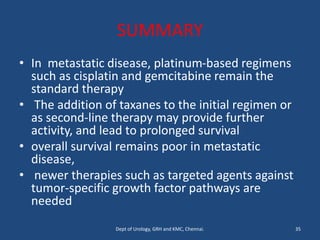
• In metastatic disease, platinum-based regimens
such as cisplatin and gemcitabine remain the
standard therapy
• The addition of taxanes to the initial regimen or
as second-line therapy may provide further
activity, and lead to prolonged survival
• overall survival remains poor in metastatic
disease,
• newer therapies such as targeted agents against
tumor-specific growth factor pathways are
needed
35
Dept of Urology, GRH and KMC, Chennai.
Radiotherapy
36
Dept of Urology, GRH and KMC, Chennai.
MODALITIES
• Radical RT – curative
• Adjuvant RT – preop / postop
• Palliative RT
METHODS
• EBRT
• INTERSTITIAL
37
Dept of Urology, GRH and KMC, Chennai.
Radical Radiation Therapy
Indications :
• Patients unfit / unwilling for surgery
Bladder conservation protocols
38
Dept of Urology, GRH and KMC, Chennai.
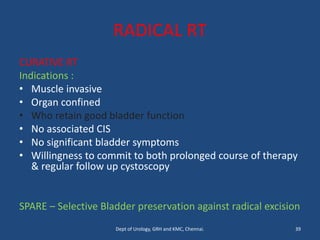
RADICAL RT
CURATIVE RT
Indications :
• Muscle invasive
• Organ confined
• Who retain good bladder function
• No associated CIS
• No significant bladder symptoms
• Willingness to commit to both prolonged course of therapy
& regular follow up cystoscopy
SPARE – Selective Bladder preservation against radical excision
39
Dept of Urology, GRH and KMC, Chennai.
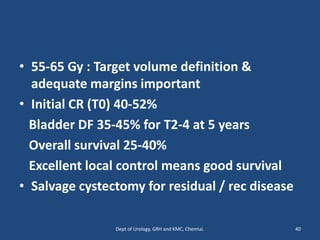
• 55-65 Gy : Target volume definition &
adequate margins important
• Initial CR (T0) 40-52%
Bladder DF 35-45% for T2-4 at 5 years
Overall survival 25-40%
Excellent local control means good survival
• Salvage cystectomy for residual / rec disease
40
Dept of Urology, GRH and KMC, Chennai.
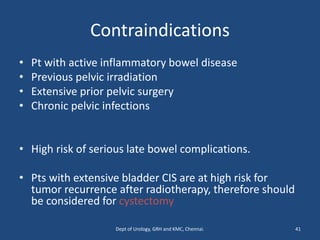
Contraindications
• Pt with active inflammatory bowel disease
• Previous pelvic irradiation
• Extensive prior pelvic surgery
• Chronic pelvic infections
• High risk of serious late bowel complications.
• Pts with extensive bladder CIS are at high risk for
tumor recurrence after radiotherapy, therefore should
be considered for cystectomy
41
Dept of Urology, GRH and KMC, Chennai.
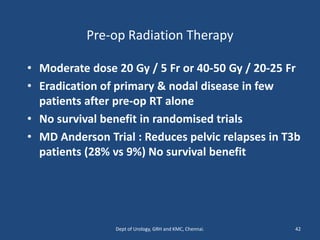
Pre-op Radiation Therapy
• Moderate dose 20 Gy / 5 Fr or 40-50 Gy / 20-25 Fr
• Eradication of primary & nodal disease in few
patients after pre-op RT alone
• No survival benefit in randomised trials
• MD Anderson Trial : Reduces pelvic relapses in T3b
patients (28% vs 9%) No survival benefit
42
Dept of Urology, GRH and KMC, Chennai.
Salvage Cystectomy
• Cystectomy following definitive radiation therapy
• Planned procedure or for progressive, residual or
recurrent disease after RT or for RT related
complications
• Survivals comparable to radical cystectomy in 4
randomised trials
• Technical challenge: Devascularisation & fibrosis
• Acceptable mortality & morbidity
43
Dept of Urology, GRH and KMC, Chennai.
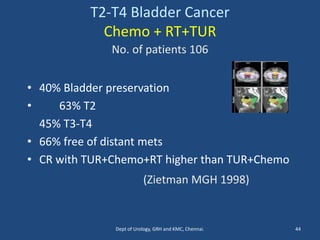
T2-T4 Bladder Cancer
Chemo + RT+TUR
No. of patients 106
• 40% Bladder preservation
• 63% T2
45% T3-T4
• 66% free of distant mets
• CR with TUR+Chemo+RT higher than TUR+Chemo
(Zietman MGH 1998)
44
Dept of Urology, GRH and KMC, Chennai.
EBRT
2 Protocols
• 64Gy – 2Gy x 32 daily doses over 6 1/2 weeks
• 52.5 – 55 Gy x 20 daily doses over 4 weeks
45
Dept of Urology, GRH and KMC, Chennai.
complications
• Bladder contraction – 2%
• Incontinence – 6%
• Bowel frequency – 20%
• Rectal bleed – 2%
• Impotence – 40%
• Vaginal stenosis
• Recurrence 10-20% (salvage cystectomy)
46
Dept of Urology, GRH and KMC, Chennai.
factors affecting Outcome
• T
• Size
• Age
• Nodal status
• Pre RT RFT, Hb%
• Presence of HUN
• TURBT completeness
47
Dept of Urology, GRH and KMC, Chennai.
Bladder : EMPTY or FULL ???
• Empty bladder –
• More comfort to patient
• Overall irradiated volume is smaller.
• Full bladder –
• Displaces small intestine & some part of
rectum out of radiation portals
48
Dept of Urology, GRH and KMC, Chennai.
Factors influencing bladder volume
• Interval between voiding & T/t delivery
• Pts state of hydration
• Use of diuretic medications
• Ingestion of diuretic beverages ( coffee, soft
drinks)
• Extrinsic pressure ( rectal filling, tumor mass)
49
Dept of Urology, GRH and KMC, Chennai.
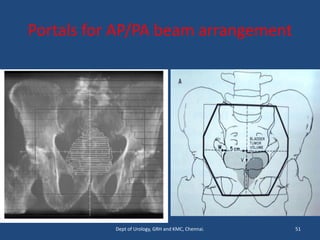
Radiation portals
• ANTERIOR POSTERIOR FIELDS :
• Superior border- L5-S1 interface,
• Inferior border – Lower border of obturator foramen
• Lateral border – 1.5- 2 cm outside the bony pelvic wall
• Anterior field should not include femoral heads & neck.
• Upper corners can be shielded to reduce small bowel
volume.
50
Dept of Urology, GRH and KMC, Chennai.
Portals for AP/PA beam arrangement
51
Dept of Urology, GRH and KMC, Chennai.
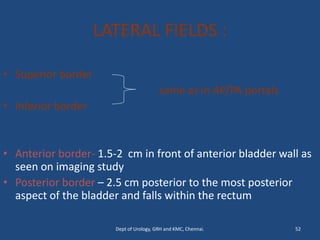
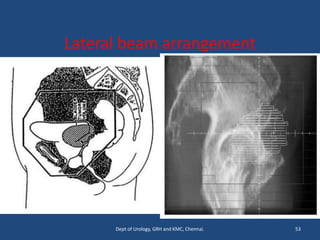
LATERAL FIELDS :
• Superior border
same as in AP/PA portals
• Inferior border
• Anterior border- 1.5-2 cm in front of anterior bladder wall as
seen on imaging study
• Posterior border – 2.5 cm posterior to the most posterior
aspect of the bladder and falls within the rectum
52
Dept of Urology, GRH and KMC, Chennai.
Lateral beam arrangement
53
Dept of Urology, GRH and KMC, Chennai.
Areas irradiated
• The whole pelvis
• The pelvic lymph nodes
• The whole Bladder
• Proximal urethra (trigonal invl)
• Any extravesical disease spread
• Any region deemed to be at risk of
microscopic disease spread.
54
Dept of Urology, GRH and KMC, Chennai.
Preoperative Radiation Therapy
❖Destroys local micrometastases
❖potentially downstage otherwise unresectable
tumors
❖improve local control after cystectomy.
55
Dept of Urology, GRH and KMC, Chennai.
Post operative radiotherapy
Indications – i) Extravesical disease
ii) Positive resection margins
iii) Pelvic LN involvement
• Advantage – Availability of pathologic staging
• Allows administration of adjuvant irradiation to those
having high probability of tumor recurrence
• Disadvantage- increased small intestine toxicity
(adhesions).
• Dose schedule- 40-50 Gy/ 5-6 weeks @ 1.8-2Gy/ #
56
Dept of Urology, GRH and KMC, Chennai.
Palliative RT
INDICATIONS
• Hematuria
• Severe urgency
• Pain
Dose
• 7Gy x 3
or
• 3-3.5Gy x 10
• Troublesome bowel side effects
57
Dept of Urology, GRH and KMC, Chennai.
Radiosensitisers
• CT – cisplatin / gemcitabine
• Hyperbaric oxygen therapy
• Misonidazole no role
• Carbogen (ARCO)
• Carbogen nicotinamide (ARCON) – Doubles
the rate of survival
58
Dept of Urology, GRH and KMC, Chennai.
Interstitial Radiation Therapy
• Never as a primary therapy
• After preoperative external-beam radiation therapy, partial
cystectomy, or TUR
• Overall survival rates for low-stage tumors (T1-T2) of 60% to 80%
have been reported.
• In selected cases - provide an acceptable alternative bladder
preservation strategy.
•
Complications( 25%)
• delayed wound healing,
• fistula formation,
• hematuria,
• chronic cystitis..
59
Dept of Urology, GRH and KMC, Chennai.
Side effects
ACUTE TOXICITY :
• Cystitis – frequency, urge incontinence, dysuria.
• Diarrhea, anal irritation
• Mild proctitis
LATE SEQUELAE:
• Teleangiectasia of bladder mucosa
• Intractable Hematuria
• Rectal bleeding
• Reduced bladder capacity
60
Dept of Urology, GRH and KMC, Chennai.
POTENTIAL
BLADDER
PRESERVATION
61
Dept of Urology, GRH and KMC, Chennai.
Invasive Bladder Cancer
Chemo : Observations
(Herr 1989)
• 30 patients had cystectomy post - MVAC
• 10 patients had no disease in cystectomy specimens
POTENTIAL BLADDER PRESERVATION
33%
62
Dept of Urology, GRH and KMC, Chennai.
Invasive Bladder Cancer
Chemo : Is bladder saving possible?
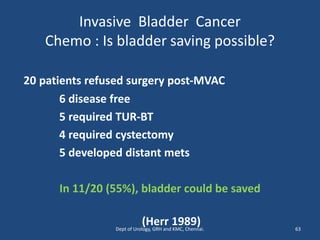
20 patients refused surgery post-MVAC
6 disease free
5 required TUR-BT
4 required cystectomy
5 developed distant mets
In 11/20 (55%), bladder could be saved
(Herr 1989) 63
Dept of Urology, GRH and KMC, Chennai.
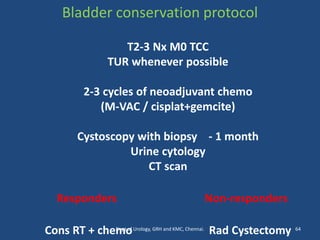
Bladder conservation protocol
T2-3 Nx M0 TCC
TUR whenever possible
2-3 cycles of neoadjuvant chemo
(M-VAC / cisplat+gemcite)
Cystoscopy with biopsy - 1 month
Urine cytology
CT scan
Responders Non-responders
Cons RT + chemo Rad Cystectomy 64
Dept of Urology, GRH and KMC, Chennai.
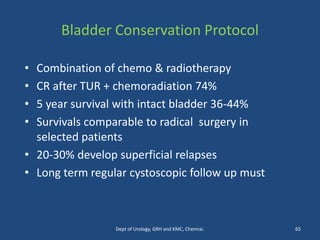
Bladder Conservation Protocol
• Combination of chemo & radiotherapy
• CR after TUR + chemoradiation 74%
• 5 year survival with intact bladder 36-44%
• Survivals comparable to radical surgery in
selected patients
• 20-30% develop superficial relapses
• Long term regular cystoscopic follow up must
65
Dept of Urology, GRH and KMC, Chennai.
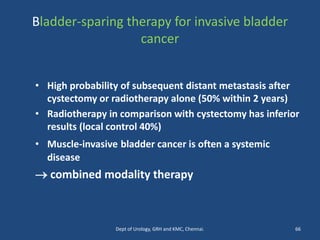
Bladder-sparing therapy for invasive bladder
cancer
• High probability of subsequent distant metastasis after
cystectomy or radiotherapy alone (50% within 2 years)
• Radiotherapy in comparison with cystectomy has inferior
results (local control 40%)
• Muscle-invasive bladder cancer is often a systemic
disease
→ combined modality therapy
66
Dept of Urology, GRH and KMC, Chennai.
Bladder Conservation Approach
Case Selection
• T2/T3a tumours
• Unifocal tumours
• Absence of associated diffuse Tis
• Good bladder capacity
• Low chance of metastatic disease
Prospective randomised trials essential
to compare oncologic value with cystectomy
67
Dept of Urology, GRH and KMC, Chennai.
Bladder Conservation Approach
contraindications
• Hydronephrosis
• Multifocal disease
• Irritative bladder symptoms
• Low capacity bladder
68
Dept of Urology, GRH and KMC, Chennai.
Bladder Preservation Protocols
• Bimodality & trimodalities
• First step is always TURBT → CT ± RT
• TURBT is for tissue diagnosis (muscle
invasive)and removal of all macroscopic
disease.
• Not advocated in CIS (severe) – requires BCG /
R cystectomy
69
Dept of Urology, GRH and KMC, Chennai.
Thank you
70
Dept of Urology, GRH and KMC, Chennai.

Chemotherapy radiotherapy in Urinary bladder malignancy

  • 1.
    ROLE OF CHEMOTHERAPY& RADIOTHERAPY IN CARCINOMA BLADDER Dept of Urology Govt Royapettah Hospital and Kilpauk Medical College Chennai 1
  • 2.
    Moderators: Professors: • Prof. Dr.G. Sivasankar, M.S., M.Ch., • Prof. Dr. A. Senthilvel, M.S., M.Ch., Asst Professors: • Dr. J. Sivabalan, M.S., M.Ch., • Dr. R. Bhargavi, M.S., M.Ch., • Dr. S. Raju, M.S., M.Ch., • Dr. K. Muthurathinam, M.S., M.Ch., • Dr. D. Tamilselvan, M.S., M.Ch., • Dr. K. Senthilkumar, M.S., M.Ch. Dept of Urology, GRH and KMC, Chennai. 2
  • 3.
    OPTIONS • Chemotherapy-neoadjuvant&adjuvant • Radiotherapy-preoperative&postoperative • Bladder Conservation Protocol 3 Dept of Urology, GRH and KMC, Chennai.
  • 4.
    Peri-operative chemotherapy Rationale • Deathsfrom TCC are generally not local events • Patients die as a result of metastatic disease • Local interventions will not deal with micro- metastatic disease • Systemic therapy must be given to eradicate micrometastatic disease in order to improve cure rates 4 Dept of Urology, GRH and KMC, Chennai.
  • 5.
    Adjuvant Chemotherapy • Basis: 50% develop distant mets despite adequate local therapy within 2 years • Survival advantage seen in locally advanced disease & limited nodal metastatic disease (Skinner 1991, Stockle 1992) • Does not delay local treatment 5 Dept of Urology, GRH and KMC, Chennai.
  • 6.
    WHEN is Adjuvanttherapy indicated presence of High Risk Factors After Cystectomy • Deep muscle invasion or extravesical spread • Prostate or adjacent organ involvement • High grade or undiff histology • Lymphatic or vascular emboli • Lymph node metastases • +ve surgical cut margins (Residual) 6 Dept of Urology, GRH and KMC, Chennai.
  • 7.
    • Stockle etal noted a difference was noted in the 80 patients who received adjuvant chemotherapy as compared with 86 patients who underwent cystectomy alone. • adjuvant chemotherapy was most effective in patients with N-1 disease • usefulness of adjuvant chemotherapy is now being tested in an EORTC/intergroup trial 7 Dept of Urology, GRH and KMC, Chennai.
  • 8.
    Compare and Contrast Neoadjuvant •Deals with micromets sooner Concern delay in surgery Best evidence of benefit • ? Increased surgical complications • Is benefit worth it? Adjuvant • Treats only the highest risk pts. • No delay in local Rx • Evidence of benefit is weaker • Delays in healing may preclude giving therapy • Is benefit worth it? 8 Dept of Urology, GRH and KMC, Chennai.
  • 9.
    Chemo in Invasivebladder cancer • Adjuncts to standard surgical therapy • Alternatives to standard surgical therapy 9 Dept of Urology, GRH and KMC, Chennai.
  • 10.
    Neoadjuvant CT 10 Dept ofUrology, GRH and KMC, Chennai.
  • 11.
    Rationale for NeoadjuvantTherapy • Give systemic therapy when the pelvic blood supply is intact • in vivo chemo-sensitivity trial • Deal with micrometastatic disease immediately • Patient is fitter and more able to tolerate chemotherapy 11 Dept of Urology, GRH and KMC, Chennai.
  • 12.
    Bladder Cancer Neoadjuvant Chemotherapy Rationale: • Treatment of micrometastases to improve overall survival • Treatment of local tumour permitting organ preservation • Determination of chemosensitivity in vivo • More efficient & higher drug delivery Problems : • Progression of disease • Delay in curative local therapies • Toxicity of chemo • Accurate staging not obtained 12 Dept of Urology, GRH and KMC, Chennai.
  • 13.
    Advantages of NeoadjuvantTherapy • Give systemic therapy when the pelvic blood supply is intact • in vivo chemo-sensitivity trial • Deal with micrometastatic disease immediately • Patient is fitter and more able to tolerate chemotherapy 13 Dept of Urology, GRH and KMC, Chennai.
  • 14.
    • study byGrossman et al • the Nordic Cystectomy Trial 1 • The Nordic Cystectomy Trial 2 • Raghavan et al. • Patients with muscularis propria invasive bladder cancer (stage T2 to T4a) were randomly assigned to radical cystectomy alone or three cycles of MVAC followed by radical cystectomy. 14 Dept of Urology, GRH and KMC, Chennai.
  • 15.
    Neoadjuvant chemotherapy • MRCtrial (European) – 967 patients randomized to CMV vs no chemotherapy – Definitive management of primary either cystectomy or RT – 7 yr follow shows statistically significant benefit with neoadjuvant chemotherapy Lancet 354 (9178): 533-40, 1999 15 Dept of Urology, GRH and KMC, Chennai.
  • 16.
    • Black etal. make the case for risk-adapted neoadjuvant chemotherapy, that is, offering neoadjuvant chemotherapy to patients who are at highest risk the tumor biology, the tumor grade, the histologic subtype and biomarkers size, clinical TNM stage, location in the bladder, ureteral obstruction and extravesical extension • pTo status was the only factor independently predictive of overall survival in multivariate analyses of four trials 16 Dept of Urology, GRH and KMC, Chennai.
  • 17.
    Molecular Markers inNeoadjuvant Chemotherapy • Takata et al studied gene expression profiles from biopsies prior to neoadjuvant MVAC and identified 14 genes that were expressed differently in responders and nonresponders. SWOG phase III trial, evaluates the therapeutic and prognostic significance of altered p53 expression by the tumor p53 following radical cystectomy in pT1 or pT2 with p53-negative tumors, the treatment is observation. with p53-positive tumors, MVAC or observation 17 Dept of Urology, GRH and KMC, Chennai.
  • 18.
    regime • three 28-daycycles of MVAC as follows: • methotrexate (30 mg/m2 on days 1, 15, and 22), • vinblastine (3 mg/m2 on days 2, 15, and 22), • doxorubicin (30 mg/m2 on day 2), • and cisplatin (70 mg/m2 on day 2). 18 Dept of Urology, GRH and KMC, Chennai.
  • 19.
    Conclusions of trials •(1) The survival benefit associated with MVAC related to down-staging of the tumor to pTo. • Thirty-eight percent of the chemotherapy-treated patients had no evidence of cancer at cystectomy as compared with 15% of patients in the cystectomy-only group • (2) The median survival was 77 months for the chemotherapy-treated patients compared with 46 months for the cystectomy-only group. • (3) The 5-year actuarial survival was 43% in the cystectomy group, 57% in the chemotherapy-treated group 19 Dept of Urology, GRH and KMC, Chennai.
  • 20.
    conclusions: • single-agent neoadjuvantchemotherapy is ineffective and should not be used; • current combination chemotherapy regimens improve the 5-year survival by 5%, which reduces the risk of death by 13% compared with the use of definitive local treatment alone (i.e., from 43% to 38%). • patients should be informed of the potential benefits versus the risks of neoadjuvant chemotherapy 20 Dept of Urology, GRH and KMC, Chennai.
  • 21.
    Adjuvant chemotherapy 21 Dept ofUrology, GRH and KMC, Chennai.
  • 22.
    Combination therapy • thecombination of methotrexate, vinblastine, and cisplatin (MCV), a total of three 28-day cycles • four cycles of cisplatin, gemcitabine, and paclitaxel, 22 Dept of Urology, GRH and KMC, Chennai.
  • 23.
    Combined Modality Treatmentof Locoregionally Advanced Disease Caseselection • patients with locally advanced unresectable bladder cancer with • 1) an excellent performance status • (2) locally advanced measurable disease • (3) a normal hemogram and kidney function tests • (4) no evidence of distant metastases beyond the common iliac lymph nodes. 23 Dept of Urology, GRH and KMC, Chennai.
  • 24.
    • four tosix cycles of combination chemotherapy, usually MCV, or gemcitabine-cisplatin. • If significant regression of tumor was achieved, radiation treatment was administered in combination with radiosensitizing chemotherapy, usually cisplatin-paclitaxel. • When gemcitabine was used avoid gemcitabine- radiation interactions by using a waiting period of at least 2 months from the completion of gemcitabine treatment to the start of radiation 24 Dept of Urology, GRH and KMC, Chennai.
  • 25.
    Metastatic Bladder Cancer •The prognosis of metastatic bladder cancer, as with other metastatic solid tumors, is poor, with a median survival of only12 Months transitional cell cancer is chemosensitive • . In phase II clinical trials, radiographic response rates -70% to 80%, and in phase III clinical trials, - 50% • duration of response in TCC is short, with a median of 4 to 6 months, and therefore the impact of chemotherapy on survival has been disappointing 25 Dept of Urology, GRH and KMC, Chennai.
  • 26.
    Cisplatin -single drugtherapy • the response rate to single-agent cisplatin has been lower than that of cisplatin-containing combination therapy. 26 Dept of Urology, GRH and KMC, Chennai.
  • 27.
    Cisplatin-Based Combination Chemotherapy •The standard chemotherapy regimen for advanced bladder cancer • methotrexate, vinblastine, doxorubicin, and cisplatin (MVAC). • MVAC is administered in 28-day cycles methotrexate 30 mg/m2 (days 1, 15, and 22), vinblastine 3 mg/m2 (days 2, 15, and 22), doxorubicin 30 mg/m2 (day 2), cisplatin 70 mg/m2 (day 2). 27 Dept of Urology, GRH and KMC, Chennai.
  • 28.
    CMV, regime • omitsdoxorubicin and has less toxicity. • Cisplatin 70 mg/m2 d 2 Methotrexate 30 mg/m2 d 1, 8 Vinblastine 4mg/m2 d 1, 8 GC regime • Gemcitabine 1000 mg/m2 d 1, 8, 15 Cisplatin 70 mg/m2 d 2 • response rate of 42% to 66% and a CR rate of 18% to 28% • . 28 Dept of Urology, GRH and KMC, Chennai.
  • 29.
    • The responserate to MVAC is 40% to 65%and there is improved progression-free and median survival of 12 months 29 Dept of Urology, GRH and KMC, Chennai.
  • 30.
    Toxic effects ofMVAC • neutropenia, anemia, thrombocytopenia, stomatitis, nausea, and fatigue • grade 3 or 4 myelosuppression • grade 3 or 4 gastrointestinal toxicity . • neutropenic sepsis . • Primary toxicity of GC was hematologic, febrile neutropenia 30 Dept of Urology, GRH and KMC, Chennai.
  • 31.
    • Toxic deaths(1% vs. 3%), • neutropenic fevers (2% vs. 14%), • grade 3/4 neutropenia (71% vs. 82%), grade 3/4 mucositis (1% vs. 22%), and • alopecia (11% vs. 55%), were all lower in the GC group. • Patients receiving GC gained more weight, reported less fatigue, and had better performance status than patients receiving MVAC. • GC is generally considered the current standard of care for metastatic bladder cancer. 31 Dept of Urology, GRH and KMC, Chennai.
  • 32.
    • GC wascompared with standard MVAC in a multicenter phase III study • more adverse factors on the GC arm. • Median survival was 14.0 months with GC and 15.2 months with MVAC, • Median progression-free survivals were 7.7 and 8.3 months with GC and MVAC 32 Dept of Urology, GRH and KMC, Chennai.
  • 33.
    Taxane- and Platinum-Containing Regimens Cisplatin/paclitaxel Carboplatin/paclitaxel •Cisplatin/docetaxel • Cisplatin/gemcitabine/paclitaxel • Carboplatin/gemcitabine/paclitaxel • Cisplatin/gemcitabine/docetaxel • Gemcitabine/paclitaxeL 33 Dept of Urology, GRH and KMC, Chennai.
  • 34.
    summary • Whether bladder-sparingor cystectomy is used as local treatment, combined modality approaches are essential if treatment is to be optimal. • Neoadjuvant chemotherapy improv es survival, although further studies will be necessary before this combined approach can be considered standard treatment. • For adjuvant treatment, the data are much less convincing. • The results of studies using newer drug combinations may help to establish the role of adjuvant chemotherapy in improving survival 34 Dept of Urology, GRH and KMC, Chennai.
  • 35.
    SUMMARY • In metastaticdisease, platinum-based regimens such as cisplatin and gemcitabine remain the standard therapy • The addition of taxanes to the initial regimen or as second-line therapy may provide further activity, and lead to prolonged survival • overall survival remains poor in metastatic disease, • newer therapies such as targeted agents against tumor-specific growth factor pathways are needed 35 Dept of Urology, GRH and KMC, Chennai.
  • 36.
    Radiotherapy 36 Dept of Urology,GRH and KMC, Chennai.
  • 37.
    MODALITIES • Radical RT– curative • Adjuvant RT – preop / postop • Palliative RT METHODS • EBRT • INTERSTITIAL 37 Dept of Urology, GRH and KMC, Chennai.
  • 38.
    Radical Radiation Therapy Indications: • Patients unfit / unwilling for surgery Bladder conservation protocols 38 Dept of Urology, GRH and KMC, Chennai.
  • 39.
    RADICAL RT CURATIVE RT Indications: • Muscle invasive • Organ confined • Who retain good bladder function • No associated CIS • No significant bladder symptoms • Willingness to commit to both prolonged course of therapy & regular follow up cystoscopy SPARE – Selective Bladder preservation against radical excision 39 Dept of Urology, GRH and KMC, Chennai.
  • 40.
    • 55-65 Gy: Target volume definition & adequate margins important • Initial CR (T0) 40-52% Bladder DF 35-45% for T2-4 at 5 years Overall survival 25-40% Excellent local control means good survival • Salvage cystectomy for residual / rec disease 40 Dept of Urology, GRH and KMC, Chennai.
  • 41.
    Contraindications • Pt withactive inflammatory bowel disease • Previous pelvic irradiation • Extensive prior pelvic surgery • Chronic pelvic infections • High risk of serious late bowel complications. • Pts with extensive bladder CIS are at high risk for tumor recurrence after radiotherapy, therefore should be considered for cystectomy 41 Dept of Urology, GRH and KMC, Chennai.
  • 42.
    Pre-op Radiation Therapy •Moderate dose 20 Gy / 5 Fr or 40-50 Gy / 20-25 Fr • Eradication of primary & nodal disease in few patients after pre-op RT alone • No survival benefit in randomised trials • MD Anderson Trial : Reduces pelvic relapses in T3b patients (28% vs 9%) No survival benefit 42 Dept of Urology, GRH and KMC, Chennai.
  • 43.
    Salvage Cystectomy • Cystectomyfollowing definitive radiation therapy • Planned procedure or for progressive, residual or recurrent disease after RT or for RT related complications • Survivals comparable to radical cystectomy in 4 randomised trials • Technical challenge: Devascularisation & fibrosis • Acceptable mortality & morbidity 43 Dept of Urology, GRH and KMC, Chennai.
  • 44.
    T2-T4 Bladder Cancer Chemo+ RT+TUR No. of patients 106 • 40% Bladder preservation • 63% T2 45% T3-T4 • 66% free of distant mets • CR with TUR+Chemo+RT higher than TUR+Chemo (Zietman MGH 1998) 44 Dept of Urology, GRH and KMC, Chennai.
  • 45.
    EBRT 2 Protocols • 64Gy– 2Gy x 32 daily doses over 6 1/2 weeks • 52.5 – 55 Gy x 20 daily doses over 4 weeks 45 Dept of Urology, GRH and KMC, Chennai.
  • 46.
    complications • Bladder contraction– 2% • Incontinence – 6% • Bowel frequency – 20% • Rectal bleed – 2% • Impotence – 40% • Vaginal stenosis • Recurrence 10-20% (salvage cystectomy) 46 Dept of Urology, GRH and KMC, Chennai.
  • 47.
    factors affecting Outcome •T • Size • Age • Nodal status • Pre RT RFT, Hb% • Presence of HUN • TURBT completeness 47 Dept of Urology, GRH and KMC, Chennai.
  • 48.
    Bladder : EMPTYor FULL ??? • Empty bladder – • More comfort to patient • Overall irradiated volume is smaller. • Full bladder – • Displaces small intestine & some part of rectum out of radiation portals 48 Dept of Urology, GRH and KMC, Chennai.
  • 49.
    Factors influencing bladdervolume • Interval between voiding & T/t delivery • Pts state of hydration • Use of diuretic medications • Ingestion of diuretic beverages ( coffee, soft drinks) • Extrinsic pressure ( rectal filling, tumor mass) 49 Dept of Urology, GRH and KMC, Chennai.
  • 50.
    Radiation portals • ANTERIORPOSTERIOR FIELDS : • Superior border- L5-S1 interface, • Inferior border – Lower border of obturator foramen • Lateral border – 1.5- 2 cm outside the bony pelvic wall • Anterior field should not include femoral heads & neck. • Upper corners can be shielded to reduce small bowel volume. 50 Dept of Urology, GRH and KMC, Chennai.
  • 51.
    Portals for AP/PAbeam arrangement 51 Dept of Urology, GRH and KMC, Chennai.
  • 52.
    LATERAL FIELDS : •Superior border same as in AP/PA portals • Inferior border • Anterior border- 1.5-2 cm in front of anterior bladder wall as seen on imaging study • Posterior border – 2.5 cm posterior to the most posterior aspect of the bladder and falls within the rectum 52 Dept of Urology, GRH and KMC, Chennai.
  • 53.
    Lateral beam arrangement 53 Deptof Urology, GRH and KMC, Chennai.
  • 54.
    Areas irradiated • Thewhole pelvis • The pelvic lymph nodes • The whole Bladder • Proximal urethra (trigonal invl) • Any extravesical disease spread • Any region deemed to be at risk of microscopic disease spread. 54 Dept of Urology, GRH and KMC, Chennai.
  • 55.
    Preoperative Radiation Therapy ❖Destroyslocal micrometastases ❖potentially downstage otherwise unresectable tumors ❖improve local control after cystectomy. 55 Dept of Urology, GRH and KMC, Chennai.
  • 56.
    Post operative radiotherapy Indications– i) Extravesical disease ii) Positive resection margins iii) Pelvic LN involvement • Advantage – Availability of pathologic staging • Allows administration of adjuvant irradiation to those having high probability of tumor recurrence • Disadvantage- increased small intestine toxicity (adhesions). • Dose schedule- 40-50 Gy/ 5-6 weeks @ 1.8-2Gy/ # 56 Dept of Urology, GRH and KMC, Chennai.
  • 57.
    Palliative RT INDICATIONS • Hematuria •Severe urgency • Pain Dose • 7Gy x 3 or • 3-3.5Gy x 10 • Troublesome bowel side effects 57 Dept of Urology, GRH and KMC, Chennai.
  • 58.
    Radiosensitisers • CT –cisplatin / gemcitabine • Hyperbaric oxygen therapy • Misonidazole no role • Carbogen (ARCO) • Carbogen nicotinamide (ARCON) – Doubles the rate of survival 58 Dept of Urology, GRH and KMC, Chennai.
  • 59.
    Interstitial Radiation Therapy •Never as a primary therapy • After preoperative external-beam radiation therapy, partial cystectomy, or TUR • Overall survival rates for low-stage tumors (T1-T2) of 60% to 80% have been reported. • In selected cases - provide an acceptable alternative bladder preservation strategy. • Complications( 25%) • delayed wound healing, • fistula formation, • hematuria, • chronic cystitis.. 59 Dept of Urology, GRH and KMC, Chennai.
  • 60.
    Side effects ACUTE TOXICITY: • Cystitis – frequency, urge incontinence, dysuria. • Diarrhea, anal irritation • Mild proctitis LATE SEQUELAE: • Teleangiectasia of bladder mucosa • Intractable Hematuria • Rectal bleeding • Reduced bladder capacity 60 Dept of Urology, GRH and KMC, Chennai.
  • 61.
  • 62.
    Invasive Bladder Cancer Chemo: Observations (Herr 1989) • 30 patients had cystectomy post - MVAC • 10 patients had no disease in cystectomy specimens POTENTIAL BLADDER PRESERVATION 33% 62 Dept of Urology, GRH and KMC, Chennai.
  • 63.
    Invasive Bladder Cancer Chemo: Is bladder saving possible? 20 patients refused surgery post-MVAC 6 disease free 5 required TUR-BT 4 required cystectomy 5 developed distant mets In 11/20 (55%), bladder could be saved (Herr 1989) 63 Dept of Urology, GRH and KMC, Chennai.
  • 64.
    Bladder conservation protocol T2-3Nx M0 TCC TUR whenever possible 2-3 cycles of neoadjuvant chemo (M-VAC / cisplat+gemcite) Cystoscopy with biopsy - 1 month Urine cytology CT scan Responders Non-responders Cons RT + chemo Rad Cystectomy 64 Dept of Urology, GRH and KMC, Chennai.
  • 65.
    Bladder Conservation Protocol •Combination of chemo & radiotherapy • CR after TUR + chemoradiation 74% • 5 year survival with intact bladder 36-44% • Survivals comparable to radical surgery in selected patients • 20-30% develop superficial relapses • Long term regular cystoscopic follow up must 65 Dept of Urology, GRH and KMC, Chennai.
  • 66.
    Bladder-sparing therapy forinvasive bladder cancer • High probability of subsequent distant metastasis after cystectomy or radiotherapy alone (50% within 2 years) • Radiotherapy in comparison with cystectomy has inferior results (local control 40%) • Muscle-invasive bladder cancer is often a systemic disease → combined modality therapy 66 Dept of Urology, GRH and KMC, Chennai.
  • 67.
    Bladder Conservation Approach CaseSelection • T2/T3a tumours • Unifocal tumours • Absence of associated diffuse Tis • Good bladder capacity • Low chance of metastatic disease Prospective randomised trials essential to compare oncologic value with cystectomy 67 Dept of Urology, GRH and KMC, Chennai.
  • 68.
    Bladder Conservation Approach contraindications •Hydronephrosis • Multifocal disease • Irritative bladder symptoms • Low capacity bladder 68 Dept of Urology, GRH and KMC, Chennai.
  • 69.
    Bladder Preservation Protocols •Bimodality & trimodalities • First step is always TURBT → CT ± RT • TURBT is for tissue diagnosis (muscle invasive)and removal of all macroscopic disease. • Not advocated in CIS (severe) – requires BCG / R cystectomy 69 Dept of Urology, GRH and KMC, Chennai.
  • 70.
    Thank you 70 Dept ofUrology, GRH and KMC, Chennai.