Locally Advanced High Risk Prostate Cancer -
Current SOC and Evolving Treatment options
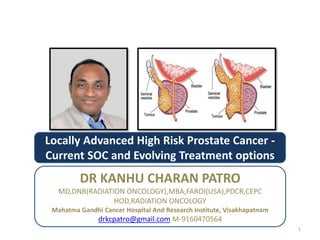
DR KANHU CHARAN PATRO
MD,DNB(RADIATION ONCOLOGY),MBA,FAROI(USA),PDCR,CEPC
HOD,RADIATION ONCOLOGY
Mahatma Gandhi Cancer Hospital And Research Institute, Visakhapatnam
drkcpatro@gmail.com M-9160470564
1
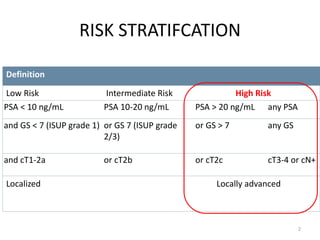
RISK STRATIFCATION
Definition
Low Risk Intermediate Risk High Risk
PSA < 10 ng/mL PSA 10-20 ng/mL PSA > 20 ng/mL any PSA
and GS < 7 (ISUP grade 1) or GS 7 (ISUP grade
2/3)
or GS > 7 any GS
and cT1-2a or cT2b or cT2c cT3-4 or cN+
Localized Locally advanced
2
RISK ASSESMENT- GPS
1. Gleason score, PSA, and Stage are more useful tool
2. Ability to assess pathologic stage permits better pre-
treatment counseling of patients,
1. More appropriate selection of therapy
2. Consideration of those with more advanced disease for novel
clinical trials.
3. Most important pathologic criteria predicting prognosis
after RADICAL PROSTATECTOMY are
1. Gleason score, surgical margin status, and presence of non–
organ- confined disease (e.g.extracapsular extension, seminal
vesicle invasion, lymph node involvement).
3
EUROPEAN ASSOCIATION OF UROLOGY GUIDELINES FOR BIOPSY
EUA GUIDELINE UPDATES 21st AUGUST 2021/PROSTATE
4
EUROPEAN ASSOCIATION OF UROLOGY GUIDELINES FOR BIOPSY
EUA GUIDELINE UPDATES 20th AUGUST 2021/PROSTATE
5
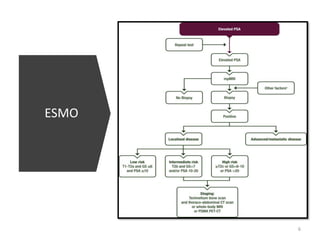
ESMO
6
7
8
IMAGING
• Multiparametric MRI (mpMRI)
– Enables reliable detection of clinically significant
cancers
– Is currently the leading imaging modality:
• For the detection, characterization, and local
staging of prostate cancer.
9
OPTIONS OF THE TREATMENT
• Radical Prostatectomy
• Neo-Adjuvant Androgen Deprivation
• Radiation Therapy
– EBRT
– BRACHY
• Adjuvant ADT
• Adjuvant Chemotherapy
10
11
ESMO OPTIONS
12
WHAT ESMO SAYS
• Primary ADT alone is not recommended as standard
initial treatment for non-metastatic disease [I, D].
• External beam RT plus ADT is recommended for men
with high-risk or locally advanced prostate cancer [I, B].
• RP plus pelvic lymphadenectomy is an option for
selected men with high-risk disease [III, B].
• Men receiving radical RT for high-risk disease should
have long-course ADT (18 to 36 months) [I, A].
• Neoadjuvant docetaxel may be offered before RT for
young, fit men with very high-risk localised prostate
cancer [I, C].
13
WHAT ESMO SAYS
• Following RP, patients should have their serum PSA level monitored, with
salvage RT recommended in the event of PSA failure [III, B].
• Adjuvant postoperative RT after RP is not routinely recommended [I, B].
• Salvage RT should start early (e.g. PSA < 5ng/ml[III,B]
• Concomitant ADT for 6 months or bicalutamide 150 mg daily for 2 years
may be offered to men having salvage RT [I, B].
• Men having SRT to the prostate bed may be offered pelvic nodal RT [I, C].
• Men with biochemical relapse after radical RT who may be candidates for
local salvage or metastasis-directed treatment should undergo imaging
with PET-CT [III, B].
• Early ADT alone is not recommended for men with biochemical relapse
unless they have a rapid PSA doubling time, symptomatic local disease or
proven metastases [II, D].
• Men starting ADT for biochemical relapse, in the absence of metastatic
disease, should be offered intermittent rather than continuous treatment
[I, B].
14
ADVANCES IN RADIOTHERAPY
15
WHY SBRT FOR PROSTATE CANCER?
EUA GUIDELINE
UPDATES
21st AUGUST 2021/PROSTATE
1. Low alpha/beta ratio of 1.5-1.8 (CHHiP trial and Perez and Brady)
2. If the alpha/beta for dose-limiting normal tissue is less than that of the tumor, larger fraction sizes preferentially kill
the tumor compared to normal tissue
3. Increased patient convenience
4. Increased access for underserved patient populations (long commute etc)
5. More cost-effective than other EBRT fractionation schedules
6. NCCN 2020: very low, low, favorable intermediate, unfavorable intermediate, high, very high-risk prostate cancer
and low volume M1 disease
7. ASTRO, ASCO and AUA 2018: low and intermediate risk disease
8. 2020 COVID19 pandemic recommendation: 5- to 7- fraction SBRT is preferred for localized prostate cancer that
requires treatment
9. HYPO-RT-PC trial
1. SBRT (42.7 Gy in 7 fractions) vs conventional fractionation (78 Gy in 39 fractions) with no ADT
10. PRIME TRIAL
1. SBRT: 36.25Gy in 5 fractions over 7–10 days; (node-positive disease - 25Gy in five fractions) versus moderate
hypofractionation: 68Gy in 25 fractions over 5 weeks; (node-positive disease – 50Gy in 25 fractions
11. PACE B TRAIL
1. SBRT (36.25 Gy in 5 fractions with a concomitant boost to 40 Gy) vs conventionally fractionated or
moderately hypofractionated EBRT (78 Gy in 39 fractions or 62 Gy in 20 fractions) with no ADT
12. NRG GU005
1. Stereotactic Body Radiation Therapy or Intensity Modulated Radiation Therapy in Treating Patients With
Stage IIA-B Prostate Cancer
13. HEAT-Radiation Hypofractionation Via Extended Versus Accelerated Therapy
1. 70.2 Gy in 26 fractions vs 36.25 Gy in 5 fractions in Low and intermediate risk disease included
16
PHASE III TRIALS IN PROSTATE CANCER
VEDANG MURTHY/BMJ
OPEN/2020
23rd AUGUST 2021/PROSTATE
17
18
19
Single-Dose Radiotherapy in Patients With Intermediate-Risk Prostate Cancer
Carlo Greco/JAMAONCOLOGY/2021 18th AUGUST 2021/PROSTATE
1. This randomized phase II trial evaluated the feasibility of ultra-high single-dose
radiation therapy at 24 Gy compared with standard hypofractionated curative
radiation (5 x 9 Gy) in men with intermediate-risk prostate cancer confined to the
prostate.
2. Acute urinary frequency and dysuria, grade 1, were noted in 40% of single-dose
radiation recipients and 27% of standard stereotactic body radiation therapy
(SBRT) recipients.
3. In both arms, symptoms had resolved within 4 weeks of radiation therapy.
4. There was no significant difference in the cumulative late genitourinary toxic
effects between the two groups (HR, 1.07 for grade 2 or higher).
5. There were similar PSA declines over the duration of follow-up for the two
treatment arms.
6. The 48-month actuarial biochemical relapse–free survival was 85.7% in the SBRT
group and 77.1% in the single-dose radiation group (HR, 0.69).
7. These results indicate that single-dose radiation may be safe and effective among
patients with intermediate-risk organ-confined prostate cancer.
PROSINT TRIAL
20
ADVANCES IN POST OP RADIOTHERAPY
21
WHAT IS DOUBLE TROUBLE?
• Most of the post op prostate patients require radiation
• Why we should choose surgery, where hypofractionation
radiation of 20 days available with equal results with
conventional radiotherapy?
• It is double trouble when we add radiotherapy after surgery
as dual toxicity.
• Let’s discuss in detail
22
23
24
25
26
27
28
29
CONCLUSION
• Surgery also a mode of treatment
• Careful selection is the key point
• Side effects of surgery takes more time to
recover.
• Hypofractionation radiotherapy is the best I
feel.
• Do not invite double trouble because you may
not able to troubleshoot always .
30
ADVANCES IN HORMONAL THERAPY
31
CHANGES IN HORMONAL THERAPY
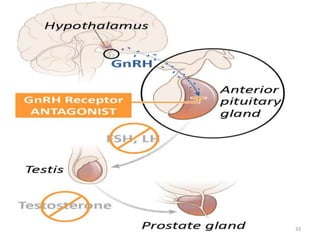
• GnRH analogue
– Luperolide
• GnRH antagonist
– Degarelix
– Relugolix [oral]
32
33
26th AUGUST 2021/PROSTATE
Mohammad Abufaraj /EUROPEAN UROLOGY/2021
GNRH AGONIST VS ANATGONIST IN MET.PROSTATE CA.A METAANALYSIS
1. Androgen deprivation therapy is the mainstay treatment of metastatic prostate cancer,
achieved mainly by gonadotropin-releasing hormone (GnRH) agonists or antagonists.
2. Gonadotropin-releasing hormone (GnRH) antagonist is associated with lower death rates
and cardiovascular events than GnRH agonists, based on the data from trials with short
follow-up duration.
3. GnRH agonists are associated with lower adverse events, such as decreased libido, hot
flushes, erectile dysfunction, back pain, weight gain, constipation, and injection site reactions.
4. There were no significant differences in PSA progression or fatigue
5. On the contrary, injection site reactions were higher in patients treated with GnRH antagonist
6. GnRH antagonist was associated with lower overall mortality rates than GnRH agonists (RR:
0.48, 95% CI: 0.26–0.90, p = 0.02)
34
HERO study
35
HERO study
36
HERO study
37
HERO study
38
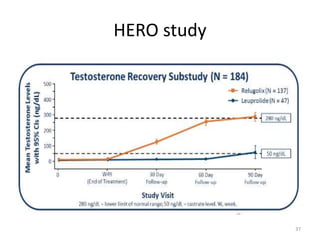
• Relugolix achieved castration as early as Day
4 and demonstrated superiority over
leuprolide in sustained testosterone
suppression through 48 weeks
• Relugolix also had faster testosterone
recovery after discontinuation and a 54%
reduction in MACE
• Relugolix has the potential to become a new
standard for testosterone suppression for
patients with advanced prostate cancer
HERO study
39
ADVANCES IN CHEMOTHERAPY
40
Neoadjuvant docetaxel for M0 disease
• GETUG-12
• RTOG 0521
• STAMPEDE
• SPCG-12,
• SPCG-13
• VA Cooperative Study Program (CSP)
#553
41
42
43
OS
FFS
44
GUIDELINES FOR SECOND-LINE THERAPY AFTER TREATMENT WITH CURATIVE INTENT
EUA GUIDELINE UPDATES 22nd AUGUST 2021/PROSTATE
45

Prostate cancer updates 2021

  • 1.
    Locally Advanced HighRisk Prostate Cancer - Current SOC and Evolving Treatment options DR KANHU CHARAN PATRO MD,DNB(RADIATION ONCOLOGY),MBA,FAROI(USA),PDCR,CEPC HOD,RADIATION ONCOLOGY Mahatma Gandhi Cancer Hospital And Research Institute, Visakhapatnam drkcpatro@gmail.com M-9160470564 1
  • 2.
    RISK STRATIFCATION Definition Low RiskIntermediate Risk High Risk PSA < 10 ng/mL PSA 10-20 ng/mL PSA > 20 ng/mL any PSA and GS < 7 (ISUP grade 1) or GS 7 (ISUP grade 2/3) or GS > 7 any GS and cT1-2a or cT2b or cT2c cT3-4 or cN+ Localized Locally advanced 2
  • 3.
    RISK ASSESMENT- GPS 1.Gleason score, PSA, and Stage are more useful tool 2. Ability to assess pathologic stage permits better pre- treatment counseling of patients, 1. More appropriate selection of therapy 2. Consideration of those with more advanced disease for novel clinical trials. 3. Most important pathologic criteria predicting prognosis after RADICAL PROSTATECTOMY are 1. Gleason score, surgical margin status, and presence of non– organ- confined disease (e.g.extracapsular extension, seminal vesicle invasion, lymph node involvement). 3
  • 4.
    EUROPEAN ASSOCIATION OFUROLOGY GUIDELINES FOR BIOPSY EUA GUIDELINE UPDATES 21st AUGUST 2021/PROSTATE 4
  • 5.
    EUROPEAN ASSOCIATION OFUROLOGY GUIDELINES FOR BIOPSY EUA GUIDELINE UPDATES 20th AUGUST 2021/PROSTATE 5
  • 6.
  • 7.
  • 8.
  • 9.
    IMAGING • Multiparametric MRI(mpMRI) – Enables reliable detection of clinically significant cancers – Is currently the leading imaging modality: • For the detection, characterization, and local staging of prostate cancer. 9
  • 10.
    OPTIONS OF THETREATMENT • Radical Prostatectomy • Neo-Adjuvant Androgen Deprivation • Radiation Therapy – EBRT – BRACHY • Adjuvant ADT • Adjuvant Chemotherapy 10
  • 11.
  • 12.
  • 13.
    WHAT ESMO SAYS •Primary ADT alone is not recommended as standard initial treatment for non-metastatic disease [I, D]. • External beam RT plus ADT is recommended for men with high-risk or locally advanced prostate cancer [I, B]. • RP plus pelvic lymphadenectomy is an option for selected men with high-risk disease [III, B]. • Men receiving radical RT for high-risk disease should have long-course ADT (18 to 36 months) [I, A]. • Neoadjuvant docetaxel may be offered before RT for young, fit men with very high-risk localised prostate cancer [I, C]. 13
  • 14.
    WHAT ESMO SAYS •Following RP, patients should have their serum PSA level monitored, with salvage RT recommended in the event of PSA failure [III, B]. • Adjuvant postoperative RT after RP is not routinely recommended [I, B]. • Salvage RT should start early (e.g. PSA < 5ng/ml[III,B] • Concomitant ADT for 6 months or bicalutamide 150 mg daily for 2 years may be offered to men having salvage RT [I, B]. • Men having SRT to the prostate bed may be offered pelvic nodal RT [I, C]. • Men with biochemical relapse after radical RT who may be candidates for local salvage or metastasis-directed treatment should undergo imaging with PET-CT [III, B]. • Early ADT alone is not recommended for men with biochemical relapse unless they have a rapid PSA doubling time, symptomatic local disease or proven metastases [II, D]. • Men starting ADT for biochemical relapse, in the absence of metastatic disease, should be offered intermittent rather than continuous treatment [I, B]. 14
  • 15.
  • 16.
    WHY SBRT FORPROSTATE CANCER? EUA GUIDELINE UPDATES 21st AUGUST 2021/PROSTATE 1. Low alpha/beta ratio of 1.5-1.8 (CHHiP trial and Perez and Brady) 2. If the alpha/beta for dose-limiting normal tissue is less than that of the tumor, larger fraction sizes preferentially kill the tumor compared to normal tissue 3. Increased patient convenience 4. Increased access for underserved patient populations (long commute etc) 5. More cost-effective than other EBRT fractionation schedules 6. NCCN 2020: very low, low, favorable intermediate, unfavorable intermediate, high, very high-risk prostate cancer and low volume M1 disease 7. ASTRO, ASCO and AUA 2018: low and intermediate risk disease 8. 2020 COVID19 pandemic recommendation: 5- to 7- fraction SBRT is preferred for localized prostate cancer that requires treatment 9. HYPO-RT-PC trial 1. SBRT (42.7 Gy in 7 fractions) vs conventional fractionation (78 Gy in 39 fractions) with no ADT 10. PRIME TRIAL 1. SBRT: 36.25Gy in 5 fractions over 7–10 days; (node-positive disease - 25Gy in five fractions) versus moderate hypofractionation: 68Gy in 25 fractions over 5 weeks; (node-positive disease – 50Gy in 25 fractions 11. PACE B TRAIL 1. SBRT (36.25 Gy in 5 fractions with a concomitant boost to 40 Gy) vs conventionally fractionated or moderately hypofractionated EBRT (78 Gy in 39 fractions or 62 Gy in 20 fractions) with no ADT 12. NRG GU005 1. Stereotactic Body Radiation Therapy or Intensity Modulated Radiation Therapy in Treating Patients With Stage IIA-B Prostate Cancer 13. HEAT-Radiation Hypofractionation Via Extended Versus Accelerated Therapy 1. 70.2 Gy in 26 fractions vs 36.25 Gy in 5 fractions in Low and intermediate risk disease included 16
  • 17.
    PHASE III TRIALSIN PROSTATE CANCER VEDANG MURTHY/BMJ OPEN/2020 23rd AUGUST 2021/PROSTATE 17
  • 18.
  • 19.
  • 20.
    Single-Dose Radiotherapy inPatients With Intermediate-Risk Prostate Cancer Carlo Greco/JAMAONCOLOGY/2021 18th AUGUST 2021/PROSTATE 1. This randomized phase II trial evaluated the feasibility of ultra-high single-dose radiation therapy at 24 Gy compared with standard hypofractionated curative radiation (5 x 9 Gy) in men with intermediate-risk prostate cancer confined to the prostate. 2. Acute urinary frequency and dysuria, grade 1, were noted in 40% of single-dose radiation recipients and 27% of standard stereotactic body radiation therapy (SBRT) recipients. 3. In both arms, symptoms had resolved within 4 weeks of radiation therapy. 4. There was no significant difference in the cumulative late genitourinary toxic effects between the two groups (HR, 1.07 for grade 2 or higher). 5. There were similar PSA declines over the duration of follow-up for the two treatment arms. 6. The 48-month actuarial biochemical relapse–free survival was 85.7% in the SBRT group and 77.1% in the single-dose radiation group (HR, 0.69). 7. These results indicate that single-dose radiation may be safe and effective among patients with intermediate-risk organ-confined prostate cancer. PROSINT TRIAL 20
  • 21.
    ADVANCES IN POSTOP RADIOTHERAPY 21
  • 22.
    WHAT IS DOUBLETROUBLE? • Most of the post op prostate patients require radiation • Why we should choose surgery, where hypofractionation radiation of 20 days available with equal results with conventional radiotherapy? • It is double trouble when we add radiotherapy after surgery as dual toxicity. • Let’s discuss in detail 22
  • 23.
  • 24.
  • 25.
  • 26.
  • 27.
  • 28.
  • 29.
  • 30.
    CONCLUSION • Surgery alsoa mode of treatment • Careful selection is the key point • Side effects of surgery takes more time to recover. • Hypofractionation radiotherapy is the best I feel. • Do not invite double trouble because you may not able to troubleshoot always . 30
  • 31.
  • 32.
    CHANGES IN HORMONALTHERAPY • GnRH analogue – Luperolide • GnRH antagonist – Degarelix – Relugolix [oral] 32
  • 33.
  • 34.
    26th AUGUST 2021/PROSTATE MohammadAbufaraj /EUROPEAN UROLOGY/2021 GNRH AGONIST VS ANATGONIST IN MET.PROSTATE CA.A METAANALYSIS 1. Androgen deprivation therapy is the mainstay treatment of metastatic prostate cancer, achieved mainly by gonadotropin-releasing hormone (GnRH) agonists or antagonists. 2. Gonadotropin-releasing hormone (GnRH) antagonist is associated with lower death rates and cardiovascular events than GnRH agonists, based on the data from trials with short follow-up duration. 3. GnRH agonists are associated with lower adverse events, such as decreased libido, hot flushes, erectile dysfunction, back pain, weight gain, constipation, and injection site reactions. 4. There were no significant differences in PSA progression or fatigue 5. On the contrary, injection site reactions were higher in patients treated with GnRH antagonist 6. GnRH antagonist was associated with lower overall mortality rates than GnRH agonists (RR: 0.48, 95% CI: 0.26–0.90, p = 0.02) 34
  • 35.
  • 36.
  • 37.
  • 38.
  • 39.
    • Relugolix achievedcastration as early as Day 4 and demonstrated superiority over leuprolide in sustained testosterone suppression through 48 weeks • Relugolix also had faster testosterone recovery after discontinuation and a 54% reduction in MACE • Relugolix has the potential to become a new standard for testosterone suppression for patients with advanced prostate cancer HERO study 39
  • 40.
  • 41.
    Neoadjuvant docetaxel forM0 disease • GETUG-12 • RTOG 0521 • STAMPEDE • SPCG-12, • SPCG-13 • VA Cooperative Study Program (CSP) #553 41
  • 42.
  • 43.
  • 44.
  • 45.
    GUIDELINES FOR SECOND-LINETHERAPY AFTER TREATMENT WITH CURATIVE INTENT EUA GUIDELINE UPDATES 22nd AUGUST 2021/PROSTATE 45