Class 11
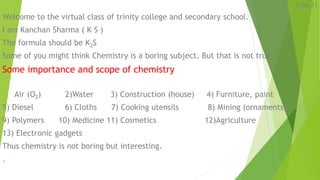
Welcome to the virtual class of trinity college and secondary school.
I am Kanchan Sharma ( K S )
The formula should be K2S
Some of you might think Chemistry is a boring subject. But that is not true
Some importance and scope of chemistry
1) Air (O2) 2)Water 3) Construction (house) 4) Furniture, paint
5) Diesel 6) Cloths 7) Cooking utensils 8) Mining (ornaments)
9) Polymers 10) Medicine 11) Cosmetics 12)Agriculture
13) Electronic gadgets
Thus chemistry is not boring but interesting.
.
WHAT IS CHEMISTRY?
Chemistry is the branch of science that deals with the study of composition, properties
and transformation of matter.
Matter is anything that occupies space, has mass and can be judged by one or more of
the five senses.
Chemistry is everything and vice versa.
The constituent of any matter or anything is atom, molecule or ions.
Atom – the smallest particle of an element which can take part in chemical reaction is
called an atom. It is neutral because the no. of proton( positive charge) and no. of
electron (negative charge) in an atom is always equal.
Molecule – the smallest particle of a substance (element or compound) which has its
independent existence is called molecule. Molecule of an element contains only one
type of atoms and molecule of a compound contains more than one type of atoms. Eg.
H2, P4, S8 etc.
H2O, NH3, CO2 etc.
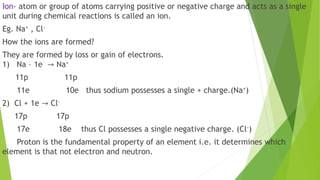
Ion- atom or group of atoms carrying positive or negative charge and acts as a single
unit during chemical reactions is called an ion.
Eg. Na+ , Cl-
How the ions are formed?
They are formed by loss or gain of electrons.
1) Na – 1e → Na+
11p 11p
11e 10e thus sodium possesses a single + charge.(Na+)
2) Cl + 1e → Cl-
17p 17p
17e 18e thus Cl possesses a single negative charge. (Cl-)
Proton is the fundamental property of an element i.e. it determines which
element is that not electron and neutron.
What happens when a proton is added to sodium atom?
Na + 1p →?
11p + 1p= 12p
11e 11e, it will be Mg+
The element will no longer be sodium but changes to Mg.
Atomic mass-it is the sum of the no. of proton and neutron.
The sum of no. does not give mass. It is the sum of mass of proton and neutron.
Mass of 1 proton = 1 amu
Mass of 1 neutron = 1 amu
Thus the no is equal to mass in amu.
Atomic mass of Na= 23 amu
Atomic mass of P = 31 amu
Is there any difference between the mass of Na and Na+?
Mass is the sum of proton and neutron because the mass of electron is negligible in
comparison to proton and neutron. Thus there is no remarkable difference in mass of
Na and Na+. Thus the mass will not differ by forming ions.
Hw
write atomic mass of all the elements having atomic no. 1 to 30 and Ag, Au, Br, I and
Hg.
Molecular mass
It is the sum of the atomic masses of all the atoms present in one molecule of the
substance.
Molecular mass o f H2O = 1x2 + 16 = 18 amu.
Hw
calculate the molecular mass of at least 10 different compounds you know.
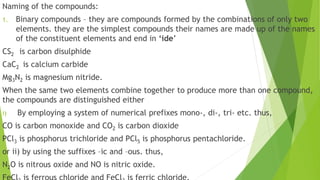
Naming of the compounds:
1. Binary compounds – they are compounds formed by the combinations of only two
elements. they are the simplest compounds their names are made up of the names
of the constituent elements and end in ‘ide’
CS2 is carbon disulphide
CaC2 is calcium carbide
Mg3N2 is magnesium nitride.
When the same two elements combine together to produce more than one compound,
the compounds are distinguished either
i) By employing a system of numerical prefixes mono-, di-, tri- etc. thus,
CO is carbon monoxide and CO2 is carbon dioxide
PCl3 is phosphorus trichloride and PCl5 is phosphorus pentachloride.
or ii) by using the suffixes –ic and –ous. thus,
N2O is nitrous oxide and NO is nitric oxide.
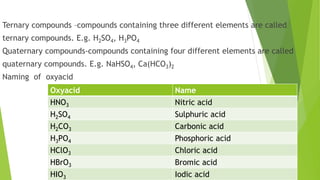
Ternary compounds –compounds containing three different elements are called
ternary compounds. E.g. H2SO4, H3PO4
Quaternary compounds-compounds containing four different elements are called
quaternary compounds. E.g. NaHSO4, Ca(HCO3)2
Naming of oxyacid
Oxyacid Name
HNO3 Nitric acid
H2SO4 Sulphuric acid
H2CO3 Carbonic acid
H3PO4 Phosphoric acid
HClO3 Chloric acid
HBrO3 Bromic acid
HIO3 Iodic acid
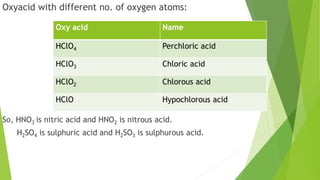
Oxyacid with different no. of oxygen atoms:
So, HNO3 is nitric acid and HNO2 is nitrous acid.
H2SO4 is sulphuric acid and H2SO3 is sulphurous acid.
Oxy acid Name
HClO4 Perchloric acid
HClO3 Chloric acid
HClO2 Chlorous acid
HClO Hypochlorous acid
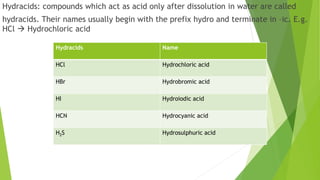
Hydracids: compounds which act as acid only after dissolution in water are called
hydracids. Their names usually begin with the prefix hydro and terminate in –ic. E.g.
HCl  Hydrochloric acid
Hydracids Name
HCl Hydrochloric acid
HBr Hydrobromic acid
HI Hydroiodic acid
HCN Hydrocyanic acid
H2S Hydrosulphuric acid
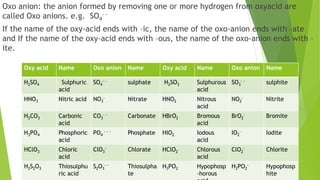
Oxo anion: the anion formed by removing one or more hydrogen from oxyacid are
called Oxo anions. e.g. SO4
- -
If the name of the oxy-acid ends with –ic, the name of the oxo-anion ends with –ate
and If the name of the oxy-acid ends with –ous, the name of the oxo-anion ends with –
ite.
Oxy acid Name Oxo anion Name Oxy acid Name Oxo anion Name
H2SO4 Sulphuric
acid
SO4
- - sulphate H2SO3 Sulphurous
acid
SO3
- - sulphite
HNO3 Nitric acid NO3
- Nitrate HNO2 Nitrous
acid
NO2
- Nitrite
H2CO3 Carbonic
acid
CO3
- - Carbonate HBrO2 Bromous
acid
BrO2
- Bromite
H3PO4 Phosphoric
acid
PO4
- - - Phosphate HIO2 Iodous
acid
IO2
- Iodite
HClO3 Chloric
acid
ClO3
- Chlorate HClO2 Chlorous
acid
ClO2
- Chlorite
H2S2O3 Thiosulphu
ric acid
S2O3
- - Thiosulpha
te
H3PO2 Hypophosp
-horous
H2PO2
- Hypophosp
hite
The names and formulae of some common compounds are given below.
General name Chemical name Formula General name Chemical name Formula
Common salt Sodium chloride NaCl Blue vitriol Copper sulphate
pentahydrate
CuSO4
water Hydrogen
monoxide
H2O Alumina Aluminium oxide Al2O3
Marble Calcium
carbonate
CaCO3 Dry ice Solid carbon
dioxide
CO2
Lime Calcium oxide CaO Calomel Mercurous
chloride
Hg2Cl2
Sand Silicon dioxide SiO2 Hydrolith Calcium hydride CaH2
Washing soda Sodium carbonate Na2CO3.10H2O Plaster of paris Calcium sulphate
semihydrate
CaSO4.
1
2
H2O
Baking powder Sodium
bicarbonate
NaHCO3 Gypsum Calcium sulphate
dihydrate
CaSO4.2H2O
Caustic soda Sodium hydroxide NaOH Epsom salt Magnesium
sulphate
heptahydrate
MgSO4.7H2O
Caustic potash Potassium KOH Quick silver mercury Hg

Chemistry Grade 11 Basic

  • 1.
    Class 11 Welcome tothe virtual class of trinity college and secondary school. I am Kanchan Sharma ( K S ) The formula should be K2S Some of you might think Chemistry is a boring subject. But that is not true Some importance and scope of chemistry 1) Air (O2) 2)Water 3) Construction (house) 4) Furniture, paint 5) Diesel 6) Cloths 7) Cooking utensils 8) Mining (ornaments) 9) Polymers 10) Medicine 11) Cosmetics 12)Agriculture 13) Electronic gadgets Thus chemistry is not boring but interesting. .
  • 2.
    WHAT IS CHEMISTRY? Chemistryis the branch of science that deals with the study of composition, properties and transformation of matter. Matter is anything that occupies space, has mass and can be judged by one or more of the five senses. Chemistry is everything and vice versa. The constituent of any matter or anything is atom, molecule or ions. Atom – the smallest particle of an element which can take part in chemical reaction is called an atom. It is neutral because the no. of proton( positive charge) and no. of electron (negative charge) in an atom is always equal. Molecule – the smallest particle of a substance (element or compound) which has its independent existence is called molecule. Molecule of an element contains only one type of atoms and molecule of a compound contains more than one type of atoms. Eg. H2, P4, S8 etc. H2O, NH3, CO2 etc.
  • 3.
    Ion- atom orgroup of atoms carrying positive or negative charge and acts as a single unit during chemical reactions is called an ion. Eg. Na+ , Cl- How the ions are formed? They are formed by loss or gain of electrons. 1) Na – 1e → Na+ 11p 11p 11e 10e thus sodium possesses a single + charge.(Na+) 2) Cl + 1e → Cl- 17p 17p 17e 18e thus Cl possesses a single negative charge. (Cl-) Proton is the fundamental property of an element i.e. it determines which element is that not electron and neutron.
  • 4.
    What happens whena proton is added to sodium atom? Na + 1p →? 11p + 1p= 12p 11e 11e, it will be Mg+ The element will no longer be sodium but changes to Mg. Atomic mass-it is the sum of the no. of proton and neutron. The sum of no. does not give mass. It is the sum of mass of proton and neutron. Mass of 1 proton = 1 amu Mass of 1 neutron = 1 amu Thus the no is equal to mass in amu. Atomic mass of Na= 23 amu Atomic mass of P = 31 amu
  • 5.
    Is there anydifference between the mass of Na and Na+? Mass is the sum of proton and neutron because the mass of electron is negligible in comparison to proton and neutron. Thus there is no remarkable difference in mass of Na and Na+. Thus the mass will not differ by forming ions. Hw write atomic mass of all the elements having atomic no. 1 to 30 and Ag, Au, Br, I and Hg. Molecular mass It is the sum of the atomic masses of all the atoms present in one molecule of the substance. Molecular mass o f H2O = 1x2 + 16 = 18 amu. Hw calculate the molecular mass of at least 10 different compounds you know.
  • 6.
    Naming of thecompounds: 1. Binary compounds – they are compounds formed by the combinations of only two elements. they are the simplest compounds their names are made up of the names of the constituent elements and end in ‘ide’ CS2 is carbon disulphide CaC2 is calcium carbide Mg3N2 is magnesium nitride. When the same two elements combine together to produce more than one compound, the compounds are distinguished either i) By employing a system of numerical prefixes mono-, di-, tri- etc. thus, CO is carbon monoxide and CO2 is carbon dioxide PCl3 is phosphorus trichloride and PCl5 is phosphorus pentachloride. or ii) by using the suffixes –ic and –ous. thus, N2O is nitrous oxide and NO is nitric oxide.
  • 7.
    Ternary compounds –compoundscontaining three different elements are called ternary compounds. E.g. H2SO4, H3PO4 Quaternary compounds-compounds containing four different elements are called quaternary compounds. E.g. NaHSO4, Ca(HCO3)2 Naming of oxyacid Oxyacid Name HNO3 Nitric acid H2SO4 Sulphuric acid H2CO3 Carbonic acid H3PO4 Phosphoric acid HClO3 Chloric acid HBrO3 Bromic acid HIO3 Iodic acid
  • 8.
    Oxyacid with differentno. of oxygen atoms: So, HNO3 is nitric acid and HNO2 is nitrous acid. H2SO4 is sulphuric acid and H2SO3 is sulphurous acid. Oxy acid Name HClO4 Perchloric acid HClO3 Chloric acid HClO2 Chlorous acid HClO Hypochlorous acid
  • 9.
    Hydracids: compounds whichact as acid only after dissolution in water are called hydracids. Their names usually begin with the prefix hydro and terminate in –ic. E.g. HCl  Hydrochloric acid Hydracids Name HCl Hydrochloric acid HBr Hydrobromic acid HI Hydroiodic acid HCN Hydrocyanic acid H2S Hydrosulphuric acid
  • 10.
    Oxo anion: theanion formed by removing one or more hydrogen from oxyacid are called Oxo anions. e.g. SO4 - - If the name of the oxy-acid ends with –ic, the name of the oxo-anion ends with –ate and If the name of the oxy-acid ends with –ous, the name of the oxo-anion ends with – ite. Oxy acid Name Oxo anion Name Oxy acid Name Oxo anion Name H2SO4 Sulphuric acid SO4 - - sulphate H2SO3 Sulphurous acid SO3 - - sulphite HNO3 Nitric acid NO3 - Nitrate HNO2 Nitrous acid NO2 - Nitrite H2CO3 Carbonic acid CO3 - - Carbonate HBrO2 Bromous acid BrO2 - Bromite H3PO4 Phosphoric acid PO4 - - - Phosphate HIO2 Iodous acid IO2 - Iodite HClO3 Chloric acid ClO3 - Chlorate HClO2 Chlorous acid ClO2 - Chlorite H2S2O3 Thiosulphu ric acid S2O3 - - Thiosulpha te H3PO2 Hypophosp -horous H2PO2 - Hypophosp hite
  • 11.
    The names andformulae of some common compounds are given below. General name Chemical name Formula General name Chemical name Formula Common salt Sodium chloride NaCl Blue vitriol Copper sulphate pentahydrate CuSO4 water Hydrogen monoxide H2O Alumina Aluminium oxide Al2O3 Marble Calcium carbonate CaCO3 Dry ice Solid carbon dioxide CO2 Lime Calcium oxide CaO Calomel Mercurous chloride Hg2Cl2 Sand Silicon dioxide SiO2 Hydrolith Calcium hydride CaH2 Washing soda Sodium carbonate Na2CO3.10H2O Plaster of paris Calcium sulphate semihydrate CaSO4. 1 2 H2O Baking powder Sodium bicarbonate NaHCO3 Gypsum Calcium sulphate dihydrate CaSO4.2H2O Caustic soda Sodium hydroxide NaOH Epsom salt Magnesium sulphate heptahydrate MgSO4.7H2O Caustic potash Potassium KOH Quick silver mercury Hg