Colligative Properties of
Solutions
Colligative Properties
 Colligative Property: A property that
depends only upon the number of solute
particles (concentration), and NOT upon
their identity.
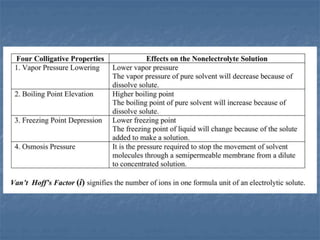
 Four Important Colligative Properties of
Solutions.
 Vapor-pressure lowering
 Boiling-point elevation
 Freezing-point depression
 Osmotic Pressure
Vapor-Pressure Lowering
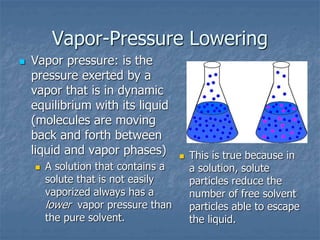
 Vapor pressure: is the
pressure exerted by a
vapor that is in dynamic
equilibrium with its liquid
(molecules are moving
back and forth between
liquid and vapor phases)
 A solution that contains a
solute that is not easily
vaporized always has a
lower vapor pressure than
the pure solvent.
 This is true because in
a solution, solute
particles reduce the
number of free solvent
particles able to escape
the liquid.
Vapor-Pressure Lowering
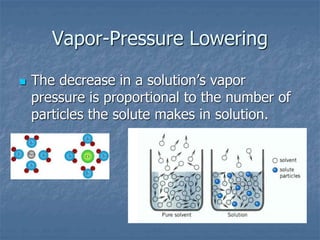
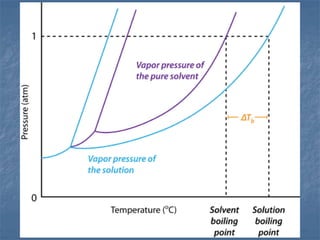
 The decrease in a solution’s vapor
pressure is proportional to the number of
particles the solute makes in solution.
Boiling-Point Elevation
 Boiling Point: The temperature at
which the vapor pressure of the
liquid phase equals atmospheric
pressure.
 Because of the decrease in vapor
pressure, additional kinetic energy
must be added to raise the vapor
pressure of the liquid phase of the
solution to atmospheric pressure to
initiate boiling.
Boiling-Point Elevation
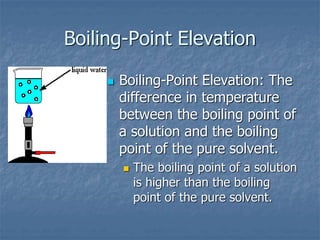
 Boiling-Point Elevation: The
difference in temperature
between the boiling point of
a solution and the boiling
point of the pure solvent.
 The boiling point of a solution
is higher than the boiling
point of the pure solvent.
Boiling-Point Elevation
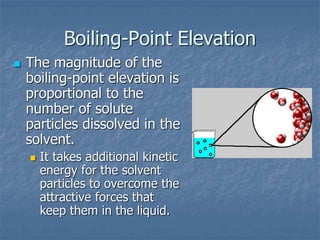
 The magnitude of the
boiling-point elevation is
proportional to the
number of solute
particles dissolved in the
solvent.
 It takes additional kinetic
energy for the solvent
particles to overcome the
attractive forces that
keep them in the liquid.
Boiling-Point Elevation
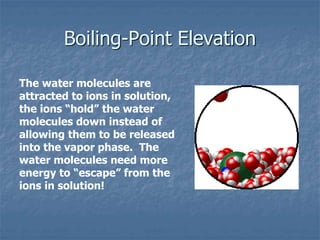
The water molecules are
attracted to ions in solution,
the ions “hold” the water
molecules down instead of
allowing them to be released
into the vapor phase. The
water molecules need more
energy to “escape” from the
ions in solution!
DOES ADDING SALT HELP
WATER BOIL?
Salt is often added to boiling water when
preparing spaghetti or other pasta. One
reason is to add flavor to the food. Some
people believe that the addition of salt
increases the boiling point of the water.
Technically, they are correct, but the
increase is rather small. You would need to
add over 100 grams of NaCl to a liter of
water to increase the boiling point a couple
of degrees, which is just not healthy.
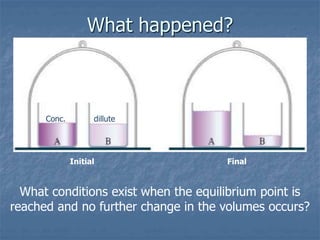
What happened?
Initial Final
Conc. dillute
What conditions exist when the equilibrium point is
reached and no further change in the volumes occurs?
Freezing-Point Depression
 Freezing-Point Depression: The difference
in temperature between the freezing point
of a solution and the freezing point of the
pure solvent (water).
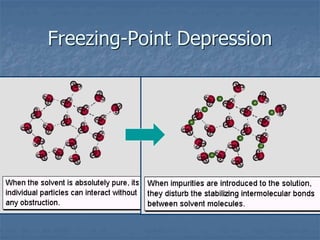
 The presence of a solute in water disrupts the
formation of the orderly pattern of ice.
Therefore more kinetic energy must be
withdrawn from a solution than from the pure
solvent to cause the solution to solidify.
Freezing-Point Depression
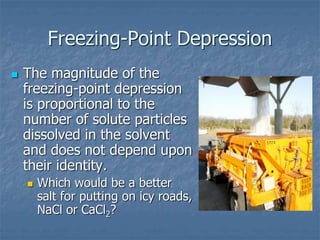
 The magnitude of the
freezing-point depression
is proportional to the
number of solute particles
dissolved in the solvent
and does not depend upon
their identity.
 Which would be a better
salt for putting on icy roads,
NaCl or CaCl2?
???
Why do we spread SALT on the
roads in the winter?
Chem 2 module 4 colligative properties.pptx

Chem 2 module 4 colligative properties.pptx

  • 1.
  • 4.
    Colligative Properties  ColligativeProperty: A property that depends only upon the number of solute particles (concentration), and NOT upon their identity.  Four Important Colligative Properties of Solutions.  Vapor-pressure lowering  Boiling-point elevation  Freezing-point depression  Osmotic Pressure
  • 5.
    Vapor-Pressure Lowering  Vaporpressure: is the pressure exerted by a vapor that is in dynamic equilibrium with its liquid (molecules are moving back and forth between liquid and vapor phases)  A solution that contains a solute that is not easily vaporized always has a lower vapor pressure than the pure solvent.  This is true because in a solution, solute particles reduce the number of free solvent particles able to escape the liquid.
  • 6.
    Vapor-Pressure Lowering  Thedecrease in a solution’s vapor pressure is proportional to the number of particles the solute makes in solution.
  • 9.
    Boiling-Point Elevation  BoilingPoint: The temperature at which the vapor pressure of the liquid phase equals atmospheric pressure.  Because of the decrease in vapor pressure, additional kinetic energy must be added to raise the vapor pressure of the liquid phase of the solution to atmospheric pressure to initiate boiling.
  • 10.
    Boiling-Point Elevation  Boiling-PointElevation: The difference in temperature between the boiling point of a solution and the boiling point of the pure solvent.  The boiling point of a solution is higher than the boiling point of the pure solvent.
  • 11.
    Boiling-Point Elevation  Themagnitude of the boiling-point elevation is proportional to the number of solute particles dissolved in the solvent.  It takes additional kinetic energy for the solvent particles to overcome the attractive forces that keep them in the liquid.
  • 12.
    Boiling-Point Elevation The watermolecules are attracted to ions in solution, the ions “hold” the water molecules down instead of allowing them to be released into the vapor phase. The water molecules need more energy to “escape” from the ions in solution!
  • 13.
    DOES ADDING SALTHELP WATER BOIL? Salt is often added to boiling water when preparing spaghetti or other pasta. One reason is to add flavor to the food. Some people believe that the addition of salt increases the boiling point of the water. Technically, they are correct, but the increase is rather small. You would need to add over 100 grams of NaCl to a liter of water to increase the boiling point a couple of degrees, which is just not healthy.
  • 14.
    What happened? Initial Final Conc.dillute What conditions exist when the equilibrium point is reached and no further change in the volumes occurs?
  • 15.
    Freezing-Point Depression  Freezing-PointDepression: The difference in temperature between the freezing point of a solution and the freezing point of the pure solvent (water).  The presence of a solute in water disrupts the formation of the orderly pattern of ice. Therefore more kinetic energy must be withdrawn from a solution than from the pure solvent to cause the solution to solidify.
  • 16.
  • 17.
    Freezing-Point Depression  Themagnitude of the freezing-point depression is proportional to the number of solute particles dissolved in the solvent and does not depend upon their identity.  Which would be a better salt for putting on icy roads, NaCl or CaCl2?
  • 18.
    ??? Why do wespread SALT on the roads in the winter?

Editor's Notes

  • #6 vapor pressure of a liquid is determined by how easily its molecules are able to escape the surface of the liquid and enter the gaseous phase.