By Logan Danielson
Electrochemistry
Oxidation Reduction chemistry (Electron Transfer)


Remember RedOx reactions must be balanced as two
 separate reactions, the
  Oxidation half reaction and the Reduction half reaction


  Oxidation- involves the loss of an electron : Oil
  Reduction- involves the gain of an electron: Rig
Electrical Chemical Cells
 Are split up to do the half reactions separately: an anode and a
  cathode

 The anode handles the oxidation
 The cathode handles the reduction

 Electrons flow from the anode to the cathode

 The two half reactions are connected by the wire to allow the
  electrons to flow and by a salt bridge
    The salt bridge prevents the build up of charge that would happen by
     the flow of electrons to the cathode
         Cations from the salt bridge will flow into the cathode to dissipate the electron
          charge build up from the presence of extra electrons in the cathode
         Anions from the salt bridge will flow into the anode to dissipate the electron
          charge build up from the absence of extra electrons in the anode
Galvonic cell / Voltaic Cell
It does the work and produces energy


Cell potential – electro motive force
  Electrical potential is measured in Volts, V
  It is related in dG
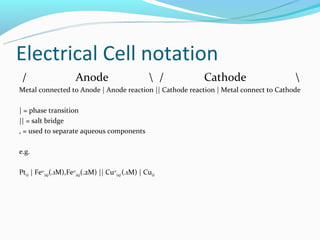
Electrical Cell notation
 /                       Anode                             /   Cathode               
Metal connected to Anode | Anode reaction || Cathode reaction | Metal connect to Cathode

| = phase transition
|| = salt bridge
, = used to separate aqueous components

e.g.

Pt(s) | Fe2+(aq)(.1M),Fe3+(aq)(.2M) || Cu2+(aq) (.1M) | Cu(s)
Standard Cells
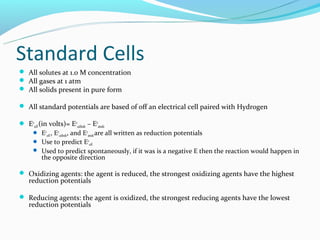
 All solutes at 1.0 M concentration
 All gases at 1 atm
 All solids present in pure form

 All standard potentials are based of off an electrical cell paired with Hydrogen

 Eocell (in volts)= Eocathode – Eoanode
    Eocell , Eocathode, and Eoanode are all written as reduction potentials
    Use to predict Eocell
    Used to predict spontaneously, if it was is a negative E then the reaction would happen in
          the opposite direction

 Oxidizing agents: the agent is reduced, the strongest oxidizing agents have the highest
   reduction potentials

 Reducing agents: the agent is oxidized, the strongest reducing agents have the lowest
   reduction potentials
Electrical Work
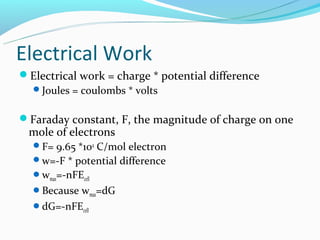
Electrical work = charge * potential difference
 Joules = coulombs * volts


Faraday constant, F, the magnitude of charge on one
 mole of electrons
  F= 9.65 *104 C/mol electron
  w=-F * potential difference
  wmax=-nFEcell
  Because wmax=dG
  dG=-nFEcell
Nerst equation
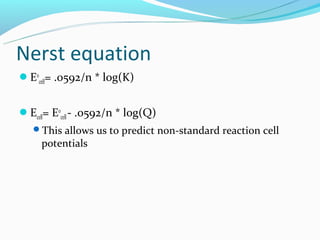
Eocell= .0592/n * log(K)


Ecell= Eocell - .0592/n * log(Q)
   This allows us to predict non-standard reaction cell
     potentials

Chemistry chapter 21

  • 1.
  • 2.
    Electrochemistry Oxidation Reduction chemistry(Electron Transfer) Remember RedOx reactions must be balanced as two separate reactions, the Oxidation half reaction and the Reduction half reaction Oxidation- involves the loss of an electron : Oil Reduction- involves the gain of an electron: Rig
  • 3.
    Electrical Chemical Cells Are split up to do the half reactions separately: an anode and a cathode  The anode handles the oxidation  The cathode handles the reduction  Electrons flow from the anode to the cathode  The two half reactions are connected by the wire to allow the electrons to flow and by a salt bridge  The salt bridge prevents the build up of charge that would happen by the flow of electrons to the cathode  Cations from the salt bridge will flow into the cathode to dissipate the electron charge build up from the presence of extra electrons in the cathode  Anions from the salt bridge will flow into the anode to dissipate the electron charge build up from the absence of extra electrons in the anode
  • 4.
    Galvonic cell /Voltaic Cell It does the work and produces energy Cell potential – electro motive force Electrical potential is measured in Volts, V It is related in dG
  • 5.
    Electrical Cell notation / Anode / Cathode Metal connected to Anode | Anode reaction || Cathode reaction | Metal connect to Cathode | = phase transition || = salt bridge , = used to separate aqueous components e.g. Pt(s) | Fe2+(aq)(.1M),Fe3+(aq)(.2M) || Cu2+(aq) (.1M) | Cu(s)
  • 6.
    Standard Cells  Allsolutes at 1.0 M concentration  All gases at 1 atm  All solids present in pure form  All standard potentials are based of off an electrical cell paired with Hydrogen  Eocell (in volts)= Eocathode – Eoanode  Eocell , Eocathode, and Eoanode are all written as reduction potentials  Use to predict Eocell  Used to predict spontaneously, if it was is a negative E then the reaction would happen in the opposite direction  Oxidizing agents: the agent is reduced, the strongest oxidizing agents have the highest reduction potentials  Reducing agents: the agent is oxidized, the strongest reducing agents have the lowest reduction potentials
  • 7.
    Electrical Work Electrical work= charge * potential difference Joules = coulombs * volts Faraday constant, F, the magnitude of charge on one mole of electrons F= 9.65 *104 C/mol electron w=-F * potential difference wmax=-nFEcell Because wmax=dG dG=-nFEcell
  • 8.
    Nerst equation Eocell= .0592/n* log(K) Ecell= Eocell - .0592/n * log(Q) This allows us to predict non-standard reaction cell potentials