Put Dej-udom
IB Chemistry
Voltaic cells
A voltaiccell consistof twodifferenthalf-cells,connected together to enable the electrons transferred
during the redox reaction to produce energy in the form of electricity. Anode is negative (Reduction).
Cathode ispositive (oxidation). Electron flows from anode to cathode. This lab will find out the factors
that impact to the flow of electron or current.
Experiment of Fe and Zn
Independent variable: the flow of electron
Dependent variable: temperature
Hypothesis:The more electricitywill flow whenthereismore temperature because temperature effect
to the rate of reaction so it might increase the amount of voltage it create.
Control variable: the beakers are the same size and contain same amount of solution, atmosphere
pressure
Equipment:2beakers, 1 piece of Zn, 1 piece of Fe, Volt meter, wires, balance, heating machine and u-
tube, cotton fabric
Procedure:
1. Put Fe into Fe solution of 100 ml and Zn to Zn solution of 100 ml.
2. Used the balance to measure 3 g of NaCl in 50g of water to make .5 mole of NaCl (M = 58.5
g/mole)
3. Put the NaCl solution in the u-tube to make a salt bridge between Zn and Fe solutions
4. Plug the cotton fabric in 2 sides of u- tube and put it in the Zn and Fe solutions
5. Connection wires to the volt meter and connection wires to the metals (Zn and Fe)
6. Start collection the data by the logger pro
7. Record it
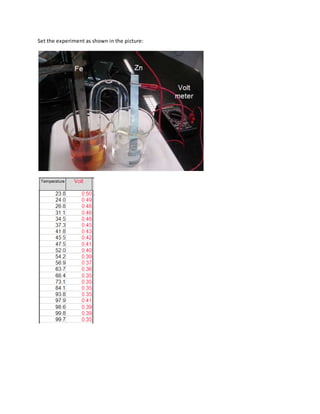
Set the experiment as shown in the picture:
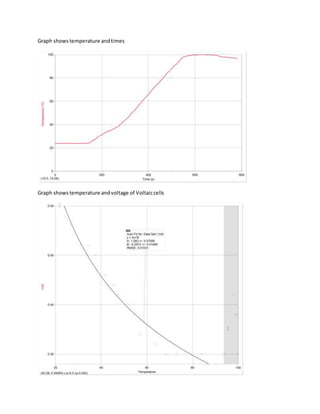
Graph showstemperature andtimes
Graph showstemperature andvoltage of Voltaiccells
Conclusion,Limitation and Evaluation
My hypothesisisthat more electricityflowsastemperature increases.
Accordingto the experiment,itshowsthattemperaturedecreasesvoltage.
Voltage is electromotiveforce whichisderivedfrom electricpotential difference,isanaverage flowof
electronina giventime.
Whentemperature risesup more than90, the voltage does notdecrease butitincreasedsoat thispoint
maybe the molecule isshakingsofastthatit makes anerror or fluctuation.
Limitation
The data is collectedmanuallysoitmightnotbe soaccurate, automation shouldbe used tocollect
temperature,voltageandtime,andthiswill helpstoconclude betterbecauseithasmore accurate
result.
Evaluation
As a result,temperaturecanbe lowertothe pointthatthe experimentcangenerate the mostvoltage.
From thisithelpspeople todecide touse the voltaiccell inthe mosteffective wayas people should
decrease the temperature tomake the mostvolt.
In conclusionwhen decreasedthe temperatureto0 degree Kelvinorabsolute zero, electroncanmove
fastestandproduce the bestvoltage.

Voltaic cells

  • 1.
    Put Dej-udom IB Chemistry Voltaiccells A voltaiccell consistof twodifferenthalf-cells,connected together to enable the electrons transferred during the redox reaction to produce energy in the form of electricity. Anode is negative (Reduction). Cathode ispositive (oxidation). Electron flows from anode to cathode. This lab will find out the factors that impact to the flow of electron or current. Experiment of Fe and Zn Independent variable: the flow of electron Dependent variable: temperature Hypothesis:The more electricitywill flow whenthereismore temperature because temperature effect to the rate of reaction so it might increase the amount of voltage it create. Control variable: the beakers are the same size and contain same amount of solution, atmosphere pressure Equipment:2beakers, 1 piece of Zn, 1 piece of Fe, Volt meter, wires, balance, heating machine and u- tube, cotton fabric Procedure: 1. Put Fe into Fe solution of 100 ml and Zn to Zn solution of 100 ml. 2. Used the balance to measure 3 g of NaCl in 50g of water to make .5 mole of NaCl (M = 58.5 g/mole) 3. Put the NaCl solution in the u-tube to make a salt bridge between Zn and Fe solutions 4. Plug the cotton fabric in 2 sides of u- tube and put it in the Zn and Fe solutions 5. Connection wires to the volt meter and connection wires to the metals (Zn and Fe) 6. Start collection the data by the logger pro 7. Record it
  • 2.
    Set the experimentas shown in the picture:
  • 3.
    Graph showstemperature andtimes Graphshowstemperature andvoltage of Voltaiccells
  • 4.
    Conclusion,Limitation and Evaluation Myhypothesisisthat more electricityflowsastemperature increases. Accordingto the experiment,itshowsthattemperaturedecreasesvoltage. Voltage is electromotiveforce whichisderivedfrom electricpotential difference,isanaverage flowof electronina giventime. Whentemperature risesup more than90, the voltage does notdecrease butitincreasedsoat thispoint maybe the molecule isshakingsofastthatit makes anerror or fluctuation. Limitation The data is collectedmanuallysoitmightnotbe soaccurate, automation shouldbe used tocollect temperature,voltageandtime,andthiswill helpstoconclude betterbecauseithasmore accurate result. Evaluation As a result,temperaturecanbe lowertothe pointthatthe experimentcangenerate the mostvoltage. From thisithelpspeople todecide touse the voltaiccell inthe mosteffective wayas people should decrease the temperature tomake the mostvolt. In conclusionwhen decreasedthe temperatureto0 degree Kelvinorabsolute zero, electroncanmove fastestandproduce the bestvoltage.