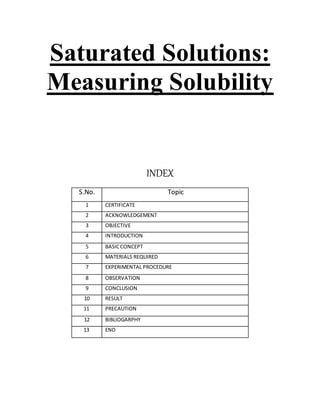
Saturated Solutions:
Measuring Solubility
INDEX
S.No. Topic
1 CERTIFICATE
2 ACKNOWLEDGEMENT
3 OBJECTIVE
4 INTRODUCTION
5 BASICCONCEPT
6 MATERIALS REQUIRED
7 EXPERIMENTAL PROCEDURE
8 OBSERVATION
9 CONCLUSION
10 RESULT
11 PRECAUTION
12 BIBLIOGARPHY
13 END
CERTIFICATE
This is to certify that the Project titled ‘Saturated solutions: Measuring
Solubility’ was completed under my guidance and supervision by Roll
No. _________ a student of XII SCI, CAMBRIDGE
INTERNATIONAL SCHOOL,DASUYA within the stipulated time as
prescribed by the CBSE.
ACKNOWLEDGEMENTS
I gratefully acknowledge my sincere thanks to our respected chemistry
teacher to Mr. LAXMAN SINGH RAWAT for her remarkable, valuable
guidance and supervision throughout the project work. I’m also most
indebted to Mr. LAXMAN SINGH RAWAT for his encouragement,
help, suggestion and readily helpful service in performing the
experiment.
OBJECTIVE
The goal of this project is to measure the solubility of some common
chemicals:
 Table salt (NaCl)
 Epsom salts (MgSO4)
 sugar (sucrose, C12H22O11)
Introduction
A good part of the substances we deal with in daily life,
such as milk, gasoline, shampoo, wood, steel and air are
mixtures. When the mixture is homogenous, that is to say,
when its componentsare intermingled evenly, it is called
a solution. There are various types of solutions, and these
can be categorized by state (gas, liquid, or solid). The
chart below gives some examples of solutionsin different
states. Many essential chemical reactions and natural
processes occur in liquid solutions, particularly those
containingwater (aqueoussolutions)because so many
things dissolve in water. In fact, water is sometimes
referred to as the universal solvent. The electrical charges
in water molecules help dissolve different kinds of
substances. Solutionsform when the force of attraction
between soluteand solvent is greater than the force of
attraction between the particles in the solute.
If one takes a moment to consider aqueoussolutions, one
quickly observes that they exhibit many interesting
properties. For example, the tap water in your kitchen
sink does not freeze at exactly 0°C.
Basic Concepts
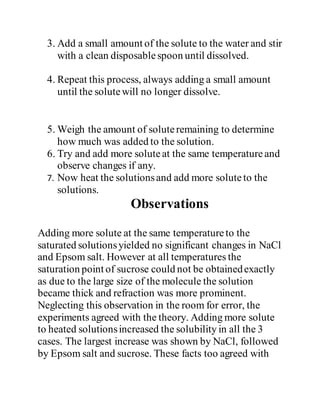
A saturated solution is a mixture in which no more solute
can be practicallydissolved in a solvent at a given
temperature. It is said practical because theoretically
infinite amount of solute can be added to a solvent, but
after a certain limit the earlier dissolved soluteparticles
start rearranging and come out at a constant rate. Hence
overall it appears that no solute is dissolved after a given
amount of soluteis dissolved.
This is known as a saturated solution. In an unsaturated
solution, if solute is dissolved in a solvent the solute
particles dissociate and mix with the solvent without the
re-arrangement of earlier dissolved soluteparticles.
Solubilitydependson various factors like the Ksp of the
salt, bond strength between the cation and anion,
covalency of the bond, extent of inter and intramolecular
hydrogen bonding, polarity, dipolemoment etc. Out of
these the conceptsof H-bonding, covalency, ionic bond
strength and polarityplay a major role if water is taken as
a solvent. Also physical conditionslike temperatureand
pressure also play very important roles as they affect the
kinetic energy of the molecules.
Materials and Equipment
To do this experiment following materials and equipment
are required:
•Distilled water
•Metric liquid measuring cup (or graduated cylinder)
•Three clean glass jars or beakers
•Non-iodized tablesalt (NaCl)
•Epsomsalts (MgSO4)
•Sugar (sucrose, C12H22O11)
•Disposable plastic spoons
•Thermometer
•Three shallow plates or saucers
•Oven
•Electronickitchen balance(accurateto 0.1 g)
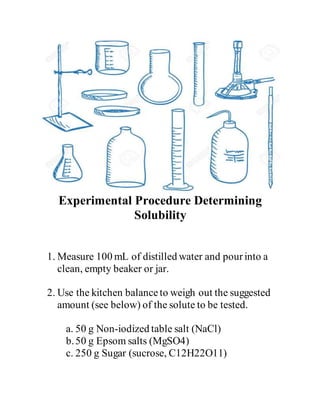
Experimental Procedure Determining
Solubility
1. Measure 100 mL of distilled water and pourinto a
clean, empty beaker or jar.
2. Use the kitchen balanceto weigh out the suggested
amount (see below) of the solute to be tested.
a. 50 g Non-iodized table salt (NaCl)
b.50 g Epsom salts (MgSO4)
c. 250 g Sugar (sucrose, C12H22O11)
3. Add a small amount of the solute to the water and stir
with a clean disposablespoon until dissolved.
4. Repeat this process, always adding a small amount
until the solutewill no longer dissolve.
5. Weigh the amount of soluteremaining to determine
how much was added to the solution.
6. Try and add more soluteat the same temperatureand
observe changes if any.
7. Now heat the solutionsand add more soluteto the
solutions.
Observations
Adding more solute at the same temperatureto the
saturated solutionsyielded no significant changes in NaCl
and Epsom salt. However at all temperatures the
saturation point of sucrose could not be obtainedexactly
as due to the large size of the molecule the solution
became thick and refraction was more prominent.
Neglecting this observation in the room for error, the
experiments agreed with the theory. Adding more solute
to heated solutionsincreased the solubility in all the 3
cases. The largest increase was shown by NaCl, followed
by Epsom salt and sucrose. These facts too agreed with
the theory as at high temperaturesthe kinetic energy of
molecules increases and the collisions are more effective.
Conclusions
The solubility of NaCl is the highest as it an ionic salt and
easily dissociates in water. Also since the size of both the
cation and anion are small, the collisions are more and
hence probabilityof dissociation is high.
The solubility of MgSO4 is also high as it is also an ionic
salt, but due to a larger anion, collisions are not very
effective.
The solubility of C12H22O11is the least as it a very large
moleculedue to which hydrogen bondingwith the water
molecules is not very effective.
Also due to the large number of carbon and oxygen
atoms, inter molecularH-bondingis more dominant than
intramolecularH-bonding.
Result
The saturated solutionsof NaCl, MgSO4 and
C12H22O11were made and observed. The observations
agreed with the related theory within the range of
experimental error.
Precautions
While adding the solute to the solvent, the solution
should be stirred slowly so as to avoid the formation
of any globules.
Stirring should not be vigorous as the kinetic energy
of the molecules might change due to which
solubilitycan increase.
While stirring, contact with the walls of the container
should be avoided as with every collision, an impulse
is generated which makes the dissolved solute
particles rearrange themselves. As a result solubility
can decrease.
The temperaturewhile conductingall the three
experiments should be approximately same. ^
 Epsomsalt should be first dried in order to remove
the water of crystallization (MgSO4.7H2O).
Bibliography:
INTERNET
MODERN ABC REFERENCEBOOK
TEACHER
ROLL NO.-
SUBMITTED BY-
SUBMITTED TO-
SIGNATURE(INTERNAL)-
SINGATURE(EXTERNAL)-

Saturated solutions

  • 1.
    Saturated Solutions: Measuring Solubility INDEX S.No.Topic 1 CERTIFICATE 2 ACKNOWLEDGEMENT 3 OBJECTIVE 4 INTRODUCTION 5 BASICCONCEPT 6 MATERIALS REQUIRED 7 EXPERIMENTAL PROCEDURE 8 OBSERVATION 9 CONCLUSION 10 RESULT 11 PRECAUTION 12 BIBLIOGARPHY 13 END
  • 2.
    CERTIFICATE This is tocertify that the Project titled ‘Saturated solutions: Measuring Solubility’ was completed under my guidance and supervision by Roll No. _________ a student of XII SCI, CAMBRIDGE INTERNATIONAL SCHOOL,DASUYA within the stipulated time as prescribed by the CBSE. ACKNOWLEDGEMENTS I gratefully acknowledge my sincere thanks to our respected chemistry teacher to Mr. LAXMAN SINGH RAWAT for her remarkable, valuable guidance and supervision throughout the project work. I’m also most indebted to Mr. LAXMAN SINGH RAWAT for his encouragement, help, suggestion and readily helpful service in performing the experiment. OBJECTIVE The goal of this project is to measure the solubility of some common chemicals:  Table salt (NaCl)  Epsom salts (MgSO4)  sugar (sucrose, C12H22O11)
  • 3.
    Introduction A good partof the substances we deal with in daily life, such as milk, gasoline, shampoo, wood, steel and air are mixtures. When the mixture is homogenous, that is to say, when its componentsare intermingled evenly, it is called a solution. There are various types of solutions, and these can be categorized by state (gas, liquid, or solid). The chart below gives some examples of solutionsin different states. Many essential chemical reactions and natural processes occur in liquid solutions, particularly those containingwater (aqueoussolutions)because so many things dissolve in water. In fact, water is sometimes referred to as the universal solvent. The electrical charges in water molecules help dissolve different kinds of substances. Solutionsform when the force of attraction between soluteand solvent is greater than the force of attraction between the particles in the solute. If one takes a moment to consider aqueoussolutions, one quickly observes that they exhibit many interesting properties. For example, the tap water in your kitchen sink does not freeze at exactly 0°C.
  • 4.
    Basic Concepts A saturatedsolution is a mixture in which no more solute can be practicallydissolved in a solvent at a given temperature. It is said practical because theoretically infinite amount of solute can be added to a solvent, but after a certain limit the earlier dissolved soluteparticles start rearranging and come out at a constant rate. Hence overall it appears that no solute is dissolved after a given amount of soluteis dissolved. This is known as a saturated solution. In an unsaturated solution, if solute is dissolved in a solvent the solute particles dissociate and mix with the solvent without the re-arrangement of earlier dissolved soluteparticles. Solubilitydependson various factors like the Ksp of the salt, bond strength between the cation and anion, covalency of the bond, extent of inter and intramolecular hydrogen bonding, polarity, dipolemoment etc. Out of these the conceptsof H-bonding, covalency, ionic bond strength and polarityplay a major role if water is taken as a solvent. Also physical conditionslike temperatureand pressure also play very important roles as they affect the kinetic energy of the molecules.
  • 5.
    Materials and Equipment Todo this experiment following materials and equipment are required: •Distilled water •Metric liquid measuring cup (or graduated cylinder) •Three clean glass jars or beakers •Non-iodized tablesalt (NaCl) •Epsomsalts (MgSO4) •Sugar (sucrose, C12H22O11) •Disposable plastic spoons •Thermometer •Three shallow plates or saucers •Oven •Electronickitchen balance(accurateto 0.1 g)
  • 6.
    Experimental Procedure Determining Solubility 1.Measure 100 mL of distilled water and pourinto a clean, empty beaker or jar. 2. Use the kitchen balanceto weigh out the suggested amount (see below) of the solute to be tested. a. 50 g Non-iodized table salt (NaCl) b.50 g Epsom salts (MgSO4) c. 250 g Sugar (sucrose, C12H22O11)
  • 7.
    3. Add asmall amount of the solute to the water and stir with a clean disposablespoon until dissolved. 4. Repeat this process, always adding a small amount until the solutewill no longer dissolve. 5. Weigh the amount of soluteremaining to determine how much was added to the solution. 6. Try and add more soluteat the same temperatureand observe changes if any. 7. Now heat the solutionsand add more soluteto the solutions. Observations Adding more solute at the same temperatureto the saturated solutionsyielded no significant changes in NaCl and Epsom salt. However at all temperatures the saturation point of sucrose could not be obtainedexactly as due to the large size of the molecule the solution became thick and refraction was more prominent. Neglecting this observation in the room for error, the experiments agreed with the theory. Adding more solute to heated solutionsincreased the solubility in all the 3 cases. The largest increase was shown by NaCl, followed by Epsom salt and sucrose. These facts too agreed with
  • 8.
    the theory asat high temperaturesthe kinetic energy of molecules increases and the collisions are more effective. Conclusions The solubility of NaCl is the highest as it an ionic salt and easily dissociates in water. Also since the size of both the cation and anion are small, the collisions are more and hence probabilityof dissociation is high. The solubility of MgSO4 is also high as it is also an ionic salt, but due to a larger anion, collisions are not very effective. The solubility of C12H22O11is the least as it a very large moleculedue to which hydrogen bondingwith the water molecules is not very effective.
  • 9.
    Also due tothe large number of carbon and oxygen atoms, inter molecularH-bondingis more dominant than intramolecularH-bonding. Result The saturated solutionsof NaCl, MgSO4 and C12H22O11were made and observed. The observations agreed with the related theory within the range of experimental error. Precautions While adding the solute to the solvent, the solution should be stirred slowly so as to avoid the formation of any globules. Stirring should not be vigorous as the kinetic energy of the molecules might change due to which solubilitycan increase. While stirring, contact with the walls of the container should be avoided as with every collision, an impulse is generated which makes the dissolved solute
  • 10.
    particles rearrange themselves.As a result solubility can decrease. The temperaturewhile conductingall the three experiments should be approximately same. ^  Epsomsalt should be first dried in order to remove the water of crystallization (MgSO4.7H2O). Bibliography: INTERNET MODERN ABC REFERENCEBOOK TEACHER
  • 11.
    ROLL NO.- SUBMITTED BY- SUBMITTEDTO- SIGNATURE(INTERNAL)- SINGATURE(EXTERNAL)-