Presentation Topic:Chemical Equilibrium
Present to
Name: Md. Mohin Uddin
Lecturer
Department of Textile
Engineering
Course code: CHE 101
Presented by
Name Id
Md.Torikul Islam 221002057
Md.Iftekhar Ul Alam 221002059
Forkan Hossen Noman 221002301
Department : Department of CSE
Batch : 221 (Day) Group:08
Section: CHE 101 (D11)
Content
 Reversible Reaction
 Irreversible reactions
 Chemical Equilibrium
The Equilibrium constant
 Relationship between 𝐾𝑐 and 𝐾𝑝
 Types Of Chemical Equilibrium
Reversible Reaction
A reaction in which reactants react to form products and at
the same time the products react to from reactants under the
same conditions is called reversible reactions.
In general, A+B C+D
E.g. 𝑁2(𝑔) + 3𝐻2(𝑔) 2𝑁𝐻3(𝑔)
Irreversible reactions
A reaction that takes in forward direction reactants forming
products but the reverse reaction does not take place is called an
irreversible reaction.
Example:
𝐴𝑔𝑁𝑂3(𝑎𝑞) + 𝑁𝑎𝐶𝑙(𝑎𝑞) 𝐴𝑔𝐶𝑙(𝑠) + 𝑁𝑎𝑁𝑂3(𝑎𝑞)
2𝑀𝑔(𝑠)+ 𝑂2(𝑔) 2𝑀𝑔𝑂(𝑠)
Chemical Equilibrium
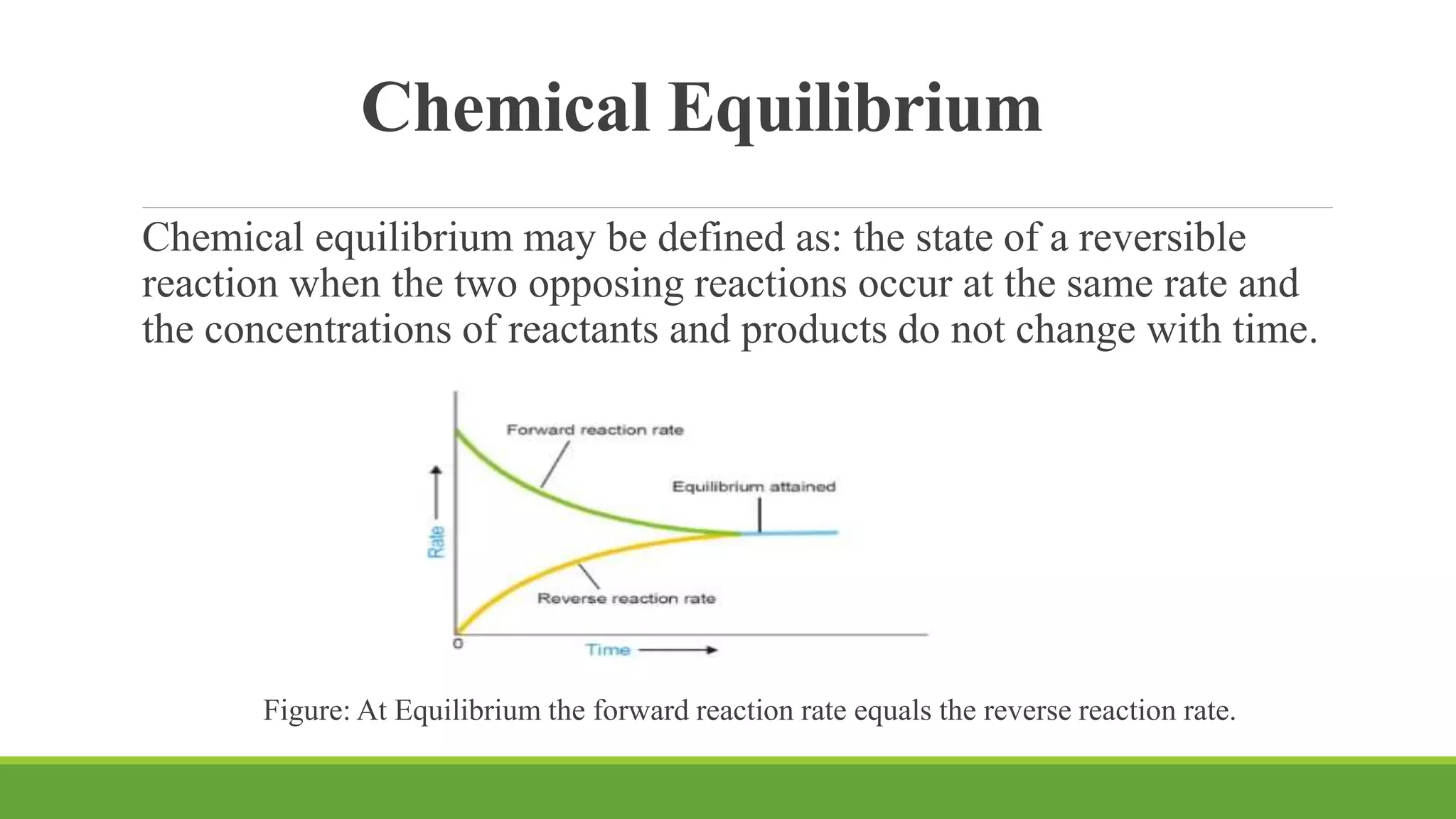
Chemical equilibrium may be defined as: the state of a reversible
reaction when the two opposing reactions occur at the same rate and
the concentrations of reactants and products do not change with time.
Figure: At Equilibrium the forward reaction rate equals the reverse reaction rate.
Md.Iftekhar Ul Alam
Id:221002059
The Equilibrium constant
To generalize this expression, consider the reaction
aA + bB cC + dD
The equilibrium expression for this reaction would be
𝐾𝑐=
[𝐶]𝑐[𝐷]𝑑
[𝐴]𝑎[𝐵]𝑏 K =
𝒑𝒓𝒐𝒅𝒖𝒄𝒕𝒔
𝒓𝒆𝒂𝒄𝒕𝒂𝒏𝒕𝒔
The Equilibrium constant
𝑁2𝑂4(𝑞) 2𝑁𝑂2(𝑞)
Forward Reaction Reverse Reaction
𝑁2𝑂4(𝑞) 2𝑁𝑂2(𝑞) 𝑁2𝑂4(𝑞) 2𝑁𝑂2(𝑞)
2𝑁𝑂2(𝑞) 𝑁2𝑂4(𝑞)
Rate Law Rate Law
rate = 𝑘𝑓[𝑁2𝑂4] rate = 𝑘𝑟[𝑁𝑂2]2
The Equilibrium constant
At equilibrium,
𝑟𝑎𝑡𝑒 𝑓 = 𝑟𝑎𝑡𝑒 𝑟
k𝑓 [𝑁2𝑂4] = 𝑘𝑟[𝑁𝑂2]2
Rearranging gives:
k𝑓
𝑘𝑟
=
[𝑁𝑂2]2
[𝑁2𝑂4]
The Equilibrium constant
Because pressure is proportional to concentration for gases
in a closed system, the equilibrium expression can also be
written in terms of partial pressures
𝐾𝑝=
( 𝑃𝐶)𝑐( 𝑃𝐷)𝑑
( 𝑃𝐴)𝑎( 𝑃𝐵)𝑏
Forkan Hossen Noman
Id:221002301
Relationship between 𝑲𝒄 and 𝑲𝒑
From the ideal gas law we know that,
PV = nRT
P =
𝑛
𝑉
RT = Pressure in terms of concentration
𝑃𝐴 =
𝑛𝐴
𝑉
RT = [A]RT
Relationship between 𝑲𝒄 and 𝑲𝒑
Substituting P=[A]RT into the expression for K, for each substance,
the relationship between K, and K, becomes
𝐾𝑝 = 𝐾𝑐(𝑅𝑇)∆𝑛
Where:
∆𝑛 = (moles of gaseous product) − (moles of gaseous reactant)
Hint: 'products-reactants' and 'products over reactants' is a common theme in
chemistry.
Types Of Chemical Equilibrium
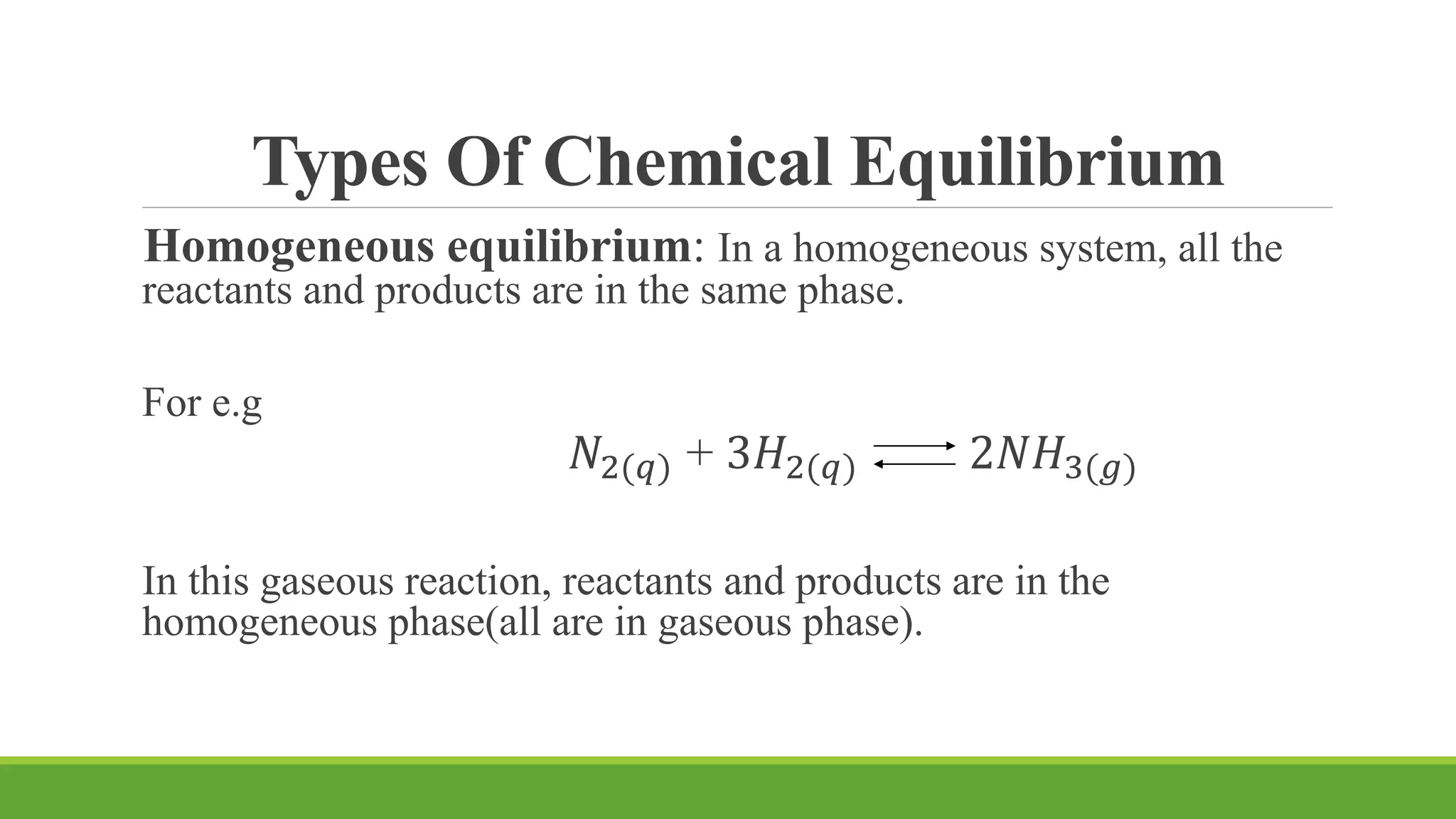
Homogeneous equilibrium: In a homogeneous system, all the
reactants and products are in the same phase.
For e.g
𝑁2(𝑞) + 3𝐻2(𝑞) 2𝑁𝐻3(𝑔)
In this gaseous reaction, reactants and products are in the
homogeneous phase(all are in gaseous phase).
Types Of Chemical Equilibrium
Heterogeneous equilibrium: when equilibrium reaction has its
reactants and products in different phases, it is termed as
heterogeneous equilibrium.
• The equilibrium between water vapour and liquid water in a closed
container is an example of heterogeneous equilibrium.
H₂O(1) H₂O(g)
THANK YOU

chemical equilibrium .pptx

  • 1.
    Presentation Topic:Chemical Equilibrium Presentto Name: Md. Mohin Uddin Lecturer Department of Textile Engineering Course code: CHE 101 Presented by Name Id Md.Torikul Islam 221002057 Md.Iftekhar Ul Alam 221002059 Forkan Hossen Noman 221002301 Department : Department of CSE Batch : 221 (Day) Group:08 Section: CHE 101 (D11)
  • 2.
    Content  Reversible Reaction Irreversible reactions  Chemical Equilibrium The Equilibrium constant  Relationship between 𝐾𝑐 and 𝐾𝑝  Types Of Chemical Equilibrium
  • 3.
    Reversible Reaction A reactionin which reactants react to form products and at the same time the products react to from reactants under the same conditions is called reversible reactions. In general, A+B C+D E.g. 𝑁2(𝑔) + 3𝐻2(𝑔) 2𝑁𝐻3(𝑔)
  • 4.
    Irreversible reactions A reactionthat takes in forward direction reactants forming products but the reverse reaction does not take place is called an irreversible reaction. Example: 𝐴𝑔𝑁𝑂3(𝑎𝑞) + 𝑁𝑎𝐶𝑙(𝑎𝑞) 𝐴𝑔𝐶𝑙(𝑠) + 𝑁𝑎𝑁𝑂3(𝑎𝑞) 2𝑀𝑔(𝑠)+ 𝑂2(𝑔) 2𝑀𝑔𝑂(𝑠)
  • 5.
    Chemical Equilibrium Chemical equilibriummay be defined as: the state of a reversible reaction when the two opposing reactions occur at the same rate and the concentrations of reactants and products do not change with time. Figure: At Equilibrium the forward reaction rate equals the reverse reaction rate.
  • 6.
  • 7.
    The Equilibrium constant Togeneralize this expression, consider the reaction aA + bB cC + dD The equilibrium expression for this reaction would be 𝐾𝑐= [𝐶]𝑐[𝐷]𝑑 [𝐴]𝑎[𝐵]𝑏 K = 𝒑𝒓𝒐𝒅𝒖𝒄𝒕𝒔 𝒓𝒆𝒂𝒄𝒕𝒂𝒏𝒕𝒔
  • 8.
    The Equilibrium constant 𝑁2𝑂4(𝑞)2𝑁𝑂2(𝑞) Forward Reaction Reverse Reaction 𝑁2𝑂4(𝑞) 2𝑁𝑂2(𝑞) 𝑁2𝑂4(𝑞) 2𝑁𝑂2(𝑞) 2𝑁𝑂2(𝑞) 𝑁2𝑂4(𝑞) Rate Law Rate Law rate = 𝑘𝑓[𝑁2𝑂4] rate = 𝑘𝑟[𝑁𝑂2]2
  • 9.
    The Equilibrium constant Atequilibrium, 𝑟𝑎𝑡𝑒 𝑓 = 𝑟𝑎𝑡𝑒 𝑟 k𝑓 [𝑁2𝑂4] = 𝑘𝑟[𝑁𝑂2]2 Rearranging gives: k𝑓 𝑘𝑟 = [𝑁𝑂2]2 [𝑁2𝑂4]
  • 10.
    The Equilibrium constant Becausepressure is proportional to concentration for gases in a closed system, the equilibrium expression can also be written in terms of partial pressures 𝐾𝑝= ( 𝑃𝐶)𝑐( 𝑃𝐷)𝑑 ( 𝑃𝐴)𝑎( 𝑃𝐵)𝑏
  • 11.
  • 12.
    Relationship between 𝑲𝒄and 𝑲𝒑 From the ideal gas law we know that, PV = nRT P = 𝑛 𝑉 RT = Pressure in terms of concentration 𝑃𝐴 = 𝑛𝐴 𝑉 RT = [A]RT
  • 13.
    Relationship between 𝑲𝒄and 𝑲𝒑 Substituting P=[A]RT into the expression for K, for each substance, the relationship between K, and K, becomes 𝐾𝑝 = 𝐾𝑐(𝑅𝑇)∆𝑛 Where: ∆𝑛 = (moles of gaseous product) − (moles of gaseous reactant) Hint: 'products-reactants' and 'products over reactants' is a common theme in chemistry.
  • 14.
    Types Of ChemicalEquilibrium Homogeneous equilibrium: In a homogeneous system, all the reactants and products are in the same phase. For e.g 𝑁2(𝑞) + 3𝐻2(𝑞) 2𝑁𝐻3(𝑔) In this gaseous reaction, reactants and products are in the homogeneous phase(all are in gaseous phase).
  • 15.
    Types Of ChemicalEquilibrium Heterogeneous equilibrium: when equilibrium reaction has its reactants and products in different phases, it is termed as heterogeneous equilibrium. • The equilibrium between water vapour and liquid water in a closed container is an example of heterogeneous equilibrium. H₂O(1) H₂O(g)
  • 16.