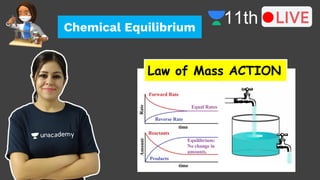
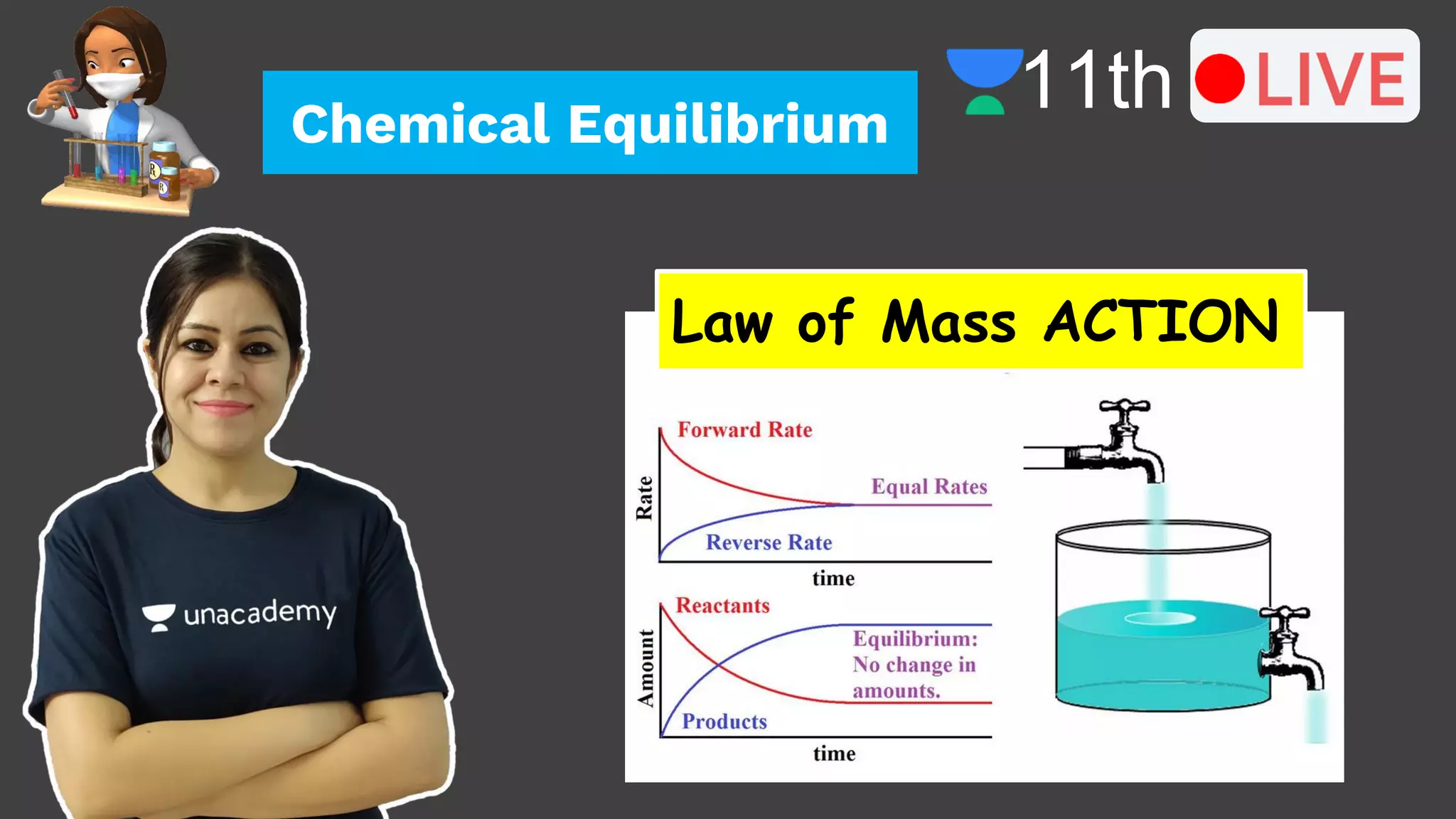
Chemical Equilibrium
11th
Law of Mass ACTION
Welcome to the Class!
Dear Learners,
I’m MONICA BEDI
Chemistry Educator (Decade+ Exp)
Ph.D Chemistry
TOPMOST Educator @ Unacademy
EDUCATOR
CODE
MBLIVE
GET 10% Off on
Unacademy Subscription
Telegram Channel
Unacademy Class 11 & 12
https://t.me/joinchat/QekesPpVTFswYmQ9
Download Notes
Just Scan
Days Class 11th Class 12th
Monday 3 PM
Tuesday 9 PM
Wednesday* 8 PM JEE -
Thursday 9 PM
Friday 3 PM 9 PM
Saturday 3 PM -
Unacademy Ask a Doubt
Ask unlimited doubts Ask doubts at
any time
Get high-quality video
solutions in English
& Hindi
Receive exact matches
for questions
Obtain instant and
accurate solutions to
lakhs of questions
Get assistance with
homework
MBLIVE
Live polls & Leaderboard
LIVE Doubt Clearing Sessions
Unacademy Subscription
LIVE Classes
Interact with Educator
CBSE Class 11 Term 2
Batch Course
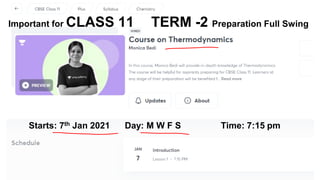
Starts: 7th Jan 2021 Day: M W F S Time: 7:15 pm
Important for CLASS 11 TERM -2 Preparation Full Swing
MBLIVE
Plus/ Iconic
Subscription
MBLIVE
MBLIVE
IIT-JEE/NEET
Plus Subscription
MBLIVE
EXCLUSIVE
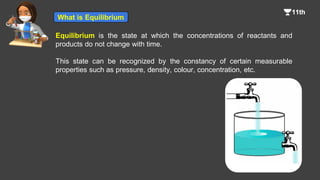
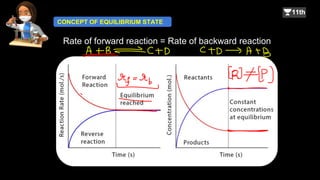
Equilibrium is the state at which the concentrations of reactants and
products do not change with time.
This state can be recognized by the constancy of certain measurable
properties such as pressure, density, colour, concentration, etc.
What is Equilibrium
..these viral ones
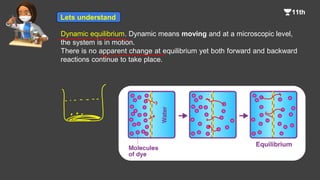
Dynamic equilibrium. Dynamic means moving and at a microscopic level,
the system is in motion.
There is no apparent change at equilibrium yet both forward and backward
reactions continue to take place.
Lets understand
Lets understand
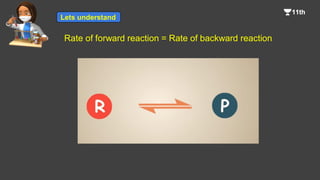
Rate of forward reaction = Rate of backward reaction
Lets understand
CONCEPT OF EQUILIBRIUM STATE
Rate of forward reaction = Rate of backward reaction
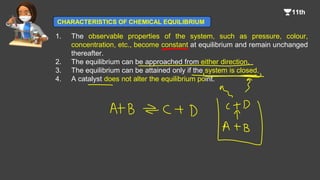
1. The observable properties of the system, such as pressure, colour,
concentration, etc., become constant at equilibrium and remain unchanged
thereafter.
2. The equilibrium can be approached from either direction.
3. The equilibrium can be attained only if the system is closed.
4. A catalyst does not alter the equilibrium point.
CHARACTERISTICS OF CHEMICAL EQUILIBRIUM
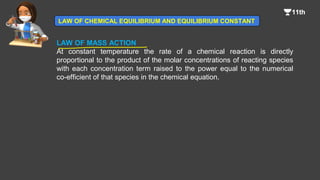
LAW OF MASS ACTION
At constant temperature the rate of a chemical reaction is directly
proportional to the product of the molar concentrations of reacting species
with each concentration term raised to the power equal to the numerical
co-efficient of that species in the chemical equation.
LAW OF CHEMICAL EQUILIBRIUM AND EQUILIBRIUM CONSTANT
For any general reaction,
aA + bB-------> Products
The law of mass action may be written as
Rate = k [A]a[B]b
LAW OF MASS ACTION
LAW OF MASS ACTION
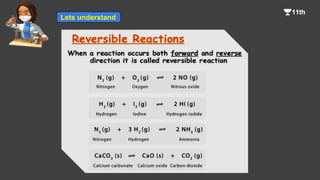
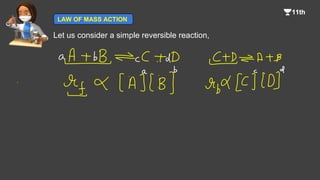
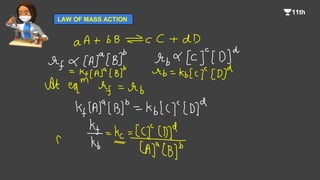
Let us consider a simple reversible reaction,
LAW OF MASS ACTION
LAW OF MASS ACTION
LAW OF MASS ACTION
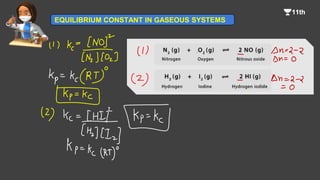
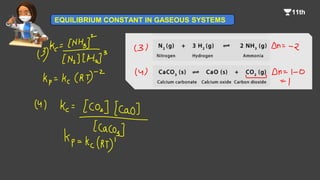
EQUILIBRIUM CONSTANT IN GASEOUS SYSTEMS
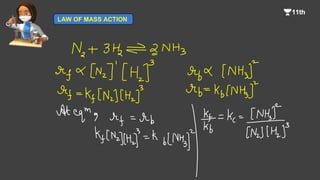
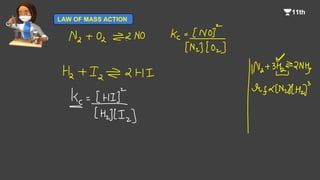
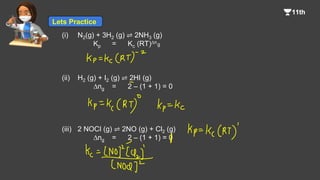
(i) N2(g) + 3H2 (g) ⇌ 2NH3 (g)
Kp = Kc (RT)Dn
(ii) H2 (g) + I2 (g) ⇌ 2HI (g)
Dng = 2 – (1 + 1) = 0
(iii) 2 NOCI (g) ⇌ 2NO (g) + Cl2 (g)
Dng = 2 – (1 + 1) = 0
g
Lets Practice
By applying law of mass action to a reversible reaction, at equilibrium, it is
possible to derive a simple mathematical expression known as law of
chemical equilibrium.
Let us consider a simple reversible reaction,
A + B  C + D
Rate of forward reaction  [A][B]
= kf [A][B]
where kf is the rate constant for the forward reaction.
Similarly,
Rate of backward reaction  [C][D]
= kb[C][D]
where kb is the rate constant for the backward.
LAW OF MASS ACTION: Application
Rate of forward reaction = Rate of backward reaction.
 kf[A][B] = kb[C][D]
or
Since kf and kb are constants, therefore, the ratio kf/kb is also constant and
is represented by Kc.
  
  
f
b
k C D
k A B

  
  
f
c
b
k C D
K
k A B
 
LAW OF MASS ACTION: Application
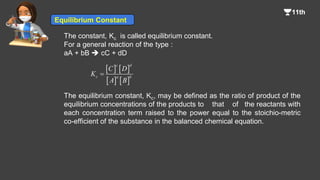
The constant, Kc is called equilibrium constant.
For a general reaction of the type :
aA + bB  cC + dD
The equilibrium constant, Kc, may be defined as the ratio of product of the
equilibrium concentrations of the products to that of the reactants with
each concentration term raised to the power equal to the stoichio-metric
co-efficient of the substance in the balanced chemical equation.
   
   
c d
c a b
C D
K
A B

Equilibrium Constant
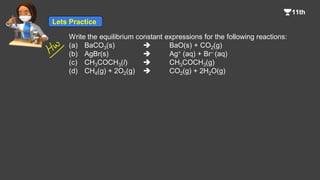
Write the equilibrium constant expressions for the following reactions:
(a) BaCO3(s)  BaO(s) + CO2(g)
(b) AgBr(s)  Ag+ (aq) + Br– (aq)
(c) CH3COCH3(l)  CH3COCH3(g)
(d) CH4(g) + 2O2(g)  CO2(g) + 2H2O(g)
Lets Practice
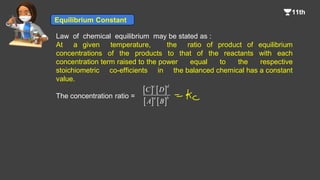
Law of chemical equilibrium may be stated as :
At a given temperature, the ratio of product of equilibrium
concentrations of the products to that of the reactants with each
concentration term raised to the power equal to the respective
stoichiometric co-efficients in the balanced chemical has a constant
value.
The concentration ratio =
   
   
c d
a b
C D
A B
Equilibrium Constant
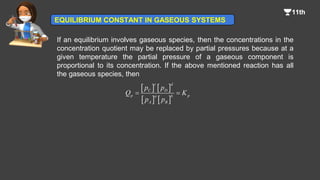
If an equilibrium involves gaseous species, then the concentrations in the
concentration quotient may be replaced by partial pressures because at a
given temperature the partial pressure of a gaseous component is
proportional to its concentration. If the above mentioned reaction has all
the gaseous species, then
   
   
c d
C D
p p
a b
A B
p p
Q K
p p
 
EQUILIBRIUM CONSTANT IN GASEOUS SYSTEMS
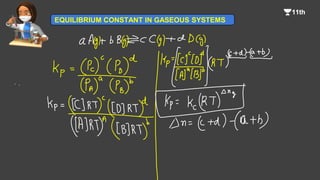
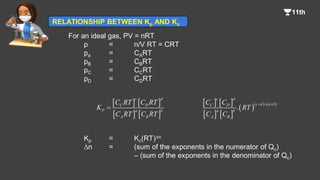
For an ideal gas, PV = nRT
p = n/V RT = CRT
pa = CART
pB = CBRT
pC = CCRT
pD = CDRT
Kp = Kc(RT)Dn
Dn = (sum of the exponents in the numerator of Qc)
– (sum of the exponents in the denominator of Qc)
   
   
c d
C D
P a b
A B
C RT C RT
K
C RT C RT

   
   
    
.
c d
c d a b
C D
a b
A B
C C
RT
C C
  
RELATIONSHIP BETWEEN Kp AND Kc
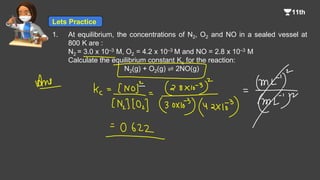
1. At equilibrium, the concentrations of N2, O2 and NO in a sealed vessel at
800 K are :
N2 = 3.0 x 10⁻³ M, O2 = 4.2 x 10⁻³ M and NO = 2.8 x 10⁻³ M
Calculate the equilibrium constant Kc for the reaction:
N2(g) + O2(g) ⇌ 2NO(g)
Lets Practice
2. What is Kc for the following equilibrium, when the equilibrium
concentration of each substance is
[SO2] = 0.60 M, (O2) = 0.82 M and (SO3] = 1.90 M
2SO2(g) + O2(g) ⇌ 2SO3(g)
Lets Practice
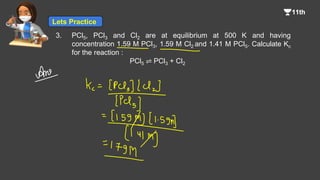
3. PCl5, PCl3 and Cl2 are at equilibrium at 500 K and having
concentration 1.59 M PCl3, 1.59 M Cl2 and 1.41 M PCl5. Calculate Kc
for the reaction :
PCl5 ⇌ PCl3 + Cl2
Lets Practice
Days Class 11th Class 12th
Monday 3 PM
Tuesday 9 PM
Wednesday* 8 PM JEE -
Thursday 9 PM
Friday 3 PM 9 PM
Saturday 3 PM -
Unacademy Ask a Doubt
Ask unlimited doubts Ask doubts at
any time
Get high-quality video
solutions in English
& Hindi
Receive exact matches
for questions
Obtain instant and
accurate solutions to
lakhs of questions
Get assistance with
homework
MBLIVE
Live polls & Leaderboard
LIVE Doubt Clearing Sessions
Unacademy Subscription
LIVE Classes
Interact with Educator
CBSE Class 11 Term 2
Batch Course
Starts: 7th Jan 2021 Day: M W F S Time: 7:15 pm
Important for CLASS 11 TERM -2 Preparation Full Swing
MBLIVE
Plus/ Iconic
Subscription
MBLIVE
MBLIVE
IIT-JEE/NEET
Plus Subscription
MBLIVE
EXCLUSIVE
Step 2
Step 1 Step 2 Step 3 Step 4 Step 5
EXCLUSIVE
Chemical Equilibruim lecture 2 8 Jan.pdf

Chemical Equilibruim lecture 2 8 Jan.pdf

  • 1.
  • 2.
    Welcome to theClass! Dear Learners, I’m MONICA BEDI Chemistry Educator (Decade+ Exp) Ph.D Chemistry TOPMOST Educator @ Unacademy EDUCATOR CODE MBLIVE GET 10% Off on Unacademy Subscription
  • 3.
    Telegram Channel Unacademy Class11 & 12 https://t.me/joinchat/QekesPpVTFswYmQ9
  • 4.
  • 5.
    Days Class 11thClass 12th Monday 3 PM Tuesday 9 PM Wednesday* 8 PM JEE - Thursday 9 PM Friday 3 PM 9 PM Saturday 3 PM -
  • 6.
    Unacademy Ask aDoubt Ask unlimited doubts Ask doubts at any time Get high-quality video solutions in English & Hindi Receive exact matches for questions Obtain instant and accurate solutions to lakhs of questions Get assistance with homework MBLIVE
  • 12.
    Live polls &Leaderboard LIVE Doubt Clearing Sessions Unacademy Subscription LIVE Classes Interact with Educator
  • 14.
    CBSE Class 11Term 2 Batch Course
  • 15.
    Starts: 7th Jan2021 Day: M W F S Time: 7:15 pm Important for CLASS 11 TERM -2 Preparation Full Swing
  • 16.
  • 17.
  • 18.
  • 19.
    Equilibrium is thestate at which the concentrations of reactants and products do not change with time. This state can be recognized by the constancy of certain measurable properties such as pressure, density, colour, concentration, etc. What is Equilibrium
  • 20.
  • 21.
    Dynamic equilibrium. Dynamicmeans moving and at a microscopic level, the system is in motion. There is no apparent change at equilibrium yet both forward and backward reactions continue to take place. Lets understand
  • 22.
  • 23.
    Rate of forwardreaction = Rate of backward reaction Lets understand
  • 24.
    CONCEPT OF EQUILIBRIUMSTATE Rate of forward reaction = Rate of backward reaction
  • 25.
    1. The observableproperties of the system, such as pressure, colour, concentration, etc., become constant at equilibrium and remain unchanged thereafter. 2. The equilibrium can be approached from either direction. 3. The equilibrium can be attained only if the system is closed. 4. A catalyst does not alter the equilibrium point. CHARACTERISTICS OF CHEMICAL EQUILIBRIUM
  • 26.
    LAW OF MASSACTION At constant temperature the rate of a chemical reaction is directly proportional to the product of the molar concentrations of reacting species with each concentration term raised to the power equal to the numerical co-efficient of that species in the chemical equation. LAW OF CHEMICAL EQUILIBRIUM AND EQUILIBRIUM CONSTANT
  • 27.
    For any generalreaction, aA + bB-------> Products The law of mass action may be written as Rate = k [A]a[B]b LAW OF MASS ACTION
  • 28.
    LAW OF MASSACTION Let us consider a simple reversible reaction,
  • 29.
  • 30.
  • 31.
  • 32.
    EQUILIBRIUM CONSTANT INGASEOUS SYSTEMS
  • 33.
    EQUILIBRIUM CONSTANT INGASEOUS SYSTEMS
  • 34.
    EQUILIBRIUM CONSTANT INGASEOUS SYSTEMS
  • 35.
    EQUILIBRIUM CONSTANT INGASEOUS SYSTEMS
  • 36.
    EQUILIBRIUM CONSTANT INGASEOUS SYSTEMS
  • 37.
    (i) N2(g) +3H2 (g) ⇌ 2NH3 (g) Kp = Kc (RT)Dn (ii) H2 (g) + I2 (g) ⇌ 2HI (g) Dng = 2 – (1 + 1) = 0 (iii) 2 NOCI (g) ⇌ 2NO (g) + Cl2 (g) Dng = 2 – (1 + 1) = 0 g Lets Practice
  • 38.
    By applying lawof mass action to a reversible reaction, at equilibrium, it is possible to derive a simple mathematical expression known as law of chemical equilibrium. Let us consider a simple reversible reaction, A + B  C + D Rate of forward reaction  [A][B] = kf [A][B] where kf is the rate constant for the forward reaction. Similarly, Rate of backward reaction  [C][D] = kb[C][D] where kb is the rate constant for the backward. LAW OF MASS ACTION: Application
  • 39.
    Rate of forwardreaction = Rate of backward reaction. kf[A][B] = kb[C][D] or Since kf and kb are constants, therefore, the ratio kf/kb is also constant and is represented by Kc.       f b k C D k A B        f c b k C D K k A B   LAW OF MASS ACTION: Application
  • 40.
    The constant, Kcis called equilibrium constant. For a general reaction of the type : aA + bB  cC + dD The equilibrium constant, Kc, may be defined as the ratio of product of the equilibrium concentrations of the products to that of the reactants with each concentration term raised to the power equal to the stoichio-metric co-efficient of the substance in the balanced chemical equation.         c d c a b C D K A B  Equilibrium Constant
  • 41.
    Write the equilibriumconstant expressions for the following reactions: (a) BaCO3(s)  BaO(s) + CO2(g) (b) AgBr(s)  Ag+ (aq) + Br– (aq) (c) CH3COCH3(l)  CH3COCH3(g) (d) CH4(g) + 2O2(g)  CO2(g) + 2H2O(g) Lets Practice
  • 42.
    Law of chemicalequilibrium may be stated as : At a given temperature, the ratio of product of equilibrium concentrations of the products to that of the reactants with each concentration term raised to the power equal to the respective stoichiometric co-efficients in the balanced chemical has a constant value. The concentration ratio =         c d a b C D A B Equilibrium Constant
  • 43.
    If an equilibriuminvolves gaseous species, then the concentrations in the concentration quotient may be replaced by partial pressures because at a given temperature the partial pressure of a gaseous component is proportional to its concentration. If the above mentioned reaction has all the gaseous species, then         c d C D p p a b A B p p Q K p p   EQUILIBRIUM CONSTANT IN GASEOUS SYSTEMS
  • 44.
    For an idealgas, PV = nRT p = n/V RT = CRT pa = CART pB = CBRT pC = CCRT pD = CDRT Kp = Kc(RT)Dn Dn = (sum of the exponents in the numerator of Qc) – (sum of the exponents in the denominator of Qc)         c d C D P a b A B C RT C RT K C RT C RT               . c d c d a b C D a b A B C C RT C C    RELATIONSHIP BETWEEN Kp AND Kc
  • 45.
    1. At equilibrium,the concentrations of N2, O2 and NO in a sealed vessel at 800 K are : N2 = 3.0 x 10⁻³ M, O2 = 4.2 x 10⁻³ M and NO = 2.8 x 10⁻³ M Calculate the equilibrium constant Kc for the reaction: N2(g) + O2(g) ⇌ 2NO(g) Lets Practice
  • 46.
    2. What isKc for the following equilibrium, when the equilibrium concentration of each substance is [SO2] = 0.60 M, (O2) = 0.82 M and (SO3] = 1.90 M 2SO2(g) + O2(g) ⇌ 2SO3(g) Lets Practice
  • 47.
    3. PCl5, PCl3and Cl2 are at equilibrium at 500 K and having concentration 1.59 M PCl3, 1.59 M Cl2 and 1.41 M PCl5. Calculate Kc for the reaction : PCl5 ⇌ PCl3 + Cl2 Lets Practice
  • 49.
    Days Class 11thClass 12th Monday 3 PM Tuesday 9 PM Wednesday* 8 PM JEE - Thursday 9 PM Friday 3 PM 9 PM Saturday 3 PM -
  • 50.
    Unacademy Ask aDoubt Ask unlimited doubts Ask doubts at any time Get high-quality video solutions in English & Hindi Receive exact matches for questions Obtain instant and accurate solutions to lakhs of questions Get assistance with homework MBLIVE
  • 56.
    Live polls &Leaderboard LIVE Doubt Clearing Sessions Unacademy Subscription LIVE Classes Interact with Educator
  • 58.
    CBSE Class 11Term 2 Batch Course
  • 59.
    Starts: 7th Jan2021 Day: M W F S Time: 7:15 pm Important for CLASS 11 TERM -2 Preparation Full Swing
  • 60.
  • 61.
  • 62.
  • 63.
    Step 2 Step 1Step 2 Step 3 Step 4 Step 5
  • 64.