Mettu University
College of Engineering and Technology
Chemical Engineering Department
Lecture Note on Chemical Engineering Apparatus Design
Targeted group- 4th year chemical engineering students
By Muktar A. (2014/2022)
We are dedicatedtoservethecommunity
Chapter-1
Mechanical Design of
Process Equipment
Warm-up questions (learning objective)
•What is pressure vessel
•What factors a process engineer must consider when setting
specifications for a pressure vessel
•How pressure vessels are designed and what determines the
vessel wall thickness
•How the ASME Boiler and Pressure Vessel Code is used in
pressure vessel design
 Mechanical Design of Process Equipment:
This chapter covers those aspects of the mechanical
design of chemical plant that are of particular interest to
chemical engineers.
The main topic considered is the design of pressure
vessels.
The chemical engineer will not usually be called on to
undertake the detailed mechanical design of a pressure
vessel.
Introduction
……Continued
 Vessel design is a specialised subject, and will be carried
out by mechanical engineers who are conversant with the
current design codes and practices, and methods of stress
analysis.
 However, the chemical engineer will be responsible for
developing and specifying the basic design information for
a particular vessel, and needs to have a general
appreciation of pressure vessel design to work effectively
with the specialist designer.
……Continued
The basic data needed by the specialist designer will be:
Vessel function
Process materials and services
Operating and design temperature and pressure
Materials of construction
Vessel dimensions and orientation
Type of vessel heads to be used
Openings and connections required
Specification of heating and cooling jackets or coils
Type of agitator
Specification of internal fittings
 Design of Pressure Vessels
Introduction
 Pressure vessels are an integral part of many manufacturing facilities and
processing plants, enabling the safe storage of pressurized liquids and gases.
 Pressure Vessels are containers which are designed to hold liquids, vapors, or
gases at high pressures, usually above 15 psig. Examples of common pressure
vessels used in the petroleum refining and chemical processing industries
 From industrial boilers and bottles to gasoline tankers pressure vessels operate
in a wide array of potentially hazardous environments.
 Each individual vessel has its own operating limits built in by design that it
has to work under, referred to as its design pressure and design temperature.
 Operating outside of these limits could damage the equipment and potentially
lead to loss of containment or catastrophic failure
Continued
 Because they work under immense pressures, a ruptured pressure
vessel can be incredibly dangerous, leading to poison gas leaks,
fires, and even explosions
 For this reason, pressure vessel safety is imperative. However if
not properly designed, constructed and maintained, pressure
vessels can be extremely dangerous
 Pressure vessels can be dangerous, and fatal accidents have
occurred in the history of their development and operation. Hence
pressure vessels should be designed and analysed as per
standards.
 There are several standards and practices that cover the
construction, maintenance, and inspection of pressure vessels.
 Among these standards are ASME Section VIII and API 510.
Continued
 ASME Section VIII is the section of the ASME Boiler & Pressure
Vessel Code (BPVC) that covers pressure vessels.
 It gives detailed requirements for the design, fabrication, testing,
inspection, and certification of both fired and unfired pressure vessels.
 API 510, "Pressure Vessel Inspection Code: In-Service Inspection,
Rating, Repair, and Alteration" is an inspection code, written and
published by the American Petroleum Institute, that covers the in-
service inspection, repair, alteration, and rerating activities for
pressure vessels and the pressure relieving devices protecting these
vessels.
Accidents Occurs in the History of Pressure Vessel
(Sumit Dubal and Hemantkumar kadam)
 Bhopal (India)-gas Leakage; December 2, 1984; 25000 killed, 600000 injured.
 Feyzin (France) Explosion; January 4, 1966; 18 killed, 81 injured.
 Texas city (America); March 23, 2005; 15 killed, 150 injured.
Definition of Design
 Design is a plan or specification for the construction of an
object or system or for the implementation of an activity
or process, or the result of that plan or specification in the
form of a prototype, product or process.
 It is the synthesis, the putting together, of ideas to achieve
a desired purpose.
Definition of Pressure vessel
 A pressure vessel is considered as any closed vessel that is
capable of storing a pressurized fluid, either internal or
external pressure.
 A pressure vessel is a container designed to hold
compressed gases or liquids at a pressure substantially
different from the ambient pressure
 Pressure vessels are the basic equipment for any fluid
processing system.
 Is generally accepted that Any closed vessel over 150 mm
diameter subject to a pressure difference of more than 0.5
bar should be designed as a pressure vessel.
…… Continued
 The liquid and gaseous chemicals are stored in a
pressurized chambers (pressure vessels) for a chemical
reaction.
 Pressure vessels are used for either transmitting fluid or
for storing fluid.
 Storage vessels are widely used in industrial plants for
storing chemical at below or higher than the atmospheric
pressure.
….. Continued
 More complicated shapes have historically been much
harder to analyse for safe operation and are usually far
harder to construct.
 Theoretically a sphere would be the optimal shape of a
pressure vessel.
 Unfortunately the sphere shape is difficult to
manufacture, therefore more expensive, so most of the
pressure vessels are cylindrical shape with 2:1 semi
elliptical heads or end caps on each end.
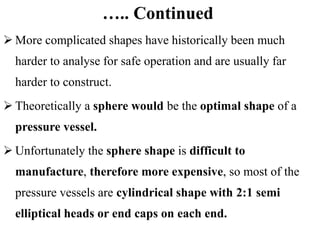
Applications of pressure vessels
 Storage of medical gases.
 Storage of breathing gases
in diving cylinder.
 Storage of gaseous fuels
for internal combustion
engines,
 heating equipment and
cooking such as LP gas,
butane and propane.
 Storage of gases used for
oxy-fuel welding and
cutting.
Medical fields
Chemical Engineering Fields
Causes of Pressure Vessel Failure
Generally, failure of pressure vessels occurred due to one of the following
reasons:
 Improper Selection Material is the major part of the defect in
the vessel.
 Incorrect design or incorrect design data and also, the
inaccurate or incorrect design methods
 Poor quality control and improper fabrication procedures
including welding are fabrication problems.
 Failure due to corrosion fatigue.
 Due to environmental problems.
Factors to be Considered for Designing of Pressure Vessel
 Maximum allowable working pressure or design pressure is
the main factor for pressure vessel design.
 Pressure in the vessel should not exceed the maximum
allowable pressure otherwise it fails.
 Allowable working temperature range or design temp. is
also an important factor for pressure vessel design, if
temperature varies beyond temperature limits then it tends
to alter the properties of material.
 Factor of safety
 Corrosion allowance is the amount of material in vessel that
is available for corrosion without affecting the pressure
containing integrity.
Loads Acting on Pressure Vessel
In working condition, pressure vessels are subjected to following
loads:
Internal or external design pressure
Weight of the vessel and normal contents under
operating or test conditions (this includes additional
pressure due to static head of liquids)
Superimposed static reactions from weight of attached
equipment, such as motors, machinery, other vessels,
piping, linings, and insulation
…. Continued
 The attachments of internals and vessel supports such as
lugs, rings, skirts, saddles, and legs
 Cyclic and dynamic reactions due to pressure or thermal
variations or from equipment mounted on a vessel, and
mechanical loadings
 Impact reactions such as those due to fluid shock
 Temperature gradients and differential thermal expansion
Classification of Pressure vessel
 For the purposes of design and analysis, pressure vessels
are subdivided into two classes depending on the ratio of
the wall thickness to vessel diameter:
 Thin-walled Pressure vessels, with a thickness ratio of
less than 1:10, and
 Thick-walled Pressure vessels above , with a thickness ratio
of greater than 1: 10.
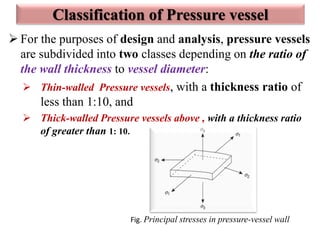
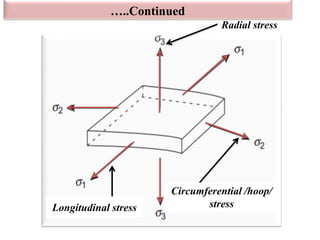
Fig. Principal stresses in pressure-vessel wall
Radial stress
Circumferential /hoop/
stress
Longitudinal stress
…..Continued
…..Continued
 In a thick wall, the magnitude of the radial stress will be
significant, and the circumferential stress will vary across
the wall.
 The majority of the vessels used in the chemical and allied
industries are classified as thin-walled pressure vessels.
Considering the figure above ,the principal stresses
acting at a point in the wall of a vessel, due to a
pressure load
 If the wall is thin, the radial stress σ3will be small and can
be neglected in comparison with the other stresses, and the
longitudinal and circumferential stresses σ1 and σ2 can be
taken as constant over the wall thickness.
 In a thick wall, the magnitude of the radial stress will be
significant, and the circumferential stress will vary across
the wall.
 The majority of the vessels used in the chemical and allied
industries are classified as thin-walled vessels.
 Thick-walled vessels are used for high pressures.
…..Continued
Pressure Vessel Codes And Standards
 The primary purpose of the design codes is to establish rules of safety
relating to the pressure integrity of vessels and provide guidance on
design, materials of construction, fabrication, inspection, and testing.
 They form a basis of agreement between the manufacturer, the
customer, and the customer’s insurance company.
 Among sections of the ASME BPV Codes Most chemical plant and
refinery vessels fall within the scope of Section VIII of the ASME
BPV Code.
….Continued
 Section VIII contains three subdivisions:
 Division 1: contains general rules and is most commonly
followed, particularly for low-pressure vessels.
 Division 2: contains alternative rules that are more
restrictive on materials, design temperatures, design details,
fabrication methods, and inspection, but allow higher
design stresses and hence thinner vessel walls.
 Division 3 : rules are usually chosen for large, high-
pressure vessels where the savings in metal cost and
fabrication complexity offset the higher engineering and
construction costs.
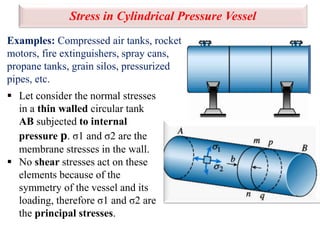
Stress in Cylindrical Pressure Vessel
Examples: Compressed air tanks, rocket
motors, fire extinguishers, spray cans,
propane tanks, grain silos, pressurized
pipes, etc.
 Let consider the normal stresses
in a thin walled circular tank
AB subjected to internal
pressure p. σ1 and σ2 are the
membrane stresses in the wall.
 No shear stresses act on these
elements because of the
symmetry of the vessel and its
loading, therefore σ1 and σ2 are
the principal stresses.
….Continued
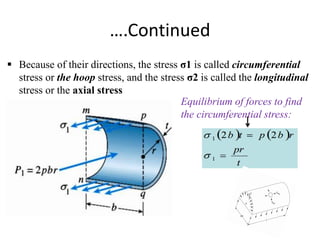
 Because of their directions, the stress σ1 is called circumferential
stress or the hoop stress, and the stress σ2 is called the longitudinal
stress or the axial stress
Equilibrium of forces to find
the circumferential stress:
….. Continued
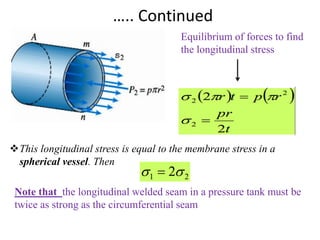
Equilibrium of forces to find
the longitudinal stress
This longitudinal stress is equal to the membrane stress in a
spherical vessel. Then
Note that the longitudinal welded seam in a pressure tank must be
twice as strong as the circumferential seam
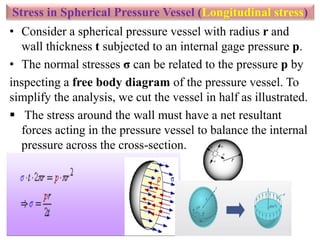
Stress in Spherical Pressure Vessel (Longitudinal stress)
• Consider a spherical pressure vessel with radius r and
wall thickness t subjected to an internal gage pressure p.
• The normal stresses σ can be related to the pressure p by
inspecting a free body diagram of the pressure vessel. To
simplify the analysis, we cut the vessel in half as illustrated.
 The stress around the wall must have a net resultant
forces acting in the pressure vessel to balance the internal
pressure across the cross-section.

Chemical Engineering Apparatus Design lecture note

  • 1.
    Mettu University College ofEngineering and Technology Chemical Engineering Department Lecture Note on Chemical Engineering Apparatus Design Targeted group- 4th year chemical engineering students By Muktar A. (2014/2022) We are dedicatedtoservethecommunity
  • 2.
  • 3.
    Warm-up questions (learningobjective) •What is pressure vessel •What factors a process engineer must consider when setting specifications for a pressure vessel •How pressure vessels are designed and what determines the vessel wall thickness •How the ASME Boiler and Pressure Vessel Code is used in pressure vessel design
  • 4.
     Mechanical Designof Process Equipment: This chapter covers those aspects of the mechanical design of chemical plant that are of particular interest to chemical engineers. The main topic considered is the design of pressure vessels. The chemical engineer will not usually be called on to undertake the detailed mechanical design of a pressure vessel. Introduction
  • 5.
    ……Continued  Vessel designis a specialised subject, and will be carried out by mechanical engineers who are conversant with the current design codes and practices, and methods of stress analysis.  However, the chemical engineer will be responsible for developing and specifying the basic design information for a particular vessel, and needs to have a general appreciation of pressure vessel design to work effectively with the specialist designer.
  • 6.
    ……Continued The basic dataneeded by the specialist designer will be: Vessel function Process materials and services Operating and design temperature and pressure Materials of construction Vessel dimensions and orientation Type of vessel heads to be used Openings and connections required Specification of heating and cooling jackets or coils Type of agitator Specification of internal fittings
  • 7.
     Design ofPressure Vessels
  • 8.
    Introduction  Pressure vesselsare an integral part of many manufacturing facilities and processing plants, enabling the safe storage of pressurized liquids and gases.  Pressure Vessels are containers which are designed to hold liquids, vapors, or gases at high pressures, usually above 15 psig. Examples of common pressure vessels used in the petroleum refining and chemical processing industries  From industrial boilers and bottles to gasoline tankers pressure vessels operate in a wide array of potentially hazardous environments.  Each individual vessel has its own operating limits built in by design that it has to work under, referred to as its design pressure and design temperature.  Operating outside of these limits could damage the equipment and potentially lead to loss of containment or catastrophic failure
  • 9.
    Continued  Because theywork under immense pressures, a ruptured pressure vessel can be incredibly dangerous, leading to poison gas leaks, fires, and even explosions  For this reason, pressure vessel safety is imperative. However if not properly designed, constructed and maintained, pressure vessels can be extremely dangerous  Pressure vessels can be dangerous, and fatal accidents have occurred in the history of their development and operation. Hence pressure vessels should be designed and analysed as per standards.  There are several standards and practices that cover the construction, maintenance, and inspection of pressure vessels.  Among these standards are ASME Section VIII and API 510.
  • 10.
    Continued  ASME SectionVIII is the section of the ASME Boiler & Pressure Vessel Code (BPVC) that covers pressure vessels.  It gives detailed requirements for the design, fabrication, testing, inspection, and certification of both fired and unfired pressure vessels.  API 510, "Pressure Vessel Inspection Code: In-Service Inspection, Rating, Repair, and Alteration" is an inspection code, written and published by the American Petroleum Institute, that covers the in- service inspection, repair, alteration, and rerating activities for pressure vessels and the pressure relieving devices protecting these vessels.
  • 11.
    Accidents Occurs inthe History of Pressure Vessel (Sumit Dubal and Hemantkumar kadam)  Bhopal (India)-gas Leakage; December 2, 1984; 25000 killed, 600000 injured.  Feyzin (France) Explosion; January 4, 1966; 18 killed, 81 injured.  Texas city (America); March 23, 2005; 15 killed, 150 injured.
  • 12.
    Definition of Design Design is a plan or specification for the construction of an object or system or for the implementation of an activity or process, or the result of that plan or specification in the form of a prototype, product or process.  It is the synthesis, the putting together, of ideas to achieve a desired purpose.
  • 13.
    Definition of Pressurevessel  A pressure vessel is considered as any closed vessel that is capable of storing a pressurized fluid, either internal or external pressure.  A pressure vessel is a container designed to hold compressed gases or liquids at a pressure substantially different from the ambient pressure  Pressure vessels are the basic equipment for any fluid processing system.  Is generally accepted that Any closed vessel over 150 mm diameter subject to a pressure difference of more than 0.5 bar should be designed as a pressure vessel.
  • 14.
    …… Continued  Theliquid and gaseous chemicals are stored in a pressurized chambers (pressure vessels) for a chemical reaction.  Pressure vessels are used for either transmitting fluid or for storing fluid.  Storage vessels are widely used in industrial plants for storing chemical at below or higher than the atmospheric pressure.
  • 15.
    ….. Continued  Morecomplicated shapes have historically been much harder to analyse for safe operation and are usually far harder to construct.  Theoretically a sphere would be the optimal shape of a pressure vessel.  Unfortunately the sphere shape is difficult to manufacture, therefore more expensive, so most of the pressure vessels are cylindrical shape with 2:1 semi elliptical heads or end caps on each end.
  • 16.
    Applications of pressurevessels  Storage of medical gases.  Storage of breathing gases in diving cylinder.  Storage of gaseous fuels for internal combustion engines,  heating equipment and cooking such as LP gas, butane and propane.  Storage of gases used for oxy-fuel welding and cutting. Medical fields Chemical Engineering Fields
  • 17.
    Causes of PressureVessel Failure Generally, failure of pressure vessels occurred due to one of the following reasons:  Improper Selection Material is the major part of the defect in the vessel.  Incorrect design or incorrect design data and also, the inaccurate or incorrect design methods  Poor quality control and improper fabrication procedures including welding are fabrication problems.  Failure due to corrosion fatigue.  Due to environmental problems.
  • 18.
    Factors to beConsidered for Designing of Pressure Vessel  Maximum allowable working pressure or design pressure is the main factor for pressure vessel design.  Pressure in the vessel should not exceed the maximum allowable pressure otherwise it fails.  Allowable working temperature range or design temp. is also an important factor for pressure vessel design, if temperature varies beyond temperature limits then it tends to alter the properties of material.  Factor of safety  Corrosion allowance is the amount of material in vessel that is available for corrosion without affecting the pressure containing integrity.
  • 19.
    Loads Acting onPressure Vessel In working condition, pressure vessels are subjected to following loads: Internal or external design pressure Weight of the vessel and normal contents under operating or test conditions (this includes additional pressure due to static head of liquids) Superimposed static reactions from weight of attached equipment, such as motors, machinery, other vessels, piping, linings, and insulation
  • 20.
    …. Continued  Theattachments of internals and vessel supports such as lugs, rings, skirts, saddles, and legs  Cyclic and dynamic reactions due to pressure or thermal variations or from equipment mounted on a vessel, and mechanical loadings  Impact reactions such as those due to fluid shock  Temperature gradients and differential thermal expansion
  • 21.
    Classification of Pressurevessel  For the purposes of design and analysis, pressure vessels are subdivided into two classes depending on the ratio of the wall thickness to vessel diameter:  Thin-walled Pressure vessels, with a thickness ratio of less than 1:10, and  Thick-walled Pressure vessels above , with a thickness ratio of greater than 1: 10. Fig. Principal stresses in pressure-vessel wall
  • 22.
  • 23.
    …..Continued  In athick wall, the magnitude of the radial stress will be significant, and the circumferential stress will vary across the wall.  The majority of the vessels used in the chemical and allied industries are classified as thin-walled pressure vessels. Considering the figure above ,the principal stresses acting at a point in the wall of a vessel, due to a pressure load
  • 24.
     If thewall is thin, the radial stress σ3will be small and can be neglected in comparison with the other stresses, and the longitudinal and circumferential stresses σ1 and σ2 can be taken as constant over the wall thickness.  In a thick wall, the magnitude of the radial stress will be significant, and the circumferential stress will vary across the wall.  The majority of the vessels used in the chemical and allied industries are classified as thin-walled vessels.  Thick-walled vessels are used for high pressures. …..Continued
  • 25.
    Pressure Vessel CodesAnd Standards  The primary purpose of the design codes is to establish rules of safety relating to the pressure integrity of vessels and provide guidance on design, materials of construction, fabrication, inspection, and testing.  They form a basis of agreement between the manufacturer, the customer, and the customer’s insurance company.  Among sections of the ASME BPV Codes Most chemical plant and refinery vessels fall within the scope of Section VIII of the ASME BPV Code.
  • 26.
    ….Continued  Section VIIIcontains three subdivisions:  Division 1: contains general rules and is most commonly followed, particularly for low-pressure vessels.  Division 2: contains alternative rules that are more restrictive on materials, design temperatures, design details, fabrication methods, and inspection, but allow higher design stresses and hence thinner vessel walls.  Division 3 : rules are usually chosen for large, high- pressure vessels where the savings in metal cost and fabrication complexity offset the higher engineering and construction costs.
  • 27.
    Stress in CylindricalPressure Vessel Examples: Compressed air tanks, rocket motors, fire extinguishers, spray cans, propane tanks, grain silos, pressurized pipes, etc.  Let consider the normal stresses in a thin walled circular tank AB subjected to internal pressure p. σ1 and σ2 are the membrane stresses in the wall.  No shear stresses act on these elements because of the symmetry of the vessel and its loading, therefore σ1 and σ2 are the principal stresses.
  • 28.
    ….Continued  Because oftheir directions, the stress σ1 is called circumferential stress or the hoop stress, and the stress σ2 is called the longitudinal stress or the axial stress Equilibrium of forces to find the circumferential stress:
  • 29.
    ….. Continued Equilibrium offorces to find the longitudinal stress This longitudinal stress is equal to the membrane stress in a spherical vessel. Then Note that the longitudinal welded seam in a pressure tank must be twice as strong as the circumferential seam
  • 30.
    Stress in SphericalPressure Vessel (Longitudinal stress) • Consider a spherical pressure vessel with radius r and wall thickness t subjected to an internal gage pressure p. • The normal stresses σ can be related to the pressure p by inspecting a free body diagram of the pressure vessel. To simplify the analysis, we cut the vessel in half as illustrated.  The stress around the wall must have a net resultant forces acting in the pressure vessel to balance the internal pressure across the cross-section.