A. Dhanaraj Int. Journal of Engineering Research and Applications www.ijera.com
ISSN : 2248-9622, Vol. 5, Issue 4, ( Part -6) April 2015, pp. 32-38
www.ijera.com 32 | P a g e
Design & Stress Analysis of a Cylinder with Closed ends using
ANSYS
A. Dhanaraj1
, Dr. M. V. Mallikarjuna2,
1
M.Tech, student, Department of Mechanical Engineering, QIS College of Engineering & Technology, Ongole,
2
Professor, Department of Mechanical Engineering, QIS College of Engineering & Technology, Ongole
ABSTRACT
The significance of the title of the project comes to front with designing structure of the pressure vessel for static
loading and its assessment by ANSYS , is basically a project concerned with design of different pressure vessel
elements such as shell, Dish end ,operating manhole ,support leg based on standards and codes ; and evolution
of shell and dish end analysed by means of ANSYS .The key feature included in the project is to check the
behaviour of pressure vessel in case of fluctuating load . The procedural step includes various aspects such as
selecting the material based on American Society of Mechanical Engineers (ASME) codes ,and then designing
on the standards procedures with referring standard manuals based on ASME .Further we have included the
different manufacturing methods practice by the industries and different aspects of it .
Key Words: Pressure Vessel, Fluctuating load, Cylinder with closed ends, American Society of Mechanical
Engineers (ASME) , Finite Element Analysis, Static load.
I. Introduction
The pressure vessels (i.e. cylinder or tanks) are
used to store fluids under pressure. The fluid being
stored may undergo a change of state inside the
pressure vessel as in case of steam boilers or it may
combine with other reagents as in a chemical plant.
The pressure vessels are designed with great care
because rupture of pressure vessels means an
explosion which may cause loss of life and property.
The material of pressure vessels may be brittle such
that cast iron or ductile such as mild steel. Cylindrical
or spherical pressure vessels (e.g., hydraulic
cylinders, gun barrels, pipes, boilers and tanks) are
commonly used in industry to carry both liquids and
gases under pressure. When the pressure vessel is
exposed to this pressure, the material comprising the
vessel is subjected to pressure loading, and hence
stresses, from all directions. The normal stresses
resulting from this pressure are functions of the
radius of the element under consideration, the shape
of the pressure vessel (i.e., open ended cylinder, closed
end cylinder, or sphere) as well as the applied pressure.
Two types of analysis are commonly applied to
pressure vessels. The most common method is based
on a simple mechanics approach and is applicable to
"thin wall" pressure vessels which by definition have
a ratio of inner radius, r, to wall thickness, t, of r/t10.
The second method is based on elasticity solution and
is always applicable regardless of the r/t ratio and can
be referred to as the solution for "thick wall" pressure
vessels. Both types of analysis are discussed here,
although for most engineering applications, the thin
wall pressure vessel can be used.
Problem Statement
Vessel failures can be grouped into four major
categories, which describe why a vessel failure occurs.
Failures can also be grouped into types of failures,
which describe how the failure occurs. Each failure
has a why and how to its history.
It may have failed through corrosion fatigue
because the wrong material was selected. The designer
must be as familiar with categories and types of
failure as with categories and types of stress and
loadings. Ultimately they are all related.
- Material - Improper selection of material; defects
in material.
- Design - Incorrect design data; inaccurate or
incorrect de- sign methods; inadequate shop
testing.
- Fabrication - Poor quality control; improper or
insufficient fabrication procedures including
welding.
Material Selection
Several of materials have been use in pressure
vessel fabrication. The selection of material is base
on the appropriateness of the design requirement. The
materials used in the manufacture of the receivers
shall comply with the requirements of the relevant
design code, and be identifiable with mill sheets. The
selection of materials of the shell shall take into
account the suitability of the materials with the
maximum working pressure and fabrication process.
RESEARCH ARTICLE OPEN ACCESS
A. Dhanaraj Int. Journal of Engineering Research and Applications www.ijera.com
ISSN : 2248-9622, Vol. 5, Issue 4, ( Part -6) April 2015, pp. 32-38
www.ijera.com 33 | P a g e
Table 1: Material assignment
Head SA- 106 B
Shell SA- 106 B
Drain SA- 106 B
Inlet SA- 106 B
Outlet SA- 106 B
According to ASTM standard this specification for
pressure vessel is suitable for higher temperature
services. The chemical and tensile requirement of
Seamless Carbon steel pipe for high temperature
service (SA-106 B) is as per table
Table 2: Material composition
Composition %, (Grade B)
Carbon, max 0.3
Copper, max 0.4
Sulfur, max 0.035
Molybdenum, max 0.15
Nickel, max 0.4
Vanadium. max 0.08
Table3: Material Properties
Structural
Young's Modulus 2.e+011 Pa
Thermal Expansion 1.2e-005 1/°C
Tensile Yield Strength 2.5e+008 Pa
Compressive Yield Strength 2.5e+008 Pa
Tensile Ultimate Strength 4.6e+008 Pa
Compressive Ultimate
Strength
0 Pa
Thermal
Thermal Conductivity 60.5 W/m·°C
Specific Heat 434. J/kg·°C
Electromagnetics
Relative Permeability 10000
Resistivity 1.7e-007 Ohm·m
Design pressure
The pressure use in the design of a vessel is call
design pressure. It is recommended to design a vessel
and its parts for a higher pressure than the operating
pressure. A design pressure higher than the operating
pressure with 10 percent, whichever is the greater,
will satisfy the requirement. The pressure of the fluid
will also be considering. The maximum allowable
working pressure (MAWP) for a vessel is the
permissible pressure at the top of the vessel in its
normal operating position at a specific temperature.
This pressure is based on calculations for every
element of the vessel using nominal thicknesses
exclusive of corrosion allowance. It is the basis for
establishing the set pressures of any pressure-
relieving devices protecting the vessel.
II. Design temperature
Design temperature is the temperature that will
be maintained in the metal of the part of the vessel
being considered for the specified operation of the
vessel. For most vessels, it is the temperature that
corresponds to the design pressure. However, there is
a maximum design temperature and a minimum
design temperature (MDMT) for any given vessel.
The MDMT shall be the lowest temperature expected
in service or the lowest allowable temperature as
calculated for the individual parts. Design
temperature for vessels under external pressure shall
not exceed the maximum temperatures
ASME Code, Section VIII, Division 1 vs. Division 2
ASME Code, Section VIII, Division 1 does not
explicitly consider the effects of combined stress.
Neither does it give detailed methods on how stresses
are combined. ASME Code, Section VIII, Division 2,
on the other hand, provides specific guidelines for
stresses, how they are combined, and allowable
stresses for categories of combined stresses. Division
2 is design by analysis whereas Division 1 is design
by rules. Although stress analysis as utilized by
Division 2 is beyond the scope of this text, the use of
stress categories, Definitions of stress, and allowable
stresses is applicable. Division 2 stress analysis
considers all stresses in a tri-axial state combined in
accordance with the maximum shear stress theory.
Division 1 and the procedures outlined in this book
consider a biaxial state of stress combined in
accordance with the maximum stress theory. Just as
one would not design a nuclear reactor to the Niles of
Division 1, one would not design an air receiver by
the techniques of Division 2. Each has its place and
applications. The following discussion on categories
of stress and allowable will utilize information from
Division 2, which can be applied in general to all
vessels.
Table 4: ASME Codes
ASME SEC. VIII DIV.1/
IS: 2825
For Pressure vessels
ASME SEC. VIII DIV.2 For Pressure vessels
(Selectively for high
pressure / high thickness
/ critical service)
ASME SEC. VIII DIV.2 For Storage Spheres
ASME SEC. VIII DIV.3 For Pressure vessels
(Selectively for high
pressure)
A. Dhanaraj Int. Journal of Engineering Research and Applications www.ijera.com
ISSN : 2248-9622, Vol. 5, Issue 4, ( Part -6) April 2015, pp. 32-38
www.ijera.com 34 | P a g e
Design of Pressure Vessel
The minimum thickness or maximum allowable
working pressure of cylindrical shells shall be the
greater thickness or lesser pressure, the thickness
equations are given below.
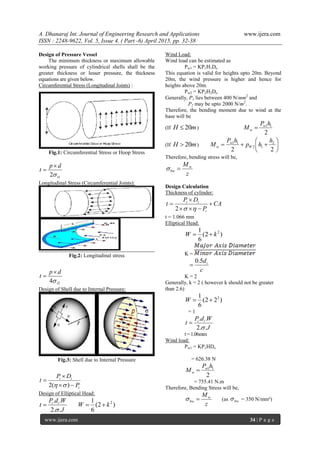
Circumferential Stress (Longitudinal Joints) :
Fig.1: Circumferential Stress or Hoop Stress
t12
dp
t


Longitudinal Stress (Circumferential Joints):
Fig.2: Longitudinal stress
t24
dp
t


Design of Shell due to Internal Pressure:
Fig.3: Shell due to Internal Pressure
i
ii
P
DP
t



)(2 
Design of Elliptical Head:
J
WdP
t ii
..2
..

 )2(
6
1 2
kW 
Wind Load:
Wind load can be estimated as
Pw1 = KP1H1Do
This equation is valid for heights upto 20m. Beyond
20m, the wind pressure is higher and hence for
heights above 20m.
Pw2 = KP2H2Do
Generally, P1 lies between 400 N/mm2
and
P2 may be upto 2000 N/m2
.
Therefore, the bending moment due to wind at the
base will be
(If mH 20 )
2
11hP
M w
w 
(If mH 20 ) 






22
2
12
11 h
hp
hP
M W
w
w
Therefore, bending stress will be,
z
Mw
bw 
Design Calculation
Thickness of cylinder:
CA
P
DP
t
i
ii




2
t = 1.066 mm
Elliptical Head:
)2(
6
1 2
kW 
K =
c
di5.0

K = 2
Generally, k = 2 ( however k should not be greater
than 2.6)
)22(
6
1 2
W
= 1
J
WdP
t ii
..2
..


t=1.06mm
Wind load:
Pw1 = KP1HDo
= 626.38 N
2
11hP
M w
w 
= 755.41 N.m
Therefore, Bending Stress will be,
z
Mw
bw  (as bw = 350 N/mm²)
A. Dhanaraj Int. Journal of Engineering Research and Applications www.ijera.com
ISSN : 2248-9622, Vol. 5, Issue 4, ( Part -6) April 2015, pp. 32-38
www.ijera.com 35 | P a g e
mt 3
1036.5 

1834
3
123
3
123
L
= 1916 mm
III. ANALYSIS OF PRESSURE VESSEL
Structural Results
Table.5: Structural Supports
Name Fixed Support Shell
Material Structural Steel
Mass(kg) 109.69
Volume(m3
) 1.4×10⁻²
Type Fixed Surface
Reaction Force 1.71×10⁻³
N
Reaction Force Vector
[-1.71×10⁻³
Nx, 1.16×10-
7
Ny,
3.67×10⁻⁹
Nz
Reaction Moment 1.81×10⁻⁵
N·m
Reaction moment vector
[1.81×10⁻⁵
N·m x,
3.16×10⁻⁹
N·m y,
1.06×10⁻⁷
N·m z]
Table.6: Structural results
Fig.4: "Equivalent Stress" Contours
Fig.5: "Total Deformation" Contours
Ellipsoidal Dish End
Table.7: Model > Static Structural > Solution >
Results
Object
Name
Equivalent
Stress
Maximu
m Shear
Stress
Total
Deformation
State Solved
Scope
Geometr
y
All Bodies
Definition
Type
Equivalent
(Von-mises)
Stress
Max
Shear
Stress
Total
Deformation
Display
Time
Solved Solved Solved
Results
Min
3.101e+006
Pa
1.613e+006
Pa
0 m
Max
3.137e+007
Pa
1.696e+007
Pa
4.1032e-005
m
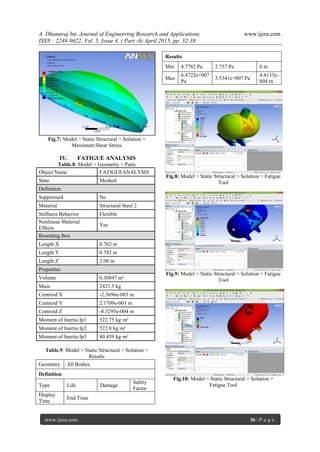
Fig.6: Model > Static Structural > Solution >
Equivalent Stress
Name Scope Min Max
Equivalent
Stress
Model 8.6×10⁶
Pa 3.5×10⁷
Pa
Maximum
Shear
Stress
Model
4.96×10⁶
Pa
1.87×10⁷
Pa
Total
Deformation
Model 0.0 m
4.27×10⁻⁵
m
A. Dhanaraj Int. Journal of Engineering Research and Applications www.ijera.com
ISSN : 2248-9622, Vol. 5, Issue 4, ( Part -6) April 2015, pp. 32-38
www.ijera.com 36 | P a g e
Fig.7: Model > Static Structural > Solution >
Maximum Shear Stress
IV. FATIGUE ANALYSIS
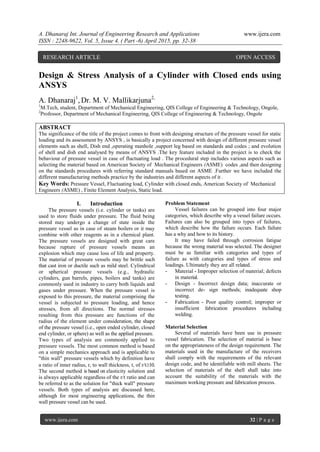
Table.8: Model > Geometry > Parts
Object Name FATIGUEANALYSIS
State Meshed
Definition
Suppressed No
Material Structural Steel 2
Stiffness Behavior Flexible
Nonlinear Material
Effects
Yes
Bounding Box
Length X 0.762 m
Length Y 0.782 m
Length Z 2.08 m
Properties
Volume 0.30847 m³
Mass 2421.5 kg
Centroid X -2.3696e-003 m
Centroid Y 2.1709e-003 m
Centroid Z -8.3295e-004 m
Moment of Inertia Ip1 522.75 kg·m²
Moment of Inertia Ip2 522.8 kg·m²
Moment of Inertia Ip3 80.459 kg·m²
Table.9: Model > Static Structural > Solution >
Results
Geometry All Bodies
Definition
Type Life Damage
Safety
Factor
Display
Time
End Time
Results
Min 4.7782 Pa 2.757 Pa 0 m
Max
6.4722e+007
Pa
3.5341e+007 Pa
4.4133e-
004 m
Fig.8: Model > Static Structural > Solution > Fatigue
Tool
Fig.9: Model > Static Structural > Solution > Fatigue
Tool
Fig.10: Model > Static Structural > Solution >
Fatigue Tool
A. Dhanaraj Int. Journal of Engineering Research and Applications www.ijera.com
ISSN : 2248-9622, Vol. 5, Issue 4, ( Part -6) April 2015, pp. 32-38
www.ijera.com 37 | P a g e
Fig.11: Constant Amplitude Load
Fig.12: Strain Amplitude vs Reversals to Failures
Table.11: Model > Static Structural > Solution >
Fatigue Tool > Result Charts
Object Name
Rainflow
Matrix
Damage
Matrix
State Solved
Scope
Geometry All Bodies
Options
Chart Viewing
Style
Three Dimensional
Results
Minimum Range 0. Pa
Maximum Range 1.9246e+008 Pa
Minimum Mean -3.2328e+008 Pa
Maximum Mean 6.1628e+007 Pa
Definition
Design Life
1.e+009
cycles
WIND ANALYSIS
Fig.10: pressure distributation on face of vessel
Fig.11: streamline and pressure representation
Solution Report
Table.12: Boundary Flows for wind analysis
Locati
on
Mass
Flow
Momentum
X Y Z
body
0.0000e
+00
-1.756
1e+03
2.7605
e+02
-8.37
6e+01
Free
walls
0.0000e
+00
-1.495
3e+02
0.0000
e+00
0.0000
e+00
inlet
1.7405e
+02
-5.181
e-07
-8.52
9e+03
1.5579
e-06
outlet
- 1.740
5e+02
1.3129e
+01
8.1929
e+03
-2.31
5e+00
Pressur
e
vessel
Defalt
0.0000e
+00
-1.932
5e-02
5.4447
e+01
8.5967
e+01
symp
0.0000e
+00
1.8922e
+03
0.0000
e+00
0.0000
e+00
By interpolation we get: for 41 m/s of wind
speed the wind pressure is 730 N/m2
and from the
standard wind load table we compare the result which
is very accurate.
V. CONCLUSION
The paper has led to numerous conclusions.
However, major conclusions are as below:
A. Dhanaraj Int. Journal of Engineering Research and Applications www.ijera.com
ISSN : 2248-9622, Vol. 5, Issue 4, ( Part -6) April 2015, pp. 32-38
www.ijera.com 38 | P a g e
- The design of pressure vessel is initialized with
the specification requirements in terms of
standard technical specifications along with
numerous requirements that lay hidden from the
market.
- The design of a pressure vessel is more of a
selection procedure, selection of its components
to be more precise rather designing each and
every component.
- The pressure vessel components are merely
selected, but the selection is very critical, a slight
change in selection will lead to a different
pressure vessel al- together from what is aimed to
be designed.
- It is observed that all the pressure vessel
components are selected on basis of available
ASME standards and the manufactures also
follow the ASME standards while manufacturing
the components. So that leaves the designer free
from designing the components. This aspect of
Design greatly reduces the Development Time
for a new pressure vessel.
REFERENCES
[1] BHPV manual on Multilayer Pressure
Vessels.
[2] Brownell and Young, "Process Equipment
Design" Chapter 7, Chapter 13, Chapter 14
and Chapter 15. Seely,
[3] F.B., and Smith, A.O., "Advanced Mechanics
of Materials" Wiley, Newyork, Chapter 10.
[4] John F.Henvey “Pressure Vessel Design -
Nuclear and Chemical Applications" An
East-west Edition, Newyork, Chapter 5 and
Chapter 7.
[5] Henry H.Bednar “Pressure Vessel Code
Book", Chapter 11.
[6] Jasper, T.M and Scudder, C.M AIChE
Transactions, PP885 -909.
[7] Fino, A.F., “Economic Considerations for
High Pressure vessel Design" pp-101-104.
[8] Fratcher, G.E: New alloys for Multilayer
Vessels" Vol 33, No.11.
[9] Jasper, T.M and Scudder, C.M “Multilayer
Construction of Thick-wall Pressure
Vessels" Volume 37.
[10] Jawad, Maan H., "Wrapping Stress and Its
Effect on strength of Concentrically Formed
Plywaals," Paper No72-PVP7.

Design & Stress Analysis of a Cylinder with Closed ends using ANSYS

  • 1.
    A. Dhanaraj Int.Journal of Engineering Research and Applications www.ijera.com ISSN : 2248-9622, Vol. 5, Issue 4, ( Part -6) April 2015, pp. 32-38 www.ijera.com 32 | P a g e Design & Stress Analysis of a Cylinder with Closed ends using ANSYS A. Dhanaraj1 , Dr. M. V. Mallikarjuna2, 1 M.Tech, student, Department of Mechanical Engineering, QIS College of Engineering & Technology, Ongole, 2 Professor, Department of Mechanical Engineering, QIS College of Engineering & Technology, Ongole ABSTRACT The significance of the title of the project comes to front with designing structure of the pressure vessel for static loading and its assessment by ANSYS , is basically a project concerned with design of different pressure vessel elements such as shell, Dish end ,operating manhole ,support leg based on standards and codes ; and evolution of shell and dish end analysed by means of ANSYS .The key feature included in the project is to check the behaviour of pressure vessel in case of fluctuating load . The procedural step includes various aspects such as selecting the material based on American Society of Mechanical Engineers (ASME) codes ,and then designing on the standards procedures with referring standard manuals based on ASME .Further we have included the different manufacturing methods practice by the industries and different aspects of it . Key Words: Pressure Vessel, Fluctuating load, Cylinder with closed ends, American Society of Mechanical Engineers (ASME) , Finite Element Analysis, Static load. I. Introduction The pressure vessels (i.e. cylinder or tanks) are used to store fluids under pressure. The fluid being stored may undergo a change of state inside the pressure vessel as in case of steam boilers or it may combine with other reagents as in a chemical plant. The pressure vessels are designed with great care because rupture of pressure vessels means an explosion which may cause loss of life and property. The material of pressure vessels may be brittle such that cast iron or ductile such as mild steel. Cylindrical or spherical pressure vessels (e.g., hydraulic cylinders, gun barrels, pipes, boilers and tanks) are commonly used in industry to carry both liquids and gases under pressure. When the pressure vessel is exposed to this pressure, the material comprising the vessel is subjected to pressure loading, and hence stresses, from all directions. The normal stresses resulting from this pressure are functions of the radius of the element under consideration, the shape of the pressure vessel (i.e., open ended cylinder, closed end cylinder, or sphere) as well as the applied pressure. Two types of analysis are commonly applied to pressure vessels. The most common method is based on a simple mechanics approach and is applicable to "thin wall" pressure vessels which by definition have a ratio of inner radius, r, to wall thickness, t, of r/t10. The second method is based on elasticity solution and is always applicable regardless of the r/t ratio and can be referred to as the solution for "thick wall" pressure vessels. Both types of analysis are discussed here, although for most engineering applications, the thin wall pressure vessel can be used. Problem Statement Vessel failures can be grouped into four major categories, which describe why a vessel failure occurs. Failures can also be grouped into types of failures, which describe how the failure occurs. Each failure has a why and how to its history. It may have failed through corrosion fatigue because the wrong material was selected. The designer must be as familiar with categories and types of failure as with categories and types of stress and loadings. Ultimately they are all related. - Material - Improper selection of material; defects in material. - Design - Incorrect design data; inaccurate or incorrect de- sign methods; inadequate shop testing. - Fabrication - Poor quality control; improper or insufficient fabrication procedures including welding. Material Selection Several of materials have been use in pressure vessel fabrication. The selection of material is base on the appropriateness of the design requirement. The materials used in the manufacture of the receivers shall comply with the requirements of the relevant design code, and be identifiable with mill sheets. The selection of materials of the shell shall take into account the suitability of the materials with the maximum working pressure and fabrication process. RESEARCH ARTICLE OPEN ACCESS
  • 2.
    A. Dhanaraj Int.Journal of Engineering Research and Applications www.ijera.com ISSN : 2248-9622, Vol. 5, Issue 4, ( Part -6) April 2015, pp. 32-38 www.ijera.com 33 | P a g e Table 1: Material assignment Head SA- 106 B Shell SA- 106 B Drain SA- 106 B Inlet SA- 106 B Outlet SA- 106 B According to ASTM standard this specification for pressure vessel is suitable for higher temperature services. The chemical and tensile requirement of Seamless Carbon steel pipe for high temperature service (SA-106 B) is as per table Table 2: Material composition Composition %, (Grade B) Carbon, max 0.3 Copper, max 0.4 Sulfur, max 0.035 Molybdenum, max 0.15 Nickel, max 0.4 Vanadium. max 0.08 Table3: Material Properties Structural Young's Modulus 2.e+011 Pa Thermal Expansion 1.2e-005 1/°C Tensile Yield Strength 2.5e+008 Pa Compressive Yield Strength 2.5e+008 Pa Tensile Ultimate Strength 4.6e+008 Pa Compressive Ultimate Strength 0 Pa Thermal Thermal Conductivity 60.5 W/m·°C Specific Heat 434. J/kg·°C Electromagnetics Relative Permeability 10000 Resistivity 1.7e-007 Ohm·m Design pressure The pressure use in the design of a vessel is call design pressure. It is recommended to design a vessel and its parts for a higher pressure than the operating pressure. A design pressure higher than the operating pressure with 10 percent, whichever is the greater, will satisfy the requirement. The pressure of the fluid will also be considering. The maximum allowable working pressure (MAWP) for a vessel is the permissible pressure at the top of the vessel in its normal operating position at a specific temperature. This pressure is based on calculations for every element of the vessel using nominal thicknesses exclusive of corrosion allowance. It is the basis for establishing the set pressures of any pressure- relieving devices protecting the vessel. II. Design temperature Design temperature is the temperature that will be maintained in the metal of the part of the vessel being considered for the specified operation of the vessel. For most vessels, it is the temperature that corresponds to the design pressure. However, there is a maximum design temperature and a minimum design temperature (MDMT) for any given vessel. The MDMT shall be the lowest temperature expected in service or the lowest allowable temperature as calculated for the individual parts. Design temperature for vessels under external pressure shall not exceed the maximum temperatures ASME Code, Section VIII, Division 1 vs. Division 2 ASME Code, Section VIII, Division 1 does not explicitly consider the effects of combined stress. Neither does it give detailed methods on how stresses are combined. ASME Code, Section VIII, Division 2, on the other hand, provides specific guidelines for stresses, how they are combined, and allowable stresses for categories of combined stresses. Division 2 is design by analysis whereas Division 1 is design by rules. Although stress analysis as utilized by Division 2 is beyond the scope of this text, the use of stress categories, Definitions of stress, and allowable stresses is applicable. Division 2 stress analysis considers all stresses in a tri-axial state combined in accordance with the maximum shear stress theory. Division 1 and the procedures outlined in this book consider a biaxial state of stress combined in accordance with the maximum stress theory. Just as one would not design a nuclear reactor to the Niles of Division 1, one would not design an air receiver by the techniques of Division 2. Each has its place and applications. The following discussion on categories of stress and allowable will utilize information from Division 2, which can be applied in general to all vessels. Table 4: ASME Codes ASME SEC. VIII DIV.1/ IS: 2825 For Pressure vessels ASME SEC. VIII DIV.2 For Pressure vessels (Selectively for high pressure / high thickness / critical service) ASME SEC. VIII DIV.2 For Storage Spheres ASME SEC. VIII DIV.3 For Pressure vessels (Selectively for high pressure)
  • 3.
    A. Dhanaraj Int.Journal of Engineering Research and Applications www.ijera.com ISSN : 2248-9622, Vol. 5, Issue 4, ( Part -6) April 2015, pp. 32-38 www.ijera.com 34 | P a g e Design of Pressure Vessel The minimum thickness or maximum allowable working pressure of cylindrical shells shall be the greater thickness or lesser pressure, the thickness equations are given below. Circumferential Stress (Longitudinal Joints) : Fig.1: Circumferential Stress or Hoop Stress t12 dp t   Longitudinal Stress (Circumferential Joints): Fig.2: Longitudinal stress t24 dp t   Design of Shell due to Internal Pressure: Fig.3: Shell due to Internal Pressure i ii P DP t    )(2  Design of Elliptical Head: J WdP t ii ..2 ..   )2( 6 1 2 kW  Wind Load: Wind load can be estimated as Pw1 = KP1H1Do This equation is valid for heights upto 20m. Beyond 20m, the wind pressure is higher and hence for heights above 20m. Pw2 = KP2H2Do Generally, P1 lies between 400 N/mm2 and P2 may be upto 2000 N/m2 . Therefore, the bending moment due to wind at the base will be (If mH 20 ) 2 11hP M w w  (If mH 20 )        22 2 12 11 h hp hP M W w w Therefore, bending stress will be, z Mw bw  Design Calculation Thickness of cylinder: CA P DP t i ii     2 t = 1.066 mm Elliptical Head: )2( 6 1 2 kW  K = c di5.0  K = 2 Generally, k = 2 ( however k should not be greater than 2.6) )22( 6 1 2 W = 1 J WdP t ii ..2 ..   t=1.06mm Wind load: Pw1 = KP1HDo = 626.38 N 2 11hP M w w  = 755.41 N.m Therefore, Bending Stress will be, z Mw bw  (as bw = 350 N/mm²)
  • 4.
    A. Dhanaraj Int.Journal of Engineering Research and Applications www.ijera.com ISSN : 2248-9622, Vol. 5, Issue 4, ( Part -6) April 2015, pp. 32-38 www.ijera.com 35 | P a g e mt 3 1036.5   1834 3 123 3 123 L = 1916 mm III. ANALYSIS OF PRESSURE VESSEL Structural Results Table.5: Structural Supports Name Fixed Support Shell Material Structural Steel Mass(kg) 109.69 Volume(m3 ) 1.4×10⁻² Type Fixed Surface Reaction Force 1.71×10⁻³ N Reaction Force Vector [-1.71×10⁻³ Nx, 1.16×10- 7 Ny, 3.67×10⁻⁹ Nz Reaction Moment 1.81×10⁻⁵ N·m Reaction moment vector [1.81×10⁻⁵ N·m x, 3.16×10⁻⁹ N·m y, 1.06×10⁻⁷ N·m z] Table.6: Structural results Fig.4: "Equivalent Stress" Contours Fig.5: "Total Deformation" Contours Ellipsoidal Dish End Table.7: Model > Static Structural > Solution > Results Object Name Equivalent Stress Maximu m Shear Stress Total Deformation State Solved Scope Geometr y All Bodies Definition Type Equivalent (Von-mises) Stress Max Shear Stress Total Deformation Display Time Solved Solved Solved Results Min 3.101e+006 Pa 1.613e+006 Pa 0 m Max 3.137e+007 Pa 1.696e+007 Pa 4.1032e-005 m Fig.6: Model > Static Structural > Solution > Equivalent Stress Name Scope Min Max Equivalent Stress Model 8.6×10⁶ Pa 3.5×10⁷ Pa Maximum Shear Stress Model 4.96×10⁶ Pa 1.87×10⁷ Pa Total Deformation Model 0.0 m 4.27×10⁻⁵ m
  • 5.
    A. Dhanaraj Int.Journal of Engineering Research and Applications www.ijera.com ISSN : 2248-9622, Vol. 5, Issue 4, ( Part -6) April 2015, pp. 32-38 www.ijera.com 36 | P a g e Fig.7: Model > Static Structural > Solution > Maximum Shear Stress IV. FATIGUE ANALYSIS Table.8: Model > Geometry > Parts Object Name FATIGUEANALYSIS State Meshed Definition Suppressed No Material Structural Steel 2 Stiffness Behavior Flexible Nonlinear Material Effects Yes Bounding Box Length X 0.762 m Length Y 0.782 m Length Z 2.08 m Properties Volume 0.30847 m³ Mass 2421.5 kg Centroid X -2.3696e-003 m Centroid Y 2.1709e-003 m Centroid Z -8.3295e-004 m Moment of Inertia Ip1 522.75 kg·m² Moment of Inertia Ip2 522.8 kg·m² Moment of Inertia Ip3 80.459 kg·m² Table.9: Model > Static Structural > Solution > Results Geometry All Bodies Definition Type Life Damage Safety Factor Display Time End Time Results Min 4.7782 Pa 2.757 Pa 0 m Max 6.4722e+007 Pa 3.5341e+007 Pa 4.4133e- 004 m Fig.8: Model > Static Structural > Solution > Fatigue Tool Fig.9: Model > Static Structural > Solution > Fatigue Tool Fig.10: Model > Static Structural > Solution > Fatigue Tool
  • 6.
    A. Dhanaraj Int.Journal of Engineering Research and Applications www.ijera.com ISSN : 2248-9622, Vol. 5, Issue 4, ( Part -6) April 2015, pp. 32-38 www.ijera.com 37 | P a g e Fig.11: Constant Amplitude Load Fig.12: Strain Amplitude vs Reversals to Failures Table.11: Model > Static Structural > Solution > Fatigue Tool > Result Charts Object Name Rainflow Matrix Damage Matrix State Solved Scope Geometry All Bodies Options Chart Viewing Style Three Dimensional Results Minimum Range 0. Pa Maximum Range 1.9246e+008 Pa Minimum Mean -3.2328e+008 Pa Maximum Mean 6.1628e+007 Pa Definition Design Life 1.e+009 cycles WIND ANALYSIS Fig.10: pressure distributation on face of vessel Fig.11: streamline and pressure representation Solution Report Table.12: Boundary Flows for wind analysis Locati on Mass Flow Momentum X Y Z body 0.0000e +00 -1.756 1e+03 2.7605 e+02 -8.37 6e+01 Free walls 0.0000e +00 -1.495 3e+02 0.0000 e+00 0.0000 e+00 inlet 1.7405e +02 -5.181 e-07 -8.52 9e+03 1.5579 e-06 outlet - 1.740 5e+02 1.3129e +01 8.1929 e+03 -2.31 5e+00 Pressur e vessel Defalt 0.0000e +00 -1.932 5e-02 5.4447 e+01 8.5967 e+01 symp 0.0000e +00 1.8922e +03 0.0000 e+00 0.0000 e+00 By interpolation we get: for 41 m/s of wind speed the wind pressure is 730 N/m2 and from the standard wind load table we compare the result which is very accurate. V. CONCLUSION The paper has led to numerous conclusions. However, major conclusions are as below:
  • 7.
    A. Dhanaraj Int.Journal of Engineering Research and Applications www.ijera.com ISSN : 2248-9622, Vol. 5, Issue 4, ( Part -6) April 2015, pp. 32-38 www.ijera.com 38 | P a g e - The design of pressure vessel is initialized with the specification requirements in terms of standard technical specifications along with numerous requirements that lay hidden from the market. - The design of a pressure vessel is more of a selection procedure, selection of its components to be more precise rather designing each and every component. - The pressure vessel components are merely selected, but the selection is very critical, a slight change in selection will lead to a different pressure vessel al- together from what is aimed to be designed. - It is observed that all the pressure vessel components are selected on basis of available ASME standards and the manufactures also follow the ASME standards while manufacturing the components. So that leaves the designer free from designing the components. This aspect of Design greatly reduces the Development Time for a new pressure vessel. REFERENCES [1] BHPV manual on Multilayer Pressure Vessels. [2] Brownell and Young, "Process Equipment Design" Chapter 7, Chapter 13, Chapter 14 and Chapter 15. Seely, [3] F.B., and Smith, A.O., "Advanced Mechanics of Materials" Wiley, Newyork, Chapter 10. [4] John F.Henvey “Pressure Vessel Design - Nuclear and Chemical Applications" An East-west Edition, Newyork, Chapter 5 and Chapter 7. [5] Henry H.Bednar “Pressure Vessel Code Book", Chapter 11. [6] Jasper, T.M and Scudder, C.M AIChE Transactions, PP885 -909. [7] Fino, A.F., “Economic Considerations for High Pressure vessel Design" pp-101-104. [8] Fratcher, G.E: New alloys for Multilayer Vessels" Vol 33, No.11. [9] Jasper, T.M and Scudder, C.M “Multilayer Construction of Thick-wall Pressure Vessels" Volume 37. [10] Jawad, Maan H., "Wrapping Stress and Its Effect on strength of Concentrically Formed Plywaals," Paper No72-PVP7.