Pressure Vessel Design
• A pressure vessel is any vessel that
falls under the definition laid down
in the ASME Boiler and Pressure
Vessel Code, Section VIII, Rules for
the Construction of Pressure
Vessels (ASME BPV Code Sec. VIII)
• The definition applies to most
process reactors, distillation
columns, separators (flashes and
decanters), pressurized storage
vessels and heat exchangers
Source: UOP
Isn’t This Something to Leave to the Mechanical
Engineers?
• Chemical engineers are usually not properly trained or qualified to carry out
detailed mechanical design of vessels. Most mechanical designs are completed
by specialists in later phases of design
But
• The process design engineer needs to understand pressure vessel design in
order to generate good cost estimates (e.g. in Aspen ICARUS)
• Costs can vary discontinuously with vessel design
• A 10C change in temperature could double the vessel cost if it causes a change in code!
• Adding a component could cause a change in metallurgy that would mean moving to a more
expensive code design
• The process engineer will end up specifying the main constraints on the vessel
design: if you don’t know how to do this properly, you can’t really design
anything
Pressure Vessel Design
• Pressure Vessel Design Codes
• Vessel Geometry & Construction
• Strength of Materials
• Vessel Specifications
• Materials of Construction
• Pressure Vessel Design Rules
• Fabrication, Inspection and Testing
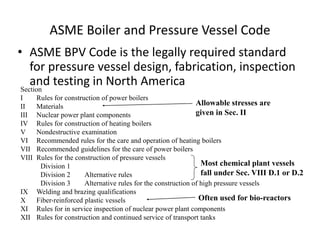
ASME Boiler and Pressure Vessel Code
• ASME BPV Code is the legally required standard
for pressure vessel design, fabrication, inspection
and testing in North America
Section
I Rules for construction of power boilers
II Materials
III Nuclear power plant components
IV Rules for construction of heating boilers
V Nondestructive examination
VI Recommended rules for the care and operation of heating boilers
VII Recommended guidelines for the care of power boilers
VIII Rules for the construction of pressure vessels
Division 1
Division 2 Alternative rules
Division 3 Alternative rules for the construction of high pressure vessels
IX Welding and brazing qualifications
X Fiber-reinforced plastic vessels
XI Rules for in service inspection of nuclear power plant components
XII Rules for construction and continued service of transport tanks
Most chemical plant vessels
fall under Sec. VIII D.1 or D.2
Allowable stresses are
given in Sec. II
Often used for bio-reactors
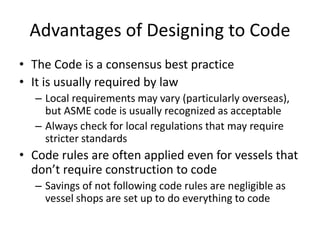
Advantages of Designing to Code
• The Code is a consensus best practice
• It is usually required by law
– Local requirements may vary (particularly overseas),
but ASME code is usually recognized as acceptable
– Always check for local regulations that may require
stricter standards
• Code rules are often applied even for vessels that
don’t require construction to code
– Savings of not following code rules are negligible as
vessel shops are set up to do everything to code
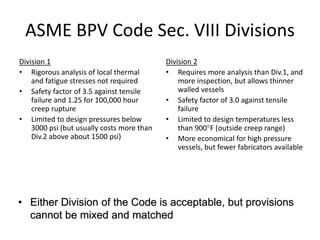
ASME BPV Code Sec. VIII Divisions
Division 1
• Rigorous analysis of local thermal
and fatigue stresses not required
• Safety factor of 3.5 against tensile
failure and 1.25 for 100,000 hour
creep rupture
• Limited to design pressures below
3000 psi (but usually costs more than
Div.2 above about 1500 psi)
Division 2
• Requires more analysis than Div.1, and
more inspection, but allows thinner
walled vessels
• Safety factor of 3.0 against tensile
failure
• Limited to design temperatures less
than 900F (outside creep range)
• More economical for high pressure
vessels, but fewer fabricators available
• Either Division of the Code is acceptable, but provisions
cannot be mixed and matched
Vessels Specifically Excluded
by ASME BPV Code Sec. VIII Div 1
• Vessels within the scope of other sections of the BPV code. For example, power boilers (Sec. I), fiber-
reinforced plastic vessels (Sec. X) and transport tanks (Sec. XIII).
• Fired process tubular heaters.
• Pressure containers that are integral parts of rotating or reciprocating devices such as pumps,
compressors, turbines or engines.
• Piping systems (which are covered by ASME B31.3 – see Chapter 5).
• Piping components and accessories such as valves, strainers, in-line mixers and spargers.
• Vessels containing water at less than 300 psi (2 MPa) and less than 210ºF (99ºC).
• Hot water storage tanks heated by steam with heat rate less than 0.2 MMBTU/hr (58.6 kW), water
temperature less than 210ºF (99ºC) and volume less than 120 gal (450 liters).
• Vessels having internal pressure less than 15 psi (100 kPa) or greater than 3000 psi (20 MPa).
• Vessels of internal diameter or height less than 6 inches (152 mm).
• Pressure vessels for human occupancy.
ASME Code Stamp Name Plate
• Can only be used if vessel is designed, inspected and tested under the
supervision of a Certified Individual employed by the manufacturer
• The code stamp must be clearly visible on the vessel
W (if arc or gas welded)
RT (if Radio graphed)
HT (if Postweld heat treated)
Name of Manufacturer
psi at °F
Max. Allowable Working Pressure
Min. Design Metal Temperature
Manufacturer’s Serial Number
Year Built
°F at psi
W (if arc or gas welded)
RT (if Radio graphed)
HT (if Postweld heat treated)
Name of Manufacturer
psi at °F
Max. Allowable Working Pressure
Min. Design Metal Temperature
Manufacturer’s Serial Number
Year Built
°F at psi
Name of Manufacturer
psi at °F
Max. Allowable Working Pressure
Min. Design Metal Temperature
Manufacturer’s Serial Number
Year Built
°F at psi
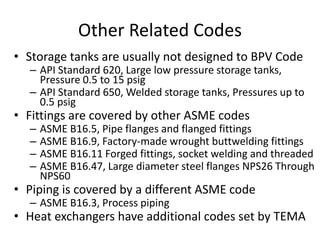
Other Related Codes
• Storage tanks are usually not designed to BPV Code
– API Standard 620, Large low pressure storage tanks,
Pressure 0.5 to 15 psig
– API Standard 650, Welded storage tanks, Pressures up to
0.5 psig
• Fittings are covered by other ASME codes
– ASME B16.5, Pipe flanges and flanged fittings
– ASME B16.9, Factory-made wrought buttwelding fittings
– ASME B16.11 Forged fittings, socket welding and threaded
– ASME B16.47, Large diameter steel flanges NPS26 Through
NPS60
• Piping is covered by a different ASME code
– ASME B16.3, Process piping
• Heat exchangers have additional codes set by TEMA
Use of Design Codes & Standards
• The latest version of the design code should
always be consulted as regulations change
– Example: new version of ASME BPV Code Sec. VIII
Div. 2 will allow for thinner walls on high pressure
vessels
• All the information given in this presentation
is from the 2004 edition
Pressure Vessel Design
• Pressure Vessel Design Codes
• Vessel Geometry & Construction
• Strength of Materials
• Vessel Specifications
• Materials of Construction
• Pressure Vessel Design Rules
• Fabrication, Inspection and Testing
Pressure Vessel Shape
• What shape of pressure vessel uses the least amount
of metal to contain a given volume, pressure?
A sphere!
• Why is this shape not more widely used?
– Usually need to have an extended section of constant
cross-section to provide support for vessel internals, trays,
distributors, etc.
– It is much easier to obtain and maintain uniform flow in a
cylindrical bed of catalyst or packing than it is in a non-
uniform cross-section
– A cylinder takes up a lot less plot space for the same
volume
– A sphere is more expensive to fabricate
Pressure Vessel Shape
• Most pressure vessels are at least 2:1 cylinders:
3:1 or 4:1 are most common:
• Distillation columns are obviously an exception:
diameter is set by flooding correlations and
height by number of trays
2:1 3:1 4:1
(To scale)
Vessel Size Restrictions
• Diameter gets very expensive if > 13.5 ft.
Why?
• Height (length) gets very expensive if > 180 ft.
Why? Roughly 50 cranes can lift > 180 ft
Only 14 can lift > 240 ft
• Vessels that can’t be transported have to be fabricated on site
Vessel Orientation
• Usually vertical
– Easier to distribute fluids across a smaller cross
section
– Smaller plot space
• Reasons for using horizontal vessels
– To promote phase separation
• Increased cross section = lower vertical velocity = less
entrainment
• Decanters, settling tanks, separators, flash vessels
– To allow internals to be pulled for cleaning
• Heat exchangers
Head (Closure) Designs
• Hemispherical
– Good for high pressures
– Higher internal volume
– Most expensive to form & join to shell
– Half the thickness of the shell
• Ellipsoidal
– Cheaper than hemispherical and less internal
volume
– Depth is half diameter
– Same thickness as shell
– Most common type > 15 bar
• Torispherical
– Part torus, part sphere
– Similar to elliptical, but cheaper to fabricate
– Cheapest for pressures less than 15 bar
Tangent and Weld Lines
• Tangent line is
where curvature
begins
• Weld line is where
weld is located
• Usually they are not
the same, as the
head is fabricated to
allow a weld away
from the
geometrical joint
Welded Joints
• Some weld types are not
permitted by ASME BPV Code
• Many other possible variations,
including use of backing strips
and joint reinforcement
• Sec. VIII Div. 1 Part UW has details
of permissible joints, corners, etc.
• Welds are usually ground smooth
and inspected
– Type of inspection depends on
Code Division
Butt weld
Single fillet
lap weld
Double fillet
lap weld
Double fillet
corner joint
Double welded
butt weld
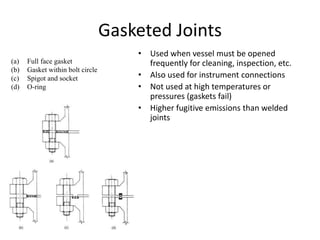
Gasketed Joints
• Used when vessel must be opened
frequently for cleaning, inspection, etc.
• Also used for instrument connections
• Not used at high temperatures or
pressures (gaskets fail)
• Higher fugitive emissions than welded
joints
(a) Full face gasket
(b) Gasket within bolt circle
(c) Spigot and socket
(d) O-ring
Nozzles
• Vessel needs nozzles for
– Feeds, Products
– Hot &/or cold utilities
– Manways, bursting disks, relief valves
– Instruments
• Pressure, Level, Thermowells
• Sample points
• More nozzles = more cost
• Nozzles are usually on side of vessel, away from
weld lines, usually perpendicular to shell
• Nozzles may or may not be flanged (as shown)
depending on joint type
• The number & location of nozzles are usually
specified by the process engineer
Nozzle Reinforcement
• Shell is weakened around nozzles, and must also support eccentric loads from
pipes
• Usually weld reinforcing pads to thicken the shell near the nozzle. Area of
reinforcement = or > area of nozzle: see Code requirements
Swaged Vessels
• Vessel does not have to be
constant diameter
• It is sometimes cheaper to
make a vessel with several
sections of different diameter
• Smaller diameters are usually
at the top, for structural
reasons
• ASME BPV Code gives rules
for tapered sections
Vessel Supports
• Supports must allow for
thermal expansion in
operation
• Smaller vessels are usually
supported on beams – a
support ring or brackets are
welded to the vessel
• Horizontal vessels often rest
on saddles
• Tall vertical vessels are often
supported using a skirt rather
than legs. Can you think why?
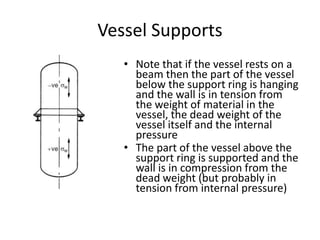
Vessel Supports
• Note that if the vessel rests on a
beam then the part of the vessel
below the support ring is hanging
and the wall is in tension from
the weight of material in the
vessel, the dead weight of the
vessel itself and the internal
pressure
• The part of the vessel above the
support ring is supported and the
wall is in compression from the
dead weight (but probably in
tension from internal pressure)
Jacketed Vessels
• Heating or cooling jackets
are often used for smaller
vessels such as stirred tank
reactors
• If the jacket can have higher
pressure than the vessel
then the vessel walls must
be designed for
compressive stresses
– Internal stiffening rings are
often used for vessels subject
to external pressure
– For small vessels the walls
are just made thicker
Vessel Internals
Source: UOP
• Most vessels have at least
some internals
– Distillation trays
– Packing supports
– Distribution grids
– Heating or cooling coils
• These may require support
rings welded to the inside of
the vessel
• The internals & support rings
need to be considered when
calculating vessel weights for
stress analysis
Pressure Vessel Design
• Pressure Vessel Design Codes
• Vessel Geometry & Construction
• Strength of Materials
• Vessel Specifications
• Materials of Construction
• Pressure Vessel Design Rules
• Fabrication, Inspection and Testing
Stress and Strain
• Stress  = force divided by area over which it is applied
– Area = original cross section in a tensile test
– Stress can be applied directly or can result from an applied
strain
– Examples: dead weight, internal or external pressure, etc.
• Strain ε = distortion per unit length
– Strain = elongation divided by original length in tensile test
– Strain can be applied directly or can result from an applied
stress
– Example: thermal movement relative to fixed supports
F F
Cross-sectional area A
L0
 = F / A
ε = (L – L0)/L0
Typical Stress-Strain Curve
for a Mild Steel
Creep
• At high temperatures, strain can continue to increase
over time under constant load or displacement
– Creep strain = increase in strain at constant load
– Creep relaxation = reduction in stress at constant
displacement
• Accumulated creep strain can lead to failure: creep
rupture
Time
Stress
or
Strain
Stress
Strain
Time
Stress
or
Strain
Stress
Strain
Fracture
Low Temp High Temp
Principle Stresses & Maximum Shear Stress
• For a two-dimensional system
the principal stresses at any
point are:
• The maximum shear stress is half
the algebraic difference between
the principal stresses:
• Compressive stresses are taken
as negative, tensile as positive
Normal stresses x, y
Shear stress τxy
τxy
x
y
x
y
τxy
1, 2 = ½(x+ y) ± ½[(y - x)2 + 4τxy
2]
Maximum shear stress = ½(1 - 2)
For design purposes, often just use 1 - 2
Failure of Materials
Failure of materials under combined tensile and shear stresses is not simple to predict.
Several theories have been proposed:
• Maximum Principal Stress Theory
– Component fails when one of the principal stresses exceeds the value that causes failure in
simple tension
• Maximum Shear Stress Theory
– Component fails when maximum shear stress exceeds the shear stress that causes failure in
simple tension
• Maximum Strain Energy Theory
– Component fails when strain energy per unit volume exceeds the value that causes failure in
simple tension
• BPV Code gives values for maximum allowable stress for different materials as a
function of temperature, incorporating a safety factor relative to the stress that causes
failure (ASME BPV Code Sec. II)
• Failure in compression is by buckling, which is much harder to predict than tensile
failure. The procedure in the Code is iterative. This should definitely be left to a
specialist
Loads Causing Stresses on Pressure Vessel Walls
• Internal or external pressure
• Dead weight of vessel
• Weight of contents under normal or
upset conditions
• Weight of contents during hydraulic
testing
• Weight of internals
• Weight of attached equipment
(piping, decks, ladders, etc)
• Stresses at geometric discontinuities
• Bending moments due to supports
• Thermal expansion, differential
thermal expansion
• Cyclic loads due to pressure or
temperature changes
• Wind & snow loads
• Seismic loads
• Residual stresses from manufacture
• Loads due to friction (solids flow)
All these must be combined to determine principal stresses
Example: Wind Load
• Wind exerts a pressure on one
side of the vessel
• Resulting force acts like a
uniform beam load and exerts a
bending moment on vessel
• Windward wall is placed in
tension, leeward in compression
• Vortex shedding can cause
vibration
– Hence spirals on chimneys
– Usually not needed for columns
due to ladders, pipes, decks, etc.
Wind
Bending
moment
Thin Cylinder Subject to Internal Pressure
• Forces due to internal pressure are balanced by shear
stresses in wall
• Horizontal section:
• Vertical section:
• Similar equations can be derived for other geometries
such as heads
t
D
P
t
D
D
P
L
L
4
4
2






H
L
Longitudinal stress, L
Hoop stress, H
Inside diameter, D
Wall thickness, t
t
D
P
t
h
D
h
P
H
H
2
2




Height,
h
Pressure Vessel Design
• Pressure Vessel Design Codes
• Vessel Geometry & Construction
• Strength of Materials
• Vessel Specifications
• Materials of Construction
• Pressure Vessel Design Rules
• Fabrication, Inspection and Testing
Vessel Specifications Set By the Process
Engineer
• The process engineer will usually specify the following
parameters based on process requirements:
– Vessel size and shape (volume, L and D)
– Vessel orientation and elevation
– Maximum and minimum design pressure
– Maximum and minimum design temperature
– Number of nozzles needed (& location)
– Vessel internals
And often also:
– Material of construction
– Corrosion allowance
• There is often a lot of dialogue with the mechanical
engineer to set the final specifications
Design Pressure
• Normal operating pressure
• The pressure at which you expect the process to usually be operated
• Maximum operating pressure
• The highest pressure expected including upset conditions such as
startup, shutdown, emergency shutdown
• Design pressure
• Maximum operating pressure plus a safety margin
• Margin is typically 10% of maximum operating pressure or 25 psi,
whichever is greater
• Usually specify pressure at top of vessel, where relief valve is located
• The BPV Code Sec. VIII Div. 1 doesn’t say much on how to
set the design pressure
• “..a pressure vessel shall be designed for at least the most severe
condition of coincident pressure and temperature expected in
normal operation.”
Design for Vacuum
• The minimum internal pressure a vessel can
experience is full vacuum (-14.7 psig)
• Vacuum can be caused by:
– Intentional process operation under vacuum (including
start-up and shutdown)
– Cooling down a vessel that contains a condensable
vapor
– Pumping out or draining contents without allowing
enough vapor to enter
– Operator error
• Vacuum puts vessel walls into compressive stress
• What happens if vessel is not designed for vacuum
conditions?
Vessel Subjected to Excess Vacuum
• Normal practice is to design for vacuum if it can be
expected to occur
Design Temperatures
• Maximum:
– Highest mean metal temperature expected in operation,
including transient conditions, plus a margin
– Margin is typically plus 50F
• Minimum
– Lowest mean metal temperature expected in operation,
including transient conditions, upsets, auto-refrigeration,
climatic conditions, anything else that could cause cooling,
minus a margin
– Margin is typically -25F
– MDMT: minimum design metal temperature is important as
metals can become brittle at low temperatures
• Designer should allow for possible failure of upstream
equipment (e.g., loss of coolant on upstream cooler)
Design Temperature Considerations
• Due to creep, maximum allowable stress drops
off rapidly at higher temperatures
– Forces designer to use more expensive alloys
• BPV Code Sec. VIII Div.2 cannot be applied for
design temperatures > 900F (no creep safety
factor in Div.2)
• The Code allows design of vessels with different
temperature zones
– Very useful for high temperature vessels
– Not usually applied to medium temperature vessels
such as heat exchangers, distillation columns
Design Temperature & Pressure Exercise 1
• What is the design
pressure?
120 + 25 = 145 psig
• What is the design
temperature?
340 + 50 = 390F
100 psig
180 F
120 psig
340 F
Design Temperature & Pressure Exercise 2
• What is the shell-
side design
pressure?
588 + 58 = 646 psig
• What is the tube-
side design
temperature?
482 + 50 = 532F
Oil
400 psig
120 F
390 psig
450 F
Steam
40 barg
482 F
Pressure Vessel Design
• Pressure Vessel Design Codes
• Vessel Geometry & Construction
• Strength of Materials
• Vessel Specifications
• Materials of Construction
• Pressure Vessel Design Rules
• Fabrication, Inspection and Testing
Materials Selection Criteria
• Safety
– Material must have sufficient strength at design conditions
– Material must be able to withstand variation (or cycling) in
process conditions
– Material must have sufficient corrosion resistance to
survive in service between inspection intervals
• Ease of fabrication
• Availability in standard sizes (plates, sections, tubes)
• Cost
– Includes initial cost and cost of periodic replacement
Commonly Used Materials
• Steels
– Carbon steel, Killed carbon steel – cheap, widely available
– Low chrome alloys (<9% Cr) – better corrosion resistance than CS, KCS
– Stainless steels:
• 304 – cheapest austenitic stainless steel
• 316 – better corrosion resistance than 304, more expensive
• 410
• Nickel Alloys
– Inconel, Incolloy – high temperature oxidizing environments
– Monel, Hastelloy – expensive, but high corrosion resistance, used for strong
acids
• Other metals such as aluminum and titanium are used for special
applications. Fiber reinforced plastics are used for some low temperature &
pressure applications. See Ch 7 for more details
Relative Cost of Metals
• The maximum allowable stress values are at 40ºC (100ºF) and are taken from ASME
BPV Code Sec. II Part D. The code should be consulted for values at other
temperatures. Several other grades exist for most of the materials listed.
• Finished vessel relative costs are not the same as materials relative costs as vessel cost
also includes manufacturing costs, labor and fabricator’s profit
Metal Type or grade Price Max allowable stress Relative cost rating
($/lb) (ksi = 1000 psi)
Carbon steel A-285 0.27 12.9 1
Austenitic stainless steel 304 0.90 20 2.2
316 1.64 20 4
Aluminum alloy A03560 1.27 8.6 2.4
Copper C10400 3.34 6.7 27
Nickel 99%Ni 8.75 10 48
Incoloy N08800 3.05 20 7.5
Monel N04400 6.76 18.7 20
Titanium R50250 9.62 10 27
Corrosion Allowance
• Wall thicknesses calculated using BPV Code
equations are for the fully corroded state
• Usually add a corrosion allowance of 1/16” to
3/16” (1.5 to 5 mm)
• Smaller corrosion allowances are used for
heat transfer equipment, where wall thickness
can affect heat transfer
Pressure Vessel Design
• Pressure Vessel Design Codes
• Vessel Geometry & Construction
• Strength of Materials
• Vessel Specifications
• Materials of Construction
• Pressure Vessel Design Rules
• Fabrication, Inspection and Testing
Determining Wall Thickness
• Under ASME BPV Code Sec. VIII D.1, minimum wall
thickness is 1/16” (1.5mm) with no corrosion
allowance
• Most pressure vessels require much thicker walls to
withstand governing load
– High pressure vessels: internal pressure usually governs
– Thickness required to resist vacuum usually governs for
lower pressure vessels
– For vessels designed for low pressure, no vacuum, then
analysis of principal stresses may be needed
– Usual procedure is to design for internal pressure (or
vacuum), round up to nearest available standard size and
then check for other loads
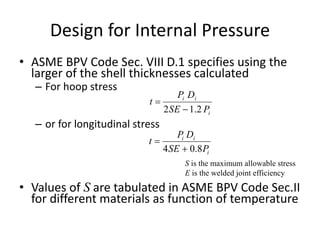
Design for Internal Pressure
• ASME BPV Code Sec. VIII D.1 specifies using the
larger of the shell thicknesses calculated
– For hoop stress
– or for longitudinal stress
• Values of S are tabulated in ASME BPV Code Sec.II
for different materials as function of temperature
i
i
i
P
SE
D
P
t
2
.
1
2 

i
i
i
P
SE
D
P
t
8
.
0
4 

S is the maximum allowable stress
E is the welded joint efficiency
Some Maximum Allowable Stresses
Under ASME BPV Code Sec. VIII D.1, Taken From Sec. II Part D
Material Grade Min Tensile Min Yield Maximum Maximum allowable stress at temperature F
strength strength temperature (ksi = 1000 psi)
(ksi) (ksi) (ºF) 100 300 500 700 900
Carbon steel A285 45 24 900 12.9 12.9 12.9 11.5 5.9
Gr A
Killed carbon A515 60 32 1000 17.1 17.1 17.1 14.3 5.9
Steel Gr 60
Low alloy steel A387 60 30 1200 17.1 16.6 16.6 16.6 13.6
1 ¼ Cr, ½ Mo, Si Gr 22
Stainless steel 410 65 30 1200 18.6 17.8 17.2 16.2 12.3
13 Cr
Stainless steel 304 75 30 1500 20.0 15.0 12.9 11.7 10.8
18 Cr, 8 Ni
Stainless steel 347 75 30 1500 20.0 17.1 15.0 13.8 13.4
18 Cr, 10 Ni, Cb
Stainless steel 321 75 30 1500 20.0 16.5 14.3 13.0 12.3
18 Cr, 10 Ni, Ti
Stainless steel 316 75 30 1500 20.0 15.6 13.3 12.1 11.5
16 Cr, 12 Ni, 2 Mo
Welded Joint Categories
ASME BPV Code has four categories of welds:
A. Longitudinal or spiral welds in the main shell, necks or nozzles, or
circumferential welds connecting hemispherical heads to the main shell,
necks or nozzles.
B. Circumferential welds in the main shell, necks or nozzles or connecting a
formed head other than hemispherical.
C. Welds connecting flanges, tubesheets or flat heads to the main shell, a
formed head, neck or nozzle.
D. Welds connecting communicating chambers or nozzles to the main shell,
to heads or to necks.
Welded Joint Efficiencies Allowed Under ASME
BPV Code Sec. VIII D.1
Joint Description Joint Category Degree of Radiographic Examination
Full Spot None
Double-welded butt joint A, B, C, D 1.0 0.85 0.70
or equivalent
Single-welded butt joint A, B, C, D 0.9 0.8 0.65
with backing strip
Single-welded butt joint A, B, C NA NA 0.60
without backing strip
Double full fillet lap A, B, C NA NA 0.55
joint
Single full fillet lap B, C NA NA 0.50
joint with plug welds
Single full fillet lap A, B NA NA 0.45
joint without plug welds
Closures Subject to Internal Pressure
• Hemispherical heads
• Ellipsoidal heads
• Torispherical heads
i
i
i
P
SE
D
P
t
4
.
0
4 

i
i
i
P
SE
D
P
t
2
.
0
2 

i
c
i
P
SE
R
P
t
1
.
0
885
.
0


Rc is the crown radius: see Ch 13
Example
• What is the wall thickness required for a 10ft diameter
304 stainless steel vessel with design pressure 500 psi and
design temperature 700F?
• From the table, S = 11700 psi
• Assume double-welded butt joint with spot radiography, E = 0.85
• For hoop stress
• For longitudinal stress
• So hoop stress governs, choose t = 3.25 or 3.5 inches,
depending on what’s readily available as plate stock
inches
11
.
3
500
2
.
1
85
.
0
11700
2
12
10
500
2
.
1
2










i
i
i
P
SE
D
P
t
inches
49
.
1
500
8
.
0
85
.
0
11700
4
12
10
500
8
.
0
4










i
i
i
P
SE
D
P
t
Software for Pressure Vessel Design
• Rules for external pressure, combined loads are more
complex
• Design methods and maximum allowable stresses are
coded into software used by specialist designers, such as:
• COMPRESS (Codeware Inc.) has free demo version
http://www.codeware.com/support/tutorials/compress_video_tutorial.
html
• Pressure Vessel Suite (Computer Engineering Inc.)
• PVElite and CodeCalc (COADE Inc.)
• Simple ASME BPV Code Sec. VIII D.1 methods are available
in Aspen ICARUS
• Good enough for an initial cost estimate if the process engineer puts in
realistic vessel specifications
• Useful for checking to see if changes to specifications give cost
discontinuities
• Not good enough for detailed vessel design
Pressure Vessel Design
• Pressure Vessel Design Codes
• Vessel Geometry & Construction
• Strength of Materials
• Vessel Specifications
• Materials of Construction
• Pressure Vessel Design Rules
• Fabrication, Inspection and Testing
Vessel Manufacture
• Shell is usually made by rolling plate and then
welding along a seam:
– Difficult to form small diameters or thick shells by this
method
– Long vessels are usually made in 8’ sections and butt
welded
• Thicker vessels are made by more expensive drum
forging – direct from ingots
• Closures are usually forged
– Hence restricted to increments of 6” in diameter
• Nozzles, support rings etc. are welded on to shell
and heads
Post Weld Heat Treating (PWHT)
• Forming and joining (welding) can leave residual
stresses in the metal
• Post-weld heat treatment is used to relax these
stresses
• Guidelines for PWHT are given in the ASME BPV
Code Sec. VIII D.1 Part UW-40
• PWHT requirements depend on material and
thickness at weld:
- Over 38mm for carbon steel
- Over 16mm for low alloy

10572621.ppt

  • 1.
  • 2.
    Pressure Vessel Design •A pressure vessel is any vessel that falls under the definition laid down in the ASME Boiler and Pressure Vessel Code, Section VIII, Rules for the Construction of Pressure Vessels (ASME BPV Code Sec. VIII) • The definition applies to most process reactors, distillation columns, separators (flashes and decanters), pressurized storage vessels and heat exchangers Source: UOP
  • 3.
    Isn’t This Somethingto Leave to the Mechanical Engineers? • Chemical engineers are usually not properly trained or qualified to carry out detailed mechanical design of vessels. Most mechanical designs are completed by specialists in later phases of design But • The process design engineer needs to understand pressure vessel design in order to generate good cost estimates (e.g. in Aspen ICARUS) • Costs can vary discontinuously with vessel design • A 10C change in temperature could double the vessel cost if it causes a change in code! • Adding a component could cause a change in metallurgy that would mean moving to a more expensive code design • The process engineer will end up specifying the main constraints on the vessel design: if you don’t know how to do this properly, you can’t really design anything
  • 4.
    Pressure Vessel Design •Pressure Vessel Design Codes • Vessel Geometry & Construction • Strength of Materials • Vessel Specifications • Materials of Construction • Pressure Vessel Design Rules • Fabrication, Inspection and Testing
  • 5.
    ASME Boiler andPressure Vessel Code • ASME BPV Code is the legally required standard for pressure vessel design, fabrication, inspection and testing in North America Section I Rules for construction of power boilers II Materials III Nuclear power plant components IV Rules for construction of heating boilers V Nondestructive examination VI Recommended rules for the care and operation of heating boilers VII Recommended guidelines for the care of power boilers VIII Rules for the construction of pressure vessels Division 1 Division 2 Alternative rules Division 3 Alternative rules for the construction of high pressure vessels IX Welding and brazing qualifications X Fiber-reinforced plastic vessels XI Rules for in service inspection of nuclear power plant components XII Rules for construction and continued service of transport tanks Most chemical plant vessels fall under Sec. VIII D.1 or D.2 Allowable stresses are given in Sec. II Often used for bio-reactors
  • 6.
    Advantages of Designingto Code • The Code is a consensus best practice • It is usually required by law – Local requirements may vary (particularly overseas), but ASME code is usually recognized as acceptable – Always check for local regulations that may require stricter standards • Code rules are often applied even for vessels that don’t require construction to code – Savings of not following code rules are negligible as vessel shops are set up to do everything to code
  • 7.
    ASME BPV CodeSec. VIII Divisions Division 1 • Rigorous analysis of local thermal and fatigue stresses not required • Safety factor of 3.5 against tensile failure and 1.25 for 100,000 hour creep rupture • Limited to design pressures below 3000 psi (but usually costs more than Div.2 above about 1500 psi) Division 2 • Requires more analysis than Div.1, and more inspection, but allows thinner walled vessels • Safety factor of 3.0 against tensile failure • Limited to design temperatures less than 900F (outside creep range) • More economical for high pressure vessels, but fewer fabricators available • Either Division of the Code is acceptable, but provisions cannot be mixed and matched
  • 8.
    Vessels Specifically Excluded byASME BPV Code Sec. VIII Div 1 • Vessels within the scope of other sections of the BPV code. For example, power boilers (Sec. I), fiber- reinforced plastic vessels (Sec. X) and transport tanks (Sec. XIII). • Fired process tubular heaters. • Pressure containers that are integral parts of rotating or reciprocating devices such as pumps, compressors, turbines or engines. • Piping systems (which are covered by ASME B31.3 – see Chapter 5). • Piping components and accessories such as valves, strainers, in-line mixers and spargers. • Vessels containing water at less than 300 psi (2 MPa) and less than 210ºF (99ºC). • Hot water storage tanks heated by steam with heat rate less than 0.2 MMBTU/hr (58.6 kW), water temperature less than 210ºF (99ºC) and volume less than 120 gal (450 liters). • Vessels having internal pressure less than 15 psi (100 kPa) or greater than 3000 psi (20 MPa). • Vessels of internal diameter or height less than 6 inches (152 mm). • Pressure vessels for human occupancy.
  • 9.
    ASME Code StampName Plate • Can only be used if vessel is designed, inspected and tested under the supervision of a Certified Individual employed by the manufacturer • The code stamp must be clearly visible on the vessel W (if arc or gas welded) RT (if Radio graphed) HT (if Postweld heat treated) Name of Manufacturer psi at °F Max. Allowable Working Pressure Min. Design Metal Temperature Manufacturer’s Serial Number Year Built °F at psi W (if arc or gas welded) RT (if Radio graphed) HT (if Postweld heat treated) Name of Manufacturer psi at °F Max. Allowable Working Pressure Min. Design Metal Temperature Manufacturer’s Serial Number Year Built °F at psi Name of Manufacturer psi at °F Max. Allowable Working Pressure Min. Design Metal Temperature Manufacturer’s Serial Number Year Built °F at psi
  • 10.
    Other Related Codes •Storage tanks are usually not designed to BPV Code – API Standard 620, Large low pressure storage tanks, Pressure 0.5 to 15 psig – API Standard 650, Welded storage tanks, Pressures up to 0.5 psig • Fittings are covered by other ASME codes – ASME B16.5, Pipe flanges and flanged fittings – ASME B16.9, Factory-made wrought buttwelding fittings – ASME B16.11 Forged fittings, socket welding and threaded – ASME B16.47, Large diameter steel flanges NPS26 Through NPS60 • Piping is covered by a different ASME code – ASME B16.3, Process piping • Heat exchangers have additional codes set by TEMA
  • 11.
    Use of DesignCodes & Standards • The latest version of the design code should always be consulted as regulations change – Example: new version of ASME BPV Code Sec. VIII Div. 2 will allow for thinner walls on high pressure vessels • All the information given in this presentation is from the 2004 edition
  • 12.
    Pressure Vessel Design •Pressure Vessel Design Codes • Vessel Geometry & Construction • Strength of Materials • Vessel Specifications • Materials of Construction • Pressure Vessel Design Rules • Fabrication, Inspection and Testing
  • 13.
    Pressure Vessel Shape •What shape of pressure vessel uses the least amount of metal to contain a given volume, pressure? A sphere! • Why is this shape not more widely used? – Usually need to have an extended section of constant cross-section to provide support for vessel internals, trays, distributors, etc. – It is much easier to obtain and maintain uniform flow in a cylindrical bed of catalyst or packing than it is in a non- uniform cross-section – A cylinder takes up a lot less plot space for the same volume – A sphere is more expensive to fabricate
  • 14.
    Pressure Vessel Shape •Most pressure vessels are at least 2:1 cylinders: 3:1 or 4:1 are most common: • Distillation columns are obviously an exception: diameter is set by flooding correlations and height by number of trays 2:1 3:1 4:1 (To scale)
  • 15.
    Vessel Size Restrictions •Diameter gets very expensive if > 13.5 ft. Why? • Height (length) gets very expensive if > 180 ft. Why? Roughly 50 cranes can lift > 180 ft Only 14 can lift > 240 ft • Vessels that can’t be transported have to be fabricated on site
  • 16.
    Vessel Orientation • Usuallyvertical – Easier to distribute fluids across a smaller cross section – Smaller plot space • Reasons for using horizontal vessels – To promote phase separation • Increased cross section = lower vertical velocity = less entrainment • Decanters, settling tanks, separators, flash vessels – To allow internals to be pulled for cleaning • Heat exchangers
  • 17.
    Head (Closure) Designs •Hemispherical – Good for high pressures – Higher internal volume – Most expensive to form & join to shell – Half the thickness of the shell • Ellipsoidal – Cheaper than hemispherical and less internal volume – Depth is half diameter – Same thickness as shell – Most common type > 15 bar • Torispherical – Part torus, part sphere – Similar to elliptical, but cheaper to fabricate – Cheapest for pressures less than 15 bar
  • 18.
    Tangent and WeldLines • Tangent line is where curvature begins • Weld line is where weld is located • Usually they are not the same, as the head is fabricated to allow a weld away from the geometrical joint
  • 19.
    Welded Joints • Someweld types are not permitted by ASME BPV Code • Many other possible variations, including use of backing strips and joint reinforcement • Sec. VIII Div. 1 Part UW has details of permissible joints, corners, etc. • Welds are usually ground smooth and inspected – Type of inspection depends on Code Division Butt weld Single fillet lap weld Double fillet lap weld Double fillet corner joint Double welded butt weld
  • 20.
    Gasketed Joints • Usedwhen vessel must be opened frequently for cleaning, inspection, etc. • Also used for instrument connections • Not used at high temperatures or pressures (gaskets fail) • Higher fugitive emissions than welded joints (a) Full face gasket (b) Gasket within bolt circle (c) Spigot and socket (d) O-ring
  • 21.
    Nozzles • Vessel needsnozzles for – Feeds, Products – Hot &/or cold utilities – Manways, bursting disks, relief valves – Instruments • Pressure, Level, Thermowells • Sample points • More nozzles = more cost • Nozzles are usually on side of vessel, away from weld lines, usually perpendicular to shell • Nozzles may or may not be flanged (as shown) depending on joint type • The number & location of nozzles are usually specified by the process engineer
  • 22.
    Nozzle Reinforcement • Shellis weakened around nozzles, and must also support eccentric loads from pipes • Usually weld reinforcing pads to thicken the shell near the nozzle. Area of reinforcement = or > area of nozzle: see Code requirements
  • 23.
    Swaged Vessels • Vesseldoes not have to be constant diameter • It is sometimes cheaper to make a vessel with several sections of different diameter • Smaller diameters are usually at the top, for structural reasons • ASME BPV Code gives rules for tapered sections
  • 24.
    Vessel Supports • Supportsmust allow for thermal expansion in operation • Smaller vessels are usually supported on beams – a support ring or brackets are welded to the vessel • Horizontal vessels often rest on saddles • Tall vertical vessels are often supported using a skirt rather than legs. Can you think why?
  • 25.
    Vessel Supports • Notethat if the vessel rests on a beam then the part of the vessel below the support ring is hanging and the wall is in tension from the weight of material in the vessel, the dead weight of the vessel itself and the internal pressure • The part of the vessel above the support ring is supported and the wall is in compression from the dead weight (but probably in tension from internal pressure)
  • 26.
    Jacketed Vessels • Heatingor cooling jackets are often used for smaller vessels such as stirred tank reactors • If the jacket can have higher pressure than the vessel then the vessel walls must be designed for compressive stresses – Internal stiffening rings are often used for vessels subject to external pressure – For small vessels the walls are just made thicker
  • 27.
    Vessel Internals Source: UOP •Most vessels have at least some internals – Distillation trays – Packing supports – Distribution grids – Heating or cooling coils • These may require support rings welded to the inside of the vessel • The internals & support rings need to be considered when calculating vessel weights for stress analysis
  • 28.
    Pressure Vessel Design •Pressure Vessel Design Codes • Vessel Geometry & Construction • Strength of Materials • Vessel Specifications • Materials of Construction • Pressure Vessel Design Rules • Fabrication, Inspection and Testing
  • 29.
    Stress and Strain •Stress  = force divided by area over which it is applied – Area = original cross section in a tensile test – Stress can be applied directly or can result from an applied strain – Examples: dead weight, internal or external pressure, etc. • Strain ε = distortion per unit length – Strain = elongation divided by original length in tensile test – Strain can be applied directly or can result from an applied stress – Example: thermal movement relative to fixed supports F F Cross-sectional area A L0  = F / A ε = (L – L0)/L0
  • 30.
  • 31.
    Creep • At hightemperatures, strain can continue to increase over time under constant load or displacement – Creep strain = increase in strain at constant load – Creep relaxation = reduction in stress at constant displacement • Accumulated creep strain can lead to failure: creep rupture Time Stress or Strain Stress Strain Time Stress or Strain Stress Strain Fracture Low Temp High Temp
  • 32.
    Principle Stresses &Maximum Shear Stress • For a two-dimensional system the principal stresses at any point are: • The maximum shear stress is half the algebraic difference between the principal stresses: • Compressive stresses are taken as negative, tensile as positive Normal stresses x, y Shear stress τxy τxy x y x y τxy 1, 2 = ½(x+ y) ± ½[(y - x)2 + 4τxy 2] Maximum shear stress = ½(1 - 2) For design purposes, often just use 1 - 2
  • 33.
    Failure of Materials Failureof materials under combined tensile and shear stresses is not simple to predict. Several theories have been proposed: • Maximum Principal Stress Theory – Component fails when one of the principal stresses exceeds the value that causes failure in simple tension • Maximum Shear Stress Theory – Component fails when maximum shear stress exceeds the shear stress that causes failure in simple tension • Maximum Strain Energy Theory – Component fails when strain energy per unit volume exceeds the value that causes failure in simple tension • BPV Code gives values for maximum allowable stress for different materials as a function of temperature, incorporating a safety factor relative to the stress that causes failure (ASME BPV Code Sec. II) • Failure in compression is by buckling, which is much harder to predict than tensile failure. The procedure in the Code is iterative. This should definitely be left to a specialist
  • 34.
    Loads Causing Stresseson Pressure Vessel Walls • Internal or external pressure • Dead weight of vessel • Weight of contents under normal or upset conditions • Weight of contents during hydraulic testing • Weight of internals • Weight of attached equipment (piping, decks, ladders, etc) • Stresses at geometric discontinuities • Bending moments due to supports • Thermal expansion, differential thermal expansion • Cyclic loads due to pressure or temperature changes • Wind & snow loads • Seismic loads • Residual stresses from manufacture • Loads due to friction (solids flow) All these must be combined to determine principal stresses
  • 35.
    Example: Wind Load •Wind exerts a pressure on one side of the vessel • Resulting force acts like a uniform beam load and exerts a bending moment on vessel • Windward wall is placed in tension, leeward in compression • Vortex shedding can cause vibration – Hence spirals on chimneys – Usually not needed for columns due to ladders, pipes, decks, etc. Wind Bending moment
  • 36.
    Thin Cylinder Subjectto Internal Pressure • Forces due to internal pressure are balanced by shear stresses in wall • Horizontal section: • Vertical section: • Similar equations can be derived for other geometries such as heads t D P t D D P L L 4 4 2       H L Longitudinal stress, L Hoop stress, H Inside diameter, D Wall thickness, t t D P t h D h P H H 2 2     Height, h
  • 37.
    Pressure Vessel Design •Pressure Vessel Design Codes • Vessel Geometry & Construction • Strength of Materials • Vessel Specifications • Materials of Construction • Pressure Vessel Design Rules • Fabrication, Inspection and Testing
  • 38.
    Vessel Specifications SetBy the Process Engineer • The process engineer will usually specify the following parameters based on process requirements: – Vessel size and shape (volume, L and D) – Vessel orientation and elevation – Maximum and minimum design pressure – Maximum and minimum design temperature – Number of nozzles needed (& location) – Vessel internals And often also: – Material of construction – Corrosion allowance • There is often a lot of dialogue with the mechanical engineer to set the final specifications
  • 39.
    Design Pressure • Normaloperating pressure • The pressure at which you expect the process to usually be operated • Maximum operating pressure • The highest pressure expected including upset conditions such as startup, shutdown, emergency shutdown • Design pressure • Maximum operating pressure plus a safety margin • Margin is typically 10% of maximum operating pressure or 25 psi, whichever is greater • Usually specify pressure at top of vessel, where relief valve is located • The BPV Code Sec. VIII Div. 1 doesn’t say much on how to set the design pressure • “..a pressure vessel shall be designed for at least the most severe condition of coincident pressure and temperature expected in normal operation.”
  • 40.
    Design for Vacuum •The minimum internal pressure a vessel can experience is full vacuum (-14.7 psig) • Vacuum can be caused by: – Intentional process operation under vacuum (including start-up and shutdown) – Cooling down a vessel that contains a condensable vapor – Pumping out or draining contents without allowing enough vapor to enter – Operator error • Vacuum puts vessel walls into compressive stress • What happens if vessel is not designed for vacuum conditions?
  • 41.
    Vessel Subjected toExcess Vacuum • Normal practice is to design for vacuum if it can be expected to occur
  • 42.
    Design Temperatures • Maximum: –Highest mean metal temperature expected in operation, including transient conditions, plus a margin – Margin is typically plus 50F • Minimum – Lowest mean metal temperature expected in operation, including transient conditions, upsets, auto-refrigeration, climatic conditions, anything else that could cause cooling, minus a margin – Margin is typically -25F – MDMT: minimum design metal temperature is important as metals can become brittle at low temperatures • Designer should allow for possible failure of upstream equipment (e.g., loss of coolant on upstream cooler)
  • 43.
    Design Temperature Considerations •Due to creep, maximum allowable stress drops off rapidly at higher temperatures – Forces designer to use more expensive alloys • BPV Code Sec. VIII Div.2 cannot be applied for design temperatures > 900F (no creep safety factor in Div.2) • The Code allows design of vessels with different temperature zones – Very useful for high temperature vessels – Not usually applied to medium temperature vessels such as heat exchangers, distillation columns
  • 44.
    Design Temperature &Pressure Exercise 1 • What is the design pressure? 120 + 25 = 145 psig • What is the design temperature? 340 + 50 = 390F 100 psig 180 F 120 psig 340 F
  • 45.
    Design Temperature &Pressure Exercise 2 • What is the shell- side design pressure? 588 + 58 = 646 psig • What is the tube- side design temperature? 482 + 50 = 532F Oil 400 psig 120 F 390 psig 450 F Steam 40 barg 482 F
  • 46.
    Pressure Vessel Design •Pressure Vessel Design Codes • Vessel Geometry & Construction • Strength of Materials • Vessel Specifications • Materials of Construction • Pressure Vessel Design Rules • Fabrication, Inspection and Testing
  • 47.
    Materials Selection Criteria •Safety – Material must have sufficient strength at design conditions – Material must be able to withstand variation (or cycling) in process conditions – Material must have sufficient corrosion resistance to survive in service between inspection intervals • Ease of fabrication • Availability in standard sizes (plates, sections, tubes) • Cost – Includes initial cost and cost of periodic replacement
  • 48.
    Commonly Used Materials •Steels – Carbon steel, Killed carbon steel – cheap, widely available – Low chrome alloys (<9% Cr) – better corrosion resistance than CS, KCS – Stainless steels: • 304 – cheapest austenitic stainless steel • 316 – better corrosion resistance than 304, more expensive • 410 • Nickel Alloys – Inconel, Incolloy – high temperature oxidizing environments – Monel, Hastelloy – expensive, but high corrosion resistance, used for strong acids • Other metals such as aluminum and titanium are used for special applications. Fiber reinforced plastics are used for some low temperature & pressure applications. See Ch 7 for more details
  • 49.
    Relative Cost ofMetals • The maximum allowable stress values are at 40ºC (100ºF) and are taken from ASME BPV Code Sec. II Part D. The code should be consulted for values at other temperatures. Several other grades exist for most of the materials listed. • Finished vessel relative costs are not the same as materials relative costs as vessel cost also includes manufacturing costs, labor and fabricator’s profit Metal Type or grade Price Max allowable stress Relative cost rating ($/lb) (ksi = 1000 psi) Carbon steel A-285 0.27 12.9 1 Austenitic stainless steel 304 0.90 20 2.2 316 1.64 20 4 Aluminum alloy A03560 1.27 8.6 2.4 Copper C10400 3.34 6.7 27 Nickel 99%Ni 8.75 10 48 Incoloy N08800 3.05 20 7.5 Monel N04400 6.76 18.7 20 Titanium R50250 9.62 10 27
  • 50.
    Corrosion Allowance • Wallthicknesses calculated using BPV Code equations are for the fully corroded state • Usually add a corrosion allowance of 1/16” to 3/16” (1.5 to 5 mm) • Smaller corrosion allowances are used for heat transfer equipment, where wall thickness can affect heat transfer
  • 51.
    Pressure Vessel Design •Pressure Vessel Design Codes • Vessel Geometry & Construction • Strength of Materials • Vessel Specifications • Materials of Construction • Pressure Vessel Design Rules • Fabrication, Inspection and Testing
  • 52.
    Determining Wall Thickness •Under ASME BPV Code Sec. VIII D.1, minimum wall thickness is 1/16” (1.5mm) with no corrosion allowance • Most pressure vessels require much thicker walls to withstand governing load – High pressure vessels: internal pressure usually governs – Thickness required to resist vacuum usually governs for lower pressure vessels – For vessels designed for low pressure, no vacuum, then analysis of principal stresses may be needed – Usual procedure is to design for internal pressure (or vacuum), round up to nearest available standard size and then check for other loads
  • 53.
    Design for InternalPressure • ASME BPV Code Sec. VIII D.1 specifies using the larger of the shell thicknesses calculated – For hoop stress – or for longitudinal stress • Values of S are tabulated in ASME BPV Code Sec.II for different materials as function of temperature i i i P SE D P t 2 . 1 2   i i i P SE D P t 8 . 0 4   S is the maximum allowable stress E is the welded joint efficiency
  • 54.
    Some Maximum AllowableStresses Under ASME BPV Code Sec. VIII D.1, Taken From Sec. II Part D Material Grade Min Tensile Min Yield Maximum Maximum allowable stress at temperature F strength strength temperature (ksi = 1000 psi) (ksi) (ksi) (ºF) 100 300 500 700 900 Carbon steel A285 45 24 900 12.9 12.9 12.9 11.5 5.9 Gr A Killed carbon A515 60 32 1000 17.1 17.1 17.1 14.3 5.9 Steel Gr 60 Low alloy steel A387 60 30 1200 17.1 16.6 16.6 16.6 13.6 1 ¼ Cr, ½ Mo, Si Gr 22 Stainless steel 410 65 30 1200 18.6 17.8 17.2 16.2 12.3 13 Cr Stainless steel 304 75 30 1500 20.0 15.0 12.9 11.7 10.8 18 Cr, 8 Ni Stainless steel 347 75 30 1500 20.0 17.1 15.0 13.8 13.4 18 Cr, 10 Ni, Cb Stainless steel 321 75 30 1500 20.0 16.5 14.3 13.0 12.3 18 Cr, 10 Ni, Ti Stainless steel 316 75 30 1500 20.0 15.6 13.3 12.1 11.5 16 Cr, 12 Ni, 2 Mo
  • 55.
    Welded Joint Categories ASMEBPV Code has four categories of welds: A. Longitudinal or spiral welds in the main shell, necks or nozzles, or circumferential welds connecting hemispherical heads to the main shell, necks or nozzles. B. Circumferential welds in the main shell, necks or nozzles or connecting a formed head other than hemispherical. C. Welds connecting flanges, tubesheets or flat heads to the main shell, a formed head, neck or nozzle. D. Welds connecting communicating chambers or nozzles to the main shell, to heads or to necks.
  • 56.
    Welded Joint EfficienciesAllowed Under ASME BPV Code Sec. VIII D.1 Joint Description Joint Category Degree of Radiographic Examination Full Spot None Double-welded butt joint A, B, C, D 1.0 0.85 0.70 or equivalent Single-welded butt joint A, B, C, D 0.9 0.8 0.65 with backing strip Single-welded butt joint A, B, C NA NA 0.60 without backing strip Double full fillet lap A, B, C NA NA 0.55 joint Single full fillet lap B, C NA NA 0.50 joint with plug welds Single full fillet lap A, B NA NA 0.45 joint without plug welds
  • 57.
    Closures Subject toInternal Pressure • Hemispherical heads • Ellipsoidal heads • Torispherical heads i i i P SE D P t 4 . 0 4   i i i P SE D P t 2 . 0 2   i c i P SE R P t 1 . 0 885 . 0   Rc is the crown radius: see Ch 13
  • 58.
    Example • What isthe wall thickness required for a 10ft diameter 304 stainless steel vessel with design pressure 500 psi and design temperature 700F? • From the table, S = 11700 psi • Assume double-welded butt joint with spot radiography, E = 0.85 • For hoop stress • For longitudinal stress • So hoop stress governs, choose t = 3.25 or 3.5 inches, depending on what’s readily available as plate stock inches 11 . 3 500 2 . 1 85 . 0 11700 2 12 10 500 2 . 1 2           i i i P SE D P t inches 49 . 1 500 8 . 0 85 . 0 11700 4 12 10 500 8 . 0 4           i i i P SE D P t
  • 59.
    Software for PressureVessel Design • Rules for external pressure, combined loads are more complex • Design methods and maximum allowable stresses are coded into software used by specialist designers, such as: • COMPRESS (Codeware Inc.) has free demo version http://www.codeware.com/support/tutorials/compress_video_tutorial. html • Pressure Vessel Suite (Computer Engineering Inc.) • PVElite and CodeCalc (COADE Inc.) • Simple ASME BPV Code Sec. VIII D.1 methods are available in Aspen ICARUS • Good enough for an initial cost estimate if the process engineer puts in realistic vessel specifications • Useful for checking to see if changes to specifications give cost discontinuities • Not good enough for detailed vessel design
  • 60.
    Pressure Vessel Design •Pressure Vessel Design Codes • Vessel Geometry & Construction • Strength of Materials • Vessel Specifications • Materials of Construction • Pressure Vessel Design Rules • Fabrication, Inspection and Testing
  • 61.
    Vessel Manufacture • Shellis usually made by rolling plate and then welding along a seam: – Difficult to form small diameters or thick shells by this method – Long vessels are usually made in 8’ sections and butt welded • Thicker vessels are made by more expensive drum forging – direct from ingots • Closures are usually forged – Hence restricted to increments of 6” in diameter • Nozzles, support rings etc. are welded on to shell and heads
  • 62.
    Post Weld HeatTreating (PWHT) • Forming and joining (welding) can leave residual stresses in the metal • Post-weld heat treatment is used to relax these stresses • Guidelines for PWHT are given in the ASME BPV Code Sec. VIII D.1 Part UW-40 • PWHT requirements depend on material and thickness at weld: - Over 38mm for carbon steel - Over 16mm for low alloy