JTS TRAINING CENTRE
ASME SEC: VIII DIV 1 (2019)
WHAT IS PRESSURE VESSEL
DATE: 21 & 22 FEB 2023
PRESENTED BY:
•
ZAINAL MOHD SALLEH
•
(MSc, CEng, CTPEng, CSWIP, CWI, ASNT LII, TTT HRDF, ToT.UK. ISO Lead)
WHAT IS A PRESSURE VESSEL?
• Pressure vessels are industrial containers designed to hold
vapors, liquids, or gases.
• Pressure vessels usually hold materials at a high pressure
they can be dangerous if not properly maintained. Regular
inspections are a critical part of the maintenance process for
pressure vessels, helping to reveal potential problems before
they develop further.
• In this guide to pressure vessels we cover what pressure
vessels are in detail, the requirements for pressure vessel
inspections, common pressure vessel questions, and how
drones can help with inspecting them.
Here is a list of the topics covered in this resource to help you
find the information of most interest:
•• What Is a Pressure Vessel?
•• Pressure Vessel Inspections
•• Common Questions about Pressure Vessels
•• Five Ways Drones Can Help with Pressure Vessel Inspections
•• The Future of Pressure Vessel Inspections
What Is a Pressure Vessel?
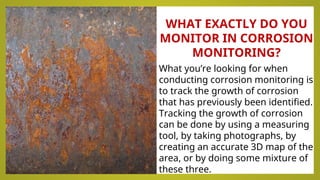
•Although already provided a definition of pressure vessels in
the first sentence of this article—they’re “containers designed
to hold vapors, liquids, or gases at a specific pressure”
•Each country has strict definitions of what they are, so it’s
worth spending some more time defining them.
•The reason for these narrow definitions is because pressure
vessels are dangerous.
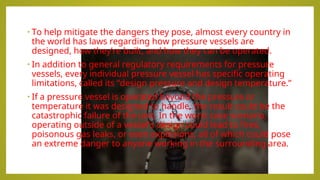
• To help mitigate the dangers they pose, almost every country in
the world has laws regarding how pressure vessels are
designed, how they’re built, and how they can be operated.
• In addition to general regulatory requirements for pressure
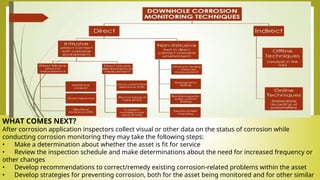
vessels, every individual pressure vessel has specific operating
limitations, called its “design pressure and design temperature.”
• If a pressure vessel is operated beyond the pressure or
temperature it was designed to handle, the result could be the
catastrophic failure of the unit. In the worst case scenario,
operating outside of a vessel’s design could lead to fires,
poisonous gas leaks, or even explosions, all of which could pose
an extreme danger to anyone working in the surrounding area.
COMMON CHARACTERISTICS OF PRESSURE VESSELS
Here are some common characteristics of pressure vessels:
•• Shape. While a pressure vessel could hypothetically be made in several different
shapes, the most common shapes used are cones, spheres, and cylinders.
•• Design. Regardless of the vessel’s shape, the minimum mass of a pressure vessel
scales along with the volume it contains and pressure it will be put under. This mass is
inversely proportional to the strength and weight ratio of the vessel’s construction
material, and the minimum mass required goes down as strength goes up.
•• Construction materials. Since they have to withstand extremely high pressures,
pressure vessels must be incredibly strong. For this reason, the most common material
used to make them is steel. Pressure vessels can also be made from composite
materials, like filament wound composite, or concrete with cabling wrapped around or
within the vessel to provide the tension needed to resist internal pressure.
•• Corrosion resistance. If a pressure vessel will be used in a scenario that may produce
corrosion, this must be taken into consideration in choosing the material.
•• Pressure. Most pressure vessels are designed to operate at 15 psig* or above.
•Note: Psig is a measure of pressure that stands for Pounds Per Square Inch Gauge.
TYPES OF PRESSURE VESSELS
It’s important to note that the term “pressure vessel” can refer to a variety
of storage containers used in industrial settings.
Most common types of pressure vessels:
•• Storage tanks/vessels. Often constructed of carbon steel, storage vessels are
typically used to store liquids and come in a variety of sizes.
•• Boilers. Usually made of alloyed steel so that it can withstand high pressures
and temperatures, a boiler is a vessel whose purpose is the creation of hot water
or steam, which is then used as a power source for various operations.
•• Heat exchangers. Carbon steel is also a common material used for
constructing heat exchangers, which are used in a huge range of industrial
applications, from industrial processing to food service.
•• Process vessels. Typically made of carbon steel and used to perform some
kind of processing of a material (as the name implies) process vessels are used
to combine, break down, or remove elements from a material.
SAFETY CONSIDERATIONS IN
PRESSURE VESSEL DESIGN
• Because pressure vessels are potentially very dangerous, they are usually
designed with safety consideration in mind.
• Here are two of the top safety considerations in the design of a pressure vessel:
• • Safety valves. Also called a relief valve, these valves allow for the quick release
of pressure so that the desired pressure is not exceeded to a dangerous extent
during use.
• • Leak before burst. This feature refers to a design element in pressure vessels
that allow them to crack instead of exploding. Most pressure vessel standards
throughout the world, including the ASME Boiler and Pressure Code and the
AIAA metallic pressure vessel standard require that pressure vessels have this
feature, which allows the vessel to crack and leak fluids rather than suddenly
burst, allowing for a safer option for releasing pressure in the event of failure.
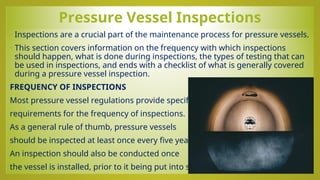
Pressure Vessel Inspections
• Inspections are a crucial part of the maintenance process for pressure vessels.
• This section covers information on the frequency with which inspections
should happen, what is done during inspections, the types of testing that can
be used in inspections, and ends with a checklist of what is generally covered
during a pressure vessel inspection.
FREQUENCY OF INSPECTIONS
Most pressure vessel regulations provide specific
requirements for the frequency of inspections.
As a general rule of thumb, pressure vessels
should be inspected at least once every five years.
An inspection should also be conducted once
the vessel is installed, prior to it being put into service.
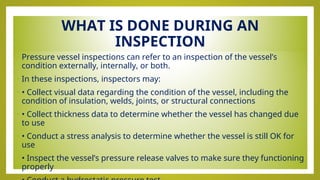
WHAT IS DONE DURING AN
INSPECTION
• Pressure vessel inspections can refer to an inspection of the vessel’s
condition externally, internally, or both.
• In these inspections, inspectors may:
• • Collect visual data regarding the condition of the vessel, including the
condition of insulation, welds, joints, or structural connections
• • Collect thickness data to determine whether the vessel has changed due
to use
• • Conduct a stress analysis to determine whether the vessel is still OK for
use
• • Inspect the vessel’s pressure release valves to make sure they functioning
properly
TYPES OF PRESSURE VESSEL TESTING
• 1. VISUAL TESTING
• Visual testing is the most common type of non-destructive testing (NDT)
an inspector might perform. The goal of a visual inspection is to visually
review both the interior and exterior of the vessel to look for any cracks
or flaws (see the checklist just below for more details).
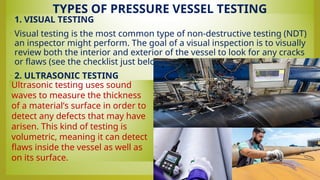
• 2. ULTRASONIC TESTING
•
Ultrasonic testing uses sound
waves to measure the thickness
of a material’s surface in order to
detect any defects that may have
arisen. This kind of testing is
volumetric, meaning it can detect
flaws inside the vessel as well as
on its surface.
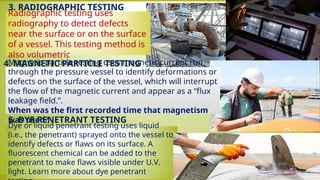
• 3. RADIOGRAPHIC TESTING
4. MAGNETIC PARTICLE TESTING
• 5. DYE PENETRANT TESTING
Radiographic testing uses
radiography to detect defects
near the surface or on the surface
of a vessel. This testing method is
also volumetric
Dye or liquid penetrant testing uses liquid
(i.e., the penetrant) sprayed onto the vessel to
identify defects or flaws on its surface. A
fluorescent chemical can be added to the
penetrant to make flaws visible under U.V.
light. Learn more about dye penetrant
Magnetic particle testing uses magnetic current run
through the pressure vessel to identify deformations or
defects on the surface of the vessel, which will interrupt
the flow of the magnetic current and appear as a “flux
leakage field.”.
When was the first recorded time that magnetism
was used?
LEAK TESTING (LT) — the process of studying leaks in a vessel or structure
in order to identify defects in it. Learn more in this guide to leak testing.
LEAK TESTING: A GUIDE
•Leak testing is a procedure that inspectors use to determine whether an
object or system is functioning within a specific leak limit.
•.
In general, leak tests are performed on objects
that are used to store or move liquids or gases.
Leak testing is one of the most commonly used
inspection methods. It falls into the category of
non-destructive testing (NDT) methods
because inspectors can perform it without
permanently altering or damaging the object
Leaks occur when there is a defect — a hole, crack, or
some other kind of flaw—in an object, allowing whatever
the liquid or gas it is holding to flow out. Leak testing uses
pressure to find these defects so that they can be
addressed as part of regular maintenance procedures
PRESSURE VESSEL INSPECTION
CHECKLIST
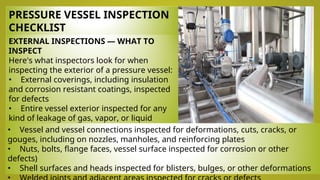
EXTERNAL INSPECTIONS — WHAT TO
INSPECT
Here's what inspectors look for when
inspecting the exterior of a pressure vessel:
• External coverings, including insulation
and corrosion resistant coatings, inspected
for defects
• Entire vessel exterior inspected for any
kind of leakage of gas, vapor, or liquid
• Mountings inspected to see if they allow
for appropriate expansion and contraction
• Vessel and vessel connections inspected for deformations, cuts, cracks, or
gouges, including on nozzles, manholes, and reinforcing plates
• Nuts, bolts, flange faces, vessel surface inspected for corrosion or other
defects)
• Shell surfaces and heads inspected for blisters, bulges, or other deformations
INTERNAL INSPECTIONS
WHAT TO INSPECT
• Here's what inspectors look for when inspecting the interior of a pressure
vessel:
• • Interior of vessel inspected for cracks, blistering, corrosion, deformation, or
any other defects
• • Threads inspected to ensure the adequate number of threads are engaged
on threaded connections
• • Openings leading to any external fittings or controls inspected to ensure
they are free from obstruction
• • Special closures inspected to ensure they are adequate
• • Areas of high stress concentration inspected for cracks or other wear
Questions about Pressure Vessels
•About pressure vessels, with answers.
•Since some of the answers are fairly long, we’ve included a
list of the questions so you can jump to the ones you’re most
interested in:
•• At what pressure does a vessel become a pressure
vessel?
•• What is the difference between an unfired and a fired
pressure vessel?
•• What regulatory bodies oversee the construction and
inspection of pressure vessels?
•• What are the pressure vessel standards throughout the
world?
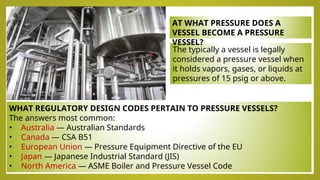
The typically a vessel is legally
considered a pressure vessel when
it holds vapors, gases, or liquids at
pressures of 15 psig or above.
AT WHAT PRESSURE DOES A
VESSEL BECOME A PRESSURE
VESSEL?
WHAT REGULATORY DESIGN CODES PERTAIN TO PRESSURE VESSELS?
The answers most common:
• Australia — Australian Standards
• Canada — CSA B51
• European Union — Pressure Equipment Directive of the EU
• Japan — Japanese Industrial Standard (JIS)
• North America — ASME Boiler and Pressure Vessel Code
WHAT IS THE DIFFERENCE BETWEEN AN UNFIRED AND A FIRED PRESSURE
VESSEL?
A fired pressure vessel is any pressure vessel that receives heat.
The vessel may be partially or fully subjected to the heat source and the heat may
be received either directly or indirectly. Fired pressure vessels require special
precautions since they can overheat, leading to safety concerns.
The most common types of fired pressure vessels:
• Thermal oil heaters used for organic liquid piping systems.
• Boilers that generate hot water, steam, or electricity.
Industries that use fired pressure vessels include Power Generation (Electricity), Oil
& Gas, and Petrochemicals.
An unfired pressure vessel can be used to cool or heat a fluid when combined with
another fluid, essentially acting as a heat exchanger. Unfired pressure vessels
typically contain several tube bundles and chambers for the heating or cooling of
fluids.
The most common types of unfired pressure vessels:
• Steam generators associated with piping systems.
• Any closed vessel that is not a boiler and that is made to hold hot water, gas, or
air.
• WHAT ARE THE PRESSURE VESSEL STANDARDS THROUGHOUT THE WORLD?
• Here is a list of all the some of the most common pressure vessel standards in
the world:
• • AD Merkblätter. This is the German standard, which has been harmonized with
the Pressure Equipment Directive (97/23/EC).
• • ASME Boiler and Pressure Vessel Code Section VIII: Rules for Construction of
Pressure Vessels.
• • API 510. This is the North American standard for a pressure vessel inspection. (This
standard is also used in other places.)
• • B51-09. Canadian Boiler, pressure vessel, and pressure piping code.
• • BS 5500. This standard has been replaced in the UK by BS EN 13445 but is retained
under the name PD 5500 for the design and construction of export equipment.
• • CODAP. This is the French Code for Construction of Unfired Pressure Vessels.
• • EN 13445. This current European Standard, which has been harmonized with the
Pressure Equipment Directive (97/23/EC).
•
Five Ways Drones Can Help with Pressure Vessel
Inspections Drones can be a powerful tool for inspectors
when it comes to collecting visual data
inside a pressure vessel.
Using a drone, inspectors can now enter
vessels and visually scan their interior
without ever having to step foot inside.
This means inspectors are kept out of
potentially hazardous, uncomfortable
environments, while collecting high quality
data. It also means that inspections can be
conducted more quickly and efficiently than
they would be using a manual approach.
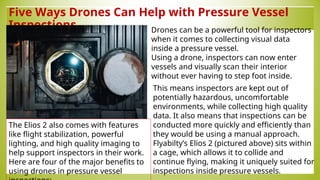
Flyabilty’s Elios 2 (pictured above) sits within
a cage, which allows it to collide and
continue flying, making it uniquely suited for
inspections inside pressure vessels.
The Elios 2 also comes with features
like flight stabilization, powerful
lighting, and high quality imaging to
help support inspectors in their work.
Here are four of the major benefits to
using drones in pressure vessel
• 1. SAFETY
• Using a drone to enter a pressure vessel for the collection of visual data
means that inspectors don’t have to enter that confined space, which helps
improve the overall safety of those involved in the inspection process.
• 2. SAVINGS
• Using a drone instead of a person to collect visual data inside a pressure
vessel can significantly reduce the cost of the inspection by removing the
need for companies to build and take down expensive scaffolding.
• Because of their speed and efficiency, drones can also shorten the
downtimes needed for pressure vessel inspections, which can help
companies realize significant savings as well.
• 3. ACCESS
• Drones can allow inspectors to get a close up view of welds, burners, and
other parts of the pressure vessel that can be hard to access in a manual
inspection.
4. BETTER DATA
•Drones can typically gather
higher quality visual data than
might be gathered manually.
They also allow inspectors to
create a detailed historic
record of an inspection, which
can be referred to in the
future as needed.
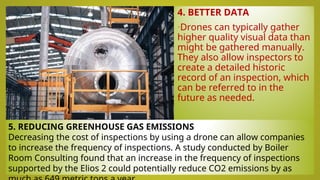
5. REDUCING GREENHOUSE GAS EMISSIONS
Decreasing the cost of inspections by using a drone can allow companies
to increase the frequency of inspections. A study conducted by Boiler
Room Consulting found that an increase in the frequency of inspections
supported by the Elios 2 could potentially reduce CO2 emissions by as
The Future of Pressure Vessel Inspections
What does the future hold for the inspection of pressure vessels?
•Emerging trends include the increased adoption of RVI equipment like drones for
inspections and advances in sensor technology that enables more diverse data to be
gathered by remote inspection tools.
THE GROWING ADOPTION OF DRONES
•Drone use for visual inspections is increasing rapidly in this sector.
•More companies are incorporating flying devices in their operations due to safety benefits
and time and cost savings. The quantity and quality of data gathered by drones —and their
ability to quickly access otherwise challenging places—make them an excellent inspection
tool.
•Inspectors can conduct drone inspections quickly, it's possible to conduct them more
frequently. It's even possible to perform a relatively spontaneous drone inspection, including
accessing areas that would require significant planning for human inspection or that are
typically inaccessible.
•Leading energy firms use environmental mitigation techniques to allow drone access to
spaces that would otherwise be restricted to intrinsically safe equipment.
•This scenario is ideal for drones, as even when not affected by potentially explosive
A COMPLETE GUIDE TO CORROSION MONITORING
What is corrosion monitoring and why is it important?
This guide to know all about corrosion monitoring,
• In any process-intensive industry that uses volatile materials, like Oil &
Gas or Petrochemicals, corrosion can be one of the biggest threats to
the longevity of assets.
•Without proper monitoring, big industrial containers like boilers or
pressure vessels can slowly wear down due to corrosion, causing leaks
or failures and contributing to poor performance and reliability.
•In extreme cases, if corrosion is left unmonitored it can lead to the all-
out failure of an asset, and even explosions, posing safety risks to
personnel, huge equipment costs, and subsequent environmental
damage.
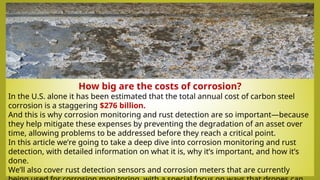
How big are the costs of corrosion?
In the U.S. alone it has been estimated that the total annual cost of carbon steel
corrosion is a staggering $276 billion.
And this is why corrosion monitoring and rust detection are so important—because
they help mitigate these expenses by preventing the degradation of an asset over
time, allowing problems to be addressed before they reach a critical point.
In this article we’re going to take a deep dive into corrosion monitoring and rust
detection, with detailed information on what it is, why it’s important, and how it’s
done.
We’ll also cover rust detection sensors and corrosion meters that are currently
Jump-down links to each section in this article
• • What Is Corrosion Monitoring?
• • Why Is Corrosion Monitoring Important?
• • How Do You Perform Corrosion Monitoring?
• • How Drones Can Help with Corrosion Monitoring
What Is Corrosion Monitoring?
•Corrosion is the gradual destruction of a material (usually metals) caused
by interacting with chemicals, electrochemical reactions, friction, or some
other environmental factor.
•Monitoring is observing and checking the progress or quality of
something over a period of time.
•So, put simply, corrosion monitoring is the tracking of the gradual
destruction of materials over time.
•Corrosion often first appears as a discontinuity in a material, such as a
discoloration or some other change to its appearance.
•This means that what you’re looking for when you set out to find
corrosion are any irregularities in the wall or other surfaces that might
reveal the existence of corrosion.
•If part of an asset, such as a wall or floor, is found to have corrosion, it’s
important to begin monitoring its growth so that you can understand how
it is changing over time, and have the data needed to recommend
maintenance work as appropriate in order to mitigate the damage.
MONITORING VS. INSPECTING
Monitoring can happen at the same time as inspecting but the two activities are different.
• Monitoring focuses on a specific area of an asset and generally happens more often than
inspecting
• Inspecting focuses on the entire asset and generally happens less often than monitoring
•When the word monitoring is used in the context of talking about the maintenance of an industrial
asset, like a boiler or pressure vessel, it is referring to regular data collection to track changes in a
particular area or areas of an asset over time.
•In comparison, an inspection refers to a full review of the entire asset, without a specific area in
mind. An inspection may reveal corrosion, which will then lead to a recommendation that the
corroded areas be monitored.
•In addition to focusing on a specific area instead of the whole asset, monitoring generally happens
more regularly than inspecting.
•While the laws in most countries only require inspections every 3-5 years (depending on the type of
asset) monitoring might happen once every quarter if a certain area of an asset appears to be
degrading at an increasing rate. For example, if the growth of corrosion on a specific section of a
boiler wall seems to be increasing rapidly, quarterly monitoring might be changed to monthly
monitoring to make sure the corrosion is being carefully tracked.
•If corrosion continues, monitoring may eventually lead to a recommendation that work be done to
WHAT EXACTLY DO YOU
MONITOR IN CORROSION
MONITORING?
What you’re looking for when
conducting corrosion monitoring is
to track the growth of corrosion
that has previously been identified.
Tracking the growth of corrosion
can be done by using a measuring
tool, by taking photographs, by
creating an accurate 3D map of the
area, or by doing some mixture of
these three.
The assets in which corrosion monitoring
systems are commonly used:
•• Vessels
•• Boilers
•• Crude oil systems
•• Transportation pipelines
•• Water systems
•• Flowlines
•• Vacuum towers
•• Cooling systems
•Why Is Corrosion Monitoring Important?
• There are three main reasons it's important to use a
corrosion monitoring system:
• • Safety
• • Cost reduction
• • Improved efficiency
SAFETY
•Corrosion monitoring is important for any industry that uses
assets that can degrade over time, but it’s especially
important in industries that work with volatile materials,
which could explode if not stored properly.
•As equipment ages it can become more and more
susceptible to corrosion, and less resistant to harsh
conditions such as high pressures and temperatures.
•The goal of corrosion monitoring is to track potential
problem areas in equipment so that accidents are avoided
and personnel are kept safe.
COST REDUCTION
•If an asset like a boiler falls apart prematurely due to
corrosion it can be incredibly expensive to replace.
•In process-intensive industries such as the Chemicals industry,
where work is done in refineries or plants which require the
use of large storage containers for potentially volatile
substances, corrosion can present huge annual costs in terms
of damaged equipment.
•Corrosion monitoring systems can help companies avoid
these expenses by contributing to the longevity of equipment
and assets.
IMPROVED EFFICIENCY
•In addition to helping prevent accidents and cut costs, corrosion
monitoring can improve the efficiency of industrial operations by:
•• Extending the life of existing assets and of related operational
equipment
•• Providing insights into the kinds of materials that are less likely
to corrode for future asset purchasing
•• Contributing to the identification of cost-effective methods for
remedying corrosion growth and related issues
•• Identifying conditions related to corrosion in the operating
environment—either that contribute to corrosion or that seem to
mitigate corrosion—which can then be used to inform purchasing and
maintenance decisions
•• Helping to reduce facility shutdown time
How Do You Perform Corrosion
Monitoring?
The most important information to collect during corrosion
monitoring is:
•• The location and extent of the corrosion
•• The rate of corrosion (i.e., how fast it is spreading over time)
•• The underlying cause(s) of the corrosion
•The first step most inspectors take to collect this information is to
start with a visual inspection and then proceed to more refined
instruments, like using an ultrasonic tester to measure wall
thickness, as needed.
VISUAL INSPECTION
•To conduct a visual inspection of an asset with the goal of monitoring
corrosion, inspectors scan the floor, sidewall, or other areas being
monitored with their eyes, trying to determine whether:
•1. The existing corrosion (i.e., the corrosion that is being monitored)
has grown
•2. There are new areas with corrosion, as indicated by a
discontinuity in the surface of the wall, floor, or ceiling
•If the visual inspection indicates that corrosion is growing or that there
is new corrosion present, inspectors may want to do a further review of
the discontinuous areas with various kinds of non-destructive testing
(NDT) tools to quantify the amount of corrosion that is present.
ULTRASONIC TESTING
•One of the most common types of NDT tools used for corrosion
monitoring, after a visual inspection has been done, is an ultrasonic
tester. These testers use short ultrasonic pulse-waves to allow
inspectors to measure the thickness of a corroded wall in order to
quantify how much metal or other material may have been lost
relative to the surrounding, uncorroded areas.
•Although ultrasonic testing is most commonly used on steel and
other metals, it can also be used on wood, concrete, and other
composite materials.
•In many cases, visual and ultrasonic data will be all that’s needed for
maintaining a reliable corrosion monitoring system. If these data
indicate that the corrosion found is an acceptable amount according
to site specifications, the inspector will make a note to continue
monitoring the growth and thickness of the corrosion, and will not
recommend any maintenance be performed at that time.
NDT TESTING METHODS USED IN
CORROSION MONITORING
•In addition to visual and ultrasonic data, inspectors may choose to use
other NDT tools to monitor corrosion.
•Some of these testing methods include:
•• Radiographic testing — using electromagnetic radiation to examine
the internal structure of a material. Learn more about radiographic NDT.
•• Guided wave testing — using acoustic waves to detect corrosion. This
method is ideal for pipelines and similar structures because it can
measure corrosion over very long distances—even hundreds of meters, in
certain instances—from a single location. Learn more about acoustic
emission NDT.
•• Magnetic flux leakage — using a powerful magnet to magnetize steel
or other metal and then measuring where there are “leaks” in the
magnetic field, indicating corrosion, pitting, or other damage to the metal.
Learn more about magnetic particle NDT.
Most common corrosion monitoring techniques:
•• Creating visual records to track corrosion growth. Using a drone you can spot the presence of corrosion and
map the information on blueprints, which can then be compared to future visual records to track the growth of
corrosion over time.
•• Monitoring ultrasonic thickness. This is a common technique that uses an ultrasonic tester to scan a wall in order
to measure its thickness.
•• Using probes to measure electrical resistance. Probes track changes in electrical resistance, which can be used
to track metal loss over time. Probes can provide regular data about the rate of corrosion (monthly, weekly, daily—
even hourly).
•• Using coupons. A “coupon” is a piece of material that matches the material in the asset being monitored. The
coupon acts as a proxy for the wall or other area being monitored, presenting a fairly simple way to monitor
corrosion in almost any scenario. To use this corrosion monitoring technique you place the corrosion coupon—also
known as a “mass loss coupon”—into the asset for a predetermined amount of time and then, once removed, test it
for type(s) of corrosion, rate of corrosion (if taking multiple readings), and amount of corrosion.
CORROSION MONITORING SYTEMS AND
TECHNIQUES
Common techniques used in corrosion monitoring
systems:
•• Monitoring biological growth. This technique identifies
bacteria within an asset that feed on sulphate. These bacteria
produce sulphuric acid (H2SO4), which is extremely corrosive, so
their presence in an asset means that some amount of corrosion
is highly likely.
•• Monitoring hydrogen penetration. Using probes, you can
measure the quantity of hydrogen that dissolves into steel. In Oil
& Gas, hydrogen is often a byproduct of many of the reactions
that take place in Oil & Gas, and its presence can eventually result
in the steel becoming brittle and cracking if left undetected and
unmonitored.
•Looking for more resources? We found this slide to be a helpful
visualization of how to troubleshoot your approach to corrosion
WHAT COMES NEXT?
After corrosion application inspectors collect visual or other data on the status of corrosion while
conducting corrosion monitoring they may take the following steps:
• Make a determination about whether the asset is fit for service
• Review the inspection schedule and make determinations about the need for increased frequency or
other changes
• Develop recommendations to correct/remedy existing corrosion-related problems within the asset
• Develop strategies for preventing corrosion, both for the asset being monitored and for other similar
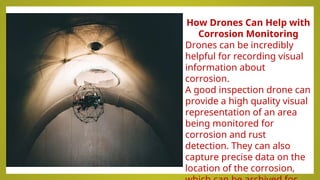
How Drones Can Help with
Corrosion Monitoring
Drones can be incredibly
helpful for recording visual
information about
corrosion.
A good inspection drone can
provide a high quality visual
representation of an area
being monitored for
corrosion and rust
detection. They can also
capture precise data on the
location of the corrosion,
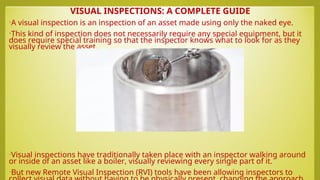
VISUAL INSPECTIONS: A COMPLETE GUIDE
•A visual inspection is an inspection of an asset made using only the naked eye.
•This kind of inspection does not necessarily require any special equipment, but it
does require special training so that the inspector knows what to look for as they
visually review the asset.
•Visual inspections have traditionally taken place with an inspector walking around
or inside of an asset like a boiler, visually reviewing every single part of it.
•But new Remote Visual Inspection (RVI) tools have been allowing inspectors to
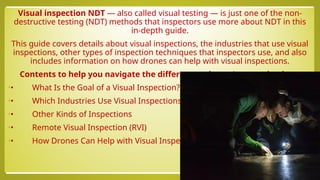
Visual inspection NDT — also called visual testing — is just one of the non-
destructive testing (NDT) methods that inspectors use more about NDT in this
in-depth guide.
This guide covers details about visual inspections, the industries that use visual
inspections, other types of inspection techniques that inspectors use, and also
includes information on how drones can help with visual inspections.
Contents to help you navigate the different topics we’re covering here
•• What Is the Goal of a Visual Inspection?
•• Which Industries Use Visual Inspections?
•• Other Kinds of Inspections
•• Remote Visual Inspection (RVI)
•• How Drones Can Help with Visual Inspections
Thank You Very Much
Have A Pleasure Day
By: Zainal Mohd Salleh
(MSc, CEng, CTPEng, CSWIP, CWI, ASNT LII, ToT UK, TTT HRDF, Lead Auditor )

WHAT IS A PRESSURE VESSEL for studys.ppt

  • 1.
    JTS TRAINING CENTRE ASMESEC: VIII DIV 1 (2019) WHAT IS PRESSURE VESSEL DATE: 21 & 22 FEB 2023 PRESENTED BY: • ZAINAL MOHD SALLEH • (MSc, CEng, CTPEng, CSWIP, CWI, ASNT LII, TTT HRDF, ToT.UK. ISO Lead)
  • 2.
    WHAT IS APRESSURE VESSEL? • Pressure vessels are industrial containers designed to hold vapors, liquids, or gases. • Pressure vessels usually hold materials at a high pressure they can be dangerous if not properly maintained. Regular inspections are a critical part of the maintenance process for pressure vessels, helping to reveal potential problems before they develop further. • In this guide to pressure vessels we cover what pressure vessels are in detail, the requirements for pressure vessel inspections, common pressure vessel questions, and how drones can help with inspecting them.
  • 3.
    Here is alist of the topics covered in this resource to help you find the information of most interest: •• What Is a Pressure Vessel? •• Pressure Vessel Inspections •• Common Questions about Pressure Vessels •• Five Ways Drones Can Help with Pressure Vessel Inspections •• The Future of Pressure Vessel Inspections
  • 4.
    What Is aPressure Vessel? •Although already provided a definition of pressure vessels in the first sentence of this article—they’re “containers designed to hold vapors, liquids, or gases at a specific pressure” •Each country has strict definitions of what they are, so it’s worth spending some more time defining them. •The reason for these narrow definitions is because pressure vessels are dangerous.
  • 5.
    • To helpmitigate the dangers they pose, almost every country in the world has laws regarding how pressure vessels are designed, how they’re built, and how they can be operated. • In addition to general regulatory requirements for pressure vessels, every individual pressure vessel has specific operating limitations, called its “design pressure and design temperature.” • If a pressure vessel is operated beyond the pressure or temperature it was designed to handle, the result could be the catastrophic failure of the unit. In the worst case scenario, operating outside of a vessel’s design could lead to fires, poisonous gas leaks, or even explosions, all of which could pose an extreme danger to anyone working in the surrounding area.
  • 6.
    COMMON CHARACTERISTICS OFPRESSURE VESSELS Here are some common characteristics of pressure vessels: •• Shape. While a pressure vessel could hypothetically be made in several different shapes, the most common shapes used are cones, spheres, and cylinders. •• Design. Regardless of the vessel’s shape, the minimum mass of a pressure vessel scales along with the volume it contains and pressure it will be put under. This mass is inversely proportional to the strength and weight ratio of the vessel’s construction material, and the minimum mass required goes down as strength goes up. •• Construction materials. Since they have to withstand extremely high pressures, pressure vessels must be incredibly strong. For this reason, the most common material used to make them is steel. Pressure vessels can also be made from composite materials, like filament wound composite, or concrete with cabling wrapped around or within the vessel to provide the tension needed to resist internal pressure. •• Corrosion resistance. If a pressure vessel will be used in a scenario that may produce corrosion, this must be taken into consideration in choosing the material. •• Pressure. Most pressure vessels are designed to operate at 15 psig* or above. •Note: Psig is a measure of pressure that stands for Pounds Per Square Inch Gauge.
  • 7.
    TYPES OF PRESSUREVESSELS It’s important to note that the term “pressure vessel” can refer to a variety of storage containers used in industrial settings. Most common types of pressure vessels: •• Storage tanks/vessels. Often constructed of carbon steel, storage vessels are typically used to store liquids and come in a variety of sizes. •• Boilers. Usually made of alloyed steel so that it can withstand high pressures and temperatures, a boiler is a vessel whose purpose is the creation of hot water or steam, which is then used as a power source for various operations. •• Heat exchangers. Carbon steel is also a common material used for constructing heat exchangers, which are used in a huge range of industrial applications, from industrial processing to food service. •• Process vessels. Typically made of carbon steel and used to perform some kind of processing of a material (as the name implies) process vessels are used to combine, break down, or remove elements from a material.
  • 8.
    SAFETY CONSIDERATIONS IN PRESSUREVESSEL DESIGN • Because pressure vessels are potentially very dangerous, they are usually designed with safety consideration in mind. • Here are two of the top safety considerations in the design of a pressure vessel: • • Safety valves. Also called a relief valve, these valves allow for the quick release of pressure so that the desired pressure is not exceeded to a dangerous extent during use. • • Leak before burst. This feature refers to a design element in pressure vessels that allow them to crack instead of exploding. Most pressure vessel standards throughout the world, including the ASME Boiler and Pressure Code and the AIAA metallic pressure vessel standard require that pressure vessels have this feature, which allows the vessel to crack and leak fluids rather than suddenly burst, allowing for a safer option for releasing pressure in the event of failure.
  • 9.
    Pressure Vessel Inspections •Inspections are a crucial part of the maintenance process for pressure vessels. • This section covers information on the frequency with which inspections should happen, what is done during inspections, the types of testing that can be used in inspections, and ends with a checklist of what is generally covered during a pressure vessel inspection. FREQUENCY OF INSPECTIONS Most pressure vessel regulations provide specific requirements for the frequency of inspections. As a general rule of thumb, pressure vessels should be inspected at least once every five years. An inspection should also be conducted once the vessel is installed, prior to it being put into service.
  • 10.
    WHAT IS DONEDURING AN INSPECTION • Pressure vessel inspections can refer to an inspection of the vessel’s condition externally, internally, or both. • In these inspections, inspectors may: • • Collect visual data regarding the condition of the vessel, including the condition of insulation, welds, joints, or structural connections • • Collect thickness data to determine whether the vessel has changed due to use • • Conduct a stress analysis to determine whether the vessel is still OK for use • • Inspect the vessel’s pressure release valves to make sure they functioning properly
  • 11.
    TYPES OF PRESSUREVESSEL TESTING • 1. VISUAL TESTING • Visual testing is the most common type of non-destructive testing (NDT) an inspector might perform. The goal of a visual inspection is to visually review both the interior and exterior of the vessel to look for any cracks or flaws (see the checklist just below for more details). • 2. ULTRASONIC TESTING • Ultrasonic testing uses sound waves to measure the thickness of a material’s surface in order to detect any defects that may have arisen. This kind of testing is volumetric, meaning it can detect flaws inside the vessel as well as on its surface.
  • 12.
    • 3. RADIOGRAPHICTESTING 4. MAGNETIC PARTICLE TESTING • 5. DYE PENETRANT TESTING Radiographic testing uses radiography to detect defects near the surface or on the surface of a vessel. This testing method is also volumetric Dye or liquid penetrant testing uses liquid (i.e., the penetrant) sprayed onto the vessel to identify defects or flaws on its surface. A fluorescent chemical can be added to the penetrant to make flaws visible under U.V. light. Learn more about dye penetrant Magnetic particle testing uses magnetic current run through the pressure vessel to identify deformations or defects on the surface of the vessel, which will interrupt the flow of the magnetic current and appear as a “flux leakage field.”. When was the first recorded time that magnetism was used?
  • 13.
    LEAK TESTING (LT)— the process of studying leaks in a vessel or structure in order to identify defects in it. Learn more in this guide to leak testing. LEAK TESTING: A GUIDE •Leak testing is a procedure that inspectors use to determine whether an object or system is functioning within a specific leak limit. •. In general, leak tests are performed on objects that are used to store or move liquids or gases. Leak testing is one of the most commonly used inspection methods. It falls into the category of non-destructive testing (NDT) methods because inspectors can perform it without permanently altering or damaging the object Leaks occur when there is a defect — a hole, crack, or some other kind of flaw—in an object, allowing whatever the liquid or gas it is holding to flow out. Leak testing uses pressure to find these defects so that they can be addressed as part of regular maintenance procedures
  • 14.
    PRESSURE VESSEL INSPECTION CHECKLIST EXTERNALINSPECTIONS — WHAT TO INSPECT Here's what inspectors look for when inspecting the exterior of a pressure vessel: • External coverings, including insulation and corrosion resistant coatings, inspected for defects • Entire vessel exterior inspected for any kind of leakage of gas, vapor, or liquid • Mountings inspected to see if they allow for appropriate expansion and contraction • Vessel and vessel connections inspected for deformations, cuts, cracks, or gouges, including on nozzles, manholes, and reinforcing plates • Nuts, bolts, flange faces, vessel surface inspected for corrosion or other defects) • Shell surfaces and heads inspected for blisters, bulges, or other deformations
  • 15.
    INTERNAL INSPECTIONS WHAT TOINSPECT • Here's what inspectors look for when inspecting the interior of a pressure vessel: • • Interior of vessel inspected for cracks, blistering, corrosion, deformation, or any other defects • • Threads inspected to ensure the adequate number of threads are engaged on threaded connections • • Openings leading to any external fittings or controls inspected to ensure they are free from obstruction • • Special closures inspected to ensure they are adequate • • Areas of high stress concentration inspected for cracks or other wear
  • 16.
    Questions about PressureVessels •About pressure vessels, with answers. •Since some of the answers are fairly long, we’ve included a list of the questions so you can jump to the ones you’re most interested in: •• At what pressure does a vessel become a pressure vessel? •• What is the difference between an unfired and a fired pressure vessel? •• What regulatory bodies oversee the construction and inspection of pressure vessels? •• What are the pressure vessel standards throughout the world?
  • 17.
    The typically avessel is legally considered a pressure vessel when it holds vapors, gases, or liquids at pressures of 15 psig or above. AT WHAT PRESSURE DOES A VESSEL BECOME A PRESSURE VESSEL? WHAT REGULATORY DESIGN CODES PERTAIN TO PRESSURE VESSELS? The answers most common: • Australia — Australian Standards • Canada — CSA B51 • European Union — Pressure Equipment Directive of the EU • Japan — Japanese Industrial Standard (JIS) • North America — ASME Boiler and Pressure Vessel Code
  • 18.
    WHAT IS THEDIFFERENCE BETWEEN AN UNFIRED AND A FIRED PRESSURE VESSEL? A fired pressure vessel is any pressure vessel that receives heat. The vessel may be partially or fully subjected to the heat source and the heat may be received either directly or indirectly. Fired pressure vessels require special precautions since they can overheat, leading to safety concerns. The most common types of fired pressure vessels: • Thermal oil heaters used for organic liquid piping systems. • Boilers that generate hot water, steam, or electricity. Industries that use fired pressure vessels include Power Generation (Electricity), Oil & Gas, and Petrochemicals. An unfired pressure vessel can be used to cool or heat a fluid when combined with another fluid, essentially acting as a heat exchanger. Unfired pressure vessels typically contain several tube bundles and chambers for the heating or cooling of fluids. The most common types of unfired pressure vessels: • Steam generators associated with piping systems. • Any closed vessel that is not a boiler and that is made to hold hot water, gas, or air.
  • 19.
    • WHAT ARETHE PRESSURE VESSEL STANDARDS THROUGHOUT THE WORLD? • Here is a list of all the some of the most common pressure vessel standards in the world: • • AD Merkblätter. This is the German standard, which has been harmonized with the Pressure Equipment Directive (97/23/EC). • • ASME Boiler and Pressure Vessel Code Section VIII: Rules for Construction of Pressure Vessels. • • API 510. This is the North American standard for a pressure vessel inspection. (This standard is also used in other places.) • • B51-09. Canadian Boiler, pressure vessel, and pressure piping code. • • BS 5500. This standard has been replaced in the UK by BS EN 13445 but is retained under the name PD 5500 for the design and construction of export equipment. • • CODAP. This is the French Code for Construction of Unfired Pressure Vessels. • • EN 13445. This current European Standard, which has been harmonized with the Pressure Equipment Directive (97/23/EC). •
  • 20.
    Five Ways DronesCan Help with Pressure Vessel Inspections Drones can be a powerful tool for inspectors when it comes to collecting visual data inside a pressure vessel. Using a drone, inspectors can now enter vessels and visually scan their interior without ever having to step foot inside. This means inspectors are kept out of potentially hazardous, uncomfortable environments, while collecting high quality data. It also means that inspections can be conducted more quickly and efficiently than they would be using a manual approach. Flyabilty’s Elios 2 (pictured above) sits within a cage, which allows it to collide and continue flying, making it uniquely suited for inspections inside pressure vessels. The Elios 2 also comes with features like flight stabilization, powerful lighting, and high quality imaging to help support inspectors in their work. Here are four of the major benefits to using drones in pressure vessel
  • 21.
    • 1. SAFETY •Using a drone to enter a pressure vessel for the collection of visual data means that inspectors don’t have to enter that confined space, which helps improve the overall safety of those involved in the inspection process. • 2. SAVINGS • Using a drone instead of a person to collect visual data inside a pressure vessel can significantly reduce the cost of the inspection by removing the need for companies to build and take down expensive scaffolding. • Because of their speed and efficiency, drones can also shorten the downtimes needed for pressure vessel inspections, which can help companies realize significant savings as well. • 3. ACCESS • Drones can allow inspectors to get a close up view of welds, burners, and other parts of the pressure vessel that can be hard to access in a manual inspection.
  • 22.
    4. BETTER DATA •Dronescan typically gather higher quality visual data than might be gathered manually. They also allow inspectors to create a detailed historic record of an inspection, which can be referred to in the future as needed. 5. REDUCING GREENHOUSE GAS EMISSIONS Decreasing the cost of inspections by using a drone can allow companies to increase the frequency of inspections. A study conducted by Boiler Room Consulting found that an increase in the frequency of inspections supported by the Elios 2 could potentially reduce CO2 emissions by as
  • 23.
    The Future ofPressure Vessel Inspections What does the future hold for the inspection of pressure vessels? •Emerging trends include the increased adoption of RVI equipment like drones for inspections and advances in sensor technology that enables more diverse data to be gathered by remote inspection tools. THE GROWING ADOPTION OF DRONES •Drone use for visual inspections is increasing rapidly in this sector. •More companies are incorporating flying devices in their operations due to safety benefits and time and cost savings. The quantity and quality of data gathered by drones —and their ability to quickly access otherwise challenging places—make them an excellent inspection tool. •Inspectors can conduct drone inspections quickly, it's possible to conduct them more frequently. It's even possible to perform a relatively spontaneous drone inspection, including accessing areas that would require significant planning for human inspection or that are typically inaccessible. •Leading energy firms use environmental mitigation techniques to allow drone access to spaces that would otherwise be restricted to intrinsically safe equipment. •This scenario is ideal for drones, as even when not affected by potentially explosive
  • 24.
    A COMPLETE GUIDETO CORROSION MONITORING What is corrosion monitoring and why is it important? This guide to know all about corrosion monitoring, • In any process-intensive industry that uses volatile materials, like Oil & Gas or Petrochemicals, corrosion can be one of the biggest threats to the longevity of assets. •Without proper monitoring, big industrial containers like boilers or pressure vessels can slowly wear down due to corrosion, causing leaks or failures and contributing to poor performance and reliability. •In extreme cases, if corrosion is left unmonitored it can lead to the all- out failure of an asset, and even explosions, posing safety risks to personnel, huge equipment costs, and subsequent environmental damage.
  • 25.
    How big arethe costs of corrosion? In the U.S. alone it has been estimated that the total annual cost of carbon steel corrosion is a staggering $276 billion. And this is why corrosion monitoring and rust detection are so important—because they help mitigate these expenses by preventing the degradation of an asset over time, allowing problems to be addressed before they reach a critical point. In this article we’re going to take a deep dive into corrosion monitoring and rust detection, with detailed information on what it is, why it’s important, and how it’s done. We’ll also cover rust detection sensors and corrosion meters that are currently
  • 26.
    Jump-down links toeach section in this article • • What Is Corrosion Monitoring? • • Why Is Corrosion Monitoring Important? • • How Do You Perform Corrosion Monitoring? • • How Drones Can Help with Corrosion Monitoring
  • 27.
    What Is CorrosionMonitoring? •Corrosion is the gradual destruction of a material (usually metals) caused by interacting with chemicals, electrochemical reactions, friction, or some other environmental factor. •Monitoring is observing and checking the progress or quality of something over a period of time. •So, put simply, corrosion monitoring is the tracking of the gradual destruction of materials over time. •Corrosion often first appears as a discontinuity in a material, such as a discoloration or some other change to its appearance. •This means that what you’re looking for when you set out to find corrosion are any irregularities in the wall or other surfaces that might reveal the existence of corrosion. •If part of an asset, such as a wall or floor, is found to have corrosion, it’s important to begin monitoring its growth so that you can understand how it is changing over time, and have the data needed to recommend maintenance work as appropriate in order to mitigate the damage.
  • 28.
    MONITORING VS. INSPECTING Monitoringcan happen at the same time as inspecting but the two activities are different. • Monitoring focuses on a specific area of an asset and generally happens more often than inspecting • Inspecting focuses on the entire asset and generally happens less often than monitoring •When the word monitoring is used in the context of talking about the maintenance of an industrial asset, like a boiler or pressure vessel, it is referring to regular data collection to track changes in a particular area or areas of an asset over time. •In comparison, an inspection refers to a full review of the entire asset, without a specific area in mind. An inspection may reveal corrosion, which will then lead to a recommendation that the corroded areas be monitored. •In addition to focusing on a specific area instead of the whole asset, monitoring generally happens more regularly than inspecting. •While the laws in most countries only require inspections every 3-5 years (depending on the type of asset) monitoring might happen once every quarter if a certain area of an asset appears to be degrading at an increasing rate. For example, if the growth of corrosion on a specific section of a boiler wall seems to be increasing rapidly, quarterly monitoring might be changed to monthly monitoring to make sure the corrosion is being carefully tracked. •If corrosion continues, monitoring may eventually lead to a recommendation that work be done to
  • 29.
    WHAT EXACTLY DOYOU MONITOR IN CORROSION MONITORING? What you’re looking for when conducting corrosion monitoring is to track the growth of corrosion that has previously been identified. Tracking the growth of corrosion can be done by using a measuring tool, by taking photographs, by creating an accurate 3D map of the area, or by doing some mixture of these three.
  • 30.
    The assets inwhich corrosion monitoring systems are commonly used: •• Vessels •• Boilers •• Crude oil systems •• Transportation pipelines •• Water systems •• Flowlines •• Vacuum towers •• Cooling systems
  • 31.
    •Why Is CorrosionMonitoring Important? • There are three main reasons it's important to use a corrosion monitoring system: • • Safety • • Cost reduction • • Improved efficiency
  • 32.
    SAFETY •Corrosion monitoring isimportant for any industry that uses assets that can degrade over time, but it’s especially important in industries that work with volatile materials, which could explode if not stored properly. •As equipment ages it can become more and more susceptible to corrosion, and less resistant to harsh conditions such as high pressures and temperatures. •The goal of corrosion monitoring is to track potential problem areas in equipment so that accidents are avoided and personnel are kept safe.
  • 33.
    COST REDUCTION •If anasset like a boiler falls apart prematurely due to corrosion it can be incredibly expensive to replace. •In process-intensive industries such as the Chemicals industry, where work is done in refineries or plants which require the use of large storage containers for potentially volatile substances, corrosion can present huge annual costs in terms of damaged equipment. •Corrosion monitoring systems can help companies avoid these expenses by contributing to the longevity of equipment and assets.
  • 34.
    IMPROVED EFFICIENCY •In additionto helping prevent accidents and cut costs, corrosion monitoring can improve the efficiency of industrial operations by: •• Extending the life of existing assets and of related operational equipment •• Providing insights into the kinds of materials that are less likely to corrode for future asset purchasing •• Contributing to the identification of cost-effective methods for remedying corrosion growth and related issues •• Identifying conditions related to corrosion in the operating environment—either that contribute to corrosion or that seem to mitigate corrosion—which can then be used to inform purchasing and maintenance decisions •• Helping to reduce facility shutdown time
  • 35.
    How Do YouPerform Corrosion Monitoring? The most important information to collect during corrosion monitoring is: •• The location and extent of the corrosion •• The rate of corrosion (i.e., how fast it is spreading over time) •• The underlying cause(s) of the corrosion •The first step most inspectors take to collect this information is to start with a visual inspection and then proceed to more refined instruments, like using an ultrasonic tester to measure wall thickness, as needed.
  • 36.
    VISUAL INSPECTION •To conducta visual inspection of an asset with the goal of monitoring corrosion, inspectors scan the floor, sidewall, or other areas being monitored with their eyes, trying to determine whether: •1. The existing corrosion (i.e., the corrosion that is being monitored) has grown •2. There are new areas with corrosion, as indicated by a discontinuity in the surface of the wall, floor, or ceiling •If the visual inspection indicates that corrosion is growing or that there is new corrosion present, inspectors may want to do a further review of the discontinuous areas with various kinds of non-destructive testing (NDT) tools to quantify the amount of corrosion that is present.
  • 37.
    ULTRASONIC TESTING •One ofthe most common types of NDT tools used for corrosion monitoring, after a visual inspection has been done, is an ultrasonic tester. These testers use short ultrasonic pulse-waves to allow inspectors to measure the thickness of a corroded wall in order to quantify how much metal or other material may have been lost relative to the surrounding, uncorroded areas. •Although ultrasonic testing is most commonly used on steel and other metals, it can also be used on wood, concrete, and other composite materials. •In many cases, visual and ultrasonic data will be all that’s needed for maintaining a reliable corrosion monitoring system. If these data indicate that the corrosion found is an acceptable amount according to site specifications, the inspector will make a note to continue monitoring the growth and thickness of the corrosion, and will not recommend any maintenance be performed at that time.
  • 38.
    NDT TESTING METHODSUSED IN CORROSION MONITORING •In addition to visual and ultrasonic data, inspectors may choose to use other NDT tools to monitor corrosion. •Some of these testing methods include: •• Radiographic testing — using electromagnetic radiation to examine the internal structure of a material. Learn more about radiographic NDT. •• Guided wave testing — using acoustic waves to detect corrosion. This method is ideal for pipelines and similar structures because it can measure corrosion over very long distances—even hundreds of meters, in certain instances—from a single location. Learn more about acoustic emission NDT. •• Magnetic flux leakage — using a powerful magnet to magnetize steel or other metal and then measuring where there are “leaks” in the magnetic field, indicating corrosion, pitting, or other damage to the metal. Learn more about magnetic particle NDT.
  • 39.
    Most common corrosionmonitoring techniques: •• Creating visual records to track corrosion growth. Using a drone you can spot the presence of corrosion and map the information on blueprints, which can then be compared to future visual records to track the growth of corrosion over time. •• Monitoring ultrasonic thickness. This is a common technique that uses an ultrasonic tester to scan a wall in order to measure its thickness. •• Using probes to measure electrical resistance. Probes track changes in electrical resistance, which can be used to track metal loss over time. Probes can provide regular data about the rate of corrosion (monthly, weekly, daily— even hourly). •• Using coupons. A “coupon” is a piece of material that matches the material in the asset being monitored. The coupon acts as a proxy for the wall or other area being monitored, presenting a fairly simple way to monitor corrosion in almost any scenario. To use this corrosion monitoring technique you place the corrosion coupon—also known as a “mass loss coupon”—into the asset for a predetermined amount of time and then, once removed, test it for type(s) of corrosion, rate of corrosion (if taking multiple readings), and amount of corrosion. CORROSION MONITORING SYTEMS AND TECHNIQUES
  • 40.
    Common techniques usedin corrosion monitoring systems: •• Monitoring biological growth. This technique identifies bacteria within an asset that feed on sulphate. These bacteria produce sulphuric acid (H2SO4), which is extremely corrosive, so their presence in an asset means that some amount of corrosion is highly likely. •• Monitoring hydrogen penetration. Using probes, you can measure the quantity of hydrogen that dissolves into steel. In Oil & Gas, hydrogen is often a byproduct of many of the reactions that take place in Oil & Gas, and its presence can eventually result in the steel becoming brittle and cracking if left undetected and unmonitored. •Looking for more resources? We found this slide to be a helpful visualization of how to troubleshoot your approach to corrosion
  • 41.
    WHAT COMES NEXT? Aftercorrosion application inspectors collect visual or other data on the status of corrosion while conducting corrosion monitoring they may take the following steps: • Make a determination about whether the asset is fit for service • Review the inspection schedule and make determinations about the need for increased frequency or other changes • Develop recommendations to correct/remedy existing corrosion-related problems within the asset • Develop strategies for preventing corrosion, both for the asset being monitored and for other similar
  • 42.
    How Drones CanHelp with Corrosion Monitoring Drones can be incredibly helpful for recording visual information about corrosion. A good inspection drone can provide a high quality visual representation of an area being monitored for corrosion and rust detection. They can also capture precise data on the location of the corrosion,
  • 43.
    VISUAL INSPECTIONS: ACOMPLETE GUIDE •A visual inspection is an inspection of an asset made using only the naked eye. •This kind of inspection does not necessarily require any special equipment, but it does require special training so that the inspector knows what to look for as they visually review the asset. •Visual inspections have traditionally taken place with an inspector walking around or inside of an asset like a boiler, visually reviewing every single part of it. •But new Remote Visual Inspection (RVI) tools have been allowing inspectors to
  • 44.
    Visual inspection NDT— also called visual testing — is just one of the non- destructive testing (NDT) methods that inspectors use more about NDT in this in-depth guide. This guide covers details about visual inspections, the industries that use visual inspections, other types of inspection techniques that inspectors use, and also includes information on how drones can help with visual inspections. Contents to help you navigate the different topics we’re covering here •• What Is the Goal of a Visual Inspection? •• Which Industries Use Visual Inspections? •• Other Kinds of Inspections •• Remote Visual Inspection (RVI) •• How Drones Can Help with Visual Inspections
  • 45.
    Thank You VeryMuch Have A Pleasure Day By: Zainal Mohd Salleh (MSc, CEng, CTPEng, CSWIP, CWI, ASNT LII, ToT UK, TTT HRDF, Lead Auditor )