REVISED POLICIES AND
STANDARDS FOR
UNDERGRADUATE
TEACHER EDUCATION
CURRICULUM
Section 1. Quality pre-service teacher
education is a key factor in quality Philippine
education. In the Philippines, the pre-service
preparation of teachers for the primary and
secondary educational sectors is a very
important function and responsibility that has
been assigned to higher education.
Section 2. All private higher education
institutions (PHEIs) intending to offer the
Bachelor of Elementary Education (BEEd) or
the Bachelor of Secondary Education (BSEd)
or any of the professional education courses
specified in both curricula must first secure
proper authority from the Commission in
accordance with existing rules and regulations.
Section 3. Degree
 The degree programs herein shall be
called bachelor of elementary education
(BEEd) or the Bachelor of Secondary
Education (BSEd).
Section 4. Program Description and
General Objectives
The BEEd is structured to meet the needs
of professional teachers for elementary
schools and special education programs in
the Philippines, and the BSEd for the
needs of professional teachers for
secondary schools in the Philippines.
The BEEd aims to develop elementary
school teachers who are either (a)
generalists who can teach across the
different learning areas in grade school, (b)
special education teachers, or (c) pre-school
teachers.
The BSEd aims to develop high school
teachers who can teach in one of the
different learning areas in high school like
Mathematics, Physical Sciences,
Biological Sciences, English, Filipino,
among others.
Section 5. Allied Programs
Teacher education is an applied discipline
which draws from many of the basic
disciplines in the Social Sciences, the
Science and Technology Fields and the
Humanities.
Section 6. Graduates of the BEEd and BSEd
programs are teachers who:
Have the basic and higher level literacy,
communication, numeracy, critical thinking,
learning skills needed for higher learning
Have a deep and principled understanding of
the learning processes and the role of the
teacher in facilitating these processes in their
students.
 Have a deep and principled understanding of
how educational processes relate to larger
historical, social, cultural and political
processes.
 Have a meaningful and comprehensive
knowledge of the subject matter they will teach.
 Can apply a wide range of teaching process
skills (including curriculum development,
lesson planning, materials development,
educational assessment and teaching
approaches.
Have direct experience in the field/classroom
(e.g., classroom observations, teaching
assistance and practice teaching)
Can demonstrate and practice the
professional and ethical requirements of the
teaching professions
Can facilitate learning of diverse types of
learners, in diverse types of learning
environments, using a wide range of
teaching knowledge and skills.
Can reflect on the relationships among the
teaching process skills, the learning
processing in the students, the nature of
the content/subject matter, and the broader
social forces encumbering the school and
educational processes in order to
constantly improve their teaching
knowledge, skills and practices.
Can be creative and innovative in thinking of
alternative teaching approaches, take
informed risks in trying out these innovative
approaches and evaluate the effectiveness of
such approaches in improving student
learning.
Are willing and capable to continue learning
in order to better fulfill their mission as
teachers.
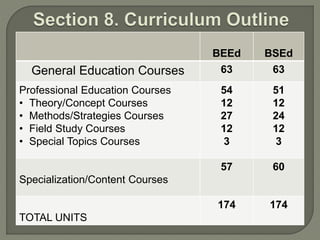
Section 7. Curriculum Description
The curriculum herein is designed to
prepare professional teachers for practice
in primary and secondary schools in the
Philippines.
BEEd BSEd
General Education Courses 63 63
Professional Education Courses
• Theory/Concept Courses
• Methods/Strategies Courses
• Field Study Courses
• Special Topics Courses
54
12
27
12
3
51
12
24
12
3
Specialization/Content Courses
57 60
TOTAL UNITS
174 174
Section 9. General Education Courses
Section 10. Professional Education
Courses
These courses represent the component of
the curriculum that aims to develop the
range of knowledge and skills needed in
the practice of teaching profession.
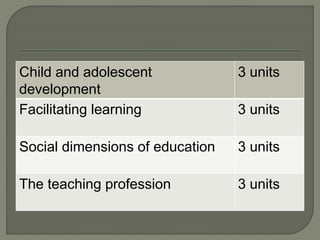
Section 11. Theory And Concepts
Theory and concepts courses that provide
the broad frameworks within which
students can understand, rationalize, and
reflect on the various methods, strategies,
processes, issues, and other matters
related to the teaching profession
Child and adolescent
development
3 units
Facilitating learning 3 units
Social dimensions of education 3 units
The teaching profession 3 units
Section 12. Methods and Strategies
Courses
The following are methods and strategies
courses in the program that aim to develop
in students a wide range of skills to
facilitate and evaluate learning in diverse
types of students in a variety of learning
environments.
Principles of Teaching 1 3 Units
Principles of Teaching 2 3 Units
Assessment of Student Learning 1 3 Units
Assessment of Student Learning 2 3 Units
Educational Technology 1 3 Units
Educational Technology 2 3 Units
Curriculum Development 3 Units
Development Reading 1 3 Units
Development Reading 2 (For BEEd Only) 3 Units
Section 13. Field Study Courses
The following series of courses are the
field study courses that are intended to
provide students with practical learning
experiences in which they can observe,
verify, reflect on, and actually experience
different components of the teaching
learning processes in actual school
settings.
Field Study 1 1 unit
Field Study 2 1 unit
Field Study 3 1 unit
Field Study 4 1 unit
Field Study 5 1 unit
Field Study 6 1 unit
Practice Teaching 6 units
Section 14. Special Topics Courses
Students will have the opportunity to explore
special topics and issues related to their field
of study by taking three one-unit elective
seminars on a range of topics chosen by the
teacher education institutions, based on their
perceived needs of the students and the
expertise of their faculty
Science 12 units
Mathematics 12 units
English 12 units
Filipino 6 units
Social Studies 6 units
Music, Arts and Physical Education 3 units
Home Economics and Livelihood
Education
3 units
Values Education 3 units
Mathematics
Physical Sciences
Biological Sciences
English
Filipino
Social Studies
Values Education
Technology and livelihood Education
Music, Art, Physical and Health Education
Islamic Studies
_CHED.-Memorandum

_CHED.-Memorandum

  • 1.
    REVISED POLICIES AND STANDARDSFOR UNDERGRADUATE TEACHER EDUCATION CURRICULUM
  • 2.
    Section 1. Qualitypre-service teacher education is a key factor in quality Philippine education. In the Philippines, the pre-service preparation of teachers for the primary and secondary educational sectors is a very important function and responsibility that has been assigned to higher education.
  • 3.
    Section 2. Allprivate higher education institutions (PHEIs) intending to offer the Bachelor of Elementary Education (BEEd) or the Bachelor of Secondary Education (BSEd) or any of the professional education courses specified in both curricula must first secure proper authority from the Commission in accordance with existing rules and regulations.
  • 4.
    Section 3. Degree The degree programs herein shall be called bachelor of elementary education (BEEd) or the Bachelor of Secondary Education (BSEd).
  • 5.
    Section 4. ProgramDescription and General Objectives The BEEd is structured to meet the needs of professional teachers for elementary schools and special education programs in the Philippines, and the BSEd for the needs of professional teachers for secondary schools in the Philippines.
  • 6.
    The BEEd aimsto develop elementary school teachers who are either (a) generalists who can teach across the different learning areas in grade school, (b) special education teachers, or (c) pre-school teachers.
  • 7.
    The BSEd aimsto develop high school teachers who can teach in one of the different learning areas in high school like Mathematics, Physical Sciences, Biological Sciences, English, Filipino, among others.
  • 8.
    Section 5. AlliedPrograms Teacher education is an applied discipline which draws from many of the basic disciplines in the Social Sciences, the Science and Technology Fields and the Humanities.
  • 9.
    Section 6. Graduatesof the BEEd and BSEd programs are teachers who: Have the basic and higher level literacy, communication, numeracy, critical thinking, learning skills needed for higher learning Have a deep and principled understanding of the learning processes and the role of the teacher in facilitating these processes in their students.
  • 10.
     Have adeep and principled understanding of how educational processes relate to larger historical, social, cultural and political processes.  Have a meaningful and comprehensive knowledge of the subject matter they will teach.  Can apply a wide range of teaching process skills (including curriculum development, lesson planning, materials development, educational assessment and teaching approaches.
  • 11.
    Have direct experiencein the field/classroom (e.g., classroom observations, teaching assistance and practice teaching) Can demonstrate and practice the professional and ethical requirements of the teaching professions Can facilitate learning of diverse types of learners, in diverse types of learning environments, using a wide range of teaching knowledge and skills.
  • 12.
    Can reflect onthe relationships among the teaching process skills, the learning processing in the students, the nature of the content/subject matter, and the broader social forces encumbering the school and educational processes in order to constantly improve their teaching knowledge, skills and practices.
  • 13.
    Can be creativeand innovative in thinking of alternative teaching approaches, take informed risks in trying out these innovative approaches and evaluate the effectiveness of such approaches in improving student learning. Are willing and capable to continue learning in order to better fulfill their mission as teachers.
  • 14.
    Section 7. CurriculumDescription The curriculum herein is designed to prepare professional teachers for practice in primary and secondary schools in the Philippines.
  • 15.
    BEEd BSEd General EducationCourses 63 63 Professional Education Courses • Theory/Concept Courses • Methods/Strategies Courses • Field Study Courses • Special Topics Courses 54 12 27 12 3 51 12 24 12 3 Specialization/Content Courses 57 60 TOTAL UNITS 174 174
  • 16.
    Section 9. GeneralEducation Courses
  • 17.
    Section 10. ProfessionalEducation Courses These courses represent the component of the curriculum that aims to develop the range of knowledge and skills needed in the practice of teaching profession.
  • 18.
    Section 11. TheoryAnd Concepts Theory and concepts courses that provide the broad frameworks within which students can understand, rationalize, and reflect on the various methods, strategies, processes, issues, and other matters related to the teaching profession
  • 19.
    Child and adolescent development 3units Facilitating learning 3 units Social dimensions of education 3 units The teaching profession 3 units
  • 20.
    Section 12. Methodsand Strategies Courses The following are methods and strategies courses in the program that aim to develop in students a wide range of skills to facilitate and evaluate learning in diverse types of students in a variety of learning environments.
  • 21.
    Principles of Teaching1 3 Units Principles of Teaching 2 3 Units Assessment of Student Learning 1 3 Units Assessment of Student Learning 2 3 Units Educational Technology 1 3 Units Educational Technology 2 3 Units Curriculum Development 3 Units Development Reading 1 3 Units Development Reading 2 (For BEEd Only) 3 Units
  • 22.
    Section 13. FieldStudy Courses The following series of courses are the field study courses that are intended to provide students with practical learning experiences in which they can observe, verify, reflect on, and actually experience different components of the teaching learning processes in actual school settings.
  • 23.
    Field Study 11 unit Field Study 2 1 unit Field Study 3 1 unit Field Study 4 1 unit Field Study 5 1 unit Field Study 6 1 unit Practice Teaching 6 units
  • 24.
    Section 14. SpecialTopics Courses Students will have the opportunity to explore special topics and issues related to their field of study by taking three one-unit elective seminars on a range of topics chosen by the teacher education institutions, based on their perceived needs of the students and the expertise of their faculty
  • 25.
    Science 12 units Mathematics12 units English 12 units Filipino 6 units Social Studies 6 units Music, Arts and Physical Education 3 units Home Economics and Livelihood Education 3 units Values Education 3 units
  • 26.
    Mathematics Physical Sciences Biological Sciences English Filipino SocialStudies Values Education Technology and livelihood Education Music, Art, Physical and Health Education Islamic Studies