1. What do you know about the
mandate of our Philippine
Constitution vis-à-vis education for all
Filipino citizens?
2. What are DepEd’s mandate, vision,
mission, and core values concerning
education?
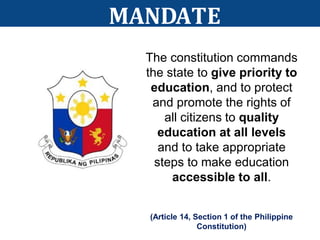
The constitution commands
the state to give priority to
education, and to protect
and promote the rights of
all citizens to quality
education at all levels
and to take appropriate
steps to make education
accessible to all.
(Article 14, Section 1 of the Philippine
Constitution)
MANDATE
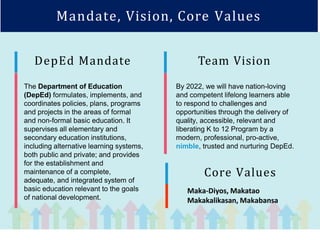
Mandate, Vision, Core Values
The Department of Education
(DepEd) formulates, implements, and
coordinates policies, plans, programs
and projects in the areas of formal
and non-formal basic education. It
supervises all elementary and
secondary education institutions,
including alternative learning systems,
both public and private; and provides
for the establishment and
maintenance of a complete,
adequate, and integrated system of
basic education relevant to the goals
of national development.
DepEd Mandate Team Vision
By 2022, we will have nation-loving
and competent lifelong learners able
to respond to challenges and
opportunities through the delivery of
quality, accessible, relevant and
liberating K to 12 Program by a
modern, professional, pro-active,
nimble, trusted and nurturing DepEd.
Core Values
Maka-Diyos, Makatao
Makakalikasan, Makabansa
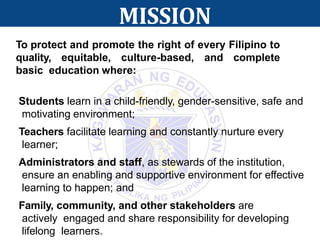
To protect and promote the right of every Filipino to
quality, equitable, culture-based, and complete
basic education where:
Students learn in a child-friendly, gender-sensitive, safe and
motivating environment;
Teachers facilitate learning and constantly nurture every
learner;
Administrators and staff, as stewards of the institution,
ensure an enabling and supportive environment for effective
learning to happen; and
Family, community, and other stakeholders are
actively engaged and share responsibility for developing
lifelong learners.
MISSION
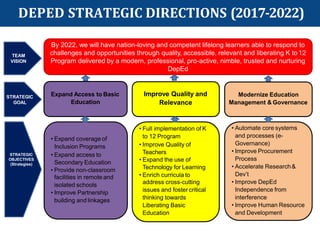
Expand Access to Basic
Education
Improve Quality and
Relevance
Modernize Education
Management & Governance
• Automate core systems
and processes (e-
Governance)
• Improve Procurement
Process
• Accelerate Research&
Dev’t
• Improve DepEd
Independence from
interference
• Improve Human Resource
and Development
• Expand coverage of
Inclusion Programs
• Expand access to
Secondary Education
• Provide non-classroom
facilities in remote and
isolated schools
• Improve Partnership
building and linkages
• Full implementation of K
to 12 Program
• Improve Quality of
Teachers
• Expand the use of
Technology for Learning
• Enrich curricula to
address cross-cutting
issues and foster critical
thinking towards
Liberating Basic
Education
By 2022, we will have nation-loving and competent lifelong learners able to respond to
challenges and opportunities through quality, accessible, relevant and liberating K to 12
Program delivered by a modern, professional, pro-active, nimble, trusted and nurturing
DepEd
TEAM
VISION
STRATEGIC
GOAL
STRATEGIC
OBJECTIVES
(Strategies)
DEPED STRATEGIC DIRECTIONS (2017-2022)
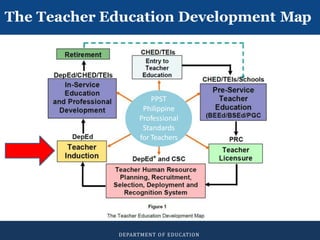
The Teacher Education Development Map
PPST
Philippine
Professional
Standards
for Teachers
DEPARTMENT OF EDUCATION
1. What guides teachers to
effectively discharge their
responsibilities and functions?
2. What standards and
expectations are expected of
them?
The New Framework
for
Teacher Quality and
Teacher
Development
THE TEACHER EDUCATION COUNCIL
Philippine ProfessionalStandards forTeachers
DEPARTMENT OF EDUCATION
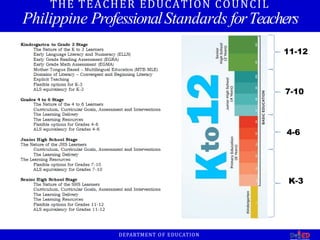
K-3
11-12
7-10
4-6
THE TEACHER EDUCATION COUNCIL
Philippine ProfessionalStandards forTeachers
DEPARTMENT OF EDUCATION
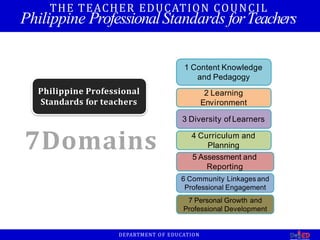
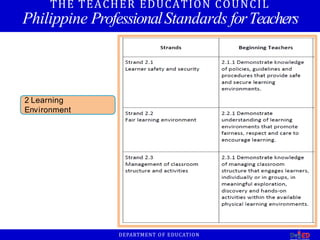
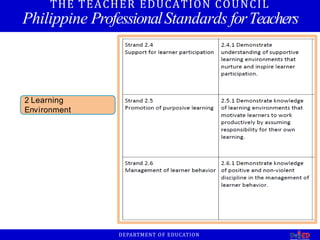
2 Learning
Environment
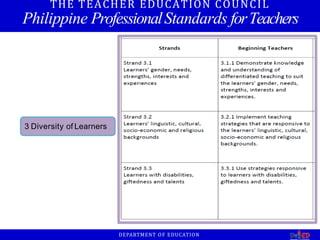
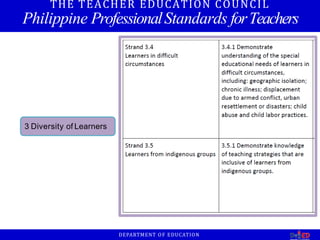
3 Diversity of Learners
4 Curriculum and
Planning
5 Assessment and
Reporting
6 Community Linkages and
Professional Engagement
7 Personal Growth and
Professional Development
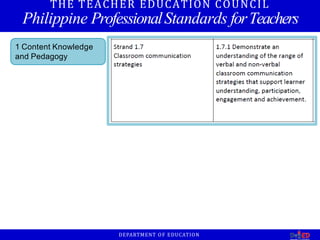
1 Content Knowledge
and Pedagogy
Philippine Professional
Standards for teachers
7Domains
THE TEACHER EDUCATION COUNCIL
Philippine ProfessionalStandards forTeachers
DEPARTMENT OF EDUCATION
2 Learning
Environment
3 Diversity of Learners
4 Curriculum and
Planning
5 Assessment and
Reporting
6 Community Linkages and
Professional Engagement
7 Personal Growth and
Professional Development
1 Content Knowledge
and Pedagogy
Philippine Professional
Standards for teachers
THE TEACHER EDUCATION COUNCIL
Philippine ProfessionalStandards forTeachers
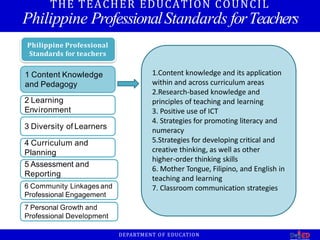
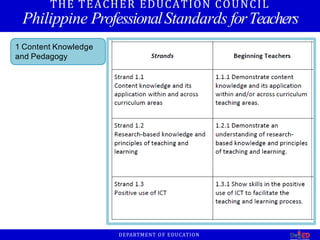
1.Content knowledge and its application
within and across curriculum areas
2.Research-based knowledge and
principles of teaching and learning
3. Positive use of ICT
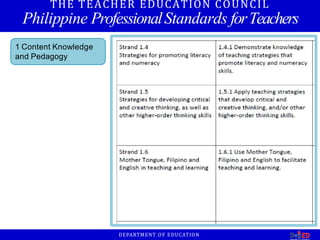
4. Strategies for promoting literacy and
numeracy
5.Strategies for developing critical and
creative thinking, as well as other
higher-order thinking skills
6. Mother Tongue, Filipino, and English in
teaching and learning
7. Classroom communication strategies
DEPARTMENT OF EDUCATION
2 Learning
Environment
3 Diversity of Learners
4 Curriculum and
Planning
5 Assessment and
Reporting
6Community Linkages and
Professional Engagement
7 Personal Growth and
Professional Development
1 Content Knowledge
and Pedagogy
Philippine Professional
Standards for teachers
THE TEACHER EDUCATION COUNCIL
Philippine ProfessionalStandards forTeachers
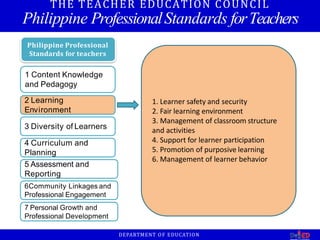
1. Learner safety and security
2. Fair learning environment
3. Management of classroom structure
and activities
4. Support for learner participation
5. Promotion of purposive learning
6. Management of learner behavior
DEPARTMENT OF EDUCATION
2 Learning
Environment
3 Diversity of Learners
4 Curriculum and
Planning
5 Assessment and
Reporting
6Community Linkages and
Professional Engagement
7 Personal Growth and
Professional Development
1 Content Knowledge
and Pedagogy
Philippine Professional
Standards for teachers
THE TEACHER EDUCATION COUNCIL
Philippine ProfessionalStandards forTeachers
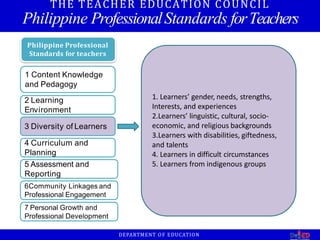
1. Learners’ gender, needs, strengths,
Interests, and experiences
2.Learners’ linguistic, cultural, socio-
economic, and religious backgrounds
3.Learners with disabilities, giftedness,
and talents
4. Learners in difficult circumstances
5. Learners from indigenous groups
DEPARTMENT OF EDUCATION
2 Learning
Environment
3 Diversity of Learners
4 Curriculum and
Planning
5 Assessment and
Reporting
6Community Linkages and
Professional Engagement
7 Personal Growth and
Professional Development
1 Content Knowledge
and Pedagogy
Philippine Professional
Standards for teachers
THE TEACHER EDUCATION COUNCIL
Philippine ProfessionalStandards forTeachers
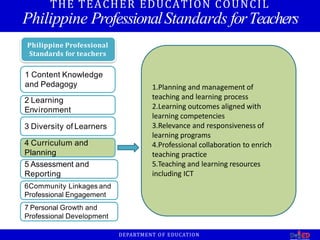
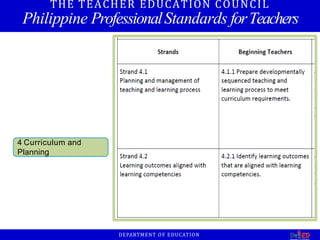
1.Planning and management of
teaching and learning process
2.Learning outcomes aligned with
learning competencies
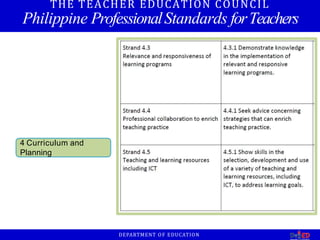
3.Relevance and responsiveness of
learning programs
4.Professional collaboration to enrich
teaching practice
5.Teaching and learning resources
including ICT
DEPARTMENT OF EDUCATION
2 Learning
Environment
3 Diversity of Learners
4 Curriculum and
Planning
5 Assessment and
Reporting
6Community Linkages and
Professional Engagement
7 Personal Growth and
Professional Development
1 Content Knowledge
and Pedagogy
Philippine Professional
Standards for teachers
THE TEACHER EDUCATION COUNCIL
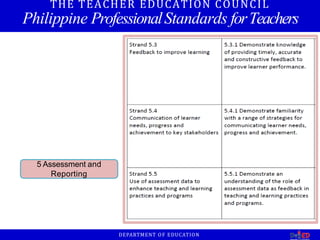
Philippine ProfessionalStandards forTeachers
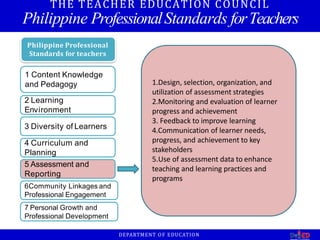
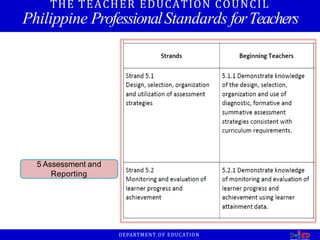
1.Design, selection, organization, and
utilization of assessment strategies
2.Monitoring and evaluation of learner
progress and achievement
3. Feedback to improve learning
4.Communication of learner needs,
progress, and achievement to key
stakeholders
5.Use of assessment data to enhance
teaching and learning practices and
programs
DEPARTMENT OF EDUCATION
2 Learning
Environment
3 Diversity of Learners
4 Curriculum and
Planning
5 Assessment and
Reporting
6Community Linkages and
Professional Engagement
7 Personal Growth and
Professional Development
1 Content Knowledge
and Pedagogy
Philippine Professional
Standards for teachers
THE TEACHER EDUCATION COUNCIL
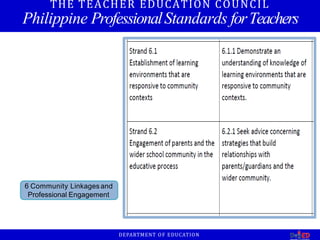
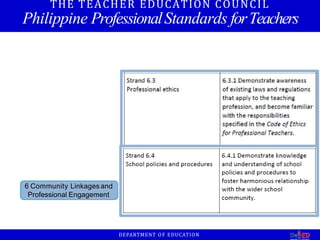
Philippine ProfessionalStandards forTeachers
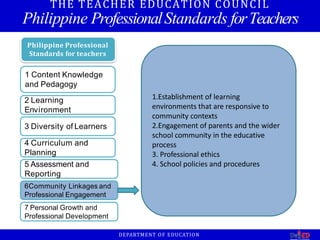
1.Establishment of learning
environments that are responsive to
community contexts
2.Engagement of parents and the wider
school community in the educative
process
3. Professional ethics
4. School policies and procedures
DEPARTMENT OF EDUCATION
2 Learning
Environment
3 Diversity of Learners
4 Curriculum and
Planning
5 Assessment and
Reporting
6Community Linkages and
Professional Engagement
7 Personal Growth and
Professional Development
1 Content Knowledge
and Pedagogy
Philippine Professional
Standards for teachers
THE TEACHER EDUCATION COUNCIL
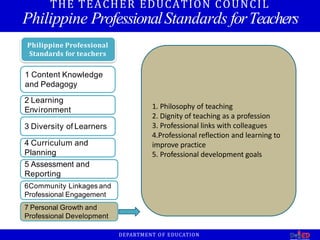
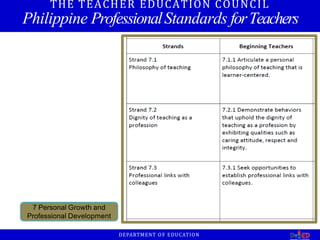
Philippine ProfessionalStandards forTeachers
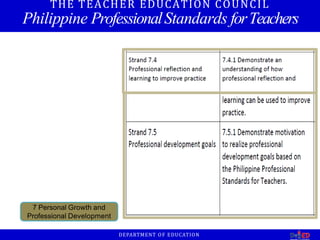
1. Philosophy of teaching
2. Dignity of teaching as a profession
3. Professional links with colleagues
4.Professional reflection and learning to
improve practice
5. Professional development goals
DEPARTMENT OF EDUCATION
2 Learning
Environment
3 Diversity of Learners
4 Curriculum and
Planning
5 Assessment and
Reporting
6 Community Linkages and
Professional Engagement
7 Personal Growth and
Professional Development
1 Content Knowledge
and Pedagogy
THE TEACHER EDUCATION COUNCIL
Philippine ProfessionalStandards forTeachers
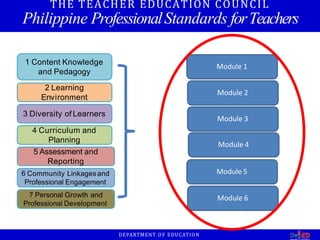
Module 1
Module 2
Module 3
Module 4
Module 5
Module 6
DEPARTMENT OF EDUCATION
THE TEACHER EDUCATION COUNCIL
Philippine ProfessionalStandards forTeachers
DEPARTMENT OF EDUCATION
THE TEACHER EDUCATION COUNCIL
Philippine ProfessionalStandards forTeachers
DEPARTMENT OF EDUCATION
THE TEACHER EDUCATION COUNCIL
Philippine ProfessionalStandards forTeachers
DEPARTMENT OF EDUCATION
THE TEACHER EDUCATION COUNCIL
Philippine ProfessionalStandards forTeachers
DEPARTMENT OF EDUCATION
THE TEACHER EDUCATION COUNCIL
Philippine ProfessionalStandards forTeachers
1 Content Knowledge
and Pedagogy
DEPARTMENT OF EDUCATION
THE TEACHER EDUCATION COUNCIL
Philippine ProfessionalStandards forTeachers
1 Content Knowledge
and Pedagogy
DEPARTMENT OF EDUCATION
THE TEACHER EDUCATION COUNCIL
Philippine ProfessionalStandards forTeachers
1 Content Knowledge
and Pedagogy
DEPARTMENT OF EDUCATION
THE TEACHER EDUCATION COUNCIL
Philippine ProfessionalStandards forTeachers
2 Learning
Environment
DEPARTMENT OF EDUCATION
THE TEACHER EDUCATION COUNCIL
Philippine ProfessionalStandards forTeachers
2 Learning
Environment
DEPARTMENT OF EDUCATION
THE TEACHER EDUCATION COUNCIL
Philippine ProfessionalStandards forTeachers
3 Diversity of Learners
DEPARTMENT OF EDUCATION
THE TEACHER EDUCATION COUNCIL
Philippine ProfessionalStandards forTeachers
3 Diversity of Learners
DEPARTMENT OF EDUCATION
THE TEACHER EDUCATION COUNCIL
Philippine ProfessionalStandards forTeachers
4 Curriculum and
Planning
DEPARTMENT OF EDUCATION
THE TEACHER EDUCATION COUNCIL
Philippine ProfessionalStandards forTeachers
4 Curriculum and
Planning
DEPARTMENT OF EDUCATION
THE TEACHER EDUCATION COUNCIL
Philippine ProfessionalStandards forTeachers
5 Assessment and
Reporting
DEPARTMENT OF EDUCATION
THE TEACHER EDUCATION COUNCIL
Philippine ProfessionalStandards forTeachers
5 Assessment and
Reporting
DEPARTMENT OF EDUCATION
THE TEACHER EDUCATION COUNCIL
Philippine ProfessionalStandards forTeachers
6 Community Linkages and
Professional Engagement
DEPARTMENT OF EDUCATION
THE TEACHER EDUCATION COUNCIL
Philippine ProfessionalStandards forTeachers
6 Community Linkages and
Professional Engagement
DEPARTMENT OF EDUCATION
THE TEACHER EDUCATION COUNCIL
Philippine ProfessionalStandards forTeachers
7 Personal Growth and
Professional Development
DEPARTMENT OF EDUCATION
THE TEACHER EDUCATION COUNCIL
Philippine ProfessionalStandards forTeachers
7 Personal Growth and
Professional Development
DEPARTMENT OF EDUCATION
Thank you.
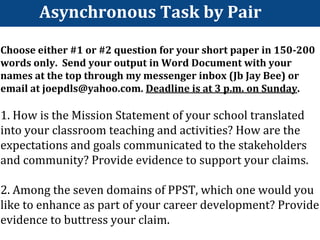
Asynchronous Task by Pair
Choose either #1 or #2 question for your short paper in 150-200
words only. Send your output in Word Document with your
names at the top through my messenger inbox (Jb Jay Bee) or
email at joepdls@yahoo.com. Deadline is at 3 p.m. on Sunday.
1. How is the Mission Statement of your school translated
into your classroom teaching and activities? How are the
expectations and goals communicated to the stakeholders
and community? Provide evidence to support your claims.
2. Among the seven domains of PPST, which one would you
like to enhance as part of your career development? Provide
evidence to buttress your claim.

SUPERVISION-OF-INSTRUCTION

  • 1.
    1. What doyou know about the mandate of our Philippine Constitution vis-à-vis education for all Filipino citizens? 2. What are DepEd’s mandate, vision, mission, and core values concerning education?
  • 2.
    The constitution commands thestate to give priority to education, and to protect and promote the rights of all citizens to quality education at all levels and to take appropriate steps to make education accessible to all. (Article 14, Section 1 of the Philippine Constitution) MANDATE
  • 3.
    Mandate, Vision, CoreValues The Department of Education (DepEd) formulates, implements, and coordinates policies, plans, programs and projects in the areas of formal and non-formal basic education. It supervises all elementary and secondary education institutions, including alternative learning systems, both public and private; and provides for the establishment and maintenance of a complete, adequate, and integrated system of basic education relevant to the goals of national development. DepEd Mandate Team Vision By 2022, we will have nation-loving and competent lifelong learners able to respond to challenges and opportunities through the delivery of quality, accessible, relevant and liberating K to 12 Program by a modern, professional, pro-active, nimble, trusted and nurturing DepEd. Core Values Maka-Diyos, Makatao Makakalikasan, Makabansa
  • 4.
    To protect andpromote the right of every Filipino to quality, equitable, culture-based, and complete basic education where: Students learn in a child-friendly, gender-sensitive, safe and motivating environment; Teachers facilitate learning and constantly nurture every learner; Administrators and staff, as stewards of the institution, ensure an enabling and supportive environment for effective learning to happen; and Family, community, and other stakeholders are actively engaged and share responsibility for developing lifelong learners. MISSION
  • 5.
    Expand Access toBasic Education Improve Quality and Relevance Modernize Education Management & Governance • Automate core systems and processes (e- Governance) • Improve Procurement Process • Accelerate Research& Dev’t • Improve DepEd Independence from interference • Improve Human Resource and Development • Expand coverage of Inclusion Programs • Expand access to Secondary Education • Provide non-classroom facilities in remote and isolated schools • Improve Partnership building and linkages • Full implementation of K to 12 Program • Improve Quality of Teachers • Expand the use of Technology for Learning • Enrich curricula to address cross-cutting issues and foster critical thinking towards Liberating Basic Education By 2022, we will have nation-loving and competent lifelong learners able to respond to challenges and opportunities through quality, accessible, relevant and liberating K to 12 Program delivered by a modern, professional, pro-active, nimble, trusted and nurturing DepEd TEAM VISION STRATEGIC GOAL STRATEGIC OBJECTIVES (Strategies) DEPED STRATEGIC DIRECTIONS (2017-2022)
  • 6.
    The Teacher EducationDevelopment Map PPST Philippine Professional Standards for Teachers DEPARTMENT OF EDUCATION
  • 7.
    1. What guidesteachers to effectively discharge their responsibilities and functions? 2. What standards and expectations are expected of them?
  • 8.
    The New Framework for TeacherQuality and Teacher Development THE TEACHER EDUCATION COUNCIL Philippine ProfessionalStandards forTeachers DEPARTMENT OF EDUCATION
  • 9.
    K-3 11-12 7-10 4-6 THE TEACHER EDUCATIONCOUNCIL Philippine ProfessionalStandards forTeachers DEPARTMENT OF EDUCATION
  • 10.
    2 Learning Environment 3 Diversityof Learners 4 Curriculum and Planning 5 Assessment and Reporting 6 Community Linkages and Professional Engagement 7 Personal Growth and Professional Development 1 Content Knowledge and Pedagogy Philippine Professional Standards for teachers 7Domains THE TEACHER EDUCATION COUNCIL Philippine ProfessionalStandards forTeachers DEPARTMENT OF EDUCATION
  • 11.
    2 Learning Environment 3 Diversityof Learners 4 Curriculum and Planning 5 Assessment and Reporting 6 Community Linkages and Professional Engagement 7 Personal Growth and Professional Development 1 Content Knowledge and Pedagogy Philippine Professional Standards for teachers THE TEACHER EDUCATION COUNCIL Philippine ProfessionalStandards forTeachers 1.Content knowledge and its application within and across curriculum areas 2.Research-based knowledge and principles of teaching and learning 3. Positive use of ICT 4. Strategies for promoting literacy and numeracy 5.Strategies for developing critical and creative thinking, as well as other higher-order thinking skills 6. Mother Tongue, Filipino, and English in teaching and learning 7. Classroom communication strategies DEPARTMENT OF EDUCATION
  • 12.
    2 Learning Environment 3 Diversityof Learners 4 Curriculum and Planning 5 Assessment and Reporting 6Community Linkages and Professional Engagement 7 Personal Growth and Professional Development 1 Content Knowledge and Pedagogy Philippine Professional Standards for teachers THE TEACHER EDUCATION COUNCIL Philippine ProfessionalStandards forTeachers 1. Learner safety and security 2. Fair learning environment 3. Management of classroom structure and activities 4. Support for learner participation 5. Promotion of purposive learning 6. Management of learner behavior DEPARTMENT OF EDUCATION
  • 13.
    2 Learning Environment 3 Diversityof Learners 4 Curriculum and Planning 5 Assessment and Reporting 6Community Linkages and Professional Engagement 7 Personal Growth and Professional Development 1 Content Knowledge and Pedagogy Philippine Professional Standards for teachers THE TEACHER EDUCATION COUNCIL Philippine ProfessionalStandards forTeachers 1. Learners’ gender, needs, strengths, Interests, and experiences 2.Learners’ linguistic, cultural, socio- economic, and religious backgrounds 3.Learners with disabilities, giftedness, and talents 4. Learners in difficult circumstances 5. Learners from indigenous groups DEPARTMENT OF EDUCATION
  • 14.
    2 Learning Environment 3 Diversityof Learners 4 Curriculum and Planning 5 Assessment and Reporting 6Community Linkages and Professional Engagement 7 Personal Growth and Professional Development 1 Content Knowledge and Pedagogy Philippine Professional Standards for teachers THE TEACHER EDUCATION COUNCIL Philippine ProfessionalStandards forTeachers 1.Planning and management of teaching and learning process 2.Learning outcomes aligned with learning competencies 3.Relevance and responsiveness of learning programs 4.Professional collaboration to enrich teaching practice 5.Teaching and learning resources including ICT DEPARTMENT OF EDUCATION
  • 15.
    2 Learning Environment 3 Diversityof Learners 4 Curriculum and Planning 5 Assessment and Reporting 6Community Linkages and Professional Engagement 7 Personal Growth and Professional Development 1 Content Knowledge and Pedagogy Philippine Professional Standards for teachers THE TEACHER EDUCATION COUNCIL Philippine ProfessionalStandards forTeachers 1.Design, selection, organization, and utilization of assessment strategies 2.Monitoring and evaluation of learner progress and achievement 3. Feedback to improve learning 4.Communication of learner needs, progress, and achievement to key stakeholders 5.Use of assessment data to enhance teaching and learning practices and programs DEPARTMENT OF EDUCATION
  • 16.
    2 Learning Environment 3 Diversityof Learners 4 Curriculum and Planning 5 Assessment and Reporting 6Community Linkages and Professional Engagement 7 Personal Growth and Professional Development 1 Content Knowledge and Pedagogy Philippine Professional Standards for teachers THE TEACHER EDUCATION COUNCIL Philippine ProfessionalStandards forTeachers 1.Establishment of learning environments that are responsive to community contexts 2.Engagement of parents and the wider school community in the educative process 3. Professional ethics 4. School policies and procedures DEPARTMENT OF EDUCATION
  • 17.
    2 Learning Environment 3 Diversityof Learners 4 Curriculum and Planning 5 Assessment and Reporting 6Community Linkages and Professional Engagement 7 Personal Growth and Professional Development 1 Content Knowledge and Pedagogy Philippine Professional Standards for teachers THE TEACHER EDUCATION COUNCIL Philippine ProfessionalStandards forTeachers 1. Philosophy of teaching 2. Dignity of teaching as a profession 3. Professional links with colleagues 4.Professional reflection and learning to improve practice 5. Professional development goals DEPARTMENT OF EDUCATION
  • 18.
    2 Learning Environment 3 Diversityof Learners 4 Curriculum and Planning 5 Assessment and Reporting 6 Community Linkages and Professional Engagement 7 Personal Growth and Professional Development 1 Content Knowledge and Pedagogy THE TEACHER EDUCATION COUNCIL Philippine ProfessionalStandards forTeachers Module 1 Module 2 Module 3 Module 4 Module 5 Module 6 DEPARTMENT OF EDUCATION
  • 19.
    THE TEACHER EDUCATIONCOUNCIL Philippine ProfessionalStandards forTeachers DEPARTMENT OF EDUCATION
  • 20.
    THE TEACHER EDUCATIONCOUNCIL Philippine ProfessionalStandards forTeachers DEPARTMENT OF EDUCATION
  • 21.
    THE TEACHER EDUCATIONCOUNCIL Philippine ProfessionalStandards forTeachers DEPARTMENT OF EDUCATION
  • 22.
    THE TEACHER EDUCATIONCOUNCIL Philippine ProfessionalStandards forTeachers DEPARTMENT OF EDUCATION
  • 23.
    THE TEACHER EDUCATIONCOUNCIL Philippine ProfessionalStandards forTeachers 1 Content Knowledge and Pedagogy DEPARTMENT OF EDUCATION
  • 24.
    THE TEACHER EDUCATIONCOUNCIL Philippine ProfessionalStandards forTeachers 1 Content Knowledge and Pedagogy DEPARTMENT OF EDUCATION
  • 25.
    THE TEACHER EDUCATIONCOUNCIL Philippine ProfessionalStandards forTeachers 1 Content Knowledge and Pedagogy DEPARTMENT OF EDUCATION
  • 26.
    THE TEACHER EDUCATIONCOUNCIL Philippine ProfessionalStandards forTeachers 2 Learning Environment DEPARTMENT OF EDUCATION
  • 27.
    THE TEACHER EDUCATIONCOUNCIL Philippine ProfessionalStandards forTeachers 2 Learning Environment DEPARTMENT OF EDUCATION
  • 28.
    THE TEACHER EDUCATIONCOUNCIL Philippine ProfessionalStandards forTeachers 3 Diversity of Learners DEPARTMENT OF EDUCATION
  • 29.
    THE TEACHER EDUCATIONCOUNCIL Philippine ProfessionalStandards forTeachers 3 Diversity of Learners DEPARTMENT OF EDUCATION
  • 30.
    THE TEACHER EDUCATIONCOUNCIL Philippine ProfessionalStandards forTeachers 4 Curriculum and Planning DEPARTMENT OF EDUCATION
  • 31.
    THE TEACHER EDUCATIONCOUNCIL Philippine ProfessionalStandards forTeachers 4 Curriculum and Planning DEPARTMENT OF EDUCATION
  • 32.
    THE TEACHER EDUCATIONCOUNCIL Philippine ProfessionalStandards forTeachers 5 Assessment and Reporting DEPARTMENT OF EDUCATION
  • 33.
    THE TEACHER EDUCATIONCOUNCIL Philippine ProfessionalStandards forTeachers 5 Assessment and Reporting DEPARTMENT OF EDUCATION
  • 34.
    THE TEACHER EDUCATIONCOUNCIL Philippine ProfessionalStandards forTeachers 6 Community Linkages and Professional Engagement DEPARTMENT OF EDUCATION
  • 35.
    THE TEACHER EDUCATIONCOUNCIL Philippine ProfessionalStandards forTeachers 6 Community Linkages and Professional Engagement DEPARTMENT OF EDUCATION
  • 36.
    THE TEACHER EDUCATIONCOUNCIL Philippine ProfessionalStandards forTeachers 7 Personal Growth and Professional Development DEPARTMENT OF EDUCATION
  • 37.
    THE TEACHER EDUCATIONCOUNCIL Philippine ProfessionalStandards forTeachers 7 Personal Growth and Professional Development DEPARTMENT OF EDUCATION
  • 38.
  • 39.
    Asynchronous Task byPair Choose either #1 or #2 question for your short paper in 150-200 words only. Send your output in Word Document with your names at the top through my messenger inbox (Jb Jay Bee) or email at joepdls@yahoo.com. Deadline is at 3 p.m. on Sunday. 1. How is the Mission Statement of your school translated into your classroom teaching and activities? How are the expectations and goals communicated to the stakeholders and community? Provide evidence to support your claims. 2. Among the seven domains of PPST, which one would you like to enhance as part of your career development? Provide evidence to buttress your claim.