CHED
MEMORANDUM
ORDER NO. 30
Competency Standards • TEC Courses •
Allied Courses
WHAT IS CHED?
• Commission on Higher Education
• Created through the passage of Republic
Act No. 7722 (Higher Education Act of
1994).
• An attached term of Office, responsible in
the formulation and implementation of
policies, plans, and programs for the
country for the development and
efficiency operation of the higher
Source:
http://www.ched.gov.ph//wp-content/uploads/2013/07/CMO-No.30-
s2004.pdf
ARTICLE I
• Highlights the essence of Quality pre-
service teacher education in the country.
“All efforts to improve the quality of education
in the Philippines are dependent on the
service of teachers who are properly prepared
to undertake the various important roles and
functions of teachers. As such, it is of utmost
importance that the highest standards are set
in defining the objectives, components, and
processes of the pre-service teacher education
curriculum.”
— Article I,Sec.1
ARTICLE III: PROGRAM
SPECIFICATIONS
• Sec. 3: “The degree program herein shall
be called Bachelor of Elementary
Education (BEEd) or the Bachelor of
Secondary Education (BSEd).
• Sec. 4: “The BEEd aims to develop
elementary school teachers who are
either (a) generalists who can teach
across the different learning areas in
grade school, (b) special education
• Meanwhile, “The BSEd aims to develop high school
teachers who can teach in one of the different learning
areas in high school like mathematics, Physical
Sciences, Biological Sciences, English, Filipino, among
others.”
• Sec. 5 tells of the different allied programs/discipline
that teacher education consists of. Among the basic
disciplines are in the social sciences (Psychology,
Sociology, Anthropology, Economics, Political
Sciences, Applied Linguistics, History, etc.), the
Science and technology Fields (Biology, Chemistry,
Physics, Mathematics, Engineering, Information
Technology, etc.) and the Humanities and related fields
(Languages, Literature, Philosophy, etc.)
ARTICLE IV: COMPETENCY
STANDARDS
• Graduates of the BEEd and BSEd programs are
teachers who:
• Have the basic and higher level literary,
communication, numeracy, critical thinking,
learning skills needed for higher learning;
• Have a deep and principled understanding of the
learning processes and the role of the teacher in
facilitating these processes in their students;
• Have a deep and principled understanding of how
educational processes relate to larger historical,
social, cultural and political processes
• Have a meaningful and comprehensive knowledge of the
subject matter they will teach
• Can apply a wide range of teaching process skills
(including curriculum development, lesson planning,
materials development, educational assessment and
teaching approaches);
• Have direct experiences in the field/classroom (e.g.,
classroom observations, teaching assistance, practice
teaching);
• Can demonstrate and practice the professional and
ethical requirements of the teaching professions;
• Can facilitate learning of diverse types of learners, in
diverse types of learning environments, using a wide
range of teaching knowledge and skills;
• Can reflect on the relationships among the teaching
process skills, the learning processing in the students,
the nature of the content/subject matter, and the broader
social forces encumbering the school and educational
processes in order to constantly improve their teaching
knowledge, skills and practices;
• Can be creative and innovative in thinking of alternative
teaching approaches, take informed risks in trying out
these innovative approaches, and evaluate the
effectiveness of such approaches in improving student
learning; and
• Are willing and capable to continue learning in order to
better fulfill their mission as teachers.
ARTICLE V – CURRICULUM
• Sec. 7 says “The curriculum is designed to prepare
professional teachers for practice in primary and
secondary schools in the Philippines”.
• Moreover,“The curriculum recognizes the need to
equip teachers with a wide range of theoretical
and methodological skills that will allow them
more options and greater flexibility in designing
and implementing learning environments…”
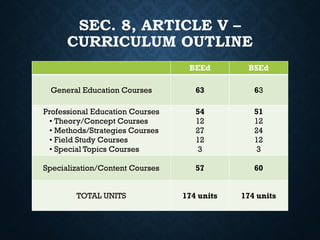
SEC. 8, ARTICLE V –
CURRICULUM OUTLINE
BEEd BSEd
General Education Courses 63 63
Professional Education Courses
• Theory/Concept Courses
• Methods/Strategies Courses
• Field Study Courses
• Special Topics Courses
54
12
27
12
3
51
12
24
12
3
Specialization/Content Courses 57 60
TOTAL UNITS 174 units 174 units
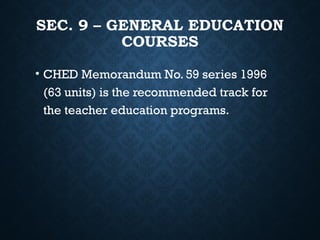
SEC. 9 – GENERAL EDUCATION
COURSES
• CHED Memorandum No. 59 series 1996
(63 units) is the recommended track for
the teacher education programs.
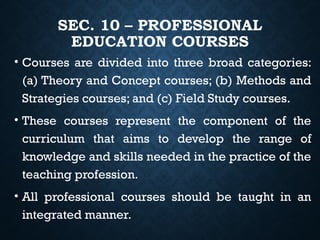
SEC. 10 – PROFESSIONAL
EDUCATION COURSES
• Courses are divided into three broad categories:
(a) Theory and Concept courses; (b) Methods and
Strategies courses; and (c) Field Study courses.
• These courses represent the component of the
curriculum that aims to develop the range of
knowledge and skills needed in the practice of the
teaching profession.
• All professional courses should be taught in an
integrated manner.
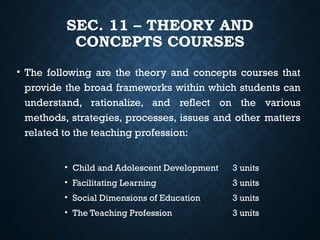
SEC. 11 – THEORY AND
CONCEPTS COURSES
• The following are the theory and concepts courses that
provide the broad frameworks within which students can
understand, rationalize, and reflect on the various
methods, strategies, processes, issues and other matters
related to the teaching profession:
• Child and Adolescent Development 3 units
• Facilitating Learning 3 units
• Social Dimensions of Education 3 units
• The Teaching Profession 3 units
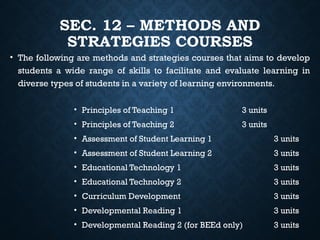
SEC. 12 – METHODS AND
STRATEGIES COURSES
• The following are methods and strategies courses that aims to develop
students a wide range of skills to facilitate and evaluate learning in
diverse types of students in a variety of learning environments.
• Principles of Teaching 1 3 units
• Principles of Teaching 2 3 units
• Assessment of Student Learning 1 3 units
• Assessment of Student Learning 2 3 units
• Educational Technology 1 3 units
• Educational Technology 2 3 units
• Curriculum Development 3 units
• Developmental Reading 1 3 units
• Developmental Reading 2 (for BEEd only) 3 units
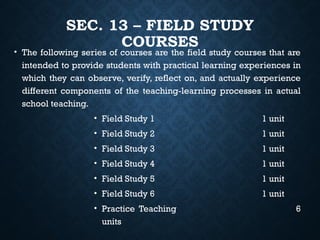
SEC. 13 – FIELD STUDY
COURSES
• The following series of courses are the field study courses that are
intended to provide students with practical learning experiences in
which they can observe, verify, reflect on, and actually experience
different components of the teaching-learning processes in actual
school teaching.
• Field Study 1 1 unit
• Field Study 2 1 unit
• Field Study 3 1 unit
• Field Study 4 1 unit
• Field Study 5 1 unit
• Field Study 6 1 unit
• Practice Teaching 6
units
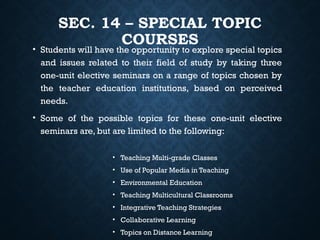
SEC. 14 – SPECIAL TOPIC
COURSES
• Students will have the opportunity to explore special topics
and issues related to their field of study by taking three
one-unit elective seminars on a range of topics chosen by
the teacher education institutions, based on perceived
needs.
• Some of the possible topics for these one-unit elective
seminars are, but are limited to the following:
• Teaching Multi-grade Classes
• Use of Popular Media in Teaching
• Environmental Education
• Teaching Multicultural Classrooms
• Integrative Teaching Strategies
• Collaborative Learning
• Topics on Distance Learning
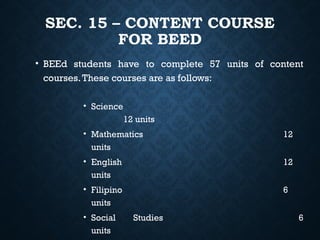
SEC. 15 – CONTENT COURSE
FOR BEED
• BEEd students have to complete 57 units of content
courses.These courses are as follows:
• Science
12 units
• Mathematics 12
units
• English 12
units
• Filipino 6
units
• Social Studies 6
units
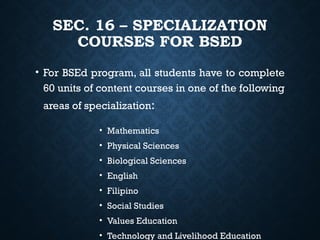
SEC. 16 – SPECIALIZATION
COURSES FOR BSED
• For BSEd program, all students have to complete
60 units of content courses in one of the following
areas of specialization:
• Mathematics
• Physical Sciences
• Biological Sciences
• English
• Filipino
• Social Studies
• Values Education
• Technology and Livelihood Education
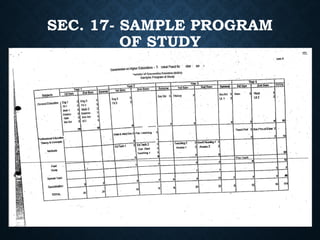
SEC. 17- SAMPLE PROGRAM
OF STUDY
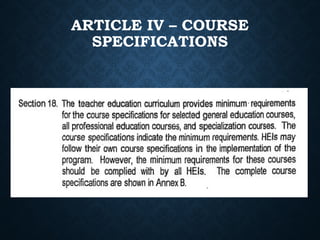
ARTICLE IV – COURSE
SPECIFICATIONS

CMO 30 S 2004 Deped order about curriculum

  • 1.
    CHED MEMORANDUM ORDER NO. 30 CompetencyStandards • TEC Courses • Allied Courses
  • 2.
    WHAT IS CHED? •Commission on Higher Education • Created through the passage of Republic Act No. 7722 (Higher Education Act of 1994). • An attached term of Office, responsible in the formulation and implementation of policies, plans, and programs for the country for the development and efficiency operation of the higher
  • 3.
  • 4.
    ARTICLE I • Highlightsthe essence of Quality pre- service teacher education in the country. “All efforts to improve the quality of education in the Philippines are dependent on the service of teachers who are properly prepared to undertake the various important roles and functions of teachers. As such, it is of utmost importance that the highest standards are set in defining the objectives, components, and processes of the pre-service teacher education curriculum.” — Article I,Sec.1
  • 5.
    ARTICLE III: PROGRAM SPECIFICATIONS •Sec. 3: “The degree program herein shall be called Bachelor of Elementary Education (BEEd) or the Bachelor of Secondary Education (BSEd). • Sec. 4: “The BEEd aims to develop elementary school teachers who are either (a) generalists who can teach across the different learning areas in grade school, (b) special education
  • 6.
    • Meanwhile, “TheBSEd aims to develop high school teachers who can teach in one of the different learning areas in high school like mathematics, Physical Sciences, Biological Sciences, English, Filipino, among others.” • Sec. 5 tells of the different allied programs/discipline that teacher education consists of. Among the basic disciplines are in the social sciences (Psychology, Sociology, Anthropology, Economics, Political Sciences, Applied Linguistics, History, etc.), the Science and technology Fields (Biology, Chemistry, Physics, Mathematics, Engineering, Information Technology, etc.) and the Humanities and related fields (Languages, Literature, Philosophy, etc.)
  • 7.
    ARTICLE IV: COMPETENCY STANDARDS •Graduates of the BEEd and BSEd programs are teachers who: • Have the basic and higher level literary, communication, numeracy, critical thinking, learning skills needed for higher learning; • Have a deep and principled understanding of the learning processes and the role of the teacher in facilitating these processes in their students; • Have a deep and principled understanding of how educational processes relate to larger historical, social, cultural and political processes
  • 8.
    • Have ameaningful and comprehensive knowledge of the subject matter they will teach • Can apply a wide range of teaching process skills (including curriculum development, lesson planning, materials development, educational assessment and teaching approaches); • Have direct experiences in the field/classroom (e.g., classroom observations, teaching assistance, practice teaching); • Can demonstrate and practice the professional and ethical requirements of the teaching professions; • Can facilitate learning of diverse types of learners, in diverse types of learning environments, using a wide range of teaching knowledge and skills;
  • 9.
    • Can reflecton the relationships among the teaching process skills, the learning processing in the students, the nature of the content/subject matter, and the broader social forces encumbering the school and educational processes in order to constantly improve their teaching knowledge, skills and practices; • Can be creative and innovative in thinking of alternative teaching approaches, take informed risks in trying out these innovative approaches, and evaluate the effectiveness of such approaches in improving student learning; and • Are willing and capable to continue learning in order to better fulfill their mission as teachers.
  • 10.
    ARTICLE V –CURRICULUM • Sec. 7 says “The curriculum is designed to prepare professional teachers for practice in primary and secondary schools in the Philippines”. • Moreover,“The curriculum recognizes the need to equip teachers with a wide range of theoretical and methodological skills that will allow them more options and greater flexibility in designing and implementing learning environments…”
  • 11.
    SEC. 8, ARTICLEV – CURRICULUM OUTLINE BEEd BSEd General Education Courses 63 63 Professional Education Courses • Theory/Concept Courses • Methods/Strategies Courses • Field Study Courses • Special Topics Courses 54 12 27 12 3 51 12 24 12 3 Specialization/Content Courses 57 60 TOTAL UNITS 174 units 174 units
  • 12.
    SEC. 9 –GENERAL EDUCATION COURSES • CHED Memorandum No. 59 series 1996 (63 units) is the recommended track for the teacher education programs.
  • 13.
    SEC. 10 –PROFESSIONAL EDUCATION COURSES • Courses are divided into three broad categories: (a) Theory and Concept courses; (b) Methods and Strategies courses; and (c) Field Study courses. • These courses represent the component of the curriculum that aims to develop the range of knowledge and skills needed in the practice of the teaching profession. • All professional courses should be taught in an integrated manner.
  • 14.
    SEC. 11 –THEORY AND CONCEPTS COURSES • The following are the theory and concepts courses that provide the broad frameworks within which students can understand, rationalize, and reflect on the various methods, strategies, processes, issues and other matters related to the teaching profession: • Child and Adolescent Development 3 units • Facilitating Learning 3 units • Social Dimensions of Education 3 units • The Teaching Profession 3 units
  • 15.
    SEC. 12 –METHODS AND STRATEGIES COURSES • The following are methods and strategies courses that aims to develop students a wide range of skills to facilitate and evaluate learning in diverse types of students in a variety of learning environments. • Principles of Teaching 1 3 units • Principles of Teaching 2 3 units • Assessment of Student Learning 1 3 units • Assessment of Student Learning 2 3 units • Educational Technology 1 3 units • Educational Technology 2 3 units • Curriculum Development 3 units • Developmental Reading 1 3 units • Developmental Reading 2 (for BEEd only) 3 units
  • 16.
    SEC. 13 –FIELD STUDY COURSES • The following series of courses are the field study courses that are intended to provide students with practical learning experiences in which they can observe, verify, reflect on, and actually experience different components of the teaching-learning processes in actual school teaching. • Field Study 1 1 unit • Field Study 2 1 unit • Field Study 3 1 unit • Field Study 4 1 unit • Field Study 5 1 unit • Field Study 6 1 unit • Practice Teaching 6 units
  • 17.
    SEC. 14 –SPECIAL TOPIC COURSES • Students will have the opportunity to explore special topics and issues related to their field of study by taking three one-unit elective seminars on a range of topics chosen by the teacher education institutions, based on perceived needs. • Some of the possible topics for these one-unit elective seminars are, but are limited to the following: • Teaching Multi-grade Classes • Use of Popular Media in Teaching • Environmental Education • Teaching Multicultural Classrooms • Integrative Teaching Strategies • Collaborative Learning • Topics on Distance Learning
  • 18.
    SEC. 15 –CONTENT COURSE FOR BEED • BEEd students have to complete 57 units of content courses.These courses are as follows: • Science 12 units • Mathematics 12 units • English 12 units • Filipino 6 units • Social Studies 6 units
  • 19.
    SEC. 16 –SPECIALIZATION COURSES FOR BSED • For BSEd program, all students have to complete 60 units of content courses in one of the following areas of specialization: • Mathematics • Physical Sciences • Biological Sciences • English • Filipino • Social Studies • Values Education • Technology and Livelihood Education
  • 20.
    SEC. 17- SAMPLEPROGRAM OF STUDY
  • 21.
    ARTICLE IV –COURSE SPECIFICATIONS