S y l l a b u s s a A n g F i l i p i n o s a K u r i k u l u m n g B a t a y a n g E d u k a s y o n
A Y 2 0 1 8 - 2 0 1 9
FOUNDATION UNIVERSITY
DUMAGUETE CITY
Life Purpose
The life purpose of Foundation University is to educate and develop individuals to become productive, creative, useful and responsible
citizens of society.
Vision
Foundation University envisions itself as a dynamic, progressive environment that cultivates effective learning, generates creative
ideas, responds to societal needs and offers equal opportunity for all.
Mission
To enhance and promote a climate of academic excellence, responsive to the challenges of the times where individuals are devoted to
the pursuit of knowledge, critical thinking, commitment to life-long learning and service to society.
Core Values
Excellence Commitment Integrity Service
Objectives of the College of Education
Specifically, the objectives of the College of Education which serve as guide in fulfilling the mission and vision of the University are the
following:
1. to produce persons of sound mind, good moral character and broad culture;
2. to produce students with specialized training in fields they are expected to teach;
3. to inculcate in the students understanding of humanism, nationhood, international unity, and desirable Filipino values; and
4. to train students in research and lifelong learning.
Institutional Outcomes
S y l l a b u s s a A n g F i l i p i n o s a K u r i k u l u m n g B a t a y a n g E d u k a s y o n
A Y 2 0 1 8 - 2 0 1 9
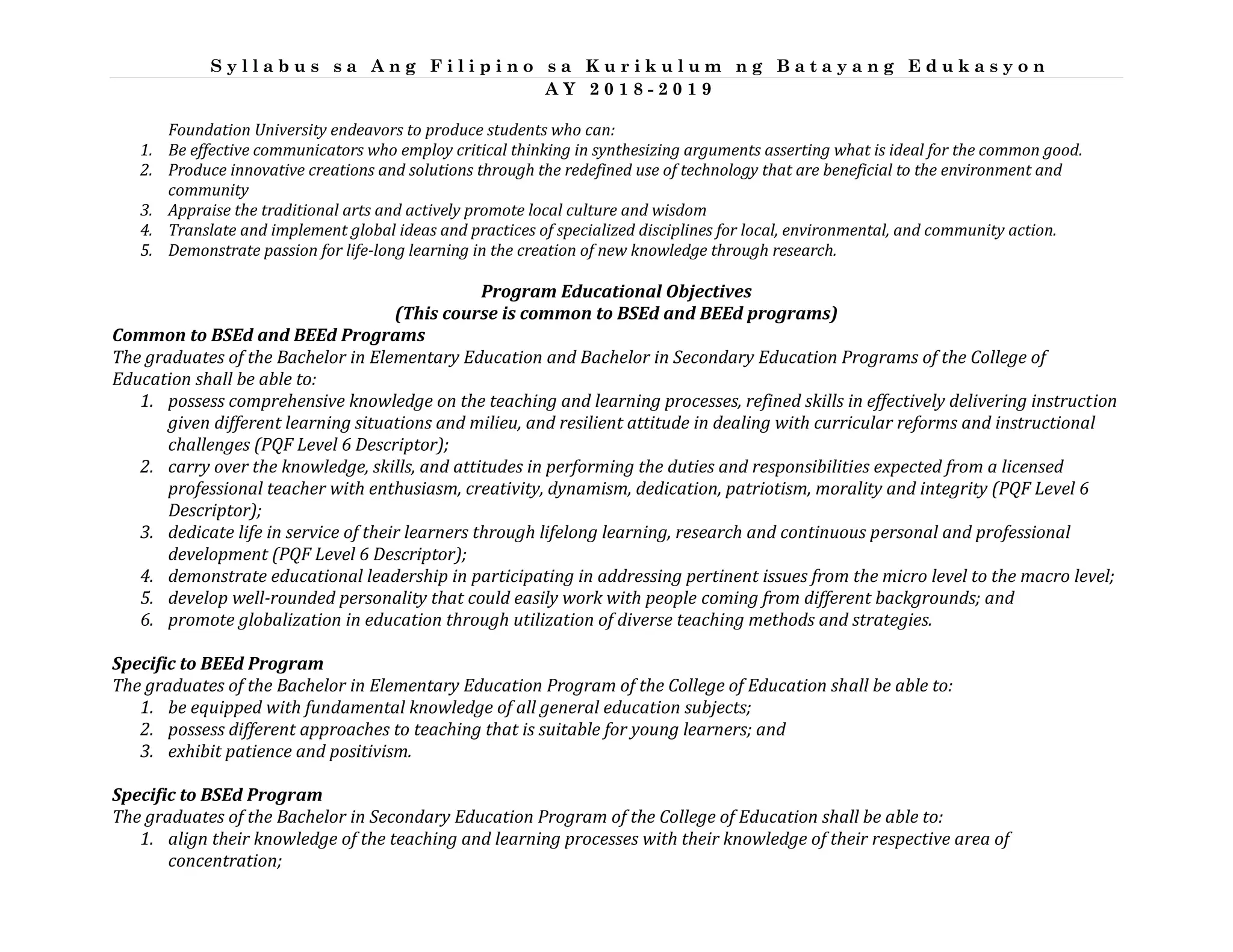
Foundation University endeavors to produce students who can:
1. Be effective communicators who employ critical thinking in synthesizing arguments asserting what is ideal for the common good.
2. Produce innovative creations and solutions through the redefined use of technology that are beneficial to the environment and
community
3. Appraise the traditional arts and actively promote local culture and wisdom
4. Translate and implement global ideas and practices of specialized disciplines for local, environmental, and community action.
5. Demonstrate passion for life-long learning in the creation of new knowledge through research.
Program Educational Objectives
(This course is common to BSEd and BEEd programs)
Common to BSEd and BEEd Programs
The graduates of the Bachelor in Elementary Education and Bachelor in Secondary Education Programs of the College of
Education shall be able to:
1. possess comprehensive knowledge on the teaching and learning processes, refined skills in effectively delivering instruction
given different learning situations and milieu, and resilient attitude in dealing with curricular reforms and instructional
challenges (PQF Level 6 Descriptor);
2. carry over the knowledge, skills, and attitudes in performing the duties and responsibilities expected from a licensed
professional teacher with enthusiasm, creativity, dynamism, dedication, patriotism, morality and integrity (PQF Level 6
Descriptor);
3. dedicate life in service of their learners through lifelong learning, research and continuous personal and professional
development (PQF Level 6 Descriptor);
4. demonstrate educational leadership in participating in addressing pertinent issues from the micro level to the macro level;
5. develop well-rounded personality that could easily work with people coming from different backgrounds; and
6. promote globalization in education through utilization of diverse teaching methods and strategies.
Specific to BEEd Program
The graduates of the Bachelor in Elementary Education Program of the College of Education shall be able to:
1. be equipped with fundamental knowledge of all general education subjects;
2. possess different approaches to teaching that is suitable for young learners; and
3. exhibit patience and positivism.
Specific to BSEd Program
The graduates of the Bachelor in Secondary Education Program of the College of Education shall be able to:
1. align their knowledge of the teaching and learning processes with their knowledge of their respective area of
concentration;
S y l l a b u s s a A n g F i l i p i n o s a K u r i k u l u m n g B a t a y a n g E d u k a s y o n
A Y 2 0 1 8 - 2 0 1 9
2. demonstrate comprehensive understanding of an adolescent learner through empathetic and sensitive approaches to
instruction; and
3. promote values in preparation for adolescence and young adulthood.
Program Outcomes
Common to Teacher Education
1. Articulate the rootedness of education in philosophical, socio-cultural, historical, psychological, and political contexts
2. Demonstrate mastery of subject matter/discipline
3. Facilitate learning using a wide range of teaching methodologies and delivery modes appropriate to specific learners and their
environments
4. Develop innovative curricula, instructional plans, teaching approaches, and resources for diverse learners
5. Apply skills in the development and utilization of ICT to promote quality, relevant, and sustainable educational practices
6. Demonstrate a variety of thinking skills in planning, monitoring, assessing, and reporting learning processes and outcomes
7. Practice professional and ethical teaching standards sensitive the local, national, and global realities
8. Pursue lifelong learning for the personal and professional growth through varied experiential and field-based opportunities
9. Demonstrate genuine concern and care towards the welfare of the learners
10. Manifest sense of responsibility and accountability in performing tasks
11. Demonstrate resilience in working conditions, initiative to instigate actions, creativity in recreating learning tasks,
innovativeness in providing learning experiences, and resourcefulness to realizing all that was mentioned
Specific to BEEd Program
1. Demonstrate in-depth understanding of the development of elementary learners.
2. Exhibit comprehensive knowledge of various learning areas in the elementary curriculum.
3. Create and utilize materials appropriate to the elementary level to enhance teaching and learning.
4. Design and implement assessment tools and procedures to measure elementary learning outcomes.
5. Demonstrate flexibility in teaching pupils of different levels.
6. Takes responsibility in facilitating activities in school and in the community.
Specific to BSEd Program
1. Demonstrate in-depth understanding of the development of adolescent learners.
2. Exhibit comprehensive knowledge of various learning areas in the secondary curriculum.
3. Create and utilize materials appropriate to the secondary level to enhance teaching and learning.
4. Design and implement assessment tools and procedures to measure secondary learning outcomes.
5. Demonstrate flexibility in teaching students of different levels.
6. Takes responsibility in facilitating activities in school and in the community.
S y l l a b u s s a A n g F i l i p i n o s a K u r i k u l u m n g B a t a y a n g E d u k a s y o n
A Y 2 0 1 8 - 2 0 1 9
A. Institutional Outcomes (IO) Program Educational Objectives (PEO) and Programs Outcomes (PO) in relationship to Life
Purpose, Vision, Mission, and Core Values
Life
Purpose
Mission Vision Core Values
a b c d
Institutional Outcomes
1. Be effective communicators who employ critical thinking in
synthesizing arguments asserting what is ideal for the common
good.
      
2. Produce innovative creations and solutions through the redefined
use of technology that are beneficial to the environment and
community
      
3. Appraise the traditional arts and actively promote local culture and
wisdom       
4. Translate and implement global ideas and practices of specialized
disciplines for local, environmental, and community action.       
5. Demonstrate passion for life-long learning in the creation of new
knowledge through research.       
Program Educational Objectives (Common)
1. possess comprehensive knowledge on the teaching and
learning processes, refined skills in effectively delivering
instruction given different learning situations and milieu, and
resilient attitude in dealing with curricular reforms and
instructional challenges;
      
2. carry over the knowledge, skills, and attitudes in performing
the duties and responsibilities expected from a licensed
professional teacher with enthusiasm, creativity, dynamism,
dedication, patriotism, morality and integrity;
      
3. dedicate life in service of their learners through lifelong
learning, research and continuous personal and professional
development;
      
4. demonstrate educational leadership in participating in
addressing pertinent issues from the micro level to the macro       
S y l l a b u s s a A n g F i l i p i n o s a K u r i k u l u m n g B a t a y a n g E d u k a s y o n
A Y 2 0 1 8 - 2 0 1 9
level;
5. develop well-rounded personality that could easily work with
people coming from different backgrounds; and       
6. promote globalization in education through utilization of
diverse teaching methods and strategies.       
Program Outcomes (Common to TEIs)
1. Articulate the rootedness of education in philosophical, socio-
cultural, historical, psychological, and political contexts       
2. Demonstrate mastery of subject matter/discipline
      
3. Facilitate learning using a wide range of teaching methodologies
and delivery modes appropriate to specific learners and their
environments
      
4. Develop innovative curricula, instructional plans, teaching
approaches, and resources for diverse learners       
5. Apply skills in the development and utilization of ICT to promote
quality, relevant, and sustainable educational practices       
6. Demonstrate a variety of thinking skills in planning, monitoring,
assessing, and reporting learning processes and outcomes       
7. Practice professional and ethical teaching standards sensitive the
local, national, and global realities       
8. Pursue lifelong learning for the personal and professional growth
through varied experiential and field-based opportunities       
9. Demonstrate genuine concern and care towards the welfare of the
learners
10. Manifest sense of responsibility and accountability in performing
tasks
11. Demonstrate resilience in working conditions, initiative to
instigate actions, creativity in recreating learning tasks,
innovativeness in providing learning experiences, and
resourcefulness to realizing all that was mentioned
S y l l a b u s s a A n g F i l i p i n o s a K u r i k u l u m n g B a t a y a n g E d u k a s y o n
A Y 2 0 1 8 - 2 0 1 9
B. Institutional Outcomes (IO) Program Educational Objectives (PEO) and Programs Outcomes (PO) in relationship to College
Objectives
College Objectives
1 2 3 4
Institutional Outcomes
1. Be effective communicators who employ critical thinking in
synthesizing arguments asserting what is ideal for the common
good.
   
2. Produce innovative creations and solutions through the redefined
use of technology that are beneficial to the environment and
community
   
3. Appraise the traditional arts and actively promote local culture and
wisdom    
4. Translate and implement global ideas and practices of specialized
disciplines for local, environmental, and community action.    
5. Demonstrate passion for life-long learning in the creation of new
knowledge through research.    
Program Educational Objectives (Common)
1. possess comprehensive knowledge on the teaching and
learning processes, refined skills in effectively delivering
instruction given different learning situations and milieu, and
resilient attitude in dealing with curricular reforms and
instructional challenges;
 
2. carry over the knowledge, skills, and attitudes in performing
the duties and responsibilities expected from a licensed
professional teacher with enthusiasm, creativity, dynamism,
dedication, patriotism, morality and integrity;
 
3. dedicate life in service of their learners through lifelong
learning, research and continuous personal and professional
development;
   
4. demonstrate educational leadership in participating in
addressing pertinent issues from the micro level to the macro
level;
 
5. develop well-rounded personality that could easily work with
people coming from different backgrounds; and   
S y l l a b u s s a A n g F i l i p i n o s a K u r i k u l u m n g B a t a y a n g E d u k a s y o n
A Y 2 0 1 8 - 2 0 1 9
6. promote globalization in education through utilization of
diverse teaching methods and strategies.    
Program Outcomes (Common to TEIs)
1. Articulate the rootedness of education in philosophical, socio-
cultural, historical, psychological, and political contexts    
2. Demonstrate mastery of subject matter/discipline

3. Facilitate learning using a wide range of teaching methodologies
and delivery modes appropriate to specific learners and their
environments
 
4. Develop innovative curricula, instructional plans, teaching
approaches, and resources for diverse learners  
5. Apply skills in the development and utilization of ICT to promote
quality, relevant, and sustainable educational practices 
6. Demonstrate a variety of thinking skills in planning, monitoring,
assessing, and reporting learning processes and outcomes   
7. Practice professional and ethical teaching standards sensitive the
local, national, and global realities    
8. Pursue lifelong learning for the personal and professional growth
through varied experiential and field-based opportunities   
9. Demonstrate genuine concern and care towards the welfare of the
learners
10. Manifest sense of responsibility and accountability in performing
tasks
11. Demonstrate resilience in working conditions, initiative to
instigate actions, creativity in recreating learning tasks,
innovativeness in providing learning experiences, and
resourcefulness to realizing all that was mentioned
C. Institutional Outcomes (IO) in Relationship to Program Educational Objectives (PEO) and Programs Outcomes (PO)
Institutional Outcomes (IO) Program Educational Objectives
(PEO)
Program Outcomes (PO)
(Common to TEIs)
S y l l a b u s s a A n g F i l i p i n o s a K u r i k u l u m n g B a t a y a n g E d u k a s y o n
A Y 2 0 1 8 - 2 0 1 9
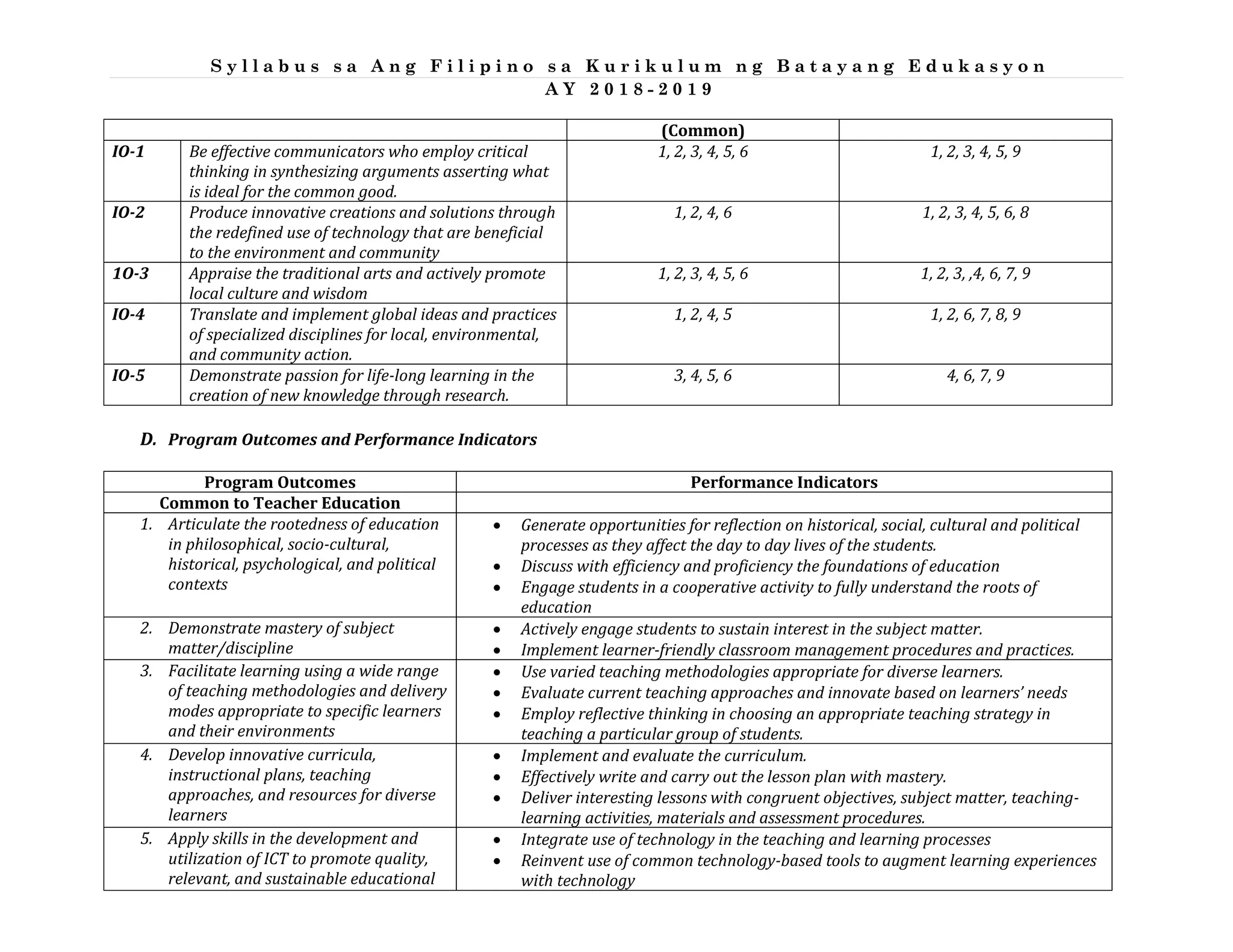
(Common)
IO-1 Be effective communicators who employ critical
thinking in synthesizing arguments asserting what
is ideal for the common good.
1, 2, 3, 4, 5, 6 1, 2, 3, 4, 5, 9
IO-2 Produce innovative creations and solutions through
the redefined use of technology that are beneficial
to the environment and community
1, 2, 4, 6 1, 2, 3, 4, 5, 6, 8
1O-3 Appraise the traditional arts and actively promote
local culture and wisdom
1, 2, 3, 4, 5, 6 1, 2, 3, ,4, 6, 7, 9
IO-4 Translate and implement global ideas and practices
of specialized disciplines for local, environmental,
and community action.
1, 2, 4, 5 1, 2, 6, 7, 8, 9
IO-5 Demonstrate passion for life-long learning in the
creation of new knowledge through research.
3, 4, 5, 6 4, 6, 7, 9
D. Program Outcomes and Performance Indicators
Program Outcomes Performance Indicators
Common to Teacher Education
1. Articulate the rootedness of education
in philosophical, socio-cultural,
historical, psychological, and political
contexts
 Generate opportunities for reflection on historical, social, cultural and political
processes as they affect the day to day lives of the students.
 Discuss with efficiency and proficiency the foundations of education
 Engage students in a cooperative activity to fully understand the roots of
education
2. Demonstrate mastery of subject
matter/discipline
 Actively engage students to sustain interest in the subject matter.
 Implement learner-friendly classroom management procedures and practices.
3. Facilitate learning using a wide range
of teaching methodologies and delivery
modes appropriate to specific learners
and their environments
 Use varied teaching methodologies appropriate for diverse learners.
 Evaluate current teaching approaches and innovate based on learners’ needs
 Employ reflective thinking in choosing an appropriate teaching strategy in
teaching a particular group of students.
4. Develop innovative curricula,
instructional plans, teaching
approaches, and resources for diverse
learners
 Implement and evaluate the curriculum.
 Effectively write and carry out the lesson plan with mastery.
 Deliver interesting lessons with congruent objectives, subject matter, teaching-
learning activities, materials and assessment procedures.
5. Apply skills in the development and
utilization of ICT to promote quality,
relevant, and sustainable educational
 Integrate use of technology in the teaching and learning processes
 Reinvent use of common technology-based tools to augment learning experiences
with technology
S y l l a b u s s a A n g F i l i p i n o s a K u r i k u l u m n g B a t a y a n g E d u k a s y o n
A Y 2 0 1 8 - 2 0 1 9
practices  Show proficiency in the use of technology as an integral tool in teaching, learning,
and assessment
6. Demonstrate a variety of thinking skills
in planning, monitoring, assessing, and
reporting learning processes and
outcomes
 Employ regular feedback to student’s performance
 Source and organize data and information concerning teaching and learning.
 Analyze and interpret data and information using appropriate tools and
procedures.
 Compose and disseminate properly well-written reports (progress reports,
assessment, official communications, among others).
7. Practice professional and ethical
teaching standards sensitive the local,
national, and global realities
 Behave in accordance to the Code of Ethics of Professional Teachers.
 Use the community as a learning resource.
8. Pursue lifelong learning for the
personal and professional growth
through varied experiential and field-
based opportunities
 Enthusiastically take part in activities that would benefit the school and the
community.
 Plan and carry out personal and professional advancement.
9. Demonstrate genuine concern and care
towards the welfare of the learners
 Proactively notice and address problems inside the classroom
 Give equal importance to the inputs of all students
 Provide contextualized discussions of topics
10. Manifest sense of responsibility and
accountability in performing tasks
 Dedicate time and effort in finishing started and assigned work
 Show passion in completing a task
 Manifest readiness by preparing contingency plans in every task given
11. Show resilience in working
conditions, initiative to instigate
actions, creativity in recreating
learning tasks, innovativeness in
providing learning experiences, and
resourcefulness to realizing all that
was mentioned
 Adapt to various teaching milieus
 Can work under pressure
 Demonstrate eagerness to learn a new task or can easily adopt to a different work
environment not related to teaching
 See limitless possibilities in recreating existing concepts and ideas
 Effectively facilitate inclusive learning by taking into consideration different ideas
from students and colleagues
 Lead in development work in school or in the community
S y l l a b u s s a A n g F i l i p i n o s a K u r i k u l u m n g B a t a y a n g E d u k a s y o n
A Y 2 0 1 8 - 2 0 1 9
Sabdyek Kowd: Filipino118
Pamagat ng Sadyek: Maikling Kuwento at Nobela
Bilang ng Units: 3
Pre-requisite:
Mga Instruktor: Felipe B. Sullera, Jr., MAEd-Filipino; Cristina P. Calisang, Ed.D.
Diskripsyon ng Kurso:
Sinasaklaw ng kursong ito ang pag-aaral at pagpapahalaga sa makasaysayang pag-unlad ng maikling kuwento at nobelang Filipino
na may pagbibigay-diin sa mga sangkap at pagkabuo nito. Gagawin din ang pag-aaral, pagpapahalaga at pagsusuri ang iba’t ibang uri ng
maikling kuwento (banghay, tauhan, kapaligiran/katutubong kulay atbp.). Kasamang tatalakayin ang sining ng pagkukuwento, pagsusuri sa
anyo at nilalaman; sangkap at kailangan ng maikling kuwento. Kasama rin ang paglinang ng kaalaman at kakayahan sa paglikha ng
kaibahan ng maikling kuwento – pagsusuri sa anyo at nilalaman ng uri ng nobela, pag-aaral at pagpapahalaga sa mga kinatawang nobela
sa lahat ng panahon ng panitikang Pilipino.
Course Learning Outcomes
Pagkatapos ng kurso, inaasahang ang mga estudyante ay:
CLO 1: Makikilala ang kalikasan ng maikling kuwento at nobela bilang anyo ng panitikan;
CLO2: Mapag-aaralan ang mga klasikal, premyado at namumukod-tanging maikling kuwento at nobela sa Pilipinas bilang
hulwaran ng artistikong kahusayan ng Pilipino;
CLO3: Malilinang ang isipan sa pamamagitan ng mga bokabularyong piling gagamitan sa pagbuo ng kani-kanilang gawa;
CLO4: Makapupulot ng aral tungo sa pag-unlad ng sariling kalinangan at kasanayan pati na sa lipunang gingagalawan; at
CLO5: Makapagbibigay inspirasyon sa kapwa estudyante at mga mambabasa dahil sa maipakitang kasiningan, kasinupan
at kahusayan sa pagbubuo ng katha mapa maikling kuwento man o nobela.
S y l l a b u s s a A n g F i l i p i n o s a K u r i k u l u m n g B a t a y a n g E d u k a s y o n
A Y 2 0 1 8 - 2 0 1 9
E. Course Learning Outcomes (CLO) in Relationship to Institutional Outcomes (IO), Program Educational Objectives (PEO),
Programs Outcomes (PO) and College Objectives (CO)
Course Learning Outcomes (CLO) Institutional
Outcomes
Program
Educational
Objectives
Program
Outcomes
(Common to
TEIs)
CE Objectives
CLO 1 Makikilala ang kalikasan ng maikling kuwento
at nobela bilang anyo ng panitikan; 1,2,5 1,2,3,5 1,4,6,7,8,9,10, 11 1,2,3,4,5
CLO 2 Mapag-aaralan ang mga klasikal, premyado at
namumukod-tanging maikling kuwento at
nobela sa Pilipinas bilang hulwaran ng
artistikong kahusayan ng Pilipino;
1,2,4,5 1,2,4,5 1,4,5,6,7,8,9,10,
11
1,2,3,4,5
CLO 3 Malilinang ang isipan sa pamamagitan ng mga
bokabularyong piling gagamitan sa pagbuo ng
kani-kanilang gawa;
1,3 2, 5 1,2,3,10 1,2,5
CLO 4 Makapupulot ng aral tungo sa pag-unlad ng
sariling kalinangan at kasanayan pati na sa
lipunang gingagalawan; at
1,3 2,5 1,2,3,10 1,2,5
CLO 5 Makapagbibigay inspirasyon sa kapwa
estudyante at mga mambabasa dahil sa
maipakitang kasiningan, kasinupan at
kahusayan sa pagbubuo ng katha mapa
maikling kuwento man o nobela.
1,2,3,5 1,3,4,6 1,4,6,7,9,10, 11 1,3,4,5
S y l l a b u s s a A n g F i l i p i n o s a K u r i k u l u m n g B a t a y a n g E d u k a s y o n
A Y 2 0 1 8 - 2 0 1 9
Grading System:
COMPONENTS PRELIM GRADE MIDTERM GRADE FINAL GRADE
Attendance 5% 5% 5%
Quizzes 20% 20% 20%
Recitation 10% 10% 10%
Presentation 20% 20% 20%
Project 20% 20% 20%
Examination 25% 25% 25%
TOTAL 100% 100% 100%
Course Grade: 0.3(PG)+0.3(MG)+0.4(FG)
Alituntuning Pang-klasrum:
1. Uniporme – Inaasahan ang kumpletong pagsusuot ng uniporme at ID sa araw ng pasukan.
2. Mga nararapat na gupit ng buhok ng mga lalaki (bawal ang paglalagay ng hikaw). Inaasahan din ang maayos na ayos ng buhok ng mga
babae lalo na ang paglalagay ng mga kolorete at pagsusuot ng mga hikaw at anupamang aksesorya ay kinakailangan ding naaayon.
3. Atendans – Mariin na ipanatutupad na sinuman ang gagawa ng tatlong (3) sunod-sunod na di-katanggap-tanggap na pagliban ay
maaaring buburahin sa pagkakatala (dropped). Ang mga nahuhuli sa pagpasok ay maaaring patawan ng mga sumusunod: (a) dalawang
sunod-sunod na pagkahuli ay papatawan ng 1 liban; (b) ang estudyanteng lalabas ng klase bago ang itinakdang oras ay huli rin at
papatawan ng katulad ng nabanggit sa una; at (c) labinlimang (15) minutong palugit lamang ang ibibigay sa mga estudyante bago
lubusang maging huli sa klase. Kinakailangang magpakita ng Liham Paumanhin ang estudyante na nilagdaan ng magulang o sinumang
nakatatanda sa kanya at naglalaman ng paliwanag at rason ng pagliban at pagkahuli. Maaari ring may lagda ng dekana/dekano.
4. Higit na ipinagbabawal ang pangongopya at pangongodego. Sinuman ang mahuli na gumagawa ng nabanggit ay makatatanggap ng
karampatang parusa. Higit na malalang parusa ang pagkaalis o dismissal sa paaralan.
S y l l a b u s s a A n g F i l i p i n o s a K u r i k u l u m n g B a t a y a n g E d u k a s y o n
A Y 2 0 1 8 - 2 0 1 9
5. Sinuman ang hindi makakakuha ng alinman sa mga pasulat na pagsusulit at makasali sa anumang pagtatanghal o presentasyon ay
bibigyan lamang ng pagkakataong makakuha nito kung balido ang rason.
6. Higit na iniimplementa sa buong unibersidad ang NO PERMIT, NO EXAM. Bibigyan lamang ng labindalawang (12) araw na palugit ang
mga estudyante na makakuha ng major exams. Lampas sa itinakdang panahon ay hindi na maaaring kumuha pa ng pasulit datapwa’t
awtomatikong zero (0) ang makukuhang eskor dito. Tuwing Pinal na Pasulit, bibigyan lamang ng limang araw na palugit ang mga
estudyante bago lubusang makakuha ng gradong INC ganun din sa pagpasa ng proyekto at anumang pagtatanghal sa presentasyon na
komponent..
7. Sa pagpasa ng mga kursong pangangailangan, marapat na ipasa ito dalawang (2) araw o sa araw na itinakda. Lampas sa itinakdang
araw ay hindi papayagang makapapagpasa pa.
8. Ang respeto ng bawat isa ay higit na kinakailangan lalong-lalo na sa guro. Sinuman ang magpapakita ng kawalan ng respeto lampas sa
makakayang bigyan ito ng konsiderasyon ay makatatanggap ng karampatang parusa depende sa guro. Ipinagbabawal din ang bullying.
9. Ugaliing panatilihin ang kalinisan at kaayusan ng silid-aralan. Itapon ang mga basura sa basurahan at hinihikayat din ang lahat na
isaayos ang mga upuan bago lalabas ng silid.
10. Ang iilan sa mga polisiya at tuntunin ay ibibigay sa mga estudyante sa mga pagkakataon o sitwasyon na kinakailangan.
S y l l a b u s s a A n g F i l i p i n o s a K u r i k u l u m n g B a t a y a n g E d u k a s y o n
A Y 2 0 1 8 - 2 0 1 9
Course Outline and Timeframe
MARKAHAN LINGGO ARAW PAKSA
PRELIM
WEEK 1 PI:1-3(August 13-17, 2018)
PII: 1-5( August 15-17, 2018)
Yunit 1: Ang Maikling Kuwento
I. Ang Panitikan
1. Katuturan ayon sa iba’t ibang tanyag na manunulat
2. Kahalagahan ng panitikan
3. Mg Impluwensiya ng panitikan
II. Maikling Kuwento
1. Kalikasan at Katuturan
2. Kasaysayan (Ang Maikling Kuwento at ang Tradisyong Oral sa
Panitikan)
3. Layunin
4. Kahalagahan mula sa Rehiyon
5. Mga Uri ng Maikling Kuwento Batay sa Layunin (rising and falling
action)
WEEK 2
PIII;1-3 ( August 20-21, 2018)
PIV; 1-4 ( August 22-23, 2018)
PV; 1-3 ( August 24, 2018)
III. Paglikha ng Banghay
1. Magkaugnay na Banghay
2. Mga Suliranin sa Paglikha ng Banghay
3. Ang galaw ng kuwento
IV. Pagsusuri sa Banghay ng Kuwento
1. Tunggalan
2. Kahulugan
3. Halaga ng Tunggalian
4. Uri ng Tunggalian
V. Ang Tema
1. Kahulugan
2. Layunin
3. Paraan ng Pagpapahayag ng Tema
VI. Pagkilala sa Tauhan
1. Kahulugan
2. Uri Batay sa Layunin
S y l l a b u s s a A n g F i l i p i n o s a K u r i k u l u m n g B a t a y a n g E d u k a s y o n
A Y 2 0 1 8 - 2 0 1 9
WEEK 3 PVI&VII ( August 28-29, 2018)
PV VIII ( August 30-31, 2018)
3. Klasipikasyon ng mga Tauhan
4. Halaga ng Pagpapangalan
VII. Tagpo
1. Kahulugan
2. Halaga ng Lunan
3. Tungkulin ng Lunan
VIII. Dayalogo
1. Kahulugan ng Dayalogo
2. Anyo ng Dayalogo sa Iba’t ibang Midyum
3. Tungkulin ng Dayalogo
4. Teknikal na Paraan ng Pagsusulat ng Dayalogo
MIDTERM
WEEK 1
( September 4 – 7, 2018)
Yunit 2: Ang Nobela
I. Kasaysayan ng Pag-unlad ng Nobela
1. Panahon ng Kastila
2. Panahon ng Amerikano
WEEK 2
( September 10 – 14, 2018) 3. Panahon ng Kalayaan
4. Panahon ng Bagong Lipunan
5. Panahon ng Kontemporaryo
WEEK 3 September 17 – 20, 2018
II. Kalikasan ng Nobela
1. Uri ng Nobela
2. Layunin ng Nobela
3. Mga Sangkap ng Nobela
FINALS WEEKS
1 - 3
( September 24 – 2018 )
( October 1 – 10, 2018)
III. Ang Pagsusuri at Pagsusulat ng Maikling Kuwento at Nobela
1. Ang Malikhaing Pagsulat
2. Mga Layunin at Proseso sa Malikhaing Pagsulat
3. Pagsusuri ng mga Piling mga Maikling Kuwento at Nobela sa
Pilipinas
IV. Ang Sining ng Pagkukuwento
S y l l a b u s s a A n g F i l i p i n o s a K u r i k u l u m n g B a t a y a n g E d u k a s y o n
A Y 2 0 1 8 - 2 0 1 9
Time
Frame
Specific Learning Outcomes Course
Learning
Outcomes
Topics Methods &
Activities
Assessment
PRELIM
WEEK 1 1. Natutukoy at naipaliliwanag
ang kahulugan ng panitikan at
iba pang konsepto ng
panitikan.
2. Nailalarawan ang iba pang
konsepto ng panitikan sa
masining na pamamaraan.
3. Natatalakay ang mga
pangunahing konsepto sa
maikling kuwento.
4. Nakalilikha ng isang
konseptong papel.
CLO1,3,4
Yunit 1: Ang Maikling
Kuwento
I. Ang Panitikan
1. Katuturan ayon sa iba’t
ibang tanyag na
manunulat
2. Kahalagahan ng
panitikan
3. Mg Impluwensiya ng
panitikan
II. Maikling Kuwento
1. Kalikasan at Katuturan
2. Kasaysayan (Ang
Maikling Kuwento at ang
Tradisyong Oral sa
Panitikan)
3. Layunin
4. Kahalagahan mula sa
Rehiyon
5. Mga Uri ng Maikling
Kuwento Batay sa
Layunin (rising and
falling action)
Malayang
talakayan
Interaktibo at
kolaboratibong
gawain sa
pagkatuto
Round table
discussion
Konseptong papel
S y l l a b u s s a A n g F i l i p i n o s a K u r i k u l u m n g B a t a y a n g E d u k a s y o n
A Y 2 0 1 8 - 2 0 1 9
WEEK 2 1. Natutukoy ang
mahahalagang bahagi sa
paglikha ng banghay.
2. Naisaalang-alang ang mga
bahagi sa pagsusuri ng
banghay ng kuwento.
3. Napalalawig ang kamalayan
sa halaga at kaugnayan ng
tema sa pagbuo ng maikling
kuwento.
4. Nakabubuo ng isang
kwentong Dagli/Bitbit,
CLO 1,2,3,4,5
III. Paglikha ng Banghay
1. Magkaugnay na
Banghay
2. Mga Suliranin sa
Paglikha ng Banghay
3. Ang galaw ng kuwento
IV. Pagsusuri sa
Banghay ng Kuwento
1. Tunggalan
2. Kahulugan
3. Halaga ng Tunggalian
4. Uri ng Tunggalian
V. Ang Tema
1. Kahulugan
2. Layunin
3. Paraan ng
Pagpapahayag ng Tema
Pag-uulat
Malayang
talakayan
Hot seat
Isang Dagli/Bitbit
WEEK 3
1. Natutukoy ang kaibahan ng
mga papel na ginagampanan
ng iba’t ibang uri ng tauhan.
2. Naisaalang-alang ang tagpo
sa pagsusuri ng kuwento.
3. Nakalilikha ng isang
epektibo at masining na
dayalogo.
CLO1,3,4
VI. Pagkilala sa Tauhan
1. Kahulugan
2. Uri Batay sa Layunin
3. Klasipikasyon ng mga
Tauhan
4. Halaga ng
Pagpapangalan
VII. Tagpo
1. Kahulugan
2. Halaga ng Lunan
3. Tungkulin ng Lunan
VIII. Dayalogo
1. Kahulugan ng Dayalogo
2. Anyo ng Dayalogo sa
Iba’t ibang Midyum
3. Tungkulin ng Dayalogo
4. Teknikal na Paraan ng
Pagsusulat ng Dayalogo
Malayang
talakayan
Jigsaw transfer
Dugtungang
Pasalaysay
Sariling likhang
Diyalogo
MIDTERM
S y l l a b u s s a A n g F i l i p i n o s a K u r i k u l u m n g B a t a y a n g E d u k a s y o n
A Y 2 0 1 8 - 2 0 1 9
WEEK 1
1. Natutukoy ang mga
mahahalagang pag-unlad ng
nobela sa panahon ng Kastila
at Amerikano.
2. Naibubukod ang mga
katangian ng mga nobela
dalawang panahon.
3. Nasusuri ang tema ng mga
piling nobela sa panahon ng
Kastila at Amerikano.
CLO1,2,3,4,5
Yunit 2: Ang Nobela
I. Kasaysayan ng Pag-
unlad ng Nobela
1. Panahon ng Kastila
2. Panahon ng Amerikano
Pag-uulat
Videoclip
Malayang
talakayan
Awtput ng
sinuring
indibidwal na
nobela sa
dalawang
panahon.
WEEK 2
1. Nakikilala ang tema at
banghay sa mga piling nobela
sa panahon ng Kalayaan,
Bagong Lipunan at
Kontemporaryo.
2. Nasusuri ang mga piling
nobela sa bawat panahon.
CLO1,2,3,4,5
3. Panahon ng Kalayaan
4. Panahon ng Bagong
Lipunan
5. Panahon ng
Kontemporaryo
Pag-uulat
Videoclip
Malayang
talakayan
Awtput ng
sinuring
indibidwal na
nobela mga
panahon.
WEEK 3 1. Natutukoy ang
mahahalagang konsepto ng
nobela.
2. Naisaalang-alang ang mga
sangkap ng nobela sa
pagsusuri.
CLO1,2,3,4,5
II. Kalikasan ng Nobela
1. Uri ng Nobela
2. Layunin ng Nobela
3. Mga Sangkap ng Nobela
Malayang
talakayan
Pasalita at pasulat
na pagsusulit
FINALS
S y l l a b u s s a A n g F i l i p i n o s a K u r i k u l u m n g B a t a y a n g E d u k a s y o n
A Y 2 0 1 8 - 2 0 1 9
WEEKS 1-3
1. Naiisa-isa ang mga
mahahalagang konsepto sa
pagsulat nang malikhain.
2. Nakapagsusuri ng mga
piling maikling kuwento at
nobela sa Pilipinas alinsunod
sa mga pamantayan sa
pagsusuri.
3. Nakapaglalahad nang
masining sa mga nabuo at
nasuring maikling kuwento at
nobela.
CLO1,2,3,4,5
III. Ang Pagsusuri at
Pagsusulat ng Maikling
Kuwento at Nobela
1. Ang Malikhaing
Pagsulat
2. Mga Layunin at Proseso
sa Malikhaing Pagsulat
3. Pagsusuri ng mga Piling
mga Maikling Kuwento at
Nobela sa Pilipinas
IV. Ang Sining ng
Pagkukuwento
Masining na
presentasyon
Malayang
talakayan
Mga awtput sa
sinuring mga
nobela at maikling
kuwento gayundin
ang mga sariling
likhang obra.
S y l l a b u s s a A n g F i l i p i n o s a K u r i k u l u m n g B a t a y a n g E d u k a s y o n
A Y 2 0 1 8 - 2 0 1 9
Prepared by/Date Reviewed by/Date Noted by/Date Approved by/Date
FELIPE B. SULLERA JR.,
LPT, MAEd
Instructor
___________________
Signature
CRISTINA P. CALISANG.,
LPT, Ed.D
___________________
Signature
__________________
Date
ANTONIA
GUEYNDOLINE B.
DESPOJO, LPT, MAEd
Chairperson, Syllabi
committee
____________________
Signature
___________________
Date
LYDIA LINDA P.
FEROLINO, MAEd
University Librarian
____________________
Signature
___________________
Date
JASPER ERIC C. CATAN,
LPT, MAEd.
CE Dean
____________________
Signature
___________________
Date

411575954-Silabus-Sa-Filipino118-Maikling-Kuwento-Nobela.pdf

  • 1.
    S y ll a b u s s a A n g F i l i p i n o s a K u r i k u l u m n g B a t a y a n g E d u k a s y o n A Y 2 0 1 8 - 2 0 1 9 FOUNDATION UNIVERSITY DUMAGUETE CITY Life Purpose The life purpose of Foundation University is to educate and develop individuals to become productive, creative, useful and responsible citizens of society. Vision Foundation University envisions itself as a dynamic, progressive environment that cultivates effective learning, generates creative ideas, responds to societal needs and offers equal opportunity for all. Mission To enhance and promote a climate of academic excellence, responsive to the challenges of the times where individuals are devoted to the pursuit of knowledge, critical thinking, commitment to life-long learning and service to society. Core Values Excellence Commitment Integrity Service Objectives of the College of Education Specifically, the objectives of the College of Education which serve as guide in fulfilling the mission and vision of the University are the following: 1. to produce persons of sound mind, good moral character and broad culture; 2. to produce students with specialized training in fields they are expected to teach; 3. to inculcate in the students understanding of humanism, nationhood, international unity, and desirable Filipino values; and 4. to train students in research and lifelong learning. Institutional Outcomes
  • 2.
    S y ll a b u s s a A n g F i l i p i n o s a K u r i k u l u m n g B a t a y a n g E d u k a s y o n A Y 2 0 1 8 - 2 0 1 9 Foundation University endeavors to produce students who can: 1. Be effective communicators who employ critical thinking in synthesizing arguments asserting what is ideal for the common good. 2. Produce innovative creations and solutions through the redefined use of technology that are beneficial to the environment and community 3. Appraise the traditional arts and actively promote local culture and wisdom 4. Translate and implement global ideas and practices of specialized disciplines for local, environmental, and community action. 5. Demonstrate passion for life-long learning in the creation of new knowledge through research. Program Educational Objectives (This course is common to BSEd and BEEd programs) Common to BSEd and BEEd Programs The graduates of the Bachelor in Elementary Education and Bachelor in Secondary Education Programs of the College of Education shall be able to: 1. possess comprehensive knowledge on the teaching and learning processes, refined skills in effectively delivering instruction given different learning situations and milieu, and resilient attitude in dealing with curricular reforms and instructional challenges (PQF Level 6 Descriptor); 2. carry over the knowledge, skills, and attitudes in performing the duties and responsibilities expected from a licensed professional teacher with enthusiasm, creativity, dynamism, dedication, patriotism, morality and integrity (PQF Level 6 Descriptor); 3. dedicate life in service of their learners through lifelong learning, research and continuous personal and professional development (PQF Level 6 Descriptor); 4. demonstrate educational leadership in participating in addressing pertinent issues from the micro level to the macro level; 5. develop well-rounded personality that could easily work with people coming from different backgrounds; and 6. promote globalization in education through utilization of diverse teaching methods and strategies. Specific to BEEd Program The graduates of the Bachelor in Elementary Education Program of the College of Education shall be able to: 1. be equipped with fundamental knowledge of all general education subjects; 2. possess different approaches to teaching that is suitable for young learners; and 3. exhibit patience and positivism. Specific to BSEd Program The graduates of the Bachelor in Secondary Education Program of the College of Education shall be able to: 1. align their knowledge of the teaching and learning processes with their knowledge of their respective area of concentration;
  • 3.
    S y ll a b u s s a A n g F i l i p i n o s a K u r i k u l u m n g B a t a y a n g E d u k a s y o n A Y 2 0 1 8 - 2 0 1 9 2. demonstrate comprehensive understanding of an adolescent learner through empathetic and sensitive approaches to instruction; and 3. promote values in preparation for adolescence and young adulthood. Program Outcomes Common to Teacher Education 1. Articulate the rootedness of education in philosophical, socio-cultural, historical, psychological, and political contexts 2. Demonstrate mastery of subject matter/discipline 3. Facilitate learning using a wide range of teaching methodologies and delivery modes appropriate to specific learners and their environments 4. Develop innovative curricula, instructional plans, teaching approaches, and resources for diverse learners 5. Apply skills in the development and utilization of ICT to promote quality, relevant, and sustainable educational practices 6. Demonstrate a variety of thinking skills in planning, monitoring, assessing, and reporting learning processes and outcomes 7. Practice professional and ethical teaching standards sensitive the local, national, and global realities 8. Pursue lifelong learning for the personal and professional growth through varied experiential and field-based opportunities 9. Demonstrate genuine concern and care towards the welfare of the learners 10. Manifest sense of responsibility and accountability in performing tasks 11. Demonstrate resilience in working conditions, initiative to instigate actions, creativity in recreating learning tasks, innovativeness in providing learning experiences, and resourcefulness to realizing all that was mentioned Specific to BEEd Program 1. Demonstrate in-depth understanding of the development of elementary learners. 2. Exhibit comprehensive knowledge of various learning areas in the elementary curriculum. 3. Create and utilize materials appropriate to the elementary level to enhance teaching and learning. 4. Design and implement assessment tools and procedures to measure elementary learning outcomes. 5. Demonstrate flexibility in teaching pupils of different levels. 6. Takes responsibility in facilitating activities in school and in the community. Specific to BSEd Program 1. Demonstrate in-depth understanding of the development of adolescent learners. 2. Exhibit comprehensive knowledge of various learning areas in the secondary curriculum. 3. Create and utilize materials appropriate to the secondary level to enhance teaching and learning. 4. Design and implement assessment tools and procedures to measure secondary learning outcomes. 5. Demonstrate flexibility in teaching students of different levels. 6. Takes responsibility in facilitating activities in school and in the community.
  • 4.
    S y ll a b u s s a A n g F i l i p i n o s a K u r i k u l u m n g B a t a y a n g E d u k a s y o n A Y 2 0 1 8 - 2 0 1 9 A. Institutional Outcomes (IO) Program Educational Objectives (PEO) and Programs Outcomes (PO) in relationship to Life Purpose, Vision, Mission, and Core Values Life Purpose Mission Vision Core Values a b c d Institutional Outcomes 1. Be effective communicators who employ critical thinking in synthesizing arguments asserting what is ideal for the common good.        2. Produce innovative creations and solutions through the redefined use of technology that are beneficial to the environment and community        3. Appraise the traditional arts and actively promote local culture and wisdom        4. Translate and implement global ideas and practices of specialized disciplines for local, environmental, and community action.        5. Demonstrate passion for life-long learning in the creation of new knowledge through research.        Program Educational Objectives (Common) 1. possess comprehensive knowledge on the teaching and learning processes, refined skills in effectively delivering instruction given different learning situations and milieu, and resilient attitude in dealing with curricular reforms and instructional challenges;        2. carry over the knowledge, skills, and attitudes in performing the duties and responsibilities expected from a licensed professional teacher with enthusiasm, creativity, dynamism, dedication, patriotism, morality and integrity;        3. dedicate life in service of their learners through lifelong learning, research and continuous personal and professional development;        4. demonstrate educational leadership in participating in addressing pertinent issues from the micro level to the macro       
  • 5.
    S y ll a b u s s a A n g F i l i p i n o s a K u r i k u l u m n g B a t a y a n g E d u k a s y o n A Y 2 0 1 8 - 2 0 1 9 level; 5. develop well-rounded personality that could easily work with people coming from different backgrounds; and        6. promote globalization in education through utilization of diverse teaching methods and strategies.        Program Outcomes (Common to TEIs) 1. Articulate the rootedness of education in philosophical, socio- cultural, historical, psychological, and political contexts        2. Demonstrate mastery of subject matter/discipline        3. Facilitate learning using a wide range of teaching methodologies and delivery modes appropriate to specific learners and their environments        4. Develop innovative curricula, instructional plans, teaching approaches, and resources for diverse learners        5. Apply skills in the development and utilization of ICT to promote quality, relevant, and sustainable educational practices        6. Demonstrate a variety of thinking skills in planning, monitoring, assessing, and reporting learning processes and outcomes        7. Practice professional and ethical teaching standards sensitive the local, national, and global realities        8. Pursue lifelong learning for the personal and professional growth through varied experiential and field-based opportunities        9. Demonstrate genuine concern and care towards the welfare of the learners 10. Manifest sense of responsibility and accountability in performing tasks 11. Demonstrate resilience in working conditions, initiative to instigate actions, creativity in recreating learning tasks, innovativeness in providing learning experiences, and resourcefulness to realizing all that was mentioned
  • 6.
    S y ll a b u s s a A n g F i l i p i n o s a K u r i k u l u m n g B a t a y a n g E d u k a s y o n A Y 2 0 1 8 - 2 0 1 9 B. Institutional Outcomes (IO) Program Educational Objectives (PEO) and Programs Outcomes (PO) in relationship to College Objectives College Objectives 1 2 3 4 Institutional Outcomes 1. Be effective communicators who employ critical thinking in synthesizing arguments asserting what is ideal for the common good.     2. Produce innovative creations and solutions through the redefined use of technology that are beneficial to the environment and community     3. Appraise the traditional arts and actively promote local culture and wisdom     4. Translate and implement global ideas and practices of specialized disciplines for local, environmental, and community action.     5. Demonstrate passion for life-long learning in the creation of new knowledge through research.     Program Educational Objectives (Common) 1. possess comprehensive knowledge on the teaching and learning processes, refined skills in effectively delivering instruction given different learning situations and milieu, and resilient attitude in dealing with curricular reforms and instructional challenges;   2. carry over the knowledge, skills, and attitudes in performing the duties and responsibilities expected from a licensed professional teacher with enthusiasm, creativity, dynamism, dedication, patriotism, morality and integrity;   3. dedicate life in service of their learners through lifelong learning, research and continuous personal and professional development;     4. demonstrate educational leadership in participating in addressing pertinent issues from the micro level to the macro level;   5. develop well-rounded personality that could easily work with people coming from different backgrounds; and   
  • 7.
    S y ll a b u s s a A n g F i l i p i n o s a K u r i k u l u m n g B a t a y a n g E d u k a s y o n A Y 2 0 1 8 - 2 0 1 9 6. promote globalization in education through utilization of diverse teaching methods and strategies.     Program Outcomes (Common to TEIs) 1. Articulate the rootedness of education in philosophical, socio- cultural, historical, psychological, and political contexts     2. Demonstrate mastery of subject matter/discipline  3. Facilitate learning using a wide range of teaching methodologies and delivery modes appropriate to specific learners and their environments   4. Develop innovative curricula, instructional plans, teaching approaches, and resources for diverse learners   5. Apply skills in the development and utilization of ICT to promote quality, relevant, and sustainable educational practices  6. Demonstrate a variety of thinking skills in planning, monitoring, assessing, and reporting learning processes and outcomes    7. Practice professional and ethical teaching standards sensitive the local, national, and global realities     8. Pursue lifelong learning for the personal and professional growth through varied experiential and field-based opportunities    9. Demonstrate genuine concern and care towards the welfare of the learners 10. Manifest sense of responsibility and accountability in performing tasks 11. Demonstrate resilience in working conditions, initiative to instigate actions, creativity in recreating learning tasks, innovativeness in providing learning experiences, and resourcefulness to realizing all that was mentioned C. Institutional Outcomes (IO) in Relationship to Program Educational Objectives (PEO) and Programs Outcomes (PO) Institutional Outcomes (IO) Program Educational Objectives (PEO) Program Outcomes (PO) (Common to TEIs)
  • 8.
    S y ll a b u s s a A n g F i l i p i n o s a K u r i k u l u m n g B a t a y a n g E d u k a s y o n A Y 2 0 1 8 - 2 0 1 9 (Common) IO-1 Be effective communicators who employ critical thinking in synthesizing arguments asserting what is ideal for the common good. 1, 2, 3, 4, 5, 6 1, 2, 3, 4, 5, 9 IO-2 Produce innovative creations and solutions through the redefined use of technology that are beneficial to the environment and community 1, 2, 4, 6 1, 2, 3, 4, 5, 6, 8 1O-3 Appraise the traditional arts and actively promote local culture and wisdom 1, 2, 3, 4, 5, 6 1, 2, 3, ,4, 6, 7, 9 IO-4 Translate and implement global ideas and practices of specialized disciplines for local, environmental, and community action. 1, 2, 4, 5 1, 2, 6, 7, 8, 9 IO-5 Demonstrate passion for life-long learning in the creation of new knowledge through research. 3, 4, 5, 6 4, 6, 7, 9 D. Program Outcomes and Performance Indicators Program Outcomes Performance Indicators Common to Teacher Education 1. Articulate the rootedness of education in philosophical, socio-cultural, historical, psychological, and political contexts  Generate opportunities for reflection on historical, social, cultural and political processes as they affect the day to day lives of the students.  Discuss with efficiency and proficiency the foundations of education  Engage students in a cooperative activity to fully understand the roots of education 2. Demonstrate mastery of subject matter/discipline  Actively engage students to sustain interest in the subject matter.  Implement learner-friendly classroom management procedures and practices. 3. Facilitate learning using a wide range of teaching methodologies and delivery modes appropriate to specific learners and their environments  Use varied teaching methodologies appropriate for diverse learners.  Evaluate current teaching approaches and innovate based on learners’ needs  Employ reflective thinking in choosing an appropriate teaching strategy in teaching a particular group of students. 4. Develop innovative curricula, instructional plans, teaching approaches, and resources for diverse learners  Implement and evaluate the curriculum.  Effectively write and carry out the lesson plan with mastery.  Deliver interesting lessons with congruent objectives, subject matter, teaching- learning activities, materials and assessment procedures. 5. Apply skills in the development and utilization of ICT to promote quality, relevant, and sustainable educational  Integrate use of technology in the teaching and learning processes  Reinvent use of common technology-based tools to augment learning experiences with technology
  • 9.
    S y ll a b u s s a A n g F i l i p i n o s a K u r i k u l u m n g B a t a y a n g E d u k a s y o n A Y 2 0 1 8 - 2 0 1 9 practices  Show proficiency in the use of technology as an integral tool in teaching, learning, and assessment 6. Demonstrate a variety of thinking skills in planning, monitoring, assessing, and reporting learning processes and outcomes  Employ regular feedback to student’s performance  Source and organize data and information concerning teaching and learning.  Analyze and interpret data and information using appropriate tools and procedures.  Compose and disseminate properly well-written reports (progress reports, assessment, official communications, among others). 7. Practice professional and ethical teaching standards sensitive the local, national, and global realities  Behave in accordance to the Code of Ethics of Professional Teachers.  Use the community as a learning resource. 8. Pursue lifelong learning for the personal and professional growth through varied experiential and field- based opportunities  Enthusiastically take part in activities that would benefit the school and the community.  Plan and carry out personal and professional advancement. 9. Demonstrate genuine concern and care towards the welfare of the learners  Proactively notice and address problems inside the classroom  Give equal importance to the inputs of all students  Provide contextualized discussions of topics 10. Manifest sense of responsibility and accountability in performing tasks  Dedicate time and effort in finishing started and assigned work  Show passion in completing a task  Manifest readiness by preparing contingency plans in every task given 11. Show resilience in working conditions, initiative to instigate actions, creativity in recreating learning tasks, innovativeness in providing learning experiences, and resourcefulness to realizing all that was mentioned  Adapt to various teaching milieus  Can work under pressure  Demonstrate eagerness to learn a new task or can easily adopt to a different work environment not related to teaching  See limitless possibilities in recreating existing concepts and ideas  Effectively facilitate inclusive learning by taking into consideration different ideas from students and colleagues  Lead in development work in school or in the community
  • 10.
    S y ll a b u s s a A n g F i l i p i n o s a K u r i k u l u m n g B a t a y a n g E d u k a s y o n A Y 2 0 1 8 - 2 0 1 9 Sabdyek Kowd: Filipino118 Pamagat ng Sadyek: Maikling Kuwento at Nobela Bilang ng Units: 3 Pre-requisite: Mga Instruktor: Felipe B. Sullera, Jr., MAEd-Filipino; Cristina P. Calisang, Ed.D. Diskripsyon ng Kurso: Sinasaklaw ng kursong ito ang pag-aaral at pagpapahalaga sa makasaysayang pag-unlad ng maikling kuwento at nobelang Filipino na may pagbibigay-diin sa mga sangkap at pagkabuo nito. Gagawin din ang pag-aaral, pagpapahalaga at pagsusuri ang iba’t ibang uri ng maikling kuwento (banghay, tauhan, kapaligiran/katutubong kulay atbp.). Kasamang tatalakayin ang sining ng pagkukuwento, pagsusuri sa anyo at nilalaman; sangkap at kailangan ng maikling kuwento. Kasama rin ang paglinang ng kaalaman at kakayahan sa paglikha ng kaibahan ng maikling kuwento – pagsusuri sa anyo at nilalaman ng uri ng nobela, pag-aaral at pagpapahalaga sa mga kinatawang nobela sa lahat ng panahon ng panitikang Pilipino. Course Learning Outcomes Pagkatapos ng kurso, inaasahang ang mga estudyante ay: CLO 1: Makikilala ang kalikasan ng maikling kuwento at nobela bilang anyo ng panitikan; CLO2: Mapag-aaralan ang mga klasikal, premyado at namumukod-tanging maikling kuwento at nobela sa Pilipinas bilang hulwaran ng artistikong kahusayan ng Pilipino; CLO3: Malilinang ang isipan sa pamamagitan ng mga bokabularyong piling gagamitan sa pagbuo ng kani-kanilang gawa; CLO4: Makapupulot ng aral tungo sa pag-unlad ng sariling kalinangan at kasanayan pati na sa lipunang gingagalawan; at CLO5: Makapagbibigay inspirasyon sa kapwa estudyante at mga mambabasa dahil sa maipakitang kasiningan, kasinupan at kahusayan sa pagbubuo ng katha mapa maikling kuwento man o nobela.
  • 11.
    S y ll a b u s s a A n g F i l i p i n o s a K u r i k u l u m n g B a t a y a n g E d u k a s y o n A Y 2 0 1 8 - 2 0 1 9 E. Course Learning Outcomes (CLO) in Relationship to Institutional Outcomes (IO), Program Educational Objectives (PEO), Programs Outcomes (PO) and College Objectives (CO) Course Learning Outcomes (CLO) Institutional Outcomes Program Educational Objectives Program Outcomes (Common to TEIs) CE Objectives CLO 1 Makikilala ang kalikasan ng maikling kuwento at nobela bilang anyo ng panitikan; 1,2,5 1,2,3,5 1,4,6,7,8,9,10, 11 1,2,3,4,5 CLO 2 Mapag-aaralan ang mga klasikal, premyado at namumukod-tanging maikling kuwento at nobela sa Pilipinas bilang hulwaran ng artistikong kahusayan ng Pilipino; 1,2,4,5 1,2,4,5 1,4,5,6,7,8,9,10, 11 1,2,3,4,5 CLO 3 Malilinang ang isipan sa pamamagitan ng mga bokabularyong piling gagamitan sa pagbuo ng kani-kanilang gawa; 1,3 2, 5 1,2,3,10 1,2,5 CLO 4 Makapupulot ng aral tungo sa pag-unlad ng sariling kalinangan at kasanayan pati na sa lipunang gingagalawan; at 1,3 2,5 1,2,3,10 1,2,5 CLO 5 Makapagbibigay inspirasyon sa kapwa estudyante at mga mambabasa dahil sa maipakitang kasiningan, kasinupan at kahusayan sa pagbubuo ng katha mapa maikling kuwento man o nobela. 1,2,3,5 1,3,4,6 1,4,6,7,9,10, 11 1,3,4,5
  • 12.
    S y ll a b u s s a A n g F i l i p i n o s a K u r i k u l u m n g B a t a y a n g E d u k a s y o n A Y 2 0 1 8 - 2 0 1 9 Grading System: COMPONENTS PRELIM GRADE MIDTERM GRADE FINAL GRADE Attendance 5% 5% 5% Quizzes 20% 20% 20% Recitation 10% 10% 10% Presentation 20% 20% 20% Project 20% 20% 20% Examination 25% 25% 25% TOTAL 100% 100% 100% Course Grade: 0.3(PG)+0.3(MG)+0.4(FG) Alituntuning Pang-klasrum: 1. Uniporme – Inaasahan ang kumpletong pagsusuot ng uniporme at ID sa araw ng pasukan. 2. Mga nararapat na gupit ng buhok ng mga lalaki (bawal ang paglalagay ng hikaw). Inaasahan din ang maayos na ayos ng buhok ng mga babae lalo na ang paglalagay ng mga kolorete at pagsusuot ng mga hikaw at anupamang aksesorya ay kinakailangan ding naaayon. 3. Atendans – Mariin na ipanatutupad na sinuman ang gagawa ng tatlong (3) sunod-sunod na di-katanggap-tanggap na pagliban ay maaaring buburahin sa pagkakatala (dropped). Ang mga nahuhuli sa pagpasok ay maaaring patawan ng mga sumusunod: (a) dalawang sunod-sunod na pagkahuli ay papatawan ng 1 liban; (b) ang estudyanteng lalabas ng klase bago ang itinakdang oras ay huli rin at papatawan ng katulad ng nabanggit sa una; at (c) labinlimang (15) minutong palugit lamang ang ibibigay sa mga estudyante bago lubusang maging huli sa klase. Kinakailangang magpakita ng Liham Paumanhin ang estudyante na nilagdaan ng magulang o sinumang nakatatanda sa kanya at naglalaman ng paliwanag at rason ng pagliban at pagkahuli. Maaari ring may lagda ng dekana/dekano. 4. Higit na ipinagbabawal ang pangongopya at pangongodego. Sinuman ang mahuli na gumagawa ng nabanggit ay makatatanggap ng karampatang parusa. Higit na malalang parusa ang pagkaalis o dismissal sa paaralan.
  • 13.
    S y ll a b u s s a A n g F i l i p i n o s a K u r i k u l u m n g B a t a y a n g E d u k a s y o n A Y 2 0 1 8 - 2 0 1 9 5. Sinuman ang hindi makakakuha ng alinman sa mga pasulat na pagsusulit at makasali sa anumang pagtatanghal o presentasyon ay bibigyan lamang ng pagkakataong makakuha nito kung balido ang rason. 6. Higit na iniimplementa sa buong unibersidad ang NO PERMIT, NO EXAM. Bibigyan lamang ng labindalawang (12) araw na palugit ang mga estudyante na makakuha ng major exams. Lampas sa itinakdang panahon ay hindi na maaaring kumuha pa ng pasulit datapwa’t awtomatikong zero (0) ang makukuhang eskor dito. Tuwing Pinal na Pasulit, bibigyan lamang ng limang araw na palugit ang mga estudyante bago lubusang makakuha ng gradong INC ganun din sa pagpasa ng proyekto at anumang pagtatanghal sa presentasyon na komponent.. 7. Sa pagpasa ng mga kursong pangangailangan, marapat na ipasa ito dalawang (2) araw o sa araw na itinakda. Lampas sa itinakdang araw ay hindi papayagang makapapagpasa pa. 8. Ang respeto ng bawat isa ay higit na kinakailangan lalong-lalo na sa guro. Sinuman ang magpapakita ng kawalan ng respeto lampas sa makakayang bigyan ito ng konsiderasyon ay makatatanggap ng karampatang parusa depende sa guro. Ipinagbabawal din ang bullying. 9. Ugaliing panatilihin ang kalinisan at kaayusan ng silid-aralan. Itapon ang mga basura sa basurahan at hinihikayat din ang lahat na isaayos ang mga upuan bago lalabas ng silid. 10. Ang iilan sa mga polisiya at tuntunin ay ibibigay sa mga estudyante sa mga pagkakataon o sitwasyon na kinakailangan.
  • 14.
    S y ll a b u s s a A n g F i l i p i n o s a K u r i k u l u m n g B a t a y a n g E d u k a s y o n A Y 2 0 1 8 - 2 0 1 9 Course Outline and Timeframe MARKAHAN LINGGO ARAW PAKSA PRELIM WEEK 1 PI:1-3(August 13-17, 2018) PII: 1-5( August 15-17, 2018) Yunit 1: Ang Maikling Kuwento I. Ang Panitikan 1. Katuturan ayon sa iba’t ibang tanyag na manunulat 2. Kahalagahan ng panitikan 3. Mg Impluwensiya ng panitikan II. Maikling Kuwento 1. Kalikasan at Katuturan 2. Kasaysayan (Ang Maikling Kuwento at ang Tradisyong Oral sa Panitikan) 3. Layunin 4. Kahalagahan mula sa Rehiyon 5. Mga Uri ng Maikling Kuwento Batay sa Layunin (rising and falling action) WEEK 2 PIII;1-3 ( August 20-21, 2018) PIV; 1-4 ( August 22-23, 2018) PV; 1-3 ( August 24, 2018) III. Paglikha ng Banghay 1. Magkaugnay na Banghay 2. Mga Suliranin sa Paglikha ng Banghay 3. Ang galaw ng kuwento IV. Pagsusuri sa Banghay ng Kuwento 1. Tunggalan 2. Kahulugan 3. Halaga ng Tunggalian 4. Uri ng Tunggalian V. Ang Tema 1. Kahulugan 2. Layunin 3. Paraan ng Pagpapahayag ng Tema VI. Pagkilala sa Tauhan 1. Kahulugan 2. Uri Batay sa Layunin
  • 15.
    S y ll a b u s s a A n g F i l i p i n o s a K u r i k u l u m n g B a t a y a n g E d u k a s y o n A Y 2 0 1 8 - 2 0 1 9 WEEK 3 PVI&VII ( August 28-29, 2018) PV VIII ( August 30-31, 2018) 3. Klasipikasyon ng mga Tauhan 4. Halaga ng Pagpapangalan VII. Tagpo 1. Kahulugan 2. Halaga ng Lunan 3. Tungkulin ng Lunan VIII. Dayalogo 1. Kahulugan ng Dayalogo 2. Anyo ng Dayalogo sa Iba’t ibang Midyum 3. Tungkulin ng Dayalogo 4. Teknikal na Paraan ng Pagsusulat ng Dayalogo MIDTERM WEEK 1 ( September 4 – 7, 2018) Yunit 2: Ang Nobela I. Kasaysayan ng Pag-unlad ng Nobela 1. Panahon ng Kastila 2. Panahon ng Amerikano WEEK 2 ( September 10 – 14, 2018) 3. Panahon ng Kalayaan 4. Panahon ng Bagong Lipunan 5. Panahon ng Kontemporaryo WEEK 3 September 17 – 20, 2018 II. Kalikasan ng Nobela 1. Uri ng Nobela 2. Layunin ng Nobela 3. Mga Sangkap ng Nobela FINALS WEEKS 1 - 3 ( September 24 – 2018 ) ( October 1 – 10, 2018) III. Ang Pagsusuri at Pagsusulat ng Maikling Kuwento at Nobela 1. Ang Malikhaing Pagsulat 2. Mga Layunin at Proseso sa Malikhaing Pagsulat 3. Pagsusuri ng mga Piling mga Maikling Kuwento at Nobela sa Pilipinas IV. Ang Sining ng Pagkukuwento
  • 16.
    S y ll a b u s s a A n g F i l i p i n o s a K u r i k u l u m n g B a t a y a n g E d u k a s y o n A Y 2 0 1 8 - 2 0 1 9 Time Frame Specific Learning Outcomes Course Learning Outcomes Topics Methods & Activities Assessment PRELIM WEEK 1 1. Natutukoy at naipaliliwanag ang kahulugan ng panitikan at iba pang konsepto ng panitikan. 2. Nailalarawan ang iba pang konsepto ng panitikan sa masining na pamamaraan. 3. Natatalakay ang mga pangunahing konsepto sa maikling kuwento. 4. Nakalilikha ng isang konseptong papel. CLO1,3,4 Yunit 1: Ang Maikling Kuwento I. Ang Panitikan 1. Katuturan ayon sa iba’t ibang tanyag na manunulat 2. Kahalagahan ng panitikan 3. Mg Impluwensiya ng panitikan II. Maikling Kuwento 1. Kalikasan at Katuturan 2. Kasaysayan (Ang Maikling Kuwento at ang Tradisyong Oral sa Panitikan) 3. Layunin 4. Kahalagahan mula sa Rehiyon 5. Mga Uri ng Maikling Kuwento Batay sa Layunin (rising and falling action) Malayang talakayan Interaktibo at kolaboratibong gawain sa pagkatuto Round table discussion Konseptong papel
  • 17.
    S y ll a b u s s a A n g F i l i p i n o s a K u r i k u l u m n g B a t a y a n g E d u k a s y o n A Y 2 0 1 8 - 2 0 1 9 WEEK 2 1. Natutukoy ang mahahalagang bahagi sa paglikha ng banghay. 2. Naisaalang-alang ang mga bahagi sa pagsusuri ng banghay ng kuwento. 3. Napalalawig ang kamalayan sa halaga at kaugnayan ng tema sa pagbuo ng maikling kuwento. 4. Nakabubuo ng isang kwentong Dagli/Bitbit, CLO 1,2,3,4,5 III. Paglikha ng Banghay 1. Magkaugnay na Banghay 2. Mga Suliranin sa Paglikha ng Banghay 3. Ang galaw ng kuwento IV. Pagsusuri sa Banghay ng Kuwento 1. Tunggalan 2. Kahulugan 3. Halaga ng Tunggalian 4. Uri ng Tunggalian V. Ang Tema 1. Kahulugan 2. Layunin 3. Paraan ng Pagpapahayag ng Tema Pag-uulat Malayang talakayan Hot seat Isang Dagli/Bitbit WEEK 3 1. Natutukoy ang kaibahan ng mga papel na ginagampanan ng iba’t ibang uri ng tauhan. 2. Naisaalang-alang ang tagpo sa pagsusuri ng kuwento. 3. Nakalilikha ng isang epektibo at masining na dayalogo. CLO1,3,4 VI. Pagkilala sa Tauhan 1. Kahulugan 2. Uri Batay sa Layunin 3. Klasipikasyon ng mga Tauhan 4. Halaga ng Pagpapangalan VII. Tagpo 1. Kahulugan 2. Halaga ng Lunan 3. Tungkulin ng Lunan VIII. Dayalogo 1. Kahulugan ng Dayalogo 2. Anyo ng Dayalogo sa Iba’t ibang Midyum 3. Tungkulin ng Dayalogo 4. Teknikal na Paraan ng Pagsusulat ng Dayalogo Malayang talakayan Jigsaw transfer Dugtungang Pasalaysay Sariling likhang Diyalogo MIDTERM
  • 18.
    S y ll a b u s s a A n g F i l i p i n o s a K u r i k u l u m n g B a t a y a n g E d u k a s y o n A Y 2 0 1 8 - 2 0 1 9 WEEK 1 1. Natutukoy ang mga mahahalagang pag-unlad ng nobela sa panahon ng Kastila at Amerikano. 2. Naibubukod ang mga katangian ng mga nobela dalawang panahon. 3. Nasusuri ang tema ng mga piling nobela sa panahon ng Kastila at Amerikano. CLO1,2,3,4,5 Yunit 2: Ang Nobela I. Kasaysayan ng Pag- unlad ng Nobela 1. Panahon ng Kastila 2. Panahon ng Amerikano Pag-uulat Videoclip Malayang talakayan Awtput ng sinuring indibidwal na nobela sa dalawang panahon. WEEK 2 1. Nakikilala ang tema at banghay sa mga piling nobela sa panahon ng Kalayaan, Bagong Lipunan at Kontemporaryo. 2. Nasusuri ang mga piling nobela sa bawat panahon. CLO1,2,3,4,5 3. Panahon ng Kalayaan 4. Panahon ng Bagong Lipunan 5. Panahon ng Kontemporaryo Pag-uulat Videoclip Malayang talakayan Awtput ng sinuring indibidwal na nobela mga panahon. WEEK 3 1. Natutukoy ang mahahalagang konsepto ng nobela. 2. Naisaalang-alang ang mga sangkap ng nobela sa pagsusuri. CLO1,2,3,4,5 II. Kalikasan ng Nobela 1. Uri ng Nobela 2. Layunin ng Nobela 3. Mga Sangkap ng Nobela Malayang talakayan Pasalita at pasulat na pagsusulit FINALS
  • 19.
    S y ll a b u s s a A n g F i l i p i n o s a K u r i k u l u m n g B a t a y a n g E d u k a s y o n A Y 2 0 1 8 - 2 0 1 9 WEEKS 1-3 1. Naiisa-isa ang mga mahahalagang konsepto sa pagsulat nang malikhain. 2. Nakapagsusuri ng mga piling maikling kuwento at nobela sa Pilipinas alinsunod sa mga pamantayan sa pagsusuri. 3. Nakapaglalahad nang masining sa mga nabuo at nasuring maikling kuwento at nobela. CLO1,2,3,4,5 III. Ang Pagsusuri at Pagsusulat ng Maikling Kuwento at Nobela 1. Ang Malikhaing Pagsulat 2. Mga Layunin at Proseso sa Malikhaing Pagsulat 3. Pagsusuri ng mga Piling mga Maikling Kuwento at Nobela sa Pilipinas IV. Ang Sining ng Pagkukuwento Masining na presentasyon Malayang talakayan Mga awtput sa sinuring mga nobela at maikling kuwento gayundin ang mga sariling likhang obra.
  • 20.
    S y ll a b u s s a A n g F i l i p i n o s a K u r i k u l u m n g B a t a y a n g E d u k a s y o n A Y 2 0 1 8 - 2 0 1 9 Prepared by/Date Reviewed by/Date Noted by/Date Approved by/Date FELIPE B. SULLERA JR., LPT, MAEd Instructor ___________________ Signature CRISTINA P. CALISANG., LPT, Ed.D ___________________ Signature __________________ Date ANTONIA GUEYNDOLINE B. DESPOJO, LPT, MAEd Chairperson, Syllabi committee ____________________ Signature ___________________ Date LYDIA LINDA P. FEROLINO, MAEd University Librarian ____________________ Signature ___________________ Date JASPER ERIC C. CATAN, LPT, MAEd. CE Dean ____________________ Signature ___________________ Date