Revised Basic Education
Curriculum (RBEC)
(Secondary)
Belinda R. Oliveros
MAT-Filipino
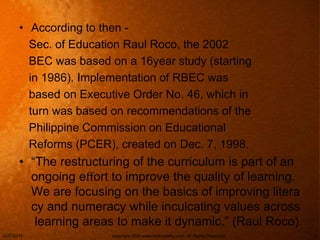
• According to then -
Sec. of Education Raul Roco, the 2002
BEC was based on a 16year study (starting
in 1986). Implementation of RBEC was
based on Executive Order No. 46, which in
turn was based on recommendations of the
Philippine Commission on Educational
Reforms (PCER), created on Dec. 7, 1998.
• “The restructuring of the curriculum is part of an
ongoing effort to improve the quality of learning.
We are focusing on the basics of improving litera
cy and numeracy while inculcating values across
learning areas to make it dynamic.” (Raul Roco)
4/27/2015 copyright 2006 www.brainybetty.com; All Rights Reserved. 2
4/27/2015 copyright 2006 www.brainybetty.com; All Rights Reserved. 3
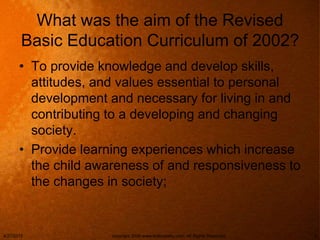
What was the aim of the Revised
Basic Education Curriculum of 2002?
• To provide knowledge and develop skills,
attitudes, and values essential to personal
development and necessary for living in and
contributing to a developing and changing
society.
• Provide learning experiences which increase
the child awareness of and responsiveness to
the changes in society;
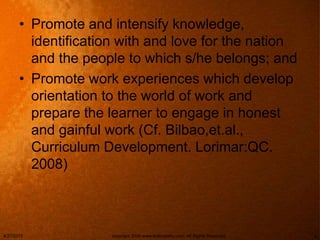
• Promote and intensify knowledge,
identification with and love for the nation
and the people to which s/he belongs; and
• Promote work experiences which develop
orientation to the world of work and
prepare the learner to engage in honest
and gainful work (Cf. Bilbao,et.al.,
Curriculum Development. Lorimar:QC.
2008)
4/27/2015 copyright 2006 www.brainybetty.com; All Rights Reserved. 4
The RBEC articulated a Vision
and Mission:
“The Department of Education envisions every
learner to be functionally literate, equipped with life
skills, appreciative of arts and sports, and imbued
with the desirable values of a person who is
makabayan, makatao, makakalikasan, at maka-
Diyos.”
“The Vision is in line with DepEd’s mission to provide
quality basic education that is equitably accessible
to all and lays the foundation for lifelong learning
and service for the common good.”
4/27/2015 copyright 2006 www.brainybetty.com; All Rights Reserved. 5
FEATURES OF RBEC
• Greater emphasis on helping every learner to
become a successful reader
• Emphasis in interactive/collaborative learning
approaches
• Emphasis in the use of integrative learning
approaches
• Teaching values in every learning areas.
• Development of self reliant and patriotic
citizens.
• Development of creative and critical thinking.
4/27/2015 copyright 2006 www.brainybetty.com; All Rights Reserved. 6
The objectives of Secondary
Education are threefold
• Continue the general education
started in elementary.
• Prepare the learners for college
• Prepare the learners for the world
of work
4/27/2015 copyright 2006 www.brainybetty.com; All Rights Reserved. 7
Curriculum Structure of RBEC
• CORE SUBJECTS:
Filipino; English; Math; Science (Science
and Technology)
• EXPERIENTIAL AREA
MAKABAYAN: Araling Panlipunan; MAPEH;
TLE; Edukasyon sa Pagpapahalaga
4/27/2015 copyright 2006 www.brainybetty.com; All Rights Reserved. 8
Curriculum Structure of RBEC
Medium of Instruction: Pursuant to the DepEd
Bilingual Policy ( Dep.Ed Order No. 52, s, 1987)
the media of instruction shall be as follows:
For Secondary Education
English: Math, Science and Tech., English, TLE,
MAPEH/CAT
Filipino: Edukasyon sa Pagpapahalaga, Filipino,
Araling Panlipunan
4/27/2015 copyright 2006 www.brainybetty.com; All Rights Reserved. 9
The desired outcome of our whole
educational reform is the development of
the patriotic human being who is
environmentally sensitive and God-fearing
- “makabayan, makatao, makakalikasan,
at maka-Diyos”.
“Teach them the difference between right
and wrong” In Makabayan, less indeed
may be more.
4/27/2015 copyright 2006 www.brainybetty.com; All Rights Reserved. 10
• The Revised Basic Education Curriculum
(RBEC) is on with emphasis to rubrics/student
performance as basis of grading system.
• Teachers are required to prepare their syllabus
based on the objectives of the revised Basic
Education Curriculum.
• Lesson plans were also patterned and organized
to meet the objectives of the implemented
curriculum.
• All test items; tables of specifications were
prepared and/or updated.
• Demonstration teachings were conducted for
staff development during school level workshop.
4/27/2015 copyright 2006 www.brainybetty.com; All Rights Reserved. 11
• Department heads make periodic
observation of classes to monitor the
implementation of the RBEC.
• Integration method, collaborative
teaching, peer teaching, team teaching,
motor activities, visual as well as oral
activities in classes were noted and
observed. Mentoring is also being
practiced.
4/27/2015 copyright 2006 www.brainybetty.com; All Rights Reserved. 12
MARAMING SALAMAT!!!

Revised basic education curriculum

  • 1.
    Revised Basic Education Curriculum(RBEC) (Secondary) Belinda R. Oliveros MAT-Filipino
  • 2.
    • According tothen - Sec. of Education Raul Roco, the 2002 BEC was based on a 16year study (starting in 1986). Implementation of RBEC was based on Executive Order No. 46, which in turn was based on recommendations of the Philippine Commission on Educational Reforms (PCER), created on Dec. 7, 1998. • “The restructuring of the curriculum is part of an ongoing effort to improve the quality of learning. We are focusing on the basics of improving litera cy and numeracy while inculcating values across learning areas to make it dynamic.” (Raul Roco) 4/27/2015 copyright 2006 www.brainybetty.com; All Rights Reserved. 2
  • 3.
    4/27/2015 copyright 2006www.brainybetty.com; All Rights Reserved. 3 What was the aim of the Revised Basic Education Curriculum of 2002? • To provide knowledge and develop skills, attitudes, and values essential to personal development and necessary for living in and contributing to a developing and changing society. • Provide learning experiences which increase the child awareness of and responsiveness to the changes in society;
  • 4.
    • Promote andintensify knowledge, identification with and love for the nation and the people to which s/he belongs; and • Promote work experiences which develop orientation to the world of work and prepare the learner to engage in honest and gainful work (Cf. Bilbao,et.al., Curriculum Development. Lorimar:QC. 2008) 4/27/2015 copyright 2006 www.brainybetty.com; All Rights Reserved. 4
  • 5.
    The RBEC articulateda Vision and Mission: “The Department of Education envisions every learner to be functionally literate, equipped with life skills, appreciative of arts and sports, and imbued with the desirable values of a person who is makabayan, makatao, makakalikasan, at maka- Diyos.” “The Vision is in line with DepEd’s mission to provide quality basic education that is equitably accessible to all and lays the foundation for lifelong learning and service for the common good.” 4/27/2015 copyright 2006 www.brainybetty.com; All Rights Reserved. 5
  • 6.
    FEATURES OF RBEC •Greater emphasis on helping every learner to become a successful reader • Emphasis in interactive/collaborative learning approaches • Emphasis in the use of integrative learning approaches • Teaching values in every learning areas. • Development of self reliant and patriotic citizens. • Development of creative and critical thinking. 4/27/2015 copyright 2006 www.brainybetty.com; All Rights Reserved. 6
  • 7.
    The objectives ofSecondary Education are threefold • Continue the general education started in elementary. • Prepare the learners for college • Prepare the learners for the world of work 4/27/2015 copyright 2006 www.brainybetty.com; All Rights Reserved. 7
  • 8.
    Curriculum Structure ofRBEC • CORE SUBJECTS: Filipino; English; Math; Science (Science and Technology) • EXPERIENTIAL AREA MAKABAYAN: Araling Panlipunan; MAPEH; TLE; Edukasyon sa Pagpapahalaga 4/27/2015 copyright 2006 www.brainybetty.com; All Rights Reserved. 8
  • 9.
    Curriculum Structure ofRBEC Medium of Instruction: Pursuant to the DepEd Bilingual Policy ( Dep.Ed Order No. 52, s, 1987) the media of instruction shall be as follows: For Secondary Education English: Math, Science and Tech., English, TLE, MAPEH/CAT Filipino: Edukasyon sa Pagpapahalaga, Filipino, Araling Panlipunan 4/27/2015 copyright 2006 www.brainybetty.com; All Rights Reserved. 9
  • 10.
    The desired outcomeof our whole educational reform is the development of the patriotic human being who is environmentally sensitive and God-fearing - “makabayan, makatao, makakalikasan, at maka-Diyos”. “Teach them the difference between right and wrong” In Makabayan, less indeed may be more. 4/27/2015 copyright 2006 www.brainybetty.com; All Rights Reserved. 10
  • 11.
    • The RevisedBasic Education Curriculum (RBEC) is on with emphasis to rubrics/student performance as basis of grading system. • Teachers are required to prepare their syllabus based on the objectives of the revised Basic Education Curriculum. • Lesson plans were also patterned and organized to meet the objectives of the implemented curriculum. • All test items; tables of specifications were prepared and/or updated. • Demonstration teachings were conducted for staff development during school level workshop. 4/27/2015 copyright 2006 www.brainybetty.com; All Rights Reserved. 11
  • 12.
    • Department headsmake periodic observation of classes to monitor the implementation of the RBEC. • Integration method, collaborative teaching, peer teaching, team teaching, motor activities, visual as well as oral activities in classes were noted and observed. Mentoring is also being practiced. 4/27/2015 copyright 2006 www.brainybetty.com; All Rights Reserved. 12
  • 13.